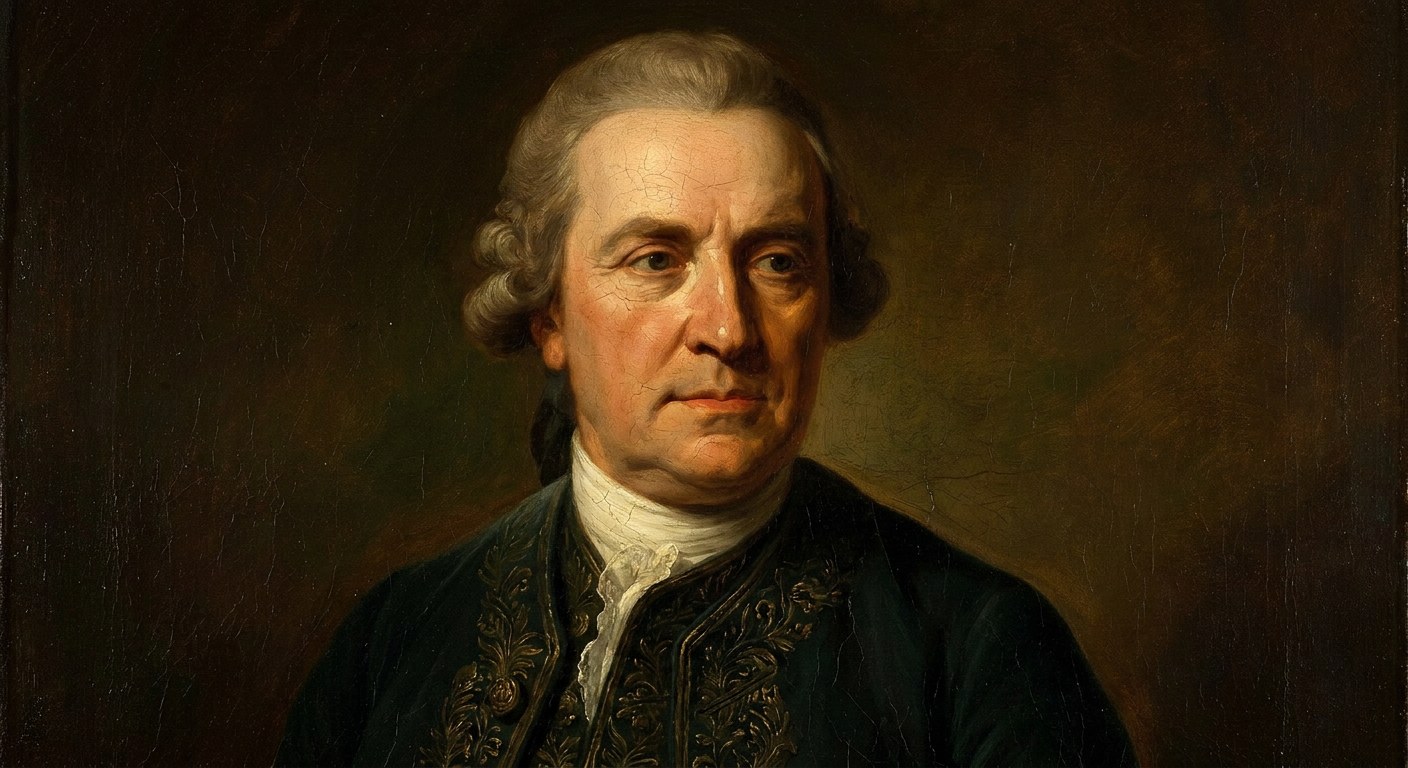
Adam Smith
1723 – 1790 · Scottish · Philosopher & Economist
Recommended Audiobooks
Listen next from Marcus Alden

Life Lessons from Frederic Chopin
Marcus Alden · 54 min

Life Lessons from John Wesley
Marcus Alden · 52 min
Introduction
Adam Smith was a Scottish moral philosopher, political economist, and leading figure of the Scottish Enlightenment. Best known as the author of An Inquiry into the Nature and Causes of the Wealth of Nations (1776), he helped establish political economy as a systematic field of study. His analyses of specialization, exchange, prices, taxation, public institutions, and economic growth profoundly influenced modern economics and political thought.
Smith is often called the “father of economics,” although that description can obscure the breadth of his work. He did not view economic life as separate from morality, law, politics, history, or psychology. His first major book, The Theory of Moral Sentiments (1759), examined sympathy, conscience, virtue, self-command, and the human desire for approval. His later economic arguments grew out of this larger inquiry into how individuals and societies function.
Smith explained how decentralized exchange can coordinate the activities of people who do not know one another. He famously showed that people pursuing their own interests may unintentionally contribute to wider social benefits. Yet he was not an advocate of unlimited selfishness or an entirely inactive state. He condemned collusion among merchants, criticized monopoly and colonial exploitation, supported public education and infrastructure, and believed that justice was indispensable to a flourishing commercial society.
His reputation has frequently been shaped by the metaphor of the “invisible hand,” a phrase that appears only once in The Wealth of Nations. Smith’s actual thought was more nuanced than later slogans associated with him. He combined confidence in voluntary exchange with acute awareness of unequal power, poverty, institutional corruption, and the intellectually damaging effects of repetitive labor. More than two centuries after his death, debates about markets, regulation, inequality, globalization, and moral responsibility continue to draw upon—and argue over—his ideas.
Quick Facts
| Fact | Detail |
|---|---|
| Born | 1723, Kirkcaldy, Fife, Scotland; baptized 5 June 1723 under the Old Style calendar |
| Died | 17 July 1790, Edinburgh, Scotland |
| Nationality | Scottish |
| Known For | The Wealth of Nations, The Theory of Moral Sentiments, division of labor, classical political economy |
| Occupation | Moral philosopher, professor, author, tutor, and customs commissioner |
| Era | Scottish Enlightenment; Age of Enlightenment |
Early Life and Education
Adam Smith was born in the port town of Kirkcaldy on the Firth of Forth. The exact date of his birth is unknown, but he was baptized on 5 June 1723 according to the Old Style calendar then used in Britain. His father, also named Adam Smith, had worked as a lawyer, comptroller of customs, and private secretary to the Earl of Loudoun. He died several months before his son’s birth. Smith was consequently raised by his mother, Margaret Douglas, with whom he maintained a close relationship throughout her long life.
A story repeated by Smith’s early biographer Dugald Stewart claims that four-year-old Adam was briefly abducted by traveling people before being recovered. The incident cannot be independently verified, but it became part of the traditional portrait of his childhood. More certain is that he attended the Burgh School of Kirkcaldy, where he studied Latin, mathematics, history, and writing.
In 1737, at about fourteen—the normal university age in eighteenth-century Scotland—Smith entered the University of Glasgow. Glasgow became one of the most important intellectual influences on his life. He studied moral philosophy under Francis Hutcheson, an eloquent teacher who defended religious toleration, natural liberty, and an innate human capacity for moral feeling. Smith later remembered Hutcheson as “the never to be forgotten Dr Hutcheson.”
Hutcheson’s approach encouraged Smith to investigate morality through observation of human nature rather than through abstract theological doctrine alone. At Glasgow, Smith also studied logic, natural philosophy, mathematics, and ancient languages. The university’s energetic intellectual environment introduced him to questions about jurisprudence, commerce, government, and social progress that would occupy him for decades.
In 1740 Smith received a Snell Exhibition, a scholarship that sent Glasgow students to Balliol College, Oxford. He remained at Oxford until 1746. His experience there was disappointing. Smith believed Oxford’s professors had little incentive to teach effectively because their incomes did not depend on student approval or performance. His later criticism of endowed universities in The Wealth of Nations probably reflected these observations.
Oxford nevertheless gave him access to major libraries and time for independent reading. He studied literature, philosophy, languages, and continental scholarship, including works that some religious authorities regarded with suspicion. According to a later account, college officials discovered him reading David Hume’s Treatise of Human Nature and confiscated it. Whether every detail is accurate or not, Smith’s eventual friendship with Hume became one of the most significant relationships of his life.
Rise to Prominence
After returning to Scotland, Smith began delivering public lectures in Edinburgh in 1748. The lectures, offered with support from the jurist and intellectual Henry Home, Lord Kames, covered rhetoric, literature, jurisprudence, and the development of social institutions. Their success introduced Smith to Edinburgh’s learned society and demonstrated his abilities as a lecturer.
He formed connections with prominent figures of the Scottish Enlightenment, including David Hume, whose philosophical skepticism and naturalistic study of human behavior strongly influenced him. Smith and Hume differed on certain issues, but they shared interests in commerce, morality, history, religion, and the unintended development of social institutions. Their friendship remained warm until Hume’s death in 1776.
In 1751 Smith was appointed professor of logic at the University of Glasgow. The following year he transferred to the more prestigious chair of moral philosophy. His course encompassed natural theology, ethics, jurisprudence, and political economy. Students reported that Smith lectured without reading from a prepared manuscript, speaking in a distinctive but absorbing manner as he developed arguments step by step.
Smith considered his Glasgow professorship one of the happiest and most useful periods of his life. His lectures attracted students from Britain and continental Europe. They also provided the intellectual framework for his two great books. His ethical teaching developed into The Theory of Moral Sentiments, while his lectures on jurisprudence and police—meaning public administration and social order—contained early versions of arguments later presented in The Wealth of Nations.
Published in 1759, The Theory of Moral Sentiments quickly established Smith’s international reputation. It examined how people form moral judgments by imaginatively placing themselves in the circumstances of others. Readers admired its psychological insight and polished style. The work passed through several editions during Smith’s lifetime and brought him to the attention of leading politicians and intellectuals.
One admirer was Charles Townshend, an influential politician who asked Smith to tutor his stepson, the young Henry Scott, 3rd Duke of Buccleuch. Smith resigned his professorship in 1764 to accompany the duke on a European tour. The position came with generous pay and a lifetime pension, giving Smith financial independence for his later research.
Major Achievements and Contributions
Smith’s most famous analytical contribution was his account of the division of labor. At the beginning of The Wealth of Nations, he described a small pin factory in which workers specialized in separate tasks. By dividing production into repeated operations, a group could manufacture vastly more pins than the same number of people working independently from start to finish.
Smith identified three principal reasons for this increase: workers become more skillful at a specialized task, avoid losing time when moving between different jobs, and are more likely to use or invent labor-saving machinery. Specialization, however, depends on the extent of the market. A larger network of potential exchange allows individuals and businesses to specialize more deeply because they can trade their output for the other things they need.
He also explained exchange through the human “propensity to truck, barter, and exchange one thing for another.” Smith did not mean that every human relationship was commercial. Rather, he argued that exchange made large-scale social cooperation possible without requiring everyone to share the same goals. People commonly obtain goods by appealing to the interests of others, not solely to their generosity.
Smith distinguished between a commodity’s “value in use” and its “value in exchange.” Water, for example, is extremely useful but historically commanded a low price, whereas diamonds had less practical utility but a high exchange value. This so-called diamond–water paradox helped frame later debates about value. Smith’s own treatment combined labor, production costs, wages, profit, rent, and changing historical conditions, but it did not provide the marginal utility theory developed by economists in the nineteenth century.
His discussion of the “natural price” and “market price” anticipated later analysis of competitive adjustment. A market price can rise above or fall below the longer-term level needed to cover wages, profit, and rent. Changes in supply, demand, and competition tend to move resources and prices, though privileges, monopolies, regulations, and unequal bargaining power can obstruct the process.
Smith’s metaphor of an “invisible hand” described one situation in which individuals preferring domestic investment unintentionally promoted national output. Later writers turned it into a general symbol of market coordination. Smith did believe that self-interested activity under suitable institutions could generate unintended public benefits, but he never argued that every private pursuit automatically served society. Fraud, monopoly, political favoritism, and conspiracies against the public could produce the opposite result.
He was also a major theorist of economic growth. Smith associated prosperity with capital accumulation, expanding markets, secure property, predictable justice, productive investment, and increasing specialization. He challenged mercantilism—the idea that national wealth consisted primarily of accumulated gold and silver and should be increased through trade restrictions. The real wealth of a nation, he argued, lay in its annual production and the goods and services available to its people.
Smith generally favored freer domestic and international trade, but his position allowed exceptions. He considered national defense more important than opulence and therefore defended Britain’s Navigation Acts as a security measure. He accepted some taxes on imports when domestic goods faced equivalent taxation and acknowledged that removing longstanding protections might need to occur gradually to limit severe disruption.
Far from proposing the abolition of government, Smith assigned the sovereign three broad responsibilities: defense against foreign aggression, administration of justice, and provision of public works and institutions that benefited society but might not yield sufficient private profit. These included roads, bridges, harbors, and education. He favored local fees in some cases, but also accepted public expenditure when it was necessary.
Smith worried that extreme specialization could make ordinary workers “as stupid and ignorant as it is possible for a human creature to become.” Repetitive labor might narrow their minds and weaken their capacity for civic judgment. Basic public education was therefore needed to counteract the harmful consequences of an advanced commercial economy. This concern reveals how different his philosophy was from a simple celebration of production at any social cost.
His principles of taxation were similarly influential. Taxes, he argued, should be proportionate to ability or revenue, certain rather than arbitrary, convenient to pay, and inexpensive to collect. These maxims became a foundation for later discussions of equitable and efficient taxation.
Key Works / Battles / Ideas
The Theory of Moral Sentiments (1759)
Smith’s first book begins with the observation that even apparently selfish people care about the fortunes of others. He used “sympathy” to mean an imaginative fellow-feeling: individuals attempt to understand another person’s emotions by picturing themselves in that person’s situation. Because people cannot directly experience one another’s feelings, moral judgment involves comparing observed passions with those an impartial observer could share.
From this process Smith developed the idea of the “impartial spectator,” an internalized standpoint from which people judge their own behavior. Conscience emerges through social experience as individuals learn to see themselves through the eyes of others. Smith praised prudence, justice, beneficence, and self-command, while recognizing the human desire for status and admiration. He also warned that people tend to admire the rich and powerful excessively and neglect the poor.
An Inquiry into the Nature and Causes of the Wealth of Nations (1776)
Smith worked on his economic masterpiece for roughly a decade. After returning from Europe in 1766, he lived mainly with his mother in Kirkcaldy while writing. He later spent time in London consulting sources and discussing policy. Published on 9 March 1776, the two-volume work sold well and soon appeared in new editions and translations.
The book analyzed labor, money, prices, wages, profit, rent, capital, banking, taxation, public debt, trade policy, colonies, defense, education, and the historical rise of European commerce. It attacked monopoly privileges, restrictions on labor mobility, and the mercantilist effort to enrich favored producers at consumers’ expense. Smith was particularly hostile to companies possessing exclusive trading rights and political power, such as the British East India Company.
Although the book appeared in the year of the American Declaration of Independence, it was not written in response to that document. Smith discussed the growing cost of maintaining Britain’s colonies and treated colonial separation as a plausible outcome. He also imagined an imperial federation in which representation was related to taxation, but doubted that Britain’s rulers would voluntarily accept such a rearrangement of power.
Lectures on Jurisprudence
Smith planned a major work on law and government but never completed it. Student notes from his Glasgow lectures, rediscovered and published long after his death, reveal his account of justice, property, family relations, government, policing, revenue, and arms. They show that The Wealth of Nations emerged from a much broader project concerning the historical development of society.
Essays on Philosophical Subjects
Published posthumously in 1795, this collection includes Smith’s history of astronomy as well as essays on physics, ancient logic, metaphysics, and the senses. The astronomy essay examines how wonder, surprise, and unease encourage human beings to create explanatory systems. It illustrates Smith’s interest in the psychology and history of scientific thought.
The Four Stages of Social Development
In his lectures, Smith employed a broad historical scheme in which societies passed through hunting, pastoral, agricultural, and commercial stages. Each mode of subsistence encouraged different forms of property, law, government, and military organization. This framework influenced later sociology, anthropology, and historical economics, although its linear assumptions and Eurocentric implications are now heavily criticized.
Timeline of Key Events
| Year | Event |
|---|---|
| 1723 | Born in Kirkcaldy, Scotland, and baptized on 5 June under the Old Style calendar |
| 1737 | Entered the University of Glasgow and studied under Francis Hutcheson |
| 1740 | Began studies at Balliol College, Oxford, as a Snell Exhibitioner |
| 1746 | Returned to Scotland after leaving Oxford |
| 1748 | Began delivering public lectures in Edinburgh |
| 1751 | Appointed professor of logic at the University of Glasgow |
| 1752 | Became professor of moral philosophy at Glasgow |
| 1759 | Published The Theory of Moral Sentiments |
| 1764 | Resigned his chair to tutor the Duke of Buccleuch in Europe |
| 1764–1766 | Traveled in France and Switzerland and met leading Enlightenment thinkers |
| 1766 | Returned to Britain and began concentrating on The Wealth of Nations |
| 1773 | Elected a fellow of the Royal Society of London |
| 1776 | Published The Wealth of Nations; his friend David Hume died |
| 1778 | Appointed commissioner of customs in Scotland and settled in Edinburgh |
| 1783 | Helped found the Royal Society of Edinburgh |
| 1787 | Elected lord rector of the University of Glasgow |
| 1790 | Issued the substantially revised sixth edition of The Theory of Moral Sentiments |
| 1790 | Died in Edinburgh on 17 July and was buried in Canongate Kirkyard |
| 1795 | Essays on Philosophical Subjects appeared posthumously |
Personal Life and Character
Smith never married and had no known children. For much of his adult life, he shared a household with his mother, Margaret Douglas, and his cousin Janet Douglas. His devotion to his mother was widely noted. Her death in 1784, at an advanced age, deeply affected him.
Contemporaries described Smith as absent-minded, physically awkward, and absorbed in thought. He sometimes spoke to himself while walking and could become so distracted that he forgot his surroundings. These anecdotes should not overshadow his sociability. He participated actively in intellectual clubs, maintained numerous friendships, and was known for generosity and loyalty.
Smith’s closest intellectual friendship was with David Hume. When Hume was dying, he named Smith his literary executor. Smith later published a letter describing Hume’s composure and good humor during his final illness, concluding that Hume approached as nearly as possible to the character of a perfectly wise and virtuous man. The statement provoked religious critics because Hume was famous for his skepticism.
During his European travels, Smith lived for extended periods in Toulouse and visited Geneva, where he met Voltaire. In Paris he associated with Anne Robert Jacques Turgot, Jean le Rond d’Alembert, Claude Adrien Helvétius, and François Quesnay. The Physiocrats around Quesnay argued that economic life followed a natural order and that agriculture produced society’s net surplus. Smith respected their systematic approach while rejecting their exclusive emphasis on land.
After becoming a commissioner of customs in 1778, Smith moved to Edinburgh and eventually lived at Panmure House. The office was not merely honorary: surviving records indicate that he attended diligently to administrative duties. His appointment placed the famous critic of trade restrictions inside the machinery that enforced customs laws, a tension often noted by later commentators.
Challenges and Controversies
The greatest controversy surrounding Smith is less about his conduct than about how his work has been interpreted. Advocates and critics of capitalism have often portrayed him as an uncompromising champion of laissez-faire. Smith did favor what he called the “system of natural liberty,” but only within a framework of justice, defense, public institutions, and enforceable rules. He accepted regulation in areas such as banking when private risk could endanger the public.
The “invisible hand” has likewise been exaggerated. The phrase occurs once in The Wealth of Nations, once in The Theory of Moral Sentiments, and once in his posthumously published essay on astronomy, in different contexts. It was not the organizing concept of his entire philosophy. His detailed discussions often focus instead on institutions, bargaining power, historical circumstances, and the danger of organized interests.
Smith distrusted merchants whenever they sought political privilege. He observed that employers could coordinate more easily than workers and that laws often favored masters over laborers. His famous warning that people of the same trade tend to conspire against the public was part of a broader argument against monopoly and collusion. Yet he also treated capital accumulation and entrepreneurship as essential sources of rising productivity.
His theories of value and distribution later became controversial. David Ricardo and Karl Marx developed parts of the classical labor theory of value in directions different from Smith’s. Neoclassical economists criticized the classical approach and explained prices through marginal utility and marginal productivity. Modern economists still value Smith’s institutional insights, but few accept every element of his price theory.
His distinction between “productive” and “unproductive” labor also created difficulties. Smith classified labor as productive when it added value embodied in a vendible commodity, whereas services often disappeared at the moment of performance. Later economies demonstrated the immense productive importance of services, knowledge, health, administration, and education, making his terminology seem too narrow.
Smith opposed slavery and argued that labor performed by free people was generally more economical than slave labor. He condemned the oppression associated with European colonialism and harshly criticized chartered trading companies. Nevertheless, his historical categories sometimes reflected eighteenth-century European assumptions about supposedly “savage” and “civilized” peoples. Scholars therefore distinguish his criticism of conquest and enslavement from aspects of his developmental framework that now appear Eurocentric.
Another debated question is the so-called “Adam Smith problem”: the alleged contradiction between sympathy in The Theory of Moral Sentiments and self-interest in The Wealth of Nations. Most contemporary scholars reject the claim that the books are fundamentally inconsistent. Smith believed that different relationships call upon different motives. Family and friendship may depend heavily on affection, markets often coordinate through reciprocal interest, and justice sets limits that all must respect.
Death and Immediate Aftermath
Smith’s health declined during the late 1780s. He nevertheless continued revising The Theory of Moral Sentiments, whose sixth edition appeared in 1790. The revision added important material on virtue, self-command, corruption, and the human tendency to admire wealth and status.
Shortly before his death, Smith asked his friends Joseph Black, the chemist, and James Hutton, the geologist, to destroy most of his unpublished manuscripts. They complied, reportedly burning numerous volumes. Smith may have believed the drafts were unfit for publication, but their loss deprived later scholars of much of his unfinished work on jurisprudence and the arts.
Adam Smith died in Edinburgh on 17 July 1790, aged sixty-seven. He was buried in Canongate Kirkyard, near his home. His estate was smaller than some acquaintances expected, partly because he had quietly given substantial sums to charity. Black and Hutton supervised the publication of approved essays in 1795.
Smith’s death received respectful notice, although his worldwide status grew over the following decades. Politicians and economists increasingly treated The Wealth of Nations as a landmark argument for commercial reform. His students and friends, especially Dugald Stewart, helped preserve an image of him as both a major philosopher and a humane, intellectually curious man.
Legacy and Influence Today
Smith became a foundational figure in classical political economy. David Ricardo, Thomas Malthus, Jean-Baptiste Say, and John Stuart Mill worked within traditions shaped partly by his questions. Karl Marx sharply criticized classical economics but admired Smith’s analysis of specialization, class income, and capital accumulation. Later free-market thinkers cited him as an advocate of economic liberty, while institutional and social-democratic readers emphasized his concern for education, worker welfare, public goods, and unequal power.
His influence extends beyond economics. The Theory of Moral Sentiments has become central to research in ethics, psychology, sociology, behavioral economics, and theories of recognition. Its account of the impartial spectator anticipates modern inquiries into empathy, social norms, identity, and moral judgment. Smith understood individuals not as isolated calculators but as social beings shaped by their desire for mutual recognition.
The division of labor remains a basic concept in economics and business. Modern supply chains, global trade, professional specialization, and industrial organization all demonstrate the productivity gains Smith described. At the same time, automation, alienation, and repetitive work reinforce his warning that specialization can diminish human capacities unless education and institutions offset its effects.
Smith’s critique of mercantilism continues to inform arguments for open trade. Yet his exceptions for defense, gradual reform, and public necessity show why invoking him does not settle contemporary disputes about tariffs or industrial policy. His method requires examining incentives, political interests, national security, consumer costs, and institutional consequences rather than applying a single slogan.
His suspicion of concentrated economic power is equally relevant. Lobbying, regulatory capture, cartels, platform monopolies, and corporate privileges resemble the combinations of political and commercial influence he opposed. Smith’s competitive markets were not spaces without rules; they depended on legal equality and resistance to arrangements designed by powerful groups for their own benefit.
Institutions, lecture series, academic societies, and research centers bear his name. His portrait appeared on the Bank of England’s £20 note issued in 2007, making him the first Scotsman featured on an English banknote. A statue of Smith stands on Edinburgh’s Royal Mile, near St Giles’ Cathedral.
His greatest legacy is therefore not a formula that private greed always creates public good. It is a wide-ranging investigation of how morality, law, incentives, institutions, and unintended consequences shape social order. Reading both of his major books reveals a thinker concerned with prosperity, freedom, justice, character, and the conditions under which commercial society can improve—or damage—human life.
Famous Quotes
“How selfish soever man may be supposed, there are evidently some principles in his nature, which interest him in the fortune of others.” — The Theory of Moral Sentiments
“Man naturally desires, not only to be loved, but to be lovely.” — The Theory of Moral Sentiments
“The great source of both the misery and disorders of human life, seems to arise from over-rating the difference between one permanent situation and another.” — The Theory of Moral Sentiments
“It is not from the benevolence of the butcher, the brewer, or the baker, that we expect our dinner, but from their regard to their own interest.” — The Wealth of Nations
“By pursuing his own interest he frequently promotes that of the society more effectually than when he really intends to promote it.” — The Wealth of Nations
“No society can surely be flourishing and happy, of which the far greater part of the members are poor and miserable.” — The Wealth of Nations
“People of the same trade seldom meet together, even for merriment and diversion, but the conversation ends in a conspiracy against the public.” — The Wealth of Nations
“Science is the great antidote to the poison of enthusiasm and superstition.” — The Wealth of Nations
Frequently Asked Questions
Why is Adam Smith called the father of economics?
Smith did not invent economic thought, but The Wealth of Nations offered one of the first large, systematic studies of production, exchange, distribution, growth, taxation, and public policy. It helped establish political economy as a distinct and influential discipline.
What did Adam Smith mean by the invisible hand?
Smith used the phrase to describe an unintended social consequence of individual action. In The Wealth of Nations, an investor who preferred domestic investment for reasons of personal security could inadvertently support domestic output. Smith did not claim that all selfish behavior automatically benefits society.
Did Adam Smith believe in selfishness?
Smith regarded self-interest as a powerful and often useful motive, especially in impersonal exchange. However, he also emphasized sympathy, justice, conscience, generosity, prudence, and self-command. His moral philosophy cannot be reduced to an endorsement of selfishness.
Was Adam Smith opposed to government intervention?
No. He supported government responsibility for national defense, justice, public works, infrastructure, and education. He also accepted some banking rules and trade restrictions under special circumstances. His main targets were arbitrary regulation, monopoly privilege, and policies serving organized interests at public expense.
What is the division of labor?
The division of labor is the separation of production into specialized tasks. Smith argued that specialization raises productivity through improved skill, saved time, and machinery. He also warned that highly repetitive work could damage workers’ intellectual and civic capacities.
How are Smith’s two major books connected?
The Theory of Moral Sentiments studies moral judgment and social relationships, while The Wealth of Nations examines commercial society and political economy. Both explore how individuals respond to others, follow rules, seek approval, pursue interests, and participate in institutions.
Did Adam Smith support free trade without exceptions?
Smith generally supported freer trade because competition and specialization could increase prosperity. Nevertheless, he accepted exceptions involving national defense, equalizing domestic taxes, and gradual removal of protections when sudden change would cause serious disruption.
Where is Adam Smith buried?
Smith is buried in Canongate Kirkyard on Edinburgh’s Royal Mile. His grave remains a prominent site for visitors interested in the Scottish Enlightenment and the history of economic thought.
Lessons We Can Learn
- Human motivation is complex. People seek material advantage, but they also desire approval, sympathy, dignity, and a sense of moral worth.
- Specialization creates both benefits and costs. Divided labor can produce extraordinary prosperity, yet education and humane institutions are needed to prevent mental and social impoverishment.
- Markets require justice and rules. Exchange flourishes when contracts are secure and powerful interests cannot manipulate the law for private privilege.
- Good outcomes may be unintended. Social systems often develop through the interaction of many individual decisions rather than through a single central design.
- Great thinkers should be read beyond their slogans. Smith’s writings are more balanced and critical than popular uses of terms such as “invisible hand” or “free market” suggest.
Further Reading
- Adam Smith, The Theory of Moral Sentiments, edited by D. D. Raphael and A. L. Macfie.
- Adam Smith, An Inquiry into the Nature and Causes of the Wealth of Nations, edited by R. H. Campbell and A. S. Skinner.
- Nicholas Phillipson, Adam Smith: An Enlightened Life.
- Ian Simpson Ross, The Life of Adam Smith.
- Emma Rothschild, Economic Sentiments: Adam Smith, Condorcet, and the Enlightenment.
Watch and Learn
POLITICAL THEORY – Adam Smith · The School of Life