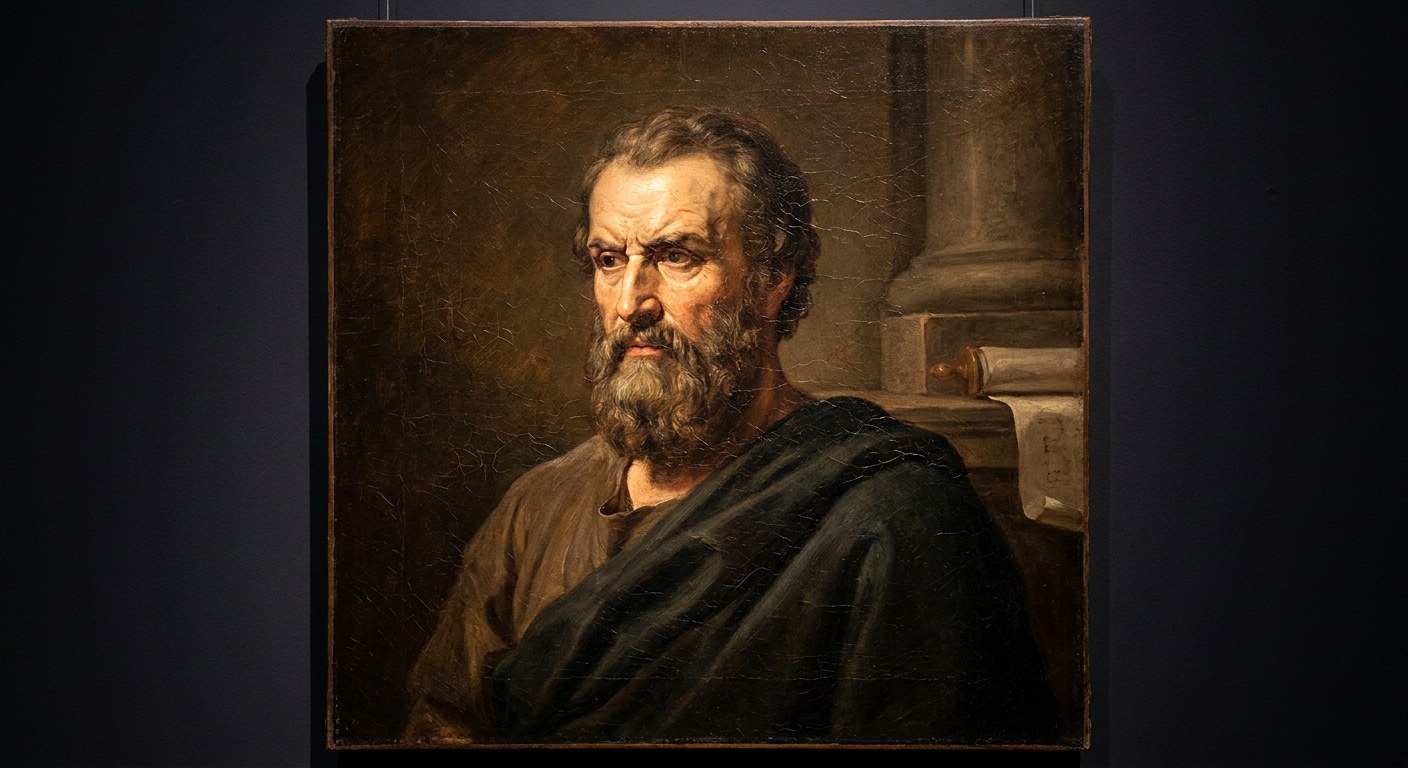
Aeschylus
525 BC – 456 BC · Ancient Greek · Poet & Playwright
Recommended Audiobooks
Listen next from Marcus Alden

Life Lessons from Frederic Chopin
Marcus Alden · 54 min

Life Lessons from John Wesley
Marcus Alden · 52 min
Introduction
Aeschylus was an ancient Greek poet and dramatist whose work helped transform tragedy from a largely choral performance into one of the most powerful forms of literary and theatrical art. Born near Athens in the late sixth century BCE, he lived during the emergence of Athenian democracy, fought in the wars against the Persian Empire, and wrote dramas that examined justice, political authority, religious obligation, inherited guilt, and the human cost of violence. Later generations consequently remembered him as the father of tragedy.
Although Greek tragedy existed before Aeschylus, ancient tradition credited him with introducing a second actor, thereby making sustained dramatic conflict possible. By expanding dialogue and reducing the chorus's dominance, he helped create the theatrical structure inherited by Sophocles, Euripides, and much of Western drama. His plays combined poetry, music, dance, spectacle, mythology, theology, and civic reflection on an unprecedented scale.
Ancient sources attributed roughly seventy to ninety plays to Aeschylus, but only seven survive complete, and the authorship of one of them, Prometheus Bound, remains disputed. Among the surviving works, The Persians is the earliest complete Greek tragedy and a rare historical drama written by someone who had personally experienced the conflict it portrays. His masterpiece, the Oresteia, is the only complete trilogy to survive from classical Athens. It traces a cycle of murder and revenge within the House of Atreus before imagining the replacement of private vengeance by public judgment under law.
Aeschylus mattered not only because he changed theatrical technique, but because he used the stage to confront fundamental questions. Can suffering produce wisdom? Does justice end violence or merely continue it? How should a community reconcile old religious claims with new political institutions? His surviving plays offer no simple answers. Instead, they dramatize the difficult movement from disorder toward a justice that remains imperfect, contested, and costly.
Quick Facts
| Fact | Details |
|---|---|
| Born | c. 525/524 BCE, Eleusis, Attica, Greece |
| Died | c. 456/455 BCE, Gela, Sicily |
| Nationality | Ancient Greek, specifically Athenian |
| Known For | Developing Greek tragedy; The Persians; Seven Against Thebes; the Oresteia |
| Occupation | Tragic poet, playwright, and military veteran |
| Era | Archaic and early Classical Greece |
Early Life and Education
Aeschylus was born around 525 or 524 BCE at Eleusis, a settlement west of Athens. His father was named Euphorion. Later biographical tradition described the family as socially prominent, possibly belonging to the landholding elite of Attica, although the surviving evidence does not permit a detailed reconstruction of its status or finances.
Eleusis was famous for the Eleusinian Mysteries, secret religious rites associated especially with Demeter and Persephone. Aeschylus's proximity to this sanctuary has often been used to explain the religious power of his poetry. That connection should be treated cautiously: initiation into the Mysteries was widespread, and no reliable evidence proves exactly what Aeschylus believed or what role he held in the cult. Nevertheless, his dramas reveal a mind deeply engaged with ritual, divine justice, purification, sacrifice, prophecy, and the relationship between mortals and gods.
Nothing certain is known about his formal education. As a young Athenian of his background, he probably learned poetry, music, dance, athletics, and the myths that formed the foundation of Greek cultural life. His language shows extensive familiarity with Homeric epic, lyric poetry, religious tradition, and heroic legend. Greek drama itself combined several of these disciplines: a tragic poet normally composed the text, arranged its choral songs, and supervised important aspects of performance.
A late story related by the geographer Pausanias claims that Aeschylus fell asleep while guarding grapes and dreamed that the god Dionysus ordered him to compose tragedies. The anecdote is legendary rather than historical, but it reflects an ancient belief that dramatic poetry belonged to the worship of Dionysus. Tragedies were presented at religious festivals, especially the City Dionysia in Athens, where playwrights competed before a large civic audience.
Aeschylus reached adulthood during a period of extraordinary change. Athens expelled the tyrant Hippias in 510 BCE, and the reforms associated with Cleisthenes soon established a broader system of citizen participation. At the same time, the Persian Empire expanded into the Aegean world. These political and military transformations formed the background to Aeschylus's career and became central to his dramatic imagination.
Rise to Prominence
According to the ancient Life of Aeschylus, he first competed in a dramatic contest around 499 BCE. He did not win his first recorded victory until 484 BCE, when he was about forty. The gap illustrates the demanding and competitive nature of Athenian theater. At the City Dionysia, selected poets presented groups of tragedies—normally three tragedies and a satyr play—funded by wealthy citizens serving as choregoi, or sponsors.
Aeschylus was also a soldier. He fought at the Battle of Marathon in 490 BCE, when an Athenian army defeated a Persian invasion force. His brother Cynegeirus became a celebrated casualty of the battle; tradition held that he died while attempting to seize or hold a Persian ship. Aeschylus probably also fought during the renewed Persian invasion of 480–479 BCE. Ancient testimony connects him with the naval Battle of Salamis, and he may have been present at Plataea, though the evidence for the latter is less secure.
Military experience gave Aeschylus firsthand knowledge of battle, collective fear, civic discipline, bereavement, and victory's cost. Yet his surviving war drama is not a triumphalist celebration of Greek superiority. The Persians, produced in 472 BCE, takes place at the Persian court and concentrates on the suffering of the defeated. The production's choregos was the young Pericles, who would later dominate Athenian politics. Its first-prize victory confirmed Aeschylus as a leading dramatist.
He traveled to Sicily, probably at the invitation of Hieron I, ruler of Syracuse. Greek rulers in Sicily attracted prominent poets and intellectuals to their courts, and Aeschylus composed Women of Aetna in connection with Hieron's refoundation of the city of Catana as Aetna. The play has been lost. Aeschylus appears to have visited Sicily more than once, while continuing to compete at Athens.
His career overlapped with that of the younger Sophocles. In 468 BCE, Sophocles defeated Aeschylus in a celebrated dramatic contest. Ancient anecdotes sometimes present the result as a humiliating turning point, but there is no reason to imagine that Aeschylus's importance suddenly declined. He continued producing major works, including the Oresteia in 458 BCE, only a few years before his death.
Major Achievements and Contributions
Aeschylus's most famous technical contribution was the introduction of a second speaking actor. Aristotle, writing more than a century later in the Poetics, credited Aeschylus with increasing the number of actors from one to two, reducing the chorus's role, and giving dialogue greater importance. Before this development, a principal performer interacted chiefly with the chorus. With two actors, playwrights could stage direct confrontation, deception, recognition, debate, and rapidly changing relationships.
Modern scholars cannot verify every detail of Aristotle's compressed history, and dramatic conventions probably evolved gradually. Nevertheless, the surviving plays demonstrate Aeschylus's command of dialogue between individual characters. Sophocles was later credited with adding a third actor, further expanding dramatic possibilities.
Aeschylus also developed tragedy as a vehicle for connected narratives. His plays were commonly produced as trilogies, with three tragedies exploring successive episodes of one mythic sequence. Most ancient trilogies are lost, but the Oresteia survives intact. Across Agamemnon, The Libation Bearers, and The Eumenides, actions acquire meaning through their consequences: sacrifice leads to murder, murder to revenge, revenge to trial, and trial to a transformed civic order.
His treatment of justice was equally influential. In Aeschylus, justice is neither a simple moral rule nor an automatic reward for virtue. Competing duties can each possess legitimacy. Clytemnestra avenges the sacrifice of her daughter but murders her husband. Orestes obeys Apollo by killing his mother but violates the sacred bond between parent and child. The Furies defend an ancient form of kinship justice, while Athena establishes a court that redirects vengeance into legal procedure. Progress occurs through conflict and accommodation rather than through the erasure of older powers.
The scale of Aeschylean theater was visual as well as intellectual. Ancient accounts associated him with elaborate costumes, imposing masks, unusual stage effects, and spectacular entrances. His language is dense with compound words, metaphors, ritual imagery, cries, prophecies, and ominous symbols. Nets, storms, sacrificial animals, polluted houses, and predatory birds create an atmosphere in which political events appear intertwined with cosmic forces.
Aeschylus also gave the chorus extraordinary dramatic weight. Although he reduced its dominance relative to earlier practice, his choruses remain central observers and participants. The elders of Argos in Agamemnon, the captive women in The Libation Bearers, the Danaids in The Suppliants, and the Furies in The Eumenides each embody communal memories and moral claims. Their songs do more than interrupt action: they interpret events, express fear, preserve tradition, and sometimes help drive the plot.
Ancient sources report that Aeschylus won first prize thirteen times during his lifetime. His plays continued to be performed after his death, an exceptional honor that contributed to the preservation of his reputation. Only seven complete plays remain from a much larger body of work, alongside fragments and titles preserved through quotations, papyri, catalogues, and later references.
Key Works / Battles / Ideas
The Persians
Produced in 472 BCE, The Persians is the earliest surviving Greek tragedy. It depicts the Persian court at Susa awaiting news of Xerxes' invasion of Greece. A messenger reports the disaster at Salamis; the ghost of Darius interprets the defeat; and Xerxes returns in ruin.
The play celebrates the defense of Greece, but it does so through Persian grief. Aeschylus had fought against Persia, yet he portrays the enemy as recognizably human. The tragedy warns against excessive power, overconfidence, and the attempt to exceed mortal limits. It is especially valuable as a dramatic response to an event within the playwright's own lifetime.
Seven Against Thebes
First produced in 467 BCE, Seven Against Thebes formed the third tragedy of a trilogy concerning the family of Oedipus. It focuses on the attack on Thebes by Polynices and six allied champions. Eteocles organizes the city's defense, assigning a Theban warrior to each gate, but ultimately meets his brother in combat. The brothers kill one another, fulfilling the family's curse.
The play combines military tension with the fatal logic of inherited violence. Its surviving ending, which introduces a dispute over Polynices' burial, may contain later additions, although scholars disagree about its exact textual history.
The Suppliants
The Suppliants concerns the fifty daughters of Danaus, who flee forced marriages to their Egyptian cousins and seek protection in Argos. King Pelasgus faces a grave decision: rejecting the women could violate Zeus's protection of suppliants, but accepting them may bring war. He refers the choice to the Argive people, who vote to offer sanctuary.
The drama raises questions about asylum, consent, collective decision-making, gender, and the obligations owed to vulnerable outsiders. Once thought to be Aeschylus's earliest surviving play, it is now often dated to around 463 BCE on the basis of papyrus evidence and dramatic features. It originally belonged to a trilogy whose lost sequels complicated the Danaids' resistance to marriage.
The Oresteia
The Oresteia, produced in 458 BCE, consists of Agamemnon, The Libation Bearers, and The Eumenides. A satyr play, Proteus, completed the festival presentation but has been lost.
In Agamemnon, the king returns from Troy with the captive prophet Cassandra. His wife, Clytemnestra, kills them both, claiming vengeance for Agamemnon's sacrifice of their daughter Iphigenia and for his other crimes. In The Libation Bearers, their son Orestes returns from exile and, with his sister Electra's support, kills Clytemnestra and her lover Aegisthus. The matricide brings the Furies against him.
In The Eumenides, Orestes seeks purification and stands trial in Athens. Apollo defends him; the Furies prosecute him; Athena establishes a citizen court on the Areopagus. When the votes are equal, Athena casts the deciding vote for acquittal. She then persuades the enraged Furies to accept an honored place within the city as the Eumenides, or Kindly Ones.
The trilogy is often interpreted as a movement from blood revenge to civic justice. That reading is important but incomplete. The settlement preserves religious fear, involves persuasion and compromise, and rests on arguments about gender and parenthood that modern readers may find troubling. Its greatness lies partly in its refusal to make justice easy.
Prometheus Bound
Prometheus Bound portrays the Titan Prometheus chained to a remote rock for giving fire and other arts to humanity against Zeus's will. Defiant and prophetic, Prometheus refuses to reveal information that could threaten Zeus's rule.
Ancient tradition attributed the play to Aeschylus, but many modern scholars question that attribution because of its language, theology, metrical patterns, and portrayal of Zeus. Some defend Aeschylean authorship or suggest later revision. The issue remains unresolved, so the play is best described as traditionally attributed to Aeschylus.
Military Service and the Persian Wars
Aeschylus's participation at Marathon was important to his own and later generations' image of him. The battle showed that a citizen army could defeat a major imperial force and became central to Athenian identity. His probable presence at Salamis connected him with another decisive Greek victory.
The Persian Wars shaped his recurring interest in leadership, collective survival, arrogance, divine order, and the suffering produced by political decisions. His drama transformed remembered warfare into reflection rather than simple patriotic propaganda.
Timeline of Key Events
| Year | Event |
|---|---|
| c. 525/524 BCE | Born at Eleusis in Attica to Euphorion's family |
| c. 499 BCE | Traditionally said to have entered his first dramatic competition |
| 490 BCE | Fought against the Persian invasion at the Battle of Marathon |
| 484 BCE | Won his first recorded victory in an Athenian tragic competition |
| 480 BCE | Probably witnessed or fought at the Battle of Salamis |
| 472 BCE | The Persians, sponsored by Pericles, won first prize at the City Dionysia |
| c. 470s BCE | Visited Sicily and composed Women of Aetna for Hieron's new city |
| 468 BCE | Defeated by the younger Sophocles in a famous dramatic competition |
| 467 BCE | Won with the Theban trilogy that included Seven Against Thebes |
| c. 463 BCE | Probable production period of The Suppliants |
| 458 BCE | The Oresteia won first prize at Athens |
| c. 456/455 BCE | Died at Gela in Sicily |
| After 456 BCE | Athenians permitted revivals of his dramas, reinforcing his canonical status |
Personal Life and Character
Reliable evidence about Aeschylus's private life is scarce. Ancient biography often filled gaps with anecdotes designed to match a writer's works or reputation. It is therefore safer to distinguish documented family connections from stories created after his death.
Aeschylus belonged to a family with strong military and theatrical associations. His brother Cynegeirus died heroically at Marathon. Aeschylus's sons Euphorion and Euaeon were connected with drama and performance; Euphorion became a tragic poet and reportedly won competitions. His nephews included dramatists such as Philocles, making the family an influential theatrical dynasty.
Ancient portraits of Aeschylus emphasize solemnity, courage, religious seriousness, and grandeur. These qualities may reflect his surviving poetry more than his everyday personality. Aristophanes' comedy Frogs, staged decades after Aeschylus's death, presents him as a majestic representative of an older, morally weighty style of tragedy. In the comedy, Aeschylus competes with Euripides in the underworld over which poet best serves the city.
His military identity seems to have mattered greatly to his posthumous image. The epitaph traditionally associated with his tomb praises his courage at Marathon but does not mention his theatrical victories. It may express a belief—whether his own or that of later admirers—that service to the community in war outweighed literary fame.
Aeschylus's plays suggest profound respect for divine forces, but they do not provide a straightforward statement of personal faith. His gods can punish arrogance and protect justice, yet their demands may conflict, develop, or require reconciliation. He was not a philosopher constructing a systematic theology. He was a dramatist who made uncertainty, fear, ritual, and moral collision visible onstage.
Challenges and Controversies
The greatest practical challenge in studying Aeschylus is the loss of most of his work. Ancient catalogues credited him with dozens of plays, but only seven survive complete. Because most connected trilogies are missing, individual plays can be difficult to interpret in their original dramatic context. Fragments discovered on papyri occasionally expand scholarly knowledge, but they rarely restore an entire plot.
The authorship of Prometheus Bound is the most prominent textual controversy. The traditional attribution is ancient, yet differences in vocabulary, meter, dramatic method, and theology have led many specialists to assign it to another fifth-century playwright, perhaps someone influenced by Aeschylus. There is no universal consensus.
Aeschylus was also said to have faced prosecution for revealing secrets of the Eleusinian Mysteries in his plays. Different ancient sources provide different versions, and the historical details are uncertain. One tradition says he defended himself by claiming that he did not know the material was secret; another connects his acquittal with his bravery at Marathon. The story may preserve a genuine controversy, but it cannot be reconstructed confidently.
His dramas themselves generate modern debate. The conclusion of the Oresteia has been praised as a celebration of democratic law, but Athens in 458 BCE was undergoing political conflict over the authority of the Areopagus. Scholars disagree over how directly the trilogy comments on those reforms. They also debate whether its conclusion represents genuine reconciliation or a settlement built upon coercion and patriarchal assumptions.
The treatment of women is similarly complex. Clytemnestra is one of ancient drama's most intelligent and commanding figures, but her power is repeatedly described as threatening established gender roles. The Danaids resist forced marriage, while the trial of Orestes includes Apollo's notorious argument that the mother is not the true parent in the same sense as the father. Aeschylus dramatizes competing claims without fitting comfortably into modern ideological categories.
Finally, the idea that Aeschylus single-handedly invented tragedy should not be taken literally. Earlier poets—most famously Thespis, according to tradition—had already developed tragic performance. Aeschylus inherited and transformed an existing art form. Calling him the father of tragedy recognizes his decisive influence, not creation from nothing.
Death and Immediate Aftermath
Aeschylus died at Gela in Sicily around 456 or 455 BCE. The exact reason for his presence there is unknown, though he had longstanding connections with the Greek cities and rulers of Sicily.
A famous legend claims that an eagle or lammergeier mistook his bald head for a rock and dropped a tortoise on it in order to break the shell, killing him. The tale appears in later ancient sources and is almost certainly folklore. It may have grown from comic traditions or from a desire to give a famous man an extraordinary death.
The epitaph traditionally attributed to Aeschylus reads, in translation:
Beneath this stone lies Aeschylus, son of Euphorion, the Athenian, who died in wheat-bearing Gela; the grove of Marathon can speak of his renowned courage, and the long-haired Persian knows it well.
Its silence about drama is striking. Whether Aeschylus composed it himself, as some traditions claim, cannot be proven.
His death did not end his theatrical career in the cultural sense. The Athenians reportedly made a special provision allowing anyone who wished to reproduce his plays to receive a chorus. Revivals were unusual in an institution primarily organized around new works. This honor helped establish Aeschylus as a classic and encouraged the preservation and transmission of his texts.
Legacy and Influence Today
Aeschylus fundamentally changed the possibilities of theater. The addition or consolidation of a second actor enabled direct dramatic conflict, while his linked trilogies demonstrated how theater could explore consequences across generations. Sophocles and Euripides developed tragedy in different directions, but both worked within a form Aeschylus had helped shape.
His influence extends through Roman drama, Renaissance humanism, neoclassical theater, Romantic poetry, modernist literature, opera, political philosophy, and contemporary performance. The Oresteia has been translated and adapted repeatedly because its subjects remain urgent: traumatized veterans, cycles of retaliation, contested trials, gendered violence, and the difficult transfer of authority from families to institutions.
Writers and thinkers have returned especially to his concept of knowledge through suffering, often summarized by the Greek phrase pathei mathos. In Aeschylus, pain does not automatically make people good or wise. Rather, suffering can force recognition of limits and consequences. Wisdom arrives reluctantly and often too late to prevent loss.
The Persians remains central to discussions of how cultures portray defeated enemies. Its sympathetic presentation of Persian grief distinguishes it from straightforward victory poetry. Modern productions have used the play to reflect on imperial overreach, military catastrophe, nationalism, and the experiences of civilian populations.
The Oresteia continues to influence legal and political thought. Its trial scene is not a documentary account of how courts began, but a mythic representation of public adjudication replacing endless retaliation. The trilogy also warns that institutions survive only when defeated or displaced groups are given a recognized place within the new order. Athena does not destroy the Furies; she persuades and incorporates them.
In education, Aeschylus remains essential to the study of Greek literature, mythology, religion, theater history, democratic culture, and classical reception. His work requires readers to understand a performance culture very different from modern commercial theater, yet its emotions—fear, grief, rage, loyalty, ambition, and longing for justice—remain immediately recognizable.
Only a small portion of his writing survives, but that remnant includes the oldest complete tragedy, the only surviving tragic trilogy, and some of antiquity's most powerful dramatic poetry. Aeschylus's legacy lies in showing that theater can be spectacle, civic ritual, moral inquiry, and political argument at once.
Famous Quotes
Translations of ancient Greek vary. The following passages are genuinely drawn from works attributed to Aeschylus; Prometheus Bound remains of disputed authorship.
“Zeus, whoever he may be—if by this name it pleases him to be invoked, by this name I call to him.”
—Agamemnon, lines 160–162, trans. Herbert Weir Smyth
“He who learns must suffer. And even in our sleep pain that cannot forget falls drop by drop upon the heart.”
—Agamemnon, lines 177–181, commonly translated from the chorus's meditation on learning through suffering
“For it is a rare man who can pay due honor to his friend's success, without begrudging him.”
—Agamemnon, around lines 832–833, trans. Herbert Weir Smyth
“Justice turns the scale for those to whom wisdom comes at last through suffering.”
—Agamemnon, from the chorus's reflections on justice and suffering; wording varies by translation
“Time in his aging course teaches all things.”
—Prometheus Bound, around line 981, traditionally attributed to Aeschylus
“For somehow this is tyranny's disease, to trust no friends.”
—Prometheus Bound, around line 224, traditionally attributed to Aeschylus
“May joy be reciprocal between them in common love, and may they hate with one accord; for therein lies the cure of many an evil in the world.”
—The Eumenides, near the conclusion, trans. Herbert Weir Smyth
Frequently Asked Questions
Why is Aeschylus called the father of tragedy?
He is called the father of tragedy because he helped turn an older choral form into fully developed drama. Aristotle credited him with adding a second actor, reducing the chorus's relative dominance, and making dialogue central. His linked trilogies and ambitious staging also established models followed by later playwrights.
How many plays did Aeschylus write?
Ancient sources credited Aeschylus with approximately seventy to ninety plays, depending on how titles and satyr plays are counted. Only seven survive complete: The Persians, Seven Against Thebes, The Suppliants, Agamemnon, The Libation Bearers, The Eumenides, and Prometheus Bound. The authorship of the last is disputed.
What is Aeschylus's most famous work?
His most famous achievement is the Oresteia, the trilogy consisting of Agamemnon, The Libation Bearers, and The Eumenides. It is the only complete trilogy surviving from ancient Greek tragedy and explores the movement from family revenge toward civic judgment.
Did Aeschylus really fight at Marathon?
Yes. His participation at the Battle of Marathon in 490 BCE is strongly supported by ancient tradition and commemorated in the epitaph associated with his tomb. He was also probably present at Salamis in 480 BCE, though details of his service there are less certain.
Is The Persians historically accurate?
The Persians is a tragedy, not a modern documentary, but it was written only eight years after the Battle of Salamis by a veteran of the Persian Wars. It preserves a contemporary Greek interpretation of the invasion while imaginatively setting its action among the defeated Persian court. Its emotional and religious framework serves dramatic purposes.
Did an eagle kill Aeschylus with a tortoise?
Probably not. The story that a bird dropped a tortoise onto his bald head is a memorable ancient legend found in later sources. There is no contemporary evidence confirming it, and historians generally regard it as folklore.
Why is the authorship of Prometheus Bound disputed?
Some scholars identify differences between Prometheus Bound and Aeschylus's secure plays in vocabulary, meter, staging, characterization, and theology. Others believe those differences can be explained by date, subject, revision, or the range of Aeschylus's style. Ancient tradition assigned the work to him, but modern scholarship remains divided.
What was Aeschylus's central idea about justice?
No single formula captures his view, but his plays repeatedly show that wrongdoing creates further wrongdoing and that competing obligations can trap individuals in cycles of violence. In the Oresteia, justice develops from private retaliation toward public trial, persuasion, and institutional compromise.
Lessons We Can Learn
-
Suffering should lead to reflection. Aeschylus's idea of learning through suffering does not glorify pain; it challenges people and communities to recognize the consequences of their actions.
-
Unchecked power invites disaster. From Xerxes' invasion to the violence of the House of Atreus, overconfidence and refusal to respect limits repeatedly produce ruin.
-
Justice requires institutions, not endless revenge. The Oresteia demonstrates how retaliation can reproduce the offense it claims to punish. Courts and public deliberation offer an alternative, even when their decisions remain imperfect.
-
Reconciliation must recognize displaced voices. Athena secures peace not by annihilating the Furies but by giving them honor and a role in the community. Stable change requires accommodation as well as victory.
-
Art can humanize an enemy. In The Persians, a Greek veteran represents the grief of the defeated. Understanding an opponent's suffering does not erase conflict, but it can resist dehumanization.
Further Reading
- Aeschylus. The Oresteia. Translated by Robert Fagles. Penguin Classics, 1977.
- Aeschylus. Aeschylus II: The Oresteia. Translated by Richmond Lattimore. University of Chicago Press, revised editions.
- Sommerstein, Alan H. Aeschylean Tragedy. Bloomsbury Academic, 2010.
- Thomson, George. Aeschylus and Athens: A Study in the Social Origins of Drama. Lawrence & Wishart, revised edition, 1966.
- Conacher, D. J. Aeschylus' Oresteia: A Literary Commentary. University of Toronto Press, 1987.
Watch and Learn
Thespis, Athens, and the Origins of Greek Drama · CrashCourse