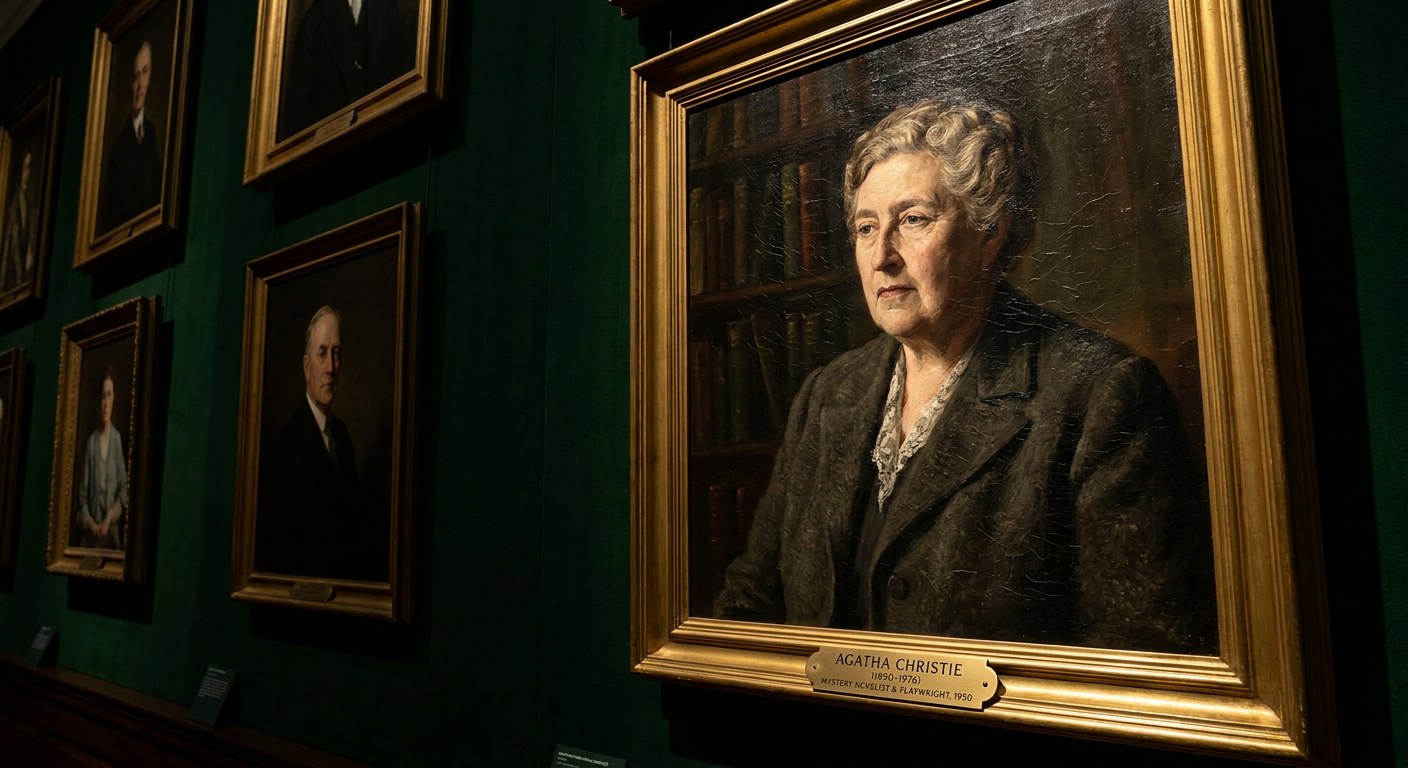
Agatha Christie
1890 – 1976 · British · Mystery Novelist & Playwright
Recommended Audiobooks
Listen next from Marcus Alden

Life Lessons from Frederic Chopin
Marcus Alden · 54 min

Life Lessons from John Wesley
Marcus Alden · 52 min
Introduction
Agatha Christie was the most commercially successful mystery writer of the twentieth century and one of the best-selling authors in literary history. Over a career spanning more than five decades, she transformed the detective story into a form of intellectual entertainment recognized around the world. Her ingenious plots, carefully planted clues, memorable suspects, and spectacular final revelations established standards that crime writers continue to study and imitate.
Christie created two of fiction's most famous detectives: Hercule Poirot, the meticulous Belgian investigator who trusted his celebrated little grey cells, and Miss Jane Marple, an observant elderly woman whose knowledge of village life gave her a remarkably clear understanding of human wrongdoing. Christie also wrote successful thrillers, short stories, romantic novels under the name Mary Westmacott, and stage plays. Her play The Mousetrap achieved an unprecedented theatrical run in London's West End.
Her appeal rests on more than surprise endings. Christie understood the narrative power of confined settings, restricted circles of suspects, unreliable testimony, hidden identities, and apparently impossible crimes. She invited readers to compete with the detective while controlling what they noticed and how they interpreted it. Her knowledge of medicines and poisons, acquired while working in hospital dispensaries during the world wars, added authenticity to many cases.
Christie's own life contained an enduring mystery. In December 1926, amid bereavement and the collapse of her first marriage, she disappeared for eleven days and became the subject of a nationwide search. She never publicly supplied a complete explanation. Yet the incident was only one episode in a long life that also encompassed international travel, archaeological expeditions, two world wars, changing social conventions, and the emergence of modern mass-market publishing.
With dozens of detective novels, numerous story collections, six Mary Westmacott novels, and a major body of dramatic work, Christie became known as the Queen of Crime. Estimates of her total sales vary and are difficult to verify, but her books have unquestionably circulated in the hundreds of millions and have been translated into scores of languages. Her reputation makes her not simply a popular author, but a central figure in the global history of detective fiction.
Quick Facts
| Fact | Details |
|---|---|
| Born | 15 September 1890, Torquay, Devon, England |
| Died | 12 January 1976, Winterbrook House, Wallingford, Oxfordshire, England |
| Nationality | British |
| Known For | Hercule Poirot, Miss Marple, ingenious mystery plots, and The Mousetrap |
| Occupation | Novelist, short-story writer, playwright, and poet |
| Era | Golden Age of Detective Fiction; twentieth century |
Early Life and Education
Agatha Mary Clarissa Miller was born at Ashfield, her family's comfortable villa in Torquay, a seaside town in Devon. She was the youngest child of Frederick Alvah Miller, an American-born gentleman of independent means, and Clarissa Margaret Boehmer Miller, usually called Clara. Her elder siblings were Margaret Frary Miller, known as Madge, and Louis Montant Miller, known as Monty.
Christie's childhood was affectionate, imaginative, and somewhat unconventional. She received most of her early education at home rather than attending school. Although her mother reportedly believed that children should not learn to read too young, Agatha taught herself at about the age of five. She read widely, played elaborate imaginary games, and invented characters and stories. The spacious house, gardens, servants, visitors, and social rituals of Ashfield later supplied emotional and physical material for her fiction.
Her family belonged to the prosperous middle class, but its finances became increasingly uncertain. Frederick Miller died in 1901 after a period of illness, when Agatha was eleven. His death profoundly affected the household. Clara attempted to preserve Ashfield, but the family's reduced circumstances gave Christie an early awareness of money, social status, and the vulnerability hidden beneath respectable appearances—themes that recur throughout her work.
As a teenager, Christie studied music and singing in Paris. She showed promise as a pianist but lacked the temperament for public performance and concluded that she was unlikely to build a professional musical career. She also wrote poems and short stories. During a stay in Cairo with her mother in 1907–08, she participated in the social life of British expatriates and tourists. Ancient Egypt fascinated her, although at that age she was reportedly more interested in dances and social engagements than archaeology.
Her elder sister Madge challenged her to write a detective story, suggesting that the genre was more difficult than it appeared. Christie began experimenting with fiction and submitted manuscripts to publishers, receiving several rejections. She benefited from advice associated with the novelist Eden Phillpotts, a family acquaintance, who encouraged her to continue and helped her understand the practical demands of professional writing.
In 1912, Agatha met Archibald Christie, an officer in the Royal Field Artillery who later joined the Royal Flying Corps. Their courtship unfolded rapidly against the mounting tensions preceding the First World War. They married on Christmas Eve 1914, while Archie was on leave. The marriage gave her the surname under which she became famous.
Rise to Prominence
During the First World War, Christie volunteered with the Voluntary Aid Detachment at the Red Cross hospital in Torquay. She first served as a nurse and later worked in the hospital dispensary. In 1917 she qualified as an apothecaries' assistant. Her training gave her detailed knowledge of medicines, toxic substances, dosages, and symptoms—knowledge that became one of the most distinctive technical features of her crime fiction.
While working during the war, she wrote The Mysterious Affair at Styles. The novel introduced Hercule Poirot, a Belgian refugee and former police officer. Belgium's wartime suffering made Belgian refugees a familiar presence in Britain, and Christie later recalled seeing Belgian exiles in Torquay. Poirot's precise habits, elaborate moustaches, foreign idioms, psychological insight, and confidence in rational order made him immediately recognizable.
Several publishers rejected the manuscript before John Lane of The Bodley Head accepted it. The novel appeared first in the United States in 1920 and in Britain in 1921. Its use of strychnine reflected Christie's pharmaceutical expertise. Reviewers noted that the mystery gave readers a fair opportunity to assess the evidence, even while concealing the correct interpretation.
Christie's second novel, The Secret Adversary (1922), introduced the adventurous young partners Tommy and Tuppence. It demonstrated that she was not limited to the formal country-house mystery. That year Christie accompanied Archie on a lengthy promotional tour connected with the British Empire Exhibition. Their travels took them to South Africa, Australia, New Zealand, Hawaii, and Canada. Christie learned to surf in South Africa and Hawaii, an unusual pastime for a British woman of her background and generation.
Her early books sold respectably, but The Murder of Roger Ackroyd (1926) established her as a major figure. The novel employed a daring narrative device that generated both admiration and controversy. Some readers believed Christie had broken the unwritten rules of fair play; others argued that she had provided the necessary clues while exploiting assumptions readers brought to first-person narration. The book became one of the defining works of Golden Age detective fiction.
Christie was now a recognized professional author, but 1926 was personally devastating. Her mother died, leaving Christie grief-stricken and responsible for sorting out Ashfield. At the same time, Archie Christie announced that he was in love with Nancy Neele and wanted a divorce. These pressures preceded Agatha's famous disappearance in December.
After her recovery and eventual divorce, Christie rebuilt both her private and professional lives. Her writing became more assured, her output remained steady, and the 1930s produced many of her most celebrated books. Far from ending her career, the upheavals of the 1920s marked the beginning of her most fertile creative period.
Major Achievements and Contributions
Christie's primary achievement was her mastery of mystery construction. She treated detective fiction as a controlled contest among author, detective, and reader. Important information was often openly presented but disguised by context, social prejudice, or an apparently innocent explanation. Her finest solutions seem surprising on first reading and retrospectively plausible once the clues are reconsidered.
She developed several structures that became classics of the genre. These included murder in an isolated location, a restricted group of suspects, crimes linked by nursery rhymes, testimony distorted by self-interest, and past events returning to disrupt the present. Trains, ships, archaeological sites, country houses, hotels, and snowbound buildings provided closed environments in which suspects could be studied under pressure.
Poirot and Miss Marple embodied different methods of detection. Poirot emphasized order, psychology, interviews, and the disciplined operation of the mind. Miss Marple interpreted crimes through analogies to the behavior she had observed in the fictional village of St Mary Mead. Her apparent harmlessness caused suspects to underestimate her, while her lack of sentimentality allowed her to recognize greed, jealousy, vanity, and cruelty.
Christie's medical knowledge made poison one of her trademarks. Arsenic, cyanide, digitalis, morphine, strychnine, and other substances appear in her fiction with an accuracy unusual in popular literature. Her use of thallium in The Pale Horse reportedly helped readers and medical professionals recognize real cases of poisoning after noticing similarities between patients' symptoms and those described in the novel.
She also expanded crime fiction's commercial reach. Her clear prose, short chapters, vivid premises, and strong narrative momentum translated effectively across languages and cultures. Although claims that her works have sold more than two billion copies derive largely from publisher and record-book estimates that cannot be independently audited, she is consistently ranked among the world's most widely read fiction writers.
Christie played an important role in the Detection Club, an association of leading British mystery writers. She became its president in 1957 and retained the position until her death. Her standing among fellow writers was reinforced by her ability to innovate within familiar conventions.
Her achievements extended to the stage. The Mousetrap, adapted from the radio play Three Blind Mice, opened in London's West End in 1952. It continued until the COVID-19 pandemic forced theatres to close in March 2020, ending an extraordinary uninterrupted initial run. The production reopened in May 2021. Audiences are traditionally asked not to reveal the identity of the murderer.
Christie was appointed Commander of the Order of the British Empire in 1956 and Dame Commander in 1971 for her contribution to literature. Her husband, the archaeologist Max Mallowan, had been knighted in 1968, making them Sir Max and Lady Mallowan in ordinary social usage, while Christie also possessed the title Dame Agatha in her own right.
Key Works / Battles / Ideas
The Murder of Roger Ackroyd (1926)
This Poirot novel centers on a wealthy man's murder in an English village and uses point of view with exceptional boldness. Its solution remains one of the genre's most discussed innovations. The book demonstrated how the narrator's selective language could guide readers toward a false conclusion without necessarily stating an outright lie.
The Murder at the Vicarage (1930)
Christie's first full-length Miss Marple novel introduced readers to St Mary Mead as a setting for serious crime. Miss Marple appears physically unthreatening but possesses a formidable understanding of character. The novel established the contrast between the village's peaceful surface and its network of secrets, resentments, and close observation.
Murder on the Orient Express (1934)
Inspired by Christie's international travels and familiarity with the famous train, this novel traps Poirot with passengers when snow halts the Orient Express. The victim's connection to an earlier kidnapping creates a morally complex case. Its communal solution challenged the ordinary structure of a mystery, in which one guilty individual is separated from an innocent group.
The A.B.C. Murders (1936)
A supposed serial killer sends Poirot letters and commits murders in alphabetical order. Christie combined the expanding scale of a modern manhunt with a deeply personal motive. The novel shows her skill at using an ostentatious pattern to distract investigators from a concealed relationship.
Death on the Nile (1937)
Set aboard a Nile steamer, the novel drew on Christie's experience in Egypt and the Middle East. A wealthy young heiress is murdered amid jealousy, romantic betrayal, and financial desperation. The confined setting permits Christie to assemble an international cast while making physical movement and timing essential to the solution.
And Then There Were None (1939)
Ten people are invited to an isolated island, accused of causing deaths that escaped legal punishment, and killed one by one. There is no conventional detective, and the diminishing cast produces an atmosphere of fear and mutual suspicion. The book is widely regarded as Christie's most successful standalone novel and one of the best-selling mysteries ever published.
Its original British title used a racial slur taken from an older minstrel song. The American edition adopted And Then There Were None, a phrase from the revised rhyme, and that is now the standard international title. Later editions and adaptations removed or replaced offensive terminology.
Five Little Pigs (1942)
Poirot investigates a murder committed sixteen years earlier by asking five witnesses to produce written accounts. With little physical evidence available, the novel focuses on memory, interpretation, and personality. Its construction demonstrates Christie's ability to make a retrospective case as compelling as an immediate investigation.
The Body in the Library (1942)
A young woman's body appears in the library of a respectable country house, apparently fulfilling a detective-fiction cliché. Miss Marple exposes the assumptions created by clothing, social identity, and the location of the corpse. The novel is both a traditional puzzle and a self-aware variation on the conventions of the genre.
The Pale Horse (1961)
This later novel combines an apparent occult conspiracy with a rational method of murder. Its depiction of thallium poisoning became famous for its medical accuracy. Christie used supernatural suggestion not as an explanation but as misdirection protecting a practical criminal scheme.
The Mousetrap (1952)
Set in an isolated guesthouse during a snowstorm, the play transforms the closed-circle mystery into live theatre. Suspicion moves rapidly among hosts and guests as details of an earlier tragedy emerge. Its record-setting London history made it a cultural institution beyond the readership of Christie's novels.
The Mary Westmacott Novels
Between 1930 and 1956, Christie published six novels as Mary Westmacott, beginning with Giant's Bread. These books concentrated on emotional relationships, sacrifice, disappointment, art, and self-knowledge rather than criminal puzzles. The pseudonym allowed her to explore a different mode without the expectations attached to the Christie name. Her authorship became publicly known in 1949.
Timeline of Key Events
| Year | Event |
|---|---|
| 1890 | Born Agatha Mary Clarissa Miller in Torquay, Devon, on 15 September. |
| 1901 | Her father, Frederick Miller, died. |
| 1907–08 | Spent a social season in Cairo with her mother. |
| 1914 | Married Archibald Christie on 24 December. |
| 1914–18 | Served as a wartime volunteer nurse and dispensary worker in Torquay. |
| 1917 | Qualified as an apothecaries' assistant. |
| 1919 | Gave birth to her only child, Rosalind. |
| 1920 | The Mysterious Affair at Styles was published in the United States. |
| 1922 | Joined Archie Christie on an extensive world tour. |
| 1926 | Published The Murder of Roger Ackroyd and disappeared for eleven days. |
| 1928 | Divorced Archibald Christie. |
| 1930 | Married archaeologist Max Mallowan; published the first Miss Marple novel. |
| 1934 | Published Murder on the Orient Express. |
| 1937 | Published Death on the Nile. |
| 1939 | Published And Then There Were None in Britain. |
| 1943 | Wrote Curtain during the war, although it remained unpublished for decades. |
| 1946 | Published the archaeological memoir Come, Tell Me How You Live. |
| 1952 | The Mousetrap opened in London's West End. |
| 1956 | Appointed Commander of the Order of the British Empire. |
| 1957 | Became president of the Detection Club. |
| 1971 | Appointed Dame Commander of the Order of the British Empire. |
| 1975 | Curtain, Poirot's final case, was published. |
| 1976 | Died on 12 January; the final Miss Marple novel appeared later that year. |
Personal Life and Character
Agatha and Archibald Christie's daughter, Rosalind Margaret Clarissa Christie, was born in 1919. The demands of Archie's work, Agatha's growing career, and their extensive travels sometimes complicated family life. Their marriage collapsed after Archie began a relationship with Nancy Neele, whom he later married.
Following the divorce, Christie traveled alone on the Orient Express to the Middle East. In 1930, while visiting the archaeological site of Ur, she met Max Mallowan, an archaeologist almost fourteen years her junior. They married in Edinburgh in September 1930. The relationship proved enduring and personally stabilizing, although each partner spent periods absorbed in demanding work.
Christie accompanied Mallowan on excavations in Iraq and Syria, including work at Nineveh, Chagar Bazar, and Tell Brak. She photographed finds, cleaned and labeled artifacts, managed practical arrangements, and helped fund expeditions through her writing income. Her memoir Come, Tell Me How You Live presents archaeological life with warmth and humor. Middle Eastern settings subsequently enriched novels such as Murder in Mesopotamia, Death on the Nile, and Appointment with Death.
Despite her celebrity, Christie was generally private and disliked delivering speeches or presenting herself as a public intellectual. Accounts from relatives and colleagues describe a shy, observant woman with a strong practical streak and a playful sense of humor. She enjoyed gardening, houses, food, travel, theatre, and ordinary conversation. Her reserved manner contrasted with the boldness of her plotting.
Christie kept notebooks filled with names, situations, fragments of dialogue, poison information, and alternative solutions. She did not always plan a book from beginning to end before writing it. Instead, she might develop several possible culprits and decide among them as the manuscript evolved. Later in life she often dictated her work.
Financial security mattered to her, partly because of the instability that followed her father's death. She took publishing contracts and theatrical rights seriously, though the complexity of copyright ownership, companies, and taxation sometimes created difficulties. She purchased and cherished Greenway, a house overlooking the River Dart in Devon, as a family holiday home. The property is now maintained by the National Trust.
Challenges and Controversies
The greatest personal crisis of Christie's public life began on the evening of 3 December 1926. After an argument with her husband, she left their home in Berkshire. Her car was found abandoned near Newlands Corner in Surrey, with clothing and identification inside. Police, volunteers, aircraft, and dogs participated in an enormous search that received sensational newspaper coverage.
On 14 December, Christie was recognized at the Swan Hydropathic Hotel in Harrogate, Yorkshire. She had registered under the name Teresa Neele—the surname of Archie's lover—and had apparently been participating in the hotel's social life. Archie traveled to meet her. Contemporary doctors described memory loss, and some later commentators have proposed dissociative amnesia or a fugue state caused by trauma. Others have suspected a deliberate attempt to embarrass her husband or generate publicity.
No interpretation has been conclusively proved. Christie avoided discussing the episode in public and omitted it from her autobiography. Responsible biographies therefore distinguish established facts from speculation. Her mother's death, marital breakdown, exhaustion, and emotional distress provide important context, but they do not yield a definitive diagnosis or motive.
Her books have also been criticized for racial, ethnic, antisemitic, and colonial stereotypes common in interwar British popular writing. Some original titles and passages are deeply offensive by modern standards. The clearest example is the first British title of And Then There Were None. Publishers and estates have revised titles and, in some recent editions, altered or removed objectionable descriptions.
Such revisions have generated debate. Supporters argue that they prevent demeaning language from obstructing the works for contemporary readers and performers. Critics contend that silent editing can obscure historical prejudice and raise questions about textual integrity. Scholarly editions can address both concerns by preserving historical context while clearly explaining harmful terminology.
Literary critics have sometimes dismissed Christie's characterization and prose as formulaic. Her social world can appear narrow, concentrating on country houses, inherited wealth, professional households, and villages. Yet her fiction also contains servants, shopkeepers, actors, nurses, soldiers, refugees, travelers, businesspeople, and financially vulnerable women. The apparent stability of respectable society is repeatedly exposed as fragile or deceptive.
Her commercial affairs were not always simple. High earnings, complex publishing rights, taxation, and adaptations produced legal and financial concerns. Christie also grew tired of Poirot, finding aspects of his personality irritating, but continued writing about him because readers and publishers demanded more. She wrote his final novel, Curtain, during the Second World War and secured it for later publication.
Death and Immediate Aftermath
Christie's health declined during the early 1970s, although she continued to revise and authorize work. Curtain: Poirot's Last Case was published in 1975. Poirot's fictional death was treated as a cultural event, and The New York Times printed an obituary for the character—an unusual distinction for a fictional detective.
Agatha Christie died peacefully from natural causes at Winterbrook House near Wallingford on 12 January 1976. She was eighty-five. She was buried in the churchyard of St Mary's Church at Cholsey, Oxfordshire. Max Mallowan died in 1978 and was buried beside her.
Later in 1976, Sleeping Murder, which Christie had written decades earlier as a concluding Miss Marple case, was published. Thus her two most famous detectives received planned final appearances close to the end of her life. Her literary estate, copyrights, theatrical interests, and family arrangements ensured that publication and adaptation continued.
Tributes emphasized both the scale of her readership and the extraordinary durability of her characters. The ongoing success of The Mousetrap gave her death an unusual theatrical aftermath: while the author was gone, one of her stories continued to be performed before new audiences night after night.
Legacy and Influence Today
Agatha Christie's legacy is visible throughout modern crime fiction. Contemporary locked-room mysteries, country-house murders, ensemble investigations, and stories with multiple reversals frequently draw on structures she perfected. Writers may imitate her methods, challenge her social assumptions, or combine the classic puzzle with greater psychological realism, but they continue to operate in a genre she helped define.
Her greatest lesson for mystery writers is the distinction between hiding information and hiding meaning. Christie often showed readers the decisive clue. Her achievement lay in making it appear trivial or encouraging an incorrect explanation. This method creates the satisfying impression that the solution was available all along.
Poirot and Miss Marple have become cultural archetypes through television, cinema, radio, theatre, audiobooks, games, and graphic adaptations. Actors including David Suchet, Joan Hickson, Margaret Rutherford, Peter Ustinov, Albert Finney, Geraldine McEwan, Julia McKenzie, Kenneth Branagh, and others have offered markedly different interpretations. These adaptations keep the characters visible even among audiences who have not read the novels.
Christie's books also remain valuable historical documents, though they must be read critically. They depict changing class relations, domestic service, tourism, empire, war, gender expectations, new technologies, and anxieties about social mobility. At the same time, their prejudices reveal limitations in the culture from which they emerged.
Museums, archives, festivals, reading groups, and academic researchers continue to examine her notebooks and manuscripts. Greenway attracts visitors interested in both Christie and the landscape associated with her family. The International Agatha Christie Festival is held in the Torquay area, celebrating her relationship with Devon.
Her influence has also extended beyond entertainment. Medical discussions of poisoning occasionally refer to her unusually accurate descriptions, particularly in The Pale Horse. Scholars analyze her manipulation of narrative perspective, while creative-writing teachers use her books to demonstrate pacing, clue placement, red herrings, and controlled revelation.
Above all, Christie endures because she understood that mysteries depend on recognizable human motives. Technology and forensic science may change, but jealousy, fear, greed, resentment, love, shame, and the desire to protect reputation remain powerful. Her fictional worlds promise that apparent chaos can be examined, reconstructed, and explained—even when the final explanation is morally unsettling.
Famous Quotes
“Every murderer is probably somebody's old friend.”
—Agatha Christie, The Mysterious Mr Quin
“Very few of us are what we seem.”
—Agatha Christie, The Man in the Mist
“Good advice is always certain to be ignored, but that's no reason not to give it.”
—Agatha Christie, The Seven Dials Mystery
“One doesn't recognize the really important moments in one's life until it's too late.”
—Agatha Christie, An Autobiography
“I like living. I have sometimes been wildly, despairingly, acutely miserable.”
—Agatha Christie, An Autobiography
“The impossible could not have happened, therefore the impossible must be possible in spite of appearances.”
—Hercule Poirot in Agatha Christie's Murder on the Orient Express
“It is the brain, the little grey cells on which one must rely.”
—Hercule Poirot in Agatha Christie's The Mysterious Affair at Styles
Frequently Asked Questions
Why is Agatha Christie called the Queen of Crime?
The title reflects her exceptional popularity, prolific output, influence on mystery plotting, and creation of Poirot and Miss Marple. Her books reached an international readership, while her stage works—especially The Mousetrap—gave her an unmatched presence in popular theatre.
How many books did Agatha Christie write?
Counts vary according to whether plays, collaborative works, and posthumous collections are included. She is generally credited with 66 detective novels, six novels written as Mary Westmacott, 14 principal short-story collections, and numerous plays. She also wrote poetry, memoirs, and nonfiction.
What happened when Agatha Christie disappeared?
Christie vanished on 3 December 1926 after a period of grief and marital crisis. Her abandoned car prompted a nationwide search. She was found eleven days later at a hotel in Harrogate, registered under the surname Neele. Memory loss was reported, but no single explanation of the episode has been conclusively established.
Was Hercule Poirot based on a real person?
No single person has been identified as Poirot's model. Christie developed him as a Belgian refugee and former police officer during the First World War, when Belgian refugees were living in Britain. His appearance and mannerisms may have drawn on several observations and literary influences.
Which Agatha Christie book should a beginner read first?
The Mysterious Affair at Styles is a natural introduction because it presents Poirot's first case. Murder on the Orient Express and And Then There Were None are also accessible starting points. Readers interested in Miss Marple might begin with The Murder at the Vicarage or The Body in the Library.
What is Agatha Christie's best-selling novel?
And Then There Were None is generally identified as her best-selling individual novel. Exact historical sales totals are difficult to verify, but it has achieved enormous international circulation and has been repeatedly adapted for stage, film, television, radio, and other media.
Why did Christie know so much about poison?
She worked as a nurse and hospital dispensary assistant during the First World War and renewed her pharmaceutical experience during the Second. This training taught her the properties and effects of medicines and toxic substances, allowing her to use poison with unusual accuracy in her fiction.
Did Agatha Christie work as an archaeologist?
She was not formally trained as an archaeologist, but she made significant practical contributions to expeditions led by Max Mallowan. She photographed, cleaned, recorded, and conserved finds, supported expedition logistics, and helped finance the work. Her experiences informed both her memoir and several novels.
Lessons We Can Learn
-
Turn practical knowledge into creative strength. Christie's pharmaceutical training gave her mysteries a distinctive realism. Specialized experience can become valuable artistic material.
-
Do not treat early rejection as a final verdict. Publishers rejected Christie's first detective manuscript several times. Persistence allowed her to develop into one of history's most successful authors.
-
Understand the audience's assumptions. Christie's plots succeed because she anticipated how readers would interpret narrators, social roles, and familiar situations. Effective communication requires knowing not only what people see, but what they expect to see.
-
Reinvention can follow personal crisis. Bereavement, divorce, and intense public scrutiny marked the mid-1920s, yet Christie rebuilt her life, remarried, traveled, and produced much of her finest work.
-
Popular art can reward serious craftsmanship. Christie's accessible style did not mean her structures were simple. Her career demonstrates that entertainment and technical sophistication can coexist.
Further Reading
- Janet Morgan, Agatha Christie: A Biography — An authorized biography based on family papers and interviews.
- Laura Thompson, Agatha Christie: A Mysterious Life — A detailed modern biography combining literary analysis with investigation of Christie's private life.
- Lucy Worsley, Agatha Christie: A Very Elusive Woman — A contextual biography emphasizing gender, celebrity, and the social world in which Christie worked.
- John Curran, Agatha Christie's Secret Notebooks: Fifty Years of Mysteries in the Making — A study of Christie's surviving notebooks and methods of plot construction.
- Agatha Christie, An Autobiography — Christie's own warm, selective account of her childhood, marriages, travel, writing, and archaeological experiences.
Watch and Learn
How to write a great mystery, according to Agatha Christie · TED-Ed