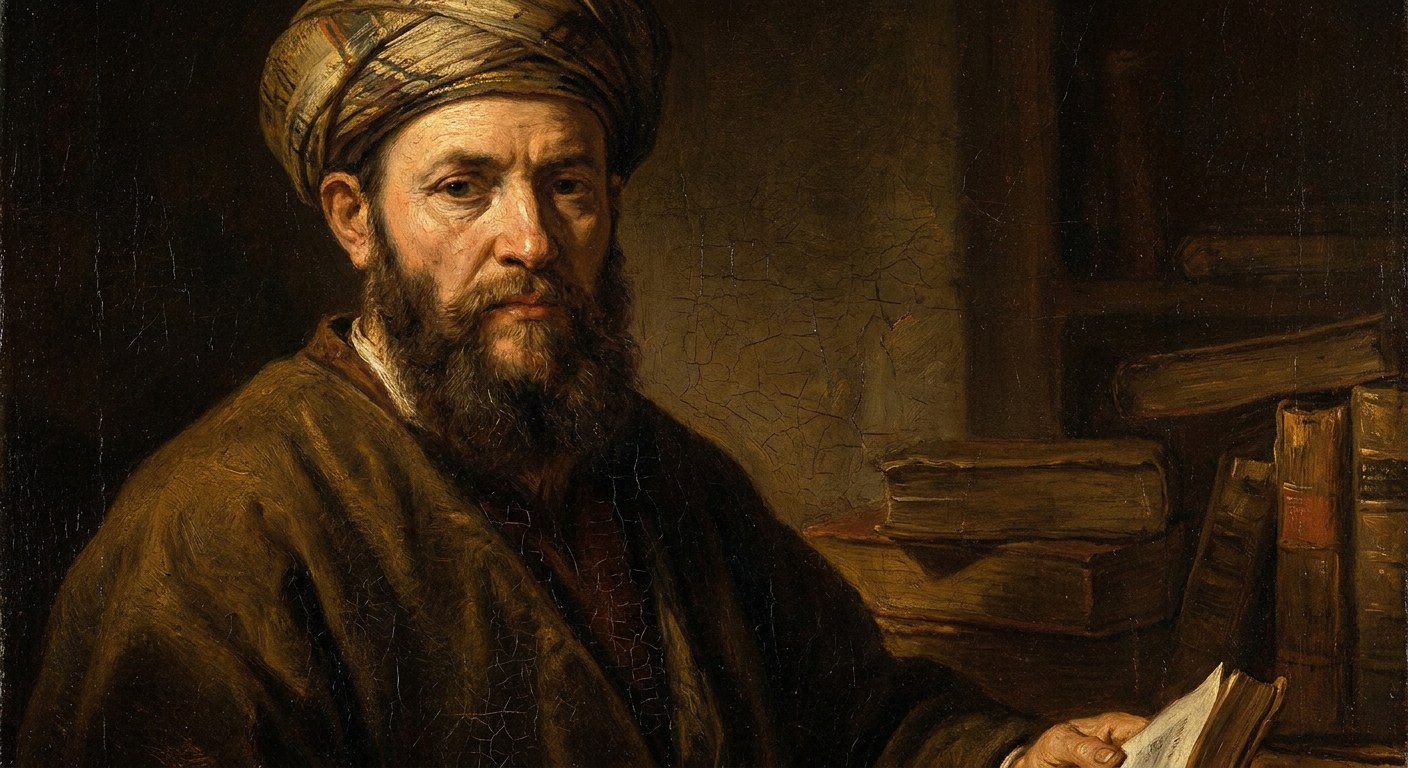
Al-Ghazali
1058 – 1111 · Persian · Theologian, Jurist & Mystic
Recommended Audiobooks
Listen next from Marcus Alden

Life Lessons from Frederic Chopin
Marcus Alden · 54 min

Life Lessons from John Wesley
Marcus Alden · 52 min
Introduction (Why He Matters)
Abu Hamid Muhammad ibn Muhammad al-Ghazali—usually known simply as Al-Ghazali—was one of the most influential theologians, jurists, philosophers and spiritual writers in Islamic history. Born in Persian-speaking Khurasan in 1058, he rose from provincial origins to occupy the prestigious chair of law at the Nizamiyya college in Baghdad. He then abandoned that celebrated position during a profound intellectual and spiritual crisis, spent years in travel and seclusion, and eventually produced a synthesis of religious law, theology, ethics and Sufi spirituality that reshaped Sunni Islam.
Al-Ghazali is often called Hujjat al-Islam, or “Proof of Islam,” an honorific reflecting the authority later generations attributed to him. His importance rests partly on his ability to bring disciplines that were frequently treated separately into a coherent vision. He defended Sunni theology, wrote sophisticated works of jurisprudence, accepted logic as a legitimate intellectual tool, criticized key doctrines of the Islamic philosophers, and argued that outward religious observance had to be joined to the inward purification of the heart.
His best-known work, the Revival of the Religious Sciences (Ihya' 'ulum al-din), is among the most widely read books in the Islamic intellectual tradition. Its forty books examine worship, social conduct, destructive character traits and virtues leading toward salvation. In The Incoherence of the Philosophers (Tahafut al-falasifa), Al-Ghazali challenged propositions associated especially with Avicenna and al-Farabi. That critique became a landmark in the history of philosophy and provoked a famous answer from Averroes.
Older accounts sometimes claimed that Al-Ghazali ended philosophy or caused the decline of Islamic science. Modern scholarship regards that story as seriously misleading. He objected to particular metaphysical conclusions, not to mathematics, medicine, demonstration or rational inquiry as such. Indeed, his own writings reveal extensive philosophical training and helped make formal logic acceptable within later Islamic theology and law.
Al-Ghazali remains influential because he addressed a perennial problem: how can intellectual conviction, ethical conduct and spiritual experience form a unified life? His response continues to be studied by theologians, philosophers, historians of religion and Muslim readers across the world.
Quick Facts
| Category | Details |
|---|---|
| Born | c. 1058 (450 AH), Tus, Khurasan, Seljuk Empire—now in Iran |
| Died | 19 December 1111 (505 AH), Tus, Khurasan |
| Nationality | Persian |
| Known For | Revival of the Religious Sciences, critique of Avicennian philosophy, integration of Sufi spirituality with Sunni scholarship |
| Occupation | Theologian, Shafi'i jurist, teacher, philosopher and Sufi writer |
| Era | Islamic Golden Age; Seljuk period |
Early Life and Education
Al-Ghazali was born around 1058 in or near Tus, an important urban center in Khurasan in northeastern Persia. His full name was Abu Hamid Muhammad ibn Muhammad al-Ghazali. The origin of the name “al-Ghazali” is disputed. It may refer to the village of Ghazala near Tus, or it may derive from his father's reported occupation as a spinner or seller of wool, called ghazzal in Arabic. Medieval spelling practices and conflicting biographical traditions prevent a definitive conclusion.
Information about his childhood comes mainly from later biographers and must be treated cautiously. His father is described as a man of modest means who respected scholars and attended religious gatherings. According to a traditional account, before dying he entrusted Muhammad and his younger brother Ahmad al-Ghazali to a Sufi friend and provided money for their care. When those funds were exhausted, the guardian arranged for the boys to enter a school where food and lodging were available.
Al-Ghazali first studied in Tus. His early curriculum would have included the Quran, Arabic, religious doctrine and Shafi'i jurisprudence, one of the four principal schools of Sunni law. He later traveled to Jurjan, probably to study with Abu Nasr al-Isma'ili. A famous anecdote says that robbers once seized his notes while he was returning from Jurjan. When Al-Ghazali begged for their return, the leader mocked knowledge that could be taken away in a bag. The young student supposedly recovered his papers and memorized their contents. Whether literal or edifying, the story reflects the medieval ideal that learning had to be internalized rather than merely recorded.
The decisive stage of his education took place at Nishapur, one of the great centers of scholarship in the eastern Islamic world. There he studied under Imam al-Haramayn al-Juwayni, the leading Shafi'i jurist and Ash'ari theologian of his generation. Al-Juwayni instructed him in jurisprudence, legal theory, dialectical theology and methods of debate. Al-Ghazali also acquired a substantial understanding of philosophical reasoning and logic.
Some sources associate his spiritual development during this period with the Sufi teacher al-Farmadhi. Whatever the precise chronology, Al-Ghazali was exposed early to Sufi ideas about discipline, sincerity and purification of the heart. His brother Ahmad later became a distinguished Sufi preacher and author in his own right.
Al-Ghazali's abilities quickly attracted notice. Medieval accounts portray him as an exceptionally forceful debater with a remarkable memory and broad command of legal and theological questions. When al-Juwayni died in 1085, Al-Ghazali left Nishapur and joined the courtly scholarly circle surrounding the powerful Seljuk vizier Nizam al-Mulk.
Rise to Prominence
Nizam al-Mulk administered a network of institutions known as the Nizamiyya colleges, established to support Sunni learning and educate officials and jurists. At the vizier's encampment, Al-Ghazali participated in debates with leading scholars. His skill brought him political patronage and, in 1091, appointment to the Nizamiyya college in Baghdad.
The Baghdad Nizamiyya was among the most prestigious teaching posts in the Sunni world. Al-Ghazali lectured to large audiences on Shafi'i law and legal theory while participating in the intellectual and political life of the Abbasid capital. Still only in his early thirties, he had achieved extraordinary fame.
This was also a politically unstable period. The Abbasid caliph remained an important symbol of Sunni legitimacy, but effective power rested largely with the Seljuk sultans and their officials. Rivalries within the Seljuk ruling house intensified after Nizam al-Mulk was assassinated in 1092 and Sultan Malik-Shah died soon afterward. The Isma'ili movement represented another major ideological and political challenge. Al-Ghazali wrote works against Isma'ili doctrines, defending the legitimacy of the Abbasid caliphate and the authority of established Sunni scholarship.
While teaching in Baghdad, he systematically studied the principal intellectual movements of his age. In his autobiographical Deliverance from Error, he grouped seekers of truth into theologians, philosophers, Isma'ili instructionalists and Sufis. He insisted that he had studied each school thoroughly before judging it.
His engagement with philosophy produced two closely related books. The Aims of the Philosophers presented a careful account of philosophical teachings, especially those derived from Avicenna. The Incoherence of the Philosophers then criticized twenty metaphysical propositions. The order mattered: Al-Ghazali wanted to demonstrate that his criticism rested on informed understanding rather than ignorance.
Public success did not bring him inner peace. By 1095 he was experiencing a severe crisis. He questioned whether his teaching was motivated by service to God or by status, wealth and admiration. According to his own account, the conflict became so intense that he lost the ability to speak and could not lecture. Physicians concluded that his physical symptoms had a psychological cause.
In November 1095, Al-Ghazali left Baghdad. Publicly, he announced an intention to perform the pilgrimage to Mecca. Privately, he resolved to renounce his position and pursue spiritual reform. He distributed much of his wealth, retained enough for his dependents, and entrusted his teaching responsibilities to his brother Ahmad. This voluntary departure from one of the most prestigious offices of the age became the turning point of his life.
Major Achievements and Contributions
Al-Ghazali's central achievement was the construction of a practical and intellectual synthesis linking law, theology, ethics and Sufism. He did not regard these as interchangeable. Law regulated outward conduct; theology defended correct belief; reason distinguished valid arguments from invalid ones; and spiritual discipline transformed the inner self. A complete religious life required all of them in proper balance.
His greatest work, the Ihya' 'ulum al-din, is organized into four quarters of ten books each. The first concerns acts of worship, including prayer, almsgiving, fasting and pilgrimage. The second covers customs and social relations, such as eating, marriage, earning a livelihood and friendship. The third examines destructive qualities, including anger, greed, envy, pride and love of worldly status. The fourth discusses saving virtues such as repentance, patience, gratitude, trust in God and love.
The Ihya' gave Sufi spirituality a systematic place within mainstream Sunni religious life. Al-Ghazali criticized antinomian claims that mystical attainment released a person from religious law. At the same time, he rebuked jurists who reduced religion to outward technical compliance. Prayer, fasting and charity were not merely valid legal acts; they had inner meanings and were supposed to reshape the heart.
In theology, Al-Ghazali worked within the Ash'ari tradition while modifying and developing it. He defended divine omnipotence and rejected the view that natural objects act independently of God. His famous discussion of fire and cotton argues that observation shows a regular conjunction between burning and contact with fire, not a logically necessary causal power existing independently in fire. God creates the burning when the two meet and may choose otherwise.
This position is often called occasionalism, although scholars debate how completely that label captures his view. Al-Ghazali did not deny observable regularity or the usefulness of investigating nature. He challenged the philosophers' claim that causal relationships were metaphysically necessary. The regular order of nature could instead be understood as God's customary mode of action.
Al-Ghazali also made major contributions to Islamic jurisprudence. His mature legal-theoretical work, al-Mustasfa min 'ilm al-usul, analyzes scriptural language, consensus, analogy and methods of legal inference. It begins with an extensive discussion of logic, illustrating his conviction that logic was a neutral instrument rather than the property of a particular philosophical sect.
His jurisprudential writings contributed to later discussions of the objectives of religious law, or maqasid al-shari'a. He identified five essential goods protected by the law: religion, life, intellect, lineage and property. Although he did not invent all aspects of this framework, his formulation became highly influential in later legal thought.
Al-Ghazali's ethical psychology drew upon the Quran, prophetic traditions, Sufi practice and philosophical ethics. He treated the human character as capable of cultivation through repeated action. Virtue involved bringing desire and anger under the guidance of reason and revelation, not eliminating them altogether. Spiritual diseases such as pride and envy had to be diagnosed through self-examination and treated through disciplined practice.
Key Works and Ideas
Revival of the Religious Sciences
The Ihya' 'ulum al-din is Al-Ghazali's comprehensive guide to religious and ethical life. Its combination of law, scripture, moral psychology and Sufi teaching made it enormously popular. Summaries and commentaries circulated throughout the Islamic world, and the Persian Alchemy of Happiness presents related teachings for a broader audience.
The Incoherence of the Philosophers
In the Tahafut al-falasifa, Al-Ghazali criticized twenty doctrines associated chiefly with al-Farabi and Avicenna. He judged three to be incompatible with Islam: the eternity of the world, denial that God knows temporal particulars as particulars, and denial of bodily resurrection. His verdict was not a wholesale condemnation of philosophy. He distinguished mathematics and logic from disputed metaphysics and warned religious critics not to deny demonstrable truths merely because philosophers accepted them.
Averroes later answered him in The Incoherence of the Incoherence. Their exchange became one of the best-known debates in medieval philosophy. Al-Ghazali's work also influenced Jewish and Christian intellectual environments through translations and adaptations.
Deliverance from Error
This autobiographical and intellectual narrative recounts Al-Ghazali's search for certainty, his crisis in Baghdad and his evaluation of competing paths to knowledge. It is not a modern autobiography and shapes events to communicate a religious argument. Nevertheless, it provides indispensable evidence about how he understood his own career.
The Niche of Lights
Mishkat al-anwar offers a sophisticated interpretation of the Quranic Light Verse. It describes levels of perception and spiritual illumination using the imagery of light, lamps and niches. The work displays a metaphysical and mystical vocabulary that has generated extensive scholarly debate about Al-Ghazali's relationship to philosophy.
The Just Balance
In al-Qistas al-mustaqim, Al-Ghazali presents logical forms through patterns he associates with Quranic reasoning. The work attacks the Isma'ili claim that truth depends upon unquestioning submission to an infallible teacher. It also demonstrates his willingness to integrate logic into religious argument.
The Beginning of Guidance and O Disciple
These shorter works focus on practical discipline. The Beginning of Guidance gives instructions for daily worship, avoidance of wrongdoing and proper companionship. O Disciple addresses a student who asks how knowledge can become spiritually beneficial. Both remain widely read as accessible introductions to Al-Ghazali's ethics.
Knowledge and Spiritual Certainty
Al-Ghazali distinguished ordinary assent from genuine certainty. During his crisis, he questioned whether sense perception and rational principles could provide an absolutely secure foundation. He described his recovery of trust in reason as a light placed in his heart by God. Yet this did not lead him to reject reasoning. Instead, he argued that discursive knowledge had limits and that spiritual practice could produce a direct experiential awareness—often described with the Sufi term dhawq, or “taste.”
Timeline of Key Events
| Year | Event |
|---|---|
| c. 1058 | Born in Tus in Khurasan, within the Seljuk Empire |
| c. 1070s | Studies in Tus and Jurjan before traveling to Nishapur |
| Before 1085 | Studies law and Ash'ari theology under al-Juwayni at Nishapur |
| 1085 | Al-Juwayni dies; Al-Ghazali joins the scholarly circle of Nizam al-Mulk |
| 1091 | Appointed professor at the Nizamiyya college in Baghdad |
| 1092 | Nizam al-Mulk is assassinated; Sultan Malik-Shah dies soon afterward |
| c. 1094–1095 | Composes major works on philosophy, including The Aims and The Incoherence of the Philosophers |
| 1095 | Suffers a spiritual crisis and leaves Baghdad, renouncing his prestigious post |
| 1095–1097 | Lives for periods in Damascus and Jerusalem, pursuing seclusion and devotional practice |
| c. 1096–1097 | Performs the pilgrimage to Mecca; the exact itinerary and dates remain uncertain |
| Late 1090s | Returns to Khurasan and continues writing and spiritual instruction |
| c. 1096–1102 | Composes much of the Revival of the Religious Sciences |
| 1106 | Returns to public teaching at the Nizamiyya in Nishapur at the urging of Seljuk authorities |
| c. 1108–1109 | Writes Deliverance from Error and major late works on law and theology |
| c. 1110 | Withdraws again to Tus, where he teaches in a small school and Sufi lodge |
| 19 December 1111 | Dies at Tus at approximately fifty-three years of age |
Personal Life and Character
Reliable information about Al-Ghazali's domestic life is limited. He married and had children, but medieval biographers devoted far more attention to his scholarship than to his household. His honorific Abu Hamid means “father of Hamid,” although reports commonly state that he left daughters and no surviving son. His brother Ahmad remained an important figure in his life and temporarily assumed his teaching duties when Al-Ghazali departed Baghdad.
Al-Ghazali's writings reveal acute self-awareness. He openly acknowledged his attraction to prestige and the pleasure he took in intellectual victory. His withdrawal from Baghdad was therefore not presented as a simple rejection of scholarship but as an attempt to purify its motive. He concluded that even religious learning could become spiritually destructive if pursued for reputation or power.
He was both intellectually confident and deeply suspicious of self-deception. He advised readers to examine their intentions, habits and emotional reactions. For him, pride was especially dangerous among scholars because learning could disguise the desire for superiority as devotion to truth.
After leaving Baghdad, Al-Ghazali reportedly spent time in Damascus, including periods of retreat in the Umayyad Mosque, and traveled to Jerusalem. He performed the pilgrimage to Mecca and eventually returned to Khurasan. Later idealized accounts sometimes portray these years as an uninterrupted decade of solitude, but he probably alternated seclusion with travel, writing, family responsibilities and limited teaching.
In 1106, he accepted an invitation to teach at the Nizamiyya in Nishapur. In Deliverance from Error, he explained that corruption and religious confusion made renewed public instruction necessary, while insisting that his intention had changed. The appointment did not last indefinitely. He eventually returned to Tus, where he established or joined a small school for students and a lodge for Sufi practitioners.
Challenges and Controversies
Al-Ghazali's attitude toward philosophy remains his most famous controversy. He has often been depicted as an enemy of reason whose attack on philosophy brought Islamic scientific achievement to an end. This sweeping claim cannot be sustained. Scientific and philosophical work continued in Muslim societies for centuries, and Al-Ghazali himself used logic, philosophical terminology and rigorous argument.
His criticism was directed primarily at metaphysical doctrines advanced by Avicenna and al-Farabi, not at every field grouped under the term philosophy. He explicitly warned against rejecting mathematics on religious grounds, since demonstrably false attacks on mathematics would only damage religion's credibility. His acceptance of logic helped establish it within later Sunni educational traditions.
At the same time, his judgments were consequential. Declaring three philosophical positions unbelief raised the stakes of metaphysical disagreement, and later critics sometimes invoked his authority more broadly than he did. Averroes accused him of misunderstanding or misrepresenting philosophical demonstration. Modern scholars continue to debate whether Al-Ghazali's deepest commitments were primarily theological, mystical or covertly philosophical.
The Revival of the Religious Sciences was also controversial. Some jurists objected to its use of weak prophetic reports, its Sufi vocabulary and its criticism of formalistic scholarship. The Andalusian jurist Abu Bakr ibn al-'Arabi criticized it, and copies were reportedly condemned and burned under Almoravid authority in the Islamic West. Other scholars defended the work, produced abridgments and evaluated its hadith material in detail.
Traditionalist critics, including Ibn al-Jawzi and later Ibn Taymiyya, argued that Al-Ghazali relied too heavily on philosophical concepts or inadequately authenticated reports. Yet even critics often acknowledged his sincerity, learning and moral influence.
Questions also surround the chronology and authorship of some writings attributed to him. Al-Ghazali was exceptionally prolific, and popular manuscripts sometimes circulated under famous names. Scholars therefore distinguish securely authenticated works from doubtful or misattributed texts. The authenticity of major works such as the Ihya', Tahafut, Mustasfa, Deliverance and Niche of Lights is well established, although their interpretation remains contested.
His political writings present another complexity. He defended order, caliphal legitimacy and obedience to rulers in an age of civil conflict. Such arguments can appear conservative, but they reflected fear that political fragmentation would produce violence and undermine religious life. He nevertheless warned rulers against injustice and treated government as morally accountable.
Death and Immediate Aftermath
Al-Ghazali died at Tus on 19 December 1111, corresponding to 505 AH, at about fifty-three years of age. A famous report transmitted by his brother Ahmad says that on the morning of his death he performed his ablutions, asked for his burial shroud, kissed it, stretched out his legs and died before sunrise. As with many medieval deathbed narratives, the account conveys an ideal of peaceful preparation and should not be read as a modern clinical record.
He was buried in the region of Tus, traditionally in the Tabaran cemetery. The exact identification of his grave is uncertain, and modern sites associated with him do not provide conclusive archaeological proof of the original burial location.
Al-Ghazali left behind students, family members and a large body of writing. His death did not create a single formal school organized around a designated successor. Instead, his influence spread through books, teaching networks, legal institutions and Sufi communities. The Ihya' was copied, summarized and taught across regions extending from North Africa to Central and South Asia.
Legacy and Influence Today
Al-Ghazali's greatest legacy is his role in making disciplined Sufi spirituality a respected component of Sunni religious scholarship. He did not single-handedly reconcile Sufism and orthodoxy, as earlier Sufis and theologians had already built bridges between them. Nevertheless, the scope, authority and accessibility of his synthesis gave it exceptional influence.
In jurisprudence, he became a major authority in the Shafi'i school. His Mustasfa shaped later legal theory, while his discussion of the five essential goods protected by the law contributed to the development of maqasid reasoning. Contemporary Muslim legal thinkers still cite this framework when discussing welfare, public interest and ethical purposes.
In philosophy, his legacy is paradoxical. He was philosophy's most formidable critic in the eastern Islamic world, yet he also absorbed its methods and vocabulary. His accurate exposition of Avicennian thought introduced philosophical ideas to readers who might otherwise have avoided them. The debate generated by the Tahafut stimulated new philosophical and theological arguments rather than ending inquiry.
Averroes' response became influential in both Islamic and European intellectual history. Through Arabic, Hebrew and Latin traditions, questions associated with Al-Ghazali entered broader medieval debates about creation, causation, divine knowledge and resurrection. The Latin writer known as “Algazel” was sometimes treated as a philosopher because his expository Aims of the Philosophers circulated without its critical sequel.
His analysis of causation remains relevant to historians of philosophy. Comparisons are sometimes drawn between Al-Ghazali and David Hume because both questioned whether observation establishes necessary causal connection. The comparison is suggestive but limited: Al-Ghazali's argument belongs to a theistic account of divine agency, whereas Hume's philosophical project operated in a very different context.
Al-Ghazali also remains important in moral psychology. His discussions of habit, intention, appetite, anger, envy and self-examination resemble concerns addressed by modern virtue ethics and psychology. He understood character formation as an embodied process: repeated behavior shapes the soul, while social environment and companionship influence moral development.
Today, his shorter devotional works are read in mosques, seminaries, universities and study circles. The Ihya' is available in Arabic and numerous translations, though its size and technical vocabulary make scholarly editions especially valuable. Academics study him as a theologian, legal theorist, mystic, philosopher and participant in Seljuk political culture.
Attempts to recruit Al-Ghazali either as an uncomplicated champion of rationalism or as an enemy of reason distort his complexity. He believed reason was indispensable but limited, revelation authoritative but requiring interpretation, and religious practice incomplete without inner transformation. That refusal to separate thought, action and character explains much of his continuing appeal.
Famous Quotes
Translations vary among editions; the following passages are genuinely drawn from works attributed securely to Al-Ghazali.
“The thirst for grasping the real meaning of things was indeed my habit and custom from my early years and in the prime of my life.”
— Deliverance from Error
“Certitude is the clear and complete knowledge of things, such knowledge as leaves no room for doubt and is not accompanied by the possibility of error or illusion.”
— Deliverance from Error
“I then examined my motive in my work of teaching, and realized that it was not pure, but was prompted and motivated by the quest for an influential position and public recognition.”
— Deliverance from Error
“Knowledge without action is insanity, and action without knowledge is vanity.”
— O Disciple, in a widely used English translation
“The key to the knowledge of God is knowledge of one's own self.”
— The Alchemy of Happiness
“When you see a scholar's tongue taking pleasure in argument and debate, know that he has become the victim of habit and is being led astray.”
— Revival of the Religious Sciences, translated in varying forms
“The good character traits are the attributes of the heart and the inner person, but actions are their fruits.”
— Revival of the Religious Sciences, translated in varying forms
Frequently Asked Questions
Who was Al-Ghazali?
Al-Ghazali was an eleventh-century Persian Muslim theologian, Shafi'i jurist, teacher, philosophical critic and Sufi spiritual writer. He taught at the Nizamiyya college in Baghdad and wrote the Revival of the Religious Sciences, one of the most influential works in Sunni Islam.
When and where was Al-Ghazali born?
He was born around 1058, or 450 AH, in or near Tus in Khurasan. The area lies in modern northeastern Iran and was then part of the Seljuk Empire.
Why did Al-Ghazali leave Baghdad?
He described experiencing a crisis of belief and motivation in 1095. Although famous and successful, he feared that his teaching was driven by ambition rather than sincere service to God. His distress affected his speech and health, leading him to abandon his position and pursue spiritual discipline.
Did Al-Ghazali oppose all philosophy and science?
No. He criticized twenty metaphysical doctrines associated particularly with Avicenna and al-Farabi, but he accepted logic and recognized the validity of mathematics and other demonstrative disciplines. He opposed specific conclusions, not rational inquiry in general.
What is Al-Ghazali's most important book?
His most influential work is the Ihya' 'ulum al-din, or Revival of the Religious Sciences. It combines worship, ethics, social conduct, moral psychology and Sufi spirituality in forty books arranged into four major sections.
What did Al-Ghazali say about causation?
He argued that observing one event follow another does not prove a logically necessary causal connection between them. Fire and cotton, for example, are regularly associated with burning because God ordinarily creates that result, not because fire possesses an independent power that limits divine action.
Was Al-Ghazali a Sufi?
Yes, though he was also a jurist and theologian. He embraced Sufi spiritual discipline while insisting that authentic mysticism remain grounded in Islamic law and doctrine. His synthesis helped bring Sufi ethics into the mainstream of Sunni scholarship.
How did Al-Ghazali influence later thinkers?
He influenced jurists, theologians, Sufis and philosophers throughout the Islamic world. Averroes wrote a major response to his philosophical critique. Jewish and Christian thinkers also encountered ideas associated with him through Hebrew and Latin translations.
Lessons We Can Learn
-
Examine the motives behind achievement. Al-Ghazali's crisis shows that public success does not guarantee integrity. Learning and leadership are most valuable when joined to honest self-examination.
-
Understand an argument before criticizing it. He studied philosophy in depth and explained it systematically before presenting his objections. Serious criticism requires knowledge rather than caricature.
-
Unite knowledge with action. For Al-Ghazali, information that does not improve conduct can become a source of pride. Education should shape judgment, habits and character.
-
Balance reason with intellectual humility. He valued logic while recognizing that human reasoning has limits. Confidence in rational inquiry need not exclude awareness of uncertainty.
-
Treat character as something that can be cultivated. Al-Ghazali believed virtues grow through repeated practice, good companionship and disciplined reflection. Moral development is an active, lifelong process.
Further Reading
- Frank Griffel, Al-Ghazali's Philosophical Theology (Oxford University Press, 2009).
- Kenneth Garden, The First Islamic Reviver: Abu Hamid al-Ghazali and His Revival of the Religious Sciences (Oxford University Press, 2014).
- Eric Ormsby, Ghazali: The Revival of Islam (Oneworld, 2007).
- Al-Ghazali, Deliverance from Error, translated by R. J. McCarthy (Fons Vitae, 2000).
- Al-Ghazali, The Incoherence of the Philosophers, translated by Michael E. Marmura, 2nd edition (Brigham Young University Press, 2000).
Watch and Learn
Al-Ghazali · The School of Life