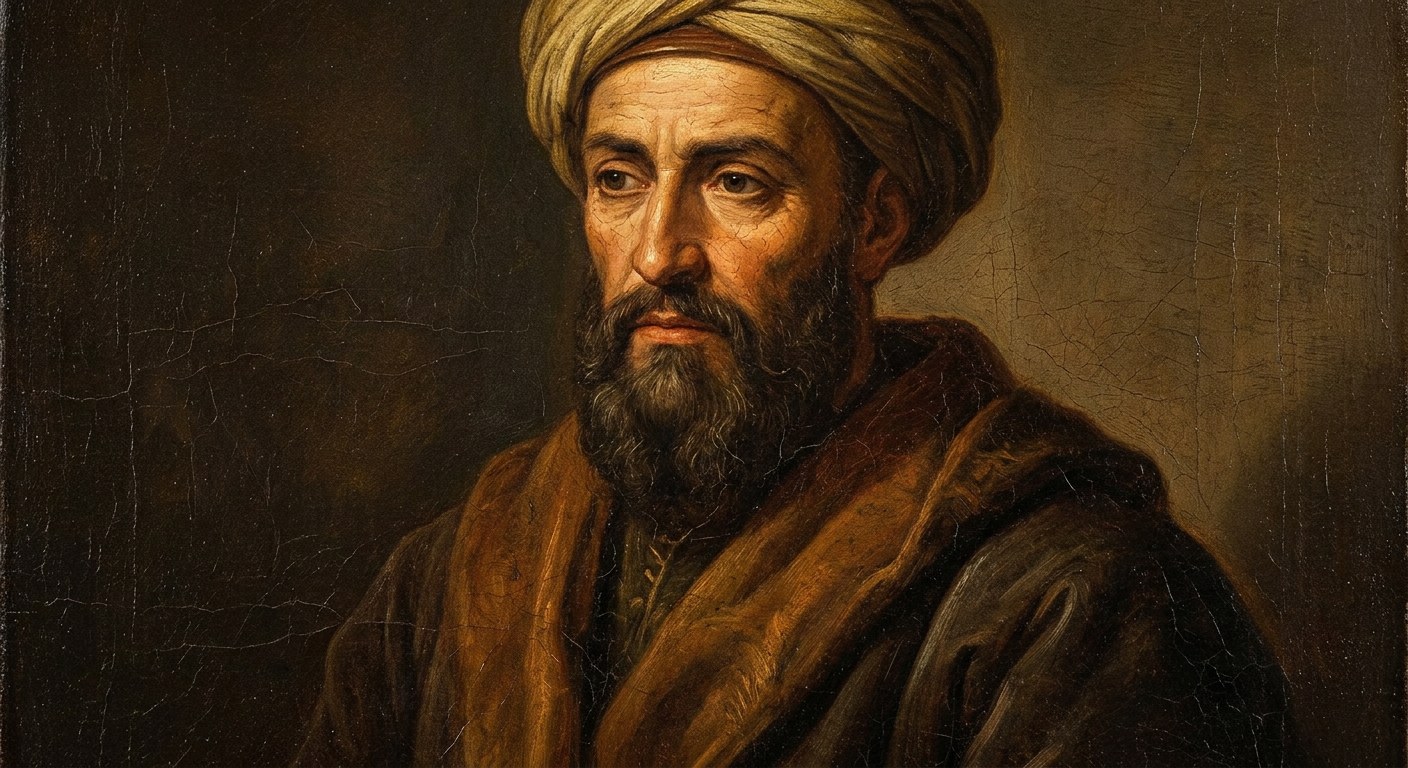
Al-Khwarizmi
780 – 850 · Persian · Mathematician, Astronomer & Geographer
Recommended Audiobooks
Listen next from Marcus Alden

Life Lessons from Frederic Chopin
Marcus Alden · 54 min

Life Lessons from John Wesley
Marcus Alden · 52 min
1. Introduction
Muhammad ibn Musa al-Khwarizmi was one of the most consequential scholars of the medieval world. Active in Baghdad during the early ninth century, he helped transform mathematics from a collection of practical techniques into a more systematic discipline. His writings played a central role in the development of algebra, introduced influential methods of calculation with Hindu-Arabic numerals, improved astronomical tables, and revised the geographical tradition inherited from the ancient Greek scholar Ptolemy.
Two words used throughout the modern world preserve his intellectual legacy. The term algebra comes from al-jabr, a word in the Arabic title of his best-known mathematical treatise. The word algorithm developed from medieval Latin forms of his name, especially Algoritmi. Few scholars have left such a visible mark on the vocabulary of science and technology.
Al-Khwarizmi did not invent every idea later associated with him. Decimal place-value notation had roots in India, algebraic reasoning existed in Babylonian, Greek, Indian, and earlier Arabic traditions, and astronomical knowledge crossed many cultural boundaries. His achievement was to select, organize, explain, and extend this inherited knowledge in works of remarkable practical value. Through Arabic manuscripts and later Latin translations, his methods circulated across the Islamic world and medieval Europe.
The surviving evidence about his personal life is sparse. Even his birthplace and precise dates remain uncertain. His books, however, reveal a scholar working at the center of the Abbasid intellectual world, where Greek, Persian, Indian, and Syriac traditions were translated, compared, and developed. For this reason, Al-Khwarizmi stands not only as a great mathematician but also as an emblem of the international scholarly culture of the Islamic Golden Age.
2. Quick Facts
| Fact | Details |
|---|---|
| Born | c. 780, probably in or connected with Khwarazm; exact place uncertain |
| Died | c. 850, probably in Baghdad or elsewhere in the Abbasid Caliphate |
| Nationality | Persian; active under the Abbasid Caliphate |
| Known For | Foundational work in algebra, algorithms, Hindu-Arabic numerals, astronomy, and geography |
| Occupation | Mathematician, astronomer, geographer, and scholar |
| Era | Islamic Golden Age; early Abbasid period |
3. Early Life and Education
Al-Khwarizmi was born around 780, but no contemporary biography records the circumstances of his childhood. His full name was Muhammad ibn Musa al-Khwarizmi, meaning Muhammad, son of Musa, associated with Khwarazm. Khwarazm was a historic region south of the Aral Sea, corresponding broadly to parts of modern Uzbekistan and Turkmenistan. His geographical surname, or nisba, has therefore often been taken to mean that he or his family came from that region.
The historian al-Tabari used a longer designation that included the terms al-Majusi and al-Qutrubbulli. These have generated considerable debate. Al-Majusi could suggest Zoroastrian ancestry, while al-Qutrubbulli may indicate a connection with Qutrubbul, a district near Baghdad. It is possible that Al-Khwarizmi's family originated in Khwarazm but later lived near Baghdad. Other interpretations are also possible, and the evidence is too limited to establish a definitive birthplace or ethnic biography.
His surviving writings identify him as a Muslim. His algebra begins with praise of God and the Abbasid caliph al-Ma'mun, following the literary conventions of learned Arabic works. Whether his family had converted from Zoroastrianism cannot be determined.
Nothing reliable is known about his parents beyond his father's name, Musa. Nor do the sources identify his teachers. His works nevertheless demonstrate training in arithmetic, geometry, astronomy, geography, calendrical science, and the scholarly Arabic of the Abbasid court. He was acquainted, directly or through translations, with material derived from Greek, Indian, and Persian traditions.
Such an education was especially possible in early ninth-century Baghdad. Founded in 762, the Abbasid capital had become one of the world's most important political, commercial, and intellectual centers. Scholars there translated scientific and philosophical texts from Greek, Syriac, Middle Persian, and Sanskrit. Merchants, administrators, physicians, astronomers, and mathematicians exchanged knowledge across an empire extending from Central Asia to North Africa.
Al-Khwarizmi's arithmetic reflects Indian place-value calculation. His astronomy drew upon an Indian tradition known in Arabic as the Sindhind, while also incorporating Persian and Ptolemaic elements. His algebra shared concerns with older Babylonian and Greek mathematics but presented them in a distinctive systematic form. This synthesis was not passive borrowing. It involved translation, selection, correction, and the construction of new methods suited to the administrative and social needs of his own society.
4. Rise to Prominence
Al-Khwarizmi rose to prominence during the reign of the Abbasid caliph al-Ma'mun, who ruled from 813 to 833. Al-Ma'mun supported astronomy, geography, philosophy, and translation, partly for practical reasons and partly as an expression of imperial prestige. The caliph's court gathered scholars capable of calculating calendars, measuring the Earth, preparing maps, and interpreting scientific texts inherited from earlier civilizations.
Al-Khwarizmi is traditionally associated with Baghdad's House of Wisdom, or Bayt al-Hikma. Medieval bibliographical evidence connects him with al-Ma'mun's scholarly library or treasury. Popular accounts sometimes portray the House of Wisdom as a modern university with formal departments and laboratories, but its exact organization remains debated. It was likely a court-supported library and intellectual institution linked to translation, book collecting, astronomy, and other scholarly activities.
Whatever the institution's precise form, Al-Khwarizmi clearly enjoyed access to valuable texts and official patronage. He dedicated his algebraic treatise to al-Ma'mun and explicitly credited the caliph's encouragement of learning. His works addressed subjects of direct interest to the Abbasid state: inheritance law, commercial calculation, land measurement, taxation, astronomical prediction, calendar conversion, and mapmaking.
His ability to explain complicated methods clearly probably contributed to his standing. Unlike writings designed only for advanced specialists, his algebra was intended to be useful. It addressed problems encountered in trade, lawsuits, property division, surveying, and inheritance. His arithmetic likewise presented procedures that could make calculation more efficient.
By the middle decades of the ninth century, Al-Khwarizmi had become part of a generation that established Arabic as a major language of science. His influence was not based on one isolated discovery. It came from producing authoritative handbooks whose structures, terminology, and computational procedures could be taught, copied, and adapted by later scholars.
5. Major Achievements and Contributions
The systematic presentation of algebra
Al-Khwarizmi's most famous work was Al-Kitab al-Mukhtasar fi Hisab al-Jabr wa'l-Muqabala, usually translated as The Compendious Book on Calculation by Completion and Balancing. Written around 820, it gave algebra its enduring name.
The Arabic word al-jabr referred to restoring or completing a quantity, such as moving a subtracted term to the other side of an equation. Al-muqabala referred to balancing or reducing corresponding terms. Together, the operations allowed equations to be converted into standard forms.
Al-Khwarizmi did not use symbolic notation. His algebra was rhetorical: equations and solutions were expressed in words. He recognized three principal kinds of quantities—numbers, roots, and squares—and classified equations into six basic types because he worked only with positive quantities. In modern notation, these can be represented as:
- Squares equal roots:
ax² = bx - Squares equal numbers:
ax² = c - Roots equal numbers:
bx = c - Squares and roots equal numbers:
ax² + bx = c - Squares and numbers equal roots:
ax² + c = bx - Roots and numbers equal squares:
bx + c = ax²
For each type, he explained a rule and supported it with geometric reasoning. His treatment of quadratic equations included procedures equivalent to completing the square. Negative numbers were not accepted as ordinary coefficients or solutions, so separate equation types were necessary.
Earlier civilizations had solved problems that can be expressed algebraically. Al-Khwarizmi's special importance lies in organizing equation-solving into a systematic, general discipline and presenting it independently of any single geometrical problem. His book connected theory with practical applications and became an influential model for later Islamic and European algebra.
Arithmetic and Hindu-Arabic numerals
Al-Khwarizmi wrote an Arabic work explaining calculation with the nine Indian digits and a placeholder for an empty position. The Arabic original has been lost, but its contents survive partly through Latin adaptations, including a text beginning with the words Dixit Algorizmi, meaning “Thus spoke Al-Khwarizmi.”
This tradition taught arithmetic using decimal place value. The value of a digit depended on its position, allowing large numbers to be represented economically. A placeholder—eventually the numeral zero—distinguished numbers such as 27, 207, and 2,007. Such notation made written addition, subtraction, multiplication, division, and extraction of roots more efficient than many competing systems.
Al-Khwarizmi did not invent the decimal system or zero; their development had a long Indian history. His role was to explain and transmit these methods within the Arabic-speaking scholarly world. Latin versions of works associated with him later helped spread the numeral system in Europe.
His Latinized name became attached to calculation by such procedures. Algoritmi produced medieval terms such as algorism, initially meaning arithmetic with Hindu-Arabic numerals. Over time, the modern word algorithm acquired the broader meaning of a finite, ordered procedure for solving a problem. Every computer algorithm therefore carries, indirectly, the memory of Al-Khwarizmi's name.
Astronomy
Al-Khwarizmi compiled an influential astronomical handbook called the Zij al-Sindhind. A zij is a collection of tables and instructions used to calculate the positions of the Sun, Moon, planets, and other celestial objects.
The original Arabic version has not survived intact. A revision made in Islamic Spain by Maslama al-Majriti, followed by a Latin translation associated with Adelard of Bath, preserves much of the tradition. The tables combined Indian astronomical material with Persian and Greek-Ptolemaic elements. They included calendrical calculations, solar and lunar tables, planetary procedures, and trigonometric values involving sines.
The Zij al-Sindhind was among the earliest major Arabic astronomical tables. Later astronomers corrected or replaced many of its numerical parameters, but its historical significance is considerable. It demonstrates the assimilation of Indian mathematical astronomy into Abbasid science and helped establish a genre that flourished for centuries.
Al-Khwarizmi also wrote on the Jewish calendar and is associated with works concerning the astrolabe and sundials. Some titles survive only in bibliographical references, and the authorship or exact contents of particular texts remain uncertain.
Geography and cartography
In his Kitab Surat al-Ard, or Book of the Description of the Earth, Al-Khwarizmi reworked the geographical system of the second-century Alexandrian scholar Claudius Ptolemy. The work listed the coordinates of more than 2,000 places and geographical features, including cities, mountains, rivers, islands, seas, and coastlines.
Al-Khwarizmi did not merely translate Ptolemy. He revised numerous coordinates and adapted the material to the wider geographical knowledge available under the Abbasids. His treatment of the Mediterranean reduced Ptolemy's exaggerated east-west length, while his representation of Africa and the Indian Ocean differed from Ptolemy's enclosed-ocean model.
Only one known Arabic manuscript of the work survives, and the accompanying maps are later reconstructions or copies rather than a complete original atlas in Al-Khwarizmi's own hand. Nevertheless, the text is essential evidence for the development of mathematical geography in the Islamic world.
Al-Khwarizmi has also been associated with al-Ma'mun's large-scale geographical projects, including the production of a world map and attempts to measure a degree of latitude. The Abbasid court did sponsor such undertakings, but the exact role played by Al-Khwarizmi in every project is difficult to establish from the surviving sources.
6. Key Works / Battles / Ideas
The Compendious Book on Calculation by Completion and Balancing
This algebraic treatise is Al-Khwarizmi's most important surviving work. It explains linear and quadratic equations, geometric proofs, rules for commercial transactions, mensuration, and complex inheritance divisions. Robert of Chester translated it into Latin in 1145 as Liber algebrae et almucabola. That translation helped introduce the word algebra and the subject itself to Latin Europe.
The book on Hindu calculation
The Arabic original of Al-Khwarizmi's arithmetic has disappeared, and the surviving Latin versions differ from one another. Even so, the work is widely regarded as a major channel through which Indian decimal arithmetic entered western mathematical culture. It showed how calculations could be performed systematically with place-value numerals.
Zij al-Sindhind
Al-Khwarizmi's astronomical tables supplied procedures for calculating celestial positions and calendar-related phenomena. The title reflects its relationship to Indian astronomical knowledge, although the work also absorbed Persian and Greek influences. Its later revision in al-Andalus and translation into Latin extended its reach.
Book of the Description of the Earth
This geographical work reorganized the inhabited world by latitude and longitude. It corrected aspects of Ptolemy's data and preserved information about regions that had become better known through Abbasid administration, trade, and travel.
Algebra as a practical science
A defining idea in Al-Khwarizmi's work was that abstract procedures should answer practical needs. His examples included property division, inheritance, trade, lawsuits, canal digging, and land measurement. This combination of general rules and useful applications helped algebra become an independent field of study.
Knowledge through synthesis
Al-Khwarizmi's scholarship illustrates how scientific progress often occurs through cultural exchange. He worked with ideas originating in India, Greece, Persia, and the ancient Near East, expressing them in Arabic and reshaping them for new audiences. His originality lay partly in this disciplined synthesis.
7. Timeline of Key Events
| Year | Event |
|---|---|
| c. 780 | Al-Khwarizmi is born, probably into a family connected with Khwarazm or the Baghdad region. |
| 813 | Al-Ma'mun becomes Abbasid caliph after a civil war; his reign supports translation and scientific scholarship. |
| c. 820 | Al-Khwarizmi writes his major algebraic treatise, dedicated to al-Ma'mun. |
| c. 820s | He prepares or develops works on Hindu arithmetic and astronomical tables. |
| c. 830 | His geographical work, Book of the Description of the Earth, is likely completed during al-Ma'mun's reign. |
| 833 | Caliph al-Ma'mun dies; court-supported scientific activity continues under later Abbasid rulers. |
| 847 | A Muhammad ibn Musa is mentioned in connection with an astrological prediction at Caliph al-Wathiq's death; this may be Al-Khwarizmi, though the identification is not certain. |
| c. 850 | Traditional approximate date of Al-Khwarizmi's death. |
| 12th century | His arithmetic, algebra, and astronomy circulate in Latin translations in Europe. |
| 1145 | Robert of Chester completes a Latin translation of Al-Khwarizmi's algebra. |
| 13th–16th centuries | European writers build upon the Hindu-Arabic arithmetic and algebra transmitted through Arabic and Latin scholarship. |
| Modern era | The terms algebra and algorithm preserve the titles and name associated with Al-Khwarizmi. |
8. Personal Life and Character
Almost nothing is known about Al-Khwarizmi's private life. No dependable source records a spouse, children, friendships, physical appearance, or household. It would therefore be misleading to construct a detailed personality from later legends.
His writings nevertheless offer limited clues about his scholarly character. The algebra is orderly, practical, and pedagogical. He classified problems before solving them, stated procedures in accessible language, and used geometrical demonstrations to justify important rules. This suggests a teacher or compiler concerned not only with obtaining answers but also with communicating repeatable methods.
His preface portrays scholarship as both socially useful and morally valuable. He praises earlier learned people who wrote for posterity and states his hope that his own concise work will assist others. Such language was conventional, but it is consistent with the practical organization of the book.
Al-Khwarizmi appears to have been comfortable crossing disciplinary boundaries. He worked in mathematics, astronomy, geography, and calendrical science rather than identifying with the narrower specializations common in modern academia. This breadth was typical of many Islamic Golden Age scholars, for whom arithmetic, geometry, astronomy, geography, and astrology could form interconnected areas of knowledge.
His relationship with al-Ma'mun also shows that he operated within a patronage system. Scholars depended on rulers, officials, libraries, and wealthy sponsors for access to manuscripts and the resources required for large projects. Al-Khwarizmi acknowledged this relationship openly by praising the caliph who encouraged his work.
9. Challenges and Controversies
The greatest challenge in writing Al-Khwarizmi's biography is the scarcity of direct evidence. His scientific reputation is secure, but many familiar biographical statements are based on inference.
Uncertain birthplace and identity
The name al-Khwarizmi points to Khwarazm, but it does not prove that he was personally born there. The additional designation al-Qutrubbulli may connect him with a district near Baghdad. He is commonly described as Persian because of his regional background and the cultural setting from which his family may have emerged, but modern national categories do not map neatly onto the ninth-century Abbasid world.
The meaning of al-Majusi
Al-Tabari's use of al-Majusi, commonly meaning a Zoroastrian or Magian, has led to the suggestion that Al-Khwarizmi or his ancestors followed Zoroastrianism. His own surviving algebra is explicitly Islamic in expression. The most cautious conclusion is that his family may have had Zoroastrian roots, but certainty is impossible.
Did he invent algebra?
Calling Al-Khwarizmi the “inventor” or “father” of algebra is useful shorthand but can obscure a longer history. Babylonian scribes solved quadratic problems many centuries earlier, Greek mathematicians developed sophisticated geometrical methods, and Indian scholars contributed important numerical and algebraic ideas. Al-Khwarizmi's distinctive achievement was the systematic classification and explanation of equations in a dedicated treatise that profoundly influenced later practice.
Did he invent zero or algorithms?
Al-Khwarizmi did not invent zero, the decimal numeral system, or the general human practice of following step-by-step procedures. Indian mathematicians had developed place-value notation and arithmetic with zero before him. His texts became exceptionally influential vehicles for transmitting those techniques. The modern term algorithm derives from his name, but its present meaning developed over many centuries.
The House of Wisdom
Popular biographies sometimes provide vivid descriptions of Al-Khwarizmi working in a grand academy called the House of Wisdom. His connection with al-Ma'mun's library and court scholarship is well grounded, but historians debate the institution's precise scale, structure, and functions. It should not automatically be imagined as a modern research university.
Lost and altered texts
Several of Al-Khwarizmi's works survive only in a single manuscript, later recension, translation, or adaptation. Latin translators sometimes modified terminology and procedures. Historians must therefore distinguish Al-Khwarizmi's original ideas from later additions made by Arabic or Latin editors.
10. Death and Immediate Aftermath
The date and circumstances of Al-Khwarizmi's death are unknown. The conventional date of approximately 850 is an informed estimate rather than a documented fact. A report concerning the death of Caliph al-Wathiq in 847 mentions a scholar named Muhammad ibn Musa among astrologers who incorrectly predicted that the caliph would live much longer. This person may have been Al-Khwarizmi, but the name was common enough to make the identification uncertain.
No surviving source describes a funeral, final illness, or immediate reaction to his death. His intellectual influence continued because his works entered active scholarly traditions. Islamic mathematicians expanded algebra far beyond his initial framework. Abu Kamil developed more complicated algebraic problems, while later figures such as al-Karaji increasingly detached algebra from geometrical forms and worked with powers of unknown quantities.
Astronomers revised Al-Khwarizmi's tables as observational methods and numerical models improved. Geographers likewise developed new approaches, but his coordinates remained important evidence of the Abbasid transformation of Ptolemaic geography.
His reputation changed dramatically when Arabic scientific works began to be translated into Latin, especially during the twelfth century. European readers often encountered his name in altered forms without possessing a full biography of the author. Thus, Al-Khwarizmi's methods became familiar in regions where the historical person behind them remained obscure.
11. Legacy and Influence Today
Al-Khwarizmi's most obvious legacy lies in language. Algebra derives from al-jabr, while algorithm derives from Latinized versions of al-Khwarizmi. These terms now name two foundations of modern mathematics and computer science.
His algebra helped establish the equation as an object that could be classified and solved by general rules. Although his notation was entirely verbal, the conceptual separation of algebraic procedure from a particular practical problem was a decisive development. Later Islamic mathematicians extended the discipline, and Latin translations brought its methods to European scholars.
The adoption of Hindu-Arabic numerals transformed commerce, accounting, science, and everyday calculation. This change was gradual and faced resistance in parts of medieval Europe, where Roman numerals and counting boards remained common. Works associated with Al-Khwarizmi were among the earliest channels of transmission. Later authors, including Fibonacci in his Liber Abaci of 1202, helped popularize the system further.
In computer science, an algorithm is a precisely specified sequence of operations. Modern algorithms range from simple sorting instructions to the procedures behind search engines, encryption, medical imaging, artificial intelligence, and spacecraft navigation. Al-Khwarizmi did not anticipate digital computers, but his commitment to systematic, repeatable calculation makes the association of his name with algorithms especially fitting.
His astronomical work forms part of the long history connecting Indian, Persian, Greek, Islamic, and European science. Astronomical tables were continually translated and improved, demonstrating that scientific traditions are rarely isolated. His geography similarly shows how ancient authorities could be respected while still being corrected.
Al-Khwarizmi's life is also important for understanding the Islamic Golden Age. His achievements challenge simplified narratives in which ancient Greek science disappeared and then reappeared unchanged in Renaissance Europe. Abbasid scholars did preserve and translate earlier knowledge, but they also criticized, reorganized, calculated, and innovated. Their works became essential stages in global intellectual history.
Universities, schools, streets, scientific institutions, and mathematical competitions have been named after Al-Khwarizmi. A lunar impact crater bears the name Al-Khwarizmi, as does the asteroid 11156 Al-Khwarismi. Statues and postage stamps commemorate him in several countries, particularly in Central Asia.
His deepest legacy, however, is methodological. He showed the power of reducing complex problems to recognized forms and applying clear procedures. That habit of mind remains fundamental wherever humans use mathematics to understand and organize the world.
12. Famous Quotes
Very few statements by Al-Khwarizmi survive outside his technical works. The following genuine excerpts come from his algebraic treatise, principally in Frederic Rosen's nineteenth-century English translation. Wording varies in modern translations.
“That fondness for science, by which God has distinguished the Imam al-Mamun, the Commander of the Faithful, besides the caliphate that He has vouchsafed unto him…”
“He has encouraged me to compose a short work on Calculating by Completion and Reduction, confining it to what is easiest and most useful in arithmetic.”
“Such as men constantly require in cases of inheritance, legacies, partition, lawsuits, and trade, and in all their dealings with one another.”
“I have found that the numbers which are required in calculating by Completion and Reduction are of three kinds, namely, roots, squares, and simple numbers relative to neither root nor square.”
“God is my defence, and in Him I put my trust, and to Him I return.”
These passages are more reliable than numerous inspirational sayings circulated online under Al-Khwarizmi's name. Quotations about reducing a person's moral worth to an equation, for example, have no secure basis in his surviving works and should not be treated as authentic.
13. Frequently Asked Questions
Who was Al-Khwarizmi?
Al-Khwarizmi was a ninth-century Persian mathematician, astronomer, and geographer who worked in Abbasid Baghdad. He is best known for systematizing algebra and transmitting methods of calculation using Hindu-Arabic numerals.
Why is Al-Khwarizmi called the father of algebra?
His Compendious Book on Calculation by Completion and Balancing was one of the earliest surviving works devoted to algebra as a systematic subject. It classified equations and presented general methods for solving linear and quadratic problems. The title's word al-jabr became “algebra.”
Did Al-Khwarizmi invent zero?
No. Zero and decimal place-value notation developed through a long Indian mathematical tradition. Al-Khwarizmi explained Indian arithmetic in an influential Arabic work, helping transmit the system to later Arabic and Latin readers.
How did Al-Khwarizmi give us the word algorithm?
Medieval Latin translators rendered his name in forms such as Algoritmi. Europeans used related words for arithmetic performed with Hindu-Arabic numerals. Over time, “algorithm” came to mean any defined step-by-step computational procedure.
Where was Al-Khwarizmi born?
His exact birthplace is unknown. His surname suggests a family connection with Khwarazm in Central Asia, while another designation may link him to Qutrubbul near Baghdad. Claims that identify one specific birthplace with certainty go beyond the evidence.
Did Al-Khwarizmi work at the House of Wisdom?
He was associated with al-Ma'mun's scholarly library or treasury in Baghdad, commonly identified with the House of Wisdom. The precise organization of that institution is debated, but Al-Khwarizmi clearly benefited from Abbasid court patronage and access to international scientific traditions.
What subjects did Al-Khwarizmi study besides algebra?
He wrote on decimal arithmetic, astronomy, geography, calendars, and practical instruments or timekeeping. His astronomical tables and revision of Ptolemaic geography were significant works in their own right.
When did Al-Khwarizmi die?
The exact date is not recorded. Historians commonly place his death around 850. He may have been alive in 847 if a contemporary reference to a Muhammad ibn Musa concerns the same scholar.
14. Lessons We Can Learn
-
Knowledge advances through cultural exchange. Al-Khwarizmi drew upon Indian, Greek, Persian, and earlier Near Eastern traditions. His career shows that major breakthroughs often emerge when ideas cross linguistic and political boundaries.
-
Clear organization can be as important as discovery. He did not originate every method he described, but his classification of equations and systematic explanations made complex knowledge teachable and reusable.
-
Theory becomes powerful when connected to practice. Al-Khwarizmi applied mathematics to inheritance, surveying, commerce, and legal disputes. His work demonstrates how abstract reasoning can address everyday needs.
-
Great scholars can improve respected authorities. In geography, he used Ptolemy without treating him as infallible. Learning from the past does not prevent correction, revision, or innovation.
-
Intellectual influence can outlast personal fame. Reliable details about Al-Khwarizmi's life nearly disappeared, yet his methods transformed world history. The words algebra and algorithm ensure that his legacy remains embedded in modern thought.
15. Further Reading
- J. L. Berggren, Episodes in the Mathematics of Medieval Islam, 2nd ed., Springer, 2016.
- Roshdi Rashed, The Development of Arabic Mathematics: Between Arithmetic and Algebra, Kluwer Academic Publishers, 1994.
- Frederic Rosen, trans., The Algebra of Mohammed ben Musa, Oriental Translation Fund, 1831. A historically important English translation of Al-Khwarizmi's algebra.
- Sonja Brentjes, Teaching and Learning the Sciences in Islamicate Societies, 800–1700, Brepols, 2018.
- Boris A. Rosenfeld and Ekmeleddin Ihsanoglu, Mathematicians, Astronomers and Other Scholars of Islamic Civilisation and Their Works, Research Centre for Islamic History, Art and Culture, 2003.
Watch and Learn
The Man Who Invented Algorithms · TED-Ed