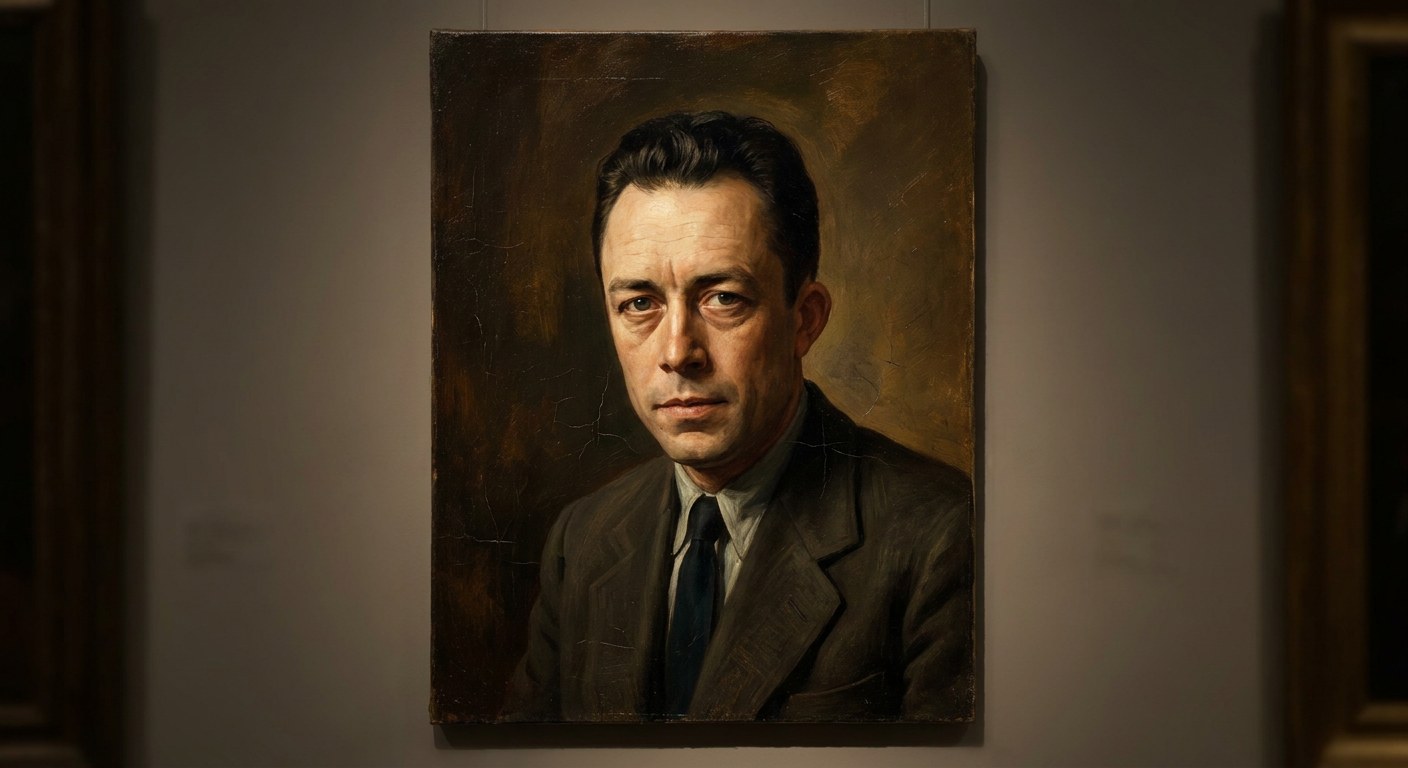
Albert Camus
1913 – 1960 · French · Philosopher & Novelist
Recommended Audiobooks
Listen next from Marcus Alden

Life Lessons from Frederic Chopin
Marcus Alden · 54 min

Life Lessons from John Wesley
Marcus Alden · 52 min
Introduction (why they matter)
Albert Camus was a French novelist, essayist, dramatist, journalist, and moral thinker whose writings confronted one of modern philosophy’s most unsettling questions: how should human beings live when the universe offers no clear, transcendent meaning? Born into poverty in colonial Algeria, Camus rose to become one of the most widely read intellectuals of the twentieth century. His novels The Stranger, The Plague, and The Fall, together with philosophical essays such as The Myth of Sisyphus and The Rebel, made him the foremost literary voice associated with the philosophy of the absurd.
Camus argued that human beings naturally seek order, purpose, and justice, yet encounter a world that remains indifferent to those demands. He called the resulting confrontation “the absurd.” His response was not despair, religious consolation, or nihilism, but lucid resistance: people should live fully, refuse false certainties, and create value through freedom, solidarity, and rebellion against suffering.
Although frequently classified as an existentialist, Camus rejected that label and differed significantly from figures such as Jean-Paul Sartre. His insistence on moral limits also separated him from intellectuals who defended revolutionary violence in pursuit of supposedly inevitable historical goals. A member of the French Resistance and an opponent of both capital punishment and political terror, he sought an ethics that would defend human dignity without excusing murder.
Camus received the 1957 Nobel Prize in Literature at the age of forty-four. He was then one of the youngest recipients in the prize’s history. His sudden death in a 1960 automobile accident ended a career still in full development, but his reflections on alienation, epidemic disease, rebellion, political violence, and personal responsibility remain strikingly relevant.
Quick Facts
| Fact | Details |
|---|---|
| Born | 7 November 1913, Mondovi, French Algeria—now Dréan, Algeria |
| Died | 4 January 1960, near Villeblevin, France |
| Nationality | French; born and raised in colonial Algeria |
| Known For | Philosophy of the absurd, The Stranger, The Plague, The Myth of Sisyphus |
| Occupation | Novelist, essayist, playwright, journalist, editor, and philosopher |
| Era | Twentieth-century continental philosophy and modern literature |
Early Life and Education
Albert Camus was born in Mondovi, a small town in northeastern French Algeria, to a working-class family of European settler background. His father, Lucien Auguste Camus, was an agricultural laborer and wine-cellar worker of French ancestry. His mother, Catherine Hélène Sintès, came from a family of Spanish origin associated with the Balearic island of Minorca. She had limited hearing, spoke little, and earned money as a cleaner.
Soon after the outbreak of the First World War, Lucien Camus joined the French Army. He was wounded during the Battle of the Marne and died in October 1914, when Albert was not yet one year old. Camus therefore grew up without knowing his father, although the human cost of war remained an important presence in his imagination. His mother moved Albert and his older brother, Lucien, into the modest Algiers apartment of their maternal grandmother.
The family lived in the working-class Belcourt district. Their home lacked electricity and running water, and Camus later remembered an atmosphere of material poverty, silence, physical closeness, and Mediterranean sunlight. His childhood gave him a lasting sensitivity to the lives of laborers and the poor. At the same time, Algeria’s beaches, sea, heat, and brilliant landscape nourished his celebration of bodily existence and the immediate world.
A decisive intervention came from his primary-school teacher, Louis Germain. Recognizing Camus’s intelligence, Germain helped him compete for a scholarship that allowed him to continue at the Grand Lycée in Algiers rather than enter manual employment. Camus remained deeply grateful. When he won the Nobel Prize decades later, he wrote to Germain to acknowledge the teacher’s role in his life.
At school Camus played football as a goalkeeper, an experience he later associated with cooperation and responsibility. In 1930, however, he suffered his first serious attack of tuberculosis. The disease repeatedly interrupted his studies and forced him to abandon competitive football. It also prevented him from following a conventional university teaching career and left him acutely aware of physical vulnerability and premature death.
Camus studied philosophy at the University of Algiers, where the philosopher and essayist Jean Grenier became an influential mentor. Grenier introduced him to a wide range of religious and philosophical traditions while encouraging his emerging literary voice. Camus completed a diploma in philosophy in 1936. His thesis examined the relationship between Greek thought and Christianity in the works of Plotinus and Saint Augustine.
His education was never confined to the classroom. He read Friedrich Nietzsche, Fyodor Dostoevsky, André Gide, Søren Kierkegaard, and the classical Greek writers. Yet he remained suspicious of abstract systems that ignored lived experience. Illness, poverty, colonial inequality, sensual pleasure, and the fragile beauty of ordinary life became the foundations of his thought.
Rise to Prominence
During the 1930s, Camus became active in theater, journalism, and left-wing politics. He joined the Algerian Communist Party in 1935, partly because it appeared to offer a means of opposing European fascism and improving conditions for Algeria’s Muslim population. His relationship with the party was short-lived. By 1937 he had been expelled or had otherwise broken with it amid disagreements over policy, political discipline, and the party’s changing approach to Algerian nationalism.
Camus helped organize the Théâtre du Travail, or Workers’ Theatre, which sought to bring socially engaged drama to broad audiences. After its political affiliations became troublesome, it was reorganized as the Théâtre de l’Équipe. Camus acted, directed, adapted plays, and developed ideas about performance that later informed his own dramas, including Caligula and The Misunderstanding.
His first books, The Wrong Side and the Right Side in 1937 and Nuptials in 1939, were collections of lyrical essays. They explored poverty, mortality, landscape, and the intense physical experience of Mediterranean life. Although less famous than his later works, they already contained the central tension of his writing: awareness of death alongside passionate attachment to the world.
As a journalist for Alger Républicain, Camus reported on trials, poverty, and colonial injustice. His 1939 series on famine and destitution in Kabylia documented the severe conditions faced by the region’s Berber population. The articles criticized administrative neglect and exposed the vast inequality between European settlers and Indigenous Algerians. French colonial authorities regarded his journalism with suspicion, and employment opportunities in Algeria narrowed.
Camus moved between Algeria and metropolitan France during the early years of the Second World War. He worked for the newspaper Paris-Soir, spent time in Oran, and eventually returned to occupied France. In 1942 he published both the novel The Stranger and the essay The Myth of Sisyphus. Together they made him an important new literary and philosophical voice.
During the German occupation, Camus joined the clandestine Resistance newspaper Combat. He became one of its principal writers and, after the liberation of Paris, its celebrated editor. His editorials called for justice, political honesty, and a democratic reconstruction of France. Resistance work also gave his reflections on rebellion and responsibility an immediate historical dimension.
Major Achievements and Contributions
Camus’s most important intellectual contribution was his account of the absurd. The absurd was not, for him, simply a property of the universe or a mood of individual despair. It arose from the collision between the human demand for meaning and the world’s silence. Because neither side of this confrontation could be eliminated without distortion, Camus argued that people should live with the tension consciously.
In The Myth of Sisyphus, he used the Greek figure condemned eternally to push a rock uphill as an image of the human condition. Sisyphus’s task has no final purpose, yet Camus imagined him achieving a kind of victory through awareness and defiance. The essay rejects suicide as an escape from absurdity and rejects what Camus called “philosophical suicide”—the leap into an unproven religious or metaphysical certainty. Instead, he advocated revolt, freedom, and passionate engagement with life.
Camus transformed these ideas into fiction rather than presenting them only as formal philosophy. In The Stranger, Meursault’s emotional detachment and refusal to conform expose the assumptions by which society assigns guilt and meaning. In The Plague, a deadly epidemic in Oran becomes both a realistic human crisis and an allegory of occupation, fascism, and recurring evil. Its characters discover that decency consists not in heroic certainty but in doing one’s work and refusing to cooperate with suffering.
His later book The Rebel expanded his inquiry from individual absurdity to collective political action. Camus defended rebellion as a protest made in the name of a shared human dignity: the rebel says that there are limits beyond which oppression cannot be tolerated. Yet rebellion betrays itself when it justifies unlimited killing. Camus therefore criticized both totalitarian government and revolutionary ideologies that sacrificed present human beings to an imagined future.
This position was unpopular in a polarized Cold War intellectual climate. Camus opposed Soviet repression, but he also rejected reactionary anti-communism, colonial torture, and capital punishment. His political independence cost him alliances, yet it became central to his reputation as a thinker of moral limits.
Camus also made major contributions as a journalist and public intellectual. His Combat editorials expressed the hope that journalism could combine factual integrity with moral seriousness. His 1946 essays later collected as Neither Victims nor Executioners argued against a world organized around political murder. In 1957, with Arthur Koestler, he published Reflections on the Guillotine, one of the twentieth century’s most influential literary arguments against capital punishment.
The Swedish Academy awarded Camus the Nobel Prize in Literature in 1957 for illuminating “the problems of the human conscience in our times.” The honor recognized not only his style and storytelling but also his sustained attempt to identify ethical responsibilities in an age marked by world war, occupation, genocide, colonial conflict, and ideological violence.
Key Works / Battles / Ideas
The Stranger
Published in 1942, The Stranger—also translated as The Outsider—is Camus’s best-known novel. Its narrator, Meursault, responds to his mother’s death and later kills an unnamed Arab man on an Algerian beach. The novel’s spare style and emotionally restrained narration challenge conventional expectations about remorse, morality, and social belonging.
The work has generated extensive debate about colonialism because its Arab victim is not given a name or developed identity. Some scholars interpret this erasure as an exposure of colonial society’s blindness; others view it as a limitation that the novel itself does not overcome. Either way, the issue has become essential to modern readings of the book.
The Myth of Sisyphus
This 1942 essay presents Camus’s most systematic discussion of the absurd. Beginning with the question of suicide, it examines whether life is worth living in the absence of ultimate meaning. Camus’s answer is affirmative: lucid revolt allows a person to embrace experience without pretending that existence has a divinely guaranteed purpose.
Caligula and The Misunderstanding
Camus used drama to examine freedom, violence, isolation, and failed communication. In Caligula, the Roman emperor reacts to mortality by pursuing absolute freedom, only to become a murderous tyrant. The Misunderstanding portrays a family tragedy created by alienation, secrecy, and the inability to recognize another human being.
The Plague
Published in 1947, The Plague describes an epidemic that seals off the Algerian city of Oran. Doctor Bernard Rieux and his companions respond through practical solidarity rather than ideological certainty. The plague can represent disease, Nazi occupation, fascism, or any recurring force that reduces people to victims. The novel became newly influential during later epidemics, especially the COVID-19 pandemic.
The Rebel
Published in 1951, The Rebel traces rebellion through literature, philosophy, revolution, and modern politics. Camus distinguishes limited rebellion, grounded in common dignity, from revolutionary nihilism that permits murder in the name of history. The book’s criticism of Marxist-Leninist politics contributed to his public break with Sartre and Sartre’s journal Les Temps modernes.
The Fall
This 1956 novel takes the form of an extended confession by Jean-Baptiste Clamence, a former Parisian lawyer living in Amsterdam. Through his seductive but unreliable voice, Camus examines guilt, hypocrisy, judgment, and the desire for moral superiority. Its irony and psychological complexity make it one of his most accomplished works.
Rebellion, Solidarity, and Measure
Camus’s ethical vocabulary centered on rebellion, solidarity, and measure. Rebellion begins with a refusal of humiliation, but it also recognizes that the dignity being defended is shared by others. “Measure” means accepting limits: no political end, however desirable, gives an unlimited right to kill. This principle guided Camus’s opposition to totalitarianism, terrorism, torture, and execution.
Timeline of Key Events
| Year | Event |
|---|---|
| 1913 | Born on 7 November in Mondovi, French Algeria |
| 1914 | His father dies after being wounded at the Battle of the Marne |
| 1930 | Contracts tuberculosis, disrupting his education and athletic life |
| 1934 | Marries Simone Hié; the marriage ends in divorce in 1936 |
| 1935 | Joins the Algerian Communist Party and begins organizing workers’ theater |
| 1936 | Completes his philosophy diploma at the University of Algiers |
| 1937 | Publishes The Wrong Side and the Right Side and breaks with the Communist Party |
| 1939 | Publishes Nuptials and reports on poverty in Kabylia |
| 1940 | Marries Francine Faure and begins working for Paris-Soir |
| 1942 | Publishes The Stranger and The Myth of Sisyphus |
| 1943–1944 | Becomes active in the Resistance newspaper Combat |
| 1944 | Caligula and The Misunderstanding reach the Paris stage during the liberation era |
| 1945 | Twins Catherine and Jean Camus are born |
| 1947 | Publishes The Plague |
| 1951 | Publishes The Rebel |
| 1952 | Publicly breaks with Jean-Paul Sartre after a dispute over The Rebel |
| 1956 | Publishes The Fall and appeals for a civilian truce in Algeria |
| 1957 | Receives the Nobel Prize in Literature and publishes Exile and the Kingdom |
| 1960 | Dies in an automobile accident near Villeblevin on 4 January |
| 1994 | His unfinished autobiographical novel The First Man is published posthumously |
Personal Life and Character
Camus married Simone Hié in 1934. Their troubled relationship was complicated by her drug dependence and by infidelity on both sides; they separated and divorced in 1936. In 1940 he married Francine Faure, a pianist and mathematician from Oran. Their twins, Catherine and Jean, were born in 1945.
The second marriage endured formally, but Camus had several extramarital relationships. The most significant was with the Spanish-French actress María Casares, whom he met in 1944. Their relationship, interrupted and later renewed, continued until his death. Their surviving correspondence reveals affection, longing, literary companionship, and the emotional complications of Camus’s private life. Francine experienced severe depression, and Camus’s behavior has led biographers to portray his personal relationships as a painful contradiction to his public ethics of responsibility.
Camus could be charming, stylish, sociable, and intensely loyal, but he also guarded his independence. Friends remembered his love of football, theater, swimming, conversation, and the Mediterranean landscape. He disliked being treated as a detached academic philosopher and preferred the identity of artist or writer. His thinking emerged through images, characters, experiences, and moral dilemmas rather than through a tightly constructed philosophical system.
Tuberculosis affected his character and habits throughout adulthood. Periods of illness forced him into isolation and created a persistent sense that time was limited. Yet his writing rarely surrendered to morbidity. He celebrated sunlight, friendship, physical beauty, and ordinary happiness precisely because they were temporary.
Challenges and Controversies
Camus’s relationship to Algeria remains the most difficult and contested part of his legacy. He condemned colonial poverty and injustice earlier and more forcefully than many European settlers. He advocated political reforms, greater equality, and citizenship rights for Muslim Algerians. He also denounced torture by French forces and attacks on civilians by the Algerian National Liberation Front, or FLN.
Nevertheless, he did not support the FLN’s demand for full independence. Camus belonged to the pied-noir community of Europeans born in Algeria, and his mother still lived in Algiers during the war. He hoped for a federal or plural political settlement in which European and Arab communities could coexist. By the mid-1950s, this position had little support among either French colonial hardliners or Algerian nationalists.
In 1956 he traveled to Algiers to appeal for a civilian truce. The proposal asked both sides to spare noncombatants, but extremists disrupted the meeting and the appeal failed. Camus subsequently became more publicly restrained about Algeria, believing that pronouncements from Paris could endanger people on the ground.
At a 1957 press conference in Stockholm, Camus responded to an Algerian student by saying, in a formulation that has been translated and abbreviated in several ways, that he believed in justice but would defend his mother before justice. Often represented as a rejection of justice itself, the remark referred to indiscriminate terrorism that might kill his mother. Even with that context, critics argue that his position gave insufficient recognition to Algerian self-determination and to the structural violence of colonial rule.
Camus’s dispute with Sartre created another major controversy. Sartre’s journal published a hostile review of The Rebel, accusing Camus of philosophical weakness and political moralism. Camus replied angrily, and Sartre responded with a devastating public letter. Behind the personal rupture lay a fundamental disagreement: Sartre and many associates remained willing, at that stage, to align with revolutionary Marxism despite Soviet abuses, whereas Camus insisted that no promised future could excuse present murder.
Camus’s rejection of the existentialist label has also generated confusion. He shared existentialism’s concern with freedom, alienation, death, and a world without predetermined meaning. Yet he rejected the conclusions of thinkers he grouped with existentialism, especially attempts to escape absurdity through religious faith, metaphysical systems, or historical necessity. Calling him an existentialist can therefore be useful as a broad literary classification, but it should not erase his explicit objections.
Death and Immediate Aftermath
On 4 January 1960, Camus was traveling from southern France toward Paris in a Facel Vega driven by his friend and publisher Michel Gallimard. Near the village of Villeblevin, the car left the road and struck a tree. Camus died at the scene at the age of forty-six. Gallimard was gravely injured and died several days later. Gallimard’s wife and daughter survived.
Camus had reportedly considered returning to Paris by train, and an unused railway ticket was found among his possessions. The apparent randomness of the accident seemed bitterly appropriate to commentators familiar with his philosophy of the absurd, although reducing his death to a philosophical symbol risks obscuring the personal tragedy.
In the wreckage was the manuscript of The First Man, an unfinished, strongly autobiographical novel about childhood, family, poverty, education, and colonial Algeria. Camus was buried in Lourmarin, Provence, where he had purchased a home with his Nobel Prize money. His death prompted international mourning and left readers wondering how his thought might have developed in response to Algerian independence and the changing politics of the 1960s.
Legacy and Influence Today
Camus remains one of the rare modern authors read widely in literature, philosophy, political theory, and general education. The clarity of his prose makes difficult questions accessible without making them simple. His fictional characters embody philosophical problems, while his essays combine argument with metaphor and personal experience.
His account of absurdity continues to speak to readers confronting secularization, alienation, repetitive labor, anxiety, and the absence of guaranteed meaning. Camus offers neither easy optimism nor surrender. His central challenge is to live consciously and intensely without appealing to comforting falsehoods.
Political thinkers continue to debate his ethics of limits. His refusal to justify murder in the name of utopia has gained force through historical knowledge of Stalinism, terrorism, genocide, and revolutionary dictatorship. At the same time, postcolonial scholars have exposed the limits of his perspective on Algeria and questioned the marginalization of Arab characters in parts of his fiction. Contemporary assessments therefore often combine admiration for his humanitarian ethics with criticism of his colonial blind spots.
The Plague has repeatedly returned to bestseller lists during public-health crises. Its portrayal of denial, quarantine, exhausted medical workers, separation, misinformation, and collective duty proved especially resonant during the COVID-19 pandemic. Readers recognized Camus’s warning that plague—literal or political—never disappears forever and that vigilance must be renewed.
His influence extends through novelists, playwrights, theologians, psychologists, political dissidents, and philosophers. Writers as different as Kenzaburō Ōe, Susan Sontag, Václav Havel, and contemporary Algerian authors have engaged with his work. Kamel Daoud’s novel The Meursault Investigation, for example, responds directly to the unnamed Arab killed in The Stranger and reimagines the story from an Algerian perspective.
Camus endures because he refused to separate thought from conduct. He asked how a person can oppose injustice without becoming unjust, face death without denying life, and acknowledge meaninglessness without ceasing to love the world. Those questions remain unresolved—and indispensable.
Famous Quotes
“There is but one truly serious philosophical problem, and that is suicide.” — The Myth of Sisyphus
“The absurd is born of this confrontation between the human need and the unreasonable silence of the world.” — The Myth of Sisyphus
“The struggle itself toward the heights is enough to fill a man’s heart. One must imagine Sisyphus happy.” — The Myth of Sisyphus
“I rebel—therefore we exist.” — The Rebel
“Real generosity toward the future lies in giving all to the present.” — The Rebel
“In the midst of winter, I found there was, within me, an invincible summer.” — “Return to Tipasa,” in Summer
“What we learn in time of pestilence: that there are more things to admire in men than to despise.” — The Plague
Translations of Camus’s French vary by edition, so wording may differ slightly among published English versions.
Frequently Asked Questions
Was Albert Camus an existentialist?
Camus is commonly grouped with existentialists because he wrote about freedom, alienation, mortality, and life without predetermined meaning. However, he explicitly rejected the label. He disagreed with both religious existentialists and the historical or political conclusions associated with Sartre’s form of existentialism. “Absurdist” is often a more accurate description, although Camus did not construct a formal school under that name.
What did Camus mean by “the absurd”?
The absurd is the confrontation between the human desire for meaning, order, and explanation and a universe that supplies no definitive answer. Camus did not say simply that life is meaningless. He argued that absurdity exists in the relationship between human longing and the world’s silence.
Why must we imagine Sisyphus happy?
Sisyphus cannot escape his endless task, but he can understand and own his condition. For Camus, lucid awareness prevents the gods—or circumstances—from achieving complete victory over him. His happiness represents defiance, freedom of consciousness, and full engagement with life despite the absence of a final purpose.
What is Albert Camus’s most famous book?
The Stranger is generally his most famous and widely taught novel. The Plague is also internationally celebrated, while The Myth of Sisyphus is his best-known philosophical essay.
Why did Camus and Jean-Paul Sartre fall out?
Their friendship collapsed after the 1951 publication of The Rebel. Sartre’s journal criticized the book, and the resulting exchange became bitter and personal. The dispute reflected deeper disagreements over communism, revolutionary violence, historical necessity, and whether political ends could justify morally unacceptable means.
What was Camus’s position on Algerian independence?
Camus opposed colonial injustice, French torture, and terrorism against civilians, but he did not support the FLN’s program of complete independence. He favored a federal or plural settlement protecting both Arab and European communities. His position satisfied neither side and remains one of the principal criticisms of his political record.
How did Albert Camus die?
Camus died on 4 January 1960 when the automobile in which he was a passenger crashed into a tree near Villeblevin, France. He was forty-six years old. His publisher and friend Michel Gallimard, who was driving, died from his injuries several days later.
Did Camus win the Nobel Prize?
Yes. Camus received the 1957 Nobel Prize in Literature for a body of work that addressed the moral problems of his era. At forty-four, he was then the second-youngest literature laureate after Rudyard Kipling.
Lessons We Can Learn
-
Meaning can be created through action. Even without certainty about life’s ultimate purpose, people can build meaningful lives through work, love, creativity, and responsibility.
-
Resistance must have moral limits. Opposing injustice does not grant permission to reproduce cruelty. Means shape ends, and human beings must not become expendable abstractions.
-
Solidarity is a practical virtue. In a crisis, ordinary competence and cooperation may matter more than grand theories or heroic self-images.
-
Clarity is better than false consolation. Camus encourages people to confront mortality, uncertainty, and suffering honestly while continuing to embrace life.
-
Great thinkers should still be questioned. Camus’s insights into violence and dignity remain valuable, but his limitations regarding colonial Algeria demonstrate why admired writers must also be read critically and historically.
Further Reading
- Olivier Todd, Albert Camus: A Life — A detailed modern biography drawing on extensive archival research and interviews.
- Herbert R. Lottman, Albert Camus: A Biography — A comprehensive account of Camus’s life, journalism, relationships, and political environment.
- Alice Kaplan, Looking for The Stranger: Albert Camus and the Life of a Literary Classic — A study of the experiences, history, and creative process behind Camus’s most famous novel.
- Ronald Aronson, Camus and Sartre: The Story of a Friendship and the Quarrel That Ended It — An accessible examination of their intellectual relationship and political break.
- Robert Zaretsky, A Life Worth Living: Albert Camus and the Quest for Meaning — A thematic exploration of Camus’s ethics, politics, and continuing relevance.
Watch and Learn
PHILOSOPHY - Albert Camus · The School of Life