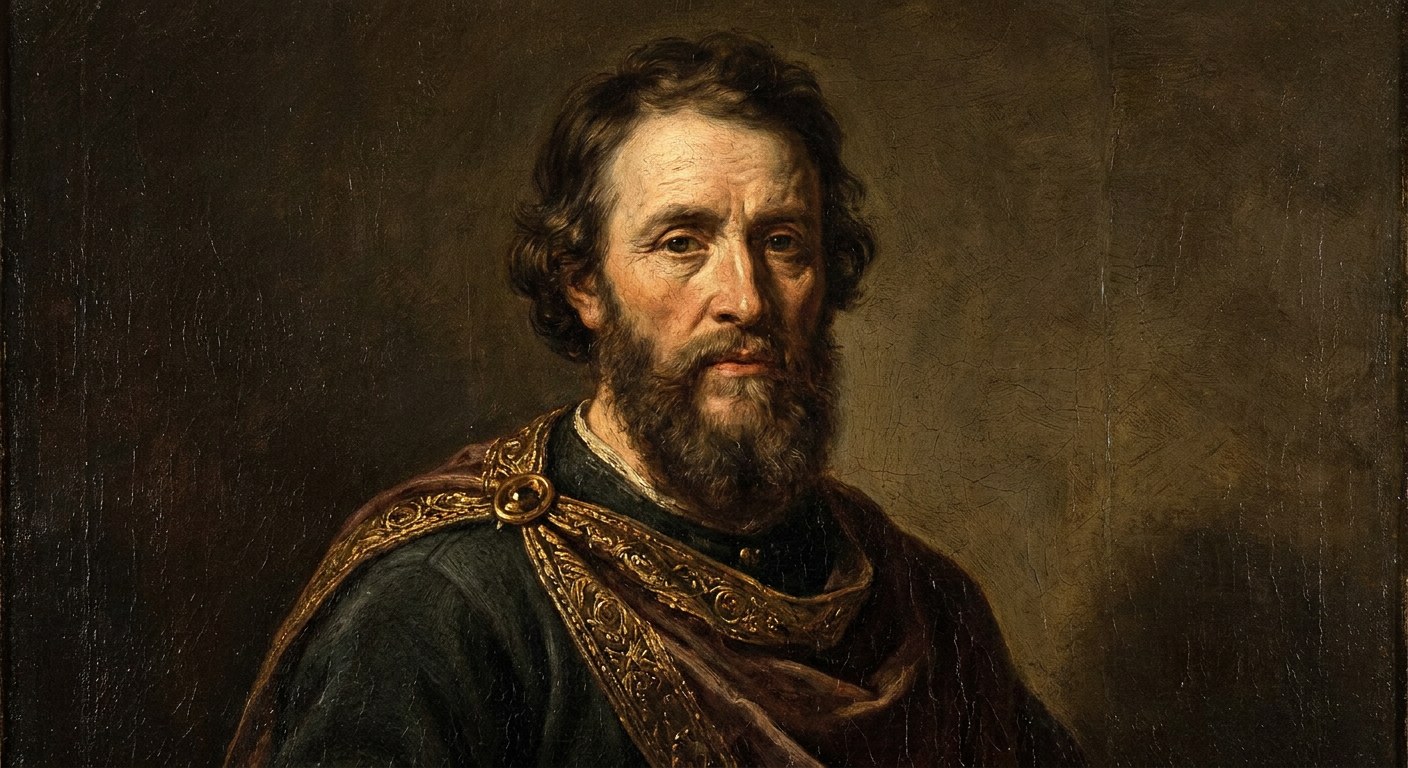
Alfred the Great
849 – 899 · Anglo-Saxon English · King of Wessex
Recommended Audiobooks
Listen next from Marcus Alden

Life Lessons from Frederic Chopin
Marcus Alden · 54 min

Life Lessons from John Wesley
Marcus Alden · 52 min
Introduction
Alfred the Great was king of the West Saxons from 871 to 899 and one of the most influential rulers of early medieval Europe. He is remembered above all for resisting Viking conquest, rebuilding the military defenses of Wessex, promoting education, reforming law and government, and encouraging the use of written English. At a time when Scandinavian armies had destroyed or divided most of the Anglo-Saxon kingdoms, Alfred preserved an independent English realm from which his descendants later created a unified kingdom of England.
Born in 849, Alfred was the youngest son of King Æthelwulf of Wessex. He came to the throne during an acute military crisis. The Viking Great Army had already conquered Northumbria, East Anglia and much of Mercia, while Wessex itself faced repeated invasion. Alfred suffered defeats as well as victories, and in early 878 he was driven into the marshes of Somerset. His recovery, culminating in victory over the Viking leader Guthrum at the Battle of Edington, became the defining episode of his reign.
Alfred’s importance extended far beyond warfare. He created a coordinated system of fortified settlements, reorganized military service, strengthened royal administration and issued an ambitious law code. Concerned by declining literacy, he recruited scholars from England and continental Europe and sponsored the translation of important Latin books into Old English. Several works were traditionally attributed directly to him, although modern historians debate the precise extent of his authorship.
Alfred did not unite all England, nor did he permanently end Scandinavian warfare. Nevertheless, his institutions enabled Wessex to survive and expand under his children and grandchildren. His reputation grew after his death, blending historical achievement with patriotic legend. He remains the only English monarch commonly known as “the Great.”
Quick Facts
| Category | Details |
|---|---|
| Full name | Alfred, Old English Ælfrēd |
| Common title | Alfred the Great |
| Born | 849 |
| Birthplace | Traditionally Wantage, Berkshire, in the Kingdom of Wessex |
| Father | Æthelwulf, king of Wessex |
| Mother | Osburh, daughter of Oslac |
| Dynasty | House of Wessex |
| Reign | 871–899 |
| Predecessor | Æthelred I |
| Successor | Edward the Elder |
| Wife | Ealhswith |
| Principal children | Æthelflæd, Edward, Æthelgifu, Ælfthryth and Æthelweard |
| Principal opponent | Guthrum, Viking king of East Anglia |
| Major battle | Battle of Edington, 878 |
| Capital and royal center | Winchester, although the court traveled throughout the kingdom |
| Religion | Christianity |
| Major works associated with him | Pastoral Care, The Consolation of Philosophy, Soliloquies and the law code known as the Domboc |
| Died | 26 October 899 |
| Place of death | Probably Winchester |
| Burial | Initially Winchester; later reburied at New Minster and then Hyde Abbey |
| Historical significance | Preserved Wessex, reorganized its defenses, promoted learning and laid foundations for the unification of England |
Early Life & Background
Alfred was born in 849, probably at the royal estate of Wantage in what is now Oxfordshire but was then part of Berkshire and the West Saxon kingdom. He was the youngest known son of Æthelwulf, king of Wessex from 839 to 858, and Æthelwulf’s first wife, Osburh. According to Alfred’s biographer Asser, Osburh was the daughter of Oslac, a royal official described as being of Gothic or Jutish ancestry.
Ninth-century Wessex was one of several competing Anglo-Saxon kingdoms. Northumbria dominated the north, Mercia had long exercised power across the Midlands, and East Anglia occupied the east. Wessex controlled much of southern England and had expanded significantly under Alfred’s grandfather, Ecgberht. Yet royal succession remained unstable, and kingship depended upon military ability, noble support and membership in the ruling dynasty.
Alfred had at least four older brothers: Æthelstan, Æthelbald, Æthelberht and Æthelred. Because he was the youngest, his prospects of becoming king initially appeared remote. His childhood nonetheless included experiences that shaped his later outlook. Asser reports that Alfred learned traditional English poems by listening to them and could recite a book of poetry offered as a prize by his mother. The story may have been designed to emphasize his intelligence, but it reflects the importance of oral culture in aristocratic education.
In 853, while still a small child, Alfred was sent to Rome, where Pope Leo IV received him. Later accounts described the pope as anointing Alfred as king, but it is improbable that a younger son was formally designated for the West Saxon throne. The ceremony was more likely a confirmation or investiture with honorary insignia. Alfred returned to Rome in 855 with his father. On their journey home, they stayed at the court of Charles the Bald, king of West Francia, whose daughter Judith subsequently married Æthelwulf.
Æthelwulf’s death in 858 was followed by the successive reigns of Alfred’s brothers. Æthelbald died in 860, Æthelberht in 865 and Æthelred in 871. During these years, Viking attacks developed from coastal raids into large campaigns of conquest. In 865 the so-called Great Heathen Army landed in East Anglia. Its leaders included Ivar the Boneless, Halfdan and, in later campaigns, Guthrum. The army captured York in 866, overthrew Northumbrian rulers, killed King Edmund of East Anglia in 869 and placed much of Mercia under its control.
Alfred married Ealhswith in 868, creating an important connection with Mercian aristocracy. In the same year he accompanied Æthelred on an unsuccessful West Saxon expedition to assist Mercia against Viking forces at Nottingham. By then Alfred held the title secundarius, indicating that he ranked immediately below his brother and was likely recognized as a potential successor.
Rise to Prominence
Alfred first emerged as a major military figure during the Viking invasion of Wessex in 870–871. The Great Army established itself at Reading, where the rivers Thames and Kennet provided strategic access to the West Saxon heartlands. A series of battles followed in rapid succession.
On 31 December 870, West Saxon forces were defeated at Englefield, although a local ealdorman, Æthelwulf of Berkshire, initially won a smaller engagement. At the Battle of Reading on 4 January 871, King Æthelred and Alfred attacked the Viking position but were driven back. Four days later, at the Battle of Ashdown, the West Saxons achieved an important victory.
Asser’s account places Alfred at the center of the action. According to him, Æthelred delayed joining battle because he was attending Mass, leaving Alfred to begin the attack. Alfred’s troops charged uphill against the Viking line and killed one of its kings, Bagsecg, along with several earls. Although the account may exaggerate Alfred’s independent role, Ashdown established his reputation as a commander.
The victory did not end the campaign. The West Saxons were defeated at Basing and again at Meretun, or Marton, in March 871. King Æthelred died shortly afterward, probably from illness or wounds, leaving young sons. In the emergency, the leading men of Wessex accepted Alfred as king rather than placing the kingdom under a child ruler.
Alfred succeeded in April 871, when he was approximately twenty-two years old. Almost immediately, he faced another defeat at Wilton. Wessex then made peace with the Vikings, probably by paying them to leave. The agreement bought time but did not resolve the deeper threat.
For several years the Viking armies focused on Mercia and Northumbria. Alfred used this breathing space to strengthen his position, but renewed conflict began in the mid-870s. In 875 a Viking force entered Wessex, and in 876 Guthrum’s army occupied Wareham in Dorset. Alfred negotiated an agreement, but the Vikings broke it and moved to Exeter. A storm destroyed part of a supporting Viking fleet, and Guthrum eventually withdrew to Mercia in 877.
The decisive crisis came in January 878. Guthrum launched a surprise winter attack on the royal estate at Chippenham, probably during the Christmas season. Alfred escaped with a small following into the Somerset marshes. Much of Wessex submitted, fled or was temporarily paralyzed. For several months, Alfred’s kingdom appeared close to extinction.
Major Achievements
Alfred’s greatest achievement was the survival of Wessex. His victory at Edington in 878 prevented the last independent major Anglo-Saxon kingdom from falling under Viking control. Yet his longer-term significance rests upon the reforms that followed.
Military Reorganization
Alfred reorganized the fyrd, the army raised from landholders and local communities. Rather than calling out the entire force for short campaigns, he appears to have divided military obligations so that one group could serve while another remained at home. This provided greater continuity in defense without abandoning agricultural production.
He also constructed or restored a network of fortified places known as burhs. These included established Roman towns, royal centers and newly fortified sites. Winchester, Wareham, Wallingford, Oxford, Shaftesbury and other settlements became part of a coordinated defensive system.
The later document known as the Burghal Hidage lists thirty-three fortified centers and assigns each a number of hides—the land units responsible for providing men to defend the walls. Although the surviving text dates from after Alfred’s reign, it probably reflects a system developed under Alfred and completed by his successors. The burhs restricted Viking movement, protected markets and populations, and provided bases for counterattack. Many later developed into important English towns.
Alfred also experimented with naval defense. The Anglo-Saxon Chronicle records that in 896 he ordered the construction of large ships intended to counter Viking vessels. These ships were longer and higher than their opponents, though some proved difficult to maneuver in coastal waters. Alfred is sometimes called the “father of the English navy,” but this is an exaggeration: earlier Anglo-Saxon rulers had used fleets, and no permanent modern navy emerged under him. His initiatives were nevertheless an important part of a broader defensive strategy.
Law and Government
Alfred issued a collection of laws commonly called the Domboc, or “Book of Judgments.” Its long introduction drew upon the Ten Commandments, Mosaic law, the Acts of the Apostles and Christian legal principles. Alfred then incorporated laws associated with earlier rulers, including Ine of Wessex, Offa of Mercia and Æthelberht of Kent.
The code did not create a uniform national legal system, but it presented kingship as a moral and judicial responsibility. It addressed compensation, oaths, theft, violence, sanctuary and obligations between lords and dependents. Alfred emphasized continuity with respected predecessors rather than claiming to invent law from nothing.
Royal administration also became more literate and organized. Charters, correspondence and written records supported the king’s dealings with churches and aristocrats. Alfred’s court brought together West Saxon, Mercian, Welsh and continental advisers, widening the intellectual and political reach of his government.
Education and Translation
Alfred believed that Viking destruction and institutional decline had produced a severe educational crisis. In the preface to his Old English version of Gregory the Great’s Pastoral Care, he lamented that few people south of the Humber could translate Latin into English.
His response was a program of educational renewal. Alfred recruited scholars including Asser of St David’s, Grimbald of Saint-Bertin, John the Old Saxon and Plegmund, who became archbishop of Canterbury in 890. He proposed that freeborn boys with the means to study should learn to read English before advancing to Latin.
Works associated with Alfred’s program included translations or adaptations of:
- Gregory the Great’s Pastoral Care
- Boethius’s Consolation of Philosophy
- Augustine’s Soliloquies
- Orosius’s History Against the Pagans
- Bede’s Ecclesiastical History of the English People
The extent of Alfred’s personal authorship remains debated. He probably participated closely in some translations, particularly Pastoral Care, while others were produced by scholars under royal patronage. The translated works were often adapted rather than rendered literally, with explanations and examples suited to an Anglo-Saxon audience.
The compilation of the Anglo-Saxon Chronicle also began around the 890s, probably within Alfred’s intellectual and political environment. Its record of English history helped shape a shared historical identity centered increasingly upon the West Saxon dynasty.
Defining Moments
The Battle of Edington was the turning point of Alfred’s reign. After taking refuge in the Somerset marshes, Alfred established a stronghold at Athelney, an island-like position surrounded by wetlands. From there he conducted raids and maintained contact with loyal supporters.
Around Easter 878, he built a fort at Athelney. In the seventh week after Easter, Alfred summoned forces from Somerset, Wiltshire and Hampshire to meet at Egbert’s Stone, probably near the borders of those shires. The response showed that West Saxon resistance remained viable.
Alfred advanced to Iley Oak and then confronted Guthrum’s army at Edington in Wiltshire, probably in May 878. The West Saxons formed a dense shield wall and defeated the Vikings, pursuing them to their fortified camp. After a siege of approximately two weeks, Guthrum surrendered.
The resulting settlement required Guthrum to leave Wessex and accept baptism. Alfred acted as his godfather at the baptism, held at Aller in Somerset, and Guthrum took the Christian name Æthelstan. Ceremonies and feasting followed at Wedmore. The phrase “Treaty of Wedmore” is commonly used for this settlement, although no contemporary treaty text under that name survives.
A later written agreement, the Treaty of Alfred and Guthrum, established a boundary between their spheres of authority and regulated trade, compensation and relations between English and Danish subjects. The exact date is uncertain, but it was probably concluded in the 880s. Rather than instantly creating a fixed “Danelaw,” the settlement marked a practical division of power that evolved over time.
Another defining moment came in 886, when Alfred occupied London. The city had previously belonged to Mercia but had suffered under Scandinavian pressure. Alfred restored its defenses and entrusted it to his Mercian son-in-law, Ealdorman Æthelred. The Anglo-Saxon Chronicle states that “all the English people who were not under submission to the Danes” accepted Alfred’s lordship. This did not make him king of a united England, but it marked a major expansion of his authority beyond Wessex.
Alfred’s reforms were tested during renewed Viking attacks between 892 and 896. Large armies crossed from the continent and established bases in Kent and elsewhere. The campaigns were difficult and prolonged, but the fortified network, mobile forces and cooperation between Wessex and Mercia prevented decisive Viking success. The invaders eventually dispersed, demonstrating that Alfred’s kingdom was far more resilient than it had been in 878.
Timeline
| Year | Event |
|---|---|
| 849 | Alfred is born, traditionally at Wantage in Berkshire. |
| 853 | He is sent to Rome and received by Pope Leo IV. |
| 855–856 | Alfred accompanies Æthelwulf to Rome and visits the court of Charles the Bald. |
| 858 | Æthelwulf dies; Alfred’s older brothers rule Wessex in succession. |
| 865 | The Viking Great Army arrives in East Anglia. |
| 868 | Alfred marries Ealhswith and campaigns with Æthelred in Mercia. |
| 870 | Viking forces invade Wessex and establish a base at Reading. |
| 4 January 871 | The West Saxons are defeated at the Battle of Reading. |
| 8 January 871 | Alfred helps win the Battle of Ashdown. |
| April 871 | Æthelred dies, and Alfred becomes king of Wessex. |
| May 871 | Alfred is defeated at Wilton and later makes peace with the Vikings. |
| 876 | Guthrum occupies Wareham; negotiations with Alfred fail. |
| 877 | Vikings move to Exeter but withdraw after setbacks. |
| January 878 | Guthrum attacks Chippenham; Alfred retreats into the Somerset marshes. |
| Spring 878 | Alfred establishes a fortified base at Athelney. |
| May 878 | Alfred defeats Guthrum at the Battle of Edington. |
| 878 | Guthrum is baptized at Aller, with Alfred as his sponsor. |
| c. 880s | The Treaty of Alfred and Guthrum defines political and legal relations. |
| 886 | Alfred takes control of London and gains wider English allegiance. |
| c. 890 | Alfred’s educational and translation program expands; Plegmund becomes archbishop of Canterbury. |
| 893 | Asser writes his Life of King Alfred. |
| 892–896 | Wessex and Mercia resist renewed large-scale Viking invasions. |
| 896 | Alfred deploys newly designed ships against Viking forces. |
| 26 October 899 | Alfred dies and is succeeded by Edward the Elder. |
Personal Life
Alfred married Ealhswith in 868. She was the daughter of Æthelred Mucel, an important Mercian nobleman associated with the Gaini, and Eadburh, who was connected to Mercian royalty. The marriage strengthened ties between Wessex and Mercia at a time when cooperation against Viking expansion was increasingly important.
Their known children included:
- Æthelflæd, who married Æthelred, lord of the Mercians, and later ruled Mercia as the “Lady of the Mercians”
- Edward the Elder, Alfred’s successor and a major architect of English unification
- Æthelgifu, who became abbess of Shaftesbury
- Ælfthryth, who married Baldwin II, count of Flanders
- Æthelweard, who received a scholarly education and held a prominent position at court
Alfred appears to have taken considerable interest in his children’s education. Asser states that both sons and daughters were taught to read and study. This was consistent with Alfred’s wider belief that literacy strengthened Christian government.
The king suffered from recurrent illness. Asser describes severe pain that began around the time of Alfred’s marriage and continued intermittently throughout his life. Proposed modern diagnoses have included Crohn’s disease, hemorrhoids and other intestinal conditions, but the evidence is too limited for certainty. The illness may explain Alfred’s intense concern with moderation, bodily discipline and the efficient use of time.
After Alfred’s death, Ealhswith founded or supported the convent known as Nunnaminster in Winchester. She died in 902.
Beliefs & Philosophy
Alfred understood kingship in explicitly Christian terms. A ruler was not merely a war leader but a guardian of justice, learning and the spiritual welfare of his people. His law code connected English legal traditions with biblical history, presenting law as part of a divinely ordered moral system.
Wisdom was central to his political philosophy. Alfred believed that power without knowledge was dangerous and that rulers required educated servants. His translation program was therefore practical as well as cultural: bishops, judges, priests and royal officials needed access to authoritative teachings.
He also valued the English language as a vehicle for serious learning. Latin remained the language of the Church and international scholarship, but Alfred argued that essential books should be made available in the vernacular. His policy did not reject Latin; it sought to create a foundation from which students could progress to it.
The works associated with Alfred repeatedly explore providence, free will, virtue, suffering and the responsibilities of office. His adaptation of Boethius, for example, considers the instability of worldly power and the superiority of wisdom. These themes had direct relevance to a king who had experienced military defeat, exile and recovery.
Alfred’s outlook was neither modern nationalism nor religious toleration in the contemporary sense. His political world was hierarchical, aristocratic and Christian. Yet his effort to connect moral authority, education and effective government was exceptional among ninth-century western rulers.
Challenges & Controversies
Alfred’s later fame can obscure the fragility and violence of his reign. He lost several battles, made payments or settlements with Viking forces, and nearly lost his kingdom in 878. His ultimate success depended not only upon personal leadership but also upon local aristocrats, soldiers, churchmen, Mercian allies and favorable divisions among Scandinavian leaders.
The concept of a sharply defined “Danelaw” created immediately after Edington is also misleading. Scandinavian-controlled territories varied politically and changed over time. Alfred’s treaty with Guthrum created a negotiated frontier, not a permanent ethnic border.
The scale of Alfred’s personal literary contribution remains disputed. Medieval tradition and older scholarship frequently treated him as the direct translator of several major works. Linguistic analysis indicates that different texts were produced by different hands. Alfred may have translated, dictated, revised, discussed or commissioned individual works to varying degrees. His role as organizer and patron is certain even where his authorship is not.
The title “the Great” was not his normal contemporary designation. His reputation as an ideal king developed over centuries, and the epithet became established much later, especially from the sixteenth century onward. Victorian historians and writers transformed him into a symbol of constitutional liberty, naval power and English national unity—ideas that only partially fit the ninth-century evidence.
The famous story that Alfred, while hiding from the Vikings, allowed a peasant woman’s cakes to burn is not found in Asser or the Anglo-Saxon Chronicle. It appeared in later traditions associated with St Neot and became popular because it presented Alfred as a humbled ruler learning attentiveness. It is a legend rather than reliable biography.
Alfred’s burial history has also generated controversy. He was first buried at Winchester and later moved to New Minster. In 1110, his remains and those of his family were transferred to Hyde Abbey. The abbey was dissolved in 1539, and the royal tombs were lost or disturbed. Later excavations have not securely identified Alfred’s remains.
Famous Quotes
The wording of Alfred’s statements varies between modern translations, and the personal authorship of some works remains debated. The following passages are associated with his prefaces or literary program:
“Very often it has come into my mind what wise men there formerly were throughout England, both of sacred and secular orders.”
— Preface to the Old English Pastoral Care
“I wondered extremely that the good and wise men who were formerly throughout England, and had perfectly learned all the books, did not wish to translate them into their own language.”
— Preface to the Old English Pastoral Care
“I then began, among the other various and manifold cares of this kingdom, to translate into English the book which is called in Latin Pastoralis.”
— Preface to the Old English Pastoral Care
“I desired to live worthily as long as I lived, and after my life to leave to the men who should come after me the memory of me in good works.”
— Traditionally associated with Alfred’s rendering of Boethius
These quotations should not be treated as verbatim modern speech. They survive in Old English manuscripts and are presented through later editorial choices and translations.
Legacy & Influence
Alfred’s immediate legacy was dynastic and institutional. His son Edward the Elder and daughter Æthelflæd used burhs, mobile armies and coordinated campaigns to conquer Scandinavian-held territories. Alfred’s grandson Æthelstan became the first ruler to exercise effective kingship over the whole of England after his victory at Brunanburh in 937.
The defensive network Alfred developed altered England’s geography. Burhs became centers of trade, taxation, coin production and administration. They helped transform royal power from an itinerant military lordship into a more organized territorial monarchy.
His educational program gave written English unusual prestige. The translations produced at or around his court preserved classical and Christian ideas while making them accessible to readers without advanced Latin. The Anglo-Saxon Chronicle, continued in different monasteries for generations, became an indispensable source for early English history.
Alfred also established a durable model of royal identity. Later writers portrayed him as a warrior, lawgiver, scholar and Christian shepherd. Medieval chroniclers praised his wisdom; early modern antiquarians celebrated his laws; Victorian authors claimed him as a founder of the navy, jury system and English constitution. Many of these later claims were exaggerated, but they reveal the extraordinary adaptability of his reputation.
Modern historians tend to present a more complex Alfred. He was not the solitary savior of England, and his reforms cannot always be reconstructed with precision. Even so, his reign marked a genuine turning point. Wessex moved from near-collapse to military resilience, political expansion and cultural renewal. Alfred’s combination of strategy, administration and scholarship gave his dynasty the tools with which England was eventually unified.
Interesting Facts
- Alfred’s Old English name, Ælfrēd, roughly means “elf-counsel” or “counseled by elves.”
- He became king only after the deaths of several older brothers.
- His biographer Asser was a Welsh churchman from St David’s and wrote the Life of King Alfred in 893.
- Alfred’s refuge at Athelney was surrounded by the marshes of the Somerset Levels.
- Guthrum, his principal Viking opponent, became a Christian and ruled East Anglia under the baptismal name Æthelstan.
- Alfred sent copies of the translated Pastoral Care to bishops, reportedly accompanied by valuable writing pointers called æstels.
- The jeweled object known as the Alfred Jewel bears the inscription “Alfred ordered me to be made.” It may have been the handle of an æstel.
- Alfred used London’s restoration to strengthen cooperation between Wessex and English Mercia.
- His daughter Æthelflæd became one of the most powerful female rulers in early medieval Britain.
- The story of Alfred burning cakes is legendary and appeared well after his lifetime.
- Alfred’s exact grave is unknown because Hyde Abbey was destroyed after the English Reformation.
- He is the only English king routinely remembered by the epithet “the Great.”
Frequently Asked Questions
Why is Alfred called “the Great”?
Alfred earned his exceptional reputation through a combination of military survival, administrative reform, educational patronage and long-term political influence. He prevented Wessex from being conquered, defeated Guthrum, developed fortified defenses and promoted learning in English. The epithet itself became standard centuries after his death.
Did Alfred the Great unite England?
No. Alfred ruled Wessex and gained authority over parts of southern and western England, including London. Large areas remained under Scandinavian or regional rule. His descendants—especially Edward the Elder, Æthelflæd and Æthelstan—completed much of the political unification he made possible.
Did Alfred defeat the Vikings?
Alfred defeated Guthrum decisively at Edington in 878 and successfully resisted later invasions, but he did not expel all Vikings from England. Scandinavian rulers continued to control East Anglia, Northumbria and other territories. His achievement was containment, recovery and the creation of stronger defenses.
What happened at the Battle of Edington?
In 878 Alfred gathered forces from several West Saxon shires and confronted Guthrum’s army at Edington in Wiltshire. The West Saxons won a shield-wall battle and besieged the Viking camp. Guthrum surrendered, withdrew from Wessex and accepted baptism.
Did Alfred really burn the cakes?
There is no contemporary evidence for the story. It first appears in later medieval tradition and was not recorded by Asser, who knew Alfred personally. The tale became popular as a moral story about humility and concentration.
Was Alfred the founder of the Royal Navy?
Not literally. English rulers used ships before Alfred, and his fleet was not a permanent navy in the modern sense. He did commission new warships and treat maritime defense as an important part of his strategy, so the legend has some historical basis.
Could Alfred read and write?
Alfred was highly interested in books and probably became literate in both English and Latin, although his Latin education developed relatively late. He worked closely with scholars and participated in translation projects. The precise extent of his personal writing is uncertain.
What was Alfred’s most important reform?
His fortified burh system was arguably his most consequential practical reform. Combined with changes to military service, it denied Viking armies easy access to supplies and undefended settlements. His educational program was equally significant for English cultural history.
When and how did Alfred die?
Alfred died on 26 October 899, probably at Winchester. The cause is unknown. He had suffered from a recurrent painful illness for much of his adult life, but no reliable modern diagnosis can be made.
Who succeeded Alfred the Great?
His son Edward the Elder succeeded him. Edward faced a challenge from his cousin Æthelwold but secured the throne and continued the expansion of West Saxon authority.
Lessons from Alfred the Great
- Prepare during periods of peace. Alfred used temporary settlements to strengthen defenses before the next invasion.
- Adapt after defeat. His success came not from avoiding failure but from learning from military reverses.
- Build resilient institutions. Burhs, military rotations and administrative systems mattered more than a single victory.
- Treat education as public infrastructure. Alfred viewed literacy as essential to effective government and religious life.
- Make knowledge accessible. Translating important works into English widened their audience without abandoning advanced scholarship.
- Combine courage with negotiation. Alfred fought when necessary but also used treaties, baptismal sponsorship and political alliances.
- Invest in capable advisers. His court drew talent from Wessex, Mercia, Wales and continental Europe.
- Connect leadership with moral responsibility. Alfred believed that authority required justice, wisdom and service.
- Think beyond immediate survival. His reforms benefited not only his own reign but also the generations that unified England.
- Distinguish history from legend. Alfred’s genuine achievements are impressive without relying on stories such as the burning of the cakes.
Further Reading
- Asser, Life of King Alfred, translated by Simon Keynes and Michael Lapidge.
- Simon Keynes and Michael Lapidge, Alfred the Great: Asser’s Life of King Alfred and Other Contemporary Sources.
- Richard Abels, Alfred the Great: War, Kingship and Culture in Anglo-Saxon England.
- David Sturdy, Alfred the Great.
- Barbara Yorke, Wessex in the Early Middle Ages.
- Ryan Lavelle, Alfred’s Wars: Sources and Interpretations of Anglo-Saxon Warfare in the Viking Age.
- Janet Bately, studies of Alfredian translation and the Old English Orosius.
- The Anglo-Saxon Chronicle, especially the entries for 871–899.
- Patrick Wormald, The Making of English Law: King Alfred to the Twelfth Century.
- John Blair, The Anglo-Saxon Age: A Very Short Introduction.