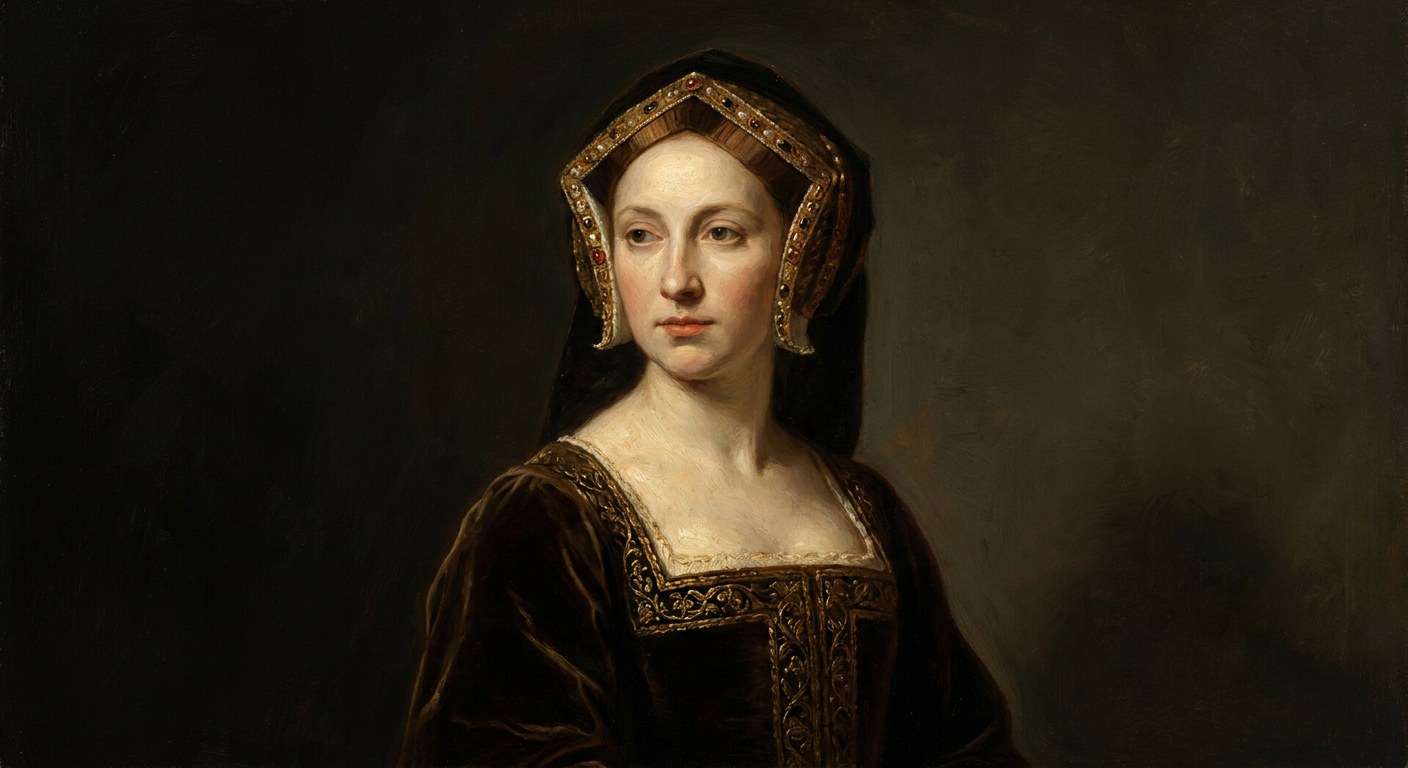
Anne Boleyn
1501 – 1536 · English · Queen Consort of England
Recommended Audiobooks
Listen next from Marcus Alden

Life Lessons from Frederic Chopin
Marcus Alden · 54 min

Life Lessons from John Wesley
Marcus Alden · 52 min
Introduction
Anne Boleyn was queen consort of England from 1533 to 1536 and the second wife of King Henry VIII. Few figures in Tudor history have inspired such intense fascination or such sharply divided interpretations. To admirers, she was intelligent, charismatic and reform-minded—a woman who helped transform England’s religious and political landscape. To her enemies, she was an ambitious interloper whose rise displaced Catherine of Aragon and disrupted the kingdom. Her dramatic fall, culminating in her execution at the Tower of London on 19 May 1536, made her one of the most famous victims of the Tudor court.
Anne’s importance extends far beyond the circumstances of her death. Henry VIII’s determination to marry her contributed directly to England’s break with papal authority. Although Anne did not single-handedly cause the English Reformation, she supported evangelical scholars, promoted reformist clergy and encouraged access to religious texts in English. She was also the mother of Elizabeth I, whose long reign became one of the defining periods of English history.
Much about Anne remains uncertain. Her birth year is disputed, many surviving descriptions were written by hostile observers, and several sayings and stories attributed to her appeared only after her death. A responsible biography must therefore distinguish between contemporary evidence, informed interpretation and later legend. What emerges is neither a flawless heroine nor a simple villain, but a politically active, highly educated and unusually consequential Tudor queen.
Quick Facts
| Category | Details |
|---|---|
| Full name | Anne Boleyn |
| Born | Probably c. 1501; possibly as late as c. 1507 |
| Probable birthplace | Blickling Hall, Norfolk, England; Hever Castle in Kent is another traditional claim |
| Parents | Thomas Boleyn, later Earl of Wiltshire and Ormond, and Elizabeth Howard |
| Siblings | Mary Boleyn and George Boleyn |
| Education | Household of Margaret of Austria in the Low Countries; later the French royal court |
| Spouse | Henry VIII of England |
| Marriage | Secret ceremony traditionally dated 25 January 1533 |
| Title | Queen consort of England |
| Reign as queen | 28 May 1533–17 May 1536 |
| Coronation | 1 June 1533, Westminster Abbey |
| Child | Elizabeth I of England |
| Religious outlook | Catholic in formal identity, but strongly sympathetic to evangelical reform |
| Arrested | 2 May 1536 |
| Tried | 15 May 1536 |
| Executed | 19 May 1536, Tower Green, Tower of London |
| Burial place | Chapel Royal of St Peter ad Vincula, Tower of London |
| Historical significance | Central figure in Henry VIII’s break with Rome and mother of Elizabeth I |
Early Life & Background
Anne was born into the Boleyn family, an ambitious and increasingly influential household with roots in trade, landownership and royal service. Her father, Thomas Boleyn, was a capable diplomat and courtier who served Henry VII and Henry VIII. Through Anne’s mother, Elizabeth Howard, the family was connected to the powerful Howard dynasty. Elizabeth was the daughter of Thomas Howard, 2nd Duke of Norfolk, one of the foremost nobles in England.
Anne’s exact birth date is unknown. Traditionally, historians often placed it around 1507, but many modern scholars favor approximately 1501. Evidence for the earlier date includes a French-language letter Anne wrote to her father in 1514, which appears sufficiently accomplished to suggest that she was already an adolescent. The debate remains unresolved because no baptismal record has survived.
Her probable birthplace was Blickling Hall in Norfolk, though she spent much of her childhood at Hever Castle in Kent. The later Boleyn residence visible at Blickling today dates largely from the 17th century, but an earlier manor house stood on the site.
Thomas Boleyn’s diplomatic career gave Anne opportunities rare even among noble English girls. Around 1513, she entered the household of Margaret of Austria, regent of the Netherlands, at Mechelen. Margaret’s court was celebrated for its education, music, art and sophisticated political culture. Anne studied French, courtly manners, dancing, music, needlework and other accomplishments expected of an elite woman.
Margaret wrote approvingly of Anne’s intelligence and pleasing manner. Anne’s surviving 1514 letter to her father, written in imperfect but ambitious French, demonstrates both her education and the international world in which she was being trained.
Anne subsequently went to France, initially in connection with Henry VIII’s sister Mary Tudor, who married King Louis XII in 1514. After Louis’s death, Anne remained in France, probably serving Queen Claude, wife of Francis I. She may also have encountered the intellectual circle of Marguerite of Angoulême, Francis’s sister and a patron of religious reform, although the precise extent of that influence is uncertain.
Years at the French court shaped Anne’s tastes and public style. She became fluent in French and acquired an appreciation for French clothing, poetry, music, devotional literature and refined conversation. Contrary to some later portrayals, she was not considered a conventional great beauty by every observer. Her appeal appears to have rested more on her dark eyes, confidence, wit, elegance and ability to command attention.
Anne returned to England late in 1521 or early in 1522 because her family hoped to arrange a marriage between her and James Butler, an Irish cousin. The proposed union was intended to resolve competing claims to the earldom of Ormond. The marriage never took place.
Rise to Prominence
Anne made a recorded court appearance on 4 March 1522 in the pageant The Château Vert, where she played Perseverance alongside Mary Tudor, Duchess of Suffolk, and other court ladies. She later entered the household of Catherine of Aragon, Henry VIII’s first wife.
At court Anne developed a relationship with Henry Percy, heir to the Earl of Northumberland. The two may have entered into a private commitment to marry. Cardinal Thomas Wolsey intervened, probably because Percy’s family had already planned a more advantageous marriage for him. Anne’s later hostility toward Wolsey may have been partly influenced by this episode, although political and religious considerations also mattered.
Sometime around 1526, Henry VIII became deeply attracted to Anne. His surviving letters reveal his emotional and physical pursuit. Anne appears initially to have resisted becoming his mistress. Her sister Mary Boleyn had previously had a sexual relationship with the king, and Anne may have understood the limited security available to a royal favorite without marriage.
By this time Henry had become increasingly preoccupied with the absence of a surviving legitimate son. Catherine of Aragon had given birth to several children, but only Princess Mary survived infancy. Henry came to believe that his marriage was invalid because Catherine had previously been married to his elder brother, Arthur. He cited a biblical prohibition in Leviticus against marrying a brother’s widow, despite the papal dispensation that had permitted the marriage.
Henry sought an annulment, beginning what became known as the “King’s Great Matter.” Anne did not create all the underlying causes of this crisis, but the prospect of marrying her gave Henry’s campaign urgency. Pope Clement VII, constrained by theology, law and European politics—especially the power of Catherine’s nephew, Emperor Charles V—did not grant the desired annulment.
Anne’s position gradually became political as well as romantic. She received gifts, property and influence, maintained her own circle, and participated in court patronage. In September 1532 Henry made her Marquess of Pembroke in her own right, an exceptional grant for a woman. The title gave her high rank before the couple traveled to Calais to meet Francis I of France.
By late 1532 Anne and Henry were probably sexually involved. Anne became pregnant, making a rapid marriage essential. They underwent a secret ceremony, traditionally dated 25 January 1533. On 23 May, Archbishop Thomas Cranmer declared Henry’s marriage to Catherine invalid; on 28 May he pronounced the marriage to Anne valid.
Major Achievements
Anne’s most consequential political role was her association with the English break from Rome. The process had many architects, including Henry VIII, Thomas Cromwell, Thomas Cranmer and reformist scholars. Nevertheless, Anne served as an important source of patronage and encouragement.
She introduced or supported religious and political works that strengthened the case for royal authority over the English Church. Among the texts associated with her circle was William Tyndale’s The Obedience of a Christian Man, which argued that kings exercised authority under God rather than through the pope. Anne reportedly drew Henry’s attention to the book, though accounts of the episode vary.
She also promoted evangelical clergy and scholars. Men linked to her patronage included Thomas Cranmer, Hugh Latimer, Nicholas Shaxton, William Barlow and Matthew Parker. Parker later became Elizabeth I’s first Archbishop of Canterbury. Anne’s chaplain William Latymer described her as supporting education, charity and the circulation of scripture.
Her household possessed religious books in French and English, including illuminated devotional manuscripts. She favored vernacular religious instruction and criticism of clerical corruption. Yet it would be misleading to call her a Protestant in the later, fully developed sense. The English Reformation was still taking shape, and Anne retained traditional Catholic practices alongside reformist sympathies.
As queen, Anne exercised patronage—one of the principal forms of female political power in the 16th century. She sought offices and appointments for allies, distributed charity, interceded in petitions and maintained a substantial royal household. Contemporary records indicate charitable giving to poor households, women in need and educational causes, although later claims about the scale of her generosity may be exaggerated.
Her most enduring achievement was dynastic: the birth of Elizabeth on 7 September 1533 at Greenwich Palace. Elizabeth did not provide the male heir Henry expected, but she eventually became one of England’s most significant monarchs. Anne supervised aspects of her daughter’s early household and remained concerned with Elizabeth’s status and presentation.
Anne’s queenship also demonstrated how a woman without a foreign crown or the highest hereditary title could rise through education, personal magnetism, family networks and royal favor. Her ascent was extraordinary, even within the volatile world of Tudor politics.
Defining Moments
Anne’s coronation was staged with exceptional splendor. On 29 May 1533 she traveled by river from Greenwich to the Tower of London. A grand procession through London followed on 31 May, and she was crowned at Westminster Abbey on 1 June. She was visibly pregnant, and the ceremonies asserted the legitimacy of both her marriage and her unborn child.
The birth of Elizabeth three months later was celebrated, but it was also a political disappointment. Official documents had anticipated the birth of a prince and were hastily amended. Anne’s position remained secure in the immediate aftermath, since a healthy daughter showed that she could conceive, but the pressure to produce a son intensified.
In 1534 Parliament passed the first Act of Succession, recognizing the children of Henry and Anne as heirs and requiring subjects to swear an oath accepting the new succession. The same year, the Act of Supremacy declared Henry “Supreme Head” of the Church of England. Opposition carried grave risks. Sir Thomas More and John Fisher were executed in 1535 after refusing to accept the royal supremacy in the required form.
Anne’s precise view of these executions is difficult to reconstruct. She benefited politically from the new order, but claims that she personally demanded the deaths of More and Fisher rely heavily on hostile or partisan testimony.
Her relationship with Thomas Cromwell, once an important ally in securing the break with Rome, deteriorated by 1536. Possible sources of conflict included foreign policy, control of monastic wealth and competing patronage networks. Anne may have wanted some ecclesiastical revenues directed toward education and charitable reform, while Cromwell pursued policies that strengthened the Crown. Historians disagree about how decisive this conflict was in her downfall.
In January 1536 Catherine of Aragon died. Later that month Anne suffered a miscarriage, reportedly of a male fetus, on the day of Catherine’s funeral, 29 January. The details come largely from the imperial ambassador Eustace Chapuys, a hostile observer, and must be treated cautiously. Even so, the pregnancy loss was a major setback.
Henry had already shown interest in Jane Seymour, one of Anne’s attendants. By spring 1536, Anne’s political position had become dangerously unstable. Henry’s desire for a son, his attraction to Jane, factional conflict and Cromwell’s political maneuvering converged with devastating speed.
In late April, investigations began into alleged sexual misconduct by the queen. Mark Smeaton, a court musician, was arrested and confessed to adultery with Anne, probably under intense pressure; whether he was tortured is uncertain. Sir Henry Norris, Sir Francis Weston, Sir William Brereton and Anne’s brother George Boleyn, Viscount Rochford, were also accused.
Anne was arrested on 2 May 1536 after watching a tennis match at Greenwich and was taken to the Tower. She was charged with adultery, incest with her brother and conspiracy to cause the king’s death. Many alleged offenses were assigned to dates or places that appear inconsistent with known court movements. Most modern historians regard the charges as fabricated or unsupported.
The accused men were tried on 12 May; Anne and George were tried separately before panels of peers on 15 May. Anne defended herself effectively, but acquittal was politically impossible. Her uncle, the Duke of Norfolk, presided as lord high steward and pronounced the sentence.
On 17 May Cranmer declared Anne’s marriage to Henry invalid, probably on grounds connected with Henry’s earlier relationship with Mary Boleyn or an alleged precontract. This created a glaring contradiction: Anne was condemned for adultery against a husband whose marriage to her was then declared invalid.
George Boleyn and the other accused men were executed on Tower Hill on 17 May. Anne’s execution, originally expected the following day, was delayed. On the morning of 19 May she was beheaded on a scaffold within the Tower by a swordsman brought from Calais. She was about 29 to 35 years old.
Timeline
| Year | Event |
|---|---|
| c. 1501 | Probable year of Anne Boleyn’s birth; some historians favor c. 1507 |
| c. 1513 | Enters the household of Margaret of Austria at Mechelen |
| 1514 | Writes a surviving French letter to her father |
| 1514–1521 | Lives at the French court, principally in the household of Queen Claude |
| 1521–1522 | Returns to England |
| 4 March 1522 | Appears in the court pageant The Château Vert |
| c. 1523 | Relationship with Henry Percy is ended before marriage |
| c. 1526 | Henry VIII begins actively pursuing Anne |
| 1527 | Henry’s formal efforts to annul his marriage to Catherine intensify |
| 1529 | Cardinal Wolsey falls from power after failing to secure the annulment |
| 1 September 1532 | Anne is created Marquess of Pembroke |
| October 1532 | Accompanies Henry to Calais for a meeting with Francis I |
| 25 January 1533 | Traditional date of Anne and Henry’s secret marriage |
| 23 May 1533 | Cranmer declares Henry’s marriage to Catherine invalid |
| 28 May 1533 | Cranmer declares Henry’s marriage to Anne valid |
| 1 June 1533 | Anne is crowned at Westminster Abbey |
| 7 September 1533 | Gives birth to the future Elizabeth I |
| 1534 | First Act of Succession recognizes Anne’s children as heirs |
| 1534 | Act of Supremacy confirms Henry as head of the Church of England |
| 1534–1535 | Anne supports reformist clergy, scholarship and religious literature |
| 29 January 1536 | Anne suffers a miscarriage, reportedly of a male fetus |
| 2 May 1536 | Arrested and taken to the Tower of London |
| 12 May 1536 | Four accused courtiers are convicted of adultery with the queen |
| 15 May 1536 | Anne and George Boleyn are tried and convicted |
| 17 May 1536 | Anne’s marriage is annulled; the accused men are executed |
| 19 May 1536 | Anne is executed on Tower Green |
| 21 May 1536 | Henry VIII becomes formally betrothed to Jane Seymour |
| 30 May 1536 | Henry marries Jane Seymour |
| 1558 | Anne’s daughter Elizabeth becomes queen |
| 1876 | Remains believed to be Anne’s are examined during restoration of St Peter ad Vincula |
Personal Life
Anne’s family relationships were central to her court identity. Her father benefited greatly from her rise, receiving titles and diplomatic prominence. Her brother George was educated, accomplished and associated with reformist interests. He and Anne appear to have shared intellectual and political sympathies. The charge that they committed incest is considered implausible by most historians.
Anne’s relationship with her sister Mary is less clear. Mary had served in France and later became Henry VIII’s mistress. Popular retellings often present the sisters as intense rivals, but the evidence is limited. In 1534 Mary secretly married William Stafford, a man of lower rank. Anne disapproved and Mary was excluded from court, although Anne later sent her money.
Anne’s marriage to Henry began after years of courtship, but its emotional character changed rapidly under dynastic pressure. Henry’s letters from the 1520s show longing and frustration, while Anne’s letters have not survived in comparable numbers. Once queen, she was expected to remain politically gracious, sexually faithful, fertile and capable of managing both royal favor and court factions.
She had a sharp temper and could speak forcefully, qualities that attracted greater criticism in a queen than they might have in a male courtier. Reports of quarrels must be weighed carefully because many were transmitted by Chapuys, who represented Catherine of Aragon’s nephew and refused for years to acknowledge Anne as queen.
Anne was deeply involved in material and artistic culture. She commissioned jewelry, clothing and manuscripts and used personal emblems such as the crowned falcon. The famous “B” necklace seen in later portraits may reflect Tudor-style jewelry, although no securely identified contemporary portrait painted from life survives.
Beliefs & Philosophy
Anne’s religious convictions combined traditional devotion with reformist ideas. She attended Mass, valued sacred objects and participated in established royal ceremonies, yet she also supported greater access to scripture and religious works in the vernacular.
Her books included French evangelical literature and English religious texts. A surviving copy of William Tyndale’s English translation of the New Testament has sometimes been linked to her, though ownership claims surrounding particular volumes require caution. Her circle promoted preaching, education and the reform of clerical abuses.
Anne appears to have believed that monarchy had a divinely sanctioned responsibility to direct religious reform. Her patronage of Cranmer, Latimer and Parker had consequences extending into later reigns. She was not an advocate of modern religious liberty: like most 16th-century political actors, she lived within a culture that assumed religious unity was essential to social order.
Her worldview was also shaped by lineage and dynastic obligation. Producing an heir was not merely personal; it was regarded as a sacred and political duty. Her inability to provide a surviving son became inseparable from the judgment of her marriage and queenship.
Challenges & Controversies
Anne faced entrenched hostility from supporters of Catherine of Aragon and Princess Mary. Many English subjects regarded Catherine as the rightful queen and Anne as the cause of her displacement. Anne was insulted in public, attacked in anonymous writings and blamed for policies actually directed by Henry and his ministers.
Her image was further damaged by hostile foreign diplomacy. Chapuys usually referred to her as “the concubine” and recorded rumors that reinforced the imperial position. His dispatches are indispensable sources, but they are not impartial.
Later Catholic writers portrayed Anne as immoral, heretical and physically deformed. Nicholas Sander, writing decades after her death, claimed that she had an extra finger, a projecting tooth and other abnormalities. There is no reliable contemporary evidence for these stories. They were part of a polemical tradition intended to discredit Anne and, by extension, Elizabeth I.
The allegations that ended her life remain the greatest controversy. Some earlier historians entertained the possibility of limited misconduct, but the broad modern consensus is that the prosecution was politically engineered. The speed of the investigation, doubtful chronology, absence of credible evidence and predetermined character of the trials all support that conclusion.
Responsibility for the plot is debated. Some historians emphasize Cromwell, who later claimed that he had planned the affair. Others stress that no minister would have acted without Henry’s authorization. Henry’s wish to marry Jane Seymour and secure a male heir was ultimately decisive, even if Cromwell organized the legal machinery.
Anne’s own political behavior also invites debate. She could be vindictive, and she participated in a court culture of patronage, exclusion and factional competition. Yet the tendency to attribute Henry’s harsh policies to her while minimizing his agency reflects both contemporary misogyny and later storytelling.
Famous Quotes
No lengthy speech or remark attributed to Anne can always be accepted as a precise transcript. Tudor reports were often reconstructed from memory, translated or shaped for political purposes.
“The King has been very good to me; he promoted me from a maid to be a marchioness. Then he raised me to be a queen. Now he will raise me to be a martyr.”
This remark was reported in connection with Anne’s imprisonment, but its exact wording and authenticity are uncertain.
“I am come hither to die, and thus to humble myself to the will of the King, my lord.”
This comes from versions of Anne’s execution speech. Witnesses agreed that she spoke cautiously, praised the king and did not publicly challenge her sentence—probably to protect her daughter and family.
“To Jesus Christ I commend my soul; Lord Jesu, receive my soul.”
These final devotional words are reported in contemporary or near-contemporary accounts of her execution and are consistent with customary Christian prayers at death.
“O Death, rock me asleep, bring me on quiet rest.”
The poem O Death, Rock Me Asleep has long been attributed to Anne, supposedly written in the Tower, but the attribution is not secure.
The celebrated letter beginning “Your Grace’s displeasure and my imprisonment are things so strange unto me” is likewise disputed. Although often presented as Anne’s last letter to Henry, many scholars doubt that she wrote it.
Legacy & Influence
Anne’s immediate enemies attempted to erase her legitimacy. Her marriage was annulled, her daughter was declared illegitimate, and her heraldic symbols were removed from royal buildings. Yet complete erasure proved impossible.
When Elizabeth I succeeded to the throne on 17 November 1558, Anne became the mother of a reigning queen. Elizabeth rarely invoked her mother publicly, perhaps because Anne’s condemnation remained politically sensitive. Nevertheless, she favored some Boleyn relatives and reportedly possessed a ring containing miniature portraits believed to represent herself and Anne.
Anne’s influence on religious history is substantial but should not be overstated. She did not design the English Reformation, and Henry’s break with Rome initially preserved many Catholic doctrines. Still, her patronage helped reform-minded figures gain prominence, and her marriage was the immediate dynastic catalyst for the jurisdictional revolution of the 1530s.
Her reputation has repeatedly changed. Protestant writers under Elizabeth treated her as a virtuous reformer and providential mother. Catholic polemicists cast her as a seductress and heretic. Victorian historians often moralized her story, while 20th- and 21st-century scholars have examined gender, law, queenship, political culture and the reliability of diplomatic sources.
Anne remains prominent in novels, theater, opera, film and television. These portrayals range from calculating schemer to feminist icon and tragic romantic heroine. Each image captures part of her cultural afterlife, but none fully replaces the complex historical woman.
Her life exposes the opportunities and dangers of Tudor queenship. Anne reached extraordinary power, influenced appointments and religious policy, and became the center of a royal revolution. Yet her authority rested on Henry’s favor and her ability to produce a male heir. Once both failed, legal institutions were manipulated to destroy her.
Interesting Facts
- Anne was the first Englishwoman to hold the title Marquess of Pembroke in her own right.
- Her education in the Low Countries and France was unusually international for an English court woman.
- Henry VIII’s surviving love letters to Anne are now held in the Vatican Library, though how they reached Rome is uncertain.
- No portrait of Anne can be identified with absolute certainty as a surviving image painted directly from life.
- Her personal badge was a crowned white falcon standing on a tree stump from which roses bloomed.
- Anne’s coronation took place nearly three months before Elizabeth’s birth, making her pregnancy publicly visible.
- The sword used for her execution was considered a cleaner and more prestigious instrument than the traditional English axe.
- Henry hired an expert swordsman from Calais before Anne’s trial had formally concluded, suggesting that her fate had already been anticipated.
- Anne was buried in an unmarked grave in the Chapel Royal of St Peter ad Vincula.
- The familiar claim that she had six fingers derives from much later hostile writing and lacks credible contemporary support.
- A small initial “A” and falcon emblem associated with Anne survived among decorative remains at Hampton Court Palace despite efforts to remove her symbols.
- Her daughter Elizabeth was two years and eight months old when Anne died.
- Jane Seymour had served in the households of both Catherine of Aragon and Anne Boleyn.
- Anne’s motto at the time of her coronation was The Most Happy.
- The date 19 May has become a major focus of modern historical commemoration at the Tower of London.
Frequently Asked Questions
When was Anne Boleyn born?
Her birth date is not securely documented. Many modern historians favor approximately 1501, while others argue for around 1507. Blickling in Norfolk is the most commonly accepted birthplace, although Hever Castle has also been proposed.
Was Anne Boleyn really guilty of adultery?
There is no convincing evidence that she committed adultery, incest or treason. The charges contained chronological and logistical problems, and the trials took place in a political environment where conviction was effectively predetermined. Most historians consider her innocent of the offenses for which she was executed.
Why did Henry VIII marry Anne Boleyn?
Henry was personally infatuated with Anne, wanted a legitimate male heir and believed—or persuaded himself—that his marriage to Catherine of Aragon was invalid. Anne’s refusal to remain merely his mistress made marriage central to their relationship.
Did Anne Boleyn cause the English Reformation?
Not by herself. The Reformation resulted from theology, politics, royal power, anticlerical sentiment and continental religious change. Anne encouraged reformist ideas and patronized important clergy, while Henry’s desire to marry her accelerated the break with papal jurisdiction.
How many children did Anne Boleyn have?
She had one child who survived birth: Elizabeth, born on 7 September 1533. Anne experienced later unsuccessful pregnancies, including a miscarriage in January 1536. The exact number and dates of all her pregnancies remain disputed.
Why was Anne Boleyn executed?
Her execution resulted from a combination of dynastic failure, Henry’s desire to marry Jane Seymour, political faction and a prosecution organized around allegations of sexual treason. The formal charges were adultery, incest and imagining the king’s death.
Was Anne Boleyn Protestant?
The label is imprecise for the 1530s. Anne remained within a Catholic sacramental world but supported evangelical reform, vernacular scripture, reformist preaching and criticism of clerical abuses. She is best described as a reform-minded or evangelical Catholic.
Did Anne Boleyn have six fingers?
Almost certainly not. The story emerged in hostile accounts written decades after her death. No trustworthy contemporary observer recorded such a deformity.
What happened to Elizabeth after Anne’s death?
Elizabeth was declared illegitimate and removed from the succession under the Second Succession Act. She retained a royal household and was later restored to the line of succession by Henry’s will and the Third Succession Act of 1543–1544. She became queen in 1558.
Where is Anne Boleyn buried?
She is buried in the Chapel Royal of St Peter ad Vincula inside the Tower of London. Her grave was not originally marked, but a memorial tile now identifies her burial place.
Lessons from Anne Boleyn
- Political influence can be powerful yet fragile. Anne exercised significant patronage, but her position depended heavily on royal favor.
- Historical sources must be read critically. Many descriptions of her came from enemies, foreign diplomats or later polemicists.
- Gender shapes reputation. Traits praised as strength in men were often condemned as arrogance or aggression in Anne.
- Institutional change rarely has a single cause. Anne helped accelerate England’s break with Rome, but she was one participant in a much larger transformation.
- Education can create unexpected opportunities. Her international upbringing gave her cultural fluency and confidence that distinguished her at court.
- Propaganda can outlive its creators. Stories about physical deformity, witchcraft and sexual corruption persisted for centuries despite weak evidence.
- Legal procedures do not always ensure justice. Anne’s trial shows how courts can be manipulated when political power determines the desired outcome.
- Legacy may differ radically from immediate reputation. Condemned and erased in 1536, Anne became the mother of one of England’s greatest-known monarchs.
- Complex figures resist simple labels. Anne was neither merely a victim nor merely an ambitious schemer; she was an active political figure operating within severe constraints.
Further Reading
- Eric Ives, The Life and Death of Anne Boleyn: “The Most Happy”
- G. W. Bernard, Anne Boleyn: Fatal Attractions
- Retha M. Warnicke, The Rise and Fall of Anne Boleyn: Family Politics at the Court of Henry VIII
- Diarmaid MacCulloch, Thomas Cromwell: A Revolutionary Life
- Susan Bordo, The Creation of Anne Boleyn
- Claire Ridgway, The Fall of Anne Boleyn: A Countdown
- Alison Weir, The Lady in the Tower: The Fall of Anne Boleyn
- David Starkey, Six Wives: The Queens of Henry VIII
- John Guy, Tudor England
- Eustace Chapuys, diplomatic correspondence in Letters and Papers, Foreign and Domestic, Henry VIII
- The National Archives, resources on Henry VIII, royal supremacy and the Tudor succession
- Historic Royal Palaces, research materials on Anne Boleyn and the Tower of London