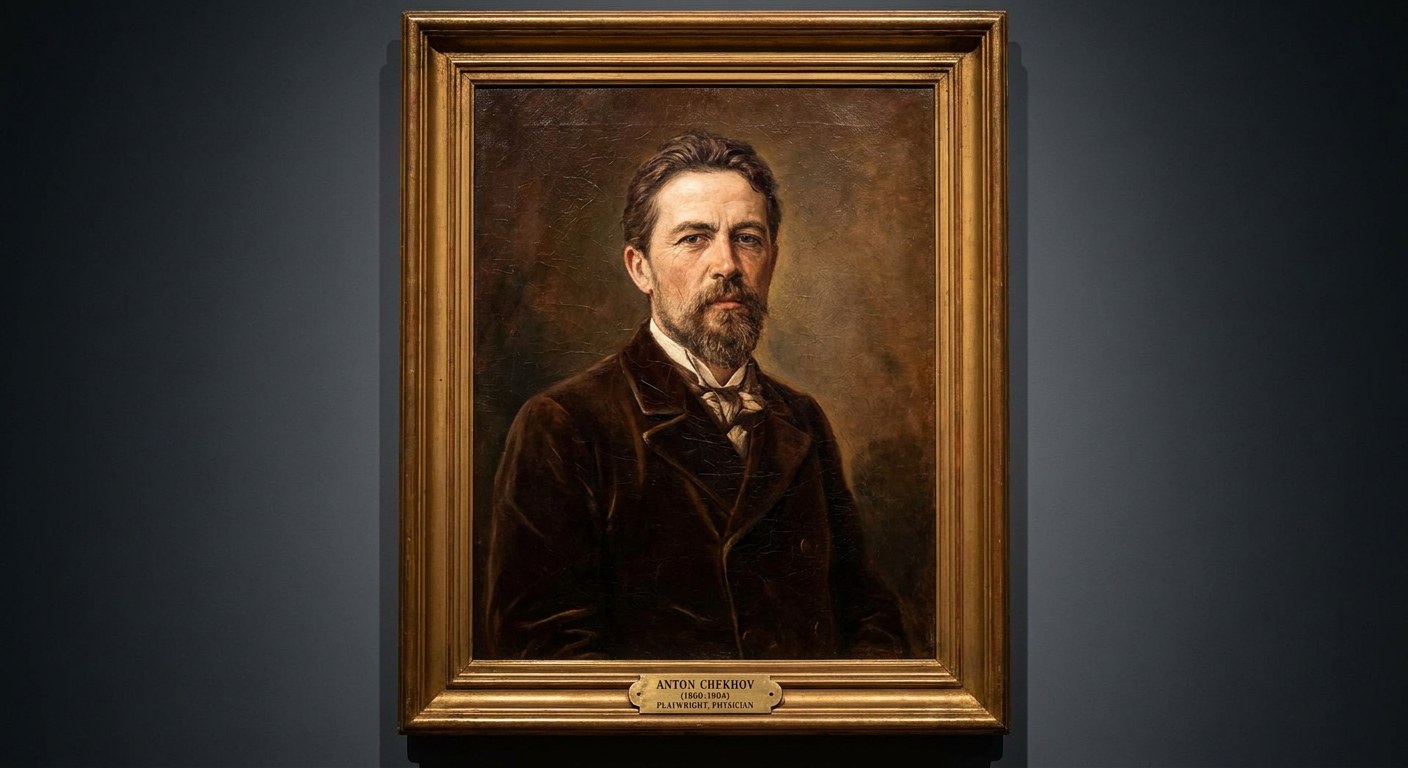
Quick Facts
- Years
- 1860 – 1904
- Nationality
- Russian
- Occupation
- Playwright, Short-Story Writer & Physician
Anton Chekhov
1860 – 1904 · Russian · Playwright, Short-Story Writer & Physician
Recommended Audiobooks
Listen next from Marcus Alden

Life Lessons from Frederic Chopin
Marcus Alden · 54 min

Life Lessons from John Wesley
Marcus Alden · 52 min
Introduction (Why He Matters)
Anton Pavlovich Chekhov was a Russian physician, short-story writer, and playwright whose deceptively quiet works transformed modern literature and theater. In stories such as “The Lady with the Dog,” “Ward No. 6,” and “The Student,” and in plays including The Seagull, Uncle Vanya, Three Sisters, and The Cherry Orchard, Chekhov replaced conventional plots and melodramatic confrontations with suggestion, atmosphere, interrupted conversation, and the unspoken pressures of ordinary life.
Chekhov’s characters rarely divide neatly into heroes and villains. They procrastinate, misunderstand one another, fall in love at inconvenient moments, and dream about lives they may never achieve. Major events often happen between scenes or outside the reader’s view. What matters is not simply what people do, but what they avoid doing, fail to say, or only dimly understand. This method helped establish the modern short story and gave twentieth-century drama a new language of subtext.
Chekhov was also a practicing doctor with a strong sense of civic responsibility. Born into a financially insecure family and raised by a severe father, he supported his parents and siblings through journalism while completing medical school. He treated peasants, organized relief during epidemics and famine, helped build schools, and undertook an arduous research journey across Siberia to the Sakhalin penal colony. His medical training encouraged close observation, skepticism, and resistance to simplistic moral judgments.
Although Chekhov died of tuberculosis at only 44, he produced hundreds of stories, sketches, and dramatic works. His influence reaches far beyond Russian literature: modernist fiction, psychological realism, ensemble drama, the acting system associated with Konstantin Stanislavski, and much contemporary film and television all bear traces of his innovations.
Quick Facts
| Fact | Details |
|---|---|
| Born | 29 January 1860, Taganrog, Russian Empire; 17 January under the Old Style calendar then used in Russia |
| Died | 15 July 1904, Badenweiler, German Empire; 2 July Old Style |
| Nationality | Russian |
| Known For | Mastery of the modern short story and transformation of realist drama |
| Occupation | Physician, playwright, short-story writer, journalist |
| Era | Late Imperial Russia; literary realism and early modernism |
Early Life and Education
Anton Chekhov was born in Taganrog, a port on the Sea of Azov in southern Russia. He was the third of six surviving children of Pavel Yegorovich Chekhov and Yevgeniya Yakovlevna Chekhova. His paternal grandfather, Yegor Mikhailovich, had been born a serf but purchased freedom for himself and his family in 1841. This recent history of serfdom remained important to Chekhov’s understanding of dignity, freedom, class, and humiliation.
Pavel Chekhov operated a grocery shop and directed the church choir. Deeply religious, musically inclined, and determined to educate his children, he could also be authoritarian and violent. Anton and his brothers worked long hours in the shop, sang in the choir, and endured strict discipline. Chekhov later wrote that tyranny and falsehood had damaged his childhood, yet church music, Orthodox ritual, and biblical language left enduring marks on his imagination.
His mother, the daughter of a cloth merchant, was a gifted storyteller. Chekhov credited his father with giving the children their talents and his mother with giving them their souls. Her accounts of travel across Russia introduced him to a wider world beyond provincial Taganrog.
Chekhov attended a Greek school and then the Taganrog Gymnasium, where he studied classical languages, literature, and science. He enjoyed theater, attended local productions, staged amateur performances, and developed a talent for comic imitation. Some of his earliest writing consisted of jokes, sketches, and a student paper.
In 1876 Pavel’s business collapsed. Threatened by creditors, he left for Moscow, where Chekhov’s older brothers were already studying. Yevgeniya and the younger children soon followed. Anton, then 16, remained in Taganrog for approximately three years to complete school, earn money through tutoring, and help settle family affairs. He lived in reduced circumstances and sent part of his income to Moscow.
The experience gave him unusual independence. It also exposed him to social embarrassment, debt, and the fragility of respectability—recurring themes in his later fiction. During these years he boarded with others, read widely, and began trying to write drama. An early untitled play, later commonly called Platonov, survives in an incomplete manuscript and anticipates his interest in wasted talent and emotional paralysis.
In 1879 Chekhov joined his family in Moscow and entered the medical faculty of Imperial Moscow University. The household was crowded and poor, and he quickly became its principal provider. He wrote humorous sketches and anecdotes for inexpensive magazines, often under pseudonyms such as Antosha Chekhonte. The work paid modestly, but his speed and productivity kept the family afloat.
Chekhov graduated as a physician in 1884. He practiced medicine intermittently for the remainder of his life, often treating poor patients without payment. His medical career and literary career were never wholly separate: the doctor’s habits of observation, diagnosis, and emotional restraint shaped the writer’s art.
Rise to Prominence
Chekhov began publishing in 1880, when the St. Petersburg weekly Strekoza printed his short piece “A Letter to a Learned Neighbor.” Early magazine editors demanded brevity, comedy, and rapid delivery. Chekhov responded with parodies, miniature scenes, monologues, and stories about clerks, actors, teachers, petty officials, and provincial families.
These early pieces are often very funny, but beneath their comic surfaces lies a sharp awareness of fear and social hierarchy. In “The Death of a Government Clerk,” a minor official becomes so terrified after accidentally sneezing on a general that anxiety destroys him. “The Chameleon” depicts a policeman changing his judgment according to the possible social rank of a dog’s owner. Such stories show how autocracy and status can enter everyday behavior.
Chekhov initially treated writing as a source of income rather than a solemn vocation. His stories were frequently written to strict length limits and published in ephemeral periodicals. Nevertheless, influential readers recognized his ability. The established writer Dmitry Grigorovich sent Chekhov an important letter in 1886 praising his talent and urging him to take his work more seriously. Chekhov was deeply moved and began devoting greater care to ambitious fiction.
He also formed a close professional relationship with Alexei Suvorin, publisher of the newspaper Novoye Vremya. Suvorin offered better pay, broader readership, and fewer restrictions. The relationship helped Chekhov achieve national recognition, though Suvorin’s conservative politics later strained their friendship.
In 1887 Chekhov’s full-length play Ivanov was staged in Moscow. Written rapidly, it centers on an indebted landowner exhausted by guilt, boredom, and loss of purpose. The first production was troubled, but a revised version received a more favorable reception in St. Petersburg in 1889. The play revealed Chekhov’s movement away from theatrical stereotypes toward morally ambiguous characters whose motives remain partially unexplained.
Chekhov’s collection At Dusk received the prestigious Pushkin Prize from the Russian Academy of Sciences in 1888. By then he had moved beyond his identity as a comic journalist. Stories such as “The Steppe,” published that year, demonstrated lyrical range and psychological depth. Its long account of a boy’s journey across the southern landscape drew on memories of Chekhov’s native region and established him as a major Russian author.
Major Achievements and Contributions
Chekhov’s greatest literary achievement was his redefinition of narrative importance. Traditional stories often move toward decisive action, revelation, punishment, or reward. Chekhov frequently withheld such closure. His endings remain open because life continues beyond the final page, and because his characters seldom understand themselves completely.
He used small physical details—a cough, a sound in the garden, an improperly worn garment, a change in weather—to reveal emotional realities without explicitly explaining them. His narrators generally avoid instructing readers what to think. This restraint does not imply indifference. Rather, Chekhov trusted readers to participate in interpretation.
His fiction expanded the expressive possibilities of the short story. In “Misery,” a cab driver grieving for his son tries unsuccessfully to tell other people about his loss and finally speaks to his horse. “Sleepy” follows an exhausted child servant driven to a terrible act. “The Student” links one brief human encounter with centuries of suffering and hope. “The Lady with the Dog” treats adultery not as a conventional scandal but as the beginning of a difficult moral awakening.
Chekhov made an equally profound contribution to drama. His mature plays combine comedy, sorrow, and apparent inactivity. Characters discuss work, art, money, forests, weather, and the future while their relationships quietly change. The dramatic action often lies beneath the words—a quality later called subtext. Pauses, gestures, repeated phrases, and background sounds carry as much weight as formal speeches.
His plays also helped establish ensemble drama. No single protagonist entirely controls The Seagull, Three Sisters, or The Cherry Orchard. Instead, meaning emerges from interacting groups, each character possessing a private history and partially valid perspective. Chekhov’s method strongly influenced the Moscow Art Theatre and Stanislavski’s approach to psychologically motivated acting.
Beyond literature, Chekhov made significant humanitarian contributions. In 1890 he traveled thousands of miles across Siberia to Sakhalin, an island penal colony in the Russian Far East. He interviewed convicts and settlers, conducted a census, and investigated living conditions. The resulting study, The Island of Sakhalin, documented corporal punishment, forced prostitution, administrative neglect, and the suffering of children. It combined literary observation with empirical social research.
At his country estate of Melikhovo, where he lived from 1892 to 1899, Chekhov treated local peasants, participated in cholera prevention, supported famine relief, planted trees, and helped establish schools. His service was practical rather than ideological. He mistrusted grand declarations unsupported by competent work.
Key Works / Plays / Ideas
Short fiction
“Ward No. 6” (1892) is among Chekhov’s most powerful explorations of institutional cruelty and intellectual complacency. Dr. Ragin, who dismisses suffering through abstract philosophy, is eventually confined in the psychiatric ward he neglected. The story attacks the use of ideas to excuse passivity.
“The Black Monk” (1894) follows an intellectual whose ecstatic visions may represent genius, mental illness, or both. Chekhov refuses to reduce the story to a medical case study. Instead, he examines ambition, happiness, and the cost of believing oneself exceptional.
“Peasants” (1897) presents rural poverty without sentimental idealization. Its overcrowding, disease, violence, and exhaustion challenged romantic images of the Russian peasantry. Some readers regarded the story as excessively bleak, while others praised its honesty.
“The Man in a Case,” “Gooseberries,” and “About Love,” all published in 1898, form a linked trilogy. Their narrators tell stories about fear, self-deception, isolation, and missed happiness. “Gooseberries” notably questions whether private contentment can be innocent in a world filled with suffering.
“The Lady with the Dog” (1899) is often considered one of the finest short stories ever written. Dmitri Gurov begins an affair with Anna Sergeyevna while both are married. What appears at first to be a passing holiday romance becomes the central emotional truth of their lives. The story ends not with a solution, but with the recognition that their greatest difficulties are beginning.
Drama
The Seagull premiered at the Alexandrinsky Theatre in St. Petersburg in 1896 and failed spectacularly. The audience was confused by its shifts in tone, while the actors struggled with its unconventional style. Chekhov, humiliated, considered abandoning drama. In 1898 the Moscow Art Theatre revived the play under Konstantin Stanislavski and Vladimir Nemirovich-Danchenko. The production’s success made the seagull the company’s emblem.
The play explores artistic ambition, unrequited love, generational conflict, and the desire for recognition. Its writers and actors pursue art for different reasons, but none is granted a simple triumph. Chekhov called it a comedy despite its suicide and unhappiness, emphasizing the absurdity woven into suffering.
Uncle Vanya, developed from an earlier play titled The Wood Demon, reached its mature form in the 1890s and was staged by the Moscow Art Theatre in 1899. It portrays people confronting wasted years on a provincial estate. Vanya realizes that he has devoted his life to serving a mediocre professor, while Sonya’s love for Dr. Astrov remains unreturned. Astrov’s concern for forests also gives the play a striking ecological dimension.
Three Sisters premiered in 1901. Olga, Masha, and Irina Prozorov long to return to Moscow, which becomes a symbol of meaning and possibility. Yet they remain trapped in a provincial military town. The play’s repeated hope that future generations will live better is inspiring and painful because the characters themselves may never see that future.
The Cherry Orchard, first performed in 1904, dramatizes the sale of an indebted aristocratic estate. Lyubov Ranevskaya cannot save the property, while Lopakhin, the son of a former serf, purchases it and plans to cut down the orchard for holiday cottages. The play captures Russia’s changing class order without reducing either aristocrat or businessman to caricature. Chekhov described the work as a comedy, even a farce, while Stanislavski emphasized its tragic mood. Their disagreement has shaped interpretations ever since.
Central ideas and methods
Chekhov resisted turning fiction into a platform for final answers. He distinguished between correctly presenting a question and pretending to solve it. His artistic objectivity meant representing human complexity accurately, not remaining morally numb.
Freedom was central to his worldview. Having grown up under paternal authority and inherited the memory of serfdom, he valued intellectual independence and personal dignity. He distrusted coercive systems, rigid doctrines, and moral vanity.
Work is another recurring idea. His characters often imagine that meaningful labor might redeem empty lives, yet Chekhov never treats work as a magical cure. Work must be joined with knowledge, compassion, and freedom if it is to improve human existence.
Timeline of Key Events
| Year | Event |
|---|---|
| 1860 | Born in Taganrog in the Russian Empire |
| 1876 | His father’s business fails; most of the family moves to Moscow while Anton remains in Taganrog |
| 1879 | Completes school, joins his family in Moscow, and begins medical studies |
| 1880 | Publishes his first known humorous piece |
| 1884 | Graduates as a physician; symptoms of tuberculosis are already appearing |
| 1886 | Receives Dmitry Grigorovich’s influential letter encouraging serious literary work |
| 1887 | Ivanov receives its first production |
| 1888 | Publishes “The Steppe” and wins the Pushkin Prize for At Dusk |
| 1890 | Travels across Siberia to investigate the Sakhalin penal colony |
| 1892 | Purchases Melikhovo and participates in famine relief and cholera prevention |
| 1892 | Publishes “Ward No. 6” |
| 1895 | The Island of Sakhalin appears in book form |
| 1896 | Disastrous first production of The Seagull in St. Petersburg |
| 1897 | Suffers a major pulmonary hemorrhage and is formally confronted with the severity of his tuberculosis |
| 1898 | Moscow Art Theatre successfully revives The Seagull |
| 1899 | Sells Melikhovo, settles increasingly in Yalta, and publishes “The Lady with the Dog” |
| 1899 | Moscow Art Theatre stages Uncle Vanya |
| 1901 | Marries actress Olga Knipper; Three Sisters premieres |
| 1904 | The Cherry Orchard premieres at the Moscow Art Theatre |
| 1904 | Dies in Badenweiler, Germany, aged 44 |
Personal Life and Character
Chekhov combined sociability and humor with emotional reserve. Friends remembered his wit, courtesy, hospitality, and dislike of self-important behavior. He enjoyed practical jokes and comic storytelling, but he could also withdraw behind irony. His letters reveal affection, restlessness, discipline, and impatience with hypocrisy.
Family responsibility shaped his adult life. His writing income supported his parents and siblings, and he often intervened in their professional or personal problems. He urged his brothers to develop self-respect, self-control, and consideration for others. In a famous letter to his brother Nikolai, he described cultivated people as compassionate, honest, tolerant, and respectful of human dignity.
Chekhov had several significant emotional relationships, although scholars continue to debate their precise nature. One of the best known involved Lidiya “Lika” Mizinova, whose complicated connection with Chekhov and other members of his circle has sometimes been compared—too directly—to relationships in The Seagull. Chekhov guarded his independence and delayed marriage.
He met Olga Knipper, a leading actress of the Moscow Art Theatre, during rehearsals connected with his plays. They married privately in 1901. Knipper continued performing in Moscow while Chekhov, whose health required a warmer climate, spent long periods in Yalta. Their marriage was therefore maintained substantially through letters and visits. The surviving correspondence records affection, teasing, loneliness, artistic discussion, and the difficulties of separation. They had no children.
Chekhov’s work as a doctor was central to his identity. He treated patients at Melikhovo, often traveling considerable distances in poor weather. During the cholera threat of 1892–1893, he supervised a large rural district with limited assistance. Medicine did not merely supply literary material; it represented disciplined service and contact with physical reality.
He also loved gardens, animals, and trees. He planted extensively at Melikhovo and later at his home in Yalta. His interest in environmental destruction appears most clearly through Dr. Astrov in Uncle Vanya, whose maps record the disappearance of forests.
Challenges and Controversies
Poverty was Chekhov’s first major challenge. He wrote at extraordinary speed partly because his family needed money. The market for comic journalism encouraged formulas and brevity, and he later judged much of his earliest work harshly. Yet those constraints also trained him to compress characterization and eliminate unnecessary explanation.
Tuberculosis overshadowed much of his adult life. Chekhov coughed blood as early as the mid-1880s but minimized the danger, even though he was a doctor. In 1897 a severe hemorrhage led to hospitalization. Physicians advised him to alter his way of life and avoid harsh winters. He consequently spent more time in Crimea and sold Melikhovo, though he disliked being separated from Moscow’s literary and theatrical life.
The Sakhalin journey exposed him to extreme physical hardship. Traveling by train, riverboat, and horse-drawn vehicle across Siberia, he endured flooding, cold, dangerous roads, and poor accommodations. Some contemporaries questioned why a successful author would undertake such a project. Chekhov believed that Russian society had neglected the penal colony and that factual investigation was necessary.
His claim to artistic objectivity has sometimes been interpreted as political passivity. Chekhov belonged to no revolutionary party and distrusted ideological certainty, but he was not indifferent to injustice. His treatment of prisoners, peasants, women, children, patients, and low-ranking officials repeatedly reveals opposition to cruelty and degradation. His practical aid to schools, public health, and relief efforts further complicates the image of a detached aesthete.
Chekhov’s relationship with Suvorin became controversial because Novoye Vremya adopted nationalist and reactionary positions. During the Dreyfus affair in France, Chekhov sympathized with Émile Zola’s defense of Alfred Dreyfus, while Suvorin’s newspaper took an anti-Dreyfus position. Their disagreement contributed to an estrangement, though contact did not cease entirely.
The staging of his plays produced another enduring controversy. Chekhov insisted that works such as The Seagull and The Cherry Orchard were comedies. Stanislavski’s productions emphasized melancholy, atmosphere, and tragedy. Chekhov complained that the Moscow Art Theatre sometimes made his plays too slow and mournful. Modern directors continue to debate the proper balance between comedy and sadness.
Some stories attracted criticism for bleakness or alleged social bias. “Peasants,” for example, was praised as unsparing realism but criticized for presenting rural life in an overwhelmingly negative light. Chekhov’s refusal to idealize either peasants or educated elites meant that few groups found uncomplicated affirmation in his work.
Death and Immediate Aftermath
By 1904 Chekhov’s tuberculosis was advanced. He attended the January premiere of The Cherry Orchard in Moscow, where the audience also celebrated the 25th anniversary of his literary career. Already seriously ill, he found the public ceremony exhausting and uncomfortable.
In June he traveled with Olga Knipper to the German spa town of Badenweiler in the hope that treatment and climate would help. His condition deteriorated. During the night of 14–15 July 1904, New Style, a doctor was summoned. According to Knipper’s account, Chekhov said in German, “Ich sterbe”—“I am dying.” The doctor ordered champagne, and Chekhov drank a glass before lying down and dying peacefully.
His body was returned to Moscow. Memoirs famously report that the coffin traveled in a refrigerated railway car marked for oysters, an incongruous detail often treated as grimly Chekhovian, though aspects of the funeral journey have been retold with variations. Confusion between mourners for Chekhov and a military funeral occurring nearby also entered literary legend.
Chekhov was buried at the cemetery of Moscow’s Novodevichy Convent. His death at 44 was widely mourned. Writers such as Maxim Gorky and Ivan Bunin published recollections, while theaters continued staging the four major plays that had established his dramatic reputation.
Legacy and Influence Today
Chekhov is regarded as one of the founders of the modern short story, alongside figures such as Guy de Maupassant, though their methods differ sharply. Later writers learned from his open endings, tonal ambiguity, compressed detail, and refusal to impose simple judgments. James Joyce, Katherine Mansfield, Virginia Woolf, Ernest Hemingway, Raymond Carver, Alice Munro, and many others have been discussed in relation to Chekhovian techniques.
His influence on drama is equally extensive. The Moscow Art Theatre’s productions connected his work with Stanislavski’s developing system of actor training. Actors learned to identify objectives, inner motivations, and emotional currents beneath ordinary dialogue. Although Chekhov sometimes objected to Stanislavski’s interpretations, their collaboration altered theatrical history.
Playwrights including Tennessee Williams, Arthur Miller, Samuel Beckett, Harold Pinter, Lillian Hellman, Edward Albee, Brian Friel, and Annie Baker inherited aspects of Chekhov’s ensemble structure, pauses, indirect conflict, and mixture of comedy with loss. The word “Chekhovian” now describes works in which ordinary conversation conceals longing, regret, and change.
His plays remain adaptable because they are historically specific yet emotionally flexible. Directors have relocated them to different countries and periods, using the decline of the Russian landed class to illuminate other societies undergoing economic or cultural transformation. The Cherry Orchard is especially resonant wherever property, memory, and social mobility collide.
Chekhov’s medical identity has also attracted continuing attention. Physicians and medical students read his stories for their portrayals of suffering, diagnostic uncertainty, professional failure, and the ethics of listening. “Ward No. 6” remains a powerful warning against treating pain as an abstraction.
His Sakhalin research is valued as a landmark of investigative literature and social documentation, even though modern scholars also examine the limitations of his methods and assumptions. It demonstrates his belief that writers should confront realities beyond literary circles.
Above all, Chekhov endures because he understood that human beings can be ridiculous and heartbreaking at the same moment. He neither excuses his characters nor denies them sympathy. His art invites attentive observation: meaning resides in an unfinished sentence, an irrelevant joke, a distant sound, or the recognition that a different life may still be possible—but will not come easily.
Famous Quotes
Translations of Chekhov vary. The following quotations are drawn from his letters and dramatic works rather than from unsupported internet attributions.
“Medicine is my lawful wife and literature is my mistress.” — Letter to Alexei Suvorin, 1888
“Brevity is the sister of talent.” — Letter to Alexander Chekhov, 1889
“A writer must be as objective as a chemist.” — Letter to Maria Kiselyova, 1887
“The artist must be not the judge of his characters and of what they say, but only an impartial witness.” — Letter to Alexei Suvorin, 1888
“In man everything should be beautiful: his face, his clothes, his soul, and his thoughts.” — Dr. Astrov in Uncle Vanya
“The whole of Russia is our orchard.” — Trofimov in The Cherry Orchard
“We shall rest.” — Sonya in Uncle Vanya
“What a fine weather today! Can’t choose whether to drink tea or to hang myself.” — Dr. Chebutykin in Three Sisters, in a commonly used English translation
Frequently Asked Questions
Why is Anton Chekhov considered important?
Chekhov transformed the short story and modern drama by emphasizing atmosphere, subtext, psychological ambiguity, and ordinary experience. His open endings and nonjudgmental narrators influenced generations of writers, while his plays helped reshape acting and stage direction through the Moscow Art Theatre.
Was Chekhov really a doctor?
Yes. He graduated from the medical faculty of Imperial Moscow University in 1884 and practiced throughout much of his life. He treated poor patients, worked during a cholera threat, and drew on medical knowledge in stories about illness, institutions, and professional responsibility.
What are Chekhov’s four major plays?
The four mature plays most frequently performed are The Seagull, Uncle Vanya, Three Sisters, and The Cherry Orchard. Ivanov is also an important full-length drama, while Chekhov wrote popular one-act farces including The Bear and The Proposal.
Why did the first production of The Seagull fail?
The 1896 production suffered from inadequate preparation, unsuitable expectations, and difficulty understanding Chekhov’s unconventional mixture of comedy and pain. The audience reacted badly, and Chekhov was humiliated. The Moscow Art Theatre’s more carefully rehearsed 1898 revival revealed the play’s dramatic power.
Why did Chekhov travel to Sakhalin?
He wanted to investigate conditions in Russia’s remote penal colony. Chekhov conducted interviews and a census, studied punishment and settlement policies, and exposed neglect and abuse. The journey produced The Island of Sakhalin, a work combining documentary research with literary observation.
What does “Chekhovian” mean?
“Chekhovian” usually describes a work marked by subdued action, indirect dialogue, emotional subtext, mixed comedy and sadness, and characters longing for change while struggling to act. The term can be overused, but it reflects Chekhov’s immense stylistic influence.
Did Chekhov invent the dramatic principle known as Chekhov’s gun?
The principle is associated with advice attributed to Chekhov: if a gun is prominently introduced, it should eventually be used. Surviving versions come from recollections and letters and vary in wording. The principle concerns dramatic economy, although Chekhov’s own works often complicate expectations rather than mechanically fulfilling them.
How did Anton Chekhov die?
He died from tuberculosis in Badenweiler, Germany, on 15 July 1904 under the modern calendar. He was 44 years old. Olga Knipper was with him, and her account of his final glass of champagne became one of the best-known scenes in literary biography.
Lessons We Can Learn
-
Observe before judging. Chekhov’s fiction shows that close attention can reveal complexities hidden by labels, stereotypes, and moral certainty.
-
Skill grows through disciplined work. Years of writing short magazine pieces taught Chekhov precision, economy, timing, and control before he produced his mature masterpieces.
-
Compassion should become practical action. His medical service, school building, epidemic work, and Sakhalin investigation demonstrate that concern for suffering should extend beyond words.
-
Ask difficult questions honestly. Chekhov believed art did not need to provide easy solutions, but it had to formulate problems truthfully and resist false consolation.
-
Comedy and sorrow can coexist. His plays remind us that life’s painful moments are often accompanied by absurdity, distraction, and laughter; acknowledging both produces a fuller understanding of human experience.
Further Reading
- Donald Rayfield, Anton Chekhov: A Life — A detailed modern biography based on extensive archival research.
- Rosamund Bartlett, Chekhov: Scenes from a Life — A concise and accessible study emphasizing the places and social settings that shaped him.
- Ernest J. Simmons, Chekhov: A Biography — A substantial classic biography of Chekhov’s personal and literary development.
- Anton Chekhov, Letters of Anton Chekhov, edited by Simon Karlinsky and translated by Michael Henry Heim — An essential selection revealing Chekhov’s humor, relationships, and artistic thought.
- Maxim Gorky, Alexander Kuprin, and Ivan Bunin, Reminiscences of Anton Chekhov — Vivid recollections by writers who knew him personally.
Watch and Learn
Why should you read Chekhov? · TED-Ed