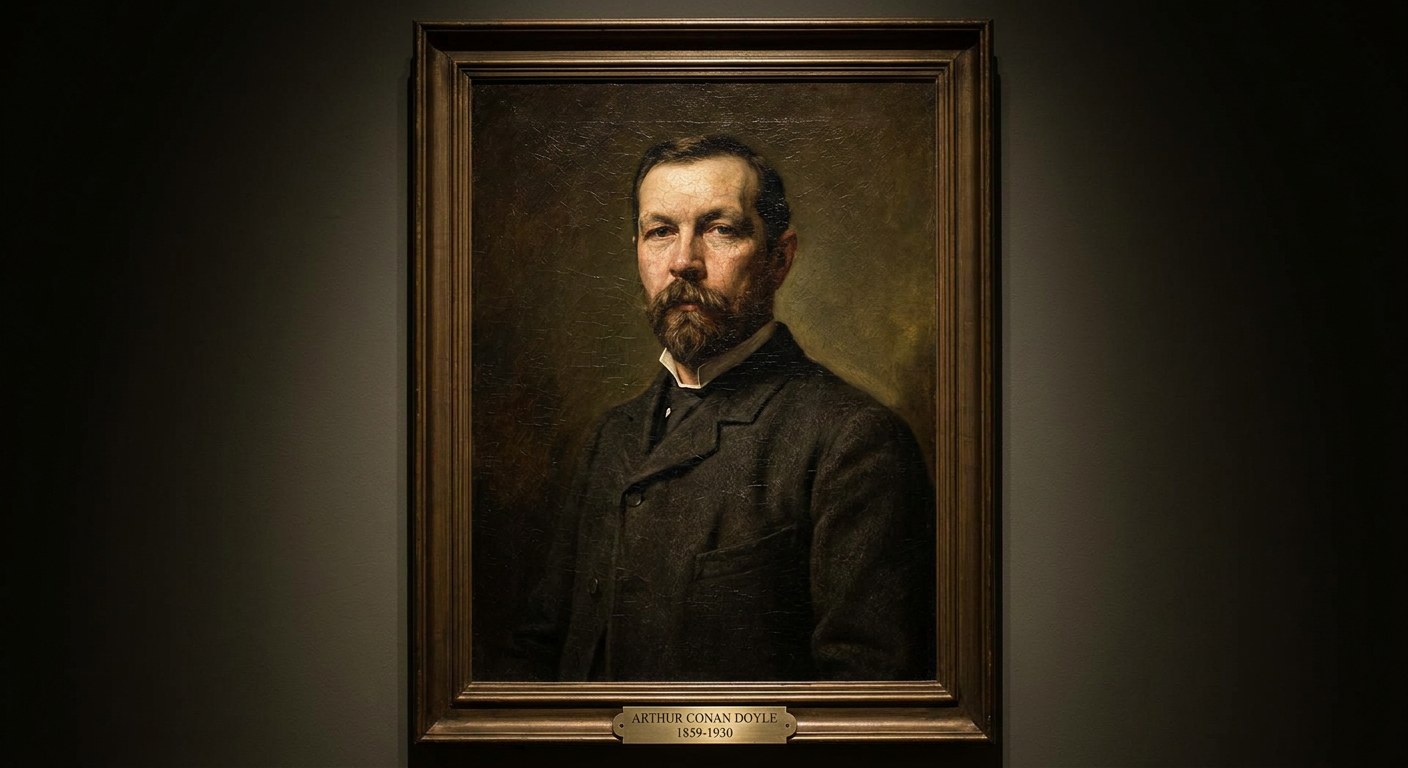
Arthur Conan Doyle
1859 – 1930 · British · Novelist & Physician
Recommended Audiobooks
Listen next from Marcus Alden

Life Lessons from Frederic Chopin
Marcus Alden · 54 min

Life Lessons from John Wesley
Marcus Alden · 52 min
Introduction
Sir Arthur Conan Doyle was a Scottish-born British physician, novelist, short-story writer, poet, journalist, sportsman, political campaigner, and advocate of Spiritualism. He is remembered above all as the creator of Sherlock Holmes, the brilliant consulting detective whose methods of close observation and logical inference helped define modern detective fiction. Accompanied by the loyal Dr. John Watson, Holmes became one of the most recognizable characters in world literature.
Doyle's importance, however, extends well beyond Baker Street. He wrote historical novels, science fiction, supernatural tales, poetry, plays, military history, political pamphlets, and memoirs. His Professor Challenger novel The Lost World helped establish a lasting popular tradition of adventure stories about prehistoric creatures surviving in remote places. As a public figure, Doyle investigated miscarriages of justice, defended British policy during the South African War, stood unsuccessfully for Parliament, promoted sport, and spent the final decades of his life campaigning for Spiritualism.
His career embodied both the confidence and the contradictions of the late Victorian and Edwardian eras. Doyle admired scientific reasoning yet ultimately became convinced that the living could communicate with the dead. He created a supremely skeptical detective but accepted claims—including the celebrated Cottingley Fairies photographs—that many contemporaries considered implausible. These tensions make him more than the author of an immensely successful fictional character: they make him a revealing figure in the cultural history of modern Britain.
Quick Facts
| Field | Details |
|---|---|
| Born | 22 May 1859, Edinburgh, Scotland |
| Died | 7 July 1930, Crowborough, Sussex, England |
| Nationality | British |
| Known For | Creating Sherlock Holmes and Professor Challenger |
| Occupation | Physician, novelist, short-story writer, journalist, campaigner |
| Era | Victorian and Edwardian literature; early 20th century |
Early Life and Education
Arthur Ignatius Conan Doyle was born on 22 May 1859 at 11 Picardy Place in Edinburgh. He was the second of ten children of Charles Altamont Doyle and Mary Foley Doyle. His parents came from Irish Catholic families. The wider Doyle family included prominent artists: his grandfather John Doyle was a noted political cartoonist, while several uncles worked as illustrators and painters.
Arthur's father was employed in Edinburgh as an architectural draughtsman and also produced imaginative, often fantastical artwork. Charles struggled with alcoholism and declining mental and physical health, however, and was eventually confined to institutions. The family's circumstances were therefore less secure than its artistic connections might suggest. Doyle later credited his mother, an accomplished storyteller with a strong interest in history and romance, as a decisive influence on his imagination. Her tales of heroic deeds helped inspire his lifelong enthusiasm for chivalry, adventure, and historical fiction.
Supported partly by wealthier relatives, Doyle was sent in 1868 to Hodder Place, a preparatory school connected with the Jesuit institution Stonyhurst College in Lancashire. He continued at Stonyhurst until 1875 and then spent approximately a year at Stella Matutina, a Jesuit school in Feldkirch, Austria. Although the schools gave him a rigorous education, he came to reject the Catholic faith of his upbringing. For much of his adult life he held broadly agnostic or unconventional religious views before embracing Spiritualism.
In 1876 Doyle entered the University of Edinburgh Medical School. Edinburgh was an important center of scientific medicine, and his training encouraged the habits of observation that later shaped Sherlock Holmes. One of the most significant models for Holmes was Dr. Joseph Bell, a surgeon and lecturer renowned for drawing striking conclusions about patients' occupations, origins, and recent activities from small physical details. Doyle later acknowledged that he had tried to build Holmes's analytical method around Bell's approach.
While studying, Doyle took several jobs. He served for a time as an assistant to a country doctor and in 1880 worked as a medical officer aboard the Arctic whaling ship Hope. The voyage exposed him to danger, harsh weather, hunting, and the rough society of sailors. In 1881 he sailed as ship's surgeon aboard the Mayumba on a voyage to the west coast of Africa, where he suffered from illness and encountered the risks of tropical travel.
Doyle earned his Bachelor of Medicine and Master of Surgery degrees in 1881. He subsequently completed an MD at Edinburgh in 1885 with a thesis concerning vasomotor changes in tabes dorsalis, a neurological complication associated with syphilis. Yet even before qualifying as a doctor, he had begun to publish fiction. His story “The Mystery of Sasassa Valley” appeared in Chambers's Journal in 1879, marking the beginning of a literary career that would eventually eclipse his medical one.
Rise to Prominence
After leaving university, Doyle briefly joined a former fellow student's medical practice in Plymouth. The partnership failed, and in 1882 he established his own practice in Southsea, near Portsmouth. Patients were initially scarce, leaving him time to write between appointments. The slow growth of his practice was financially difficult, but it proved important to literary history.
Doyle's early fiction included adventure, mystery, medical, and supernatural stories. His breakthrough came with A Study in Scarlet, the first appearance of Sherlock Holmes and Dr. Watson. Doyle wrote the novella in 1886. After several publishers rejected it, Ward, Lock & Company purchased the copyright for a modest sum. It appeared in Beeton's Christmas Annual in November 1887 and was issued in book form the following year.
A Study in Scarlet introduced many enduring elements of the Holmes stories: Watson as narrator, the rooms at 221B Baker Street, Holmes's irregular habits, and the detective's use of physical traces to reconstruct unseen events. The book attracted attention but did not immediately make Doyle famous. A second Holmes novel, The Sign of Four, was commissioned after a dinner hosted in 1889 by an American magazine representative. Oscar Wilde, another guest at that dinner, produced The Picture of Dorian Gray for the same publisher. Doyle's novel appeared in 1890.
The decisive change came when Doyle began writing Holmes short stories for The Strand Magazine. “A Scandal in Bohemia” appeared in July 1891, followed by a regular succession of cases illustrated by Sidney Paget. The stories were ideally suited to the expanding mass-circulation press: each offered a complete mystery, memorable characters, London atmosphere, and a satisfying demonstration of Holmes's reasoning. Paget's illustrations also helped establish the detective's visual identity, although the familiar curved calabash pipe was largely a later theatrical convention.
By 1891 Doyle had moved to London and studied ophthalmology in Vienna. He opened an eye specialist's consulting room in Upper Wimpole Street, but according to his own recollections, patients did not arrive. The failure liberated him to concentrate on literature. Within a few years, Sherlock Holmes had made him one of Britain's most popular writers.
Doyle did not share the public's exclusive enthusiasm for Holmes. He regarded historical fiction as a more serious artistic achievement and worried that detective stories consumed time he wanted to devote to other work. In “The Final Problem,” published in December 1893, he sent Holmes and Professor Moriarty plunging over the Reichenbach Falls. Readers protested, and many wore mourning bands or wrote angry letters. The strength of the reaction demonstrated that Holmes had escaped his creator's control and become a cultural institution.
Major Achievements and Contributions
Doyle's greatest achievement was to make analytical detection central to popular storytelling. Edgar Allan Poe's C. Auguste Dupin had provided an important precedent, and earlier writers had used detectives, clues, and criminal investigation. Doyle nevertheless transformed these elements into a durable literary formula. Holmes's examination of footprints, handwriting, ash, mud, clothing, injuries, and chemical evidence presented detection as a form of applied science.
The Holmes stories also perfected the detective-and-companion partnership. Watson is intelligent and brave but sufficiently ordinary to share the reader's confusion. His narration conceals Holmes's full reasoning until the proper dramatic moment. This arrangement influenced countless later pairings, from Hercule Poirot and Captain Hastings to modern television investigators and their partners.
Doyle wrote four Holmes novels and fifty-six short stories. Their popularity spread internationally through translation, stage adaptation, radio, film, television, comics, games, and pastiche. The stories also encouraged public fascination with forensic methods. Holmes sometimes used techniques before they were standard in police work, although claims that Doyle single-handedly invented modern forensics are exaggerated. His real contribution was to make systematic observation and physical evidence exciting to a mass audience.
Doyle was also an accomplished writer of historical adventure. Micah Clarke explored the Monmouth Rebellion of 1685, while The White Company followed English archers and knights during the Hundred Years' War. Its prequel, Sir Nigel, returned to the same medieval world. Doyle's historical novels display his admiration for courage, loyalty, martial honor, and chivalric conduct. He personally considered some of these works superior to his detective fiction.
In science fiction, Doyle created the energetic and combative Professor George Edward Challenger. The Lost World sends an expedition to an isolated South American plateau inhabited by dinosaurs and other prehistoric life. The novel became a model for later “lost world” narratives and influenced adventure cinema, including dinosaur films. Challenger appeared again in The Poison Belt, The Land of Mist, “The Disintegration Machine,” and “When the World Screamed.”
Doyle's public achievements included campaigns on behalf of people he believed had been wrongfully convicted. In 1906 he investigated the case of George Edalji, a British solicitor of Parsi descent convicted of mutilating animals. Doyle examined the evidence, argued that prejudice and faulty reasoning had shaped the prosecution, and publicized the case. Edalji received a pardon, although the official response did not fully satisfy Doyle. The controversy contributed to pressure for a more effective mechanism of criminal appeal; the Court of Criminal Appeal was established in 1907.
Doyle later supported Oscar Slater, a German-born Jewish man convicted in 1909 of murdering Marion Gilchrist in Glasgow. Doyle criticized the evidence and helped maintain public attention on the case. Slater's conviction was eventually overturned in 1928. These campaigns showed Doyle attempting to apply Holmes-like reasoning in real life, though he worked as an advocate and investigator rather than as a neutral legal authority.
During the South African War, or Second Boer War, Doyle volunteered as a physician at the privately organized Langman Field Hospital in Bloemfontein in 1900. He wrote The Great Boer War and defended British conduct in The War in South Africa: Its Cause and Conduct. He was appointed a Knight Bachelor in 1902. Doyle believed his pamphlet defending Britain against international criticism was especially important to the honor, though the precise reasons behind honors are not reducible to a single act.
Key Works / Battles / Ideas
The Sherlock Holmes canon
The Holmes canon consists of four novels—A Study in Scarlet (1887), The Sign of Four (1890), The Hound of the Baskervilles (1901–1902), and The Valley of Fear (1914–1915)—plus fifty-six short stories collected in five volumes. Among the best-known cases are “A Scandal in Bohemia,” “The Red-Headed League,” “The Speckled Band,” “Silver Blaze,” “The Dancing Men,” and “The Bruce-Partington Plans.”
The Hound of the Baskervilles, serialized while Holmes was still presumed dead, combined detective fiction with Gothic horror. Its success helped pave the way for Holmes's full return in “The Adventure of the Empty House” in 1903. Doyle continued producing Holmes stories intermittently until “The Adventure of Shoscombe Old Place” appeared in 1927.
Historical and adventure fiction
Doyle's historical works include Micah Clarke (1889), The White Company (1891), The Refugees (1893), Rodney Stone (1896), and Sir Nigel (1906). His Brigadier Gerard stories portray a brave, vain, and entertaining French cavalry officer during the Napoleonic Wars. They reveal Doyle's ability to combine affectionate comedy with military adventure.
His maritime tales, boxing stories, medical fiction, and supernatural narratives further demonstrate his range. Collections such as Round the Red Lamp drew on medical settings, while tales including “The Horror of the Heights” explored anxieties surrounding technology and the unknown.
Professor Challenger and scientific romance
In The Lost World (1912), Challenger embodies a different kind of scientific hero from Holmes. He is loud, emotional, physically imposing, and eager for confrontation, but he shares Holmes's confidence in evidence and intellect. The Challenger series gradually reflected Doyle's changing worldview. Most notably, The Land of Mist presented Spiritualism favorably and brought Challenger into contact with phenomena he had previously dismissed.
Justice and public reasoning
Doyle believed prominent citizens had a responsibility to confront injustice. His involvement in the Edalji and Slater cases combined close reading of testimony with energetic public campaigning. At the same time, these episodes exposed a paradox: his skepticism could be rigorous when assessing criminal evidence but less guarded when examining claims that confirmed his spiritual beliefs.
Spiritualism
Doyle had investigated psychical phenomena before the First World War and publicly declared his commitment to Spiritualism in 1916. He believed human personality survived bodily death and that mediums could communicate with spirits. Wartime bereavements strengthened the emotional urgency of his campaign, although they did not originate his interest.
He lectured internationally, wrote books such as The New Revelation, The Vital Message, and The History of Spiritualism, and spent substantial personal resources promoting the movement. To supporters, he offered hope after catastrophic loss. To critics, he lent prestige to unreliable mediums, weak experiments, and fraudulent practices.
Timeline of Key Events
| Year | Event |
|---|---|
| 1859 | Born in Edinburgh on 22 May |
| 1868 | Sent to Hodder Place, beginning his Jesuit schooling |
| 1876 | Entered the University of Edinburgh Medical School |
| 1879 | Published “The Mystery of Sasassa Valley” |
| 1880 | Served as medical officer aboard the Arctic whaler Hope |
| 1881 | Qualified in medicine and sailed aboard the Mayumba |
| 1882 | Opened a medical practice in Southsea |
| 1885 | Married Louisa Hawkins and completed his MD |
| 1887 | A Study in Scarlet introduced Sherlock Holmes and Dr. Watson |
| 1890 | The Sign of Four was published |
| 1891 | Holmes stories began appearing regularly in The Strand Magazine |
| 1893 | Holmes apparently died in “The Final Problem” |
| 1900 | Served as a physician in South Africa and stood unsuccessfully for Parliament |
| 1901–1902 | The Hound of the Baskervilles was serialized |
| 1902 | Knighted and published The War in South Africa |
| 1903 | Revived Holmes in “The Adventure of the Empty House” |
| 1906 | Louisa Doyle died; Doyle campaigned for George Edalji |
| 1907 | Married Jean Leckie |
| 1912 | Published The Lost World |
| 1916 | Publicly announced his belief in Spiritualism |
| 1918 | His son Kingsley died during the influenza pandemic after wartime illness and wounds |
| 1920 | Publicly defended the Cottingley Fairies photographs |
| 1928 | Oscar Slater's murder conviction was overturned |
| 1929 | Undertook a final major Spiritualist lecture tour despite poor health |
| 1930 | Died at Crowborough on 7 July |
Personal Life and Character
Doyle married Louisa Hawkins, often called “Touie,” in 1885. They had two children, Mary Louise and Arthur Alleyne Kingsley. In the early 1890s Louisa developed tuberculosis, then a frequently fatal disease. Doyle devoted considerable attention to her care, and she survived much longer than initially expected before dying in 1906.
In 1897 Doyle met Jean Elizabeth Leckie and formed a deep attachment to her while Louisa was still alive. According to Doyle and his family, the relationship remained physically chaste out of loyalty to his wife, although its emotional intensity has prompted debate among biographers. Doyle married Jean in 1907. They had three children: Denis Percy Stewart, Adrian Malcolm, and Jean Lena Annette.
Physically large and energetic, Doyle enjoyed vigorous activity and competitive sport. He played cricket, including first-class matches for the Marylebone Cricket Club, and once dismissed the legendary W. G. Grace. He played association football as a goalkeeper for the amateur Portsmouth Association Football Club under the name A. C. Smith; this club was distinct from the later Portsmouth Football Club. He also boxed, played golf and billiards, and helped popularize skiing after practicing it in Switzerland.
Friends and acquaintances often described Doyle as hearty, direct, generous, honorable, and combative. He admired courage and fair play and readily entered public disputes when he believed a principle was at stake. These qualities supported his campaigns against injustice, but they could also harden into certainty. Once persuaded of a position, he was not easily moved by criticism.
His identity was more complicated than the label “Scottish writer” alone suggests. He was born and educated in Scotland, came from an Irish Catholic family, and spent much of his career in England. He was a committed British imperial patriot and stood for Parliament twice as a Liberal Unionist—first for Edinburgh Central in 1900 and later for the Hawick Burghs in 1906—but was not elected.
Challenges and Controversies
Doyle's relationship with Sherlock Holmes was both a triumph and a burden. He came to resent the degree to which the detective overshadowed his historical fiction. Killing Holmes provoked intense public hostility, while reviving him created the impression that commercial pressure had defeated artistic independence. Yet the later stories include some of the character's most admired adventures, and Doyle's ambivalence did not prevent him from carefully managing Holmes as a valuable literary property.
His defense of British conduct in the South African War is controversial today. Doyle viewed the British Empire as a broadly civilizing institution and answered foreign accusations about military behavior. Modern readers must place his writings alongside the realities of imperial warfare, including scorched-earth policies and the concentration camps in which many Boer civilians and Black Africans suffered and died. His patriotism was sincere but reflected assumptions about empire and hierarchy widely challenged by later scholarship.
Spiritualism generated the most enduring criticism. Doyle believed that many mediums produced genuine communications, even when professional skeptics exposed tricks associated with séance culture. His public disagreement with the magician Harry Houdini became especially famous. Doyle thought Houdini may have possessed psychic powers that he refused to acknowledge, while Houdini insisted that apparently supernatural feats were illusions and campaigned against fraudulent mediums.
Doyle's support for the Cottingley Fairies damaged his reputation for critical judgment. Beginning in 1917, two girls, Elsie Wright and Frances Griffiths, produced photographs appearing to show them with fairies. Doyle accepted the images as important evidence for elemental beings and discussed them in The Coming of the Fairies. Decades later, the women admitted that most of the photographs had been staged using paper cutouts, though Frances continued to make a qualified claim for one image. The episode remains a classic example of confirmation bias: Doyle scrutinized some objections but was strongly predisposed to welcome evidence that supported his worldview.
His private relationship with Jean Leckie before Louisa's death has likewise drawn scrutiny. Evidence supports the claim that Doyle maintained formal loyalty to his ailing wife, but the emotional relationship placed all three people in a painful situation. Responsible biography must acknowledge the ambiguity rather than reducing it either to scandal or idealized self-restraint.
Doyle also lived through repeated bereavement. The First World War and influenza era cost him several people close to him. His son Kingsley, wounded during wartime service, died of pneumonia during the 1918 influenza pandemic. Doyle's brother Innes died in 1919. These losses intensified his determination to present Spiritualism as a rational source of consolation and certainty about survival after death.
Death and Immediate Aftermath
Doyle's health deteriorated during the late 1920s, but he continued traveling and lecturing for the Spiritualist cause. He suffered from heart problems and had been warned to reduce his activity. Nevertheless, he undertook demanding engagements, convinced that spreading his message was a duty.
He died of a heart attack on 7 July 1930 at Windlesham, his home in Crowborough, East Sussex. He was seventy-one. Contemporary reports emphasized both his worldwide fame as the creator of Sherlock Holmes and his devotion to Spiritualism. Spiritualists commemorated him as a leading defender of communication with the dead, while literary readers mourned one of the most popular storytellers of the age.
Doyle was initially buried in the garden at Windlesham. After Jean's death, their remains were reinterred in 1955 in the churchyard of All Saints at Minstead in Hampshire's New Forest. The gravestone bears the words “Steel True, Blade Straight,” an epitaph suited to Doyle's ideal of chivalric integrity.
His family inherited a valuable but complicated literary estate. Questions concerning copyright, adaptations, characterization, and control of the Holmes stories produced decades of legal and commercial disputes. Meanwhile, new films, radio dramas, editions, and imitations ensured that Holmes remained constantly before the public.
Legacy and Influence Today
Arthur Conan Doyle's most visible legacy is Sherlock Holmes. Holmes is among the most frequently adapted fictional characters ever created. Actors from William Gillette and Basil Rathbone to Jeremy Brett, Robert Downey Jr., Benedict Cumberbatch, and many others have reinterpreted him for changing audiences. Each adaptation emphasizes different qualities: scientific detachment, eccentric comedy, physical action, addiction, friendship, or emotional isolation.
The Holmes–Watson relationship helped establish the structure of modern detective series. Holmes's insistence that tiny details matter shaped fictional representations of police investigation, forensic science, medicine, and intelligence work. The phrase “Sherlockian” now describes exceptionally acute detection, while societies such as the Baker Street Irregulars treat the stories as objects of both scholarship and affectionate play.
Doyle also helped make short-form detective fiction commercially powerful. The Strand stories showed publishers that recurring characters could build reader loyalty across separate adventures. This serial model remains fundamental to crime novels, television procedurals, superhero stories, and franchise entertainment.
The Lost World has enjoyed an equally broad, if less celebrated, influence. Its expedition to a prehistoric enclave helped inspire later novels, films, comics, and television programs about dinosaurs and evolutionary survivors. Works ranging from pulp adventures to modern dinosaur blockbusters owe something to the imaginative path Doyle helped establish.
His real-life justice campaigns continue to attract historians of law. The Edalji case illuminates racial prejudice, provincial policing, and the weakness of criminal appeal procedures in Edwardian Britain. The Slater case demonstrates the danger of unreliable identification, selective evidence, and institutional resistance to admitting error. Doyle's interventions show how literary fame can be converted into public pressure, though celebrity advocacy does not replace careful legal procedure.
His Spiritualism remains central to understanding him. It should not be treated merely as an embarrassing appendix to the Holmes stories. Psychical research, séance culture, new religious movements, and the search for survival after death were significant features of late Victorian and postwar society. Doyle's beliefs reveal how scientific language, grief, religious doubt, and hope could combine in an era transformed by mass death and technological change.
Modern readers therefore encounter two seemingly opposed Doyles: the creator of literature's great rational detective and the campaigner who defended fairies and mediums. In reality, both emerged from his desire to uncover invisible truths. Doyle believed evidence could penetrate mystery, whether the mystery involved a footprint at a crime scene or the fate of human consciousness after death. His conclusions varied greatly in reliability, but the underlying hunger for explanation remained constant.
Above all, Doyle survives because he was an exceptionally effective storyteller. His plots move quickly, his narrators are inviting, and his characters are instantly recognizable. Even readers who have never opened a Holmes story know the detective's silhouette, address, methods, and partnership with Watson. Few authors have contributed so enduringly to the world's shared imaginative vocabulary.
Famous Quotes
The following lines are genuine passages from Doyle's works; several are spoken by Sherlock Holmes or other fictional characters rather than being statements of Doyle's personal beliefs.
“When you have eliminated the impossible, whatever remains, however improbable, must be the truth.”
— Sherlock Holmes, The Sign of Four
“It is a capital mistake to theorize before one has data.”
— Sherlock Holmes, “A Scandal in Bohemia”
“You see, but you do not observe.”
— Sherlock Holmes, “A Scandal in Bohemia”
“The world is full of obvious things which nobody by any chance ever observes.”
— Sherlock Holmes, The Hound of the Baskervilles
“Where there is no imagination there is no horror.”
— A Study in Scarlet
“Education never ends, Watson. It is a series of lessons, with the greatest for the last.”
— Sherlock Holmes, “His Last Bow”
“It is a great thing to start life with a small number of really good books which are your very own.”
— Through the Magic Door
Frequently Asked Questions
Who was Arthur Conan Doyle?
Arthur Conan Doyle was a British physician and writer born in Edinburgh in 1859. He created Sherlock Holmes and Dr. Watson and also wrote historical novels, science fiction, plays, poetry, military history, and works promoting Spiritualism.
Was Arthur Conan Doyle a real doctor?
Yes. He studied medicine at the University of Edinburgh, qualified in 1881, and earned an MD in 1885. He worked aboard ships and practiced in Southsea. He later studied ophthalmology, but his literary success led him away from regular medical practice.
Who inspired Sherlock Holmes?
The most important acknowledged model was Dr. Joseph Bell, an Edinburgh surgeon who impressed students by inferring details about patients from close observation. Holmes also belonged to a literary tradition influenced by Edgar Allan Poe's detective C. Auguste Dupin.
How many Sherlock Holmes stories did Doyle write?
Doyle wrote sixty canonical Holmes works: four novels and fifty-six short stories. They were published between 1887 and 1927, though the fictional chronology differs from publication order.
Why did Doyle kill Sherlock Holmes?
Doyle feared that Holmes was monopolizing his career and preventing him from concentrating on historical fiction. In “The Final Problem,” he attempted to end the series by sending Holmes over the Reichenbach Falls with Professor Moriarty. Public demand and substantial publishing offers eventually helped persuade him to restore the detective.
Did Arthur Conan Doyle believe in fairies?
He accepted the Cottingley Fairies photographs as evidence that fairy-like beings might exist. The photographs were later largely admitted to be staged. His support for them reflected his wider Spiritualist beliefs and remains one of the most criticized episodes of his career.
Why was Arthur Conan Doyle knighted?
Doyle was appointed a Knight Bachelor in 1902 after his medical service in South Africa and his writings supporting the British position during the South African War. He himself associated the honor particularly with his pamphlet The War in South Africa: Its Cause and Conduct.
Did Doyle solve real crimes?
He was not a police detective, but he investigated alleged miscarriages of justice. His campaigns for George Edalji and Oscar Slater helped expose serious weaknesses in their convictions. His fame allowed him to draw public attention to evidence and procedural failures.
Lessons We Can Learn
-
Observation should come before theory. The best Holmes stories dramatize the danger of forming conclusions first and forcing evidence to fit them afterward.
-
Popular work can have lasting cultural value. Doyle considered his historical novels more important, yet the stories he regarded as lighter entertainment transformed world literature.
-
Public influence can be used against injustice. His work for Edalji and Slater shows how reputation and communication skills can help challenge institutional error.
-
Intelligence does not eliminate confirmation bias. Doyle's acceptance of dubious supernatural claims demonstrates that educated and accomplished people may judge evidence unevenly when it supports deeply held hopes.
-
A creator cannot fully control a creation. Doyle tried to escape Sherlock Holmes, but readers made the detective larger than his author. Enduring art acquires meanings and lives that extend beyond its maker's intentions.
Further Reading
- Andrew Lycett, The Man Who Created Sherlock Holmes: The Life and Times of Sir Arthur Conan Doyle.
- Daniel Stashower, Teller of Tales: The Life of Arthur Conan Doyle.
- Martin Booth, The Doctor and the Detective: A Biography of Sir Arthur Conan Doyle.
- Douglas Kerr, Conan Doyle: Writing, Profession, and Practice.
- Arthur Conan Doyle, Memories and Adventures.
Watch and Learn
Who IS Sherlock Holmes? - Neil McCaw · TED-Ed