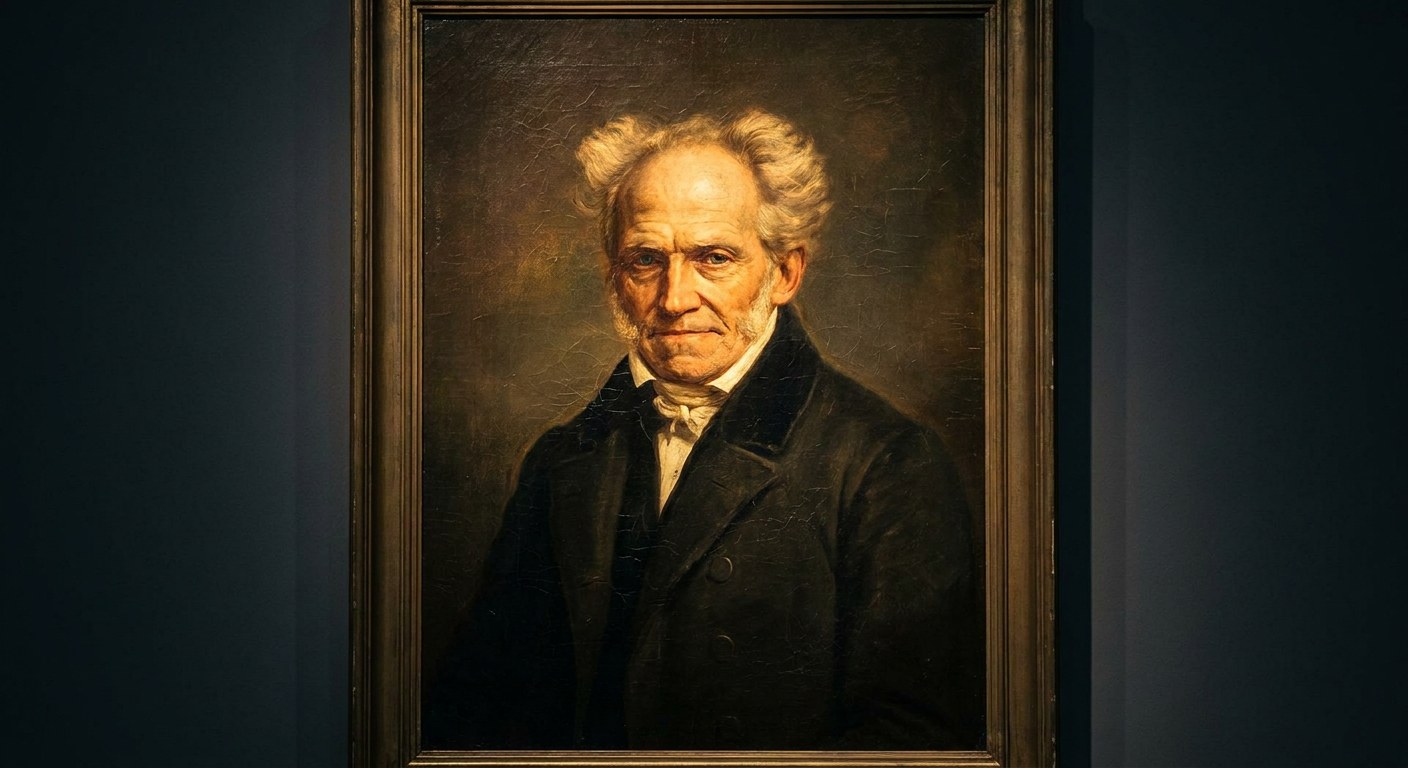
Arthur Schopenhauer
1788 – 1860 · German · Philosopher
Recommended Audiobooks
Listen next from Marcus Alden

Life Lessons from Frederic Chopin
Marcus Alden · 54 min

Life Lessons from John Wesley
Marcus Alden · 52 min
Introduction
Arthur Schopenhauer was one of the nineteenth century’s most original, unsettling, and influential philosophers. Best known for The World as Will and Representation, he argued that the universe experienced by human beings has two inseparable aspects: it is representation, the world as it appears to a knowing subject, and will, a blind, ceaseless striving that underlies nature and conscious life. Because desire continually renews itself, Schopenhauer believed that ordinary existence is marked by frustration, conflict, suffering, and boredom.
This bleak diagnosis earned him a reputation as the leading philosopher of pessimism. Yet Schopenhauer’s thought was not simply an invitation to despair. He also proposed ways of obtaining temporary or lasting relief from the tyranny of desire. Contemplation of art, especially music, could suspend self-interested striving. Compassion could weaken egoism and provide the foundation of morality. At the highest level, ascetic self-denial could lead toward what he described as the denial of the will-to-live.
Schopenhauer developed his philosophy through a critical engagement with Immanuel Kant, Plato, Western mysticism, and the Indian philosophical and religious writings available to European readers in his time. He was among the first major Western philosophers to treat Indian thought as intellectually important rather than merely exotic. His interpretations were selective and shaped by imperfect translations, but they helped widen the horizons of European philosophy.
Ignored for much of his career, Schopenhauer became famous only in his final decade. His ideas later influenced Friedrich Nietzsche, Richard Wagner, Sigmund Freud, Thomas Mann, Ludwig Wittgenstein, Marcel Proust, Samuel Beckett, Jorge Luis Borges, and many others. His discussions of unconscious motivation, sexuality, art, compassion, and self-deception continue to attract philosophers, psychologists, artists, and general readers.
Quick Facts
| Fact | Detail |
|---|---|
| Born | 22 February 1788, Danzig, Polish–Lithuanian Commonwealth, now Gdańsk, Poland |
| Died | 21 September 1860, Frankfurt am Main, Germany |
| Nationality | German |
| Known For | Philosophical pessimism; the metaphysics of will; aesthetics; ethics of compassion |
| Occupation | Philosopher, author, and independent scholar |
| Era | Nineteenth-century philosophy; post-Kantian German philosophy |
Early Life and Education
Arthur Schopenhauer was born on 22 February 1788 in Danzig, then a largely autonomous city within the Polish–Lithuanian Commonwealth. His father, Heinrich Floris Schopenhauer, was a prosperous merchant of Dutch ancestry who valued commercial independence, cosmopolitan culture, and republican civic traditions. His mother, Johanna Schopenhauer, later became a successful novelist and one of the best-known literary hostesses in Weimar. Arthur had a younger sister, Adele, who became a writer and accomplished paper-cutting artist.
The family left Danzig for Hamburg in 1793 after Prussia annexed the city in the Second Partition of Poland. Heinrich intended his son to enter international commerce and therefore gave him a practical, multilingual education. The young Schopenhauer spent time in Le Havre, France, where he became fluent in French, and attended a private commercial school in Hamburg. Between 1803 and 1804 he accompanied his parents on an extensive European journey through the Netherlands, Britain, France, Switzerland, Austria, and other regions.
The journey broadened his education but also exposed him to poverty, forced labor, punishment, and social inequality. His travel diaries reveal both curiosity and a growing sensitivity to suffering. He nevertheless remained bound by his promise to pursue a merchant’s career rather than the classical education he increasingly desired.
In 1805 Heinrich Schopenhauer died after falling from a warehouse building. The circumstances were never conclusively established, although Arthur and other family members believed that suicide was likely. His father’s death left him financially independent but emotionally affected him for years. Schopenhauer initially honored his promise by continuing his commercial apprenticeship, which he disliked intensely.
Johanna and Adele moved to Weimar, where Johanna established a salon attended by leading intellectuals, including Johann Wolfgang von Goethe. Arthur remained in Hamburg until 1807, when his mother finally allowed him to abandon commerce. He began an accelerated classical education in Gotha and then Weimar, studying Latin, Greek, history, and literature in preparation for university.
Schopenhauer entered the University of Göttingen in 1809. He first enrolled in medicine and studied the natural sciences, subjects that remained important to his philosophy. Under the influence of the skeptical philosopher Gottlob Ernst Schulze, however, he shifted toward philosophy. Schulze advised him to concentrate on Plato and Kant before becoming absorbed in more recent systems.
In 1811 Schopenhauer transferred to the University of Berlin. He attended lectures by Johann Gottlieb Fichte and Friedrich Schleiermacher but became dissatisfied with both. He increasingly believed that the idealist systems then dominating German universities obscured rather than solved Kant’s central problems. His hostility toward academic philosophy, especially the work of Georg Wilhelm Friedrich Hegel, became a permanent feature of his intellectual identity.
During the upheavals of the Napoleonic Wars, Schopenhauer withdrew to Rudolstadt and completed his doctoral dissertation. The University of Jena awarded him a doctorate in philosophy in 1813 for On the Fourfold Root of the Principle of Sufficient Reason. This work examined the different forms of explanation governing objects, concepts, space and time, and human action. It later became the epistemological foundation of his mature philosophy.
Rise to Prominence
After receiving his doctorate, Schopenhauer returned briefly to Weimar. Through his mother’s circle, he conversed with Goethe, whose theory of color interested him. Their relationship was intellectually productive but eventually cooled, partly because Schopenhauer refused to act as a deferential disciple. He later published his own account, On Vision and Colors, in 1816.
A more decisive encounter came through the orientalist Friedrich Majer, who introduced him to Indian religious and philosophical traditions. Schopenhauer read the Oupnek’hat, a Latin version of a Persian translation of selected Upanishads. He regarded these writings as profound confirmations of insights he had reached through Kant and Plato. Although modern scholarship distinguishes his system from Hindu and Buddhist traditions, Indian thought became central to the language and self-understanding of his philosophy.
From 1814 to 1818 Schopenhauer lived mainly in Dresden, where he composed his principal work. The World as Will and Representation appeared late in 1818 with an 1819 publication date. It offered a comprehensive account of knowledge, nature, human motivation, art, ethics, and salvation. Schopenhauer was only thirty when the book was published and believed that he had solved the central problems of philosophy.
The public did not agree—at least not immediately. The first edition sold poorly, and many copies were eventually pulped. German intellectual life was dominated by Hegel and other academic idealists, while Schopenhauer held no influential university position from which to promote his system.
In 1820 he qualified as a lecturer at the University of Berlin. Displaying either extraordinary confidence or calculated defiance, he scheduled his lectures at the same hour as those of Hegel, then Europe’s most celebrated academic philosopher. Hegel attracted a large audience; only a handful registered for Schopenhauer’s course. His university career quickly collapsed, though he nominally retained permission to lecture.
For years Schopenhauer lived as an independent scholar, supported by inherited wealth. He traveled in Italy, spent periods in Munich, Dresden, and Berlin, and continued revising his philosophy. During the cholera epidemic of 1831, he left Berlin for Frankfurt am Main; Hegel remained in Berlin and died during the outbreak. Schopenhauer settled permanently in Frankfurt in 1833.
His reputation grew slowly. On the Will in Nature appeared in 1836, presenting developments in the sciences that he believed supported his metaphysics. In 1839 his essay on freedom of the will won a prize from the Royal Norwegian Society of Sciences and Letters. A companion essay on morality failed to receive the prize offered by the Royal Danish Society of Sciences, partly because of its attacks on prominent philosophers. He published both essays in 1841 as The Two Fundamental Problems of Ethics.
A greatly expanded second edition of The World as Will and Representation followed in 1844. It attracted little immediate attention. The turning point came with Parerga and Paralipomena in 1851. This accessible collection of essays and reflections addressed subjects ranging from ethics and religion to education, literature, psychology, noise, and everyday conduct. Reviews, including an influential English-language article by John Oxenford in 1853, introduced Schopenhauer to a wider European audience. By the late 1850s, after decades of neglect, he had become an international philosophical celebrity.
Major Achievements and Contributions
Schopenhauer’s greatest achievement was the construction of a unified philosophical system that connected epistemology, metaphysics, psychology, aesthetics, ethics, and a theory of liberation. Unlike many system-builders, he wrote in a direct, vivid, and often literary style. His essays could be sarcastic and prejudiced, but his finest philosophical prose combined clarity with memorable imagery.
His starting point was Kant’s distinction between appearances and the thing-in-itself. Schopenhauer accepted that the world known through ordinary experience is shaped by the mind’s forms of space, time, and causality. He summarized this claim with the proposition that the world is “representation”: every experienced object exists as an object for a subject.
Schopenhauer nevertheless believed that human beings have a special form of access to reality through their own bodies. A person experiences the body externally as an object but internally as willing—as effort, appetite, impulse, and striving. He therefore identified the thing-in-itself with “will.” He extended this concept beyond conscious intention, treating natural forces, organic growth, instinct, and human desire as manifestations of one underlying will.
The will is not a rational mind directing the universe toward a good purpose. It is blind, aimless, and perpetually active. Individual creatures struggle to preserve themselves and reproduce, often at one another’s expense. Satisfaction is temporary because fulfilled desires are soon replaced by new ones. When desire is frustrated, individuals suffer; when desire has no immediate object, they become bored. Schopenhauer thus rejected optimistic accounts of historical progress and providential order.
He also developed an important philosophy of art. In aesthetic contemplation, a person may temporarily stop viewing objects as instruments of desire. The spectator becomes what Schopenhauer called a “pure subject of knowing,” absorbed in an object without asking how it can be possessed or used. Architecture, painting, sculpture, poetry, tragedy, and music disclose different aspects of reality. Music occupied the highest position because he believed it expressed the movement of the will directly rather than merely representing visible things.
In ethics, Schopenhauer challenged theories that grounded morality solely in abstract reason, divine command, or personal advantage. Genuine moral action, he argued, arises from compassion: the direct recognition that another being’s suffering matters as though it were one’s own. Compassion can break through the illusion that individuals are absolutely separate. His concern extended to animals, and he condemned cruelty toward them at a time when European moral philosophy often treated animals mainly as property or mechanisms.
His analysis of motivation anticipated later depth psychology. Schopenhauer portrayed the conscious intellect not as the master of human conduct but often as the servant and rationalizer of deeper impulses. He emphasized sexuality as a powerful expression of the will-to-live and argued that romantic attraction serves reproductive interests that individuals may not consciously understand. Freud did not simply derive psychoanalysis from Schopenhauer, but later readers recognized striking parallels involving repression, unconscious motivation, and the limited authority of reason.
Finally, Schopenhauer helped establish a serious European philosophical conversation with Asian traditions. He praised the Upanishads and found affinities between his ethics, Buddhist compassion, the concept of maya, and ascetic traditions. His readings sometimes collapsed major differences among Hinduism, Buddhism, and Western mysticism. Even so, his work contributed to the gradual erosion of the assumption that philosophy was an exclusively Greco-European achievement.
Key Works / Battles / Ideas
On the Fourfold Root of the Principle of Sufficient Reason
Schopenhauer’s 1813 dissertation, revised in 1847, argues that the demand for a reason or ground takes four distinct forms. These concern physical causation, logical judgment, mathematical relations in space and time, and motivation in human action. The work is essential for understanding his claim that causality and explanation structure the phenomenal world rather than reveal ultimate reality in itself.
The World as Will and Representation
Schopenhauer’s masterpiece is divided into four main movements: the world as representation, the world as will, aesthetic contemplation, and the affirmation or denial of the will-to-live. The 1844 edition added a large second volume of supplementary essays. Together, the two volumes contain his mature views on perception, science, sexuality, art, ethics, religion, and redemption.
The Will-to-Live
The “will” is not merely a person’s capacity to choose. It is the underlying striving manifested throughout nature. In living beings it appears as the will-to-live: the drive toward survival, nourishment, competition, and reproduction. Because striving has no final fulfillment, suffering is not an accidental defect in existence but a structural feature of it.
Pessimism and Suffering
Schopenhauer’s pessimism rests on an argument rather than a mood. Pain is experienced positively and urgently, whereas pleasure commonly consists in the removal of a lack or discomfort. Desire therefore begins in need and ends only briefly in satisfaction. His famous image of life moving between pain and boredom summarizes this cycle.
He also used the “porcupine dilemma” to describe human sociability. Like porcupines seeking warmth on a cold day, people draw together for companionship but injure one another when they become too close. They must find a tolerable distance between loneliness and conflict.
Aesthetics and Music
Art gives temporary release by quieting practical desire. Schopenhauer’s elevation of music profoundly affected composers and critics, most famously Richard Wagner. Tragedy also held a high place because it reveals the conflict and suffering inherent in willing and can turn the spectator away from naïve attachment to worldly success.
Compassion and Asceticism
Compassion is the basis of justice and loving-kindness because it weakens the boundary between self and other. Asceticism goes further. Through chastity, voluntary poverty, fasting, resignation, and the renunciation of egoistic desire, the saintly person denies the will-to-live. Schopenhauer did not present suicide as genuine liberation: in his view, suicide rejects painful circumstances while continuing to affirm the underlying desire for a different life.
Conflict with Hegelian Philosophy
Schopenhauer’s intellectual battle with Hegel was intensely personal. He regarded Hegel’s prose as obscurantist and his success as evidence of corruption within state-supported universities. Schopenhauer opposed Hegelian accounts of rational historical development with a vision of repetitive striving and suffering. His attacks were often excessive, but the decline of Hegelian dominance helped later readers view Schopenhauer as an alternative voice in German philosophy.
Parerga and Paralipomena
Published in 1851, this two-volume collection finally brought Schopenhauer broad recognition. It includes essays such as “On the Wisdom of Life,” “On Religion,” and “On Women,” as well as the “Counsels and Maxims.” The work displays both his brilliance as an essayist and the prejudices that complicate his legacy.
Timeline of Key Events
| Year | Event |
|---|---|
| 1788 | Born in Danzig on 22 February |
| 1793 | Family moves to Hamburg after the Prussian annexation of Danzig |
| 1797–1799 | Lives in Le Havre and learns French |
| 1803–1804 | Travels widely through Europe with his parents |
| 1805 | His father dies; Schopenhauer continues his commercial apprenticeship |
| 1807 | Leaves commerce and begins intensive classical studies |
| 1809 | Enters the University of Göttingen, initially studying medicine |
| 1811 | Transfers to the University of Berlin and studies philosophy |
| 1813 | Receives his doctorate from the University of Jena |
| 1814–1818 | Lives in Dresden and develops his principal philosophical system |
| 1816 | Publishes On Vision and Colors |
| 1818–1819 | First edition of The World as Will and Representation appears |
| 1820 | Begins an unsuccessful period as a lecturer at the University of Berlin |
| 1831 | Leaves cholera-stricken Berlin |
| 1833 | Settles permanently in Frankfurt am Main |
| 1836 | Publishes On the Will in Nature |
| 1839 | Wins a Norwegian prize for his essay on freedom of the will |
| 1841 | Publishes The Two Fundamental Problems of Ethics |
| 1844 | Publishes the expanded second edition of his principal work |
| 1851 | Publishes Parerga and Paralipomena and begins gaining wider fame |
| 1853 | John Oxenford’s English article helps spread his reputation abroad |
| 1859 | Third edition of The World as Will and Representation appears |
| 1860 | Dies in Frankfurt on 21 September |
Personal Life and Character
Schopenhauer never married and had no acknowledged children. He regarded marriage and romantic attachment through the lens of his theory of sexual striving, although his surviving records indicate that he was not personally indifferent to women. His relationships appear to have included infatuations and liaisons, but none developed into a permanent partnership.
His relationship with his mother was especially troubled. Johanna was sociable, optimistic, and professionally ambitious; Arthur was argumentative, intense, and contemptuous of what he considered superficiality. She respected his intelligence but disliked his gloomy manner and attacks on her associates. He, in turn, resented her independent life and doubted her literary achievements. After a severe quarrel in 1814, they became largely estranged and never reconciled fully.
Schopenhauer lived comfortably but carefully on his inheritance. He valued independence and regarded financial security as protection from institutional pressure. His daily life in Frankfurt was highly regular. He read, wrote, played the flute, took long walks, dined at an inn, and followed European newspapers closely. He reportedly maintained a keen interest in political events despite his lack of confidence in political progress.
He owned a succession of poodles, at least one of which was called Atma, a Sanskrit word associated with the self. The dogs became familiar features of his Frankfurt life. His affection for animals was consistent with his philosophical insistence that they could suffer and deserved moral consideration.
Schopenhauer could be witty, charming, and generous, particularly toward admirers who treated his work seriously. He could also be vain, suspicious, combative, and extraordinarily sensitive to criticism. Decades of neglect reinforced his resentment toward professors and fashionable intellectuals. When fame finally arrived, he took conspicuous satisfaction in the reversal of his fortunes.
Challenges and Controversies
The greatest professional challenge Schopenhauer faced was prolonged obscurity. His central book initially failed, his lectures attracted almost no students, and the academic world largely ignored him. He interpreted this rejection as proof that universities rewarded conformity and jargon. Although institutional fashion played a role, his own arrogance and refusal to cultivate professional alliances also contributed to his isolation.
A serious personal controversy arose in Berlin in 1821. Schopenhauer quarreled with Caroline Marquet, a seamstress who was conversing outside his apartment. During the altercation he physically removed or pushed her from the area. Marquet claimed that she suffered lasting injuries and sued him. After lengthy proceedings, the court ordered Schopenhauer to pay her a regular allowance. He continued doing so until her death in 1842. The episode illustrates that his impatience and aggression could have damaging consequences.
His essay “On Women” remains one of the most criticized parts of his writing. It contains sweeping, demeaning claims about women’s intelligence, character, and social role. Some interpreters connect these views to his conflicts with his mother or to nineteenth-century social assumptions, but biography and historical context do not excuse the prejudice. His misogyny stands in sharp tension with his claim that compassion should overcome egoistic distinctions.
Schopenhauer’s political attitudes were also conservative and anti-democratic. During the revolutions of 1848, he opposed the insurgents and assisted soldiers by allowing them to use his apartment as a vantage point, according to contemporary accounts. His will left part of his estate to a fund associated with Prussian soldiers, or their surviving dependents, affected by the suppression of revolutionary unrest. His sympathy for suffering did not translate into support for egalitarian political transformation.
His use of Indian traditions presents another difficulty. Schopenhauer took Asian philosophy seriously and praised it with unusual enthusiasm, but he worked from a limited selection of texts, sometimes through several layers of translation. He interpreted those sources through his own Kantian metaphysics and often treated diverse traditions as if they expressed one pessimistic doctrine. Contemporary scholars therefore recognize both his pioneering openness and the limitations of his comparative method.
Finally, his metaphysics has been challenged on philosophical grounds. Critics question whether inner awareness of willing can reveal the thing-in-itself, whether the concept of will can meaningfully apply to inorganic nature, and whether suffering outweighs pleasure as comprehensively as he claimed. These objections have not erased his importance; they define many of the debates that keep his philosophy alive.
Death and Immediate Aftermath
By 1860 Schopenhauer was enjoying the recognition he had sought for most of his adult life. Visitors came to Frankfurt to meet him, portraits were made, and new readers across Europe discussed his philosophy. Although he remained active, his health deteriorated during his final months.
Arthur Schopenhauer died at his Frankfurt home on 21 September 1860, aged seventy-two. The immediate cause was pulmonary failure, commonly described as resulting from pneumonia or respiratory complications. He was buried in Frankfurt’s main cemetery. His grave bears a deliberately simple inscription: “Arthur Schopenhauer,” without title or philosophical slogan.
His literary executor, Julius Frauenstädt, helped preserve and publish his writings. Posthumous editions, correspondence, biographical recollections, and translations broadened his reputation. The fame that had begun in the 1850s accelerated after his death, placing him among the central European thinkers of the nineteenth century.
Legacy and Influence Today
Schopenhauer’s influence extended far beyond professional philosophy. Friedrich Nietzsche initially regarded him as a liberating teacher and praised him in Schopenhauer as Educator. Nietzsche later rejected Schopenhauer’s denial of life, but his own philosophy remained shaped by the older thinker’s emphasis on instinct, struggle, art, and the non-rational sources of thought.
Richard Wagner encountered Schopenhauer’s work in the 1850s and found in it a philosophical framework for music, desire, suffering, and redemption. Schopenhauerian themes influenced Wagner’s later interpretation of The Ring of the Nibelung and became particularly evident in Tristan und Isolde and Parsifal.
His psychological influence was equally significant. By portraying intellect as subordinate to deeper drives, Schopenhauer helped undermine the image of human beings as transparently rational agents. Freud acknowledged parallels between psychoanalysis and Schopenhauer’s treatment of sexuality, repression, and unconscious motivation, even while maintaining that he developed his theories independently.
Writers and artists were drawn to Schopenhauer’s elegant prose and tragic vision. Thomas Mann, Leo Tolstoy, Marcel Proust, Joseph Conrad, Thomas Hardy, Jorge Luis Borges, and Samuel Beckett engaged with his ideas in different ways. His aesthetics proved especially attractive to those who saw artistic creation as both a revelation of suffering and a temporary escape from it.
In analytic and continental philosophy, his legacy appears in debates about free will, personal identity, motivation, animal ethics, aesthetics, and the limits of reason. Ludwig Wittgenstein encountered Schopenhauer early, while later philosophers have reassessed his account of embodiment and his challenge to human-centered ethics.
His concern for animal suffering has gained renewed relevance. Schopenhauer rejected the view that moral worth depends entirely on rationality and criticized cruelty in experimentation and everyday life. Although he did not formulate a modern theory of animal rights, his compassion-based ethics anticipated important elements of contemporary animal ethics.
Modern readers also find his analysis of desire strikingly applicable to consumer societies. The cycle in which acquisition produces only temporary satisfaction resembles contemporary ideas about hedonic adaptation. His recommended responses—attention to art, reduced attachment, compassion, and reflection on the mechanisms of desire—continue to offer practical and philosophical resources.
Schopenhauer’s legacy is therefore double-edged. He was a penetrating analyst of suffering, egoism, sexuality, art, and self-deception, but also a thinker marked by misogyny, political reaction, and personal hostility. His work remains valuable not because all of its conclusions are acceptable, but because it forces readers to confront questions that optimistic philosophies often evade: Why does satisfaction fade? How much freedom do people really possess? What grounds moral concern for other beings? Can art transform one’s relation to desire? And what, if anything, makes suffering bearable?
Famous Quotes
Translations of Schopenhauer’s German vary. The following statements are drawn from his published works.
“The world is my representation.”
— The World as Will and Representation, Volume I
“A man can indeed do what he wants, but he cannot will what he wants.”
— On the Freedom of the Will
“All willing springs from lack, from deficiency, and thus from suffering.”
— The World as Will and Representation, Volume I
“Life swings like a pendulum to and fro between pain and boredom.”
— The World as Will and Representation, Volume I
“Compassion is the real basis of all voluntary justice and all genuine loving-kindness.”
— On the Basis of Morality
“Every man takes the limits of his own field of vision for the limits of the world.”
— Parerga and Paralipomena
“Religion is the metaphysics of the people.”
— Parerga and Paralipomena
Frequently Asked Questions
What was Arthur Schopenhauer’s main philosophical idea?
Schopenhauer argued that the world has two aspects. As representation, it is the experienced world structured by the knowing mind. In itself, he believed, it is will: a blind and endless striving manifested in natural forces, bodily impulses, desire, survival, and reproduction. Because striving is never finally satisfied, suffering is built into ordinary existence.
Why is Schopenhauer called a pessimist?
He believed that pain and frustration are more fundamental than lasting pleasure. Desire originates in a sense of lack, fulfillment is temporary, and new desires continually arise. He therefore rejected the idea that the world is providentially ordered for human happiness. His philosophy nevertheless offers responses to suffering through art, compassion, self-knowledge, and renunciation.
How did Kant influence Schopenhauer?
Schopenhauer accepted Kant’s claim that human beings know appearances rather than things exactly as they exist independently of experience. He also adopted the view that space, time, and causality belong to the framework through which people experience the world. Unlike Kant, however, Schopenhauer claimed that bodily self-awareness provides a clue to the thing-in-itself, which he identified as will.
Did Schopenhauer influence Nietzsche?
Yes. The young Nietzsche revered Schopenhauer as an independent thinker who challenged academic conformity and recognized the tragic character of existence. Nietzsche later rejected pessimistic resignation and ascetic denial, developing instead an ideal of life-affirmation. Even this rebellion shows Schopenhauer’s enduring role in shaping Nietzsche’s central questions.
What did Schopenhauer believe about art and music?
He believed aesthetic contemplation could temporarily free people from desire. During genuine absorption in art, the viewer or listener ceases to treat everything as an object of personal use. Schopenhauer ranked music highest because he thought it expressed the patterns of willing directly. This idea strongly influenced Wagner and later theories of musical expression.
Was Schopenhauer influenced by Buddhism and Hinduism?
He read the Upanishads and other European accounts of Indian religions and found affinities with his ideas about suffering, illusion, compassion, and renunciation. His interest was groundbreaking in European philosophy, but his knowledge was limited by the translations and scholarship available to him. His system should not be treated as identical to either Buddhism or Hinduism.
Why did Schopenhauer become famous so late?
His first major work appeared when Hegelian philosophy dominated German universities, and Schopenhauer lacked a successful academic career or intellectual network. His combative personality also isolated him. The accessible essays in Parerga and Paralipomena, favorable reviews, and changing intellectual tastes finally brought him a wide readership during the 1850s.
What is the best book by Schopenhauer for beginners?
Readers often begin with selected essays from Parerga and Paralipomena, especially “On the Wisdom of Life,” because they are more approachable than his main system. Those seeking a complete understanding should then read The World as Will and Representation, preferably alongside a scholarly introduction explaining his relationship to Kant.
Lessons We Can Learn
-
Desire does not guarantee lasting satisfaction. Schopenhauer reminds readers that obtaining an object often ends one desire only for another to replace it. Recognizing this pattern can encourage more deliberate choices and reduce compulsive striving.
-
Compassion can challenge egoism. His ethics begins with attention to suffering rather than abstract status, nationality, intelligence, or species. Moral insight requires seeing other beings as more than instruments for personal goals.
-
Art has value beyond entertainment. Music, literature, and visual art can interrupt habitual self-concern and allow people to perceive the world without immediately seeking to control or consume it.
-
Intelligence does not eliminate bias. Schopenhauer’s misogyny, aggression, and political prejudices demonstrate that philosophical brilliance can coexist with serious moral failures. Great thinkers should be studied critically rather than treated as infallible authorities.
-
Independent thought demands both courage and humility. Schopenhauer’s refusal to follow intellectual fashion preserved his originality, but his arrogance deepened his isolation. Intellectual independence is strongest when combined with openness to criticism and evidence.
Further Reading
- Rüdiger Safranski, Schopenhauer and the Wild Years of Philosophy — A vivid intellectual biography placing Schopenhauer within nineteenth-century German culture.
- David E. Cartwright, Schopenhauer: A Biography — A comprehensive scholarly account of his life, personality, and philosophical development.
- Christopher Janaway, Schopenhauer: A Very Short Introduction — A concise and accessible guide to his principal arguments.
- Bryan Magee, The Philosophy of Schopenhauer — A clear, substantial study of Schopenhauer’s system and influence.
- Arthur Schopenhauer, The World as Will and Representation, translated and edited by Judith Norman, Alistair Welchman, and Christopher Janaway — A modern scholarly English edition of his central work.
Watch and Learn
PHILOSOPHY - Schopenhauer · The School of Life