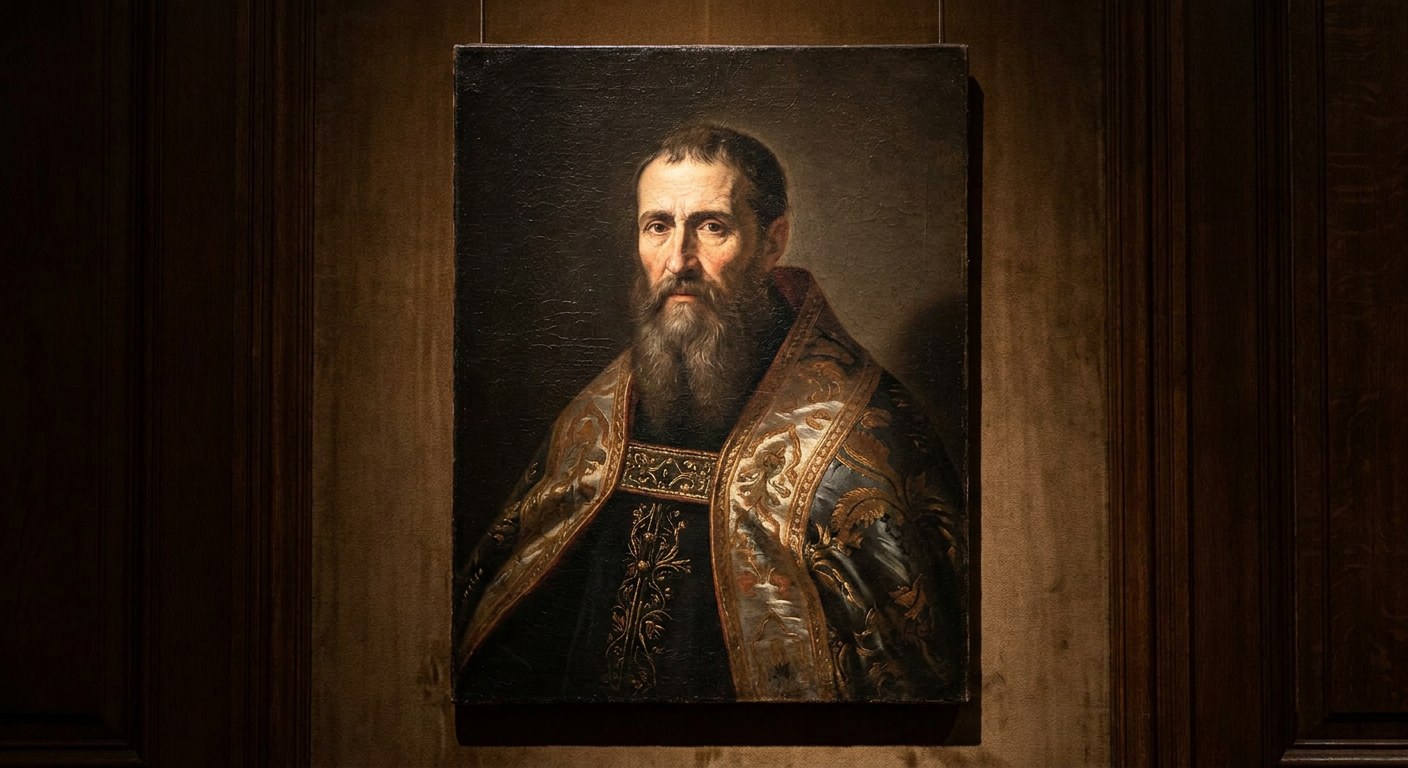
Quick Facts
- Years
- 354 – 430
- Nationality
- Roman North African
- Occupation
- Theologian, Philosopher & Bishop
Augustine of Hippo
354 – 430 · Roman North African · Theologian, Philosopher & Bishop
Recommended Audiobooks
Listen next from Marcus Alden

Life Lessons from Frederic Chopin
Marcus Alden · 54 min

Life Lessons from John Wesley
Marcus Alden · 52 min
Introduction
Augustine of Hippo—often called Saint Augustine—was a Roman North African bishop, theologian, philosopher, preacher, and writer whose ideas profoundly shaped Christianity and Western intellectual history. Born in 354 in the provincial town of Thagaste, he lived through a period of religious transformation and political instability as Christianity became dominant within the Roman Empire and imperial authority in the West began to weaken.
Augustine matters because he joined personal experience, classical philosophy, biblical interpretation, and theological argument with unusual power. His Confessions is simultaneously a prayer, an account of conversion, an investigation of memory, and one of the most influential autobiographical works ever written. In The City of God, composed after the sack of Rome in 410, he offered a sweeping interpretation of history and challenged the idea that Christianity had caused Rome's decline. His writings on grace, freedom, evil, time, language, sexuality, war, political authority, and the nature of the Church influenced medieval Catholicism, Protestant reformers, modern philosophers, and contemporary debates about human identity.
He was also a controversial figure. Augustine's arguments against Donatists and Pelagians strengthened certain doctrines and institutions but contributed to disputes over religious coercion, inherited sin, predestination, and sexuality. His legacy is therefore not merely devotional. It belongs equally to the histories of philosophy, politics, psychology, education, literature, and law.
Quick Facts
| Fact | Details |
|---|---|
| Born | 13 November 354, Thagaste, Numidia, Roman Empire—modern Souk Ahras, Algeria |
| Died | 28 August 430, Hippo Regius, Roman Africa—near modern Annaba, Algeria |
| Nationality | Roman North African |
| Known For | Confessions, The City of God, theology of grace, reflections on time and memory, and influence on Western Christianity |
| Occupation | Bishop, theologian, philosopher, preacher, rhetorician, and author |
| Era | Late antiquity; Patristic period |
Early Life and Education
Aurelius Augustinus was born at Thagaste in the Roman province of Numidia. North Africa was then a prosperous and highly urbanized region of the Roman world, with a vigorous Christian culture alongside traditional Roman religion, local traditions, Judaism, and competing Christian movements. Augustine was culturally Roman and wrote almost entirely in Latin. Claims about his precise ethnic identity should be made cautiously because the surviving evidence does not permit a simple modern classification.
His father, Patricius, was a modest landowner and local official who followed traditional religion for much of his life but received Christian baptism shortly before his death. Augustine's mother, Monica, was a committed Christian. She became one of the most memorable figures in the Confessions, where Augustine portrayed her as persistent in prayer, emotionally devoted to him, and determined to see him embrace Christianity.
The family was respectable but not wealthy. Augustine first studied in Thagaste and nearby Madauros. His education centered on grammar, rhetoric, and the Latin literary classics, especially Virgil. He later admitted that as a schoolboy he disliked Greek, a limitation that affected his later scholarship: although he acquired some knowledge of the language, he was never as comfortable with Greek Christian literature as with Latin texts.
Financial difficulties interrupted his education, but support from a wealthy patron named Romanianus enabled him to study rhetoric at Carthage around 370. Carthage offered intellectual opportunity, entertainment, ambition, and temptation. Augustine pursued a career in public speaking and teaching, the normal route by which a talented provincial might enter imperial service.
At approximately seventeen, he began a long relationship with an unnamed woman. Roman social distinctions made legal marriage difficult or undesirable for a man seeking advancement, and Augustine consistently referred to her as his concubine rather than his wife. Their son, Adeodatus—whose name means “given by God”—was born around 372. Augustine later described Adeodatus as exceptionally intelligent.
During these years, Cicero's now-lost dialogue Hortensius awakened Augustine's passion for philosophy and the pursuit of wisdom. Yet he found the style and apparent simplicity of the Latin Bible disappointing when compared with polished classical literature. Searching for an intellectually satisfying religion, he joined the Manichaeans.
Manichaeism, founded by the Persian religious teacher Mani, presented existence as a cosmic struggle between principles of light and darkness. It attracted Augustine partly because it claimed to offer rational explanations for evil and allowed him to distance God from direct responsibility for wrongdoing. He remained a Manichaean “hearer,” rather than one of its ascetic elite, for about nine years.
Rise to Prominence
Augustine taught rhetoric in Thagaste and Carthage before moving to Rome in 383. His confidence in Manichaeism had already weakened after he met Faustus of Milevis, a celebrated Manichaean bishop whose eloquence impressed him but whose answers to philosophical and scientific questions did not. In Rome, Augustine encountered further professional frustrations and became interested in Academic skepticism, which questioned whether certainty was possible.
In 384 he secured a prestigious appointment as public professor of rhetoric at Milan, then an imperial residence and political center. This position brought him into proximity with the court and with Ambrose, the influential bishop of Milan. Augustine initially admired Ambrose as an orator, but Ambrose's sophisticated, often allegorical interpretation of Scripture helped him see that Christianity was more intellectually defensible than he had assumed.
Neoplatonic writings—probably Latin translations or adaptations of works by Plotinus and Porphyry—were equally important. They helped Augustine conceive of God as immaterial and understand evil not as an independent substance but as a privation or corruption of good. Neoplatonism, however, did not by itself resolve his moral struggle or provide the Christian doctrine of divine grace that became central to his thought.
His conversion unfolded gradually and then dramatically. Augustine's mother arranged a socially advantageous marriage, requiring him to dismiss his longtime partner because she lacked the appropriate status. Their painful separation is one of the most troubling personal episodes in the Confessions. While waiting for his intended bride to reach marriageable age, Augustine took another concubine. He felt increasingly divided between ambition, sexual desire, philosophical conviction, and the Christian life.
In the summer of 386, distressed in a garden in Milan, Augustine heard a child's voice repeating tolle lege—“take up and read.” He opened a collection of Paul's letters and read Romans 13:13–14, an exhortation to abandon revelry and lust and “put on the Lord Jesus Christ.” He interpreted the moment as decisive. He withdrew from his teaching career and prepared for baptism.
Ambrose baptized Augustine, Adeodatus, and Augustine's friend Alypius during the Easter vigil of 387. Later that year Monica died at Ostia while the group waited to return to Africa. Augustine's account of their final shared contemplation at Ostia became one of the most celebrated mystical passages in Christian literature.
After a period in Rome, Augustine returned to Thagaste around 388 and established a small religious community devoted to prayer, study, and shared property. Adeodatus died young, probably before or soon after this return. In 391, while visiting Hippo Regius, Augustine was unexpectedly pressed into ordination as a priest by the local congregation and Bishop Valerius. He later said that he had feared precisely such an outcome. Valerius gave him unusual authority to preach, and around 395 or 396 Augustine became coadjutor and then bishop of Hippo.
Major Achievements and Contributions
As bishop, Augustine combined intellectual production with demanding administrative work. He preached frequently, settled disputes, cared for the poor, trained clergy, corresponded with officials and religious leaders, interpreted Scripture, and acted as a judge in civil cases under the episcopal system recognized by Roman law. Hundreds of his sermons and letters survive, although many works have been lost.
His greatest theological contribution was his sustained account of divine grace. Augustine argued that humanity's will had been damaged by sin and could not achieve righteousness merely through unaided moral effort. Salvation depended upon God's prior and transforming grace. He did not invent the concept of original sin, but he gave it its most influential Latin formulation, linking the fall of Adam to humanity's inherited condition, disordered desire, mortality, and need for redemption.
Augustine also transformed Christian reflection on the self. In the Confessions, introspection is not an end in itself: he searches memory in order to understand the soul before God. His analysis of habit, divided desire, self-deception, grief, and the unstable will has often seemed strikingly modern. Later thinkers from Martin Luther and Blaise Pascal to Søren Kierkegaard and Sigmund Freud engaged, directly or indirectly, with questions Augustine formulated with exceptional intensity.
His philosophy of time remains particularly famous. Augustine argued that the past no longer exists and the future does not yet exist, while the present seems to vanish as soon as it arrives. Human beings nevertheless experience time through memory, attention, and expectation—a “distension” of the mind. He also insisted that creation included time itself, so it was mistaken to imagine God waiting through an earlier stretch of time before creating the universe.
In political thought, The City of God distinguished between the earthly city, shaped by self-love and the pursuit of domination, and the City of God, shaped by love of God. These were not identical with any single state and church institution. They were intermingled within history and would be fully separated only at the final judgment. Augustine therefore denied that the Roman Empire possessed sacred permanence or that political success proved moral righteousness.
His remarks on war contributed to the later Christian just-war tradition. Augustine did not create a complete checklist resembling modern just-war theory, but he argued that public authority, a just cause, and rightly ordered intention mattered when force was used. Peace remained the proper goal, even though fallen societies sometimes employed coercion to restrain injustice.
Augustine also wrote influentially about language and signs. In On Christian Teaching, he explained how words and other signs communicate meaning and offered principles for interpreting difficult biblical passages. His writings affected medieval preaching, education, rhetoric, and theories of interpretation.
Key Works / Battles / Ideas
Confessions
Written around 397–400, the thirteen books of the Confessions recount Augustine's youth, intellectual wandering, moral conflict, conversion, and the death of Monica. The final books turn toward memory, creation, time, and biblical interpretation. The work is addressed to God throughout, making it a prayer and theological meditation rather than a modern autobiography in the ordinary sense.
The City of God
Augustine began The City of God after Visigoths led by Alaric sacked Rome in 410. Some traditionalists blamed Christianity for weakening Roman society. Across twenty-two books, completed around 426, Augustine criticized Roman religious claims, examined political power, and interpreted human history through the symbolic opposition of two cities formed by two loves.
On the Trinity
Composed over many years, On the Trinity explored the Christian doctrine of one God in three persons. Augustine searched for limited analogies within the human mind, especially memory, understanding, and will. He emphasized that such analogies could guide thought without comprehending the divine mystery fully.
On Christian Teaching
This treatise provided a program for interpreting and teaching Scripture. Augustine discussed signs, ambiguity, translation, rhetoric, and the ethical purpose of interpretation. For him, biblical reading should ultimately cultivate love of God and neighbor.
The Donatist controversy
The Donatists were a powerful North African Christian movement that disputed the legitimacy of clergy associated with those who had compromised during earlier persecutions. Augustine argued that sacramental validity depended upon Christ rather than the personal purity of the minister and defended the worldwide unity of the Catholic Church.
The conflict also exposed a darker aspect of his legacy. Although Augustine initially preferred persuasion, he later accepted limited state coercion against Donatists, appealing to the apparent effectiveness of legal pressure and interpreting the biblical phrase “compel them to come in” as justification. He opposed uncontrolled violence and demanded restraint, but his arguments provided later Christians with an influential rationale for religious coercion.
The Pelagian controversy
Pelagius, a British Christian ascetic, emphasized moral responsibility and the human capacity to obey God's commandments. Augustine feared that this minimized the depth of sin and made grace little more than external teaching or forgiveness. He insisted that even the beginning of faith depended on God's grace.
The controversy sharpened Augustine's doctrines of original sin, infant baptism, grace, and predestination. Pelagian positions were condemned by African councils and eventually by imperial and papal authorities. Later generations continued to debate whether Augustine's mature language preserved meaningful human freedom and how his strongest claims should be interpreted.
Evil, freedom, and the will
Rejecting Manichaean dualism, Augustine maintained that everything created by God is good insofar as it exists. Evil is not a rival substance but a privation, disorder, or corruption of the good. Moral evil arises when rational creatures turn from higher, unchangeable goods toward lower goods in a disordered manner. His later emphasis on grace complicated but did not erase his belief in human responsibility.
Timeline of Key Events
| Year | Event |
|---|---|
| 354 | Born on 13 November at Thagaste in Roman Numidia |
| c. 370 | Begins advanced studies in rhetoric at Carthage |
| c. 372 | His son, Adeodatus, is born |
| c. 373 | Reads Cicero's Hortensius and becomes associated with Manichaeism |
| 383 | Moves from Carthage to Rome |
| 384 | Appointed public professor of rhetoric at Milan |
| 386 | Undergoes his decisive conversion to Christianity |
| 387 | Baptized by Ambrose at Milan; Monica dies at Ostia later that year |
| c. 388 | Returns to North Africa and establishes a community at Thagaste |
| 391 | Ordained a priest at Hippo Regius |
| c. 395–396 | Becomes bishop of Hippo |
| c. 397–400 | Writes the Confessions |
| 411 | Participates in the Conference of Carthage against Donatist representatives |
| 410 | Rome is sacked by the Visigoths, prompting the project that becomes The City of God |
| 412–430 | Develops his anti-Pelagian writings on sin, grace, and predestination |
| 426 | Completes or nears completion of The City of God and designates Heraclius as successor |
| 429 | Vandals invade Roman North Africa |
| 430 | Dies on 28 August during the Vandal siege of Hippo Regius |
Personal Life and Character
Most knowledge of Augustine's personality comes from his own writings and from the biography by his disciple Possidius. These sources reveal an emotionally intense, intellectually restless, sociable, and sometimes combative man. He valued friendship deeply and mourned losses with unusual openness. Communities of shared life were central to his adult identity, both before and after he became a bishop.
Augustine could be unsparing toward himself. In the Confessions, he examined childhood jealousy, adolescent theft, sexual desire, professional ambition, and the wish to appear wise. His famous story of stealing pears is not significant because the offense was grave. It allowed him to ask why people sometimes enjoy wrongdoing simply because it is forbidden or shared with companions.
His treatment of his unnamed partner remains morally and historically difficult. They lived together for roughly fifteen years and had a son, yet he sent her away when an advantageous marriage was planned. Augustine reports that she vowed not to know another man, while he soon took another concubine. His grief is evident, but her voice and even her name are absent from the record.
As a bishop, Augustine embraced a disciplined communal life but did not retreat from public affairs. He was known for hospitality, pastoral energy, and extensive correspondence. Possidius described him spending his final days in penitence and prayer. At the same time, his polemical writing could be relentless, and his confidence that doctrinal error endangered souls made compromise difficult.
Challenges and Controversies
Augustine's thought emerged from conflict, and several aspects remain disputed. The most immediate controversy concerns coercion. His support for state penalties against Donatists was conditioned by the violent and unstable setting of Roman Africa, including attacks associated with radical groups commonly called Circumcellions. Nevertheless, Augustine's move from persuasion alone toward legally enforced unity established a troubling precedent. Later persecutors could cite him even when they ignored his calls for mercy and opposition to capital punishment.
His doctrine of original sin became foundational in Western Christianity but was never accepted in exactly the same form by all Christian traditions. Eastern Christian theologians generally placed less emphasis on inherited guilt, while debates within Western churches concerned whether Augustine taught that humanity inherited guilt itself, a corrupted condition, or both. His interpretation of Romans and his imperfect command of Greek influenced the Latin development of the doctrine.
Augustine's anti-Pelagian theology also raised lasting questions about predestination. In some late works, he described God as giving effective grace to an elect number while leaving others in the “mass of perdition.” Supporters see this as a rigorous defense of grace; critics argue that it strains moral responsibility and divine justice. Catholic, Lutheran, Reformed, Jansenist, and other traditions later appropriated him in different ways.
His discussion of sexuality has been criticized for associating sexual desire closely with humanity's fallen condition. Augustine did not teach that the body, marriage, or procreation was inherently evil; in fact, he defended their created goodness against Manichaean contempt for material existence. Yet he viewed involuntary sexual arousal as a vivid sign of the will's loss of inner harmony, and his influence contributed to enduring Christian suspicion of sexual pleasure.
His rhetoric concerning Jews and Judaism also requires critical attention. Augustine rejected forced conversion and developed a “witness” theory according to which Jewish communities should survive within Christian society as bearers of the Scriptures. This position sometimes offered protection compared with more openly eliminationist views. Yet it remained supersessionist, treated Judaism as subordinate to Christianity, and employed language that helped sustain discriminatory attitudes.
Finally, readers must distinguish Augustine's own developing views from later “Augustinianism.” Near the end of his life he wrote the Retractions, reviewing earlier books, correcting statements, and clarifying what he no longer accepted. His thought was not a motionless system but the work of an author who revised arguments across four decades.
Death and Immediate Aftermath
In 429, Vandals crossed from Spain into North Africa under King Geiseric. Their advance destabilized one of the Western Empire's wealthiest regions. By 430 they were besieging Hippo Regius. Augustine, then seventy-five and in failing health, remained in the city.
Possidius reported that Augustine developed a fever during the third month of the siege. He had penitential psalms copied and placed where he could read them from his bed, and he requested privacy for prayer during his final days. Augustine died on 28 August 430.
Hippo did not fall immediately; the Vandals eventually took and burned much of the city after the siege. Possidius stated that Augustine's church and its library were preserved. This mattered greatly because Augustine had supervised the preservation of his writings and asked that the church's library be protected. His books, sermons, and correspondence circulated far beyond North Africa even as Roman rule there collapsed.
The Catholic Church honors Augustine as a saint and Doctor of the Church, traditionally commemorated on 28 August. The Eastern Orthodox Church also venerates him, commonly as Blessed Augustine, while sometimes judging parts of his theological legacy differently from the Latin West.
Legacy and Influence Today
Few ancient writers have had a broader afterlife. Medieval theologians, including Anselm of Canterbury, Bonaventure, and Thomas Aquinas, drew extensively on Augustine, even when integrating his thought with Aristotelian philosophy. Monastic and clerical communities followed rules associated with the Augustinian tradition, although the surviving Rule of Saint Augustine has a complex textual history.
The Protestant Reformation intensified competition over his legacy. Martin Luther had belonged to the Order of Augustinian Hermits and found in Augustine a powerful theology of grace. John Calvin likewise cited him frequently, especially concerning predestination and the weakness of the fallen will. Catholic reformers also claimed Augustine, rejecting the idea that he belonged exclusively to Protestant interpretation.
Philosophers continue to study his arguments about skepticism, knowledge, language, time, memory, and personal identity. René Descartes's turn toward inward certainty has often been compared with Augustine's arguments against skepticism. Phenomenologists and existential thinkers have engaged his descriptions of temporality, anxiety, desire, and selfhood. Political theorists still debate his concepts of peace, authority, civic order, and the libido dominandi—the lust for domination.
In literature, the Confessions helped establish introspective life-writing as a major form. Its influence appears in spiritual autobiography, memoir, conversion narratives, and psychological fiction. Augustine's portrait of a self that remains partly hidden from itself continues to speak to readers outside religious traditions.
Modern scholarship also restores Augustine to his African setting. He was not a medieval European thinker ahead of his time but a late Roman African shaped by Carthage, Numidia, local ecclesiastical rivalries, imperial law, and Mediterranean networks. Recognizing that context makes both his achievements and limitations clearer.
Augustine endures because he treated belief as inseparable from desire, memory, community, and moral struggle. His answers remain contested, but the questions he posed—Why do we act against our judgment? What is evil? How is the past present in memory? Can political power create justice? What does it mean to love rightly?—remain fundamental.
Famous Quotes
Translations vary, but the following are securely grounded in Augustine's works.
“You have made us for yourself, and our heart is restless until it rests in you.”
—Confessions, I.1
“Give me chastity and continence, but not yet.”
—Confessions, VIII.7
“Late have I loved you, Beauty so ancient and so new, late have I loved you!”
—Confessions, X.27
“What, then, is time? If no one asks me, I know; if I wish to explain it to one who asks, I do not know.”
—Confessions, XI.14
“Love, and do what you will.”
—Homilies on the First Epistle of John, 7.8
“Believe so that you may understand.”
—Sermon 43.7.9
“If you understood him, it would not be God.”
—Sermon 52.6.16
Frequently Asked Questions
Who was Augustine of Hippo?
Augustine was a late Roman North African bishop, Christian theologian, philosopher, preacher, and author. He served as bishop of Hippo Regius from the late fourth century until his death in 430 and became one of the most influential thinkers in Western Christianity.
Where was Augustine born?
He was born in Thagaste, Numidia, in the Roman Empire. The site is modern Souk Ahras in northeastern Algeria. He later studied in Carthage and worked in Rome and Milan before returning to North Africa.
Why did Augustine convert to Christianity?
His conversion resulted from years of intellectual and moral development. Dissatisfaction with Manichaeism, encounters with skepticism and Neoplatonism, Ambrose's preaching, Christian friends, Paul's writings, and a growing sense of personal division all played roles. He considered the garden experience of 386 decisive.
What is Augustine's Confessions about?
The Confessions recounts his journey from childhood through intellectual wandering and conversion, but it is more than autobiography. Addressed directly to God, it examines sin, grace, memory, grief, creation, Scripture, and the nature of time.
What did Augustine mean by the City of God?
The City of God is the community formed by love of God, in contrast to the earthly city formed by disordered self-love and domination. The distinction is spiritual and moral, not a simple identification of the City of God with a particular earthly church or state.
Did Augustine invent original sin?
No. Earlier Christian writers had connected humanity's fallen condition with Adam. Augustine, however, developed the doctrine in an especially systematic and influential way, particularly during his disputes with Pelagius and Pelagian theologians.
Was Augustine a pacifist?
Not in an absolute sense. He considered peace the proper goal of society but accepted that legitimate authorities might use force to restrain wrongdoing or defend the innocent. His scattered arguments later contributed to just-war theory.
Is Augustine important outside Christianity?
Yes. His analyses of time, memory, language, skepticism, desire, political power, and personal identity are studied in philosophy, political theory, psychology, literature, classics, and intellectual history.
Lessons We Can Learn
-
Intellectual growth requires revision. Augustine changed his mind repeatedly and even reviewed his earlier writings in the Retractions. Serious thought includes a willingness to correct oneself.
-
Ideas are shaped by lived experience. His reflections on grief, ambition, friendship, habit, and conversion show that philosophy is not detached from biography.
-
Self-knowledge is difficult but valuable. Augustine recognized that people often misunderstand their motives and act against their better judgment. Honest reflection can expose the habits governing behavior.
-
Political success is not the same as moral worth. By denying that Rome's power proved its righteousness, Augustine warned against treating any nation or institution as sacred or permanent.
-
Great thinkers must be studied critically. Augustine's insights coexist with arguments about coercion, sexuality, and religious difference that had harmful consequences. Learning from the past requires neither uncritical admiration nor simple dismissal.
Further Reading
- Peter Brown, Augustine of Hippo: A Biography, revised edition, University of California Press, 2000.
- Henry Chadwick, Augustine: A Very Short Introduction, Oxford University Press, 2001.
- James J. O'Donnell, Augustine: A New Biography, Ecco, 2005.
- Robin Lane Fox, Augustine: Conversions and Confessions, Basic Books, 2015.
- Serge Lancel, Saint Augustine, translated by Antonia Nevill, SCM Press, 2002.
Watch and Learn
The Problem of Evil: Crash Course Philosophy #13 · CrashCourse