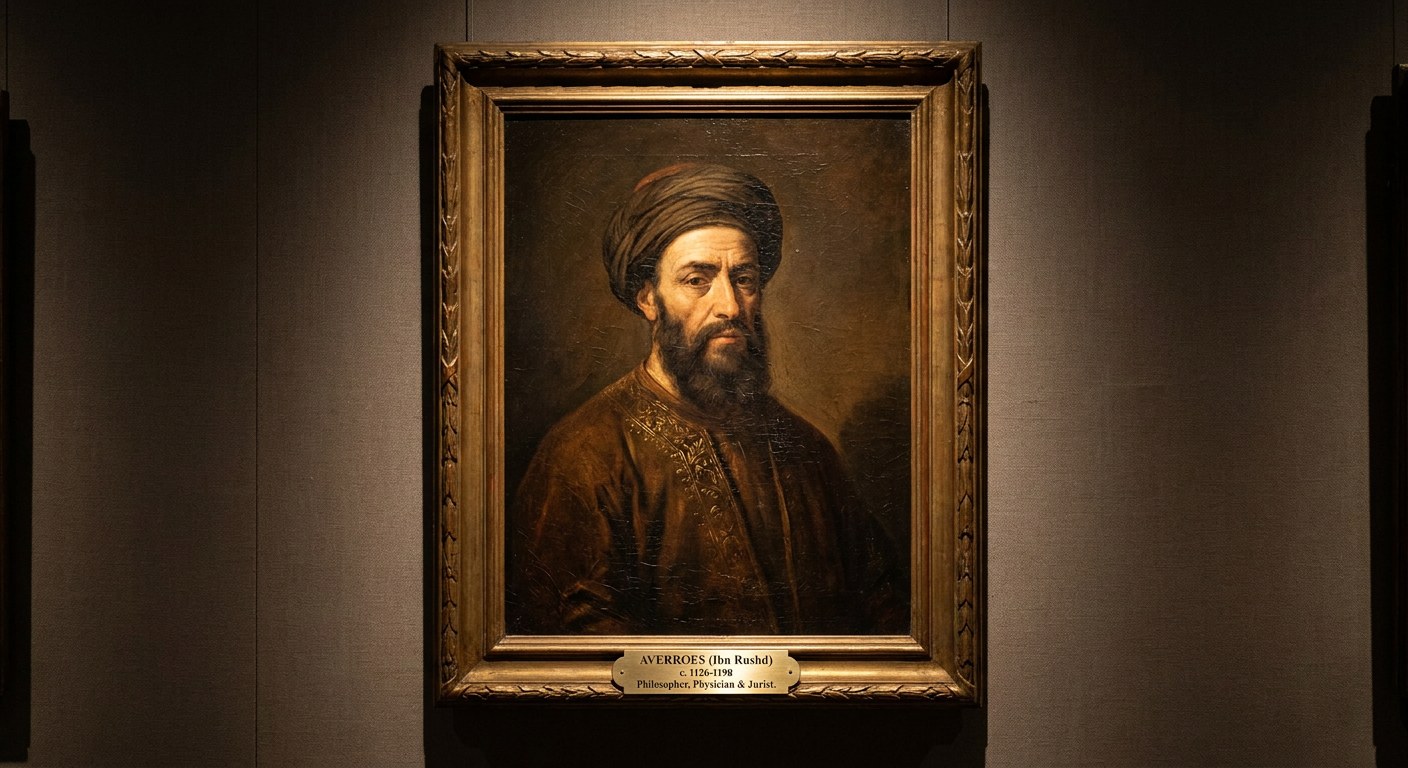
Averroes
1126 – 1198 · Andalusian · Philosopher, Physician & Jurist
Recommended Audiobooks
Listen next from Marcus Alden

Life Lessons from Frederic Chopin
Marcus Alden · 54 min

Life Lessons from John Wesley
Marcus Alden · 52 min
Introduction
Averroes, known in Arabic as Abū al-Walīd Muḥammad ibn Aḥmad ibn Rushd, was one of the most influential philosophers, physicians, jurists, and public intellectuals of the medieval world. Born in Córdoba in 1126, when Muslim-ruled al-Andalus was a major center of scholarship, he became the foremost interpreter of Aristotle in the Islamic West. His writings later transformed philosophical debate in Latin Christian Europe and helped make Aristotelian thought central to medieval university education.
Averroes mattered not merely because he preserved or summarized Aristotle. He attempted to reconstruct Aristotle's arguments with exceptional precision, distinguish demonstration from weaker forms of reasoning, and explain how philosophical inquiry could coexist with revealed religion. His commentaries were so authoritative that European scholars commonly called Aristotle simply the Philosopher and Averroes the Commentator.
His intellectual range was remarkable. He wrote on logic, metaphysics, psychology, astronomy, physics, medicine, law, theology, politics, and the interpretation of scripture. As a trained jurist of the Mālikī school, he produced an important comparative handbook of Islamic law. As a physician, he wrote the medical encyclopedia al-Kulliyyāt fī al-ṭibb, later known in Latin as the Colliget. As a philosopher, he defended disciplined rational investigation against both uncritical traditionalism and what he considered philosophically inadequate attacks on the Greek intellectual inheritance.
Averroes' legacy is also full of ironies. His philosophical works exercised a deeper and more continuous influence in Jewish and Christian intellectual circles than they initially did in much of the Islamic world. Latin thinkers debated so-called Averroism for centuries, sometimes adopting doctrines that Averroes himself may not have held in the simplified form attributed to him. At the same time, modern portrayals that reduce him to a secular rationalist opposing religion distort a thinker who was also a Muslim judge, legal scholar, and interpreter of revelation.
Averroes remains important because he confronted questions that still resonate: Can faith and reason lead to compatible truths? Who is qualified to interpret difficult religious texts? What distinguishes demonstrative knowledge from persuasive opinion? What place should philosophy have in public life? His answers emerged from the particular intellectual and political world of twelfth-century al-Andalus, yet their influence became global.
Quick Facts
| Fact | Details |
|---|---|
| Born | 14 April 1126, Córdoba, al-Andalus, Almoravid Empire |
| Died | 10 December 1198, Marrakesh, Almohad Caliphate |
| Nationality | Andalusian; subject of the Almoravid and later Almohad realms |
| Known For | Commentaries on Aristotle, defense of philosophy, Islamic jurisprudence, medicine, and the tradition called Averroism |
| Occupation | Philosopher, physician, judge, jurist, theologian, and court adviser |
| Era | Islamic Golden Age; High Middle Ages |
Early Life and Education
Averroes was born in Córdoba into a prominent family of Mālikī legal scholars. His grandfather, also named Abū al-Walīd Muḥammad ibn Rushd, had served as chief judge of Córdoba and was a respected authority on jurisprudence. Averroes' father, Abū al-Qāsim Aḥmad, likewise held judicial office. This family environment gave the young Ibn Rushd access to elite education and immersed him in the practical relationship between law, religion, scholarship, and government.
Córdoba had lost some of the political supremacy it enjoyed under the earlier Umayyad caliphate, but it remained one of the western Mediterranean's most distinguished intellectual centers. Its scholars participated in a broad Arabic-language culture stretching from Iberia and North Africa to Egypt, Syria, Iraq, and Central Asia. Books, legal opinions, scientific techniques, and philosophical controversies circulated across this world.
Averroes received the education expected of a learned Andalusian jurist. He studied the Quran, Arabic language and literature, prophetic traditions, theology, and Mālikī jurisprudence. Mālikism, the dominant legal school in al-Andalus and the Maghreb, emphasized the legal traditions associated with Medina while also possessing a substantial body of interpretive reasoning.
He also studied medicine and the mathematical sciences. His medical teachers probably included Abū Jaʿfar ibn Hārūn of Trujillo, although the surviving evidence about his education is incomplete. Averroes became familiar with the writings of Galen, Hippocrates, and major Islamic physicians. In philosophy and science he encountered Aristotle through Arabic translations and through interpreters such as Alexander of Aphrodisias, Themistius, al-Fārābī, Avicenna, and the Andalusian philosopher Avempace, or Ibn Bājja.
Averroes did not accept these authorities uncritically. A defining feature of his mature scholarship was his effort to separate Aristotle's own positions from later Neoplatonic additions and from interpretations he regarded as mistaken. He especially disagreed with important aspects of Avicenna's synthesis of Aristotelianism and Islamic metaphysics.
The biographical record of his youth is limited, and no reliable evidence supports elaborate stories about an early conversion from religious traditionalism to philosophy. His later career instead suggests that law, medicine, philosophy, and religious learning developed together as complementary parts of his education.
Rise to Prominence
Averroes came of age during a period of political transformation. The Almoravids, who ruled al-Andalus when he was born, were displaced by the Almohads, a reformist movement originating among the Berbers of North Africa. By 1147 the Almohads controlled Marrakesh, and during the following years they absorbed much of Muslim Iberia.
His path to court prominence was assisted by Ibn Ṭufayl, the philosopher and physician best known for the philosophical tale Ḥayy ibn Yaqẓān. Ibn Ṭufayl served the Almohad caliph Abū Yaʿqūb Yūsuf, an educated ruler interested in philosophy. According to a later account, Ibn Ṭufayl introduced Averroes to the caliph around 1169. The ruler asked him whether philosophers considered the heavens created or eternal. Averroes was initially alarmed by the politically and theologically sensitive question, but the caliph's own informed discussion reassured him.
The caliph reportedly complained that Aristotle's books were difficult and that existing explanations did not always make their arguments clear. Ibn Ṭufayl encouraged Averroes to write accessible and accurate commentaries. This commission became the foundation of Averroes' international reputation.
Around 1169 Averroes was appointed judge, or qāḍī, in Seville. He returned to Córdoba and eventually became its chief judge, continuing his family's judicial tradition. These offices were substantial responsibilities rather than ceremonial distinctions. They required expertise in legal procedure, evidence, contracts, family law, commerce, inheritance, and the relationship between jurists and political authorities.
In 1182 Averroes succeeded Ibn Ṭufayl as physician to Caliph Abū Yaʿqūb Yūsuf. He retained influence under the caliph's son, Abū Yūsuf Yaʿqūb al-Manṣūr. His court position gave him patronage and access to scholarly resources, but it also tied his fortunes to the changing religious and political priorities of the Almohad state.
Despite judicial and medical duties, Averroes wrote at an extraordinary pace. A report attributed to him states that he failed to study only on two nights of his adult life: the night of his marriage and the night his father died. Whether literal or not, the story reflects the reputation for discipline that surrounded him.
Major Achievements and Contributions
The great commentator on Aristotle
Averroes' most famous achievement was his extensive commentary on Aristotle. He produced three general types: concise summaries or epitomes, middle commentaries, and detailed long commentaries. Not every Aristotelian work received every form of commentary, and the surviving corpus is uneven across Arabic, Hebrew, and Latin manuscripts.
The short works presented the conclusions of a discipline in an organized form. The middle commentaries paraphrased and explained Aristotle's text. The long commentaries divided the text into sections, quoted it, and analyzed its terminology and arguments in detail. This method enabled readers to distinguish Aristotle's words from the commentator's explanation.
Averroes addressed works dealing with logic, natural philosophy, the heavens, generation and corruption, meteorology, the soul, metaphysics, ethics, poetry, and rhetoric. Because Aristotle's Politics was apparently unavailable to him, he wrote a commentary on Plato's Republic instead.
His goal was recovery as much as explanation. He wanted to identify the authentic structure of Aristotle's thought and remove interpretations derived from later commentators. Although modern historians do not regard all his readings as textually correct, his analytical rigor reshaped medieval philosophy.
Philosophy and revealed religion
In Faṣl al-maqāl, usually translated as the Decisive Treatise, Averroes argued that Islamic law commands reflection on creation because created things point toward their maker. If demonstrative reasoning establishes a conclusion that appears to conflict with the literal wording of scripture, qualified scholars should seek an allegorical or figurative interpretation.
This did not mean that everyone should interpret scripture however they wished. Averroes distinguished among demonstrative, dialectical, and rhetorical forms of reasoning. Different audiences possessed different levels of preparation, and publicizing subtle interpretations among people unable to assess them could produce confusion. His position was therefore simultaneously rationalist and intellectually hierarchical.
He did not teach a crude doctrine of two contradictory truths, one religious and one philosophical. The famous Latin theory of double truth was largely a polemical construction associated with later debates. For Averroes, truth was coherent: properly conducted demonstration and correctly interpreted revelation could not ultimately contradict one another.
Response to al-Ghazālī
The Persian theologian al-Ghazālī had criticized the philosophers in The Incoherence of the Philosophers, charging figures such as al-Fārābī and Avicenna with serious errors. Averroes responded in Tahāfut al-tahāfut, or The Incoherence of the Incoherence.
He defended philosophical demonstration while carefully distinguishing Aristotle from Avicenna. The work discusses causality, divine knowledge, creation, the nature of the heavens, and bodily resurrection. Averroes argued that denying stable causal relations undermined rational knowledge, although he did not imagine natural causes as independent of God. Created things possess natures and causal powers within the divinely grounded order of reality.
Jurisprudence
Averroes' Bidāyat al-mujtahid wa-nihāyat al-muqtaṣid is one of the most enduring works of comparative Islamic law. Rather than merely listing Mālikī rulings, it explains disagreements among legal schools and identifies the scriptural, linguistic, and methodological reasons behind them.
The book covers ritual worship, marriage, divorce, commerce, crimes, judicial procedure, inheritance, warfare, and other fields. It demonstrates that Averroes was not a philosopher detached from Islamic legal practice. His attention to disagreement reveals a comparative mind interested in why rational and textual methods produce different conclusions.
Medicine
In medicine, Averroes composed al-Kulliyyāt fī al-ṭibb, meaning the general principles of medicine. Its Latin title, Colliget, derives from the Arabic name. The work is organized around anatomy, health, disease, symptoms, drugs and foods, hygiene, and therapy.
Averroes sought general principles rather than an exhaustive catalogue of particular remedies. The book circulated together with the Taysīr, a practical medical work by his friend Ibn Zuhr, known in Latin as Avenzoar. Translated into Latin and Hebrew, the Colliget became influential in European medical education.
Astronomy and natural science
Averroes criticized the mathematically successful but physically awkward devices used in Ptolemaic astronomy, especially eccentric circles and epicycles. He hoped for an astronomical system consistent with Aristotelian physics and composed works on the celestial sphere. He did not solve the technical problem, but his criticism contributed to a tradition of astronomical reform in al-Andalus and the Maghreb.
His scientific writings also examined motion, matter, change, sensation, and the structure of living beings. He treated natural philosophy as demonstrative inquiry into a coherent causal order rather than as a loose collection of observations.
Key Works / Battles / Ideas
Decisive Treatise
The Decisive Treatise is a legal-philosophical argument about the status of philosophy under Islamic law. Averroes maintains that studying beings through rational demonstration is obligatory, or at least recommended, for qualified people because scripture repeatedly calls human beings to reflect upon creation.
The work also presents rules for interpretation. Demonstrative certainty can justify moving beyond a text's apparent meaning, but allegorical interpretation belongs to those trained to perform it. The treatise is therefore not a modern manifesto for unrestricted private judgment; it is an argument for protecting specialized philosophical inquiry within a religious legal order.
The Incoherence of the Incoherence
This work answers al-Ghazālī point by point. Written as a sustained disputation, it quotes or summarizes passages from al-Ghazālī before responding. Averroes' defense of causality became particularly influential. Fire, for example, has a genuine causal relationship to burning, even though all created powers ultimately depend upon God.
The book also shows Averroes correcting fellow philosophers. He believed that al-Ghazālī sometimes attacked Avicennian positions as though they represented philosophy as a whole. Averroes' defense was consequently a reconstruction of Aristotelian philosophy, not an indiscriminate defense of every Muslim philosopher.
Commentaries on De anima
Averroes' interpretation of Aristotle's On the Soul generated his most controversial legacy. He distinguished the material or potential intellect from the active intellect and argued that intellect, properly understood, is separate from individual bodily organs. Latin readers interpreted him as teaching that all human beings share a single intellect.
This raised a serious problem: if intellect is one and shared, in what sense does an individual person think, survive death, or deserve reward and punishment? Averroes attempted to explain individual thought through the relationship between the separate intellect and each person's images or imaginative representations. His precise position changed over time and remains debated by scholars.
Bidāyat al-mujtahid
This legal masterpiece compares the principal Sunni schools and occasionally other opinions. Its title may be rendered The Distinguished Jurist's Primer. The work identifies the roots of disagreement rather than presenting diversity as mere error. It remains studied in Islamic legal education and modern scholarship.
Commentary on Plato's Republic
Averroes adapted Plato's political philosophy to an Islamic setting. He omitted some elements of the Greek dialogue and concentrated on education, virtue, leadership, and the decline of political regimes. He also argued that women possess the capacity to perform many of the same civic functions as men if educated appropriately. He criticized societies that confined women to reproduction and domestic service, thereby wasting much of the community's productive capacity.
The unity of truth
A central Averroean idea is that demonstrated truth cannot conflict with truth revealed by God. Apparent contradictions arise from defective reasoning, misinterpretation, or failure to distinguish levels of discourse. Philosophy and revelation use different methods and address audiences in different ways, but they concern one reality.
Timeline of Key Events
| Year | Event |
|---|---|
| 1126 | Born in Córdoba on 14 April into a distinguished family of Mālikī judges. |
| 1147 | The Almohads capture Marrakesh; their expanding state soon reshapes the politics of al-Andalus. |
| 1150s–1160s | Studies Islamic law, theology, medicine, philosophy, and the mathematical sciences. |
| c. 1169 | Introduced by Ibn Ṭufayl to Caliph Abū Yaʿqūb Yūsuf and encouraged to explain Aristotle. |
| 1169 | Appointed judge in Seville; begins or intensifies work on Aristotelian commentaries. |
| 1171 | Returns to Córdoba, where he continues judicial and scholarly work. |
| 1170s | Produces important philosophical epitomes, commentaries, and legal writings. |
| c. 1177–1180 | Completes the Decisive Treatise and related works on philosophy and religion. |
| 1180 | Dates the completion of The Incoherence of the Incoherence to this period. |
| 1182 | Becomes chief judge of Córdoba and succeeds Ibn Ṭufayl as court physician. |
| 1180s–1190s | Produces major long commentaries on Aristotle and revises earlier philosophical positions. |
| 1195 | Falls from favor under Caliph al-Manṣūr and is banished for a time, probably to Lucena. |
| 1197–1198 | Restored to court favor and recalled to Marrakesh. |
| 1198 | Dies in Marrakesh on 10 December; his remains are later taken to Córdoba. |
| 13th century | Latin and Hebrew translations spread his writings across European and Jewish intellectual communities. |
| 1270 and 1277 | Parisian condemnations target propositions associated with radical Aristotelianism and Latin Averroism. |
Personal Life and Character
Far less is known about Averroes' private life than about his public offices and books. Sources indicate that he married and had children. At least one son, Abū Muḥammad ʿAbd Allāh, became a physician, and descendants of the family continued to occupy respected positions. The absence of detailed personal documentation makes it unwise to reconstruct his domestic life imaginatively.
Contemporaries and later biographers portrayed him as disciplined, courteous, serious, and exceptionally devoted to study. His writings support the image of a systematic mind. Even in polemical works he usually analyzes an opponent's argument before answering it. He respected al-Ghazālī's intelligence despite criticizing his methods and conclusions.
Averroes combined intellectual confidence with respect for specialized expertise. He believed demonstrative philosophy could reach certainty, but only through rigorous education. He did not assume that every argument should be communicated identically to every audience. This elitist feature of his thought can appear uncomfortable today, but it was central to his account of education and social stability.
His legal work also reveals a practical temperament. He was interested not only in abstract rules but in the causes of scholarly disagreement. His medical writing similarly sought a structured relationship between general theory and clinical practice.
The philosopher was deeply embedded in Almohad society. He served rulers, applied Islamic law, and wrote within institutions of patronage. He should therefore be understood neither as an isolated freethinker nor as a passive court servant. His life involved a continuing negotiation among scholarship, professional duty, religious authority, and political power.
Challenges and Controversies
The greatest crisis of Averroes' life came in the mid-1190s. Caliph al-Manṣūr, who had previously favored him, ordered his banishment and publicly distanced the regime from philosophy. Some of Averroes' teachings were condemned, and philosophical books were reportedly restricted or burned. Averroes was sent to Lucena, a town near Córdoba associated with a substantial Jewish population.
The exact cause remains uncertain. Later biographers offered different explanations, including an allegedly disrespectful reference to the caliph, complaints by religious scholars, and politically damaging interpretations of Averroes' writings. The wider context probably mattered more than any single incident. After military campaigns in Iberia, al-Manṣūr had reasons to cultivate support among conservative jurists and to display religious orthodoxy. A court philosopher could become a convenient target amid changing political needs.
The punishment was temporary. Averroes was eventually recalled to Marrakesh, suggesting that the charges were not treated as permanent proof of heresy. Nevertheless, the episode demonstrated the vulnerability of scholarship dependent on royal patronage.
His philosophical teachings generated longer controversies after his death. The unity of the intellect appeared to threaten individual immortality. His defense of the eternity of celestial motion, derived from Aristotle, seemed difficult to reconcile with creation understood as an event beginning at a first moment. His account of divine knowledge was likewise criticized by theologians who feared it limited God's knowledge of particulars.
Averroes attempted nuanced solutions. He distinguished divine knowledge from human knowledge and rejected the idea that God knows things merely as humans do. Yet his formulations remained controversial in Muslim, Jewish, and Christian settings.
In thirteenth-century Europe, thinkers labeled Latin Averroists were accused of teaching conclusions contrary to Christian doctrine while accepting them philosophically. Bishop Étienne Tempier's condemnations at Paris in 1270 and 1277 included propositions connected to this intellectual environment. Thomas Aquinas wrote On the Unity of the Intellect Against the Averroists, attacking the doctrine of one intellect for all humans while continuing to respect Averroes as a major interpreter of Aristotle.
The label Averroism must therefore be used carefully. It can refer to Averroes' own philosophy, to Jewish interpretations of his work, to Latin Aristotelian traditions inspired by him, or to positions constructed by opponents. These were related but not identical phenomena.
Death and Immediate Aftermath
Averroes died in Marrakesh on 10 December 1198, approximately seventy-two years old. He had been restored to favor shortly before his death, but he did not live long enough to rebuild fully the position he had held before his disgrace.
His body was initially buried in Marrakesh and later transferred to Córdoba. The Sufi thinker Ibn ʿArabī reported witnessing the transfer. In a famous symbolic scene, the coffin containing Averroes' remains was placed on one side of a pack animal and his books on the other to balance the load. A companion reportedly reflected upon the man on one side and his works on the other. Whether interpreted literally or symbolically, the account became an evocative image of a scholar surviving through his books.
Averroes left students, relatives, and a substantial written corpus, but philosophy did not retain the same institutional prominence in the western Islamic world. Some Arabic originals disappeared, surviving only in Hebrew or Latin translations. Political instability, changing educational priorities, and suspicion toward parts of the philosophical tradition all affected transmission.
Yet the immediate decline of his school in al-Andalus did not mean the end of his influence. Translation carried his thought into new intellectual worlds just as Christian conquests were reducing Muslim political control in Iberia.
Legacy and Influence Today
Averroes' greatest posthumous impact occurred through translation. From the early thirteenth century onward, scholars translated his commentaries into Latin, sometimes from Arabic and sometimes through Hebrew intermediaries. Michael Scot, working in circles connected with the court of Frederick II, was among the important translators associated with this movement.
At medieval universities, Averroes became indispensable to the study of Aristotle. Albert the Great, Thomas Aquinas, Siger of Brabant, Boethius of Dacia, and many others engaged his interpretations. Even thinkers who rejected his conclusions relied on the questions he had framed. Dante placed Averroes among the virtuous non-Christians in Limbo and called him the one who made the great commentary.
His influence on Jewish philosophy was equally significant. Jewish scholars translated many of his works into Hebrew, preserving texts whose Arabic originals were later lost. Moses Maimonides knew and respected Averroes' Aristotelian writings, although the precise relationship between the two thinkers requires careful chronology. Later figures such as Gersonides engaged deeply with Averroean psychology, astronomy, and metaphysics.
During the Renaissance, Averroist traditions remained prominent at Italian universities, especially Padua and Bologna. Philosophers debated the intellect, immortality, natural causation, and the proper interpretation of Aristotle. Printed editions often placed Aristotle's text beside Averroes' commentary, visually enacting his status as the authoritative interpreter.
Modern assessments have changed repeatedly. Nineteenth- and early twentieth-century writers sometimes portrayed Averroes as a secular hero crushed by Islamic orthodoxy. Others treated him as little more than a transmitter of Greek thought to Europe. Both views are inadequate. He was an original philosopher working within Islamic legal and theological debates, and his ideas cannot be reduced to their later European reception.
Today, Averroes is frequently invoked as a symbol of intellectual exchange among Islamic, Jewish, and Christian civilizations. Universities, medical institutions, cultural organizations, and even a lunar crater bear his name. The asteroid 8318 Averroes also commemorates him.
His comparative jurisprudence remains useful to scholars of Islamic law. Historians of medicine study his effort to organize general medical knowledge. Philosophers continue to analyze his theories of intellect, causation, interpretation, and religious language. Political theorists have renewed interest in his reading of Plato and his remarks on women's civic capacities.
Averroes' enduring importance lies not in a simple victory of reason over faith, but in his more demanding claim that reason, law, and revelation each require disciplined interpretation. He believed intellectual conflict should be addressed by clarifying methods, concepts, and audiences. That commitment made him one of history's most consequential mediators between traditions.
Famous Quotes
Translations of Averroes vary. The following passages are genuinely drawn from works attributed to him rather than from popular internet sayings.
“The activity of philosophy is nothing more than study of existing beings and reflection on them as indications of the Artisan.”
— Decisive Treatise
“Truth does not contradict truth; rather, it agrees with and bears witness to it.”
— Decisive Treatise
“Since this religion is true and summons to the study which leads to knowledge of the truth, we, the Muslim community, know definitively that demonstrative study does not lead to conclusions conflicting with what Scripture has given us.”
— Decisive Treatise
“Whenever the conclusion of a demonstration is in conflict with the apparent meaning of Scripture, that apparent meaning admits of allegorical interpretation.”
— Decisive Treatise
“The philosophers inquire into beings only insofar as they are indications of the Artisan.”
— Decisive Treatise
“Women in these cities may attain the same ranks as men.”
— Commentary on Plato's Republic, in the context of education and civic capacities
Widely circulated lines such as the claim that ignorance leads to fear, fear to hatred, and hatred to violence cannot be securely traced to Averroes and should not be treated as authentic quotations.
Frequently Asked Questions
What was Averroes' real name?
His Arabic name was Abū al-Walīd Muḥammad ibn Aḥmad ibn Muḥammad ibn Rushd. Averroes is the Latinized form of Ibn Rushd, produced through medieval patterns of transliteration.
Was Averroes Spanish or Arab?
Modern national categories fit him imperfectly. He was born in Córdoba in al-Andalus, in present-day Spain, and wrote in Arabic within an Islamic civilization ruled during his life by the Almoravids and Almohads. He is most accurately described as an Andalusian Muslim scholar. Sources generally identify his family as Arab, although modern claims about ethnicity should be made cautiously.
What is Averroes best known for?
He is best known for his commentaries on Aristotle and his defense of philosophical inquiry in relation to Islam. He was also an important Mālikī jurist and physician whose legal and medical books remained influential for centuries.
Did Averroes believe in two separate truths?
No. The doctrine commonly called double truth is not a satisfactory description of his position. Averroes argued that genuine demonstration and correctly understood revelation cannot contradict each other because truth is consistent with truth. Apparent conflicts require closer reasoning or interpretation.
Why was Averroes exiled?
The precise reason is unknown. His fall in 1195 probably reflected a combination of court politics, pressure from religious opponents, and al-Manṣūr's desire to emphasize orthodoxy. He was later pardoned and recalled to Marrakesh.
How did Averroes influence Thomas Aquinas?
Aquinas learned from Averroes' close readings of Aristotle and cited him frequently. He also strongly opposed the Averroist interpretation of a single intellect shared by all human beings. Averroes thus influenced Aquinas both as an authority and as a major philosophical adversary.
Was Averroes a scientist?
In medieval terms, he was a natural philosopher and physician rather than a scientist in the modern professional sense. He wrote on medicine, astronomy, physics, psychology, and biology, using observation and rational analysis within an Aristotelian framework.
Are Averroes' works still studied?
Yes. The Decisive Treatise, The Incoherence of the Incoherence, The Distinguished Jurist's Primer, the Colliget, and his Aristotelian commentaries remain important in philosophy, Islamic studies, legal history, medical history, and the study of medieval Europe.
Lessons We Can Learn
-
Serious disagreement requires accurate understanding. Averroes tried to reconstruct an opponent's reasoning before criticizing it. His example encourages readers to distinguish argument from caricature.
-
Different disciplines can illuminate one another. His work joined law, philosophy, medicine, theology, and science rather than treating knowledge as a collection of isolated specialties.
-
Translation can transform world history. Averroes' movement from Arabic into Hebrew and Latin shows how ideas can survive lost manuscripts, political collapse, and cultural boundaries.
-
Intellectual freedom is vulnerable to political change. His exile demonstrates how quickly court favor and scholarly security can disappear when rulers alter their alliances or public priorities.
-
Tradition and reason need not be simple enemies. Averroes approached rational inquiry as a disciplined means of understanding creation and revelation. Whether or not one accepts his conclusions, his work challenges simplistic accounts of an inevitable conflict between religion and philosophy.
Further Reading
- Majid Fakhry, Averroes: His Life, Works and Influence. A concise scholarly introduction to Averroes' career and philosophical significance.
- Oliver Leaman, Averroes and His Philosophy. A thematic study of Averroes' major arguments and their place in Islamic philosophy.
- Dominique Urvoy, Ibn Rushd (Averroes). A substantial intellectual biography attentive to the political and religious setting of al-Andalus.
- Averroes, The Decisive Treatise and Epistle Dedicatory, translated by Charles E. Butterworth. A reliable English translation of Averroes' defense of philosophy.
- Averroes, The Incoherence of the Incoherence, translated by Simon van den Bergh. A major English edition of his response to al-Ghazālī, with extensive notes.
Watch and Learn
Ibn Rushd (Averroes) – The Great Islamic Philosopher · Let's Talk Religion