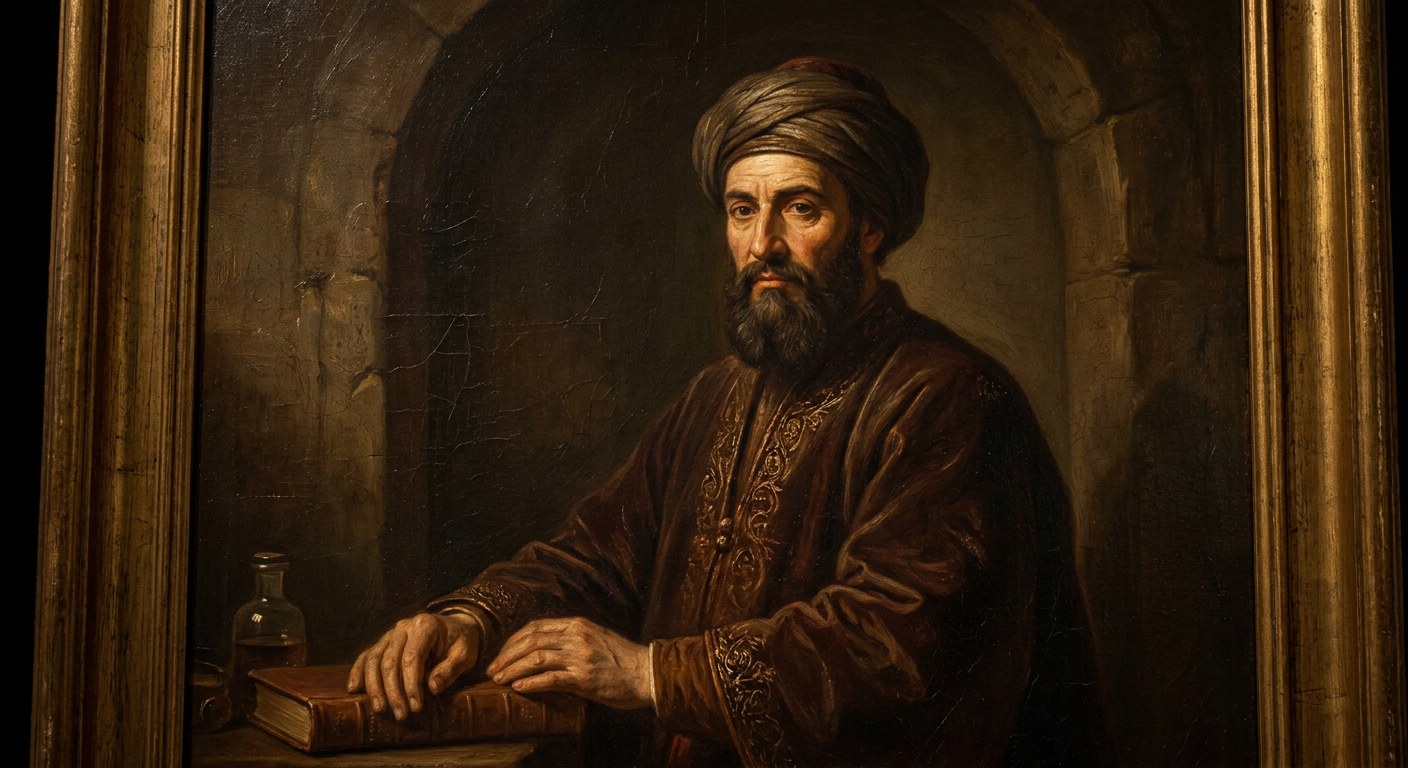
Avicenna
980 – 1037 · Persian · Physician, Philosopher & Polymath
Recommended Audiobooks
Listen next from Marcus Alden

Life Lessons from Frederic Chopin
Marcus Alden · 54 min

Life Lessons from John Wesley
Marcus Alden · 52 min
1. Introduction
Avicenna, known in Persian and Arabic as Ibn Sina, was one of the most influential physicians, philosophers and scientists of the medieval world. Born around 980 in the eastern territories of the Islamic world, he produced an extraordinary body of writing that attempted to organize nearly all the major fields of knowledge available in his age. His works addressed medicine, logic, natural philosophy, metaphysics, psychology, astronomy, mathematics, music, theology and ethics.
His best-known medical encyclopedia, The Canon of Medicine, became an authoritative reference across the Islamic world and, in Latin translation, in European universities. It remained part of medical education for centuries. His vast philosophical encyclopedia, The Book of Healing, was not a medical textbook despite its title; it sought instead to heal the mind from ignorance through a systematic presentation of logic, natural science, mathematics and metaphysics.
Avicenna matters because he did more than preserve Greek learning. Drawing on Aristotle, Galen, Neoplatonic thinkers and earlier Muslim philosophers—especially al-Farabi—he constructed an original intellectual system. His distinction between essence and existence, his analysis of causation and his proof of a Necessary Existent profoundly influenced Islamic theology, Jewish philosophy and Latin scholasticism. Thinkers as different as Thomas Aquinas, Duns Scotus, Maimonides and Shahab al-Din al-Suhrawardi engaged with his ideas.
He was also a practicing physician and political official whose life unfolded amid warfare and dynastic fragmentation. He served rulers, treated members of royal courts, administered government, endured imprisonment and repeatedly fled political upheaval. Much of what is known about his life comes from an autobiography dictated to his student and companion Abu Ubayd al-Juzjani, who continued the account after Avicenna's narrative ended.
Although some of his scientific theories were later superseded, his insistence on rational investigation, organized clinical knowledge and philosophical demonstration made him a defining scholar of the Islamic Golden Age and one of the most consequential intellectual figures in world history.
2. Quick Facts
| Category | Information |
|---|---|
| Born | Around 980, Afshana near Bukhara, Samanid Empire, in present-day Uzbekistan |
| Died | June 1037, Hamadan, in present-day Iran |
| Nationality | Persian; a subject of successive Central Asian and Iranian dynasties |
| Known For | The Canon of Medicine, The Book of Healing, Avicennian philosophy and the Flying Man thought experiment |
| Occupation | Physician, philosopher, scientist, author, court adviser and vizier |
| Era | Islamic Golden Age; late 10th and early 11th centuries |
3. Early Life and Education
Avicenna's full name was Abu Ali al-Husayn ibn Abd Allah ibn Sina. He was born in the village of Afshana, close to Bukhara, around 980. Bukhara was then the capital of the Samanid dynasty, a Persianate state that encouraged scholarship and played a major role in the cultural revival of the Persian language. Although Avicenna wrote most of his scholarly works in Arabic—the principal international language of learning in the Islamic world—he also composed important works and poetry in Persian.
His father, Abd Allah, came from Balkh and served as a local administrator in the Samanid government. His mother, Setareh, was from the region near Bukhara. The household appears to have been intellectually active. Avicenna later recalled discussions involving philosophy, mathematics and the Ismaili movement, whose missionaries sought to persuade his father and brother. Avicenna listened to their arguments but did not adopt their doctrines.
He received the education expected of a gifted Muslim boy, studying the Quran, Arabic language and literature. According to his own account, he had memorized the Quran and mastered substantial literary learning by the age of ten. His father then arranged instruction in arithmetic, jurisprudence, philosophy and other subjects.
One of Avicenna's teachers was Abu Abd Allah al-Natili, who introduced him to formal logic and philosophical texts. The relationship soon revealed the pupil's unusual ability. Avicenna claimed that he frequently understood problems more deeply than his tutor. He proceeded to study Euclid's geometry and Ptolemy's Almagest, often working independently after receiving initial guidance.
Medicine attracted him while he was still an adolescent. In his autobiography, Avicenna described it as less difficult than mathematics and metaphysics, though that claim should be understood as an expression of confidence rather than a dismissal of the discipline. He read existing authorities, observed experienced practitioners and began treating patients. Clinical experience, he said, revealed methods of treatment that could not be learned from books alone.
By about sixteen, he had become known locally as a physician. He continued an intense program of study, reportedly working late into the night and using logic to reduce difficult questions to their basic premises. When exhausted, he slept and sometimes found that solutions appeared to him in dreams. His autobiographical account also says that he prayed in a mosque when confronted by especially stubborn intellectual problems.
Metaphysics initially proved more difficult. Avicenna famously recalled reading Aristotle's Metaphysics forty times until he had memorized the text without understanding its central purpose. The breakthrough came when he purchased a short work by al-Farabi explaining the aims of Aristotle's book. The episode demonstrates the importance of earlier Islamic philosophers to Avicenna's development, even though he eventually built a distinctive system of his own.
4. Rise to Prominence
Avicenna's medical reputation brought him to the Samanid court. The emir Nuh ibn Mansur suffered from an illness that court physicians had been unable to cure, and the young Avicenna was invited to participate in his treatment. After the emir recovered, Avicenna received access to the royal library at Bukhara. Its collection introduced him to rare books and expanded his command of philosophy and science.
He was probably no more than eighteen when he concluded that he had mastered the principal disciplines of his time. This did not mean that his thought ceased developing; rather, he believed that he had acquired the fundamental concepts and methods from which later works could be constructed.
The political world around him soon collapsed. The Samanid state fell to the Qarakhanids in 999, and Avicenna's father died not long afterward. Without his father's position and facing uncertain conditions, Avicenna left Bukhara. For the remainder of his life, he moved among courts and cities in Khwarazm and western Iran, seeking patrons, employment and security.
He first traveled to Gurganj in Khwarazm, where the learned minister Abu al-Husayn al-Sahli introduced him to the local ruler. Avicenna found a stimulating scholarly environment there, but the expanding power of Mahmud of Ghazni threatened the region. Later traditions claim that Avicenna avoided Mahmud's demand that leading scholars join his court. Whatever the precise circumstances, he left Khwarazm and undertook a difficult journey through towns including Nasa, Tus and Gorgan.
At Gorgan, near the Caspian Sea, Avicenna met al-Juzjani, who became his devoted pupil, secretary and biographer. Their association lasted for the rest of Avicenna's life. In Gorgan, Avicenna began or continued work on The Canon of Medicine and delivered lectures on logic and astronomy.
He later moved to Rayy, where he treated the Buyid ruler Majd al-Dawla and served his court. Political conflict eventually drove him toward Hamadan. There he successfully treated the Buyid emir Shams al-Dawla for colic and was appointed vizier. The office brought prestige but also danger. Army officers resented his policies, mutinied and demanded his execution. The emir refused to kill him but dismissed him temporarily. After another illness, Shams al-Dawla recalled Avicenna, who again treated the ruler and returned to office.
Avicenna's rise was therefore never a smooth academic progression. Medical skill opened palace doors, but service at court placed him inside unstable political systems. He wrote many of his most important works amid administrative responsibilities, military campaigns and sudden changes of fortune.
5. Major Achievements and Contributions
Medicine
Avicenna's greatest medical achievement was the organization of Greek, Roman, Islamic and personal clinical knowledge into a systematic framework. The Canon of Medicine discusses the principles of medicine, anatomy, causes and symptoms of disease, hygiene, diagnostic techniques, simple and compound drugs, and the treatment of illnesses affecting particular organs.
The Canon emphasizes that medicine concerns both the preservation of health and the restoration of health after disease. Avicenna considered environment, diet, exercise, sleep, age and emotional condition important to physical well-being. His descriptions of the pulse and urine reflect the diagnostic practices of medieval medicine, while his discussions of quarantine-like separation, contagious illness and the transmission of disease show careful attention to observation—even though they do not amount to modern germ theory.
He proposed rules for evaluating medicines, including testing a drug on a relatively uncomplicated disease, controlling its quality and observing whether its effects occurred consistently. These principles are sometimes described as an early outline of clinical pharmacology. They should not be equated with modern randomized trials, but they reveal a serious effort to distinguish reliable effects from accidental ones.
Avicenna described numerous conditions, including diabetes-like symptoms, meningitis, facial paralysis, pleurisy and disorders of the eye. He also linked bodily and psychological states. Medieval reports credit him with recognizing how fear, grief or romantic obsession could produce physical symptoms. Such accounts combine clinical observation with the humoral and psychological theories of his age.
Philosophy and Metaphysics
Avicenna transformed the philosophical tradition inherited from Aristotle and al-Farabi. One of his most influential distinctions was between a thing's essence—what it is—and its existence—that it is. The essence of a horse, triangle or human being does not by itself explain whether any particular example exists. Existing things therefore require causes, unless they possess existence necessarily in themselves.
This led to his argument for the Necessary Existent. Ordinary beings are possible or contingent: considered in themselves, they may exist or fail to exist. If they do exist, their existence depends upon a cause. Avicenna argued that the chain of contingent beings must ultimately depend on a reality whose existence is necessary through itself. This Necessary Existent is one, uncaused and the source of all other existence.
His proof differs from a simple argument beginning with the temporal creation of the universe. It analyzes the metaphysical dependence of contingent reality. This approach influenced Muslim theologians and Latin Christian philosophers, even when they criticized aspects of his account.
Avicenna also developed a theory of emanation explaining how multiplicity proceeds from the unity of the First Cause through a hierarchy of intellects and celestial spheres. The final intelligence in this hierarchy, the Active Intellect, plays a central role in human knowledge. Human minds pass from potential understanding to actual understanding through intellectual contact with this source.
Psychology and the Soul
Avicenna treated psychology as part of natural philosophy while also arguing that the rational soul is immaterial. His celebrated Flying Man thought experiment asks readers to imagine a person created fully formed, suspended in empty space, deprived of sensory contact and unable to perceive any part of the body. Avicenna maintained that this person would nevertheless affirm his own existence. The experiment was intended to show that self-awareness is more immediate than awareness of the body.
He classified internal senses such as imagination, estimation and memory, assigning them distinct functions. These faculties explained how animals and humans process information beyond direct sensation. His example of a sheep perceiving the hostility of a wolf illustrates the faculty of estimation: the sheep apprehends a non-sensory meaning—danger—associated with a sensory image.
Logic and Scientific Knowledge
Logic formed the foundation of Avicenna's philosophical system. He revised Aristotelian logic, explored conditional propositions and developed an influential theory of demonstration. For Avicenna, genuine science sought knowledge of causes, not merely collections of facts. A complete explanation showed both that something occurred and why it occurred.
In astronomy and physics, he discussed motion, force, light, heat, geological processes and celestial phenomena. His concept of an acquired inclination impressed later historians as resembling aspects of impetus theory, although it should not be treated as identical to modern inertia. He criticized astrology's claim to make precise predictions, distinguishing astronomy as a mathematical science from unreliable astrological judgment.
Cultural and Linguistic Contributions
Most of Avicenna's technical writings were in Arabic, but his Persian Book of Knowledge for Ala al-Dawla helped establish philosophical terminology in New Persian. He also wrote poetry, medical verse and allegorical narratives. These works made him a major figure not only in science and philosophy but also in Persianate intellectual culture.
6. Key Works / Battles / Ideas
The Canon of Medicine
Known in Arabic as al-Qanun fi al-Tibb, the Canon is arranged in five books. The first presents general medical principles; the second catalogs simple medicines; the third examines diseases of individual organs; the fourth treats conditions affecting the whole body; and the fifth discusses compound remedies. Gerard of Cremona's 12th-century Latin translation helped make it a standard European medical text. It was printed repeatedly during the early age of European printing and used in universities into the early modern period.
The Book of Healing
Kitab al-Shifa, or The Book of Healing, is Avicenna's largest philosophical and scientific encyclopedia. Its title refers to the healing of ignorance rather than physical illness. It contains extensive sections on logic, natural philosophy, mathematics and metaphysics. Portions translated into Latin under titles such as Sufficientia and Metaphysica became central to medieval scholastic debate.
The Book of Salvation
Kitab al-Najat, or The Book of Salvation, offers a more concise presentation of logic, physics, mathematics and metaphysics. It became an important summary of Avicennian thought and circulated widely.
Pointers and Reminders
Al-Isharat wa al-Tanbihat, commonly translated as Pointers and Reminders or Remarks and Admonitions, is one of Avicenna's most mature philosophical works. Its compressed arguments inspired extensive commentaries, including those of Fakhr al-Din al-Razi and Nasir al-Din al-Tusi. Its later sections address spiritual discipline, mystical experience and the stages of contemplative knowledge.
The Book of Knowledge
The Persian Danishnama-yi Ala'i was dedicated to Ala al-Dawla, Avicenna's patron in Isfahan. It presents philosophy in Persian and is among the most important early works of Persian philosophical prose.
Essence and Existence
Avicenna's essence-existence distinction became one of the foundations of medieval metaphysics. Later thinkers disagreed over precisely how the two relate, but his formulation shaped discussions of being in Islamic, Jewish and Christian philosophy.
The Necessary Existent
His proof from contingency argues that dependent existence ultimately requires an independent, necessary source. Avicenna regarded this as a rigorous demonstration of God based on being itself rather than on scripture or physical motion alone.
The Flying Man
The Flying Man remains one of philosophy's most memorable thought experiments. It explores self-consciousness and the soul's relation to the body. Although often compared with René Descartes' later reflections on the thinking self, the two arguments arose from different intellectual and theological settings.
7. Timeline of Key Events
| Year | Event |
|---|---|
| c. 980 | Born in Afshana near Bukhara in the Samanid Empire |
| c. 990 | Completes memorization of the Quran and begins advanced studies |
| c. 996 | Studies medicine intensively and starts treating patients |
| c. 997 | Helps treat the Samanid emir Nuh ibn Mansur and gains access to the royal library |
| 999 | The Samanid state falls to the Qarakhanids |
| c. 1002 | Following his father's death, leaves Bukhara and begins years of travel |
| c. 1008–1012 | Works in Khwarazm and journeys through northeastern Iran |
| c. 1012 | Meets al-Juzjani in Gorgan and works on major writings |
| c. 1014 | Moves to Rayy and serves the court of Majd al-Dawla |
| c. 1015 | Arrives in Hamadan and treats the emir Shams al-Dawla |
| c. 1015–1021 | Serves twice as vizier while continuing his philosophical writing |
| 1021 | Shams al-Dawla dies; Avicenna's political position becomes precarious |
| c. 1023 | Imprisoned in the fortress of Fardajan during a period of political conflict |
| 1024 | Escapes Hamadan in disguise and reaches Isfahan |
| 1024–1037 | Enjoys the patronage of Ala al-Dawla in Isfahan and completes important works |
| 1030 | Isfahan is attacked by the Ghaznavids; some of Avicenna's possessions and manuscripts are lost |
| 1037 | Dies in Hamadan while accompanying Ala al-Dawla on campaign |
8. Personal Life and Character
The principal portrait of Avicenna's personality comes from his autobiography and al-Juzjani's continuation, both written within a culture that celebrated exceptional scholarship. Their claims must therefore be read critically. Even so, they reveal a man of extraordinary energy, confidence and ambition.
Avicenna described a disciplined youth dominated by reading, argument and solitary study. He believed that he had reached a comprehensive command of the sciences at an unusually early age. This confidence sometimes appeared as intellectual pride, but it also reflected the encyclopedic ideal of his era: a philosopher should understand the ordered relationships among all branches of knowledge.
He was not an isolated scholar. As a physician, adviser and vizier, he interacted continually with rulers, soldiers, officials, patients and students. Al-Juzjani depicts him lecturing in the evenings even after days devoted to administration. Students read sections of The Canon and The Book of Healing with him while he corrected and expanded the texts.
Accounts of his adult habits describe a life that alternated intense work with convivial pleasures. Al-Juzjani says that Avicenna possessed unusual physical vigor and enjoyed wine and sexual relationships. Such reports were later used both to humanize him and to criticize him. Wine could be discussed medically and consumed in some elite circles despite Islamic prohibitions, but the surviving stories also belong to a biographical tradition fond of contrasting intellectual greatness with worldly appetite.
Avicenna never appears to have married, and no securely documented children are known. His deepest and most durable personal relationship in the surviving record was with al-Juzjani, who served as pupil, collaborator, secretary and guardian of his memory.
He could also be politically pragmatic. He changed patrons as dynasties rose and fell, composed works for rulers and used medical service to secure protection. Yet he maintained a striking commitment to writing under adverse conditions. Some works were dictated while traveling, others produced during military campaigns, and at least one short philosophical text was composed during imprisonment.
9. Challenges and Controversies
Avicenna lived during the fragmentation of political authority after the decline of the Samanids and Abbasid central power. Regional dynasties competed across Central Asia and Iran, and court scholars depended upon patrons whose defeat could instantly become their own disaster. Repeated travel, insecure employment and confiscated property interrupted his work.
His tenure as vizier in Hamadan was especially dangerous. Military officers opposed him, attacked his house and demanded his death. Although Shams al-Dawla spared him, Avicenna was forced into hiding. After the emir's death, he secretly contacted Ala al-Dawla of Isfahan. The Hamadan authorities discovered the correspondence and imprisoned him in Fardajan fortress. He later escaped disguised as a Sufi ascetic.
Some writings were lost amid warfare. When the Ghaznavid ruler Masud captured and plundered Isfahan in 1030, Avicenna's possessions suffered. Al-Juzjani reported the disappearance of works, possibly including portions of The Book of Fair Judgment, in which Avicenna allegedly compared and adjudicated thousands of philosophical problems.
His philosophy also provoked major theological controversy. Avicenna held that God knows particulars in a manner different from human, changeable knowledge; he defended a form of the world's eternal dependence on God; and his account of personal immortality emphasized the soul rather than the resurrection of the physical body as commonly understood. The influential theologian al-Ghazali attacked the philosophers on these issues in The Incoherence of the Philosophers. He judged three positions associated with al-Farabi and Avicenna to be unbelief: the eternity of the world, denial that God knows particulars in the ordinary sense, and denial of bodily resurrection.
Yet al-Ghazali also adopted Avicennian logic and philosophical vocabulary. This pattern recurred throughout Islamic intellectual history: theologians criticized Avicenna while absorbing his methods. In the Latin West, church authorities likewise disputed propositions derived from Arabic Aristotelian philosophy, but Avicenna remained indispensable to debates about the soul, causation and being.
Modern popular accounts sometimes exaggerate his scientific achievements. He did not discover germ theory, invent modern clinical trials or practice medicine according to modern anatomy. He worked within a Galenic framework of humors, qualities and bodily faculties. His importance lies not in secretly possessing modern science, but in systematizing the best knowledge available to him, integrating observation with reason and creating questions that shaped later inquiry.
His ethnicity and national identity are also debated in modern nationalist narratives. Avicenna was born in territory now belonging to Uzbekistan and traveled across present-day Iran and Central Asia. Calling him Persian refers primarily to his family background, language and Persianate cultural environment; modern national categories did not exist in his lifetime.
10. Death and Immediate Aftermath
During his final years, Avicenna lived mainly in Isfahan under the protection of the Kakuyid ruler Ala al-Dawla Muhammad. The city offered greater security and intellectual freedom than Hamadan had, although Avicenna still accompanied his patron on military expeditions. He completed and revised important works, made astronomical observations and participated in courtly scholarly discussions.
In 1037, while traveling with Ala al-Dawla toward Hamadan, Avicenna suffered a severe intestinal illness, usually described in the sources as colic. He attempted to treat himself with enemas and medicines, but his condition worsened. Al-Juzjani claimed that a servant administered an excessive amount of an ingredient, whether through negligence or for personal motives. The details cannot now be verified.
Avicenna temporarily recovered but relapsed. Realizing that he was dying, he reportedly ceased aggressive treatment, gave away possessions, freed enslaved people in his household, made restitution and devoted himself to religious preparation. He died in Hamadan in June 1037, probably at the age of fifty-seven according to the lunar calendar, or about fifty-six by solar reckoning.
He was buried in Hamadan. His present mausoleum, rebuilt in the 20th century, has become a major Iranian cultural monument. Al-Juzjani completed the biographical narrative and helped preserve his master's writings. Manuscripts spread rapidly, while students and commentators transformed Avicenna's philosophy into a durable intellectual tradition.
11. Legacy and Influence Today
Avicenna's medical influence endured for centuries. The Canon circulated throughout the Islamic world in Arabic and in later translations and commentaries. In Europe, Latin versions became standard texts at medical schools such as Montpellier, Bologna and Padua. More than a source of individual remedies, the work supplied a coherent curriculum: it defined medicine, classified its branches and arranged diseases and drugs in an accessible order.
The decline of Avicennian medicine came gradually as anatomical dissection, chemical medicine, experimental physiology and new theories of disease transformed European and global medical practice. Criticism by Renaissance physicians did not immediately eliminate the Canon. Its continuing use reflected both institutional conservatism and the practical value of its systematic presentation.
In philosophy, his influence may have been even deeper. Avicennism became a dominant framework in the eastern Islamic world. Later thinkers wrote commentaries, summaries and critiques of his works. Fakhr al-Din al-Razi challenged many of his conclusions while adopting his conceptual language. Nasir al-Din al-Tusi defended and reinterpreted him. Suhrawardi developed Illuminationist philosophy partly in response to Avicennian thought, while Mulla Sadra later transformed debates over existence and essence.
Jewish philosophers encountered Avicenna through Arabic intellectual culture. His psychology, cosmology and metaphysics influenced figures including Judah Halevi, Abraham ibn Daud and Maimonides, although the degree and character of that influence varied.
Latin translations made him one of the principal authorities through whom European scholars encountered a comprehensive Aristotelian philosophy. Albert the Great and Thomas Aquinas drew upon and criticized him. Aquinas adopted important elements of the essence-existence distinction while rejecting Avicenna's emanationist cosmology and revising his account of the soul. Duns Scotus and other scholastics likewise engaged with Avicennian concepts.
Today, Avicenna is commemorated in universities, hospitals, medical associations, postage stamps and public monuments from Iran and Uzbekistan to Europe. The lunar crater Avicenna bears his Latinized name. UNESCO's Avicenna Prize for Ethics in Science invokes his association with learning and ethical reflection.
Historians now study him not merely as a bridge between ancient Greece and Renaissance Europe but as an original thinker situated within a dynamic Islamic intellectual world. His career demonstrates that medieval scholarship was international and multilingual. Greek concepts reached him through Arabic translations and commentaries; he transformed them in Persianate courts; and his conclusions traveled onward in Arabic, Hebrew and Latin.
His lasting relevance rests on the breadth of his questions. What distinguishes necessary from contingent existence? How does the mind know itself? What makes medical knowledge reliable? How are body and soul related? What does it mean to explain something through its cause? Even when his answers no longer persuade modern scholars, the precision with which he framed these problems continues to command attention.
12. Famous Quotes
Translations of Avicenna vary considerably. The following passages come from works attributed securely to him or from the early biographical account transmitted by al-Juzjani.
“Medicine is a science from which one learns the states of the human body with respect to what is healthy and what is not, in order to preserve good health when it exists and restore it when it is lacking.” — The Canon of Medicine
“The knowledge of anything, since all things have causes, is not acquired or complete unless it is known by its causes.” — The Canon of Medicine
“We say that the Necessary Existent is one, and that nothing shares with it its rank.” — The Book of Healing, Metaphysics
“Return to yourself and reflect.” — opening instruction of the Flying Man passage in Pointers and Reminders
“He will not doubt that he affirms his own existence, yet he will not affirm any of his limbs, nor any of his internal organs.” — the Flying Man thought experiment, Pointers and Reminders
“I read the Metaphysics, but I did not understand what it contained and the author's intention remained obscure to me, even after I had read it forty times.” — Avicenna's autobiography, preserved by al-Juzjani
“I prefer a short life with breadth to a narrow one with length.” — reported by al-Juzjani in his continuation of Avicenna's biography
13. Frequently Asked Questions
What was Avicenna's real name?
His full name was Abu Ali al-Husayn ibn Abd Allah ibn Sina. Ibn Sina is the form commonly used in Arabic and Persian. Avicenna is the Latinized name under which he became known in medieval Europe.
Where was Avicenna born?
He was born around 980 in Afshana, a village near Bukhara in the Samanid Empire. The location is now in Uzbekistan. Bukhara was then a major center of Persianate government, commerce and scholarship.
Was Avicenna Arab, Persian or Uzbek?
He is generally identified as a Persian scholar because of his family background and Persianate cultural setting. He wrote most scholarly works in Arabic and some in Persian. Labels based on today's borders can be misleading because modern Iran, Uzbekistan and their national identities did not exist in his era.
Why is The Canon of Medicine important?
The Canon organized medical theory, diagnosis, drugs and treatments into a clear five-book system. It synthesized earlier Greek and Islamic medicine with Avicenna's own reasoning and clinical experience. Translated into Latin, it influenced medical education in Europe for several centuries.
Did Avicenna invent modern medicine?
No. His medicine remained based largely on Galenic humoral theory and differed fundamentally from modern biomedical science. Nevertheless, his systematic classifications, attention to observation and rules for evaluating drugs made a major contribution to the development of medical thought.
What is Avicenna's Flying Man argument?
It asks the reader to imagine a newly created person suspended without sensory contact. Avicenna argues that the person would still be aware of existing, even without awareness of the body. He used this scenario to demonstrate the immediacy of self-consciousness and support the distinction between the rational soul and the body.
What did Avicenna believe about God?
He argued that contingent beings depend on a Necessary Existent that cannot fail to exist and has no cause. This Necessary Existent is one and is the ultimate source of all reality. His philosophical theology sought to demonstrate divine existence through reason while remaining within an Islamic intellectual context.
How did Avicenna die?
He died in 1037 after suffering a severe intestinal illness while accompanying Ala al-Dawla toward Hamadan. Repeated treatment failed, and he was buried in Hamadan, where a modern mausoleum now commemorates him.
14. Lessons We Can Learn
-
Organize knowledge as well as acquiring it. Avicenna's influence came partly from his ability to arrange vast bodies of information into systems that students and practitioners could use.
-
Combine books with experience. He respected authoritative texts but emphasized that clinical practice could reveal facts and treatments not found in written sources.
-
Search for causes, not just correlations. His model of science required an explanation of why something happens, a principle that remains central to serious inquiry.
-
Continue working through instability. Political collapse, exile, imprisonment and war repeatedly disrupted his life, yet he continued teaching, dictating and revising major works.
-
Engage critically with inherited traditions. Avicenna learned from Aristotle, Galen, al-Farabi and others without merely copying them. He treated inherited knowledge as material to examine, reorganize and transform.
15. Further Reading
- Dimitri Gutas, Avicenna and the Aristotelian Tradition: Introduction to Reading Avicenna's Philosophical Works.
- Jon McGinnis, Avicenna.
- Peter Adamson, Philosophy in the Islamic World: A History of Philosophy Without Any Gaps.
- Soheil M. Afnan, Avicenna: His Life and Works.
- Jules L. Janssens, An Annotated Bibliography on Ibn Sina.
Watch and Learn
Avicenna's Argument for the Existence of God · Wireless Philosophy