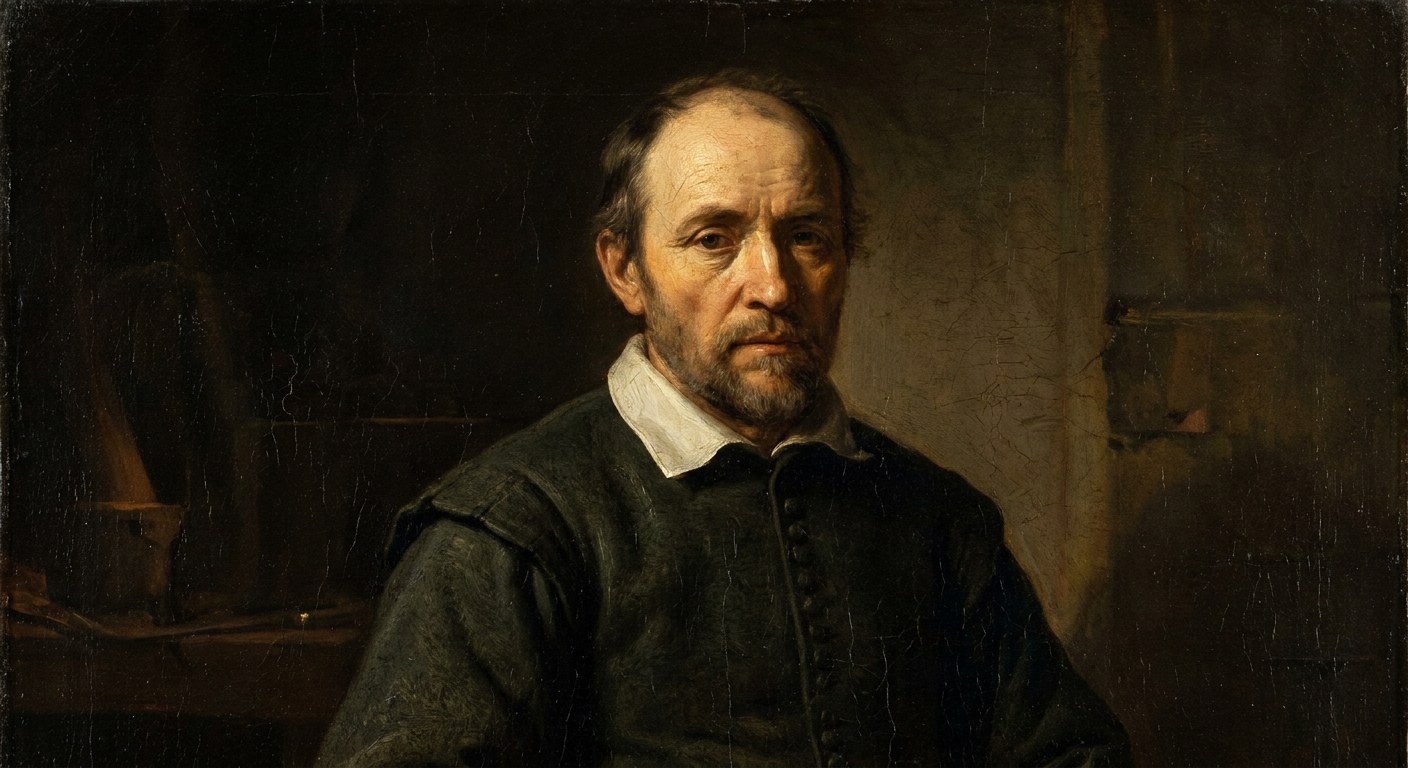
Baruch Spinoza
1632 – 1677 · Dutch · Philosopher & Lens Grinder
Recommended Audiobooks
Listen next from Marcus Alden

Life Lessons from Frederic Chopin
Marcus Alden · 54 min

Life Lessons from John Wesley
Marcus Alden · 52 min
Introduction
Baruch Spinoza (1632–1677), also known by the Latinized name Benedictus de Spinoza, was a Dutch philosopher whose radical reinterpretations of God, nature, humanity, and freedom helped transform Western thought. Writing during the scientific revolution and the Dutch Golden Age, he created one of philosophy’s most ambitious systems: a vision in which everything belongs to a single, intelligible reality governed by necessary laws.
Spinoza rejected the picture of a humanlike God who intervenes in nature, rewards obedience, or suspends natural laws through miracles. His famous expression Deus sive Natura—“God, or Nature”—identified God with the one infinite substance of which all things are modes or expressions. Human beings, in this system, are not a separate kingdom within nature. Their thoughts, bodies, desires, virtues, and conflicts must be understood through the same causal principles that govern everything else.
This philosophy made Spinoza one of the most controversial thinkers of early modern Europe. In 1656, Amsterdam’s Portuguese Jewish congregation placed him under a severe ban of excommunication. Christian critics later denounced him as an atheist, even though God occupied the central place in his philosophy. His anonymous Theological-Political Treatise defended freedom of philosophizing, challenged traditional biblical interpretation, and argued that political authority should not be controlled by religious dogma. Authorities condemned and prohibited the book.
Yet Spinoza’s importance extends far beyond controversy. He offered a naturalistic account of the emotions, developed a sophisticated theory of mind and body, defended toleration and freedom of expression, and treated democracy as the political order most consistent with human liberty. His Ethics, written in a geometric form modeled on Euclid, remains one of the most demanding and influential works in philosophy. Later thinkers as different as Goethe, Hegel, Nietzsche, Einstein, George Eliot, Gilles Deleuze, and contemporary neuroscientists have engaged with his ideas.
Spinoza matters because he joined intellectual fearlessness with a practical concern for human flourishing. His central question was not merely what exists, but how people trapped by fear, hatred, superstition, and uncontrolled desire might become more active, rational, and free.
Quick Facts
| Fact | Details |
|---|---|
| Born | 24 November 1632, Amsterdam, Dutch Republic |
| Died | 21 February 1677, The Hague, Dutch Republic |
| Nationality | Dutch |
| Known For | Ethics; “God, or Nature”; mind–body parallelism; biblical criticism; defense of free thought |
| Occupation | Philosopher, lens grinder, and optical instrument maker |
| Era | Early modern philosophy; Scientific Revolution; early Enlightenment |
Early Life and Education
Baruch Spinoza was born in Amsterdam on 24 November 1632. His parents belonged to the city’s community of Portuguese and Spanish Jews, many of whose families had fled or descended from refugees escaping forced conversion and the Iberian inquisitions. His father, Miguel—also called Michael—de Espinoza was a merchant who dealt in imported goods and held offices in Amsterdam’s Portuguese Jewish congregation. His mother, Deborah Senior, died in 1638, when Baruch was five years old.
The family used several forms of its surname, including Espinoza, d’Espinosa, and de Spinoza. Baruch was his Hebrew given name, Bento its Portuguese equivalent, and Benedictus the Latin name he later used in scholarly life. All three mean “blessed.”
Amsterdam offered unusual commercial prosperity and relative religious toleration, but its Jewish community remained internally disciplined. Refugees who had been compelled to live as Christians in Portugal often had to reconstruct Jewish practice and learning after arriving in the Dutch Republic. Community leaders were therefore anxious to preserve religious unity and avoid provoking their Christian hosts.
Spinoza attended the congregation’s Talmud Torah school. He learned Hebrew, studied scripture and Jewish tradition, and encountered the writings of medieval Jewish thinkers. Important intellectual predecessors included Maimonides, who attempted to reconcile revelation with Aristotelian philosophy, and Hasdai Crescas, whose criticism of Aristotle may have influenced Spinoza’s thinking about infinity, necessity, and divine attributes. He also became familiar with biblical commentators such as Abraham ibn Ezra, whose observations later helped Spinoza question the traditional authorship of the Pentateuch.
He probably did not complete the school’s advanced rabbinical curriculum. The demands of the family business became more pressing, especially following the death of his elder brother Isaac in 1649 and his father in 1654. Baruch and his surviving brother Gabriel operated the family firm, although it suffered from debts and the economic disruptions of the First Anglo-Dutch War.
A decisive stage in Spinoza’s education came through his association with Franciscus van den Enden, a former Jesuit, Latin teacher, dramatist, and political radical. The exact date at which Spinoza entered Van den Enden’s school is uncertain, but he studied Latin there and gained access to classical literature, scholastic philosophy, contemporary science, and the works of René Descartes. Van den Enden later advocated democratic and egalitarian ideas, and his circle probably strengthened Spinoza’s interest in secular politics and intellectual liberty.
Descartes was especially important. His insistence on rational method and his mechanistic account of nature gave Spinoza a starting point, although Spinoza ultimately rejected Cartesian dualism. Whereas Descartes treated mind and extended matter as distinct created substances, Spinoza argued that thought and extension are attributes of one infinite substance.
Rise to Prominence
The turning point in Spinoza’s life came on 27 July 1656, when the leaders of Amsterdam’s Talmud Torah congregation pronounced a herem, or ban, against him. The surviving document condemns his “abominable heresies” and “monstrous deeds” but does not specify them. No definitive record of the proceedings survives, so historians must avoid treating later stories as established fact.
Spinoza was only twenty-three. He had not yet published a philosophical work, but he may already have expressed heterodox opinions concerning God, the soul, scripture, or Jewish law. His increasing association with Christians and freethinkers, together with his refusal to conform, probably intensified the dispute. The ban prohibited members of the congregation from communicating with him, reading his writings, or approaching him closely.
The excommunication did not simply represent a conflict between a modern secular thinker and an intolerant medieval institution. Amsterdam’s Jewish leaders governed a vulnerable refugee community whose security depended partly on convincing Dutch authorities that Jews could maintain order among themselves. Spinoza’s developing ideas threatened both theology and communal discipline. Nevertheless, the exceptional severity and permanent character of the ban reveal how serious the rupture had become.
Spinoza did not seek reconciliation. He adopted the name Benedictus more regularly and built a new social world among Dutch Collegiant Christians, Mennonites, merchants, physicians, and philosophical correspondents. The Collegiants were a loose movement that favored religious tolerance, lay participation, and freedom from rigid ecclesiastical authority. Friends including Jarig Jelles, Pieter Balling, Simon de Vries, and the publisher Jan Rieuwertsz supported Spinoza and helped circulate his manuscripts.
To support himself, Spinoza ground and polished lenses for microscopes and telescopes. Lens making required mathematical understanding and exceptional manual precision. His expertise was respected by scientifically informed contemporaries, including the Dutch physicist Christiaan Huygens. Spinoza also discussed optics and instruments with Henry Oldenburg, secretary of the Royal Society in London, who became one of his most important correspondents.
By about 1661, Spinoza had moved from Amsterdam to Rijnsburg, near Leiden, a Collegiant center. There he worked on an early exposition of his philosophy now known as the Short Treatise on God, Man, and His Well-Being. He also began the unfinished Treatise on the Emendation of the Intellect, an inquiry into knowledge, method, and the highest human good.
Spinoza’s first published book appeared in 1663: René Descartes’ Principles of Philosophy, accompanied by Metaphysical Thoughts. It originated in lessons prepared for a student and presented Cartesian doctrines in geometric order. Spinoza did not endorse every proposition in it, but the work demonstrated his analytical power. It was the only book issued during his lifetime under his own name.
He moved to Voorburg near The Hague in 1663. As manuscripts and letters circulated, his reputation spread through the learned Republic of Letters. Admirers regarded him as a philosopher of unusual clarity and personal integrity; opponents increasingly associated his name with atheism and religious subversion.
Major Achievements and Contributions
Spinoza’s greatest achievement was the creation of a unified philosophical system encompassing metaphysics, epistemology, psychology, ethics, religion, and politics. Unlike philosophers who began with isolated human consciousness, he began with the structure of reality as a whole.
At the center of his metaphysics is the claim that there can be only one substance: God or Nature. A substance exists in itself and is conceived through itself. Because an absolutely infinite substance cannot be limited by another substance of the same kind, Spinoza concluded that everything that exists is in God and must be understood through God. Individual objects, organisms, and minds are not independent substances; they are finite modes, or particular ways in which the one reality is expressed.
Spinoza’s God is not a supernatural person standing outside creation. God does not deliberate, experience changing emotions, design nature for human purposes, or interrupt causality. Nature follows necessarily from divine reality. This view undermines providential and anthropomorphic theology, yet it is not a simple denial of God. Spinoza believed that understanding nature’s eternal order is itself a way of knowing God.
His account of mind and body also broke with tradition. Thought and extension are two attributes through which human beings understand the same underlying reality. A human mind is the idea of a human body; mental and bodily events are not two separate chains that mysteriously interact. Instead, they express one event under different attributes. This doctrine is commonly called psychophysical parallelism, although Spinoza himself did not use that later label.
Spinoza transformed ethics by grounding it in a naturalistic psychology. Every being strives to persevere in its existence, a tendency he called conatus. In human beings this striving appears as appetite or desire. Emotions are not sinful intrusions into an otherwise rational soul; they are natural changes in a person’s power to act. Joy accompanies an increase in that power, while sadness accompanies its decrease.
People are passive when external causes and inadequate ideas dominate them. They become more active when they understand causes adequately and organize their lives through reason. Spinoza therefore redefined freedom. Freedom does not mean an uncaused power to choose between alternatives. Because every event has a cause, the conventional idea of free will is illusory. Genuine freedom consists in acting from the necessity of one’s own understood nature rather than being driven blindly by forces one does not comprehend.
He also became a pioneer of historical and critical biblical interpretation. In the Theological-Political Treatise, he argued that scripture should be studied through its language, historical circumstances, authors, transmission, and intended audiences. Philosophy seeks truth through reason, whereas scripture primarily teaches obedience, justice, and charity. The Bible should not be forced to provide scientific or philosophical doctrines.
This approach helped lay foundations for modern biblical criticism. Spinoza questioned the traditional belief that Moses wrote the entire Pentateuch and suggested that the biblical books were compiled and edited over time. He interpreted prophecy through the imaginative capacities of prophets rather than supernatural philosophical knowledge. Miracles, he maintained, were events whose natural causes were unknown, not violations of nature’s order.
Politically, Spinoza defended toleration, freedom of thought, and a strong but secular civil authority. The state exists to secure peace and enable people to develop their rational capacities, not to control inward belief. Subjects may be required to obey public laws, but governments cannot successfully command what people think. Attempts to suppress opinion tend to produce hypocrisy, resentment, and instability.
Key Works / Battles / Ideas
Ethics
Spinoza’s masterpiece, fully titled Ethics Demonstrated in Geometrical Order, is divided into five parts: God; the nature and origin of the mind; the origin and nature of the affects; human bondage; and the power of the intellect, or human freedom. It proceeds through definitions, axioms, propositions, demonstrations, corollaries, and scholia.
The geometric presentation was meant to display logical dependence rather than offer an easy reading experience. Beneath its austere structure lies a practical therapeutic project. Spinoza explains how people become enslaved by hope, fear, envy, hatred, and ambition, then asks how understanding can transform their relationship to those emotions. The work culminates in intuitive knowledge and the “intellectual love of God,” a rational joy arising from comprehension of reality’s necessary unity.
Theological-Political Treatise
Published anonymously in 1670 with a false place of publication, the Theological-Political Treatise was among the century’s most explosive books. Spinoza defended the liberty to philosophize, separated theology from philosophy, analyzed Hebrew scripture historically, and challenged clerical efforts to dominate politics.
He argued that the purpose of political society is freedom, not the conversion of human beings into obedient machines. Although Spinoza accepted substantial sovereign power as necessary for peace, he regarded relatively democratic government as especially compatible with human nature because citizens participate in collective authority.
Political Treatise
The unfinished Political Treatise, written near the end of Spinoza’s life, examines monarchy, aristocracy, and democracy. Rather than imagining ideal citizens governed entirely by reason, it asks how institutions can work with human beings as they actually are. Stable government should channel ambition and conflict through structures in which private interests support public security. Spinoza died while drafting the section on democracy.
Knowledge and Human Freedom
Spinoza distinguished three kinds of cognition. The first includes imagination, hearsay, and fragmentary experience; it often produces inadequate ideas. The second is reason, which grasps common properties and causal relations. The third is intuitive knowledge, which understands particular things through their dependence on God or Nature.
Freedom grows with adequate understanding. This does not allow people to escape causality. Instead, knowledge enables them to become more active causes within the causal order. A person who understands an emotion can connect it to broader causes, reduce its passive force, and respond more rationally.
Religion, Superstition, and Toleration
Spinoza believed that fear and uncertainty encourage superstition. People readily interpret natural events as signs of divine favor or anger, while political and religious authorities may exploit those beliefs. He did not dismiss the ethical value of religion: the teachings of justice and neighborly love could guide people who were not philosophers. His target was dogmatism—the claim that speculative doctrines should be imposed as conditions of salvation or citizenship.
Ethics Without Final Causes
Spinoza rejected the belief that nature acts for predetermined ends. Human beings assume that rain falls to water crops or that eyes were created “in order to” see because they project their own goal-directed behavior onto the universe. For Spinoza, natural things follow from causes rather than cosmic purposes. Concepts such as perfection, imperfection, good, and evil express human comparisons and interests, not independent features built into nature. Nevertheless, “good” remains meaningful as what genuinely increases human power, understanding, and cooperative flourishing.
Timeline of Key Events
| Year | Event |
|---|---|
| 1632 | Born on 24 November in Amsterdam to a Portuguese Jewish merchant family. |
| 1638 | His mother, Deborah Senior, dies. |
| 1649 | The death of his elder brother Isaac increases Baruch’s role in the family business. |
| 1654 | His father dies; Baruch and his brother Gabriel continue the merchant firm. |
| 1656 | Excommunicated by Amsterdam’s Portuguese Jewish congregation on 27 July. |
| c. 1656–1660 | Studies Latin and contemporary philosophy, probably with Franciscus van den Enden. |
| c. 1661 | Moves to Rijnsburg and works on the Short Treatise and Treatise on the Emendation of the Intellect. |
| 1661 | Begins corresponding with Henry Oldenburg of the Royal Society. |
| 1663 | Publishes René Descartes’ Principles of Philosophy and moves to Voorburg. |
| 1670 | Publishes the anonymous Theological-Political Treatise and relocates to The Hague. |
| 1672 | The Dutch Republic suffers invasion and political crisis; Johan and Cornelis de Witt are lynched. |
| 1673 | Declines an offer of a philosophy professorship at Heidelberg. |
| 1674 | Dutch authorities formally prohibit the Theological-Political Treatise. |
| 1675 | Considers publishing the Ethics but withdraws it after reports of hostile opposition. |
| 1677 | Dies in The Hague on 21 February at the age of forty-four. |
| 1677 | Friends publish the Opera Posthuma, including the Ethics, letters, and unfinished treatises. |
Personal Life and Character
Spinoza never married and had no known children. Later anecdotes about a youthful romantic attachment to Van den Enden’s daughter are uncertain and should not be treated as reliable biography. His surviving correspondence is intellectually rich but reveals relatively little about intimate life.
He lived modestly, first in Rijnsburg and Voorburg and later in rented rooms in The Hague. His income came from lens work and assistance provided by friends. Simon de Vries offered to make Spinoza his heir, but Spinoza declined; he did accept a smaller annuity. Reports that statesman Johan de Witt also provided a pension come from early biographical sources and are plausible, though not documented beyond doubt.
Spinoza’s surviving household inventory was sparse. He owned books, optical equipment, clothing, and basic furnishings, but accumulated no substantial wealth. His apparent simplicity was not an embrace of misery. He regarded health, friendship, music, beauty, and moderate pleasure as genuine goods when enjoyed rationally.
Friends described him as calm, courteous, disciplined, and resistant to quarrels. These portraits came largely from admirers and may idealize him, but his letters support the impression of a thinker who valued measured argument. He could nevertheless be firm and occasionally cutting when confronting what he considered confusion or intolerance.
Lens grinding connected his philosophy to the practical world of experimental science. Fine glass dust may have worsened the lung illness that eventually killed him, although the precise diagnosis is unknown. Tuberculosis, silicosis, and other chronic pulmonary conditions have all been proposed.
Spinoza communicated with an international network that included Oldenburg, the physician and anatomist Lodewijk Meyer, the mathematician Ehrenfried Walther von Tschirnhaus, and the young Gottfried Wilhelm Leibniz. Their exchanges addressed theology, physics, optics, Descartes, human freedom, and Spinoza’s own developing system.
Challenges and Controversies
The 1656 excommunication shaped Spinoza’s public identity, but its exact causes remain debated. The ban’s language is severe, yet it lists no propositions. Claims that community leaders offered him money to remain outwardly observant or that an attacker tried to stab him derive from later sources and cannot be independently verified.
Spinoza also faced legal and financial difficulties after his father’s death. He took steps to avoid responsibility for burdensome business debts and successfully asserted his rights in family matters. Contrary to a romantic picture of someone indifferent to all practical concerns, he could act decisively to protect his independence.
His greatest public controversy followed the publication of the Theological-Political Treatise. Reformed theologians, Cartesian professors, civic authorities, and some former associates attacked it. Critics described Spinoza as an atheist because his God did not possess providential will, personality, or moral judgment in the conventional sense. “Spinozist” became a term of abuse across Europe.
The book’s anonymous publication did not preserve secrecy for long. In 1674, the Court of Holland prohibited it along with other works considered irreligious. Printers and readers nevertheless continued to circulate it under false titles and imprints.
Political events made such disputes dangerous. Spinoza was broadly sympathetic to the republican regime associated with Grand Pensionary Johan de Witt. In 1672, French invasion and domestic upheaval brought down that government. A mob in The Hague murdered Johan and his brother Cornelis. According to an early biography, the horrified Spinoza wanted to display a notice reading Ultimi barbarorum—“the ultimate of barbarians”—but his landlord prevented him from confronting the crowd. The episode is famous, though dependent on later testimony.
In 1673, Elector Palatine Charles Louis offered Spinoza a professorship at Heidelberg. The invitation promised broad philosophical liberty but asked him not to disturb the publicly established religion. Spinoza politely declined, explaining that he did not know within what limits that freedom would be confined and that teaching would interfere with his philosophical work.
The same year, he visited French-occupied Utrecht after receiving an invitation connected with Prince Louis II de Bourbon, the Grand Condé. Spinoza did not meet Condé, but he spoke with French officials. On returning to The Hague, some people suspected him of treason. His landlord reportedly feared a mob, but Spinoza expressed confidence that his known loyalty and conduct would protect the household.
Spinoza finished the Ethics by 1675 and traveled to Amsterdam intending to publish it. Reports that theologians were preparing accusations against him persuaded him to postpone publication. He preferred delay to a public crisis that could endanger his friends and publisher.
Modern interpretation brings further controversies. Some scholars call Spinoza a pantheist because he equated God and Nature; others prefer panentheist, naturalist, or substance monist. His “God” cannot be mapped neatly onto modern labels. Similarly, his defense of democracy coexists with a strong theory of sovereignty, limited discussion of women’s equality, and assumptions rooted in seventeenth-century society.
Death and Immediate Aftermath
Spinoza died in The Hague on Sunday, 21 February 1677. He was forty-four years old. He had suffered from a chronic respiratory illness, and his death appears to have come after a period of declining health rather than without warning. A physician friend was reportedly present. The exact medical cause remains uncertain.
He was buried in the churchyard of the Nieuwe Kerk, the New Church, in The Hague. Because graves were later cleared and reused, his exact remains cannot now be identified. A memorial near the church commemorates him.
Spinoza left debts associated with his final illness and funeral, and his possessions were inventoried and sold. More important than his material estate were the manuscripts kept by trusted friends. Jarig Jelles, Lodewijk Meyer, Jan Rieuwertsz, and others prepared them for publication with remarkable speed.
Later in 1677, the Opera Posthuma appeared in Latin, accompanied by a Dutch collection titled Nagelate Schriften. These volumes included the Ethics, the Political Treatise, the Treatise on the Emendation of the Intellect, selected correspondence, and a Hebrew grammar. The editors concealed their names and omitted the place of publication for protection.
The books immediately attracted scrutiny. In 1678, the States of Holland prohibited the posthumous works. Suppression could not prevent their international circulation, however. Spinoza’s philosophical afterlife had begun.
Legacy and Influence Today
For decades after his death, Spinoza’s name was synonymous with dangerous unbelief. Refutations spread his arguments even as they condemned them. Pierre Bayle gave him a prominent place in the Historical and Critical Dictionary, portraying him paradoxically as a virtuous atheist. This image intensified European fascination with the relationship between morality and traditional religion.
During the eighteenth century, Spinoza influenced clandestine freethought, radical Enlightenment criticism, and debates about toleration. His precise role in the Enlightenment remains contested, but his attacks on superstition, clerical power, providential history, and biblical literalism supplied intellectual resources for later secular thought.
A dramatic revival occurred in late eighteenth-century Germany. The Pantheism Controversy began when Friedrich Heinrich Jacobi claimed that the celebrated writer Gotthold Ephraim Lessing had embraced Spinozism. Thinkers including Moses Mendelssohn, Goethe, Herder, Schelling, and Hegel reconsidered a philosopher previously treated mainly as a threat. Goethe admired Spinoza’s serene vision of nature, while Hegel famously declared that one must begin philosophy by being a Spinozist.
Spinoza also influenced literature. The novelist George Eliot produced an important English translation of the Ethics, although it was not published in her lifetime. Poets and writers found in Spinoza a language for impersonal divinity, natural unity, emotional discipline, and freedom from dogma.
Albert Einstein repeatedly expressed sympathy for “Spinoza’s God,” meaning a divinity revealed in the lawful harmony of existence rather than a personal being concerned with individual destinies. Einstein’s use of the phrase did not amount to endorsement of every feature of Spinoza’s metaphysics, but it made the philosopher’s religious naturalism widely known.
In twentieth-century philosophy, Spinoza became important to thinkers such as Louis Althusser, Étienne Balibar, Antonio Negri, and Gilles Deleuze. They drew on his accounts of immanence, power, collective life, affects, and freedom. Political theorists continue to debate whether he should be understood as a liberal defender of expression, a radical democrat, a republican, or a theorist whose work exceeds those categories.
Contemporary psychology and neuroscience have also renewed interest in his theory of emotion and embodiment. Spinoza’s refusal to separate reason sharply from bodily life resembles modern approaches that treat cognition, emotion, and physiological regulation as interconnected. Neuroscientist Antonio Damasio explicitly engaged with Spinoza in Looking for Spinoza.
His biblical criticism remains foundational to the secular historical study of scripture. His argument that free thought strengthens rather than destroys political peace remains relevant wherever governments or religious institutions seek to police opinion. At the same time, his deterministic account of humanity challenges modern readers to reconsider responsibility: understanding why people act as they do need not mean approving their actions, but it may lead to more effective and less vindictive responses.
Spinoza’s legacy finally rests on an ethical ideal. Freedom is not isolation, arbitrary choice, or domination over nature. It is greater understanding of the networks of causation to which one belongs, greater capacity to act from adequate knowledge, and greater ability to cooperate with others. That demanding vision explains why a thinker once cursed as an atheist is now regarded as one of the central architects of modern philosophy.
Famous Quotes
Translations of Spinoza vary. The following statements come from identifiable passages in his works.
“The order and connection of ideas is the same as the order and connection of things.”
—Ethics, Part II, Proposition 7
“Desire is the very essence of man, insofar as his essence is conceived as determined to any action from any given affection of itself.”
—Ethics, Part III, Definitions of the Affects
“A free man thinks of nothing less than of death, and his wisdom is a meditation not on death but on life.”
—Ethics, Part IV, Proposition 67
“The more we understand singular things, the more we understand God.”
—Ethics, Part V, Proposition 24
“Blessedness is not the reward of virtue, but virtue itself.”
—Ethics, Part V, Proposition 42
“All things excellent are as difficult as they are rare.”
—Ethics, Part V, Proposition 42, Scholium
“Peace is not the absence of war, but a virtue which springs from strength of mind.”
—Political Treatise, Chapter 5, Section 4
“I have laboured carefully, not to mock, lament, or execrate human actions, but to understand them.”
—Political Treatise, Chapter 1, Section 4
Frequently Asked Questions
Who was Baruch Spinoza?
Baruch Spinoza was a seventeenth-century Dutch philosopher of Portuguese Jewish ancestry. He developed a comprehensive rationalist philosophy in which God and Nature are one infinite reality. He also made influential contributions to ethics, political theory, psychology, biblical criticism, and the philosophy of mind.
Why was Spinoza excommunicated?
Amsterdam’s Portuguese Jewish congregation excommunicated him in 1656 for unspecified “heresies” and misconduct. His developing rejection of conventional ideas about God, scripture, the immortal soul, or religious law probably contributed, but the surviving decree gives no precise charges. Detailed later stories about the case are not securely documented.
What did Spinoza mean by “God or Nature”?
The Latin phrase Deus sive Natura expresses Spinoza’s claim that God is not a separate creator outside the universe. God is the one infinite, self-caused substance, and all finite things exist in and through that reality. Nature is therefore not a machine constructed by an external deity; it is the necessary expression of divine being.
Was Spinoza an atheist?
Spinoza denied the personal, providential God accepted by mainstream Judaism and Christianity, so many contemporaries called him an atheist. Yet his philosophy constantly speaks of God as infinite, eternal, and the foundation of everything. Scholars variously describe him as a pantheist, naturalist, panentheist, or religious rationalist. None of these labels captures every aspect of his position.
Did Spinoza believe in free will?
He rejected free will understood as an uncaused ability to choose. Every decision arises from prior causes, even when people do not know them. Nevertheless, he defended a form of freedom: people become freer when adequate understanding, rather than confused passions and external pressures, determines their actions.
What is Spinoza’s most important book?
His most important work is Ethics Demonstrated in Geometrical Order. It presents his metaphysics, theory of mind and body, psychology of emotions, account of human bondage, and path toward rational freedom. Completed during his lifetime, it was published only after his death in 1677.
How did Spinoza earn a living?
Spinoza ground and polished precision lenses used in telescopes and microscopes. He also received financial assistance from friends, including an annuity from Simon de Vries. He declined a university professorship at Heidelberg and lived without holding a conventional academic or clerical position.
Why is Spinoza still relevant?
His ideas speak directly to modern debates about religious freedom, censorship, democracy, emotion, mind and body, scientific naturalism, and humanity’s place in nature. His proposal that greater causal understanding can reduce hatred and increase freedom remains both philosophically challenging and practically relevant.
Lessons We Can Learn
-
Understanding is more useful than condemnation. Spinoza urged people to study human behavior causally rather than merely mock or denounce it. Understanding wrongdoing does not excuse it; it can produce wiser responses.
-
Freedom requires self-knowledge. Acting on impulse is not necessarily freedom. Greater liberty comes from recognizing the causes of desires, fears, and habits and becoming more capable of deliberate action.
-
Intellectual independence may carry a cost. Spinoza lost his religious community, faced public hostility, and withheld major work from publication. He nevertheless refused to profess beliefs he did not accept.
-
Political peace depends on room for disagreement. Attempts to control thought create resentment and hypocrisy. A secure society can permit wide freedom of inquiry while regulating conduct through common laws.
-
Human beings belong to nature. Spinoza’s philosophy discourages the belief that humanity stands outside natural causation. Recognizing interdependence can foster humility, scientific understanding, and more realistic ethics.
Further Reading
- Steven Nadler, Spinoza: A Life — The standard modern biography, attentive to Amsterdam’s Jewish community and the politics of the Dutch Republic.
- Steven Nadler, A Book Forged in Hell: Spinoza’s Scandalous Treatise and the Birth of the Secular Age — A study of the origins, arguments, and reception of the Theological-Political Treatise.
- Jonathan Israel, Radical Enlightenment: Philosophy and the Making of Modernity, 1650–1750 — A major, debated account of Spinoza’s place in the radical Enlightenment.
- Michael Della Rocca, Spinoza — A systematic introduction emphasizing the philosophical unity and rationalism of Spinoza’s thought.
- Clare Carlisle, Spinoza’s Religion: A New Reading of the Ethics — A reinterpretation of the religious and ethical dimensions of Spinoza’s masterpiece.
Watch and Learn
PHILOSOPHY - Baruch Spinoza · The School of Life