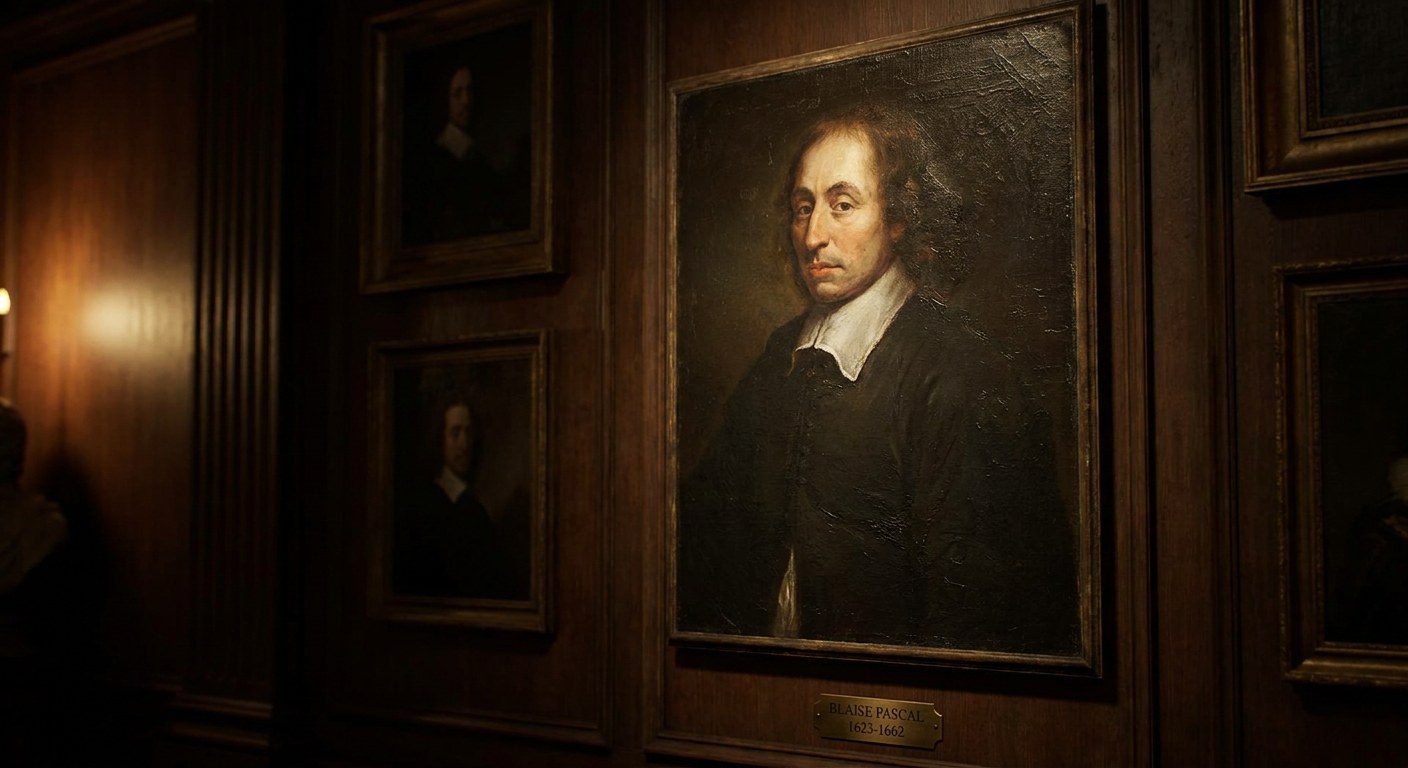
Blaise Pascal
1623 – 1662 · French · Mathematician, Physicist & Philosopher
Recommended Audiobooks
Listen next from Marcus Alden

Life Lessons from Frederic Chopin
Marcus Alden · 54 min

Life Lessons from John Wesley
Marcus Alden · 52 min
Introduction
Blaise Pascal was a French mathematician, physicist, inventor, philosopher, and religious writer whose brief life produced achievements of extraordinary range. Before reaching adulthood, he had made an original contribution to projective geometry. In his twenties, he designed one of the earliest mechanical calculating machines and conducted experiments that helped establish the existence of atmospheric pressure and the possibility of a vacuum. In correspondence with Pierre de Fermat, he helped lay the foundations of mathematical probability. He also contributed to the study of fluids, combinatorics, and the cycloid.
Pascal was equally important as a writer and thinker. His Provincial Letters transformed a dispute over Catholic theology into a masterpiece of French prose and a powerful attack on moral evasiveness. His unfinished notes for a defense of Christianity were published after his death as the Pensées. They contain some of the most memorable reflections in Western literature on human greatness and misery, distraction, reason, faith, self-interest, and uncertainty. The argument later called Pascal’s Wager remains one of the best-known and most controversial ideas in the philosophy of religion.
The apparent contradictions in Pascal’s career are central to his importance. He was a mathematical prodigy who emphasized the limits of reason, an experimental scientist committed to religious revelation, and an ingenious inventor who became suspicious of worldly ambition. He belonged to the Scientific Revolution but resisted the idea that scientific knowledge could answer humanity’s deepest moral and spiritual questions. His name survives in Pascal’s theorem, Pascal’s triangle, Pascal’s law, the pascal unit of pressure, the Pascal programming language, and a large body of philosophical debate.
Quick Facts
| Category | Details |
|---|---|
| Born | 19 June 1623, Clermont in Auvergne, Kingdom of France, now Clermont-Ferrand |
| Died | 19 August 1662, Paris, Kingdom of France |
| Nationality | French |
| Known For | Probability theory, Pascaline, Pascal’s theorem, fluid mechanics, vacuum experiments, Provincial Letters, Pensées, and Pascal’s Wager |
| Occupation | Mathematician, physicist, inventor, philosopher, and religious writer |
| Era | Scientific Revolution and seventeenth-century French classicism |
Early Life and Education
Blaise Pascal was born at Clermont in the Auvergne region of central France. He was the third child and only son of Étienne Pascal and Antoinette Begon. His mother died in 1626, when Blaise was three. His elder sister, Gilberte, later wrote an important biographical account of him, while his younger sister, Jacqueline, became a gifted poet and eventually a nun at Port-Royal.
Étienne Pascal was a magistrate, tax official, and capable amateur mathematician. In 1631 he moved the family to Paris, where Blaise received an education directed almost entirely by his father rather than through a conventional school. Étienne followed a deliberate program: languages and the humanities were to come first, while mathematics was initially withheld until his son was older. According to Gilberte’s account, this restriction only intensified Blaise’s curiosity. He independently explored geometrical relationships, supposedly reconstructing several propositions of Euclid before being given formal mathematical instruction.
Some details in family narratives were designed to display Pascal’s precocious genius and should not be treated as independently documented in every particular. Nevertheless, his exceptional ability is beyond dispute. Étienne introduced him to the intellectual circle associated with the friar Marin Mersenne. Its participants included leading mathematicians and natural philosophers such as Gilles de Roberval, Pierre Gassendi, and Gérard Desargues. The group exchanged problems, reported experiments, and criticized new theories. It functioned as an important predecessor of later scientific academies.
Pascal was especially influenced by Desargues’s innovative work on conic sections and perspective. In 1640, at approximately sixteen, he circulated an Essay on Conics. Only a short portion survives, but the work announced the result now called Pascal’s theorem. For a hexagon inscribed in a conic, the three intersection points formed by pairs of opposite sides lie on a straight line. The theorem became a foundational result in projective geometry.
René Descartes reportedly doubted that so young a mathematician could have produced the work without substantial help from his father. Although Étienne encouraged Blaise and moved in the same mathematical circles, no evidence justifies denying the younger Pascal authorship. His subsequent achievements confirmed that the teenage essay was no isolated performance.
Rise to Prominence
In 1639 Étienne Pascal received an appointment connected with royal taxation in Rouen, Normandy. The work required lengthy calculations involving additions and subtractions in the pre-decimal French currency system. To reduce his father’s labor, Blaise began designing a mechanical calculator around 1642.
The resulting machine, later known as the Pascaline, used interlocking geared wheels to represent numerical values. It could perform addition directly and subtraction through a complementary method. Carrying from one digit to the next was mechanically automated, a difficult engineering achievement at the time. Pascal supervised repeated modifications and worked with skilled craftsmen to improve reliability. In 1649, King Louis XIV granted him a royal privilege protecting the design.
Pascal did not invent mechanical calculation in an absolute sense. Wilhelm Schickard had designed an earlier calculating device in the 1620s, although knowledge of it was lost for centuries. Pascal nevertheless created his machine independently, demonstrated it publicly, and attempted to produce it for customers. Approximately twenty Pascalines are believed to have been made, of which several survive. Their expense and mechanical complexity prevented widespread adoption, but the project established Pascal as a major early figure in calculating technology.
During his years in Rouen, Pascal also became involved in debates over the vacuum. Evangelista Torricelli, a student of Galileo, had shown in 1643 that a column of mercury in an inverted tube would descend and leave an apparently empty space above it. Traditional Aristotelian physics held that nature abhorred a vacuum, and alternative explanations proposed that invisible matter filled the space.
Pascal repeated and extended barometric experiments using mercury, water, wine, syringes, tubes, and bellows. He argued that the observed effects resulted from the pressure and weight of the surrounding atmosphere rather than from a mysterious attraction exerted by empty space. His 1647 pamphlet New Experiments Concerning the Vacuum presented these findings cautiously while insisting that experimental evidence must guide natural philosophy.
To test whether atmospheric pressure decreased with altitude, Pascal arranged a decisive experiment on the Puy de Dôme, a mountain near Clermont. Because illness kept him in Paris, his brother-in-law Florin Périer conducted the ascent on 19 September 1648. The mercury column stood lower near the summit than at the mountain’s base. Repeated observations under controlled conditions supported the conclusion that the atmosphere has weight and that its pressure varies with altitude. The experiment became a celebrated example of hypothesis-driven experimental science.
Major Achievements and Contributions
Projective geometry
Pascal’s theorem generalized relationships among points, lines, and conic sections without depending on ordinary measurements of length or angle. This approach helped shape projective geometry, in which geometrical properties are studied under projection. Although much of Pascal’s larger treatise on conics was lost, later mathematicians recognized the surviving theorem as evidence of remarkable originality.
The Pascaline and mechanical computation
The Pascaline was among the first mechanical calculators constructed in more than a single experimental example. Its carry mechanism anticipated a central problem in later calculating machines. The device did not lead directly to modern computers, but it belongs to the historical sequence connecting mechanical arithmetic with the calculators of Gottfried Wilhelm Leibniz, Charles Babbage’s designs, and eventually automated computation.
Pascal understood that invention required more than a theoretical plan. He confronted friction, delicate components, manufacturing inconsistency, user error, expense, and unauthorized imitation. His experience therefore illustrates both the promise and the practical limitations of early modern technology.
Atmospheric pressure and the vacuum
Pascal’s research strengthened the case that air is a material substance with measurable weight. The Puy de Dôme experiment linked barometric height to altitude and undermined explanations based on nature’s supposed horror of empty space. Pascal did not work in isolation: Torricelli established the crucial mercury experiment, and other European investigators contributed to the debate. Pascal’s importance lies in the clarity, range, and logical design of his experimental investigations.
The SI derived unit of pressure, the pascal, is named in his honor. One pascal equals one newton of force applied over one square metre.
Hydrostatics and Pascal’s law
In work published after his death as treatises on the equilibrium of liquids and the weight of air, Pascal developed major principles of fluid statics. Pascal’s law states that pressure applied to a confined fluid is transmitted throughout the fluid. This principle underlies hydraulic presses, braking systems, lifts, and other machines that use fluid pressure to multiply force.
He also discussed the hydrostatic paradox: pressure at a given depth depends on the height and density of a liquid rather than simply on the total amount of liquid in a vessel. His famous barrel experiment, whether understood as a literal demonstration or an illustrative account, showed how a tall, narrow column of water could produce substantial pressure in a larger container.
Probability theory
In 1654 Pascal corresponded with Pierre de Fermat about problems posed by the gambler and writer Antoine Gombaud, the Chevalier de Méré. The most important was the problem of points: if a game of chance is interrupted before completion, how should the stakes be divided fairly according to each player’s prospects of winning?
Pascal and Fermat developed systematic methods for counting possible outcomes and calculating expected shares. Their correspondence did not create every earlier idea about chance, but it is widely regarded as a foundational moment in mathematical probability. The work encouraged later developments in statistics, insurance, economics, decision theory, and risk analysis.
Combinatorics and the arithmetical triangle
Pascal’s Treatise on the Arithmetical Triangle examined the triangular arrangement of binomial coefficients now commonly called Pascal’s triangle. The arrangement had been studied centuries earlier by mathematicians in India, Persia, China, and the Islamic world, so Pascal was not its original discoverer. His contribution was to develop a systematic treatment of its properties and applications, including combinations, figurate numbers, binomial expansions, and problems of chance.
Pascal used a form of mathematical induction in analyzing the triangle. His presentation helped make combinatorial methods more explicit within European mathematics.
Work on the cycloid and infinitesimal methods
Late in life Pascal returned to intensive mathematics through the study of the cycloid, the curve traced by a point on the rim of a rolling circle. In 1658 he announced a competition under the pseudonym Amos Dettonville for solutions concerning areas, centers of gravity, volumes, and related properties of the curve. His own solutions employed methods involving indivisibles and summation.
The episode contributed to the mathematical developments immediately preceding the formal creation of calculus by Isaac Newton and Leibniz. Pascal did not invent calculus, but his characteristic triangle and techniques for treating infinitesimal quantities influenced later work, especially that of Leibniz.
Public transportation
Pascal also participated in a practical urban innovation. In 1662 a company supported by Pascal and several aristocratic associates launched the carrosses à cinq sols, horse-drawn coaches operating along fixed routes in Paris for a standard fare. Often described as an early public bus system, the service initially proved popular. Restrictions on who could ride and later fare increases weakened it, and it disappeared within several years. Even so, the project anticipated important features of modern urban transit.
Key Works / Battles / Ideas
Essay on Conics
Pascal’s youthful geometrical work introduced his celebrated theorem concerning a hexagon inscribed in a conic. The surviving text is brief, but it secured his early reputation and became an important landmark in projective geometry.
New Experiments Concerning the Vacuum
Published in 1647, this pamphlet summarized experiments involving barometers and apparently empty spaces. Pascal defended the use of reproducible observation while avoiding broader claims that exceeded the available evidence. His later account of the Puy de Dôme experiment provided further support for atmospheric pressure.
Treatise on the Arithmetical Triangle
Written in the 1650s and published posthumously, this work organized properties of the numerical triangle associated with Pascal’s name. It connected combinatorics with probability and displayed his ability to derive many consequences from a carefully constructed mathematical framework.
The Provincial Letters
Between January 1656 and March 1657, Pascal published eighteen anonymous letters under the name Louis de Montalte. They arose from a conflict involving Antoine Arnauld, the Sorbonne, the Jesuits, and the Jansenist-associated community of Port-Royal.
The letters defended Arnauld and attacked what Pascal portrayed as lax Jesuit casuistry: the adaptation of moral judgments through fine distinctions and probabilistic reasoning. Pascal used dialogue, irony, satire, and lucid examples rather than dense scholastic argument. His presentation was polemical and sometimes unfair to the range of Jesuit moral theology, but its literary effectiveness was immense. The work influenced later French prose and was admired by writers including Voltaire, despite Voltaire’s opposition to Pascal’s religious outlook. The letters were condemned in Rome and ordered burned by the French royal authorities.
The Pensées
Pascal planned a major defense of the Christian religion but died before completing it. He left bundles of notes, fragments, drafts, and headings rather than a finished manuscript. Friends at Port-Royal published a selected and edited version in 1670 under a title commonly rendered as Thoughts of M. Pascal on Religion and Some Other Subjects. Later editors attempted to reconstruct the arrangement of the surviving papers, but no universally accepted final order exists.
The Pensées examines the paradoxical human condition. Human beings possess reason, imagination, and awareness of the infinite, yet they are physically fragile, morally divided, and destined to die. Pascal argued that people avoid confronting their condition through divertissement, or diversion: entertainment, ambition, gambling, warfare, social activity, and even work can prevent serious self-knowledge.
He distinguished the geometrical mind, which reasons from explicit principles, from the intuitive or perceptive mind, which grasps subtle realities that cannot easily be reduced to formal demonstration. This distinction did not reject reason. Instead, Pascal argued that different subjects require different forms of judgment and that reason should recognize its own domain and limits.
Pascal’s Wager
The Wager appears among the notes of the Pensées. Pascal considers a person unable to prove conclusively through reason whether God exists. Because life requires a practical commitment, abstaining from choice is itself a choice. If the potential gain associated with belief is infinite while the worldly cost is finite, wagering for God appears rational under uncertainty.
Pascal did not present the Wager as a proof of God’s existence, nor did he suppose that belief could simply be switched on at will. He suggested that a person begin with religious practice and participation, through which disposition might change. The argument forms only one part of his broader account of Christianity.
Critics have raised enduring objections. The many-gods objection asks why the calculation should privilege Pascal’s form of Christianity over other possible religions. Others question whether sincere belief can arise from self-interest, whether probabilities can be assigned meaningfully, and whether an all-knowing God would reward strategic belief. Defenders answer that Pascal was addressing a culturally specific audience and offering a practical argument for inquiry and commitment, not a universal mathematical proof.
Timeline of Key Events
| Year | Event |
|---|---|
| 1623 | Born on 19 June at Clermont in Auvergne |
| 1626 | His mother, Antoinette Begon, dies |
| 1631 | The Pascal family moves to Paris |
| 1630s | Educated by his father and introduced to Mersenne’s scientific circle |
| 1640 | Circulates the Essay on Conics and states Pascal’s theorem |
| 1642 | Begins developing a calculating machine to assist his father |
| 1646 | Encounters rigorous Augustinian Christianity through followers of Jean Guillebert and the Jansenist current |
| 1647 | Publishes New Experiments Concerning the Vacuum |
| 1648 | Florin Périer performs the Puy de Dôme barometric experiment at Pascal’s request |
| 1649 | Receives a royal privilege for the Pascaline |
| 1651 | Étienne Pascal dies; Jacqueline later enters Port-Royal |
| 1654 | Corresponds with Fermat on probability and the problem of points |
| 1654 | Experiences the Night of Fire on 23 November and records it in the Memorial |
| 1656–1657 | Publishes the eighteen Provincial Letters |
| 1658 | Conducts intensive research on the cycloid under the name Amos Dettonville |
| 1662 | Helps establish the five-sol public coach service in Paris |
| 1662 | Dies in Paris on 19 August at the age of thirty-nine |
| 1670 | The first edition of the Pensées is published posthumously |
Personal Life and Character
Pascal never married and had no children. His closest relationships were with members of his family, especially his sisters Gilberte and Jacqueline. Gilberte married Florin Périer and preserved valuable information about Pascal’s life. Jacqueline’s decision to enter Port-Royal created tension because Pascal initially resisted the financial arrangements required for her religious profession. The disagreement was eventually resolved, and her commitment reinforced his connection to Port-Royal spirituality.
Ill health affected Pascal from youth. Accounts describe headaches, digestive problems, weakness, insomnia, and periods in which he had difficulty swallowing or walking. Yet modern diagnoses based on these reports remain speculative. His illnesses repeatedly interrupted his research and probably intensified his awareness of physical fragility and death.
Pascal’s personality combined intellectual confidence with religious self-criticism. He could be exacting, combative, and sharply satirical. The Provincial Letters show his ability to ridicule opponents with controlled precision. At the same time, religious conversion led him to fear pride, including pride in his own brilliance. He practiced forms of ascetic discipline, gave money to the poor, and increasingly treated personal suffering as spiritually meaningful.
His decisive religious experience occurred during the night of 23 November 1654, an event known as the Night of Fire. Pascal wrote a brief record beginning with the word Fire and contrasting the living God of biblical revelation with the abstract God of philosophers and scholars. He sewed this document, now called the Memorial, into the lining of his coat. It was discovered after his death, and evidence suggests that he transferred it whenever he changed clothes.
The experience did not cause him to abandon mathematics and science immediately. His major work on the cycloid came later. Rather, it reordered his priorities. Intellectual activity remained valuable, but it could no longer serve as an ultimate source of identity or salvation.
Challenges and Controversies
Pascal’s religious commitments placed him within one of seventeenth-century France’s bitterest theological conflicts. Port-Royal was associated with Jansenism, a movement inspired by the posthumous work of the Dutch bishop Cornelius Jansen. Jansenists emphasized original sin, human dependence on divine grace, and a rigorous reading of Saint Augustine. Their opponents accused them of approaching Calvinism, while many associated with Port-Royal insisted that they were loyal Catholics defending Augustinian doctrine.
Pascal was not a systematic theologian of Jansenism, but he defended Port-Royal and Antoine Arnauld. His representation of Jesuit casuistry in the Provincial Letters was based partly on real texts and real abuses, yet it selected extreme examples and presented a diverse tradition as if it were uniformly permissive. Jesuit critics therefore regarded the letters as brilliant propaganda rather than balanced analysis. Modern historians generally study them as both literary masterpieces and partisan documents.
Pascal also disputed questions of scientific priority and interpretation. His vacuum research built on Torricelli, and he faced accusations concerning what he knew of earlier experiments. The evidence supports substantial originality in Pascal’s program, but older heroic narratives sometimes credited him too exclusively. Scientific change was collaborative and international, involving instrument makers, correspondents, family members, and rival investigators.
Similar caution applies to Pascal’s triangle and the mechanical calculator. The number pattern had a long global history, and Schickard’s calculator preceded the Pascaline. Acknowledging these predecessors does not diminish Pascal’s achievements. It places them within a broader history in which discoveries were often reinvented, extended, and communicated across cultures.
A further controversy concerns a reported miracle in 1656. Pascal’s niece Marguerite Périer suffered from a severe eye condition and was said to have been cured after contact with a relic believed to be a thorn from Christ’s crown at Port-Royal. Church authorities accepted the cure as miraculous. Pascal interpreted it as divine support for the persecuted community. Historians can document the testimony and its influence on him but cannot establish a supernatural explanation through historical method.
Death and Immediate Aftermath
Pascal’s health worsened sharply in 1662. He experienced severe pain and was moved to the Paris home of his sister Gilberte. He received the sacraments and died on 19 August 1662, two months after his thirty-ninth birthday. He was buried in the Church of Saint-Étienne-du-Mont in Paris.
An autopsy revealed serious abnormalities affecting several organs and the brain, but the surviving descriptions do not permit a secure modern diagnosis. Suggestions have included tuberculosis, cancer, gastrointestinal disease, and neurological conditions. It is more accurate to say that he suffered from chronic, complex illness whose precise nature remains uncertain.
Pascal left no completed version of his projected apology for Christianity. His relatives and associates gathered his papers, while editors connected to Port-Royal prepared the first edition of the Pensées in 1670. They altered, selected, and organized material to produce a more continuous and doctrinally cautious book. The original manuscript papers later allowed scholars to study Pascal’s unfinished project and devise alternative arrangements.
His scientific treatises on fluids were also published after his death. Thus, Pascal’s immediate posthumous reputation rested on both his religious prose and scientific work, although different audiences often emphasized one side at the expense of the other.
Legacy and Influence Today
Pascal’s mathematical legacy extends across geometry, combinatorics, probability, and the prehistory of calculus. Students around the world encounter Pascal’s triangle, while Pascal’s theorem remains central to projective geometry. The Pascal–Fermat correspondence is regularly treated as a starting point for modern probability, even though earlier traditions of counting and commercial arithmetic contributed important foundations.
In physics and engineering, Pascal’s work remains visible in fluid mechanics, hydraulics, meteorology, and pressure measurement. The pascal, symbol Pa, is the SI unit of pressure. Hydraulic brakes, presses, and lifts illustrate principles associated with Pascal’s law. His barometric investigations are remembered as models of experiments designed to distinguish among competing explanations.
The Pascaline gives him a place in the history of computing. In 1970 the computer scientist Niklaus Wirth named the Pascal programming language after him. Developed to encourage structured programming and clear data organization, the language became influential in computer-science education and software development.
Pascal’s literary influence is equally substantial. The Provincial Letters helped establish an ideal of lucid, flexible French prose. The Pensées influenced theologians, philosophers, novelists, and existential writers through its analysis of anxiety, boredom, self-deception, mortality, and the search for meaning. Thinkers as different as Søren Kierkegaard, Friedrich Nietzsche, William James, and twentieth-century Christian existentialists engaged themes that Pascal had expressed with exceptional force, whether they accepted his conclusions or opposed them.
In decision theory and philosophy of religion, Pascal’s Wager continues to generate formal models and objections. It raises questions that reach beyond theology: How should people act when evidence is incomplete? Can very large possible outcomes dominate a decision? How should tiny or unknown probabilities be treated? What is the relationship between rational choice and genuine commitment?
Pascal’s broader importance lies in his refusal to reduce human life to a single method. Mathematics could produce certainty within carefully defined systems, and experiment could reveal patterns in nature. Neither, he believed, could by itself explain moral obligation, love, suffering, or humanity’s longing for the infinite. His answer was Christian, but the questions he posed remain accessible to religious and secular readers alike.
Famous Quotes
Translations and fragment numbering vary among editions of the Pensées. The following are securely associated with Pascal’s writings.
The heart has its reasons, which reason does not know. — Pensées
Man is but a reed, the weakest in nature; but he is a thinking reed. — Pensées
All of humanity’s misfortune comes from one thing, which is not knowing how to remain at rest in a room. — Pensées
The eternal silence of these infinite spaces frightens me. — Pensées
Justice without force is powerless; force without justice is tyrannical. — Pensées
Cleopatra’s nose: had it been shorter, the whole face of the earth would have changed. — Pensées
I have made this letter longer than usual, only because I have not had the time to make it shorter. — Provincial Letters, Letter XVI
Frequently Asked Questions
What is Blaise Pascal best known for?
Pascal is known for foundational work in probability, projective geometry, fluid mechanics, and atmospheric pressure; for designing the Pascaline calculator; and for writing the Provincial Letters and Pensées. Pascal’s triangle, Pascal’s law, Pascal’s theorem, and Pascal’s Wager all bear his name.
Did Blaise Pascal invent probability theory?
Pascal and Pierre de Fermat helped establish mathematical probability through their 1654 correspondence about games of chance and the fair division of stakes. They did not create every idea concerning probability, but their systematic analysis of uncertain outcomes was a decisive foundation for the modern field.
Did Pascal invent the first calculator?
The Pascaline was one of the earliest functional mechanical calculators and one of the first produced in multiple examples. Wilhelm Schickard designed an earlier machine in the 1620s. Pascal developed his device independently and made major engineering advances, particularly in its carrying mechanism.
What is Pascal’s triangle?
Pascal’s triangle is a triangular arrangement of binomial coefficients. Each interior number is obtained by adding the two numbers above it. The pattern has applications in algebra, combinatorics, and probability. It was known in several cultures before Pascal, but his systematic study made it especially influential in European mathematics.
What is Pascal’s Wager?
Pascal’s Wager argues that, under conditions of uncertainty, commitment to belief in God can be treated as a rational practical choice because the possible gain is infinite and the possible loss finite. It is not intended as a proof that God exists. Philosophers continue to debate its assumptions and implications.
Was Pascal a Jansenist?
Pascal strongly supported Port-Royal and defended thinkers associated with Jansenism, particularly Antoine Arnauld. He shared their Augustinian emphasis on grace and human fallenness. However, the label can oversimplify his position, and Pascal regarded himself as a faithful Catholic rather than a member of a separate church.
Why did Pascal conduct the Puy de Dôme experiment?
He wanted to test whether the height of mercury in a barometer changed with altitude. A lower column at the summit would support the theory that barometric effects came from atmospheric weight. Florin Périer performed the experiment for him in 1648, and the measurements supported Pascal’s prediction.
How old was Blaise Pascal when he died?
Pascal was thirty-nine. He died in Paris on 19 August 1662 after years of serious health problems. The exact disease or combination of diseases responsible for his death remains uncertain.
Lessons We Can Learn
-
Curiosity can overcome educational boundaries. Pascal’s early progress grew from intense curiosity and active problem-solving, not merely from following a prescribed curriculum.
-
Theory should be tested against evidence. His work on atmospheric pressure demonstrated the value of designing experiments that distinguish among competing explanations.
-
Innovation requires practical persistence. Developing the Pascaline demanded repeated redesign, collaboration with craftsmen, and attention to manufacturing limitations.
-
Intellectual humility strengthens inquiry. Pascal celebrated reason while insisting that rational methods have limits. Recognizing those limits can prevent expertise in one field from becoming unwarranted certainty about every field.
-
A short life can have wide influence. Pascal died before completing many of his projects, yet the depth and range of his work changed mathematics, science, literature, technology, and philosophy.
Further Reading
- Donald Adamson, Blaise Pascal: Mathematician, Physicist, and Thinker About God.
- Hugh M. Davidson, Blaise Pascal.
- Ben Rogers, Pascal: In Praise of Vanity.
- Nicholas Hammond, editor, The Cambridge Companion to Pascal.
- A. J. Krailsheimer, translator, Pascal: Pensées.
Watch and Learn
The Famous Wager That Could Change Your Life · TED-Ed