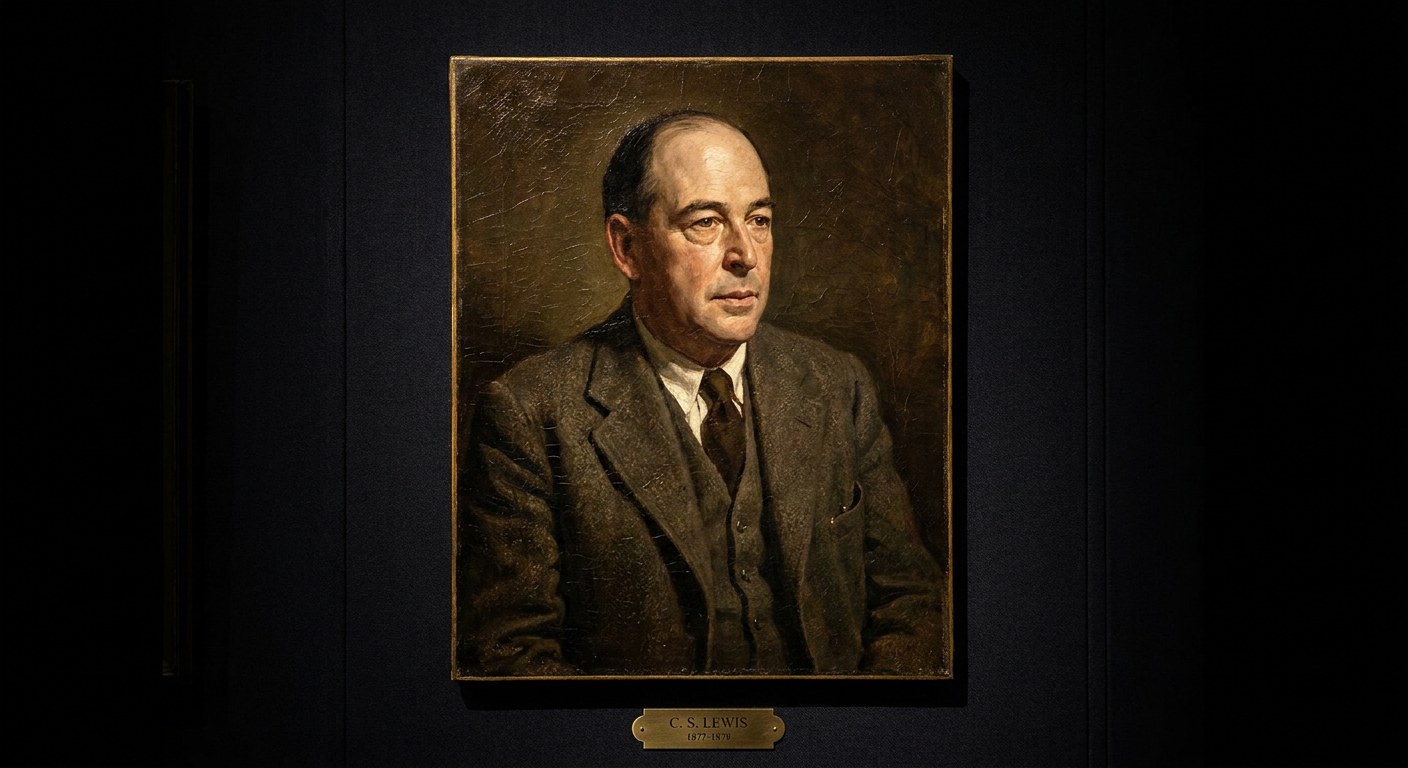
Quick Facts
- Years
- 1898 – 1963
- Nationality
- British (born in Ireland)
- Occupation
- Novelist, Scholar & Theologian
C. S. Lewis
1898 – 1963 · British (born in Ireland) · Novelist, Scholar & Theologian
Recommended Audiobooks
Listen next from Marcus Alden

Life Lessons from Frederic Chopin
Marcus Alden · 54 min

Life Lessons from John Wesley
Marcus Alden · 52 min
1. Introduction
Clive Staples Lewis—better known as C. S. Lewis—was one of the twentieth century's most influential writers on literature, imagination and Christian belief. A distinguished scholar at the universities of Oxford and Cambridge, he wrote learned studies of medieval and Renaissance literature, internationally popular works of Christian apologetics, imaginative science fiction and one of the best-known series in children's literature: The Chronicles of Narnia.
Lewis matters because he moved with unusual fluency between academic scholarship and popular writing. He could analyze medieval allegory for specialists, explain difficult theological ideas to radio listeners during the Second World War and create a fantasy world capable of enchanting generations of children. Books such as Mere Christianity, The Screwtape Letters, The Problem of Pain and The Four Loves remain widely read, while The Lion, the Witch and the Wardrobe has become a landmark of modern fantasy.
His intellectual journey also gave his work a distinctive shape. Raised within Christianity, Lewis became an atheist in adolescence, served in the First World War and gradually returned first to belief in God and then to Christianity. That conversion did not end his questioning. His later writings repeatedly examined suffering, moral choice, longing, friendship, temptation, grief and the limitations of human understanding.
Lewis was neither a systematic theologian nor an uncontroversial cultural figure. Some scholars have criticized his arguments, assumptions about gender and representations of other cultures. Nevertheless, his combination of reasoned argument, humor, narrative skill and mythic imagination has given him an enduring audience far beyond his own Anglican setting.
2. Quick Facts
| Fact | Detail |
|---|---|
| Born | 29 November 1898, Belfast, Ireland, United Kingdom |
| Died | 22 November 1963, Oxford, England, United Kingdom |
| Nationality | British; Irish-born and strongly attached to Ulster |
| Known For | The Chronicles of Narnia, Mere Christianity, Christian apologetics and literary scholarship |
| Occupation | Novelist, literary scholar, essayist, broadcaster and Christian apologist |
| Era | Twentieth century |
3. Early Life and Education
Clive Staples Lewis was born in Belfast to Albert James Lewis, a solicitor, and Florence Augusta Hamilton Lewis, known as Flora. His elder brother, Warren Hamilton Lewis, called Warnie, became his closest lifelong companion. As a young child, Lewis rejected his given names and announced that he wished to be called Jack. Friends and family used that name for the rest of his life.
The Lewis household was prosperous, book-filled and intellectually lively. Jack and Warnie invented an imaginary realm called Boxen, populated by talking animals and shaped by their enthusiasm for stories, maps and political history. This childhood practice of constructing fictional worlds anticipated Lewis's later imaginative writing, although Narnia was not simply a continuation of Boxen.
A decisive loss occurred in 1908, when Flora Lewis died of cancer. Lewis was nine. Her death damaged his childhood sense of stability and affected his religious outlook. Soon afterward, he was sent to Wynyard School in England. The school was poorly run, and its headmaster was later committed to a psychiatric institution. Lewis subsequently attended Campbell College in Belfast briefly, Cherbourg House in Malvern and Malvern College.
Lewis disliked much of English public-school culture, especially its social hierarchies and compulsory athletics. His education improved dramatically when he became a private pupil of William T. Kirkpatrick, a former headmaster who had taught Lewis's father. Kirkpatrick, nicknamed the Great Knock, trained Lewis in rigorous logic, argument and classical languages. Lewis later credited him with teaching him to demand evidence and define terms precisely.
During adolescence Lewis abandoned the Christianity of his upbringing. Several influences contributed, including bereavement, dissatisfaction with compulsory religion, philosophical materialism and the apparent conflict between suffering and belief in a benevolent God. At the same time, he developed a powerful attraction to myth, especially Norse mythology. He used the German word Sehnsucht to describe an intense, elusive longing awakened by beauty, music, nature and stories. He later called this experience Joy—not ordinary happiness, but desire for something beyond immediate possession.
Lewis won a scholarship to University College, Oxford, in 1916, but the First World War interrupted his studies. He joined the Officers' Training Corps and was commissioned as a second lieutenant in the Somerset Light Infantry. Sent to France in 1917, he experienced trench warfare on the Western Front. On 15 April 1918, near Arras, he was wounded by a British shell that exploded short of its target. Two comrades were killed. Lewis recovered in England and was demobilized in December 1918.
During military training Lewis formed a close friendship with another cadet, Edward Courtenay Francis Paddy Moore. They reportedly promised that if either died, the survivor would help care for the other's parent. Moore was killed in 1918, and Lewis subsequently shared a household for many years with Moore's mother, Janie King Moore, and her daughter Maureen. The exact nature of Lewis's relationship with Mrs. Moore remains uncertain because surviving evidence is incomplete.
Returning to Oxford, Lewis achieved an exceptional academic record. He earned first-class honors in Honour Moderations, or Greek and Latin literature, in 1920; in Literae Humaniores, encompassing ancient history and philosophy, in 1922; and in English in 1923. These studies supplied the classical, philosophical and literary foundations of his later career.
4. Rise to Prominence
After temporary teaching posts, Lewis was elected in 1925 to a fellowship and tutorship in English language and literature at Magdalen College, Oxford. He remained there for nearly three decades. His lectures became known for their clarity, range and dramatic force. He specialized in medieval and Renaissance literature, periods that many readers approached through assumptions Lewis believed to be anachronistic.
Lewis's religious views changed gradually. By 1929 he had abandoned atheism and accepted the existence of God, describing himself in Surprised by Joy as a reluctant convert. He was not yet a Christian. Conversations with friends, his philosophical reflections on reason and morality, and his understanding of myth all contributed to the next stage.
A particularly important discussion occurred in September 1931, when Lewis walked along Addison's Walk at Magdalen College with J. R. R. Tolkien and Hugo Dyson. Tolkien, a devout Roman Catholic, argued that myths could convey truth and that Christianity was the true myth: a story with the qualities of myth that had also occurred in history. Lewis soon accepted Christianity. He later recalled that during a journey to Whipsnade Zoo he passed from believing in God to believing in Christ.
Lewis returned to the Church of England rather than becoming a Roman Catholic, disappointing Tolkien. Differences over authority, doctrine and Lewis's Ulster Protestant background helped shape that decision. Although explicitly Christian, Lewis sought to defend what he called mere Christianity: the central beliefs shared by historic Christian traditions rather than the distinctive claims of one denomination.
His earliest books attracted limited public notice. His poetry collections Spirits in Bondage and Dymer appeared under the name Clive Hamilton. Greater recognition followed The Pilgrim's Regress in 1933, an allegorical account of his conversion, and especially The Allegory of Love in 1936. The latter, a major study of courtly love and allegorical poetry, established his scholarly reputation and received the Hawthornden Prize.
Lewis also became a central member of the Inklings, an informal Oxford circle that included Tolkien, Charles Williams, Owen Barfield and Lewis's brother Warnie. Members gathered in Lewis's rooms and at Oxford pubs, particularly the Eagle and Child, to converse and read unfinished work aloud. Tolkien read portions of The Lord of the Rings to the group, while Lewis shared manuscripts of his own fiction. The Inklings were never a formal school with a single program, but their friendships significantly encouraged some of the century's most influential fantasy writing.
5. Major Achievements and Contributions
Lewis's achievement rested first on his literary scholarship. The Allegory of Love traced the development of medieval courtly love and allegorical writing. A Preface to Paradise Lost offered a vigorous interpretation of John Milton's epic, urging readers to approach it as heroic and theological poetry. English Literature in the Sixteenth Century Excluding Drama, published in 1954 as part of the Oxford History of English Literature, displayed enormous command of Reformation-era texts. His final major academic work, The Discarded Image, reconstructed the medieval model of the universe and explained how it shaped literature and imagination.
His second major contribution was popular Christian apologetics. During the Second World War, the BBC invited Lewis to deliver radio talks on Christian belief. Broadcast between 1941 and 1944, they reached listeners living through air raids, bereavement and uncertainty. Revised versions appeared first in several short books and were later gathered as Mere Christianity in 1952.
Lewis's apologetic method combined logic, analogy and ordinary experience. His moral argument began with the human tendency to appeal to standards of right and wrong, even while failing to obey them consistently. From this he argued toward a moral reality beyond individual preference. He also defended human freedom, presented pride as a central spiritual danger and explained Christian doctrine through memorable metaphors.
These arguments have remained influential but are not universally accepted. Philosophers have disputed his inferences, and theologians sometimes find his presentation incomplete. Lewis nevertheless succeeded in making doctrinal questions accessible to readers without specialist training. His goal was not to replace churches or professional theology, but to bring readers into what he compared to the shared hall of a house whose rooms represented different denominations.
Lewis's third great contribution was imaginative fiction. His Space Trilogy—Out of the Silent Planet, Perelandra and That Hideous Strength—combined science fiction, Christian cosmology and criticism of technocratic power. Rather than rejecting science, the trilogy questioned scientism: the belief that scientific authority alone can settle moral, spiritual and political questions.
His greatest popular success came with the seven Narnia books, published between 1950 and 1956. Lewis built a world of talking animals, witches, giants, fauns, centaurs and deep magic. The lion Aslan functions as the imaginative representation of Christ within Narnia, but Lewis resisted describing the books as straightforward allegory. He preferred to explain them as supposal: what might Christ be like if a world such as Narnia existed and needed redemption?
Lewis also made an important contribution to the defense of myth, fairy tale and fantasy. He rejected the idea that imaginative stories were inherently childish or escapist. For Lewis, fantasy could remove the familiarity that dulls perception and allow readers to encounter courage, evil, sacrifice and grace afresh.
6. Key Works / Battles / Ideas
The Chronicles of Narnia
Beginning with The Lion, the Witch and the Wardrobe, the Narnia series became Lewis's most famous work. Its seven books combine Christian imagery with elements drawn from classical mythology, medieval romance, European folklore and children's adventure stories. Their publication order differs from their internal chronology, leading to debate about reading order. Many scholars and longtime readers favor publication order because it preserves the gradual discovery of Narnia.
Mere Christianity
This book developed from Lewis's BBC broadcasts. It presents an argument from morality, an outline of Christian doctrine and discussions of conduct, virtue, faith and spiritual transformation. Its accessible style made it a modern classic of Christian apologetics. Its influence extends across Anglican, Catholic, Orthodox and evangelical communities, although Lewis himself insisted that readers ultimately needed to enter a particular religious community rather than remain indefinitely in generalized Christianity.
The Screwtape Letters
Published in book form in 1942, The Screwtape Letters consists of advice sent by a senior demon to his inexperienced nephew. By reversing the moral viewpoint, Lewis exposes vanity, resentment, distraction and self-deception. The book's comic satire made complex spiritual observations vivid, though Lewis later said that sustained writing from a demonic perspective was emotionally oppressive.
The Space Trilogy
In Out of the Silent Planet, the scholar Elwin Ransom travels to Mars and discovers a world untouched by humanity's fall. Perelandra reimagines temptation on Venus, while That Hideous Strength brings cosmic conflict to an English university town. Ransom was partly inspired by Tolkien, though he is not a direct portrait. The trilogy addresses colonialism, language, obedience, corruption and the dangers of power severed from moral truth.
The Problem of Pain and A Grief Observed
The Problem of Pain offers a reasoned account of suffering, freedom and divine goodness. Two decades later, A Grief Observed recorded Lewis's raw response to the death of his wife. Read together, the books reveal the difference between discussing pain intellectually and enduring personal bereavement. The later work is not a formal rejection of his earlier theology, but it is far less orderly and more emotionally exposed.
The Four Loves
Lewis examines affection, friendship, erotic love and charity. He argues that natural loves are genuine goods but can become distorted when treated as absolute. His praise of friendship is especially celebrated. At the same time, parts of the book reflect assumptions about gender and social roles that many modern readers contest.
Reason, Imagination and Joy
Lewis opposed the idea that reason and imagination were enemies. Reason tested truth claims; imagination helped human beings grasp meaning. His concept of Joy described a longing that no finite experience could fully satisfy. Lewis interpreted that desire as a sign that human beings were made for a reality beyond the material world.
7. Timeline of Key Events
| Year | Event |
|---|---|
| 1898 | Born in Belfast on 29 November |
| 1908 | His mother, Flora Lewis, dies; Lewis is sent to school in England |
| 1914 | Begins private study with William T. Kirkpatrick |
| 1916 | Wins a scholarship to University College, Oxford |
| 1917 | Commissioned into the Somerset Light Infantry and sent to France |
| 1918 | Wounded near Arras; later demobilized |
| 1920–1923 | Earns three first-class Oxford degrees in classics, philosophy, history and English |
| 1925 | Elected fellow and tutor at Magdalen College, Oxford |
| 1929 | Accepts belief in God after years of atheism |
| 1931 | Converts to Christianity after discussions with Tolkien and Dyson |
| 1933 | Publishes The Pilgrim's Regress; the Inklings begin meeting regularly during the 1930s |
| 1936 | Publishes The Allegory of Love |
| 1938 | Publishes Out of the Silent Planet |
| 1941–1944 | Delivers influential BBC radio talks on Christianity |
| 1942 | Publishes The Screwtape Letters in book form |
| 1950 | Publishes The Lion, the Witch and the Wardrobe |
| 1952 | Publishes Mere Christianity |
| 1954 | Accepts the new chair of Medieval and Renaissance English at Cambridge |
| 1956 | Marries Joy Davidman in a civil ceremony; publishes The Last Battle |
| 1957 | Lewis and Joy receive a Christian marriage ceremony during her illness |
| 1960 | Joy Davidman dies of cancer |
| 1961 | Publishes A Grief Observed under the name N. W. Clerk |
| 1963 | Dies in Oxford on 22 November |
8. Personal Life and Character
Lewis lived much of his adult life at the Kilns, a house in Headington Quarry near Oxford, with Warnie Lewis, Janie Moore and, for a time, Moore's daughter Maureen. Domestic life there could be difficult. Mrs. Moore's declining health placed substantial demands on Lewis, while Warnie struggled periodically with alcoholism.
Friends remembered Lewis as intellectually energetic, humorous and extraordinarily learned. He enjoyed long walks, conversation, beer, tobacco and the companionship of close male friends. He could also be combative in debate and sometimes intimidating. His clothing was often unfashionable, and he showed little interest in cultivating the image of a celebrity.
Friendship was central to his life. Tolkien's role in Lewis's conversion was especially important, although their relationship later cooled. Several factors contributed, including Tolkien's dislike of some aspects of the Narnia books, Lewis's rapid style of composition, religious disagreements and the changing circumstances of both men. They remained historically linked through the Inklings even when their intimacy diminished.
Lewis's relationship with the American writer Joy Davidman transformed his later years. Davidman, born Jewish and later a convert to Christianity, had corresponded with Lewis before moving to England. Their friendship deepened, and in April 1956 they entered a civil marriage, initially in part to allow her to remain in Britain. Lewis subsequently acknowledged that he had fallen in love with her.
After Davidman was diagnosed with cancer, the Reverend Peter Bide performed a Christian marriage ceremony at her hospital bedside in March 1957. Her illness temporarily went into remission, allowing the couple to travel to Ireland and Greece. Cancer returned, and she died on 13 July 1960. Lewis's grief became the subject of A Grief Observed. Their marriage was later dramatized in William Nicholson's Shadowlands, though theatrical and film versions inevitably reshaped events.
Lewis had no biological children, but he became stepfather to Davidman's sons, David and Douglas Gresham. Douglas later became a prominent guardian and promoter of Lewis's literary legacy.
9. Challenges and Controversies
The First World War, his mother's early death and his wife's cancer all confronted Lewis with the problem of suffering. His writing did not eliminate the tension. Critics sometimes argue that The Problem of Pain sounds too confident, while admirers note that A Grief Observed demonstrates his willingness to expose doubt, anger and emotional disorientation.
His Christian arguments have generated substantial philosophical debate. In 1948, the philosopher Elizabeth Anscombe criticized Lewis's argument about reason and naturalism at Oxford's Socratic Club. A popular story later claimed that she decisively defeated him and caused him to abandon apologetics for children's fiction. The evidence does not support that dramatic version. Lewis revised the relevant chapter of Miracles and continued writing apologetics, while Anscombe herself did not describe the encounter as ending his intellectual career.
Modern criticism has also focused on gender. Lewis often celebrated traditionally masculine friendship and sometimes made broad claims about women. Critics have found aspects of That Hideous Strength, The Four Loves and The Chronicles of Narnia paternalistic. Defenders respond that his women characters include figures of intelligence and courage and that his views developed over time, particularly through his relationship with Joy Davidman. The tension cannot be resolved by treating him as either wholly progressive or simply reducible to his period.
The treatment of Susan Pevensie in The Last Battle remains especially controversial. Susan does not join the other protagonists in the final Narnian reunion and is described as interested in lipstick, nylons and invitations. Some readers interpret this as punishment for sexuality or adulthood. Lewis's defenders note that the text says Susan is still alive and that Lewis indicated her story might not be finished. Even so, her exclusion has troubled many readers and inspired later literary responses.
Representations of the Calormenes in Narnia have likewise been criticized for Orientalist imagery, cultural stereotyping and associations between dark complexion, tyranny and a false god. Lewis complicates the picture through admirable Calormene characters such as Aravis and Emeth, but those exceptions do not erase the concerns raised by the broader portrayal.
Lewis declined a CBE in 1951, apparently fearing that acceptance might lead people to associate his Christian work with party politics. His political thought did not fit neatly into contemporary categories. He distrusted utopian schemes and concentrated power but did not produce a comprehensive political philosophy.
10. Death and Immediate Aftermath
Lewis's health declined in the early 1960s. He suffered from kidney and heart problems and experienced a heart attack in 1963. He resigned from his Cambridge position shortly before his death.
On 22 November 1963, exactly one week before his sixty-fifth birthday, Lewis died at the Kilns. His brother Warnie found him in his bedroom. Lewis's death received less international attention than it otherwise might have because President John F. Kennedy was assassinated in Dallas on the same day. The writer Aldous Huxley also died that day, a coincidence later used by Peter Kreeft as the premise of the imaginative dialogue Between Heaven and Hell.
Lewis was buried in the churchyard of Holy Trinity Church, Headington Quarry, Oxford. The gravestone he shares with Warnie bears a line from Shakespeare: “Men must endure their going hence.” A memorial stone honoring Lewis was placed in Poets' Corner at Westminster Abbey in 2013, the fiftieth anniversary of his death.
Several important books appeared posthumously, including Letters to Malcolm: Chiefly on Prayer and The Discarded Image. Editors and heirs subsequently published collections of his essays, letters and shorter works, expanding scholarly access to his thought.
11. Legacy and Influence Today
Lewis remains one of the world's most widely read Christian writers. Mere Christianity continues to introduce readers to basic Christian claims, while clergy, laypeople and university groups study his works across denominational boundaries. His influence is especially strong in English-speaking evangelicalism, but it extends well beyond it.
In literature, Lewis helped legitimize fantasy as a vehicle for serious moral and philosophical reflection. Alongside Tolkien, he influenced later fantasy writers, although their methods differed significantly. Tolkien built an intricately developed mythology and disliked obvious mixtures of traditions; Lewis delighted in combining fauns, Father Christmas, medieval symbolism and Christian themes.
Narnia has generated stage productions, radio adaptations, television series and major films. The books have sold more than 100 million copies and have been translated into many languages. Their popularity has also produced continuing arguments about adaptation, theology, race, gender and reading order.
Lewis's academic criticism remains significant. Scholars still consult The Allegory of Love, A Preface to Paradise Lost and The Discarded Image, even where later research has revised particular conclusions. His insistence that readers understand the conceptual world of earlier authors before judging them remains a valuable historical principle.
Institutions devoted to Lewis and the Inklings preserve manuscripts, sponsor conferences and encourage new scholarship. The Wade Center at Wheaton College holds major collections relating to Lewis and six other British Christian writers. The Marion E. Wade Center, the Bodleian Libraries and the C. S. Lewis Foundation have all contributed to sustaining study of his life and work.
Lewis's continued relevance comes partly from his ability to make abstract ideas concrete. Pride becomes a spiritual disease, temptation becomes correspondence between devils, redemption becomes the return of a lion and grief becomes a locked door. Readers need not accept his theology to recognize his gift for joining thought with narrative imagination.
12. Famous Quotes
“Some day you will be old enough to start reading fairy tales again.”
—Dedication to Lucy Barfield, The Lion, the Witch and the Wardrobe
“Friendship is born at that moment when one man says to another: ‘What! You too? I thought that no one but myself . . .’”
—The Four Loves
“To love at all is to be vulnerable.”
—The Four Loves
“Pain insists upon being attended to. God whispers to us in our pleasures, speaks in our conscience, but shouts in our pains.”
—The Problem of Pain
“Joy is the serious business of Heaven.”
—Letters to Malcolm: Chiefly on Prayer
“No book is really worth reading at the age of ten which is not equally—and often far more—worth reading at the age of fifty and beyond.”
—“On Stories,” collected in Of Other Worlds
“Christianity, if false, is of no importance, and if true, of infinite importance. The one thing it cannot be is moderately important.”
—“Christian Apologetics,” collected in God in the Dock
13. Frequently Asked Questions
What was C. S. Lewis's full name?
His full name was Clive Staples Lewis. As a child he chose to call himself Jack, and relatives, friends and colleagues continued to use that name throughout his life.
Was C. S. Lewis Irish or British?
Lewis was born in Belfast when all Ireland was part of the United Kingdom. He was a British citizen and spent most of his adult life in England, but he retained a strong attachment to Belfast, County Down and the landscapes of Ulster. He can accurately be described as an Irish-born British writer.
Why did C. S. Lewis become a Christian?
His conversion resulted from years of philosophical reflection, reading and conversation. Important influences included George MacDonald, G. K. Chesterton, Owen Barfield, Hugo Dyson and J. R. R. Tolkien. Lewis first accepted theism in 1929 and Christianity in 1931.
Was Aslan intended to represent Jesus?
Yes, but Lewis did not view Aslan as a simple one-to-one allegorical symbol. He described the imaginative premise as a supposal: if a world such as Narnia existed, what form might Christ take there? Aslan's sacrifice, resurrection and sovereignty clearly draw upon Christian belief.
How many Narnia books did Lewis write?
Lewis wrote seven: The Lion, the Witch and the Wardrobe, Prince Caspian, The Voyage of the Dawn Treader, The Silver Chair, The Horse and His Boy, The Magician's Nephew and The Last Battle.
Were C. S. Lewis and J. R. R. Tolkien friends?
Yes. They were colleagues, close friends and members of the Inklings. Tolkien helped Lewis return to Christianity, and Lewis strongly encouraged Tolkien's fiction. Their friendship later became less close, but their intellectual and literary association remained highly consequential.
Did Lewis stop writing apologetics after debating Elizabeth Anscombe?
No. Anscombe offered a serious criticism of an argument in Miracles, and Lewis later revised the chapter. He continued to publish theological and apologetic writing. The claim that the debate humiliated him into abandoning argument for children's fiction is an exaggeration unsupported by the chronology.
What is the best C. S. Lewis book to read first?
For fantasy, begin with The Lion, the Witch and the Wardrobe. For Christian apologetics, Mere Christianity is the standard introduction. Readers interested in his personal journey may prefer Surprised by Joy, while A Grief Observed is his most intimate treatment of bereavement.
14. Lessons We Can Learn
-
Reason and imagination can cooperate. Lewis showed that logical argument and imaginative storytelling need not compete. Each can reveal aspects of experience that the other may miss.
-
Intellectual honesty requires revision. His movement from inherited religion to atheism and later to Christianity demonstrates a willingness to reconsider fundamental beliefs. His revision of Miracles also shows that criticism can improve an argument.
-
Friendship can shape creative achievement. The Inklings offered criticism, encouragement and companionship. Lewis's career illustrates how sustained intellectual friendship can nourish important work.
-
Suffering looks different when personally endured. The contrast between The Problem of Pain and A Grief Observed cautions against treating grief as a merely abstract problem. Compassion must accompany explanation.
-
Great works can be valued without ignoring their limitations. Lewis's books contain enduring insight and imaginative power, yet they also reflect assumptions open to criticism. Serious reading permits admiration, disagreement and historical understanding at the same time.
15. Further Reading
- Alister McGrath, C. S. Lewis—A Life: Eccentric Genius, Reluctant Prophet (2013).
- George Sayer, Jack: A Life of C. S. Lewis (revised edition, 1994).
- Humphrey Carpenter, The Inklings: C. S. Lewis, J. R. R. Tolkien, Charles Williams, and Their Friends (1978).
- Alan Jacobs, The Narnian: The Life and Imagination of C. S. Lewis (2005).
- Walter Hooper, C. S. Lewis: A Companion and Guide (1996).
Watch and Learn
C. S. Lewis: The Inner Ring · C.S. Lewis Doodle