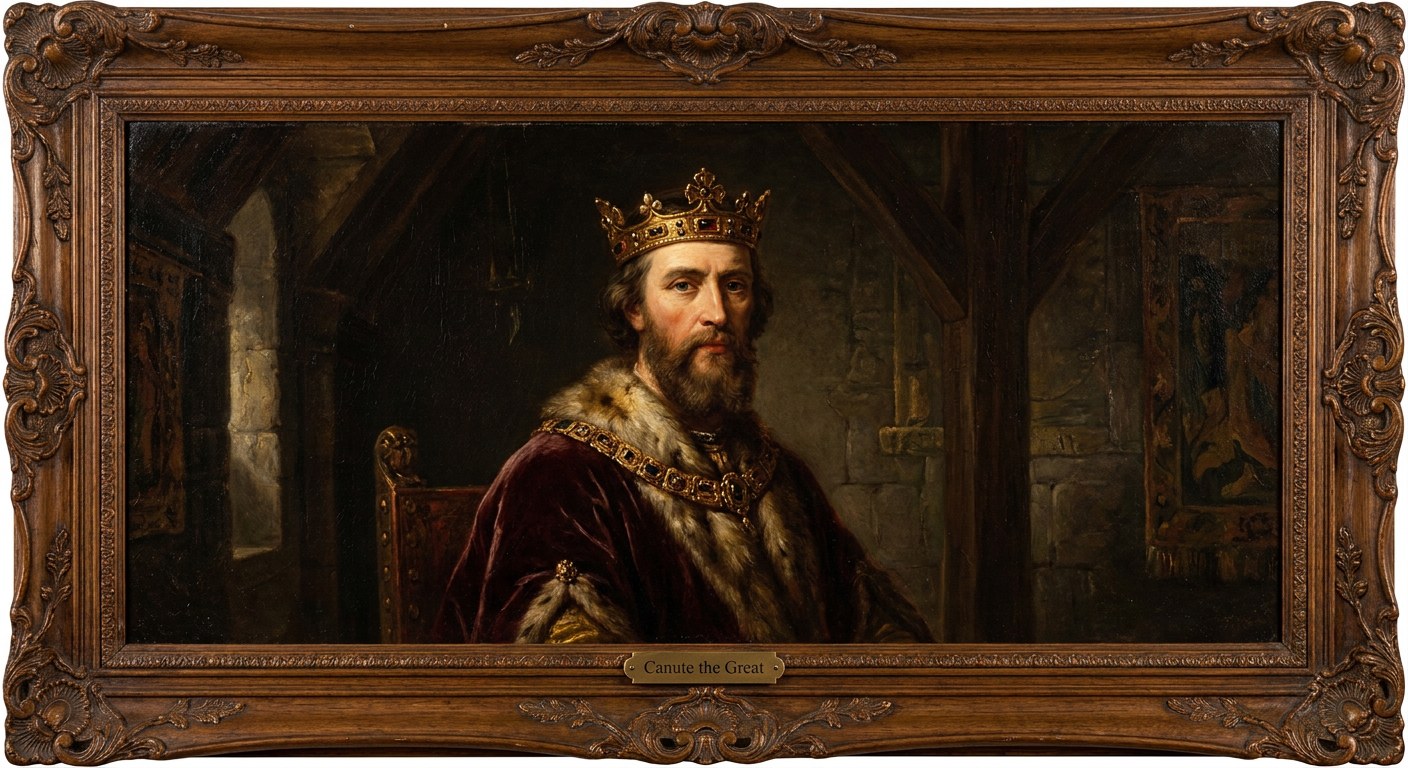
Canute the Great
990 – 1035 · Danish · King & Conqueror
Recommended Audiobooks
Listen next from Marcus Alden

Life Lessons from Frederic Chopin
Marcus Alden · 54 min

Life Lessons from John Wesley
Marcus Alden · 52 min
Introduction
Canute the Great—also spelled Cnut or Knut—was one of the most powerful rulers of eleventh-century Europe. From his accession in England in 1016 until his death in 1035, he transformed himself from a Danish conqueror into the Christian monarch of a maritime empire encompassing England, Denmark, Norway, and influence across parts of the Baltic world. At its height, this collection of kingdoms is often called the North Sea Empire, although Canute himself never used that term and governed each realm through its own institutions and customs.
Canute’s career emerged from the long age of Scandinavian expansion commonly known as the Viking Age. Yet his importance lies not merely in conquest. He successfully adapted to English political traditions, cooperated with leading churchmen, maintained a sophisticated royal administration, issued stable coinage, cultivated alliances through marriage and diplomacy, and presented himself as a divinely sanctioned European king. His pilgrimage to Rome in 1027 symbolized his transformation from Viking war leader into an accepted member of Latin Christendom’s ruling elite.
His success was nevertheless built upon violence, political calculation, and fragile personal authority. Rivals were killed or exiled, conquered peoples resisted his deputies, and his imperial structure did not survive long after his death. Even so, Canute’s reign brought England a period of comparative stability after decades of invasion. His image endured in chronicles, royal traditions, and the famous story—recorded long after his lifetime—in which he demonstrated that even a king could not command the sea.
Quick Facts
| Category | Details |
|---|---|
| Full name | Canute, Cnut, or Knut; Old Norse: Knútr inn ríki |
| Epithet | “The Great” |
| Born | About 990, probably in Denmark |
| Father | Sweyn Forkbeard, king of Denmark and briefly king of England |
| Mother | Uncertain; later traditions identify her as Gunhild or connect her with the Polish Piast dynasty |
| Dynasty | House of Jelling |
| King of England | 1016–1035 |
| King of Denmark | About 1018/1019–1035 |
| King of Norway | 1028–1035 |
| Principal spouses or partners | Ælfgifu of Northampton; Emma of Normandy |
| Notable children | Svein Knutsson, Harold Harefoot, Harthacnut, and Gunhilda |
| Major rival | Edmund Ironside, son of Æthelred II |
| Major battle | Battle of Ashingdon, 18 October 1016 |
| Religion | Christianity |
| Died | 12 November 1035, at Shaftesbury in Dorset |
| Burial | Old Minster, Winchester; remains later transferred to Winchester Cathedral |
| Historical significance | Creator of a powerful Anglo-Scandinavian monarchy often called the North Sea Empire |
Early Life & Background
Canute was born around 990 into the Danish royal house founded by Gorm the Old and strengthened by Harald Bluetooth. His father, Sweyn Forkbeard, ruled Denmark and became one of the most formidable Scandinavian war leaders of his age. Canute’s grandfather Harald had promoted Christianity and claimed authority over Denmark and Norway, though control in Scandinavia remained contested.
The identity of Canute’s mother is uncertain. Medieval sources provide contradictory accounts, and later genealogies may reflect dynastic legend rather than fact. Some associate her with Gunhild, a daughter of the Polish ruler Mieszko I; others identify her with the semi-legendary Sigrid the Haughty. Modern historians therefore avoid treating either identification as certain.
Canute’s youth coincided with renewed Scandinavian attacks on England. The English king Æthelred II, later called “the Unready”—from an Old English word meaning “ill-advised”—struggled against armies from Denmark and Norway. England’s wealth, commercial towns, established taxation system, and silver coinage made it an attractive target. Payments known as Danegeld sometimes bought temporary peace but also demonstrated the English kingdom’s financial resources.
Canute probably acquired military experience in the campaigns surrounding his father’s invasion of England in 1013. Some later sources also associate him with earlier Viking operations, including the campaigns of Thorkell the Tall, but the evidence is uncertain. What is clear is that Canute belonged to a political culture in which kingship depended upon lineage, military success, personal loyalty, wealth, and recognition by regional elites.
In 1013 Sweyn launched a full-scale invasion. English resistance collapsed, and Æthelred fled to Normandy with his wife, Emma of Normandy, and their children. Sweyn was accepted as king, but his triumph was brief. He died suddenly at Gainsborough on 3 February 1014.
The Danish army proclaimed Canute king, providing the young prince with his first claim to the English throne. English political leaders instead recalled Æthelred from exile after obtaining promises of better government. Canute, unable to maintain his position, withdrew to Denmark. According to the Anglo-Saxon Chronicle, he left mutilated hostages at Sandwich—an episode illustrating the brutality that accompanied early eleventh-century warfare.
Canute’s retreat was a setback, not the end of his ambitions. With assistance from his brother Harald II of Denmark, he assembled another fleet and prepared to return.
Rise to Prominence
Canute landed in England in September 1015, beginning the campaign that would establish him as king. He entered Wessex and gained the support of important English figures, most notably the powerful and notoriously changeable nobleman Eadric Streona, ealdorman of Mercia. Canute’s forces campaigned through Wessex, Mercia, and Northumbria, using ships for mobility and drawing support from Scandinavian warriors as well as English collaborators.
The political situation changed dramatically when Æthelred died in London on 23 April 1016. The citizens and leaders in London proclaimed his energetic son Edmund Ironside king. Other nobles recognized Canute. England therefore had two rival kings, each supported by armies and regional factions.
Edmund mounted an aggressive resistance. Several battles followed, including engagements at Penselwood, Sherston, and Brentford. London withstood attempts by Canute’s forces to capture it. Neither side achieved an immediate decisive victory, but Canute possessed considerable naval power and could rely upon experienced commanders such as Thorkell the Tall.
The decisive confrontation occurred at the Battle of Ashingdon—usually identified with Ashingdon in Essex—on 18 October 1016. Edmund’s army was defeated. The Anglo-Saxon Chronicle blamed Eadric Streona for fleeing and causing confusion, though the precise details remain uncertain.
After Ashingdon, Canute and Edmund negotiated at Alney, an island in the River Severn near Deerhurst. The settlement divided England: Edmund retained Wessex, while Canute received authority over territory north of the Thames, including Mercia and probably Northumbria. The survivor was apparently expected to inherit the other’s lands.
Edmund died on 30 November 1016, only weeks after the agreement. Medieval rumor sometimes accused Canute or his agents of arranging his death, but no reliable evidence proves assassination. Edmund may have died from wounds or illness. His death removed the principal obstacle to Canute’s rule, and English leaders recognized the Danish conqueror as king of the whole realm.
Canute then moved swiftly to secure his position. In 1017 he divided major regions among trusted magnates: Wessex remained closely associated with the crown, Thorkell received East Anglia, Eadric retained Mercia temporarily, and Erik of Hláðir held authority in Northumbria. The arrangement combined Scandinavian military leadership with existing English territorial structures.
Canute also eliminated potential opponents. Eadric Streona was executed in 1017, despite—or because of—his earlier service. Other nobles were killed, dispossessed, or driven into exile. Edmund Ironside’s young sons were sent abroad, eventually reaching Hungary. These actions were ruthless, but they reduced the likelihood of an immediate uprising.
In July 1017 Canute married Emma of Normandy, Æthelred’s widow. The marriage connected him with a prestigious Norman dynasty and strengthened his claim to succeed the previous English royal house. It also created a complicated family arrangement, since Canute already had a union with Ælfgifu of Northampton and children by her.
Major Achievements
Canute’s greatest achievement was the creation of a durable kingship in England after decades of conflict. Unlike many Viking leaders who extracted tribute and departed, he governed through the English state. He retained shires, royal councils, written law, ecclesiastical institutions, taxation, and a highly developed system of coin production.
The English kingdom offered Canute resources unmatched by his Scandinavian territories. Its regular coinage and administrative machinery helped him reward followers and finance policy across the North Sea. English coins bearing his name circulated widely, and imitations appeared in Scandinavia. Several coin types were issued during his reign, including the Quatrefoil, Pointed Helmet, and Short Cross types. Their broad distribution reflects both royal authority and the commercial integration of northern Europe.
Canute initially maintained a large fleet and collected substantial payments to reward his invasion army. In 1018 the English paid an enormous levy—recorded as £72,000 from the kingdom and an additional £10,500 from London. Much of the army was then dismissed, while a smaller standing naval force was retained. Although these sums burdened the population, the settlement reduced dependence on an uncontrolled conquest host.
His government increasingly relied upon English magnates and churchmen. The most important secular figure to rise under him was Godwin, who became earl of Wessex. Godwin’s family later dominated English politics, and his son Harold Godwinson became king in 1066.
Canute also issued or confirmed law codes influenced by earlier English legislation. The laws associated with his reign were shaped in part by Wulfstan, archbishop of York, a major churchman and political thinker. They emphasized public order, Christian observance, proper conduct by royal officials, suppression of pagan practices, protection of churches, and the king’s responsibility to provide justice.
After the death of his brother Harald II, probably in 1018, Canute became king of Denmark. His control there was not always direct; he depended upon deputies while spending much of his time in England. Nevertheless, possession of both kingdoms allowed him to coordinate resources and dominate North Sea routes.
His Scandinavian ambitions brought him into conflict with Olaf Haraldsson of Norway and Anund Jacob of Sweden. A major naval confrontation occurred near the Helgeå in the mid-1020s, conventionally dated to 1026. The location and outcome are debated, but Canute retained sufficient strength to expand his authority.
In 1028 he sailed to Norway with a large fleet, reportedly including fifty ships from England. Norwegian nobles dissatisfied with Olaf shifted their allegiance, and Olaf fled eastward. Canute was recognized as king of Norway, completing the broadest extent of his dominion. He later entrusted Norwegian government to his son Svein and Ælfgifu of Northampton.
Canute’s diplomacy extended beyond Scandinavia. His daughter Gunhilda married Henry, son of the German emperor Conrad II and later Emperor Henry III. Canute also maintained ties with Normandy and with rulers around the Baltic. His influence rested on a mixture of dynastic marriage, military force, commercial connections, and Christian kingship.
Defining Moments
The first defining moment of Canute’s life was his rejection by the English elite in 1014. Instead of ending his ambitions, the failure taught him that conquest alone did not guarantee legitimate rule. When he returned, he combined military pressure with alliances and political negotiation.
The victory at Ashingdon in 1016 was the decisive military event of his career. It destroyed Edmund Ironside’s ability to resist effectively and led directly to the partition agreement at Alney. Canute later commemorated the battlefield by supporting a church there, linking military victory with Christian thanksgiving.
His marriage to Emma of Normandy in 1017 marked a transition from conqueror to dynastic monarch. Emma had been queen to Æthelred and remained a politically significant figure. Canute’s marriage to her connected his reign with the old royal order while also excluding, at least temporarily, Emma’s sons by Æthelred.
Another defining moment was Canute’s journey to Rome in 1027. He attended the imperial coronation of Conrad II at Easter and met leading secular and ecclesiastical figures. In a letter sent to his subjects, Canute described negotiations intended to reduce charges imposed on English pilgrims and clergy traveling through Europe. He also promised just government and condemned abuses by royal officials.
The Roman journey displayed Canute as more than a Scandinavian warrior. He appeared as a Christian emperor-like king whose authority linked northern kingdoms with the political and religious center of western Europe.
His conquest of Norway in 1028 represented the peak of his power, but events there also exposed the limits of his empire. Olaf Haraldsson returned in 1030 and was killed at the Battle of Stiklestad. Olaf’s subsequent veneration as a saint strengthened Norwegian religious identity, while the unpopular rule of Svein and Ælfgifu provoked resistance. Canute could conquer Norway, but integrating it into a lasting multi-kingdom state proved much harder.
Timeline
| Year | Event |
|---|---|
| c. 990 | Canute is born, probably in Denmark, to Sweyn Forkbeard and an uncertain mother. |
| 1013 | Sweyn invades England; Canute likely accompanies the campaign. Æthelred II flees to Normandy. |
| 3 February 1014 | Sweyn dies at Gainsborough; the Danish army proclaims Canute king. |
| 1014 | English leaders recall Æthelred; Canute withdraws to Denmark. |
| September 1015 | Canute returns to England with an invasion fleet. |
| 23 April 1016 | Æthelred dies; Edmund Ironside and Canute claim the English throne. |
| 18 October 1016 | Canute defeats Edmund at the Battle of Ashingdon. |
| Late 1016 | The agreement at Alney divides England between Canute and Edmund. |
| 30 November 1016 | Edmund Ironside dies; Canute becomes king of all England. |
| 1017 | Canute consolidates power, executes Eadric Streona, and marries Emma of Normandy. |
| 1018 | A large payment is collected to dismiss most of Canute’s invasion army. |
| c. 1018–1019 | Canute succeeds his brother Harald II as king of Denmark. |
| 1020 | Canute attends the dedication of the church commemorating the victory at Ashingdon. |
| c. 1022–1023 | Thorkell the Tall disappears from English political life after a period of reconciliation with Canute. |
| c. 1026 | Canute campaigns against Anund Jacob of Sweden and Olaf Haraldsson near the Helgeå. |
| 1027 | Canute travels to Rome for the imperial coronation of Conrad II and writes to his subjects. |
| 1028 | Canute conquers Norway; Olaf Haraldsson flees. |
| 1030 | Olaf returns and is killed at Stiklestad; he is later revered as Saint Olaf. |
| 1031 | Scottish rulers, including Malcolm II, are reported to have submitted to Canute, though the meaning of this submission is debated. |
| 12 November 1035 | Canute dies at Shaftesbury. |
| 1035–1042 | His sons Harold Harefoot and Harthacnut successively rule England. |
| 1042 | Harthacnut dies; the Anglo-Danish royal line loses the English throne to Edward the Confessor. |
Personal Life
Canute’s personal and dynastic relationships reflected both Scandinavian custom and Christian royal politics. Before marrying Emma, he was joined to Ælfgifu of Northampton, a woman from an influential English Midlands family. Their relationship is sometimes described as a marriage according to Scandinavian custom, although its precise legal and ecclesiastical status is unclear.
Ælfgifu bore at least two sons: Svein, who later governed Norway, and Harold Harefoot, who became king of England after Canute’s death. Hostile later sources questioned whether Canute was truly their father, but these claims likely arose from succession propaganda and cannot be accepted uncritically.
Canute’s marriage to Emma of Normandy produced Harthacnut, who became king of Denmark and later England, and Gunhilda, who married the future Emperor Henry III. The marriage agreement appears to have favored Emma’s sons by Canute in the succession, creating rivalry with the children of Ælfgifu.
Emma was more than a ceremonial consort. She witnessed royal documents, possessed substantial estates, supported ecclesiastical institutions, and helped shape the presentation of Canute’s dynasty. The later work known as the Encomium Emmae Reginae, commissioned in her interests, portrays her marriage to Canute as central to legitimate rule, though its narrative is highly partisan.
Canute spent much of his reign traveling among royal estates and between kingdoms. England was probably the administrative center of his power, but Denmark and Norway required personal intervention or trusted deputies. His court contained English, Danish, Norwegian, and other Scandinavian elites, along with bishops, abbots, poets, and royal officials.
Norse court poets, or skalds, celebrated his victories and generosity. Their surviving verses are valuable evidence, although praise poetry naturally magnified royal success. Canute’s ability to operate within both Norse warrior culture and Latin Christian kingship was a central feature of his rule.
Beliefs & Philosophy
Canute was a Christian king, although he descended from a dynasty only recently converted from traditional Scandinavian religion. His reign illustrates how Scandinavian monarchs used Christianity not simply as a private faith but as a framework for law, diplomacy, legitimacy, and royal duty.
He supported churches and monasteries, honored saints, and cultivated leading clergy. He made gifts to institutions including Winchester, Canterbury, and Bury St Edmunds. The martyrdom of King Edmund by Viking attackers in 869 might have made his cult politically awkward for a Danish ruler, yet Canute supported Bury St Edmunds. Such patronage helped reconcile Scandinavian rule with English religious memory.
His laws condemned heathen practices, required Christian observance, and portrayed the king as guardian of both church and people. This did not mean that all Scandinavian customs disappeared. His court remained deeply influenced by Norse traditions, and his authority still depended on martial prestige and personal bonds with warriors.
Canute’s 1027 letter presents an ideal of penitent and responsible monarchy. He claimed that he intended to govern justly, protect church rights, prevent official extortion, and correct youthful errors. The language may have been shaped by clerical advisers, but its public circulation made it a statement of royal policy.
His pilgrimage to Rome reinforced this image. By attending Conrad II’s coronation and communicating with the pope and European princes, Canute placed his northern monarchy within universal Christendom. His style as king was therefore hybrid: Scandinavian in ancestry and military foundation, English in administration, and European Christian in ideology.
Challenges & Controversies
Canute’s rise was inseparable from warfare and coercion. The invasions of 1013–1016 devastated communities, and his settlement imposed an enormous financial burden on England. His reputation for orderly government should not obscure the violence that created his regime.
His treatment of political rivals was severe. Eadric Streona, Northumbrian earl Uhtred, and several members of the English elite were killed or removed. Uhtred was murdered after submitting to Canute in 1016, apparently through the actions of a rival, Thurbrand, and possibly with royal approval. Canute benefited from these deaths even when his direct responsibility is uncertain.
The fate of Edmund Ironside remains controversial. Later writers offered sensational stories of murder, but near-contemporary evidence does not establish that Canute ordered Edmund’s death. The speed with which Canute profited from it encouraged suspicion.
His dynastic arrangements created lasting instability. Maintaining relationships with both Ælfgifu and Emma produced competing branches of the royal family. After his death, Harold Harefoot and Harthacnut struggled for control of England, while Magnus the Good took Denmark after Harthacnut’s death.
Canute’s authority in Norway was especially fragile. Ælfgifu and Svein reportedly introduced unpopular laws and fiscal demands. Norwegian opposition grew, and Canute’s regime there collapsed soon after his death. The episode demonstrates that his empire depended heavily upon his own prestige and ability to balance local elites.
His claimed dominance over Sweden and Scotland must also be treated cautiously. In his 1027 letter, Canute styled himself king of England, Denmark, Norway, and “part of the Swedes.” This probably reflected military or political supremacy in certain areas rather than undisputed rule over Sweden. Likewise, the submission of Scottish rulers in 1031 may have been a temporary diplomatic acknowledgment rather than permanent subjection.
The term North Sea Empire can itself be misleading. Canute did not create a centralized empire with a single bureaucracy. England, Denmark, and Norway retained distinct laws, assemblies, political communities, and succession traditions. His dominion was a personal union held together by kingship, ships, wealth, deputies, alliances, and intimidation.
Famous Quotes
No informal speech by Canute survives from his lifetime. The following statements come from medieval texts, and their wording varies by modern translation.
“I have vowed to God to lead a right life in all things, to rule justly and piously my kingdoms and peoples, and to administer just judgment to all.”
—Canute’s letter to the English, 1027, preserved by later chroniclers
“I have never spared, nor will I spare, myself or my labor, when my people’s needs are concerned.”
—Attributed to Canute in his 1027 letter, in modern translation
“Let all men know how empty and worthless is the power of kings; for there is none worthy of the name but God, whom heaven, earth, and sea obey.”
—Speech attributed to Canute in the story of the tide, recorded by Henry of Huntingdon in the twelfth century
The tide quotation is not contemporary evidence for Canute’s exact words. It belongs to a moralizing story written roughly a century after his death. In its original form, however, the tale depicts Canute as demonstrating the limits of earthly kingship—not foolishly believing that he could stop the sea.
Legacy & Influence
Canute’s reign was one of the most successful examples of conquest followed by political integration in early medieval Europe. He entered England as the leader of an invading army but became a ruler who preserved and used English institutions. His success helps explain why his reign was remembered less as a prolonged foreign occupation than as a period of forceful, comparatively stable monarchy.
The North Sea realm encouraged movement among England, Scandinavia, and continental Europe. Soldiers, merchants, clergy, craftspeople, coins, manuscripts, and political ideas crossed the sea. England’s administrative wealth strengthened Canute’s Scandinavian ambitions, while Scandinavian connections placed England at the center of a wider northern network.
His reign also helped elevate powerful earldoms within English government. Figures such as Godwin accumulated regional authority that would shape politics under Canute’s successors and Edward the Confessor. The political world that culminated in the crisis of 1066 owed much to structures and families that had risen under Canute.
Dynastically, his achievement proved short-lived. Harold Harefoot ruled England from 1035 to 1040, followed by Harthacnut from 1040 to 1042. After Harthacnut’s sudden death, the throne passed to Edward the Confessor, Emma’s son by Æthelred. Norway and Denmark also escaped Canute’s family’s lasting control. His imperial project had no enduring institutional foundation independent of his person.
Canute’s reputation developed in several directions. Scandinavian tradition remembered a great warrior-king; English sources acknowledged both his harsh conquest and his later devotion; ecclesiastical writers praised his church patronage. The tide story eventually became the most famous anecdote associated with him, though it was frequently misunderstood. Rather than illustrating royal arrogance, it was originally a lesson in humility and the supremacy of God.
Modern historians regard Canute as a pragmatic, mobile, and culturally adaptable ruler. He was neither merely a Viking raider nor a fully centralized emperor. His greatness lay in his ability to govern different political societies simultaneously, using the resources and traditions of each while presenting himself as a legitimate Christian monarch.
Interesting Facts
- The spelling Cnut is closer to the form used on many of his coins and in contemporary documents; Canute became common in later English usage.
- His Old Norse epithet, inn ríki, can mean “the powerful,” “the mighty,” or “the great.”
- Canute’s empire was maritime: ships and North Sea routes were essential to communication, taxation, war, and royal travel.
- The famous tide story first appears in surviving form in Henry of Huntingdon’s twelfth-century history, not in an account written during Canute’s reign.
- Canute’s coins were produced at numerous English mints and became models for coinage in Scandinavia.
- His 1027 visit to Rome coincided with the imperial coronation of Conrad II in St Peter’s Basilica.
- Canute supported the cult of St Edmund, an English king traditionally believed to have been killed by Viking invaders.
- His daughter Gunhilda’s marriage connected his dynasty to the Holy Roman Empire.
- The precise site of the Battle of Ashingdon remains debated, although Ashingdon in Essex is the conventional identification.
- Some medieval writers described Canute as ruler of “five kingdoms,” but the nature and extent of these claims varied.
- His remains were disturbed during the English Civil War when parliamentary soldiers damaged royal mortuary chests at Winchester.
- Bones believed to belong to Canute and other early rulers are now intermingled in mortuary chests at Winchester Cathedral, making individual identification difficult.
- Canute’s death occurred at Shaftesbury, an important royal and religious center where a prominent nunnery stood.
- The name “North Sea Empire” is a modern historical label rather than Canute’s official title.
Frequently Asked Questions
When was Canute the Great born?
Canute was probably born around 990, although no contemporary source records an exact date. He was a son of Sweyn Forkbeard, king of Denmark and conqueror of England.
How did Canute become king of England?
He invaded England in 1015 and fought Edmund Ironside for the throne after Æthelred II’s death. Canute defeated Edmund at Ashingdon in October 1016. The rivals divided the kingdom, but Edmund died in November, leaving Canute as king of all England.
Which countries did Canute rule?
He ruled England, Denmark, and Norway. He also claimed authority over part of the Swedes and exercised influence in the Baltic and over neighboring rulers. The exact limits of his supremacy fluctuated.
Was Canute a Viking?
Yes, in the broad historical sense. He was a Scandinavian prince who led a seaborne invasion and belonged to the political culture of the Viking Age. However, he later ruled as a Christian king using English and European institutions.
Did Canute really try to stop the tide?
The story was recorded about a century after his death. In it, Canute orders the tide to stop in order to show his courtiers that royal power is limited and only God commands nature. It should not be read as evidence that he believed he could control the sea.
Why did Canute marry Emma of Normandy?
The marriage strengthened his legitimacy in England, linked him to Normandy, and connected his new regime with the dynasty of Æthelred II, Emma’s first husband. Their son Harthacnut became king of Denmark and England.
Was Canute a good king?
His reign brought greater stability to England and preserved effective laws, coinage, taxation, and church institutions. He also promoted international diplomacy and trade. Yet he gained power through invasion, imposed heavy levies, and eliminated rivals. Assessments depend on balancing effective government against violent conquest.
What was the North Sea Empire?
The term describes Canute’s combined rule over England, Denmark, and Norway, together with his wider influence. It was not a centralized state. Each kingdom kept its own institutions and was united mainly through Canute’s personal authority.
Who succeeded Canute?
His son Harold Harefoot became the effective ruler and later king of England, while Harthacnut initially held Denmark and claimed England. Harold died in 1040, after which Harthacnut ruled England until 1042.
Where is Canute buried?
He was originally buried in the Old Minster at Winchester. His remains were later transferred to Winchester Cathedral, where bones associated with several early English rulers are held in mortuary chests.
Lessons from Canute the Great
- Adaptation can secure what conquest begins. Canute preserved English institutions rather than attempting to replace them wholesale.
- Legitimacy requires more than military victory. Marriage, law, religion, diplomacy, and cooperation with local elites all strengthened his rule.
- Different societies cannot always be governed identically. Policies tolerated in one kingdom could provoke resistance in another, as Norway demonstrated.
- Stable administration is a source of geopolitical power. England’s taxation, coinage, and bureaucracy enabled Canute’s wider ambitions.
- Personal empires are vulnerable. A dominion held together primarily by one ruler’s prestige may fragment quickly after that ruler’s death.
- Political symbolism matters. Canute’s pilgrimage, church patronage, laws, and royal letters helped recast him as a Christian monarch.
- Historical anecdotes require context. The tide story teaches humility in its medieval form, despite later retellings that portray Canute as deluded.
- Effective rulers can have morally complicated legacies. Administrative competence and relative peace do not erase violence, coercion, or political killings.
Further Reading
- M. K. Lawson, Cnut: England’s Viking King, 1016–35.
- Timothy Bolton, The Empire of Cnut the Great: Conquest and the Consolidation of Power in Northern Europe in the Early Eleventh Century.
- Levi Roach, Æthelred the Unready.
- Pauline Stafford, Queen Emma and Queen Edith: Queenship and Women’s Power in Eleventh-Century England.
- Simon Keynes, studies on late Anglo-Saxon kingship and royal administration.
- The Anglo-Saxon Chronicle, especially the entries for 1013–1035.
- Encomium Emmae Reginae, translated as In Praise of Queen Emma.
- Henry of Huntingdon, Historia Anglorum, for the later medieval story of Canute and the tide.
- Snorri Sturluson, Heimskringla, used cautiously alongside contemporary evidence for Scandinavian events.
- The surviving law codes and royal letters of Canute, particularly his letter of 1027.