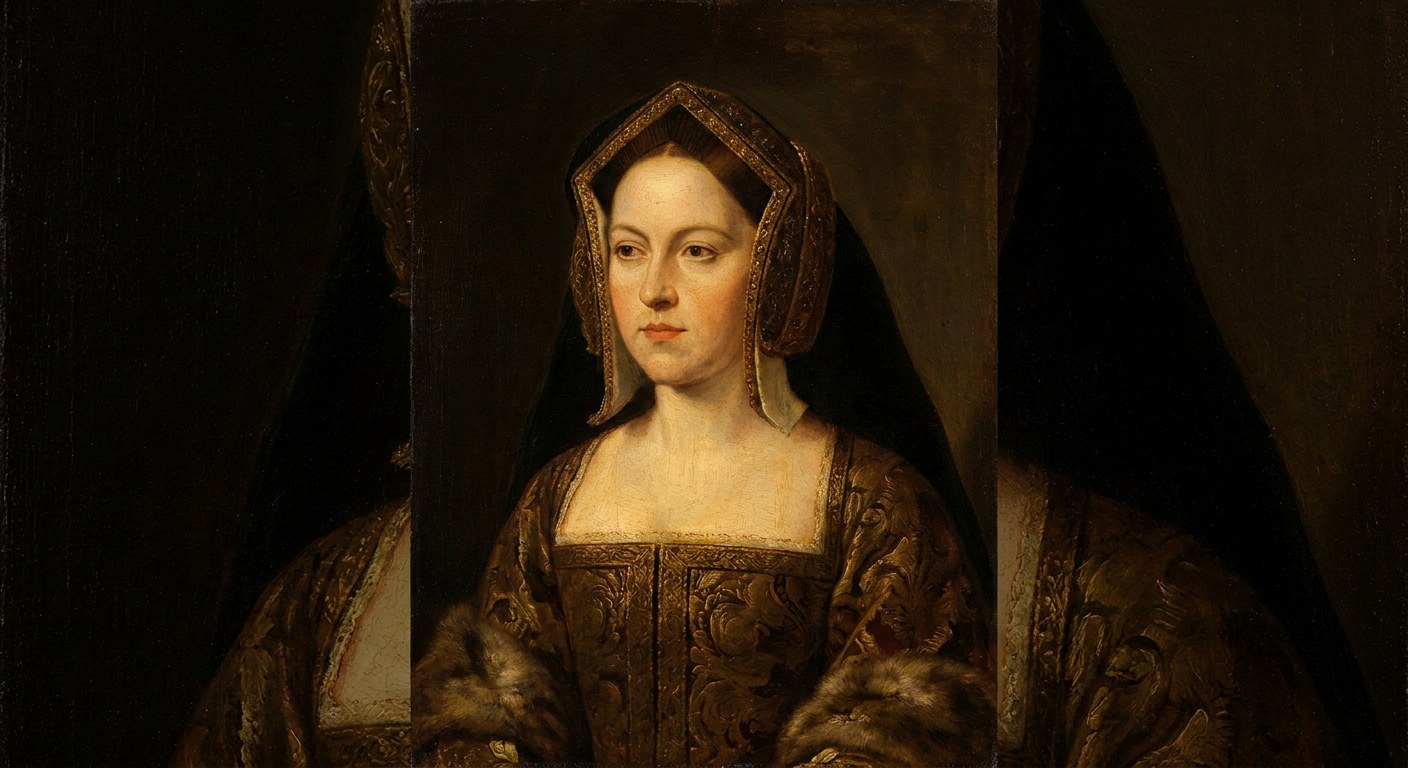
Catherine of Aragon
1485 – 1536 · Spanish · Queen Consort of England
Recommended Audiobooks
Listen next from Marcus Alden

Life Lessons from Frederic Chopin
Marcus Alden · 54 min

Life Lessons from John Wesley
Marcus Alden · 52 min
Introduction
Catherine of Aragon (16 December 1485–7 January 1536) was a Spanish princess who became the first wife and queen consort of Henry VIII of England. The daughter of the formidable Catholic monarchs Isabella I of Castile and Ferdinand II of Aragon, she was raised to serve as an instrument of dynastic diplomacy. Yet Catherine became far more than a ceremonial royal bride. During almost a quarter-century as queen, she acted as a diplomat, regent, political adviser, patron of Renaissance scholarship, advocate for women’s education and influential model of Christian queenship.
Her marriage to Henry VIII produced several pregnancies but only one surviving child, the future Mary I. Henry’s desire for a legitimate male heir—and his growing attachment to Anne Boleyn—led him to seek an annulment. Catherine’s refusal to accept that their marriage had been invalid helped transform a private marital crisis into the “King’s Great Matter,” a struggle involving the English Crown, Parliament, the papacy and the major powers of Europe. The consequences included England’s break with papal authority and the emergence of the independent Church of England.
Catherine’s final years were marked by separation from her daughter, declining health and enforced isolation. Nevertheless, she continued to identify herself as Henry’s lawful wife and England’s rightful queen. Her intelligence, political courage and determination won admiration even among some who supported Henry’s religious policies. Her story occupies a central place in the history of the Tudor monarchy, the English Reformation and the political experiences of royal women in early modern Europe.
Quick Facts
| Category | Details |
|---|---|
| Full name | Catherine of Aragon; Spanish: Catalina de Aragón |
| Born | 16 December 1485 |
| Birthplace | Archbishop’s Palace, Alcalá de Henares, Castile |
| Parents | Ferdinand II of Aragon and Isabella I of Castile |
| Dynasty | House of Trastámara |
| First husband | Arthur, Prince of Wales |
| Second husband | Henry VIII of England |
| Queen consort | 24 June 1509–23 May 1533, although Henry ceased recognizing her as queen before the formal judgment |
| Coronation | 24 June 1509, Westminster Abbey |
| Surviving child | Mary I of England |
| Political role | Queen consort, diplomat and regent of England in 1513 |
| Religion | Roman Catholic |
| Died | 7 January 1536, aged 50 |
| Place of death | Kimbolton Castle, Huntingdonshire |
| Burial | Peterborough Abbey, now Peterborough Cathedral |
| Best known for | Her queenship, the victory at Flodden during her regency and her resistance to Henry VIII’s attempt to annul their marriage |
Early Life & Background
Catherine was born at Alcalá de Henares, near Madrid, on 16 December 1485. She was the youngest surviving child of Isabella I of Castile and Ferdinand II of Aragon, whose marriage had united two of the most powerful crowns in the Iberian Peninsula. Their realms remained legally distinct, but the partnership created the foundation of a powerful Spanish monarchy.
Catherine’s childhood unfolded during a period of war, religious consolidation and overseas expansion. In January 1492, her parents completed the conquest of the Nasrid kingdom of Granada, ending the last Muslim-ruled state in Iberia. Later that year, they supported Christopher Columbus’s first Atlantic voyage and ordered the expulsion of practicing Jews from their kingdoms. Catherine was therefore raised in a court shaped by military triumph, intense Catholic devotion and the increasingly global ambitions of the Spanish monarchy.
Her siblings were Isabella, queen of Portugal; John, prince of Asturias; Joanna, later known as Juana of Castile; and Maria, queen of Portugal. Through Joanna’s marriage to Philip of Burgundy, Catherine became an aunt of the future Holy Roman Emperor Charles V.
Isabella personally supervised the education of her daughters. Catherine studied Latin, scripture, theology, canon and civil law, history, philosophy, classical literature, music, dancing and domestic administration. She also learned French and acquired the ceremonial and practical skills expected of a Renaissance princess. Her education was unusually substantial for a woman of her rank, although learned royal women were not unknown at the Castilian court.
Catherine’s marriage prospects were tied to her parents’ foreign policy. England and Spain shared an interest in containing French power. Under the Treaty of Medina del Campo in 1489, the three-year-old Catherine was betrothed to Arthur, Prince of Wales, the eldest son of Henry VII and Elizabeth of York. The proposed marriage promised to strengthen Henry VII’s relatively new Tudor dynasty by connecting it to one of Europe’s most prestigious royal houses.
After years of negotiation over the marriage treaty and dowry, Catherine sailed for England in 1501. She landed at Plymouth on 2 October and met Arthur at Dogmersfield in Hampshire the following month. Their marriage took place at St Paul’s Cathedral in London on 14 November 1501. Catherine was fifteen and Arthur was also fifteen.
The young couple established their household at Ludlow Castle, the traditional administrative center for the Prince of Wales. In the spring of 1502, however, both became seriously ill, perhaps during a regional epidemic. Arthur died on 2 April 1502. Catherine survived, becoming the Dowager Princess of Wales after fewer than five months of marriage.
Whether the marriage had been consummated later became one of the most consequential questions in English history. Catherine consistently maintained that she and Arthur had never had sexual relations. Henry VIII’s supporters later challenged her claim because marriage to a deceased brother’s widow was prohibited under certain interpretations of biblical law. No conclusive evidence resolves the question.
Rise to Prominence
Following Arthur’s death, Catherine’s position became precarious. Henry VII wished to preserve the Spanish alliance but disputed with Ferdinand over payment of the remainder of her dowry. A marriage between Catherine and Arthur’s younger brother, Prince Henry, was proposed. Because Catherine had been Arthur’s wife, a papal dispensation was obtained from Pope Julius II to remove any canonical impediment.
Prince Henry formally protested against the proposed marriage in 1505, almost certainly under pressure from his father. Catherine then spent years in diplomatic and financial uncertainty. Her household suffered from shortages, and she repeatedly appealed to her father for assistance. Isabella I’s death in November 1504 weakened Catherine’s value in the marriage market because the Castilian succession passed to her sister Joanna.
Despite these difficulties, Catherine gained political experience. In 1507 Ferdinand appointed her his diplomatic representative in England. She is often described as the first formally accredited female ambassador in European history, although the exact status and precedents of early diplomatic appointments are debated. In that role, she communicated with both the Spanish and English courts and attempted to protect her own interests.
Henry VII died on 21 April 1509. His seventeen-year-old son succeeded as Henry VIII and promptly decided to marry Catherine. The wedding took place at the church of the Observant Franciscans at Greenwich on 11 June 1509. Catherine was twenty-three; Henry was seventeen. They were crowned together at Westminster Abbey on 24 June.
The marriage initially appeared affectionate and politically successful. Catherine participated in court festivities, received foreign envoys and exercised influence over patronage. Henry trusted her judgment and described her in affectionate terms. She adopted the pomegranate—a symbol associated with Granada, fertility and resurrection—as her principal emblem.
Catherine’s most important independent political opportunity came in 1513, when Henry invaded France. He appointed her regent and governor of England during his absence. Scotland, allied with France, invaded northern England under James IV. English forces led by Thomas Howard, Earl of Surrey, defeated the Scots at the Battle of Flodden on 9 September 1513. James IV and many Scottish nobles were killed.
Catherine did not command the army in person, but she played an active role in mobilizing troops, issuing warrants, managing supplies and maintaining government. Before the battle, she traveled to the Midlands and addressed military forces while visibly pregnant. After the victory, she sent Henry the bloodstained coat of James IV, writing that it would have made a more impressive trophy than the king’s body. Her regency demonstrated administrative confidence and reinforced her public image as a capable queen.
Major Achievements
Catherine’s achievements extended beyond her dynastic role, although they were frequently expressed through the expected duties of queenship.
Regency and national defense: Her government during Henry’s 1513 campaign in France was the clearest display of her political authority. She helped organize England’s response to the Scottish invasion and presided over the administration at a moment of national danger. The victory at Flodden occurred under her regency and became one of the greatest English military successes of the period.
Diplomatic influence: Catherine represented the connection between England and Spain, and later between England and her nephew Charles V’s Habsburg empire. She participated in diplomatic discussions and attempted to reconcile the interests of her husband with those of her birth family. Her divided loyalties could create tension, but they also made her a valuable intermediary.
Patronage of learning: Catherine supported Renaissance humanism and corresponded with prominent intellectuals. Desiderius Erasmus praised her learning. The Spanish humanist Juan Luis Vives dedicated The Education of a Christian Woman to Catherine in 1523. Written partly with Princess Mary’s education in mind, the work became influential across Europe, although its arguments remained rooted in conservative assumptions about female obedience and domestic virtue.
Catherine promoted a demanding education for Mary, ensuring that her daughter studied Latin, music, theology and classical literature. Mary’s intellectual accomplishments owed much to the educational program her mother encouraged.
Support for educational and religious institutions: Catherine became patroness of Queens’ College, Cambridge, in 1509, continuing a tradition of royal female support established by Margaret of Anjou and Elizabeth Woodville. She also gave assistance to religious houses, scholars and charitable causes.
A model of active queenship: Catherine combined the roles of wife, mother, intercessor, patron and temporary ruler. Her conduct drew upon the example of Isabella of Castile, who had exercised sovereign authority in her own right. Although Catherine never possessed her mother’s independent crown, she demonstrated that an English queen consort could make a substantial contribution to government and diplomacy.
Defining Moments
The central tragedy of Catherine’s marriage was the failure to produce a surviving son. She experienced several pregnancies, although historians differ over their exact number and outcomes because the evidence is incomplete.
A daughter was stillborn in January 1510. On 1 January 1511, Catherine gave birth to a son, Henry, Duke of Cornwall. Celebrations spread throughout the kingdom, but the child died on 22 February. Further pregnancies ended in miscarriage, stillbirth or early infant death. On 18 February 1516, Catherine gave birth at Greenwich to a healthy daughter, Mary. Another daughter appears to have been stillborn in November 1518.
The loss of so many children caused intense personal grief and created a dynastic problem. Henry had an acknowledged illegitimate son, Henry FitzRoy, born in 1519, but no legitimate male heir. England had not previously been ruled by a crowned queen regnant, and Henry feared that a female succession might provoke instability.
By the mid-1520s, Catherine was no longer likely to bear children. Henry became convinced—or claimed to be convinced—that their marriage violated divine law. He relied particularly on Leviticus 20:21: “If a man shall take his brother’s wife, it is an unclean thing … they shall be childless.” Catherine and her supporters cited Deuteronomy 25, which directed a man to marry his deceased brother’s widow under certain circumstances. They also argued that the papal dispensation had made the marriage valid and that Catherine’s first marriage had never been consummated.
Henry’s attraction to Anne Boleyn gave the issue additional urgency. By 1527 he was seeking a formal declaration that his marriage to Catherine had always been invalid. Cardinal Thomas Wolsey attempted to secure an annulment from Pope Clement VII. The pope, however, faced political pressure from Catherine’s nephew Charles V, whose forces had sacked Rome in 1527 and dominated Italy.
In 1529 a legatine court convened at Blackfriars in London under Wolsey and the papal legate Cardinal Lorenzo Campeggio. Catherine rejected the court’s authority and appealed directly to Rome. In a dramatic appearance, she knelt before Henry and defended her conduct as his loyal wife. She reminded him that she had come to England as a young woman and had borne him children, and she called upon God to judge the truth of her claim that her marriage to Arthur had not been consummated.
Campeggio adjourned the proceedings without reaching a decision. The failure contributed to Wolsey’s downfall. Henry’s advisers then developed a more radical solution: rejecting papal jurisdiction within England.
Thomas Cranmer became archbishop of Canterbury in 1533. A court at Dunstable declared Henry’s marriage to Catherine invalid on 23 May. Cranmer pronounced Henry’s secret marriage to Anne Boleyn valid five days later. Anne was crowned on 1 June, and in September she gave birth to the future Elizabeth I.
Catherine was denied the title of queen and officially called Dowager Princess of Wales, referring to her marriage to Arthur. She refused to accept the title. Pope Clement VII issued a final judgment in March 1534 affirming the validity of Catherine’s marriage and ordering Henry to restore her, but Henry no longer recognized papal authority. Parliament’s Act of Supremacy in November 1534 declared him supreme head of the Church of England.
Timeline
| Year | Event |
|---|---|
| 1485 | Catherine is born at Alcalá de Henares on 16 December. |
| 1489 | She is betrothed to Arthur, Prince of Wales, under the Treaty of Medina del Campo. |
| 1492 | Her parents conquer Granada; Columbus begins his first Atlantic voyage. |
| 1501 | Catherine arrives in England and marries Arthur at St Paul’s Cathedral on 14 November. |
| 1502 | Arthur dies at Ludlow on 2 April; Catherine becomes Dowager Princess of Wales. |
| 1503 | A papal dispensation is secured for a proposed marriage to Prince Henry. |
| 1504 | Catherine’s mother, Isabella I of Castile, dies. |
| 1507 | Ferdinand appoints Catherine his diplomatic representative in England. |
| 1509 | Henry VIII becomes king; he marries Catherine on 11 June. They are crowned on 24 June. |
| 1510 | Catherine gives birth to a stillborn daughter. |
| 1511 | Prince Henry, Duke of Cornwall, is born on 1 January and dies on 22 February. |
| 1513 | Catherine serves as regent while Henry campaigns in France; England defeats Scotland at Flodden. |
| 1516 | Princess Mary, the future Mary I, is born on 18 February. |
| 1518 | Catherine’s last known pregnancy ends with a stillborn daughter. |
| 1523 | Juan Luis Vives dedicates The Education of a Christian Woman to Catherine. |
| 1527 | Henry begins formal efforts to have the marriage declared invalid. |
| 1529 | Catherine appears before the legatine court at Blackfriars and appeals to Rome. |
| 1531 | Henry separates from Catherine; she is removed from court. |
| 1533 | Cranmer’s court declares the marriage invalid; Anne Boleyn is recognized as queen. |
| 1534 | Pope Clement VII upholds Catherine’s marriage; Henry is declared supreme head of the Church of England. |
| 1535 | Catherine is held at Kimbolton Castle and continues to refuse the title Dowager Princess of Wales. |
| 1536 | Catherine dies on 7 January and is buried at Peterborough Abbey on 29 January. |
Personal Life
Catherine’s marriage to Henry VIII was not uniformly unhappy. For many years they appeared to share affection, ceremonial partnership and common religious values. Henry publicly honored her, entrusted her with political responsibility and sometimes sought her counsel. They hunted, traveled and participated in elaborate court entertainments together.
Their repeated bereavements placed enormous strain on the marriage. Early Tudor medicine could do little to prevent miscarriage, stillbirth or infant mortality. Catherine responded to these losses with religious devotion, prayer, fasting and pilgrimage. Her surviving daughter, Mary, became the emotional center of her life.
Catherine took a close interest in Mary’s education and status. In 1525 the princess was sent to Ludlow to preside nominally over the Council of Wales and the Marches. Catherine wanted Mary to be treated as heir to the throne, but Henry never formally granted her the title Princess of Wales.
After Henry separated from Catherine, mother and daughter were prevented from meeting. Catherine repeatedly requested permission to see Mary, especially when either of them was ill, but Henry refused. Their servants carried messages when possible. Catherine encouraged Mary to remain obedient to her father without surrendering her belief in the legitimacy of her parents’ marriage.
Catherine’s household reflected her Spanish origins as well as her English position. Some Spanish attendants accompanied her to England, though their numbers diminished over time. She retained affection for her family and homeland while developing a strong identification with England. By the annulment crisis, she insisted that she was not a foreign intruder but England’s anointed queen.
Beliefs & Philosophy
Catherine’s worldview was grounded in Catholic theology, dynastic duty and the example of her mother. She believed marriage to be a sacramental and binding union. Her resistance to annulment was therefore not simply an attempt to preserve rank. To concede Henry’s argument would have meant admitting that she had lived in an unlawful relationship and that Mary was illegitimate.
She practiced an intense personal piety. She attended Mass, supported the Observant Franciscans and engaged in charitable works. At times her fasting was so severe that religious advisers reportedly urged moderation. Her faith helped her interpret suffering as a spiritual trial rather than evidence that her cause was unjust.
Catherine accepted traditional expectations of female obedience but did not understand obedience as unconditional submission to an unlawful demand. She believed that conscience and divine law stood above royal command. This conviction enabled her to oppose one of Europe’s most powerful monarchs while continuing to describe herself as his loyal wife.
Her support for women’s education was significant but not modern in the egalitarian sense. Catherine believed educated women could become wiser Christians, better household governors and more capable royal consorts. Her patronage nonetheless helped establish a precedent for the advanced education of Tudor princesses, including Mary and, indirectly, Elizabeth I.
Challenges & Controversies
Catherine’s greatest challenge was her dynastic failure as understood by Tudor society. A queen was expected to produce legitimate heirs, particularly sons. Although the biological causes of the couple’s reproductive losses are unknown, responsibility was often placed upon the woman.
The controversy over consummation remains unresolved. Catherine swore that she entered her marriage to Henry as a virgin. Her solemn declarations carried enormous weight in a deeply religious culture, and no direct evidence proves otherwise. Arthur’s reported morning-after remarks about having been “in the midst of Spain” may have been adolescent boasting rather than reliable testimony.
Catherine’s political relationship with Spain was also complicated. She occasionally promoted Ferdinand’s interests, even when they did not align perfectly with Henry’s. Yet Ferdinand could be manipulative and often failed to provide the financial or diplomatic support she needed. Later, Charles V defended her publicly, but the demands of imperial policy limited what he would do militarily on her behalf.
Some later accounts portray Catherine as entirely passive, while others transform her into a modern political rebel. Neither image is adequate. She operated within a conservative framework of monarchy, marriage and Catholic orthodoxy. Her resistance was powerful precisely because it invoked established law and religion against Henry’s innovations.
Her death generated rumors of poisoning after an examiner reportedly found her heart blackened during embalming. Modern historians generally reject poisoning. Cancer, possibly of the heart or surrounding tissue, has often been suggested, though no secure diagnosis is possible.
Famous Quotes
The wording of sixteenth-century speeches and letters often survives through copies or later reports. The following statements are traditionally associated with Catherine, with appropriate qualifications.
“Sir, I beseech you, for all the loves that hath been between us, and for the love of God, let me have justice and right.”
This appeal was reported in accounts of Catherine’s appearance before Henry VIII at Blackfriars in 1529.
“I take God and all the world to witness that I have been to you a true, humble and obedient wife.”
Also associated with the Blackfriars hearing, this declaration summarized Catherine’s defense of her marriage and personal conduct.
“I am his wife, and so I will call myself.”
Catherine repeatedly expressed this position in correspondence after Henry ordered that she be called Dowager Princess of Wales.
“Lastly, I make this vow, that mine eyes desire you above all things.”
These words appear in a celebrated “last letter” supposedly written to Henry shortly before Catherine’s death. The letter’s authenticity is disputed, and the surviving version may reflect later embellishment.
Legacy & Influence
Catherine’s resistance altered the course of English history. Henry’s inability to obtain a papal annulment encouraged the Crown to reject papal jurisdiction, subordinate the English Church to royal authority and use parliamentary statutes to redefine the relationship between church and state. Catherine did not create the English Reformation, but the dispute over her marriage was one of its principal catalysts.
Her daughter Mary became England’s first crowned queen regnant in 1553. Mary reversed her own illegitimacy, restored papal authority and attempted to reestablish Roman Catholicism. Her policies reflected both her personal faith and the traumatic experience of watching her mother’s status destroyed.
Catherine also influenced ideals of queenship. Her 1513 regency demonstrated that a queen consort could govern effectively during a king’s absence. Her patronage strengthened humanist education at the Tudor court, while her determination made her an enduring symbol of conscience and dignity under political pressure.
At Peterborough Cathedral, Catherine’s grave remains marked with her title as Queen of England. Each January, the cathedral holds commemorative events associated with her life and burial. Visitors often leave pomegranates, recalling her personal badge.
Historical interpretations have shifted over time. Protestant writers sometimes depicted her resistance as an obstacle to reform, whereas Catholic tradition celebrated her fidelity. Modern scholarship presents a more complex figure: a highly educated Renaissance princess, skilled dynastic actor, orthodox Catholic and determined defender of her daughter’s rights.
Interesting Facts
- Catherine’s Spanish name was Catalina, and she was named after her English great-grandmother Catherine of Lancaster.
- She had red-gold hair and a fair complexion, traits inherited from her English and northern European ancestry.
- She descended from John of Gaunt through both of her parents and therefore possessed English royal ancestry.
- Catherine was more than five years older than Henry VIII.
- Her emblem, the pomegranate, referred to Granada and symbolized fertility—an especially poignant association given her repeated pregnancy losses.
- She was the only one of Henry VIII’s wives to be formally crowned alongside him.
- Her service as Ferdinand’s representative in 1507 is frequently cited as an early landmark in the history of women in diplomacy.
- She commissioned an ambitious humanist education for Mary at a time when advanced classical learning for royal women was becoming increasingly respected.
- During the 1513 regency, she ordered banners depicting Saint George and personally participated in military preparations.
- Catherine never met Anne Boleyn as Henry’s acknowledged wife and queen.
- She was not executed or formally tried for treason; instead, Henry isolated her and reduced her household.
- She died approximately four months before Anne Boleyn’s execution in May 1536.
- Henry VIII wore yellow after Catherine’s death. Whether this signified celebration, mourning or conventional court display remains debated.
- Catherine was buried as Dowager Princess of Wales because Henry refused to recognize her as queen.
- Peterborough Cathedral now identifies her unequivocally as “Katharine Queen of England.”
Frequently Asked Questions
Why was Catherine of Aragon important?
Catherine was an influential queen consort, regent and patron of education. Her refusal to accept the annulment of her marriage contributed directly to the political and religious crisis that produced England’s break with Rome.
Was Catherine of Aragon really Spanish?
Yes. She was born in the Crown of Castile to Isabella I of Castile and Ferdinand II of Aragon. The term “Spain” was increasingly used geographically and diplomatically, although Castile and Aragon remained separate political entities with their own laws and institutions.
Did Catherine marry both Arthur and Henry VIII?
Yes. She married Arthur, Prince of Wales, in November 1501. After Arthur’s death, she married his younger brother Henry in June 1509, shortly after he became king.
Was Catherine’s marriage to Arthur consummated?
The answer is unknown. Catherine consistently swore that it was not consummated. Henry’s case for annulment depended partly on treating her first marriage as creating a prohibited relationship, but no surviving evidence conclusively proves whether Catherine or her opponents were correct.
How many children did Catherine have?
The exact number is disputed because records of some pregnancies are uncertain. She experienced at least six known or probable pregnancies. Only Mary, born in 1516, survived infancy.
Did Catherine of Aragon lead an army at Flodden?
Not personally. She was regent and helped organize national defense while Henry was in France, but the English army at Flodden was commanded by Thomas Howard, Earl of Surrey. Claims that Catherine rode into battle in armor are later exaggerations.
Why did Henry VIII want to annul the marriage?
Henry wanted a legitimate male heir and believed Catherine could no longer provide one. He argued that their marriage violated biblical law because she had been his brother’s wife. His desire to marry Anne Boleyn was also a decisive factor.
Why did the pope refuse Henry’s request?
Pope Clement VII doubted the legal basis for overturning a papal dispensation and faced pressure from Catherine’s nephew, Emperor Charles V. The case also raised serious questions about papal authority: declaring the marriage invalid could imply that an earlier pope had issued an ineffective dispensation.
Did Catherine recognize Anne Boleyn as queen?
No. Catherine maintained that she remained Henry’s lawful wife and queen until her death. She therefore regarded Anne’s marriage as invalid.
Did Catherine ever see Mary after the separation?
No. Henry prevented Catherine and Mary from meeting during Catherine’s final years, despite repeated requests. They remained in contact indirectly through letters and trusted servants.
How did Catherine of Aragon die?
She died at Kimbolton Castle on 7 January 1536 after a period of declining health. Cancer is a common modern suggestion, but the evidence does not permit a definite medical diagnosis. Rumors that she was poisoned are not considered credible by most historians.
Where is Catherine buried?
She was buried on 29 January 1536 at Peterborough Abbey, which became Peterborough Cathedral in 1541. Her grave remains there and is marked in her honor as Queen of England.
Lessons from Catherine of Aragon
- Education can create political strength: Catherine’s learning enabled her to participate effectively in diplomacy, government and theological argument.
- Conscience may require resistance: She distinguished loyalty to a ruler from surrendering deeply held legal and religious convictions.
- Public dignity can be a form of power: Even after losing access to court, Catherine preserved substantial moral authority.
- Political disputes can have unintended consequences: A conflict over one royal marriage helped transform England’s religious and constitutional order.
- Women exercised power within restrictive systems: Catherine used queenship, patronage, diplomacy and regency to influence events despite formal limitations on female authority.
- Historical figures should be understood in their own context: Catherine’s courage was rooted in traditional Catholic and dynastic beliefs, not modern ideas of individual freedom.
- Succession politics can shape nations: The pressure to produce a male heir affected Catherine’s marriage and changed the direction of English history.
- Personal resilience does not eliminate suffering: Catherine remained steadfast, but her isolation from Mary and the destruction of her status imposed a profound human cost.
Further Reading
- Giles Tremlett, Catherine of Aragon: The Spanish Queen of Henry VIII.
- Theresa Earenfight, Catherine of Aragon: Infanta of Spain, Queen of England.
- Garrett Mattingly, Catherine of Aragon.
- Patrick Williams, Catherine of Aragon: The Tragic Story of Henry VIII’s First Unfortunate Wife.
- Amy Licence, Catherine of Aragon: An Intimate Life of Henry VIII’s True Wife.
- David Starkey, Six Wives: The Queens of Henry VIII.
- J. J. Scarisbrick, Henry VIII.
- John Guy, Tudor England.
- Juan Luis Vives, The Education of a Christian Woman, edited and translated by Charles Fantazzi.
- Letters and Papers, Foreign and Domestic, of the Reign of Henry VIII, a major collection of Tudor documents.
- Calendar of State Papers, Spain, for diplomatic correspondence involving Catherine, Ferdinand II and Charles V.