Catherine Parr
1512 – 1548 · English · Queen Consort & Author
Recommended Audiobooks
Listen next from Marcus Alden

Life Lessons from Frederic Chopin
Marcus Alden · 54 min

Life Lessons from John Wesley
Marcus Alden · 52 min
Introduction
Catherine Parr—or Katherine Parr, as she commonly signed her name—was the sixth and final wife of King Henry VIII and one of the most intellectually accomplished women of Tudor England. Born in 1512 and queen from 1543 until Henry’s death in 1547, she is often remembered through the misleading rhyme that says Henry’s wives were “divorced, beheaded, died; divorced, beheaded, survived.” Catherine did survive Henry, but survival was only one part of her significance.
As queen, Catherine helped restore a functioning royal family after years of marital upheaval. She developed affectionate relationships with Henry’s children—Mary, Elizabeth and Edward—and supported their education and return to courtly favor. During Henry’s military campaign in France in 1544, she served as regent-general, exercising royal authority in England at a time of war and potential invasion. She was also a patron of scholars, preachers, artists and religious reformers.
Catherine was exceptional as an author. Her Prayers or Meditations, published in 1545, made her the first Englishwoman known to have issued an original work in English under her own name. Her more explicitly Protestant The Lamentation of a Sinner appeared after Henry’s death in 1547. These works reveal a queen deeply engaged with theology, personal devotion and the contentious religious debates of the Reformation.
Her position was nevertheless precarious. Conservative opponents at court attempted to use her reformist associations and religious discussions with Henry against her. In 1546 an arrest warrant was reportedly prepared, but Catherine successfully reconciled herself with the king. After Henry’s death, she secretly married Thomas Seymour, a charismatic but dangerously ambitious courtier. Their marriage became entangled in scandal involving the young Princess Elizabeth. Catherine died at Sudeley Castle on 5 September 1548, shortly after giving birth to her only child.
Catherine Parr’s life combined political authority, literary achievement, religious conviction and personal vulnerability. Far more than the nursemaid of an aging monarch, she was a royal administrator, stepmother, patron, theologian and published writer whose career illuminates the opportunities and dangers faced by women at the Tudor court.
Quick Facts
| Category | Details |
|---|---|
| Full name | Catherine Parr, often spelled Katherine Parr |
| Born | August 1512 |
| Probable birthplace | London, England; the traditional claim that she was born at Kendal Castle is uncertain |
| Parents | Sir Thomas Parr and Maud Green |
| Siblings | William Parr and Anne Parr |
| Known for | Sixth wife of Henry VIII, queen consort, regent, religious writer and patron |
| First husband | Edward Borough, married around 1529; died in 1533 |
| Second husband | John Neville, 3rd Baron Latimer, married in 1534; died in 1543 |
| Third husband | Henry VIII, married 12 July 1543; died 28 January 1547 |
| Fourth husband | Thomas Seymour, 1st Baron Seymour of Sudeley, married in 1547 |
| Queen consort | 12 July 1543–28 January 1547 |
| Child | Mary Seymour, born 30 August 1548 |
| Major publications | Psalms or Prayers; Prayers or Meditations; The Lamentation of a Sinner |
| Died | 5 September 1548, aged about 36 |
| Place of death | Sudeley Castle, Gloucestershire |
| Burial place | St Mary’s Church, Sudeley Castle |
Early Life & Background
Catherine Parr was born in August 1512 into a prominent northern English family with strong connections to the royal court. Her father, Sir Thomas Parr of Kendal, was a landowner, courtier and officeholder who served Henry VIII. Her mother, Maud Green, was a member of the household of Henry’s first queen, Catherine of Aragon. Catherine Parr was probably named in the queen’s honor.
The Parr family’s ancestral influence lay in Westmorland, especially around Kendal. Catherine was therefore long believed to have been born at Kendal Castle. Modern historians generally treat this tradition with caution. Her father was frequently at court, and her mother appears to have been in or near London around the time of Catherine’s birth. London is consequently regarded as a more probable birthplace, although no conclusive record settles the question.
Catherine had two surviving siblings. Her brother, William Parr, later became Marquess of Northampton and a leading figure under Edward VI. Her sister, Anne Parr, married William Herbert, later Earl of Pembroke. Both siblings benefited from Catherine’s royal advancement, but they were already connected to the court through family service.
Sir Thomas Parr died in 1517, when Catherine was about five. Maud Green then assumed responsibility for the family’s estates, finances and children. Her competent management offered Catherine an early example of female authority within an aristocratic household. Maud died in 1531.
Little direct evidence survives about Catherine’s childhood education, but her later writings and activities demonstrate substantial learning. She became fluent in French and acquired some knowledge of Latin and Italian. She read scripture and devotional literature attentively, wrote polished English prose and took an active interest in the education of others. Claims that she was fully fluent in several classical languages are probably exaggerated, but she was unusually well educated by the standards applied to most noblewomen of her generation.
Around 1529, Catherine married Edward Borough, the son of Sir Thomas Burgh of Gainsborough Hall in Lincolnshire. Older accounts sometimes confused him with his father or assigned him an incorrect age and title. Edward was probably close to Catherine’s own age. The marriage produced no known children and ended with Edward’s death in 1533.
In 1534 Catherine married John Neville, 3rd Baron Latimer. Latimer was considerably older than she was and had children from an earlier marriage. Through this union Catherine became Lady Latimer and gained experience managing a substantial noble household. The marriage also placed her directly within one of the most dangerous political crises of Henry VIII’s reign.
Rise to Prominence
In October 1536, rebellion erupted across northern England in response to religious changes, taxation, economic grievances and resentment of royal ministers. The largest movement, known as the Pilgrimage of Grace, drew tens of thousands of participants. Lord Latimer was pressured into association with the rebels. Whether he sympathized with them or acted mainly under coercion remains debated, but his conduct made him vulnerable to accusations of treason.
During the disturbances, Catherine and members of the Latimer household were held by rebels at Snape Castle in Yorkshire. In early 1537 the castle was threatened and searched, and Catherine endured a frightening period in which her family’s security depended on the actions of armed insurgents and the uncertain loyalty of her husband. The experience may have contributed to her later emphasis on obedience, order and providential deliverance.
Latimer ultimately escaped execution, but he spent his remaining years under financial and political strain. Catherine’s management of his household and her care for his children helped prepare her for the responsibilities of queenship. When Latimer died on 2 March 1543, Catherine became a wealthy widow with greater freedom than she had previously possessed.
By this time, she had entered the household of Lady Mary, Henry VIII’s eldest daughter. At court she attracted the attention of both Thomas Seymour and the king. Seymour was the brother of Henry’s late third wife, Jane Seymour, and uncle of Prince Edward. Catherine later acknowledged that she had intended to marry him. Henry’s interest, however, could not safely be refused.
Catherine married Henry VIII on 12 July 1543 in the queen’s closet at Hampton Court Palace. She was approximately 30 or 31; Henry was 52. The king was obese, increasingly immobile and afflicted by chronic ulcers on his legs. Yet Catherine’s role was not simply that of a nurse. She entered a politically divided court in which religious conservatives and reformers competed for influence, while the succession remained a matter of national importance.
As queen, Catherine cultivated cordial relationships with all three royal children. Mary was only a few years younger than she was, and the two shared intellectual and devotional interests despite developing different religious outlooks. Catherine encouraged the education of Elizabeth and Edward and brought them into a more coherent family setting. Elizabeth spent significant periods in Catherine’s household and later translated religious texts as gifts for her stepmother.
Catherine’s success in creating an image of domestic unity had political importance. In 1544 Parliament passed a new Act of Succession that restored Mary and Elizabeth to the line of inheritance after Edward, although both daughters remained legally illegitimate. The policy was Henry’s, and Catherine’s precise role cannot be proved, but her warm relations with the children supported the atmosphere of reconciliation surrounding it.
Major Achievements
Catherine’s most visible political achievement was her appointment as regent-general while Henry campaigned in France. From July to September 1544, she governed in the king’s name with the assistance of a regency council. Her formal authority extended over domestic administration, finance, military preparedness and correspondence with commanders and officials.
England faced serious strategic risks. Henry had personally led an expensive invasion of France, while Scotland remained allied with the French. Catherine monitored defenses, approved proclamations, received reports and helped coordinate the kingdom’s resources. She signed documents as “Katherine the Queen Regent” and was represented in council as the temporary embodiment of royal authority.
Her regency drew on precedents established by earlier queens, especially Catherine of Aragon, who had served as regent during Henry’s 1513 French campaign. Catherine Parr may have consciously followed that example. Surviving letters show her seeking information, encouraging the king and presenting herself as a dutiful but capable deputy. Although the council handled much daily business, her appointment demonstrated Henry’s confidence in her judgment.
Catherine also became an important literary figure. In 1544, Psalms or Prayers appeared in association with her, adapting material from the Latin works of the reform-minded bishop John Fisher. Her Prayers or Meditations was published on 2 June 1545. It was an original English devotional compilation and carried her name, making her the first Englishwoman known to publish original writing in English under her own identity.
Her final book, The Lamentation of a Sinner, was probably written during Henry’s reign but published in November 1547, after his death. Its language was more openly evangelical than that of her earlier works. Catherine emphasized justification through faith, human sinfulness, the saving work of Christ and the authority of scripture. The book included a preface by William Cecil, who later became Elizabeth I’s principal minister.
Catherine used queenship to patronize learning and religious scholarship. Her circle included figures associated with reform, among them Miles Coverdale, Nicholas Udall and John Parkhurst. She supported vernacular religious reading and encouraged the royal children’s education. Elizabeth translated Marguerite of Navarre’s The Mirror or Glass of the Sinful Soul into English and presented it to Catherine in 1544. Edward also produced translations and exercises for her.
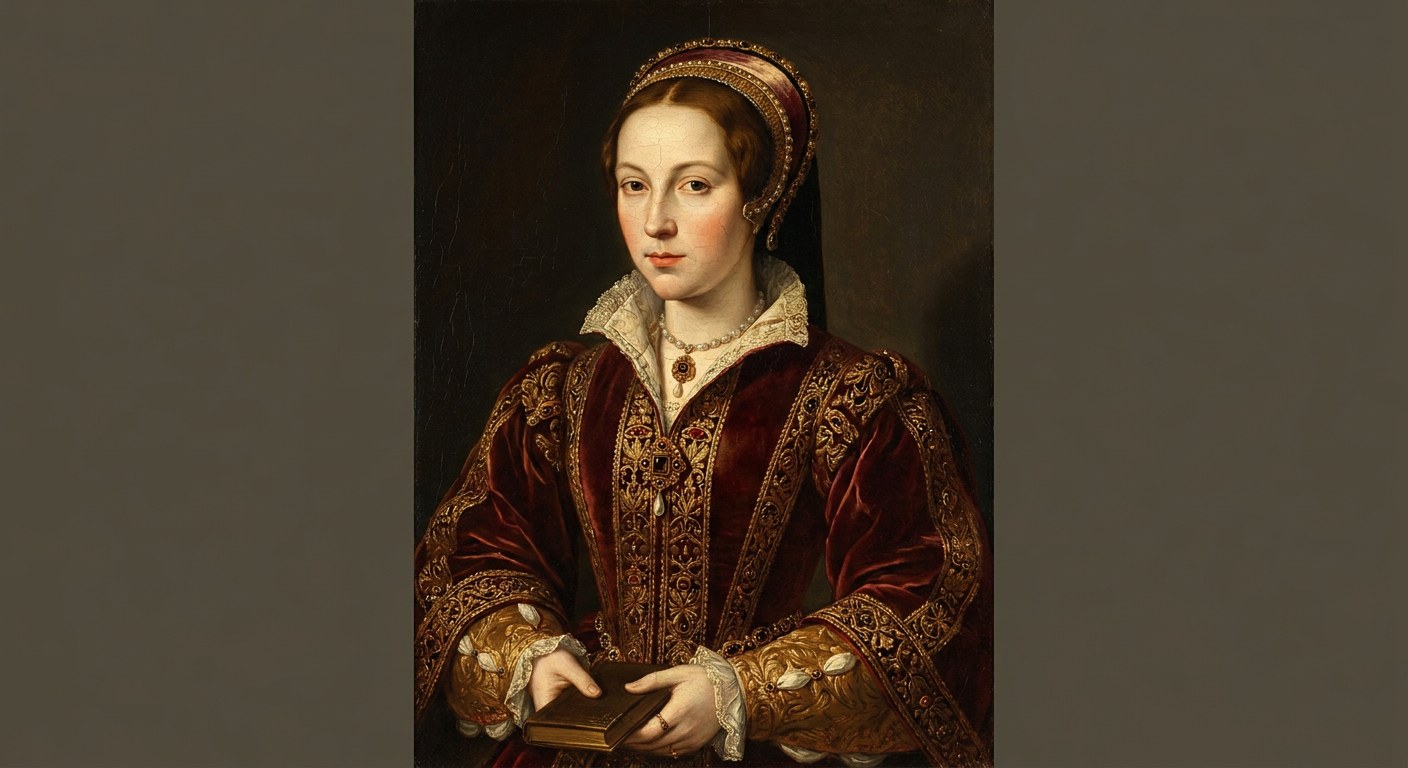
Her cultural patronage extended to visual representation. The full-length portrait of Catherine attributed to Master John, now in the National Portrait Gallery, presents her in magnificent clothing and jewels. For many years it was misidentified as a portrait of Lady Jane Grey. Its royal scale and symbolism assert Catherine’s rank and authority rather than depicting her merely as Henry’s companion.
Defining Moments
Catherine’s experience during the Pilgrimage of Grace was one of the defining episodes of her early adulthood. The detention of her household at Snape Castle exposed how quickly noble status could become dangerous during rebellion. It also gave her direct experience of the relationship between religious upheaval and political violence.
Her marriage to Henry VIII was the decisive transformation of her life. As queen, she had access to wealth, influence and intellectual networks unavailable to nearly every other Englishwoman. Yet she also became wife to a ruler who had annulled two marriages and ordered the execution of two wives. Catherine’s conduct therefore required exceptional caution.
The regency of 1544 marked the high point of her public political power. Henry’s selection of Catherine signaled trust, while her competent performance strengthened her status. Her letters from the period blended conventional declarations of wifely submission with an evident awareness of public responsibility.
A more dangerous moment came in 1546. Catherine regularly discussed theology with Henry, whose religious position combined rejection of papal authority with resistance to several Protestant doctrines. Conservative officials, particularly Lord Chancellor Thomas Wriothesley and Bishop Stephen Gardiner of Winchester, regarded the queen’s evangelical sympathies as a threat.
According to the later account of John Foxe, Henry became irritated when Catherine argued with him about religion. Her enemies prepared articles or a warrant for her arrest and sought evidence among women connected to reformist networks. Anne Askew, who was tortured and burned for heresy in July 1546, was questioned about links to ladies at court, although no secure evidence directly implicated Catherine.
Warned of the danger, Catherine approached Henry and explained that she had discussed theology only to learn from his superior wisdom and to distract him from the pain of his illness. Henry accepted her submission. When Wriothesley arrived with guards on the following day, the king angrily dismissed him. The precise details depend heavily on Foxe’s Protestant martyrology and may have been dramatized, but there is good reason to believe Catherine faced a genuine conservative campaign.
Henry died at Whitehall Palace on 28 January 1547. Catherine received a substantial settlement but was excluded from the regency government established for the nine-year-old Edward VI. She was given the honorable status of dowager queen, yet real power passed to Edward Seymour, Duke of Somerset, Thomas Seymour’s elder brother.
Within months, Catherine secretly married Thomas Seymour. The exact date is uncertain, but the marriage probably took place in late May 1547. Its haste created scandal, partly because Henry had been dead for only a short time and partly because the king’s council had not approved it.
The marriage offered Catherine personal affection but led to the most controversial episode of her life. Princess Elizabeth, then about 14, lived in Catherine’s household. Thomas Seymour engaged in improper and flirtatious behavior toward her, reportedly entering her chamber in the mornings, touching her and engaging in horseplay. Catherine initially participated in or tolerated some playful encounters, but she eventually recognized the danger and sent Elizabeth away in May 1548. No conclusive evidence proves a sexual relationship between Seymour and Elizabeth, but his behavior violated household and political boundaries.
Catherine became pregnant in late 1547 or early 1548. On 30 August 1548 she gave birth to Mary Seymour at Sudeley Castle. Catherine developed puerperal fever and died six days later, on 5 September. She was buried in the castle chapel on 7 September in a service often described as the first Protestant royal funeral conducted in English.
Timeline
| Year | Event |
|---|---|
| 1512 | Catherine Parr is born in August, probably in London. |
| 1517 | Her father, Sir Thomas Parr, dies. |
| c. 1529 | Catherine marries Edward Borough. |
| 1531 | Her mother, Maud Green, dies. |
| 1533 | Edward Borough dies, leaving Catherine a widow. |
| 1534 | Catherine marries John Neville, 3rd Baron Latimer. |
| 1536–1537 | The Pilgrimage of Grace places the Latimer family in danger; Catherine is held by rebels at Snape Castle. |
| 1543 | Lord Latimer dies on 2 March. Catherine marries Henry VIII at Hampton Court on 12 July. |
| 1544 | Catherine serves as regent during Henry’s campaign in France; Psalms or Prayers appears. |
| 1545 | Prayers or Meditations is published under Catherine’s name. |
| 1546 | Conservative courtiers move against Catherine over her religious interests, but she reconciles with Henry. |
| 1547 | Henry VIII dies on 28 January. Catherine secretly marries Thomas Seymour. The Lamentation of a Sinner is published in November. |
| 1548 | Catherine gives birth to Mary Seymour on 30 August and dies at Sudeley Castle on 5 September. |
| 1782 | Catherine’s coffin is rediscovered at Sudeley, beginning a troubled history of investigation and reburial. |
| 1863 | Her restored tomb and effigy are formally completed at St Mary’s Church, Sudeley Castle. |
Personal Life
Catherine married four times, more than any other English queen consort. Her first two marriages were conventional aristocratic arrangements, while her marriage to Henry VIII was shaped by the demands of monarchy. Only her fourth marriage, to Thomas Seymour, appears to have originated primarily in mutual attraction.
No children are known from her marriages to Edward Borough, Lord Latimer or Henry. As Lady Latimer, however, Catherine was stepmother to Latimer’s children. As queen, she assumed a broader maternal role toward Henry’s three heirs. Contemporary evidence suggests that she felt genuine affection for them, although their relationships differed.
Mary and Catherine exchanged gifts and shared courtly interests. Elizabeth benefited particularly from Catherine’s encouragement of female learning. Edward addressed his stepmother with respect and affection. Catherine helped create the courtly environment in which Henry’s children appeared together as members of a renewed dynasty.
Her relationship with Thomas Seymour was emotionally important but politically disastrous. Surviving correspondence suggests that Catherine had loved him before marrying Henry. After 1547, however, Seymour resented his elder brother’s authority and pursued influence over Edward VI. He also clashed with Catherine over money, property and control of the dowager queen’s household.
Catherine’s only child, Mary Seymour, was born at Sudeley Castle. After Catherine’s death, Thomas Seymour was arrested for treason and executed in March 1549. Mary was placed in the care of Catherine Willoughby, Duchess of Suffolk. Records of payments for the child survive into 1550, after which she disappears from the historical record. She probably died young, although neither the date nor place of her death is known.
Beliefs & Philosophy
Catherine’s religious development reflected the unsettled character of the English Reformation. Raised within traditional Catholic practice, she gradually adopted evangelical ideas emphasizing scripture, personal faith and Christ’s saving grace. Her beliefs were Protestant by the end of her life, though they developed within a court where open doctrinal radicalism could be fatal.
Her early devotional writing remained relatively cautious. Prayers or Meditations focused on repentance, moral discipline and dependence on God. Its publication under her own name was itself significant: authorship allowed a queen to present spiritual instruction to a mixed readership of men and women.
The Lamentation of a Sinner was more explicit. Catherine described the insufficiency of human merit and criticized the religious errors in which she believed she had once lived. Her focus on justification by faith placed her close to Protestant theology, even if she avoided defining every contested doctrine.
Education formed another central element of her outlook. She believed religious knowledge should rest on informed reading rather than passive custom. Her support for translations and scholarly study helped normalize the image of the learned royal woman. This example was especially important for Elizabeth, whose later queenship combined humanist education, scriptural knowledge and carefully controlled religious authority.
Catherine’s political philosophy remained hierarchical. She did not advocate modern equality or religious liberty. Her writings accepted monarchy, social rank and obedience as divinely ordered. Yet her career expanded the practical boundaries of female participation in governance and public religious authorship.
Challenges & Controversies
The greatest challenge of Catherine’s queenship was balancing reformist conviction with obedience to Henry VIII. The king authorized an English Bible and rejected papal supremacy, but he continued to defend doctrines and ceremonies opposed by many evangelicals. Catherine could encourage reform only within limits set by an unpredictable monarch.
The alleged arrest plot of 1546 remains controversial because its fullest narrative comes from John Foxe, writing later with a desire to celebrate Protestant deliverance. Historians generally accept that conservative officials targeted the queen’s circle, but the exact sequence of her reconciliation with Henry cannot be reconstructed with certainty.
Catherine’s association with Anne Askew also requires caution. Askew was tortured in an illegal attempt to obtain names of highly placed supporters. She knew people connected with the queen’s household, but no reliable evidence establishes a close personal relationship between Askew and Catherine.
Her conduct in the Seymour–Elizabeth episode has attracted stronger criticism. Catherine initially seems to have treated Seymour’s behavior as joking, even when it was clearly inappropriate. One report describes Catherine joining Seymour in cutting Elizabeth’s black gown during play in a garden. She later removed Elizabeth from the household, suggesting that she understood the situation’s seriousness. Whether Catherine acted from jealousy, concern for Elizabeth or fear of scandal is uncertain; several motives may have operated together.
The condition of Catherine’s remains became a posthumous controversy. Her lead coffin was discovered at Sudeley in 1782. It was repeatedly opened, examined and disturbed during subsequent decades, causing severe damage to the remains. In the nineteenth century, Sudeley’s owners restored the chapel and provided Catherine with the elaborate tomb and effigy visible today.
Famous Quotes
Catherine’s most reliable words come from her books and surviving letters. Spelling and punctuation are commonly modernized in quotations.
“I embraced ignorance as perfect knowledge; and knowledge seemed to me superfluous and vain.”
—The Lamentation of a Sinner
“I thought myself out of danger, when I was most in danger.”
—The Lamentation of a Sinner
“Christ was obscurely and darkly preached, and instead of him, men’s traditions and laws were set forth.”
—The Lamentation of a Sinner
“My mind was fully bent the other time I was at liberty, to marry you before any man I knew.”
—Letter to Thomas Seymour, recalling her feelings before her marriage to Henry VIII
“Let us therefore work our salvation with fear and trembling, and let us continually pray that we may be established in the truth.”
—Attributed to Catherine’s devotional writing, in modernized form
The famous speech in which Catherine allegedly told Henry that she debated religion only to benefit from his wisdom derives from John Foxe’s later account. It should be read as a report of the episode rather than a verbatim transcript.
Legacy & Influence
Catherine Parr’s reputation has changed substantially over time. Earlier popular histories often depicted her as a kindly, middle-aged nurse who soothed Henry VIII in his final years. She was neither elderly—she was only about 30 when they married—nor politically insignificant. Modern scholarship emphasizes her regency, authorship, patronage and theological engagement.
Her contribution to women’s literary history is especially important. By publishing Prayers or Meditations under her own name, Catherine claimed a public devotional voice at a time when female authorship was frequently anonymous, translated or confined to manuscript circulation. The Lamentation of a Sinner went further by presenting a queen’s spiritual autobiography and doctrinal argument to the public.
Her example helped create space for learned women in the later Tudor world. Princess Elizabeth’s intellectual relationship with Catherine connected female scholarship to royal service and Protestant devotion. Although Elizabeth developed her own religious and political style, Catherine’s household formed part of the educational environment that prepared her for rule.
Catherine’s regency also deserves recognition. She did not govern independently of Henry or his council, but she exercised legitimate delegated sovereignty during wartime. Her performance demonstrated that queenship could include administrative leadership as well as ceremony, intercession and dynastic motherhood.
Religiously, Catherine served as a bridge between the cautious reforms of Henry VIII’s later reign and the more openly Protestant policies of Edward VI. Her writings circulated evangelical ideas while maintaining a language of order and obedience. They are now studied as major documents in the history of Reformation spirituality, Tudor politics and women’s writing.
Her restored tomb at Sudeley Castle has made her the only one of Henry VIII’s queens buried on private property. The site remains a center of public commemoration, while her books continue to attract attention from historians of gender, monarchy and religion.
Interesting Facts
- Catherine usually signed her name “Kateryn the Quene,” which is why some historians prefer the spelling Katherine.
- She was probably named after Catherine of Aragon, whom her mother served.
- Despite her family’s northern roots, she was probably not born at Kendal Castle.
- She married four times and was widowed three times.
- She was the first of Henry VIII’s wives also to have held the title of an English peeress through marriage: as Lady Latimer.
- Catherine and Henry VIII were related within the prohibited degrees recognized by the Church and required a dispensation.
- She served as regent-general in 1544 while Henry campaigned around Boulogne in France.
- Her regency council dealt with the danger of French or Scottish military action.
- Prayers or Meditations made her the first Englishwoman known to publish an original English work under her own name.
- She owned books, commissioned translations and encouraged the education of Henry’s children.
- A celebrated portrait of Catherine was once incorrectly identified as Lady Jane Grey.
- She narrowly escaped a conservative attack connected to religious politics in 1546.
- Her marriage to Thomas Seymour was concealed at first because it occurred so soon after Henry VIII’s death.
- Catherine’s daughter, Mary Seymour, was her only known biological child.
- Her funeral at Sudeley is commonly identified as the first Protestant royal funeral conducted in English.
- Catherine’s coffin was opened several times after its rediscovery in the eighteenth century, badly damaging her remains.
Frequently Asked Questions
Why is Catherine Parr famous?
Catherine Parr is famous as the sixth and last wife of Henry VIII, but her historical importance extends beyond that marriage. She served as regent of England in 1544, helped foster unity among Henry’s children, patronized reform-minded scholars and became a pioneering published female author.
Did Catherine Parr love Henry VIII?
Her private feelings cannot be known with certainty. Catherine behaved as a loyal and attentive wife, but her later letter to Thomas Seymour indicates that she had wanted to marry Seymour before Henry chose her. Her marriage to the king was therefore probably based more on duty and political necessity than romantic love.
Was Catherine Parr Henry VIII’s nurse?
Catherine helped care for Henry during periods of illness, but calling her merely his nurse is inaccurate. Royal physicians and servants handled much of his physical care. Catherine’s responsibilities included ceremonial queenship, household management, diplomacy, patronage, family politics and national government.
Did Catherine Parr save Princess Elizabeth?
Catherine provided Elizabeth with affection, educational encouragement and a place in her household. However, after Henry’s death, she exposed Elizabeth to Thomas Seymour’s inappropriate behavior before eventually sending the princess away. Their relationship was important and often warm, but it should not be idealized.
Was Catherine Parr a Protestant?
By the final years of her life, Catherine held clearly evangelical or Protestant beliefs, particularly concerning justification by faith and the importance of scripture. During Henry’s reign she expressed those convictions cautiously because some Protestant teachings remained legally dangerous.
Did Henry VIII plan to arrest Catherine?
Evidence suggests that conservative officials prepared action against her in 1546 and that an arrest warrant may have existed. Catherine reconciled herself with Henry before it could be carried out. The most vivid details come from John Foxe and may contain later embellishment.
How many children did Catherine Parr have?
She had one known biological child, Mary Seymour, born on 30 August 1548. Catherine also acted as stepmother to Lord Latimer’s children and to Henry VIII’s children, Mary, Elizabeth and Edward.
How did Catherine Parr die?
Catherine died at Sudeley Castle on 5 September 1548, six days after childbirth. The likely cause was puerperal fever, a postpartum infection that was frequently fatal before modern antiseptic medicine and antibiotics.
What happened to Mary Seymour?
Mary was placed in the care of Catherine Willoughby, Duchess of Suffolk, after Thomas Seymour’s arrest and execution. Documentation survives through 1550, but Mary then disappears from the record. Most historians conclude that she died in childhood.
Where is Catherine Parr buried?
She is buried in St Mary’s Church within the grounds of Sudeley Castle in Gloucestershire. Her current nineteenth-century tomb includes a recumbent effigy of the queen.
Lessons from Catherine Parr
- Education can become a form of influence. Catherine used learning, translation and publication to participate in debates from which women were often excluded.
- Political authority may be exercised through delegated roles. Her 1544 regency shows that a queen consort could perform substantial governmental duties.
- Survival at court required judgment as well as luck. Catherine escaped the fate of Anne Boleyn and Catherine Howard by recognizing danger and adapting her behavior.
- Private belief and public responsibility can conflict. Her religious career illustrates the difficulty of maintaining conviction under an authoritarian ruler.
- Family reconciliation can have political consequences. Her relationships with Henry’s children helped present a more stable Tudor dynasty.
- Intelligence does not prevent personal misjudgment. Catherine’s handling of Thomas Seymour’s behavior toward Elizabeth remains a serious blemish on her record.
- Historical stereotypes should be questioned. Describing Catherine only as a nurse obscures her achievements as regent, author and religious thinker.
- Written work can outlast political office. Catherine’s books preserve her voice more clearly than the ceremonial records of her queenship.
- Women’s authority in the past was real but constrained. Catherine exercised power within systems that still demanded submission to male monarchy and household hierarchy.
- Legacy is often reconstructed over time. Modern research has recovered a far more complex Catherine than the passive “surviving wife” of popular memory.
Further Reading
- Susan E. James, Catherine Parr
- Linda Porter, Katherine the Queen: The Remarkable Life of Katherine Parr
- Janel Mueller, ed., Katherine Parr: Complete Works and Correspondence
- Susan E. James, The Feminine Dynamic in English Art, 1485–1603
- David Starkey, Six Wives: The Queens of Henry VIII
- Antonia Fraser, The Six Wives of Henry VIII
- Alison Weir, The Six Wives of Henry VIII
- Elizabeth Norton, Catherine Parr
- John Foxe, Acts and Monuments, for the influential Protestant account of the 1546 arrest crisis
- Catherine Parr, Prayers or Meditations
- Catherine Parr, The Lamentation of a Sinner