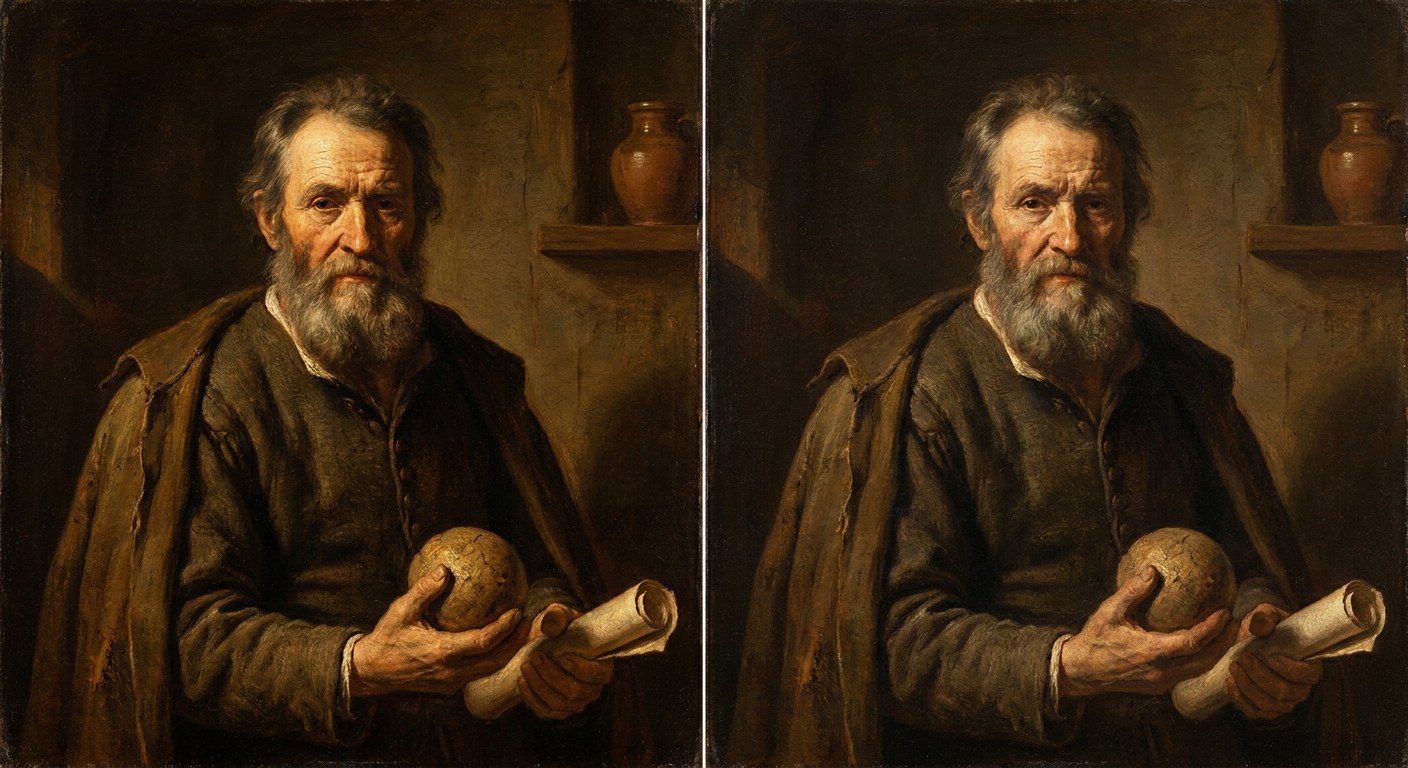
Democritus
460 BC – 370 BC · Ancient Greek · Philosopher & Scientist
Recommended Audiobooks
Listen next from Marcus Alden

Life Lessons from Frederic Chopin
Marcus Alden · 54 min

Life Lessons from John Wesley
Marcus Alden · 52 min
Introduction
Democritus of Abdera was one of the most original thinkers of the ancient Greek world. Best known for developing an early form of atomism, he argued that all physical reality consists of indivisible bodies—atoms—moving through empty space. The countless objects of ordinary experience, from stones and plants to animals and human beings, arise through the combinations, separations, shapes, and motions of these atoms. Although his theory differed fundamentally from modern atomic physics, it represented a remarkable attempt to explain nature through consistent material processes rather than through myth or direct divine intervention.
Born around 460 BCE in Abdera, a Greek city on the coast of Thrace, Democritus belonged to the generation of thinkers commonly called the Presocratics. The label is useful but imperfect: Democritus was probably a younger contemporary of Socrates and may have outlived him by several decades. He inherited atomistic ideas from Leucippus, an obscure philosopher whose life and writings are so poorly documented that ancient and modern scholars have sometimes debated whether he was a distinct historical figure. Democritus nevertheless transformed atomism into an ambitious philosophical system covering cosmology, perception, mathematics, biology, ethics, language, and human culture.
His works were widely known in antiquity. Later authors credited him with dozens of treatises, but none survives intact. What remains consists of fragments, paraphrases, titles, and reports preserved by writers such as Aristotle, Theophrastus, Cicero, Seneca, Plutarch, Sextus Empiricus, Diogenes Laertius, and Stobaeus. This fragmentary evidence makes reconstructing his thought difficult. Statements associated with him may have been abbreviated, translated, detached from context, or confused with those of Leucippus and later atomists.
Ancient tradition remembered Democritus as the “Laughing Philosopher”, contrasting his cheerful response to human folly with the supposed melancholy of Heraclitus, the “Weeping Philosopher.” That image is partly literary rather than strictly biographical, but it reflects an important aspect of his ethics. Democritus taught that a good life depends not on wealth or public fame but on moderation, intellectual cultivation, self-command, and a balanced state of mind often called euthymia—cheerfulness, tranquility, or well-being.
Democritus stands at a crucial point in the history of ideas. His atoms are not those of contemporary chemistry, and his arguments were philosophical rather than experimental in the modern sense. Yet his insistence that complex phenomena could be explained through invisible natural structures made him an enduring symbol of rational inquiry.
Quick Facts
| Category | Details |
|---|---|
| Full name | Democritus of Abdera |
| Greek name | Δημόκριτος (Dēmokritos) |
| Born | Traditionally c. 460 BCE; some ancient chronologies suggest c. 470 BCE |
| Birthplace | Abdera, Thrace, in northern Greece |
| Died | Traditionally c. 370 BCE, probably at Abdera |
| Era | Classical Greece; conventionally classified as a Presocratic philosopher |
| School | Ancient atomism |
| Teacher or predecessor | Leucippus, according to the dominant ancient tradition |
| Main interests | Physics, cosmology, epistemology, ethics, mathematics, biology, language, and culture |
| Central doctrine | Reality consists fundamentally of atoms and void |
| Ethical ideal | Euthymia: a stable, cheerful, and well-ordered state of mind |
| Common epithet | “The Laughing Philosopher” |
| Notable contemporaries | Socrates, Hippocrates, Protagoras, Thucydides, and Plato |
| Surviving works | None complete; only fragments and later reports remain |
| Historical importance | Systematized ancient atomism and influenced Epicurus, Lucretius, and later materialist thought |
Early Life & Background
Democritus was born in Abdera, a prosperous Greek settlement in Thrace near the northern coast of the Aegean Sea. Abdera had been founded by Greek colonists and later refounded by settlers from Teos after the Persian conquest of Ionia. Although ancient comic stereotypes portrayed the Abderites as foolish provincials, the city produced several important intellectuals, including the sophist Protagoras and the natural philosopher Anaxarchus.
The standard birth date of approximately 460 BCE is based on ancient chronological calculations and remains uncertain. Apollodorus of Athens, whose dates were transmitted by Diogenes Laertius, reportedly placed Democritus’ birth in the 80th Olympiad, corresponding roughly to 460–457 BCE. Another tradition made him older, perhaps born around 470 BCE. Democritus himself was said to have described his youth in relation to the old age of the philosopher Anaxagoras, but the interpretation of that statement is disputed.
Ancient biographies claim that Democritus came from a wealthy family. One story held that his father—variously named Hegesistratus, Athenocritus, or Damasippus—received the Persian king Xerxes I when the royal army passed through Thrace during the invasion of Greece in 480 BCE. Persian or Chaldean scholars supposedly remained with the family and instructed the young Democritus in astronomy and theology. This account is chronologically difficult if Democritus was born around 460 BCE and should be treated as legend rather than established fact.
More plausible, though still unverified, are reports that Democritus used his inheritance to travel extensively in search of knowledge. Later sources sent him to Egypt, Babylonia, Persia, and possibly India and Ethiopia. Democritus was himself credited with boasting that he had traveled farther, seen more countries, and heard more learned men than anyone of his time. His interest in Egyptian geometry and Near Eastern astronomy makes some travel plausible, but the most distant journeys cannot be independently confirmed.
Democritus’ most important intellectual association was with Leucippus, traditionally regarded as the founder of Greek atomism. Leucippus may have come from Miletus, Elea, or Abdera. Almost nothing certain is known about him, and only one sentence is commonly assigned to him with confidence: “Nothing happens at random, but everything from reason and by necessity.” Aristotle consistently treated Leucippus and Democritus as related but distinct thinkers, providing strong evidence that antiquity regarded Leucippus as a real predecessor.
The atomists responded to a major problem created by Parmenides of Elea. Parmenides had argued that what truly exists cannot come into being, pass away, or move into nonbeing. If “what is not” cannot exist, change and motion become philosophically puzzling. Leucippus and Democritus accepted part of this reasoning while rejecting its conclusion. They proposed that reality contains both solid being—atoms—and empty space, or the void. The void is “not-being” in the sense that it is not solid matter, but it nonetheless exists as the space in which atoms can move.
Rise to Prominence
No reliable narrative survives of Democritus’ career. Unlike Socrates, Plato, and Aristotle, he is not associated with a clearly documented school in Athens. His reputation appears to have grown through his writings, teaching, travels, and participation in the wider intellectual culture of the Greek world.
Ancient catalogues credited Democritus with an extraordinary range of works. The scholar Thrasyllus of Mendes, active in the early Roman Empire, arranged his writings into groups of four, or tetralogies. Titles attributed to Democritus included The Great World-System, The Little World-System, On the Nature of Man, On the Mind, On Shapes, On Colors, On the Senses, On Geometry, On Numbers, On Poetry, On Agriculture, and ethical works such as On Cheerfulness. Authorship is not always certain: The Great World-System, for example, was sometimes assigned to Leucippus.
This breadth earned Democritus a reputation as a universal scholar. Later admirers compared his range with that of Aristotle. He wrote on topics that modern institutions would separate into physics, astronomy, mathematics, medicine, zoology, linguistics, literary criticism, and moral philosophy. His prose style was also admired; Cicero praised the ornament and rhythm of his language.
Democritus may have visited Athens, then the leading intellectual center of Greece. A fragment attributed to him says that he went to Athens and that nobody recognized him. Another tradition states that he knew Socrates without being known by him. These anecdotes express his supposed indifference to fame, but they cannot be verified. Plato never names Democritus in the surviving dialogues, despite discussing ideas relevant to atomism. Later reports claimed that Plato disliked Democritus so intensely that he wanted to burn his books, but this story is late and probably reflects philosophical rivalry more than historical fact.
Aristotle became the most important ancient critic and transmitter of atomism. He rejected the void and denied that indivisible bodies could explain nature adequately, yet he treated Democritus seriously. Aristotle’s detailed discussions preserved the outlines of atomist theory and occasionally praised Democritus for approaching biological and physical questions systematically. Without Aristotle and his successor Theophrastus, far less would be known about Democritus today.
Major Achievements
Democritus’ greatest achievement was the systematic development of atomism. The Greek word atomos means “uncuttable” or “indivisible.” Atoms, in his theory, are eternal, solid, and internally without void. They cannot be created or destroyed. Observable change therefore does not involve the coming-to-be of matter from nothing; it results from atoms joining, separating, and rearranging.
Atoms do not differ in basic substance. Instead, they differ in geometrical and relational properties. Aristotle summarized these differences through the concepts of shape, arrangement, and position, using letters as an analogy: A differs from N in shape, AN differs from NA in arrangement, and N differs from Z in position. Ancient reports also attribute differences of size to the atoms. Their possible shapes were innumerable—smooth, rough, hooked, curved, angular, or spherical—and these features helped account for the properties of compound bodies.
The second fundamental constituent of reality was the void. Without empty space, motion would be impossible. The atomists expressed the paradox by saying that “what is” exists no more than “what is not”: the full and the empty are both necessary components of the cosmos. This did not mean that nothingness was a material object. Rather, empty space had to be admitted as real if atoms were to separate and move.
Democritus envisioned an infinite universe containing infinitely many atoms and, apparently, innumerable worlds. These worlds form and perish through natural processes. Some have suns and moons; some may lack them. Some may support living things, while others may be barren. Worlds can grow, collide, and dissolve. This vision displaced the Earth from any necessary position as the unique center or purpose of creation.
Atomist cosmology described atoms moving in vortices. Larger aggregates formed as bodies became entangled and sorted through motion, impact, and necessity. Democritus did not formulate modern laws of inertia, gravity, or probability, and the precise origin of motion in his system remains debated. Nevertheless, his cosmos operated without requiring divine craftsmanship at every stage.
He also offered a material account of the soul. Soul atoms were said to be especially fine, smooth, mobile, and spherical, resembling the atoms of fire. They were distributed throughout the body and produced life and motion. Breathing replenished them against the pressure of the surrounding environment; death occurred when they dispersed and were no longer retained. This account left little room for the survival of an individual soul after death.
Democritus’ theory of perception was equally ambitious. Objects continuously emit extremely thin films or images, called eidōla, which travel through the air and affect the sensory organs. Vision occurs when such images interact with the eye and surrounding medium. Other sensations arise from the physical effects of atomic shapes and motions. Sweetness might be associated with smooth atoms, while bitterness could result from sharp or rough configurations.
He distinguished between the underlying reality of atoms and void and the qualities experienced by perceivers. One famous formulation states:
“By convention sweet, by convention bitter, by convention hot, by convention cold, by convention color; in reality atoms and void.”
This did not necessarily mean that sensory qualities were unreal in every sense. They arise from genuine interactions between objects and perceiving bodies, but they are not intrinsic properties of atoms themselves. The distinction anticipates later debates over primary and secondary qualities.
Democritus also recognized the limits of reason. The senses are imperfect, yet rational thought depends on evidence received through them. A fragment dramatizes the senses answering the intellect: “Wretched mind, do you take your evidence from us and then try to overthrow us?” Knowledge is therefore possible but difficult, and ultimate reality lies beneath ordinary appearances.
His mathematical work is known only through reports. He apparently investigated cones, pyramids, tangencies, irrational lines, and geometry. Archimedes credited Democritus with stating that the volume of a cone is one-third that of a cylinder with the same base and height, and that a pyramid similarly has one-third the volume of the corresponding prism. Democritus probably did not possess the rigorous proofs later developed by Eudoxus and Archimedes, but his insight was historically significant.
Defining Moments
The first defining intellectual moment in Democritus’ life was his adoption and expansion of Leucippus’ atomism. By combining Parmenidean arguments about being with an acceptance of void, plurality, and motion, the atomists created one of antiquity’s most powerful alternatives to both Eleatic monism and purpose-driven cosmology.
A second defining feature was his commitment to broad inquiry. Whether or not every reported journey occurred, Democritus became the ancient model of the philosopher who valued discovery above wealth. A saying attributed to him declares that he would prefer to discover a single causal explanation than become king of Persia. The sentiment captures his reputation even if its exact wording is uncertain.
Another important moment was the formulation of a naturalistic account of human civilization. Democritus appears to have believed that early humans gradually developed speech, social cooperation, crafts, and political arrangements in response to necessity. People learned by observing nature: weaving from spiders, building from swallows, and music from birds. Culture thus emerged historically rather than arriving fully formed as a divine gift.
His ethical writings marked a further development. Atomism could have remained a theory of matter, but Democritus connected the study of nature with the art of living. Happiness, he maintained, does not reside in possessions or bodily pleasure alone. It arises from the soul’s measured condition, freedom from excessive fear, and disciplined judgment.
Finally, the disappearance of his books profoundly shaped his later reputation. In antiquity Democritus was a major author; in the modern world he is known through fragments. The survival of Plato’s and Aristotle’s works, contrasted with the loss of Democritus’ corpus, has made his place in philosophy appear smaller and less secure than it was to many ancient readers.
Timeline
| Year | Event |
|---|---|
| c. 470–460 BCE | Democritus is born at Abdera in Thrace; c. 460 BCE is the conventional date. |
| c. 450s–440s BCE | He is traditionally associated with Leucippus and the emerging atomist school. |
| c. 440s–420s BCE | Possible period of travel in Egypt, western Asia, and other regions; the extent of these journeys is uncertain. |
| 430s–420s BCE | Democritus develops atomism amid the intellectual culture of Classical Greece and the era of the Peloponnesian War. |
| c. 420 BCE | Traditional approximate period for the composition or circulation of major atomist works, though individual dates are unknown. |
| 399 BCE | Socrates is executed in Athens; Democritus, if the standard chronology is correct, is still alive. |
| 390s–380s BCE | Democritus’ writings and reputation continue to circulate across the Greek world. |
| c. 370 BCE | Traditional approximate date of Democritus’ death, probably at Abdera. |
| 4th century BCE | Aristotle and Theophrastus analyze and criticize the atomist theories of Leucippus and Democritus. |
| c. 307 BCE onward | Epicurus adapts ancient atomism into a new physical and ethical system. |
| 1st century BCE | Lucretius presents Epicurean atomism in Latin in On the Nature of Things. |
| 1st century CE | Thrasyllus organizes a catalogue of works attributed to Democritus. |
| 17th century CE | Early modern thinkers revive corpuscular and atomistic explanations of nature. |
| 19th–20th centuries CE | Modern atomic theory prompts renewed interest in Democritus, while historians emphasize differences between ancient and scientific atoms. |
Personal Life
Reliable information about Democritus’ private life is extremely limited. Ancient sources do not provide secure evidence that he married or had children. Some traditions portray him as deliberately avoiding marriage and sexual entanglements because they disturbed intellectual tranquility. Such stories may reflect later philosophical ideals rather than biographical fact.
His family was supposedly wealthy enough to leave him and his brothers a substantial inheritance. Democritus was said to have chosen the more portable share, converted much of it into travel expenses, and returned with little money but great learning. Another story claims that Abderite law threatened those who squandered inherited property with denial of an honorable burial. Democritus allegedly defended himself by reading one of his major works aloud, whereupon the citizens rewarded him. The tale celebrates philosophy over material wealth but is not independently verifiable.
Accounts of his old age became increasingly fanciful. He was said to have lived more than a century, with reported ages ranging from about 90 to 109. One legend relates that, when death approached during a women’s festival, he prolonged his life by smelling warm bread so that his sister could complete the observance without ritual disruption. Such anecdotes belong to philosophical folklore.
The image of Democritus as the Laughing Philosopher also shaped depictions of his personality. He supposedly laughed at human ambition, greed, and self-importance—not because suffering was trivial, but because people repeatedly made themselves miserable by pursuing unstable goals. In Renaissance and early modern art, he was often paired with a sorrowful Heraclitus: Democritus laughed at the world’s absurdity, while Heraclitus wept over its misery.
Beliefs & Philosophy
Democritus’ philosophy joined physics, psychology, epistemology, and ethics into a broadly naturalistic worldview. At the deepest level, everything consisted of atoms and void. Yet human life still required moral evaluation. Materialism did not eliminate ethics; it made the ordering of the embodied soul central to happiness.
His preferred ethical term was euthymia, which can be translated as cheerfulness, tranquility, confidence, or well-being. Democritus described it as a condition in which the soul proceeds calmly and steadily, undisturbed by fear, superstition, or excessive passion. Other terms associated with his ideal include ataraxia—untroubledness—and symmetria, balance or proportion.
Pleasure played a role in his ethics, but he did not recommend uncontrolled indulgence. The best pleasures are measured, stable, and governed by intelligence. Desires that exceed reasonable limits produce dependence and anxiety. A person who constantly compares possessions with those of the rich will never feel secure; one who remembers those with less may develop gratitude and contentment.
For Democritus, moral worth belongs primarily to intention and character rather than external reputation. A person should avoid wrongdoing not merely from fear of law or public shame, but because wrongdoing damages the self. Education and habituation reshape character, almost creating a “second nature.” This emphasis on internal discipline helped make Democritus an important precursor to later Greek ethical traditions.
He appears to have regarded conventional gods with skepticism, though his exact position is disputed. Some reports suggest that unusual atmospheric images or powerful eidōla contributed to human beliefs about divine beings. Fear of thunder, lightning, eclipses, and other natural phenomena may have encouraged religion. Democritus did not necessarily deny every kind of divine entity, but his physics removed the need for immortal creators directing cosmic events for human purposes.
His account of necessity also raises questions about determinism. Atomist events occur through motion, collision, and causal necessity rather than arbitrary divine choice. However, surviving evidence does not permit a complete reconstruction of his position on human freedom. Later Epicurus introduced an unpredictable atomic “swerve,” partly to avoid strict determinism, but that innovation should not be attributed to Democritus.
Politically, Democritus’ surviving maxims favor law, civic order, competent leadership, and the common good. One fragment states that poverty in a democracy is preferable to prosperity under rulers, just as freedom is preferable to slavery. Other sayings reflect assumptions typical of elite Greek male authors and should not be mistaken for modern egalitarianism.
Challenges & Controversies
The greatest challenge in studying Democritus is the loss of his writings. Nearly every interpretation depends on quotations and summaries selected by later authors with their own philosophical agendas. Aristotle was exceptionally informative but also a critic. Christian writers sometimes preserved Democritean material to attack pagan materialism, while ethical anthologists extracted maxims without their original contexts.
Authorship presents another difficulty. Because Leucippus and Democritus developed closely related doctrines, ancient sources often referred collectively to “Leucippus and Democritus.” Scholars cannot always determine which thinker originated a specific idea. Some works attributed to Democritus may also be later pseudonymous compositions.
The reliability of the ethical fragments is debated. Many survive in the anthology of Stobaeus, and some belong to collections associated with a figure called “Democrates.” Scholars disagree over how much of this material is authentically Democritean. Its emphasis on moderation and inner well-being is broadly consistent, but individual sayings may have been altered or misassigned.
Democritus’ relationship to Plato is another controversy. Plato’s silence is striking but proves little. The story that Plato wished to burn Democritus’ books appears in Diogenes Laertius, writing centuries later, and is usually regarded with caution.
Calling Democritus the “father of modern science” or claiming that he discovered the modern atom is also misleading. His atoms had no internal parts, whereas modern atoms contain electrons and nuclei made of smaller particles. He had no experimental chemistry, quantitative atomic weights, or laboratory evidence. His achievement was conceptual: he developed a coherent microscopic explanation of macroscopic change.
Some aspects of his thought are ethically troubling from a modern perspective. Fragments attributed to him include conventional ancient Greek views about women, household authority, disability, and reproduction. These statements reflect the inequalities of his historical setting and should be examined critically rather than excused or ignored.
Famous Quotes
The following quotations survive in fragments or later reports. Wording varies among translations, and some attributions remain uncertain.
“By convention sweet, by convention bitter, by convention hot, by convention cold, by convention color; in reality atoms and void.”
“A life without festivity is a long road without an inn.”
“It is better to destroy one’s own errors than those of others.”
“The hopes of the educated are stronger than the wealth of the ignorant.”
“Good breeding in cattle depends on bodily health, but in human beings on a well-formed character.”
“Medicine heals diseases of the body; wisdom frees the soul from passions.”
“The world is a stage, life is a passage: you came, you saw, you departed.”
The last saying is transmitted under Democritus’ name but, like many ancient maxims, has an uncertain textual history.
Legacy & Influence
Democritus’ most direct philosophical heir was Epicurus, who founded his school in Athens around 306 BCE. Epicurus accepted atoms, void, the mortality of the soul, and the existence of innumerable worlds. He modified Democritean physics, most famously by proposing a slight atomic deviation or “swerve.” He also made freedom from fear—especially fear of death and divine punishment—central to philosophy.
The Roman poet Lucretius gave atomism its greatest surviving ancient literary expression in De rerum natura (On the Nature of Things) during the first century BCE. Although Lucretius followed Epicurus rather than Democritus directly, his poem transmitted a recognizably atomist universe to later readers.
Atomism remained controversial. Plato’s cosmology emphasized mathematical order and a divine craftsman, while Aristotle rejected both indivisible bodies and empty space. Because Aristotelian natural philosophy became dominant in medieval European universities, Democritean atomism often survived at the margins. It also faced religious objections because it could appear to deny providence, creation, and an immortal soul.
During the Renaissance and Scientific Revolution, interest revived. Pierre Gassendi sought to reconcile a Christianized Epicurean atomism with seventeenth-century science. Thinkers including Robert Boyle, Isaac Newton, and other corpuscular philosophers explored explanations based on particles and motion, though their theories were not simply restorations of Democritus.
In the nineteenth century, John Dalton’s chemical atomic theory gave atoms a precise role in explaining fixed proportions in chemical reactions. Later discoveries showed that atoms were divisible and structurally complex. Democritus had not anticipated these findings in detail, but the resemblance between ancient atomism and modern microscopic explanation made him a celebrated intellectual ancestor of physics.
His ethical legacy is less famous but substantial. The pursuit of euthymia anticipates Epicurean tranquility and overlaps with themes in Stoicism: moderation, independence from fortune, and attention to one’s own judgments. Modern readers continue to find value in his argument that happiness depends more on a well-ordered mind than on possessions or status.
Democritus’ deepest legacy is methodological. He asked whether the visible world could be explained through invisible structures governed by regular processes. His specific answers were speculative, but the question became foundational to scientific thought.
Interesting Facts
- Democritus came from Abdera, a city unfairly stereotyped in ancient comedy as a home of foolish people.
- His name may be interpreted as “chosen by the people” or “judge of the people.”
- He was traditionally credited with roughly 60 to 70 works, depending on how ancient catalogues are counted.
- No complete book by Democritus survives.
- Ancient authors gave him several nicknames, including “the Laughing Philosopher” and, according to some reports, “Wisdom.”
- He may have lived for about 90 years, although stories that he reached 100 or more are uncertain.
- Aristotle discussed Democritus more extensively than Plato did and preserved much of what is known about atomist physics.
- Democritus’ atom was a philosophical indivisible body, not the chemically defined atom of modern science.
- His universe contained innumerable worlds that could form and perish naturally.
- He wrote or was credited with writing about geometry, music, medicine, farming, grammar, and poetry as well as physics.
- His ethical ideal, euthymia, meant a balanced and cheerful state rather than constant amusement.
- The popular pairing of laughing Democritus and weeping Heraclitus became a recurring subject in European painting.
- A lunar impact crater, Democritus, is named after him.
- The chemical element darmstadtium was once temporarily assigned the systematic placeholder name ununilium, but proposals and popular discussions of element names have sometimes invoked Democritus as an emblem of atomism; no officially recognized element bears his name.
- Karl Marx’s doctoral dissertation compared the natural philosophies of Democritus and Epicurus.
Frequently Asked Questions
When and where was Democritus born?
Democritus was probably born around 460 BCE in Abdera, a Greek city in Thrace. Some ancient evidence suggests a somewhat earlier date, around 470 BCE, so the chronology remains approximate.
Who taught Democritus?
Ancient tradition identifies Leucippus as his teacher or immediate philosophical predecessor. Leucippus is usually credited with founding atomism, while Democritus developed it into a much broader system.
What did Democritus believe about atoms?
He believed that atoms were eternal, indivisible, solid bodies moving through void. They differed in shape, size, position, and arrangement. All visible objects and changes resulted from their combinations and separations.
Did Democritus discover the atom?
Not in the modern scientific sense. He proposed atoms through philosophical reasoning rather than experimental chemistry. Modern atoms are divisible structures composed of subatomic particles, unlike Democritus’ absolutely indivisible units.
What did he mean by “atoms and void”?
He meant that fundamental reality consists of solid, indivisible bodies and the empty space in which they move. Color, taste, heat, and other experienced qualities arise from interactions among atoms, objects, and perceivers.
Why was Democritus called the Laughing Philosopher?
Later tradition portrayed him as laughing at human vanity, greed, and foolishness. His laughter represented philosophical detachment and cheerfulness, although the familiar image is partly legendary.
Did Democritus believe in gods?
His exact view is uncertain. His natural philosophy did not require gods to create or direct the universe. Reports suggest that he explained some religious beliefs through fear of natural events or encounters with unusual images, but he may not have denied every form of divine being.
What was Democritus’ view of happiness?
He associated happiness with euthymia: tranquility, cheerfulness, moderation, and inner balance. Wealth and pleasure were valuable only when governed by judgment and kept within reasonable limits.
Did he believe the soul was immortal?
Probably not. He described the soul as composed of fine, mobile atoms that disperse at death. This implies that personal consciousness does not survive the dissolution of the body.
Did Democritus visit Egypt and India?
Ancient sources credit him with extensive travel, including visits to Egypt, Babylonia, Persia, and sometimes India. Travel to Egypt or the Near East is plausible, but the full itinerary cannot be confirmed.
Why have Democritus’ books been lost?
The precise reasons are unknown. Ancient texts disappeared through changes in educational priorities, limited manuscript copying, physical decay, war, and religious or philosophical shifts. His ideas survived mainly because later writers quoted or summarized them.
How did Democritus influence modern science?
He did not directly establish modern atomic theory, but he offered an influential model of explaining visible phenomena through invisible particles and natural laws. Early modern corpuscular philosophers and later scientists regarded him as an important precursor.
Lessons from Democritus
- Seek causes rather than comforting appearances. Democritus valued explanation and inquiry above status or inherited opinion.
- Recognize the limits of perception. The senses provide essential evidence, but reality may possess structures that cannot be observed directly.
- Distinguish models from facts. His atomism was extraordinarily imaginative, yet modern science reminds us that even powerful models require testing and revision.
- Value intellectual breadth. Democritus treated physics, ethics, mathematics, language, and culture as connected areas of understanding.
- Practice moderation. Stable satisfaction is more sustainable than endless pursuit of wealth, fame, or intense pleasure.
- Cultivate inner order. Happiness depends partly on habits, judgments, and emotional balance rather than external fortune alone.
- Question fear-based explanations. Natural inquiry can reduce fear by replacing superstition with causal understanding.
- Accept historical uncertainty. Much of Democritus’ life is legendary, illustrating the need to separate evidence from attractive stories.
- Do not confuse ancient insight with modern discovery. Respecting Democritus means understanding both the originality and the limitations of his ideas.
- Remain open to invisible explanations. Features beyond immediate observation may account for the world we experience, provided that such explanations are critically examined.
Further Reading
- Aristotle, On Generation and Corruption, Book I — a major ancient discussion of Leucippus and Democritus.
- Aristotle, Metaphysics, especially Books I and VII — includes accounts and criticism of atomist principles.
- Aristotle, On the Soul — discusses the atomist theory of soul and motion.
- Diogenes Laertius, Lives of Eminent Philosophers, Book IX — the fullest surviving ancient biography of Democritus, though rich in legend.
- Theophrastus, On the Senses — an essential source for Democritus’ theory of perception.
- Lucretius, On the Nature of Things — a poetic presentation of later Epicurean atomism.
- C. C. W. Taylor, The Atomists: Leucippus and Democritus: Fragments — a useful collection and commentary in English.
- Jonathan Barnes, The Presocratic Philosophers — a major analytical study of early Greek philosophy.
- Daniel W. Graham, The Texts of Early Greek Philosophy — translations and contextual material for Presocratic thinkers.
- Patricia Curd and Daniel W. Graham, eds., The Oxford Handbook of Presocratic Philosophy — scholarly essays on the intellectual setting of ancient atomism.
- André Laks and Glenn W. Most, eds., Early Greek Philosophy, Volume VII — modern texts and translations concerning later Presocratic systems, including atomism.
- Sylvia Berryman, “Ancient Atomism,” Stanford Encyclopedia of Philosophy — an accessible scholarly overview of Leucippus, Democritus, Epicurus, and their legacy.