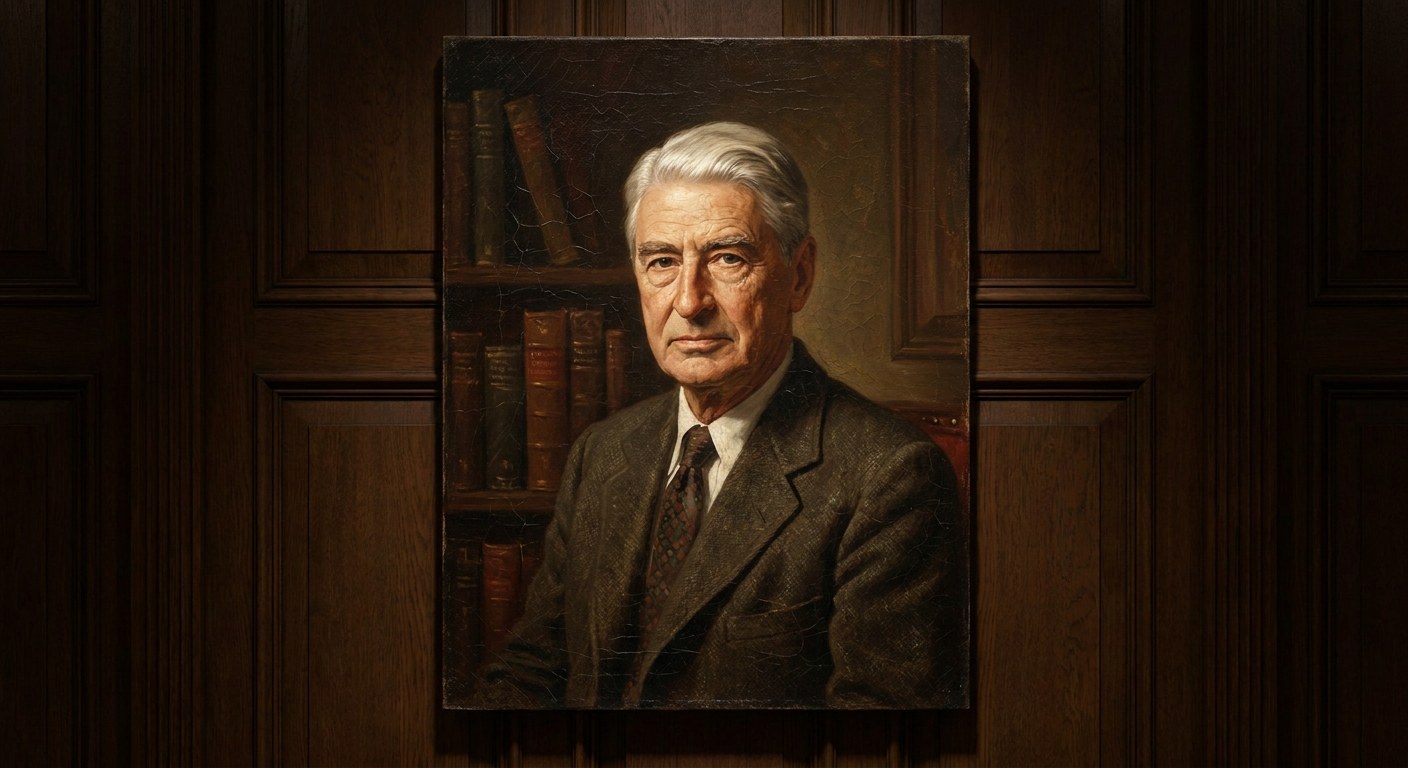
Dr. Seuss
1904 – 1991 · American · Children's Author & Illustrator
Recommended Audiobooks
Listen next from Marcus Alden

Life Lessons from Frederic Chopin
Marcus Alden · 54 min

Life Lessons from John Wesley
Marcus Alden · 52 min
1. Introduction
Dr. Seuss was the pen name of Theodor Seuss Geisel, an American writer, illustrator, cartoonist and filmmaker who transformed modern children's literature. Through such books as The Cat in the Hat, Green Eggs and Ham, Horton Hears a Who!, How the Grinch Stole Christmas! and The Lorax, he demonstrated that books for beginning readers could be educational without being dull, moral without becoming sermons and fantastical without losing emotional depth.
Geisel's importance rests partly on his extraordinary command of rhythm, rhyme, repetition and invented language. His springing anapestic verse encouraged children to read aloud, while his elastic creatures and impossible machines made the act of decoding words feel like play. He created a visual universe of crooked buildings, tufted animals, striped hats, spindly trees and gleefully unstable contraptions that remains instantly recognizable.
His career was broader and more complicated than his image as a genial children's author suggests. Before becoming internationally famous, Geisel produced advertising art and political cartoons. During the Second World War, he served in the United States Army and helped make military training and propaganda films. His wartime cartoons fiercely opposed fascism but also included racist caricatures of Japanese people and support for policies associated with Japanese American incarceration. These images, along with stereotypes in several early children's books, have become essential parts of modern discussions about his legacy.
At his best, Dr. Seuss used absurdity to explore prejudice, environmental destruction, authoritarianism, materialism, nuclear competition and personal responsibility. By the time of his death in 1991, his books had become fixtures of homes, libraries and classrooms. They continue to influence children's publishing, literacy education, animation and popular culture around the world.
2. Quick Facts
| Fact | Details |
|---|---|
| Born | March 2, 1904, Springfield, Massachusetts, United States |
| Died | September 24, 1991, La Jolla, California, United States |
| Nationality | American |
| Known For | The Cat in the Hat, Green Eggs and Ham, How the Grinch Stole Christmas!, The Lorax and other children's books |
| Occupation | Author, illustrator, cartoonist, screenwriter and filmmaker |
| Era | Twentieth-century American literature |
3. Early Life and Education
Theodor Seuss Geisel was born in Springfield, Massachusetts, on March 2, 1904. He was the son of Theodor Robert Geisel and Henrietta Seuss Geisel. His grandparents were German immigrants, and his middle name, Seuss, came from his mother's family. Although Americans generally pronounce his pseudonym as “Soos,” the German pronunciation of Seuss resembles “Zoice,” rhyming approximately with “voice.” Geisel accepted and eventually used the popular American pronunciation.
His father worked in the family's brewing business until Prohibition damaged the industry. He later became superintendent of Springfield's public parks and Forest Park zoo. Trips to the zoo, along with his father's interest in animals, contributed to Geisel's fascination with strange creatures. Springfield itself supplied visual memories that scholars have connected to his later landscapes, although the world of Dr. Seuss was never simply a disguised version of his hometown.
Geisel grew up during the First World War, when anti-German prejudice was widespread in the United States. He later recalled being mocked because of his German heritage. Experiences of exclusion may have helped shape his recurring interest in outsiders and intolerance, though direct one-to-one explanations of his books should be treated cautiously.
In 1921, Geisel entered Dartmouth College in Hanover, New Hampshire. He wrote and drew cartoons for the campus humor magazine, Jack-O-Lantern, eventually becoming its editor in chief. In 1925, he and several friends were caught drinking gin in violation of Prohibition and college rules. Administrators barred him from official participation in extracurricular activities. To continue contributing to the magazine, he signed cartoons with variants of his name, including “Seuss.” This episode helped establish the pseudonym that later became famous.
After graduating from Dartmouth in 1925, Geisel went to Lincoln College, Oxford, intending to pursue a doctorate in English literature. He found formal academic study uninspiring and spent much of his time doodling. At Oxford he met Helen Palmer, an American student who recognized his ability as a cartoonist and encouraged him to make art his profession. Geisel left Oxford without earning a degree, traveled in Europe and returned to the United States in 1927. He and Helen married that year.
The “Dr.” in Dr. Seuss was initially playful rather than an earned academic title. It may also have gently answered his father's hope that he would become a professor. Universities later awarded Geisel several honorary doctorates, including one from Dartmouth in 1955, giving the invented title an ironic form of legitimacy.
4. Rise to Prominence
Geisel began his professional career as a commercial illustrator and humorist. He sold cartoons to magazines including Judge, Life, Vanity Fair and The Saturday Evening Post. His major breakthrough came through an advertisement showing a knight troubled by an insect. The drawing led to a long-running campaign for Flit insecticide, a Standard Oil product. Its slogan, “Quick, Henry, the Flit!”, became a nationally familiar catchphrase.
Advertising provided financial security and gave Geisel opportunities to refine his technique. He produced energetic figures, imaginary beasts and visual jokes for companies including Standard Oil, General Electric, NBC and the Narragansett Brewing Company. Commercial work also taught him how to make an image immediately readable—a skill that became central to his children's books.
His first children's manuscript, And to Think That I Saw It on Mulberry Street, was repeatedly rejected. Accounts differ about the exact number of rejections; the often-repeated figure is 27. In 1937, Geisel happened to encounter former Dartmouth classmate Mike McClintock, who had recently become a children's-book editor at Vanguard Press. McClintock helped secure the book's publication.
The story follows a boy who transforms an ordinary sight into an increasingly elaborate parade. It established several trademarks of Dr. Seuss: escalating fantasy, rhythmic narration, eccentric machinery and the power of imaginative exaggeration. Its setting also drew on the name of a real Springfield street. The book attracted favorable notice, though it did not immediately make Geisel a household name.
He followed it with works including The 500 Hats of Bartholomew Cubbins and The King's Stilts in 1938, The Seven Lady Godivas in 1939 and Horton Hatches the Egg in 1940. The last introduced Horton, an elephant whose steadfast promise—maintained despite humiliation and danger—gave Geisel one of his first enduring characters.
From 1941 to 1943, Geisel worked as an editorial cartoonist for the liberal New York newspaper PM. He produced more than 400 political cartoons attacking Adolf Hitler, Benito Mussolini, American isolationists and racial discrimination against Black and Jewish Americans. He supported President Franklin D. Roosevelt and American intervention against the Axis powers. His cartoons were forceful and sometimes perceptive, but his depictions of Japanese people relied on dehumanizing racial stereotypes.
In 1943, Geisel joined the United States Army and served in the Signal Corps under filmmaker Frank Capra. He rose to the rank of lieutenant colonel and worked with the First Motion Picture Unit. Among his best-known assignments was the Private Snafu series, animated training films that used humor to teach soldiers about secrecy, disease prevention, equipment and military procedure.
His wartime film work strengthened his abilities as a storyteller and screenwriter. Geisel and Helen later wrote Design for Death, a documentary about the origins of Japanese militarism. The film won the 1947 Academy Award for Best Documentary Feature. After the war, Geisel returned to children's publishing with a deeper understanding of pacing, animation and mass communication.
5. Major Achievements and Contributions
Dr. Seuss's greatest achievement was helping to reinvent the American beginning-reader book. In the 1950s, educators worried that widely used reading primers were too repetitive and lifeless to hold children's attention. Publisher William Spaulding challenged Geisel to write an exciting book using a tightly controlled elementary vocabulary list. The result was The Cat in the Hat, published in 1957.
The story's limited vocabulary did not prevent it from being anarchic, suspenseful and funny. Its tall, mischievous Cat invades the home of two children on a rainy day, balancing increasingly unstable objects and releasing chaos while their mother is away. The book became an immediate success and proved that reading instruction could combine discipline with imaginative freedom.
Geisel, Helen Palmer Geisel and Random House editor Phyllis Cerf subsequently founded Beginner Books, an imprint devoted to entertaining books for early readers. It published works by Geisel and by authors such as P. D. Eastman, Stan and Jan Berenstain and Robert Lopshire. Beginner Books influenced school and home literacy by emphasizing visual clues, limited vocabulary, repetition and humor.
Publisher Bennett Cerf reportedly challenged Geisel to write a book using no more than 50 different words. Geisel responded with Green Eggs and Ham in 1960. Its persistent Sam-I-Am persuades a resistant character to taste an unfamiliar meal. The book's cumulative structure, exact vocabulary limit and comic momentum made it one of the bestselling English-language children's books ever published.
Geisel also expanded the thematic possibilities of picture books. The Sneetches addresses status and discrimination through creatures divided by stars on their bellies. The Lorax dramatizes environmental destruction caused by unchecked industrial exploitation. Yertle the Turtle presents a tyrant who builds his throne on the bodies of others; Geisel acknowledged that the character was inspired in part by Hitler. The Butter Battle Book depicts an absurd arms race between societies separated by the way they butter bread, ending with both sides holding civilization-destroying weapons.
His honors reflected the breadth of his career. Three books—McElligot's Pool, Bartholomew and the Oobleck and If I Ran the Zoo—received Caldecott Honors. Geisel received the Laura Ingalls Wilder Medal in 1980 for his contribution to children's literature. In 1984, he received a special Pulitzer Prize citation for nearly half a century of work that educated and delighted children and their parents. Adaptations and projects based on his writing also earned Academy, Emmy and Grammy recognition.
Beyond awards, his major contribution was psychological: he treated children as readers capable of recognizing nonsense, hypocrisy, fear, vanity and injustice. He did not eliminate moral lessons, but concealed them inside comedy, suspense and verbal play.
6. Key Works / Battles / Ideas
Horton Hatches the Egg and Horton Hears a Who!
Horton is among Geisel's most morally consistent characters. In Horton Hatches the Egg (1940), he keeps a promise under extreme conditions. In Horton Hears a Who! (1954), he protects the microscopic inhabitants of Whoville even though other animals cannot hear them. The declaration “A person's a person, no matter how small” has been invoked in many political settings, sometimes beyond Geisel's own intentions. At its core, the story argues that power and size do not determine human worth.
The Cat in the Hat
Published in 1957, The Cat in the Hat joined controlled vocabulary with near-total disorder. The Cat embodies creative disruption, while the silent fish warns of rules and consequences. The unresolved final question—whether the children should tell their mother—invites readers into an ethical decision rather than supplying a neat answer.
How the Grinch Stole Christmas!
The 1957 book tells of a solitary creature who tries to stop Christmas by stealing its material symbols. When the Whos celebrate without gifts, the Grinch realizes that the holiday means more than consumption. Geisel reportedly saw something of his own irritability in the character. The 1966 animated television special, directed by Chuck Jones with narration by Boris Karloff, made the story a seasonal institution.
Green Eggs and Ham
With only 50 distinct words, this 1960 book is a technical feat of repetition and variation. Its appeal lies not merely in vocabulary control but in performance: children can predict phrases, join the recitation and experience mastery. The story also gently encourages openness to unfamiliar experiences.
The Sneetches and Other Stories
The title story, published in book form in 1961, concerns birdlike creatures whose social hierarchy depends on whether they possess belly stars. Entrepreneur Sylvester McMonkey McBean profits by repeatedly adding and removing stars until the distinction becomes meaningless. The satire applies broadly to racism, antisemitism, class snobbery and consumer manipulation.
The Lorax
Published in 1971 amid the growth of the modern environmental movement, The Lorax follows the Once-ler, who destroys a flourishing ecosystem to manufacture profitable Thneeds. Its final seed represents responsibility and uncertain hope. The book helped generations of young readers understand that environmental damage connects individual choices, industry and public indifference.
The Butter Battle Book
This 1984 work was Geisel's strongest statement against the nuclear arms race. The Yooks and Zooks escalate a trivial disagreement into a confrontation involving mutually catastrophic weapons. Its open ending gives no reassurance, forcing readers to confront the logic of deterrence and escalation.
Oh, the Places You'll Go!
Geisel's final book published during his lifetime appeared in 1990. Rather than presenting life as a simple march toward success, it acknowledges loneliness, confusion, delay and failure. Its balance between optimism and uncertainty made it a popular gift for graduates.
7. Timeline of Key Events
| Year | Event |
|---|---|
| 1904 | Born Theodor Seuss Geisel in Springfield, Massachusetts, on March 2. |
| 1921 | Entered Dartmouth College and joined the humor magazine Jack-O-Lantern. |
| 1925 | Graduated from Dartmouth and began studying at Lincoln College, Oxford. |
| 1927 | Married Helen Palmer and began establishing himself as a professional cartoonist. |
| 1937 | Published his first children's book, And to Think That I Saw It on Mulberry Street. |
| 1940 | Published Horton Hatches the Egg. |
| 1941 | Began producing political cartoons for the newspaper PM. |
| 1943 | Joined the U.S. Army Signal Corps and worked on training and propaganda films. |
| 1947 | Design for Death, written by Geisel and Helen, won an Academy Award. |
| 1954 | Published Horton Hears a Who!. |
| 1957 | Published The Cat in the Hat and How the Grinch Stole Christmas!. |
| 1960 | Published Green Eggs and Ham, written with a vocabulary of 50 words. |
| 1961 | Published The Sneetches and Other Stories. |
| 1967 | Helen Palmer Geisel died; the animated How the Grinch Stole Christmas! received wide acclaim. |
| 1968 | Married Audrey Stone Dimond. |
| 1971 | Published the environmental parable The Lorax. |
| 1980 | Received the Laura Ingalls Wilder Medal. |
| 1984 | Published The Butter Battle Book and received a special Pulitzer Prize citation. |
| 1990 | Published Oh, the Places You'll Go!, his final book during his lifetime. |
| 1991 | Died in La Jolla, California, on September 24. |
| 2021 | Dr. Seuss Enterprises stopped publishing six books containing stereotypical imagery. |
8. Personal Life and Character
Geisel's public image was inseparable from playful nonsense, but acquaintances described a more private and complicated man. He could be charming, generous and intensely funny, yet he was also disciplined, perfectionistic and sometimes moody. His apparently spontaneous rhymes were produced through extensive revision. He might spend months or years adjusting a manuscript, searching for the correct word or redrawing a figure until its posture conveyed the intended energy.
Helen Palmer Geisel was an important influence on his development. A writer and editor in her own right, she encouraged him to abandon an academic career and pursue cartooning. She also offered editorial judgment and participated in film and publishing projects. The couple did not have children, a fact that sometimes surprised readers who assumed that a successful children's writer must be a parent.
During the 1950s, the Geisels moved permanently to La Jolla, California. Geisel worked in a hilltop studio and observation tower overlooking the Pacific. The studio became the center of his creative life. He maintained collections of hats and objects that could inspire visual ideas, and he guarded his working hours carefully.
Helen suffered from significant health problems, including partial paralysis associated with Guillain-Barré syndrome. On October 23, 1967, she died by suicide. In a farewell letter, she referred to Geisel's relationship with Audrey Stone Dimond, the wife of a friend. The event remains one of the most painful and ethically difficult episodes in his biography.
Geisel married Audrey in 1968. She had two daughters from her previous marriage, and she later played a major role in managing his estate and adaptations of his work. Their marriage lasted until his death.
Politically, Geisel was generally liberal, internationalist and supportive of the Democratic Party. He distrusted authoritarianism, isolationism and racial hierarchy. At the same time, his record contains contradictions, particularly between his opposition to European fascism and his wartime treatment of Japanese people in cartoons. Those contradictions make him a revealing figure in twentieth-century American culture rather than a simple moral spokesman.
9. Challenges and Controversies
Geisel's greatest professional challenge was making simple books that did not feel simplistic. Vocabulary restrictions could easily have produced mechanical prose. He overcame that difficulty through repetition, visual action, suspense, invented terms and carefully controlled rhythm. His success sometimes obscures how difficult this work was.
More serious controversies concern race and representation. During the Second World War, Geisel drew Japanese people with exaggerated eyes, teeth and other stereotypical features. One notorious cartoon portrayed Japanese Americans collectively as a potential internal threat while they waited to receive explosives. Such imagery helped normalize suspicion at a time when the U.S. government forcibly removed and incarcerated about 120,000 people of Japanese ancestry, most of them American citizens.
Geisel later visited Japan and dedicated Horton Hears a Who! to a Japanese friend, Mitsugi Nakamura. Some commentators interpret the book's defense of a vulnerable community as evidence of changed attitudes. It would be speculative, however, to call the story a direct apology unless supported by explicit evidence. Acknowledging moral growth does not erase the effects of the earlier cartoons.
Stereotypes also appeared in several children's books. On March 2, 2021, Dr. Seuss Enterprises announced that it would cease publishing and licensing six titles: And to Think That I Saw It on Mulberry Street, If I Ran the Zoo, McElligot's Pool, On Beyond Zebra!, Scrambled Eggs Super! and The Cat's Quizzer. The company cited portrayals of people that were hurtful and wrong, including racial and ethnic caricatures.
The decision generated intense debate. Critics called it censorship, while supporters described it as a publisher's decision not to continue distributing outdated imagery. The books were not prohibited by the government, and existing copies remained legal to own, sell and study. Scholars have argued that the controversy should encourage historical examination rather than either uncritical celebration or wholesale dismissal.
Geisel's political books also attracted opposition. The logging industry criticized The Lorax, and a California school district briefly challenged it during a dispute involving timber interests. The Butter Battle Book disturbed some readers because it offered no comforting resolution to nuclear confrontation. Geisel nevertheless believed that children could engage with frightening public questions when those questions were expressed through story.
Commercialization presents another tension. His books often criticize greed and conformity, yet Dr. Seuss became a vast brand encompassing films, television programs, merchandise, theme-park attractions and promotional campaigns. Some adaptations have expanded access to his stories; others have been criticized for overwhelming the economy and restraint of the original books.
10. Death and Immediate Aftermath
Theodor Seuss Geisel died of cancer at his home in La Jolla on September 24, 1991. He was 87. His body was cremated, and no public funeral was held. He was survived by his wife, Audrey, and her daughters.
His death prompted tributes from authors, educators, librarians and readers who had learned to read through his books. By then, Dr. Seuss was not merely a successful writer but an institution in American childhood. His death did not slow the circulation of his work. Oh, the Places You'll Go! became especially associated with graduations and major life transitions.
Posthumous publications assembled material from manuscripts and sketches left in his archive. These included Daisy-Head Mayzie, My Many Colored Days, Hooray for Diffendoofer Day! and What Pet Should I Get? Such books varied in the amount of editorial or artistic completion required, raising useful questions about authorship while extending access to Geisel's unfinished ideas.
Audrey Geisel supervised the intellectual property through Dr. Seuss Enterprises and approved numerous adaptations. The University of California, San Diego, where Geisel had been a supporter, houses a major collection of his papers. Its main library was renamed the Geisel Library in 1995 in honor of Theodor and Audrey Geisel.
11. Legacy and Influence Today
Dr. Seuss remains one of the most influential children's authors in the English-speaking world. His books have sold hundreds of millions of copies and have been translated into numerous languages. Characters such as the Cat in the Hat, the Grinch, Horton and the Lorax have become cultural symbols independent of their original stories.
His influence on literacy education is especially important. Beginner Books showed that controlled-vocabulary texts need not sacrifice personality or narrative momentum. Modern phonics books, leveled readers and humorous early-reader series continue to draw on principles he helped popularize: short sentences, repeated structures, strong correspondence between text and image and rewards for reading aloud.
Writers and illustrators also inherited his willingness to embrace absurdity. Shel Silverstein, Sandra Boynton, Mo Willems, Jon Klassen and many others work in a children's literary culture that Geisel helped make more visually daring and comically sophisticated. His invented words demonstrated that linguistic play can deepen, rather than obstruct, a child's awareness of how language works.
His social parables remain widely taught. The Sneetches supports discussions about discrimination and arbitrary status. The Lorax introduces environmental stewardship. Yertle the Turtle illustrates dictatorship and resistance, while The Butter Battle Book offers an entry point into nuclear history and arms competition. The books endure because they dramatize ideas instead of reducing them to definitions.
His legacy today is also inseparable from critical reappraisal. Libraries, teachers and families increasingly place his racial imagery in historical context. The goal is not necessarily to choose between admiration and condemnation, but to understand how a creator could challenge some prejudices while reproducing others. That tension offers lessons about propaganda, cultural blind spots and the possibility—though not the automatic certainty—of moral change.
Annual reading celebrations have often been held on or near his March 2 birthday. In recent years, some educational organizations have broadened those events to feature a more diverse range of children's authors rather than making Dr. Seuss their sole focus. This shift reflects the growth of children's literature, not the disappearance of his influence.
Dr. Seuss matters because he understood that learning to read is an intellectual, physical and emotional act. Words have sound; pictures have motion; nonsense has rules; laughter can carry an argument. His best works continue to invite children to question appearances, resist cruelty, care for vulnerable beings and take responsibility for the worlds they inherit.
12. Famous Quotes
The following lines are genuinely attributed to Dr. Seuss's published works:
“A person's a person, no matter how small.”
— Horton Hears a Who!
“Unless someone like you cares a whole awful lot, nothing is going to get better. It's not.”
— The Lorax
“Think and wonder, wonder and think.”
— Oh, the Thinks You Can Think!
“From there to here, from here to there, funny things are everywhere.”
— One Fish Two Fish Red Fish Blue Fish
“I meant what I said and I said what I meant. An elephant's faithful one hundred percent!”
— Horton Hatches the Egg
“It is fun to have fun, but you have to know how.”
— The Cat in the Hat
“You have brains in your head. You have feet in your shoes. You can steer yourself any direction you choose.”
— Oh, the Places You'll Go!
13. Frequently Asked Questions
What was Dr. Seuss's real name?
His full name was Theodor Seuss Geisel. He used Dr. Seuss as his principal pen name and also wrote under names including Theo. LeSieg—“Geisel” spelled backward—and Rosetta Stone.
Was Dr. Seuss a real doctor?
He did not earn a medical degree or complete a doctorate. The title began as part of his humorous pseudonym. He later received honorary doctorates from institutions including Dartmouth, Princeton and other universities.
Did Dr. Seuss have children?
No. Geisel and his first wife, Helen, had no children. His second wife, Audrey, had two daughters from an earlier marriage. His lack of biological children did not prevent him from developing a strong understanding of children's humor and reading habits.
What was Dr. Seuss's first book?
His first published children's book was And to Think That I Saw It on Mulberry Street in 1937. It had been rejected by numerous publishers before Vanguard Press accepted it.
Why was The Cat in the Hat important?
It demonstrated that a book constructed from a restricted beginner's vocabulary could still have memorable characters, suspense and humor. Its success helped launch Beginner Books and influenced generations of early-reading materials.
Did Dr. Seuss serve in the military?
Yes. He joined the U.S. Army during the Second World War and served in the Signal Corps, reaching the rank of lieutenant colonel. He wrote and helped produce training and propaganda films, including episodes of Private Snafu.
Were Dr. Seuss's books banned?
In 2021, Dr. Seuss Enterprises voluntarily stopped publishing six titles because of stereotypical depictions. This was not a government ban. Other institutions have occasionally challenged particular books, but the great majority of his works remain widely available.
What was the last Dr. Seuss book published during his lifetime?
Oh, the Places You'll Go! was published in 1990, one year before his death. Several books based on unfinished manuscripts and drawings appeared posthumously.
14. Lessons We Can Learn
-
Learning works best when curiosity and pleasure are involved. Geisel showed that educational constraints can inspire creativity rather than eliminate it.
-
Simple language can express serious ideas. Books written for children can address prejudice, dictatorship, environmental destruction and war without relying on technical vocabulary.
-
Imagination requires disciplined revision. Dr. Seuss's apparent spontaneity emerged from exacting work with rhythm, word choice, page design and illustration.
-
Opposing one injustice does not make a person immune to other prejudices. Geisel's wartime record demonstrates why admired historical figures should be studied critically and in full context.
-
Individual responsibility matters, but it must lead to action. From Horton keeping his promise to the final seed in The Lorax, Geisel repeatedly suggested that caring has value only when it changes conduct.
15. Further Reading
- Judith Morgan and Neil Morgan, Dr. Seuss & Mr. Geisel: A Biography — A foundational biography written with access to Geisel, his family and professional associates.
- Brian Jay Jones, Becoming Dr. Seuss: Theodor Geisel and the Making of an American Imagination — A detailed modern biography covering his art, marriages, politics and publishing career.
- Charles D. Cohen, The Seuss, the Whole Seuss and Nothing but the Seuss — A richly illustrated study of Geisel's lesser-known cartoons, advertisements and early work.
- Richard H. Minear, Dr. Seuss Goes to War — An important examination of Geisel's PM political cartoons, including their antifascism and anti-Japanese racism.
- Donald E. Pease, Theodor SEUSS Geisel — A concise critical biography placing Geisel's career within American literary and cultural history.
Watch and Learn
Dr. Seuss - Author & Illustrator | Mini Bio · Biography