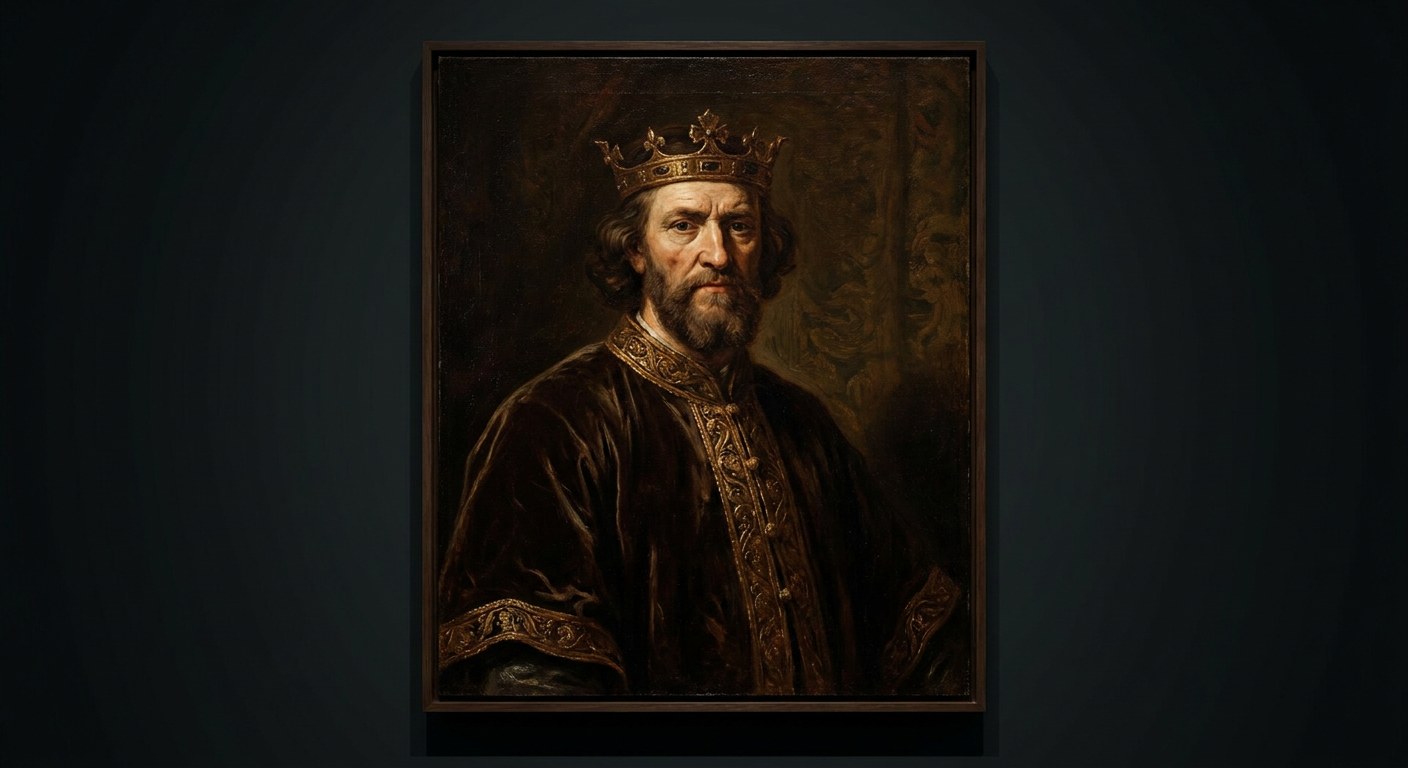
Edward I
1239 – 1307 · English · King of England
Recommended Audiobooks
Listen next from Marcus Alden

Life Lessons from Frederic Chopin
Marcus Alden · 54 min

Life Lessons from John Wesley
Marcus Alden · 52 min
Introduction
Edward I of England (17/18 June 1239–7 July 1307) was one of the most formidable and consequential monarchs of medieval Britain. Reigning from 1272 until 1307, he transformed English government, conquered independent Wales, asserted royal authority over Scotland, reshaped Parliament, and sponsored an ambitious program of legal reform. His imposing height earned him the nickname “Longshanks,” while later generations called him the “Hammer of the Scots.”
Edward’s reputation has always been divided. Admirers have portrayed him as an energetic lawgiver, gifted commander, and disciplined administrator who restored royal authority after the disorder of his father Henry III’s reign. Critics emphasize the violence of his conquests, his harsh treatment of rebels, his exploitation and eventual expulsion of England’s Jewish population, and his determination to impose English supremacy throughout Britain.
His career stretched across Europe and the Mediterranean. Before becoming king, Edward fought in the Second Barons’ War and participated in the Ninth Crusade. As monarch, he traveled through Gascony, negotiated with European rulers, constructed a chain of castles in Wales, arbitrated the Scottish succession, defeated William Wallace at Falkirk, and campaigned against Robert the Bruce. At home, statutes issued under his authority addressed landholding, debt, criminal justice, local government, and the powers of the Crown.
Edward did not create a modern nation-state, nor was he the sole architect of every reform associated with his reign. Nevertheless, his government helped give English kingship a more legal, bureaucratic, parliamentary, and militarized character. The consequences—constructive and destructive—shaped relations among England, Wales, Scotland, Ireland, and France for centuries.
Quick Facts
| Category | Details |
|---|---|
| Full name | Edward of Westminster |
| Regnal name | Edward I |
| Nicknames | Edward Longshanks; Hammer of the Scots |
| Born | 17 or 18 June 1239 |
| Birthplace | Palace of Westminster, London, England |
| Died | 7 July 1307 |
| Place of death | Burgh by Sands, Cumberland, England |
| Reign | 20 November 1272–7 July 1307 |
| Coronation | 19 August 1274, Westminster Abbey |
| Dynasty | Plantagenet |
| Father | Henry III of England |
| Mother | Eleanor of Provence |
| First wife | Eleanor of Castile |
| Second wife | Margaret of France |
| Heir and successor | Edward II |
| Major conflicts | Second Barons’ War, Ninth Crusade, conquest of Wales, Anglo-French War, Wars of Scottish Independence |
| Major legislation | First and Second Statutes of Westminster, Statute of Gloucester, Statute of Mortmain, Statute of Winchester, Statute of Merchants, Quia Emptores |
| Burial place | Westminster Abbey |
| Historical significance | Legal reform, conquest of Wales, development of Parliament, intervention in Scotland, expulsion of the Jews from England |
Early Life & Background
Edward was born at Westminster on 17 or 18 June 1239, the eldest son of King Henry III and Eleanor of Provence. He was named after Edward the Confessor, the Anglo-Saxon king whom Henry III deeply revered. Edward’s birth secured the Plantagenet succession after more than twenty years in which Henry had lacked a male heir.
Although later remembered for his exceptional height, military bearing, and forceful temperament, Edward was reportedly a sickly child. He grew into an unusually tall man for the period—probably about six feet two inches, or 1.88 meters—and possessed long arms and legs. These physical characteristics contributed to the later nickname “Longshanks.” Contemporary descriptions also mention a drooping eyelid and a speech impediment, though neither prevented him from becoming an effective public leader.
Edward’s childhood unfolded in a court dominated by tensions among the English political elite, Henry III’s continental relatives, and ambitious aristocratic factions. The king’s preference for foreign-born courtiers—especially members of the Savoyard and Lusignan families—generated resentment. Henry’s costly foreign policies, financial difficulties, and inconsistent government further weakened confidence in the monarchy.
In 1254, at the age of fifteen, Edward married Eleanor of Castile, the half-sister of Alfonso X of Castile. The marriage took place at the monastery of Las Huelgas near Burgos on 1 November. It served an important diplomatic purpose: Castile abandoned its claim to Gascony, the English-held duchy in southwestern France.
Henry III granted Edward extensive lands and rights, including holdings in Wales, Ireland, the Channel Islands, and Gascony. Yet many of these revenues remained under royal or administrative control, frustrating the young prince’s desire for political and financial independence. Edward’s early experiences as a landholder exposed him to the problems of governing border territories, managing noble rivalries, and financing military operations.
His political loyalties were initially unstable. During the reform crisis of the late 1250s, Edward sometimes sympathized with aristocratic opposition to his father, particularly when the barons attacked the influence of the king’s Lusignan relatives. He later returned firmly to the royalist cause. This shifting position reflected youth, factional pressures, and his growing recognition that baronial efforts to control the king might also restrict the authority of the future monarch.
Rise to Prominence
The decisive political conflict of Edward’s youth was the Second Barons’ War, led by Simon de Montfort, Earl of Leicester. In 1258, a group of magnates compelled Henry III to accept the Provisions of Oxford, which placed royal government under a baronial council. The reform movement soon fragmented, but Montfort revived it and took up arms against the king.
At the Battle of Lewes on 14 May 1264, Edward commanded part of the royal army. His cavalry drove a contingent of Londoners from the field, but his extended pursuit left Henry III’s main force vulnerable. Montfort won the battle and captured both king and prince. Edward remained a prisoner under relatively loose supervision until May 1265, when he escaped at Hereford.
Edward then assembled royalist support and formed an alliance with Gilbert de Clare, Earl of Gloucester, who had become disillusioned with Montfort. On 4 August 1265, Edward defeated Montfort at the Battle of Evesham. Montfort was killed and mutilated, while the royal government was restored. Edward’s campaign demonstrated strategic patience, mobility, and a willingness to use overwhelming force.
The aftermath remained unsettled. Disinherited rebels continued resisting from strongholds such as the Isle of Ely and Kenilworth Castle. Edward participated in efforts to suppress them, though the Dictum of Kenilworth of 1266 eventually offered former rebels a path to recover their estates through payment rather than permanent confiscation. These events taught Edward that uncompromising victory often had to be followed by negotiated political settlement.
In 1270, Edward departed England on crusade with Eleanor of Castile. He reached Tunis after the death of the French king Louis IX and then traveled to Acre, arriving in May 1271. His expedition, conventionally called part of the Ninth Crusade, was too small to reverse the decline of the crusader states. Edward organized raids and pursued alliances against the Mamluk sultan Baybars, but achieved no lasting territorial gain.
In June 1272, an assassin—possibly connected to the Nizari Ismailis, later romanticized as the “Assassins”—attacked Edward in his chamber at Acre with a poisoned or contaminated dagger. Edward killed the attacker but suffered a serious wound. The story that Eleanor sucked poison from the wound is a later legend; surgeons probably saved him by cutting away infected tissue.
Henry III died on 16 November 1272. Edward was recognized as king on 20 November, even though he remained abroad. The peaceful recognition of his succession marked a significant development: royal authority no longer depended upon immediate coronation. Edward returned slowly through Italy and France, dealt with a revolt in Gascony, and reached England in August 1274. He and Eleanor were crowned at Westminster Abbey on 19 August.
Major Achievements
Edward’s most visible achievement was the conquest and reorganization of Wales. Relations between the English Crown and Llywelyn ap Gruffudd, Prince of Wales, deteriorated after Edward’s accession. Llywelyn had expanded his authority during Henry III’s troubled reign and was reluctant to perform homage to Edward. His proposed marriage to Eleanor de Montfort, daughter of Simon de Montfort, further alarmed the king.
Edward invaded Wales in 1277. By mobilizing a large army, securing maritime supply routes, and isolating Llywelyn diplomatically, he forced the Welsh prince to accept the Treaty of Aberconwy. Llywelyn retained Gwynedd west of the River Conwy but surrendered much of his wider authority.
A larger Welsh rebellion began in 1282, initially led by Llywelyn’s brother Dafydd ap Gruffudd. Llywelyn joined the uprising but was killed near Builth Wells on 11 December 1282. Dafydd was captured the following year and executed at Shrewsbury on 3 October 1283 by hanging, drawing, and quartering—an especially brutal punishment intended to define rebellion against the king as treason.
The Statute of Wales, issued at Rhuddlan in 1284, placed conquered territories under direct royal administration. English criminal law and administrative practices were introduced, although some Welsh customs survived in private law. Edward reinforced his conquest with an extraordinary castle-building program. Caernarfon, Conwy, Harlech, and Beaumaris—many designed under the Savoyard master mason James of St George—were both military fortresses and symbols of domination. Walled boroughs populated largely by English settlers strengthened royal control.
Edward also pursued extensive legal and administrative reform. The First Statute of Westminster of 1275 addressed abuses in local government and clarified numerous areas of law. The Statute of Gloucester of 1278 initiated inquiries into the legal authority by which nobles exercised private jurisdictions. When landholders were asked “by what warrant”—quo warranto—they claimed such liberties, the Crown sought to recover rights or require proof of lawful possession.
The Statute of Mortmain of 1279 restricted grants of land to the Church that removed property from feudal obligations. The Statute of Winchester of 1285 reorganized public responsibility for law enforcement and military preparedness. The Second Statute of Westminster, also issued in 1285, included the provision known as De Donis Conditionalibus, strengthening hereditary entails. The Statute of Merchants of 1285 provided mechanisms for recovering commercial debts, while Quia Emptores in 1290 prevented further subinfeudation and encouraged the direct sale of freehold land.
These measures did not constitute a single planned “English constitution,” but collectively they made royal law more systematic and strengthened the reach of the central courts. Edward’s reign became so strongly associated with legislation that the seventeenth-century jurist Sir Edward Coke later called him the “English Justinian.”
Parliament also developed under Edward. Assemblies involving magnates, clergy, knights of the shire, and representatives of towns had existed before his reign, but Edward summoned them frequently to secure taxation and political consent. The Parliament of 1295, later called the Model Parliament, included bishops, abbots, earls, barons, two knights from each county, and two representatives from selected boroughs. It was not the first representative parliament, but it became an influential precedent.
Defining Moments
Edward’s accession while abroad in 1272 revealed the growing stability of hereditary monarchy. Unlike earlier kings, he was treated as king immediately after his father’s death rather than only after coronation. Yet his long absence also meant that the new reign began with a deliberate review of royal administration. Inquiries conducted through the Hundred Rolls investigated rights, landholding, and official misconduct.
The death of Eleanor of Castile on 28 November 1290 profoundly affected Edward. She died at Harby in Nottinghamshire while traveling north. Her body was carried to Westminster, and Edward later ordered memorial crosses to be erected at the places where the funeral procession rested overnight. Twelve Eleanor crosses were built between Lincoln and London; only those at Geddington, Hardingstone, and Waltham survive substantially intact. The modern cross at Charing Cross is a Victorian reconstruction.
Another defining event occurred in the same year: the expulsion of the Jews from England. Jewish communities had lived in England since at least the Norman period and were legally under royal protection, but they were also heavily taxed, restricted, and exposed to antisemitic violence. Edward’s Statute of Jewry of 1275 prohibited usury, undermining an economic role into which Christian restrictions had helped channel Jewish lenders. Accusations of coin clipping led to mass arrests and executions in 1278–79.
On 18 July 1290, Edward issued an edict ordering the Jews to leave England by 1 November. Several thousand people were expelled, and their property and debts were subject to royal control. The measure brought political and financial advantages to the Crown and was welcomed by many contemporaries, but it stands as one of the darkest acts of Edward’s reign. An openly established Jewish community did not return to England until the seventeenth century.
Edward’s intervention in Scotland became the dominant issue of his later reign. After the death of the young Margaret, Maid of Norway, in 1290, Scotland lacked an undisputed monarch. Scottish guardians invited Edward to arbitrate among rival claimants in the “Great Cause.” Edward insisted that the competitors recognize him as lord superior of Scotland. In 1292 he selected John Balliol, whose hereditary claim was strongest under the legal principles adopted.
Edward subsequently treated Balliol as a subordinate vassal, hearing appeals from Scottish courts and demanding military support against France. Scottish leaders responded by allying with France in 1295. Edward invaded in 1296, captured Berwick-upon-Tweed, defeated the Scots at Dunbar, forced Balliol to abdicate, and removed the Stone of Scone to Westminster.
Resistance continued. Andrew Moray and William Wallace defeated an English army at Stirling Bridge on 11 September 1297. Edward personally invaded Scotland the following year and defeated Wallace at Falkirk on 22 July 1298, in part through the use of archers against Scottish spear formations. Wallace was captured in 1305 and executed in London for treason, despite his argument that he had never sworn allegiance to Edward.
In 1306, Robert Bruce killed his rival John Comyn at Greyfriars Church in Dumfries and was crowned king of Scots at Scone. Edward responded with severe reprisals against Bruce’s family and supporters. Already elderly and ill, he marched north in 1307 but died at Burgh by Sands, near the Solway Firth, on 7 July before he could confront Bruce.
Timeline
| Year | Event |
|---|---|
| 1239 | Edward is born at the Palace of Westminster on 17 or 18 June |
| 1254 | Marries Eleanor of Castile at Las Huelgas near Burgos |
| 1258 | Political reform crisis produces the Provisions of Oxford |
| 1264 | Captured after the royalist defeat at the Battle of Lewes |
| 1265 | Escapes captivity and defeats Simon de Montfort at Evesham |
| 1266 | Dictum of Kenilworth offers terms to former baronial rebels |
| 1270 | Departs England on crusade |
| 1271 | Arrives at Acre and campaigns in the Holy Land |
| 1272 | Survives an assassination attempt; succeeds Henry III as king |
| 1274 | Returns to England and is crowned at Westminster Abbey |
| 1275 | First Statute of Westminster; Statute of Jewry |
| 1277 | First major invasion of Wales; Treaty of Aberconwy |
| 1278–79 | Hundreds of Jews are arrested on coin-clipping charges |
| 1279 | Statute of Mortmain restricts transfer of land to the Church |
| 1282 | Welsh rebellion; Llywelyn ap Gruffudd is killed |
| 1283 | Dafydd ap Gruffudd is captured and executed |
| 1284 | Statute of Wales establishes royal government in conquered Wales |
| 1285 | Second Statute of Westminster, Statute of Winchester, and Statute of Merchants |
| 1286–89 | Edward spends an extended period governing his continental lands |
| 1290 | Quia Emptores enacted; Jews expelled; Eleanor of Castile dies |
| 1292 | Edward awards the Scottish crown to John Balliol |
| 1294 | War begins with France; major Welsh rebellion under Madog ap Llywelyn |
| 1295 | “Model Parliament” is summoned |
| 1296 | Edward invades Scotland, takes Berwick, and defeats the Scots at Dunbar |
| 1297 | English defeat at Stirling Bridge; Confirmatio Cartarum limits non-parliamentary taxation |
| 1298 | Edward defeats William Wallace at Falkirk |
| 1299 | Marries Margaret of France |
| 1303 | England and France conclude the Treaty of Paris |
| 1304 | Stirling Castle falls to Edward’s forces |
| 1305 | William Wallace is captured and executed |
| 1306 | Robert Bruce is crowned king of Scots |
| 1307 | Edward dies at Burgh by Sands on 7 July; Edward II succeeds him |
Personal Life
Edward’s first marriage, to Eleanor of Castile, lasted thirty-six years and appears to have been unusually close by the standards of medieval royal marriages. Eleanor accompanied him on crusade and on many journeys through his dominions. She also accumulated a substantial landed estate, sometimes through transactions criticized by contemporaries for placing pressure on debtors and landholders.
The couple had at least fourteen and possibly sixteen children, though only six survived into adulthood. Their surviving son, the future Edward II, was born at Caernarfon Castle on 25 April 1284. The often-repeated story that Edward presented the Welsh with a prince “born in Wales who spoke no English” is a later legend. The title Prince of Wales was formally granted to the younger Edward in 1301.
Eleanor died in 1290. Edward’s memorial program for her, including the Eleanor crosses and an elaborate tomb in Westminster Abbey, provides evidence of personal grief as well as royal magnificence.
In 1299, Edward married Margaret of France, daughter of Philip III and sister of Philip IV. Edward was about sixty; Margaret was probably around twenty. Despite the age difference, the marriage seems to have been affectionate. They had three children: Thomas of Brotherton, Edmund of Woodstock, and a daughter named Eleanor who died young. Margaret sometimes interceded with her husband on behalf of individuals seeking mercy.
Edward enjoyed hunting, hawking, tournaments, and Arthurian symbolism. In 1278 he attended the ceremonial reburial at Glastonbury of remains claimed to be those of King Arthur and Queen Guinevere. The Crown also sponsored “Round Table” festivities, using Arthurian legend to promote an image of chivalric and pan-British kingship.
His temperament combined discipline, piety, impatience, and a capacity for intimidating anger. Contemporary observers respected his ability to command but also feared his outbursts. He could be pragmatic toward defeated political opponents, yet exceptionally ruthless when he interpreted resistance as treason.
Beliefs & Philosophy
Edward understood kingship as a divinely sanctioned office governed by law, custom, hereditary right, and feudal obligation. He believed that a king had a duty to preserve peace, administer justice, defend the Church, and recover rights belonging to the Crown. His legal inquiries and statutes reflected this conviction, although they also expanded royal power.
He was conventionally devout. He attended religious services, patronized monasteries, venerated Edward the Confessor, and took the crusading vow. His experience in the Holy Land remained important to his identity, but plans for another crusade repeatedly gave way to wars in Wales, France, and Scotland.
Edward’s political thinking was hierarchical. He accepted consultation with magnates, clergy, knights, and towns when taxation or war required broad support, but he did not believe in popular sovereignty. Parliament was a mechanism of royal government and consent, not a democratic institution.
His treatment of Wales and Scotland reflected a vision of superior English kingship. Edward relied on feudal claims, legal argument, military conquest, and legendary British history to justify authority beyond England. The tension between law and coercion was central to his reign: he sought legal grounds for action, but he was prepared to enforce those claims through overwhelming force.
Challenges & Controversies
Edward inherited a monarchy weakened by civil war, debt, and mistrust. His early reforms restored authority, but continuous warfare eventually created new financial and constitutional pressures. Campaigns in Wales, Gascony, Flanders, and Scotland demanded unprecedented taxation.
The king levied customs duties, sought clerical subsidies, called out feudal military service, and requisitioned wool and supplies. Resistance intensified in 1297, when Roger Bigod, Earl of Norfolk, and Humphrey de Bohun, Earl of Hereford, opposed overseas service and taxation. Edward was forced to confirm Magna Carta and the Charter of the Forest through the Confirmatio Cartarum, acknowledging that taxation required a greater degree of communal consent.
His conflict with Archbishop Robert Winchelsey also reflected wider tensions between royal authority and the Church. Pope Boniface VIII’s bull Clericis Laicos of 1296 restricted secular taxation of clergy. Edward retaliated by placing uncooperative clergy outside royal protection, exposing them to legal and financial pressure.
The conquest of Wales destroyed its independent native principality. Royal castles and English boroughs imposed a colonial structure in which native Welsh inhabitants often faced legal, political, and economic disadvantages. The enormous cost of the building program burdened both royal finances and local populations.
Edward’s Scottish policy proved even less durable. His insistence on overlordship helped transform a succession dispute into a prolonged war of independence. The sack of Berwick in 1296, the humiliation of John Balliol, the removal of the Stone of Scone, and the execution of Wallace became enduring symbols of English aggression. Edward won major battles but failed to secure a stable political settlement.
The expulsion of the Jews in 1290 was both an act of religious persecution and a calculated political measure. Long-term royal exploitation had already impoverished much of the Jewish community. By expelling it, Edward satisfied widespread prejudice and strengthened his position when requesting taxation from Parliament. Modern assessments of his reign must treat this policy as central, not incidental.
His use of spectacular punishment was equally controversial. Dafydd ap Gruffudd’s execution in 1283 helped establish hanging, drawing, and quartering as a penalty for treason. William Wallace suffered the same punishment in 1305. Such executions were designed not merely to kill but to communicate the consequences of rejecting royal authority.
Famous Quotes
Few statements attributed to Edward survive as securely verified, word-for-word speech. Medieval chroniclers often reconstructed dialogue for dramatic or moral effect, while later writers added legends. The following should therefore be read with appropriate caution.
“By God, Sir Earl, either you shall go with me to battle or you shall hang.”
This threat is traditionally associated with Edward’s efforts to compel Gilbert de Clare, Earl of Gloucester, to cooperate before the Battle of Evesham in 1265.
“God may give me other sons, but he will never give me another brother.”
Chroniclers attributed this sentiment to Edward when contrasting his reaction to the deaths of a young son and his cousin Henry of Almain, whom he regarded with brotherly affection. The exact wording is uncertain.
“Pactum serva.”
Meaning “Keep the pact,” “Keep faith,” or “Keep your word,” this Latin phrase appears on Edward’s tomb inscription. The inscription itself is later than his death and should not be treated as a verified spoken quotation.
“Edward the First, Hammer of the Scots, is here.”
This is an English rendering of the famous Latin tomb inscription: Edwardus Primus Scottorum Malleus hic est. It summarizes Edward’s posthumous reputation rather than recording his own words.
A later story claims that Edward ordered his bones to be carried at the head of an English army until Scotland was conquered. The account is memorable but unsupported by strong contemporary evidence.
Legacy & Influence
Edward I left a powerful but deeply conflicted legacy. In England, his reign became associated with law, administrative vigor, and the assertion of public order. His statutes influenced property law, commercial regulation, policing, and royal jurisdiction for generations. Quia Emptores and De Donis remained especially significant in the history of English land law.
His Parliaments helped normalize the participation of county knights and borough representatives in national taxation and legislation. Edward did not create Parliament, and the assembly of 1295 was not a modern legislature. Even so, the fiscal demands of his wars encouraged the principle that broad taxation required broad consultation.
The conquest of Wales permanently altered the political map of Britain. Edward’s castles remain among the finest surviving examples of medieval military architecture and are now recognized as a UNESCO World Heritage Site. Yet their architectural grandeur cannot be separated from their purpose as instruments of occupation and settlement.
In Scotland, Edward’s legacy was largely one of resistance. His intervention helped stimulate a stronger sense of political community around the defense of the Scottish kingdom. William Wallace and Robert the Bruce became national heroes partly because Edward represented the threat of external domination. Within a year of Edward’s death, Bruce defeated Edward II’s supporters in the field, and in 1314 he won the decisive Battle of Bannockburn.
Edward’s son inherited many of his father’s commitments but not his political authority or military reputation. Edward II abandoned the northern campaign soon after the succession and struggled with aristocratic opposition. The contrast between father and son contributed to the elder Edward’s later image as an ideal warrior-king.
Historians now resist both heroic and purely villainous portrayals. Edward was an exceptionally capable medieval ruler whose legal and institutional achievements were real. He was also an expansionist monarch whose ambitions brought conquest, displacement, persecution, punitive violence, and prolonged war. Understanding him requires keeping both realities in view.
Interesting Facts
- Edward was among the tallest European rulers of the Middle Ages, probably standing around six feet two inches.
- The regnal number “I” was applied retrospectively. Earlier English kings named Edward existed, but the numbering followed the Norman Conquest.
- He became king in November 1272 but was not crowned until August 1274 because he was still returning from crusade.
- Eleanor of Castile accompanied Edward to the eastern Mediterranean; the story that she sucked poison from his wound is legendary.
- The surviving Eleanor crosses stand at Geddington, Hardingstone, and Waltham Cross.
- Caernarfon Castle incorporated colored masonry and polygonal towers that may have evoked the walls of Constantinople and Roman imperial imagery.
- Edward temporarily removed the Stone of Scone from Scotland in 1296. It remained at Westminster until 1996, apart from a brief removal in 1950–51.
- His government’s Hundred Rolls inquiries have provided historians with exceptionally detailed evidence about landholding and local administration.
- The term “Model Parliament” was coined much later; contemporaries did not use it.
- Edward kept a household of skilled administrators, soldiers, clergy, craftsmen, and legal experts who traveled with him.
- His tomb in Westminster Abbey is unusually plain on the outside compared with the elaborate monuments of his father and first wife.
- When Edward’s tomb was opened in 1774, observers reported that his body was richly dressed and unusually well preserved.
- The title “Hammer of the Scots” comes from a later tomb inscription, not a nickname commonly documented during his lifetime.
- Edward’s reign saw extensive use of longbowmen from Wales in English armies.
- Although often depicted only as a soldier, Edward was deeply involved in legal cases, diplomatic negotiations, and administrative detail.
Frequently Asked Questions
Why was Edward I called Longshanks?
“Longshanks” referred to Edward’s unusual height and long legs. At approximately six feet two inches, he was exceptionally tall for a thirteenth-century man. The nickname became common in later historical writing.
Why was he called the Hammer of the Scots?
The title derives from the Latin phrase Scottorum Malleus on his tomb. It reflects his invasions of Scotland and his attempts to impose English overlordship. The inscription was added long after his death, probably in the sixteenth century.
Did Edward I conquer Wales?
Yes. His campaigns of 1277 and 1282–83 destroyed the independent principality led by Llywelyn ap Gruffudd and Dafydd ap Gruffudd. The Statute of Wales of 1284 reorganized conquered territories under English royal administration. Welsh resistance continued, most notably during the revolt of Madog ap Llywelyn in 1294–95.
Did Edward I conquer Scotland?
He occupied much of Scotland and won major victories, but he did not achieve a permanent conquest. English authority repeatedly faced rebellion, first under leaders including Andrew Moray and William Wallace and later under Robert the Bruce. Scottish independence survived and was restored militarily and diplomatically after Edward’s death.
What was the Model Parliament?
The Model Parliament was the assembly summoned in 1295 that included senior clergy, nobles, county knights, and borough representatives. It became a useful later model for Parliament’s composition, although representative assemblies had existed before it.
Was Edward I a good king?
The answer depends on the criteria used. He was an effective administrator, legislator, diplomat, and military organizer. He also pursued aggressive wars, imposed severe taxation, expelled the Jews, executed opponents brutally, and attempted to dominate neighboring kingdoms. His reign combined institutional achievement with repression and conquest.
Why did Edward I expel the Jews?
The expulsion reflected religious prejudice, economic exploitation, political calculation, and the declining fiscal value of a heavily taxed community. The 1275 prohibition of Jewish moneylending had restricted livelihoods, while later prosecutions intensified persecution. In 1290 Edward ordered all Jews to leave England.
Who succeeded Edward I?
His surviving son by Eleanor of Castile succeeded him as Edward II on 7 July 1307. Edward II inherited wars in Scotland and serious financial and political difficulties.
Where is Edward I buried?
He is buried in Westminster Abbey, close to Edward the Confessor and Henry III. His relatively plain tomb bears the later inscription identifying him as the Hammer of the Scots.
Did Edward I really ask for his bones to be carried into Scotland?
Probably not. A later chronicler claimed that Edward wanted his bones carried with the army until Scotland was subdued. Historians generally regard the story as a dramatic legend rather than a reliable deathbed instruction.
Lessons from Edward I
- Administrative reform can outlast military victory. Edward’s legal statutes had a more durable impact than many of his conquests.
- Power based only on force is difficult to sustain. His occupation of Scotland produced resistance rather than a stable settlement.
- Consultation often grows from financial necessity. The cost of war encouraged the development of representative Parliament.
- Law can restrain power or serve it. Edward used legal procedure both to regulate government and to justify expanded royal authority.
- Architecture can function as political messaging. The castles of Wales were military bases, administrative centers, and symbols of conquest.
- Personal ability does not guarantee a successful succession. Edward’s system depended heavily on his own authority and was difficult for Edward II to maintain.
- Historical achievement must be judged alongside human cost. Legal reform cannot erase the persecution of Jews, the devastation of war, or punitive violence.
- Short-term coercion may create long-term national resistance. Edward’s Scottish policies strengthened the very opposition they were intended to eliminate.
- Reputation changes across time and perspective. A lawgiving king in English tradition could simultaneously be remembered as a conqueror in Wales and an oppressor in Scotland.
Further Reading
- Michael Prestwich, Edward I
- Marc Morris, A Great and Terrible King: Edward I and the Forging of Britain
- R. F. Treharne, The Baronial Plan of Reform, 1258–1263
- David Carpenter, Henry III: The Rise to Power and Personal Rule, 1207–1258
- F. M. Powicke, King Henry III and the Lord Edward
- R. R. Davies, The Age of Conquest: Wales, 1063–1415
- J. E. Morris, The Welsh Wars of Edward I
- John Maddicott, The Origins of the English Parliament, 924–1327
- G. W. S. Barrow, Robert Bruce and the Community of the Realm of Scotland
- Michael Brown, The Wars of Scotland, 1214–1371
- Robin Frame, The Political Development of the British Isles, 1100–1400
- John Carmi Parsons, Eleanor of Castile: Queen and Society in Thirteenth-Century England
- Robert C. Stacey, Politics, Policy, and Finance under Henry III, 1216–1245
- Cecil Roth, A History of the Jews in England
- Robert Bartlett, England Under the Norman and Angevin Kings, 1075–1225