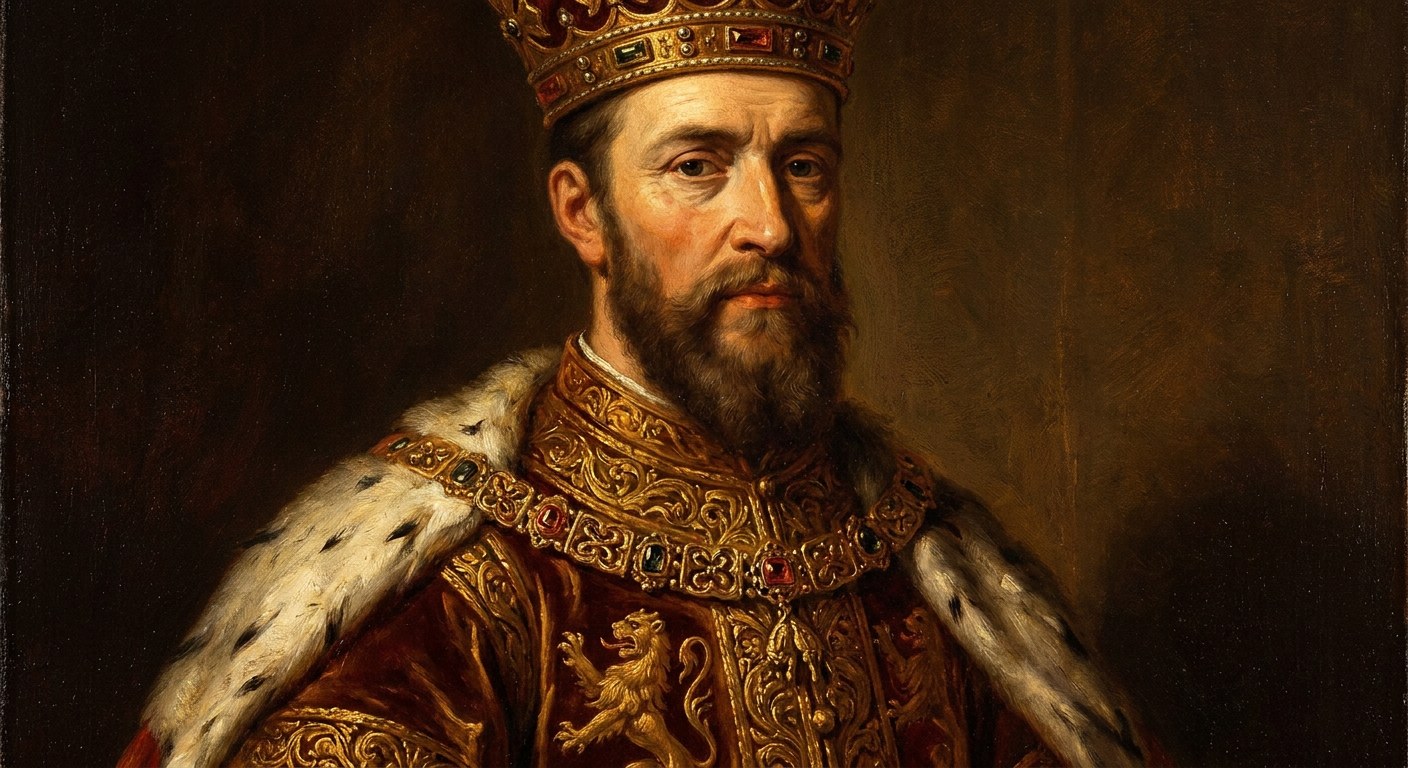
Edward III
1312 – 1377 · English · King of England
Recommended Audiobooks
Listen next from Marcus Alden

Life Lessons from Frederic Chopin
Marcus Alden · 54 min

Life Lessons from John Wesley
Marcus Alden · 52 min
Introduction
Edward III of England (13 November 1312–21 June 1377) was one of the most formidable monarchs of medieval Europe. During a reign lasting more than fifty years, he restored royal authority after the disastrous government of his father, Edward II, transformed England into a major military power, and initiated the prolonged conflict later known as the Hundred Years’ War. Victories at Crécy, Neville’s Cross and Calais, followed by the triumph of his son Edward the Black Prince at Poitiers, gave the English monarchy unprecedented prestige.
Edward’s reign was not simply a succession of battles. It witnessed the growing political importance of Parliament, the emergence of the Commons as a more coherent institution, significant legal legislation, changes in military recruitment and the increasing use of English in government and public life. Edward also promoted an aristocratic culture of chivalry, symbolized by the foundation of the Order of the Garter at Windsor.
The achievements of his middle years were followed by a difficult decline. The Black Death devastated England, the renewed French war erased many earlier conquests, royal finances deteriorated, and Edward’s court became associated with faction and corruption. His eldest son predeceased him, while rivalries among his surviving sons helped create the dynastic tensions that eventually contributed to the Wars of the Roses.
Edward III was therefore both a heroic king in medieval memory and a ruler whose ambitions imposed immense costs. His reign marked the high point of English chivalric monarchy, but it also exposed the political, financial and human consequences of prolonged war.
Quick Facts
| Category | Details |
|---|---|
| Full name | Edward of Windsor |
| Reign | 25 January 1327–21 June 1377 |
| Coronation | 1 February 1327, Westminster Abbey |
| Born | 13 November 1312, Windsor Castle, Berkshire |
| Died | 21 June 1377, Sheen Palace, Surrey |
| Age at death | 64 |
| Burial place | Westminster Abbey, London |
| Dynasty | Plantagenet |
| Father | Edward II of England |
| Mother | Isabella of France |
| Spouse | Philippa of Hainault |
| Children | Thirteen traditionally recorded, including Edward the Black Prince, Lionel of Antwerp, John of Gaunt, Edmund of Langley and Thomas of Woodstock |
| Predecessor | Edward II |
| Successor | Richard II |
| Principal English residences | Windsor Castle, Westminster, Eltham Palace and Sheen Palace |
| Major conflicts | Second War of Scottish Independence; Hundred Years’ War |
| Famous victories | Halidon Hill, Sluys, Crécy and the capture of Calais |
| Chivalric foundation | Order of the Garter |
| Length of reign | Just over fifty years |
Early Life & Background
Edward was born at Windsor Castle on 13 November 1312, the eldest son of King Edward II and Queen Isabella of France. His birth provided the troubled royal family with a male heir and was celebrated throughout the kingdom. Known in childhood as Edward of Windsor, he was granted the title Earl of Chester in 1320.
His father’s reign was marked by military humiliation, political rebellion and bitter disputes over royal favourites. Edward II’s defeat by Robert the Bruce at Bannockburn in 1314 weakened English authority in Scotland. His dependence on figures such as Piers Gaveston and, later, Hugh Despenser the Younger alienated powerful nobles. Civil conflict culminated in the execution of the king’s cousin Thomas, Earl of Lancaster, in 1322 and the dominance of the Despenser family.
Edward’s mother came from one of Europe’s most prestigious royal houses. Isabella was the daughter of Philip IV of France and sister to the French kings Louis X, Philip V and Charles IV. Her ancestry later became central to Edward’s claim to the French crown.
The prince received an education appropriate to a future medieval king. He learned about warfare, horsemanship, hunting, religion, aristocratic conduct and government. He probably understood French, the principal language of the English court, as well as some English and Latin. His upbringing took place against a background of political instability, exposing him early to the dangers of weak kingship and factional rule.
In 1325 Edward accompanied Isabella to France. Officially, the queen was attempting to resolve a dispute between Edward II and Charles IV over English-held lands in Gascony. The young prince was invested with Aquitaine and Ponthieu and performed homage to the French king, allowing his father to avoid travelling personally to France.
Isabella refused to return to England while the Despensers remained in power. She formed an alliance with Roger Mortimer, an exiled English baron who had escaped imprisonment in the Tower of London. Isabella also arranged Edward’s betrothal to Philippa, daughter of William, Count of Hainault, in exchange for military and financial support.
In September 1326 Isabella and Mortimer invaded England with a relatively small force. Edward II’s government collapsed rapidly. The Despensers were captured and executed, while the king was imprisoned and compelled to relinquish the throne. Parliament recognized the young Edward as king in January 1327. His father died at Berkeley Castle that September, almost certainly while in custody, although the precise circumstances remain uncertain.
Rise to Prominence
Edward III formally began his reign on 25 January 1327 and was crowned at Westminster Abbey on 1 February. He was only fourteen, so power initially rested with a regency council. In practice, Isabella and Mortimer dominated the government.
Their administration soon became unpopular. Mortimer accumulated lands, titles and wealth, eventually making himself Earl of March. The regime concluded the Treaty of Edinburgh–Northampton in 1328, recognizing Robert the Bruce as king of an independent Scotland. Although the treaty acknowledged military reality, many English nobles considered it humiliating.
Edward married Philippa of Hainault at York Minster on 24 January 1328. Their first surviving son, Edward of Woodstock—the future Black Prince—was born on 15 June 1330. The birth of an heir strengthened the young king’s position.
Tensions reached a crisis after Mortimer engineered the execution of Edward’s uncle, Edmund, Earl of Kent, in March 1330. Edward began conspiring with trusted companions, including William Montagu. On the night of 19 October 1330, the king’s supporters entered Nottingham Castle through a concealed passage and arrested Mortimer despite Isabella’s protests.
Mortimer was condemned without a conventional trial and hanged at Tyburn on 29 November. Isabella was removed from political control but treated with respect and provided with a substantial income. Edward, not yet eighteen, had asserted his personal authority.
The coup at Nottingham established the qualities that defined the successful phase of Edward’s reign: decisiveness, political calculation and an ability to inspire loyal aristocratic companions. Unlike his father, he cultivated the nobility through shared military enterprise, patronage and chivalric fellowship.
Scotland provided his first major field of action. Edward supported Edward Balliol, son of the deposed Scottish king John Balliol, against David II, the young son of Robert the Bruce. At Halidon Hill near Berwick on 19 July 1333, English archers and dismounted men-at-arms destroyed a larger Scottish army. The victory demonstrated the effectiveness of tactics that Edward would later use in France.
English control in Scotland nevertheless proved temporary. Scottish resistance continued, aided by France under the terms of the Auld Alliance. The connection between Scottish and French opposition encouraged Edward to adopt a broader continental strategy.
Major Achievements
Edward’s greatest military achievement was the creation of an army capable of defeating larger forces through discipline, tactical positioning and the coordinated use of archers and men-at-arms. English armies increasingly relied on paid troops recruited by contract rather than purely traditional feudal levies. The longbow was not a new weapon, but under Edward it became a decisive component of battlefield tactics.
His conflict with France arose from disputes over Gascony, French support for Scotland and competing claims to sovereignty. When Charles IV died without a surviving son in 1328, the French crown passed to Philip VI of Valois. Edward, as Charles’s nephew through Isabella, later argued that he possessed the superior hereditary claim. French jurists and nobles rejected inheritance through the female line and supported Philip.
Edward initially performed homage to Philip for his French territories. Relations deteriorated, however, and in 1337 Philip declared the duchy of Aquitaine confiscated. Edward responded by asserting his right to the French throne, formally adopting the title King of France in 1340.
His early alliances in the Low Countries were expensive and produced limited results, but the naval victory at Sluys on 24 June 1340 destroyed or captured much of the French fleet. This gave England control of the Channel for the immediate future and reduced the threat of invasion.
Edward’s most celebrated campaign began in Normandy in July 1346. His army captured Caen and conducted a destructive chevauchée—a fast-moving raid intended to devastate enemy territory, undermine royal authority and provoke battle. On 26 August, Edward defeated Philip VI at Crécy in northern France. English forces occupied a strong defensive position, while repeated French cavalry attacks were disrupted by archery and poor coordination.
The victory was followed by the siege of Calais. The town surrendered on 4 August 1347 after nearly a year of resistance. Calais became an English military base, commercial centre and gateway to continental Europe, remaining under English rule until 1558.
Edward also benefited from victory in Britain. On 17 October 1346, an English army led by figures including William de la Zouche and Ralph Neville defeated David II of Scotland at Neville’s Cross near Durham. The Scottish king was captured and remained an English prisoner for eleven years.
The next generation continued Edward’s military successes. At Poitiers on 19 September 1356, the Black Prince defeated King John II of France and took him prisoner. England simultaneously held both the French and Scottish kings in captivity—a remarkable demonstration of Plantagenet power.
The Treaty of Brétigny, agreed on 8 May 1360 and ratified at Calais in October, represented the peak of Edward’s continental position. He received greatly enlarged territories in southwestern France, including extensive sovereignty in Aquitaine, while John II’s ransom was fixed at three million gold écus. Plans for mutual renunciations of Edward’s claim to France and French sovereignty over ceded lands were never fully completed, leaving future disputes unresolved.
Edward’s domestic achievements were also substantial. The Treason Act of 1352 clarified important categories of high treason and remained influential for centuries. The Statute of Provisors of 1351 and legislation associated with praemunire sought to restrict papal interference in English appointments and legal jurisdiction.
The 1362 Statute of Pleading required oral proceedings in royal courts to be conducted in English, although records continued to be written in Latin. This reflected the growing public importance of English after centuries in which aristocratic and governmental culture had been dominated by French.
Edward also reformed the gold coinage. The introduction of the gold noble in 1344 created one of medieval England’s most recognizable coins, depicting the king standing in a ship—an image associated with maritime power and the victory at Sluys.
Defining Moments
The first defining moment of Edward’s life was the overthrow of his father. Although the prince was not the principal architect of the invasion of 1326, his accession was inseparable from deposition, rebellion and the suspicious death of an anointed king. These events taught him that royal authority depended on military credibility and cooperation with the political elite.
His arrest of Mortimer in 1330 was the true beginning of his personal rule. The operation at Nottingham Castle transformed Edward from a figurehead into an active monarch. It also demonstrated that he would use sudden and ruthless action when his authority was threatened.
Crécy was the central moment of Edward’s military career. The battle established his reputation across Europe and validated his tactical system. It also enhanced the status of the sixteen-year-old Black Prince, who commanded part of the English line. Medieval chroniclers turned the battle into an idealized story of courage, paternal confidence and chivalric honour.
The Black Death was an entirely different kind of turning point. Arriving in England in 1348, the epidemic killed a vast proportion of the population—perhaps between one-third and one-half, though precise figures are impossible. Labour became scarce, wages rose and traditional economic relationships came under pressure.
The government attempted to control these changes through the Ordinance of Labourers in 1349 and the Statute of Labourers in 1351. These measures required able-bodied people to work and sought to fix wages at pre-plague levels. Enforcement was uneven, but the legislation revealed the crown and landowning elite’s determination to preserve the existing social order.
The Treaty of Brétigny marked the summit of Edward’s power, yet it also concealed weaknesses. The French monarchy recovered under Charles V, while English rule in Aquitaine provoked resistance over taxation and legal sovereignty. War resumed in 1369, and the French commander Bertrand du Guesclin avoided large pitched battles while gradually recapturing territory. By Edward’s death, England had lost most of the lands obtained in 1360.
The Good Parliament of 1376 defined the troubled end of the reign. Members of the Commons attacked corrupt courtiers and used impeachment against royal officials. Alice Perrers, Edward’s influential mistress, was accused of abusing her access to the king. Although some reforms were reversed after Parliament’s dissolution, the proceedings became an important precedent for parliamentary accountability.
Timeline
| Year | Event |
|---|---|
| 1312 | Edward is born at Windsor Castle on 13 November. |
| 1320 | He is created Earl of Chester. |
| 1325 | Travels to France with Queen Isabella and performs homage for English territories. |
| 1326 | Isabella and Roger Mortimer invade England and overthrow Edward II’s government. |
| 1327 | Edward becomes king on 25 January and is crowned on 1 February. |
| 1328 | Marries Philippa of Hainault at York Minster; Treaty of Edinburgh–Northampton recognizes Scottish independence. |
| 1330 | Edward the Black Prince is born; Edward III arrests Mortimer at Nottingham Castle and begins personal rule. |
| 1333 | English victory over the Scots at Halidon Hill. |
| 1337 | Philip VI declares Aquitaine confiscated; conventional beginning of the Hundred Years’ War. |
| 1340 | Edward assumes the title King of France and wins the naval Battle of Sluys. |
| 1344 | The English gold noble is introduced. |
| 1346 | Edward wins at Crécy; David II of Scotland is captured at Neville’s Cross. |
| 1347 | Calais surrenders to Edward after a prolonged siege. |
| 1348 | The Black Death reaches England; the Order of the Garter is established around this period. |
| 1349 | Ordinance of Labourers attempts to regulate wages and employment. |
| 1351 | Statute of Labourers and Statute of Provisors are enacted. |
| 1352 | Treason Act defines major forms of high treason. |
| 1356 | The Black Prince defeats and captures John II of France at Poitiers. |
| 1360 | Treaty of Brétigny grants Edward extensive territories in France. |
| 1362 | Statute of Pleading promotes spoken English in royal courts. |
| 1369 | Queen Philippa dies; major Anglo-French hostilities resume. |
| 1372 | English fleet suffers a major defeat off La Rochelle. |
| 1375 | Truce of Bruges leaves England with greatly reduced possessions in France. |
| 1376 | Good Parliament challenges court corruption; the Black Prince dies. |
| 1377 | Edward III dies at Sheen Palace on 21 June and is succeeded by Richard II. |
Personal Life
Edward’s marriage to Philippa of Hainault was both politically valuable and, by the standards of medieval royal marriages, notably successful. Philippa accompanied the court, acted as an intercessor and maintained her own household and patronage networks. Chroniclers portrayed her as generous, compassionate and dignified.
The couple had thirteen children traditionally recorded in royal genealogies, though several died young. Their adult sons became founders of powerful dynastic branches:
- Edward of Woodstock, the Black Prince, became Prince of Wales and a celebrated commander.
- Lionel of Antwerp became Duke of Clarence.
- John of Gaunt became Duke of Lancaster and one of Europe’s most influential princes.
- Edmund of Langley became Duke of York.
- Thomas of Woodstock became Duke of Gloucester.
Their daughters included Isabella, Joan, Mary and Margaret. Joan died of plague at Bordeaux in 1348 while travelling to marry Pedro of Castile.
Edward’s descendants profoundly shaped English history. The Lancastrian claim descended through John of Gaunt, while the Yorkist claim drew legitimacy from both Lionel of Antwerp and Edmund of Langley. These competing lines later became central to the Wars of the Roses.
Edward enjoyed hunting, tournaments, feasting and elaborate ceremonies. He cultivated close relationships with military aristocrats and treated shared danger in war as a bond between king and nobility. Windsor Castle became a major centre of his chivalric court.
Philippa died at Windsor on 15 August 1369. During Edward’s later years, Alice Perrers became his most prominent mistress. She acquired wealth and influence and was accused by her enemies of manipulating the elderly king and intervening improperly in legal proceedings. Some accusations may have been politically motivated, but her visibility made her a symbol of the court’s declining reputation.
Edward’s health worsened in the 1370s. He became less capable of directing government, leaving greater power to John of Gaunt and royal councillors. The Black Prince died on 8 June 1376, removing the expected heir. Edward died at Sheen Palace on 21 June 1377, probably after a stroke, and was buried in Westminster Abbey. He was succeeded by the Black Prince’s ten-year-old son, Richard II.
Beliefs & Philosophy
Edward III was a conventionally devout medieval Catholic. He attended Mass, supported religious institutions, venerated saints and understood kingship as an office sanctioned by God. His wars were presented not merely as struggles for territory but as the defence of hereditary right and divinely ordained justice.
His political outlook emphasized honour, lineage and lawful inheritance. These principles underpinned his claim to France and his determination to restore lands and status that he believed belonged to the English crown. Yet hereditary arguments were also flexible instruments of policy, used when they served military and diplomatic objectives.
Chivalry was central to Edward’s public identity. He promoted courage, loyalty, generosity and martial companionship as aristocratic ideals. The Order of the Garter, founded around 1348 and dedicated to St George, brought the king and a select group of knights into a prestigious fellowship based at Windsor. Its motto, Honi soit qui mal y pense—usually translated as “Shame on him who thinks evil of it”—remains the motto of the order.
Edward also entertained crusading ambitions, although no major crusade led by him took place. The language and symbolism of holy warfare enhanced his status, but practical conflict with France and Scotland consumed his resources.
His restrictions on papal appointments and jurisdiction should not be mistaken for Protestantism or religious rejection of the papacy. They arose from disputes over money, patronage, sovereignty and foreign influence within a fully Catholic political world.
Challenges & Controversies
Edward’s wars brought fame but inflicted severe suffering. English chevauchées deliberately burned settlements, destroyed crops and weakened local economies. Civilians were displaced, robbed or killed. Such methods were accepted instruments of medieval warfare, but their human cost was enormous.
The French claim itself remains controversial. Edward possessed a plausible dynastic connection through his mother, but French political custom and elite opinion rejected succession through a woman. His adoption of the French royal title was as much a diplomatic and strategic weapon as a straightforward inheritance claim.
War required heavy taxation, customs revenue, loans and parliamentary grants. Edward’s campaigns sometimes left the crown deeply indebted, especially to Italian and English financiers. The collapse of major banking companies, including the Bardi and Peruzzi, had multiple causes, but royal borrowing contributed to their difficulties.
His social legislation after the Black Death favoured employers and landowners. Attempts to cap wages and compel labour could not reverse demographic change, yet they generated resentment and helped establish coercive policies that remained contentious for decades.
Edward’s treatment of Mortimer was politically effective but legally harsh. Mortimer was condemned by Parliament without being permitted a normal defence. The episode restored royal power while demonstrating Edward’s willingness to bypass procedure against a dangerous opponent.
The celebrated story that Queen Philippa saved the six Burghers of Calais from execution comes principally from Jean Froissart. Its details may have been shaped for dramatic and moral effect. Likewise, later stories connecting the foundation of the Garter to a countess dropping her garter are unsupported by contemporary evidence.
An especially serious allegation appears in the chronicle of Jean le Bel, who accused Edward of sexually assaulting the Countess of Salisbury. The account is uncorroborated, chronologically problematic and was altered by later chroniclers. Historians cannot verify it, but its existence illustrates the need to distinguish contemporary testimony, political storytelling and demonstrable fact.
The final decade damaged Edward’s reputation. Military defeats, administrative disorder and the influence of courtiers fuelled criticism. The Good Parliament’s proceedings showed that the cooperative political order of his successful years had begun to break down.
Famous Quotes
Directly authenticated personal quotations from Edward III are rare. Several famous statements come from chronicles written after, or at some distance from, the events they describe.
“Let the boy win his spurs.”
This is the traditional shortened version of Edward’s reported response when asked to send assistance to the Black Prince at Crécy. Froissart gives a longer speech expressing the king’s wish that his son earn the honour of the day. It should be treated as a literary chronicler’s account rather than a verbatim transcript.
“Shame on him who thinks evil of it.”
This is the conventional translation of Honi soit qui mal y pense, the motto of the Order of the Garter. Although closely associated with Edward’s court, it cannot be securely established as a spontaneous remark by the king.
“It is as it is.”
The phrase Moult sera comme sera, or variants translated in this manner, has sometimes been associated with Edwardian chivalric culture. Its status as a personal quotation is uncertain and illustrates how readily medieval royal sayings accumulated through later tradition.
Legacy & Influence
Edward III’s reputation rests above all on the restoration of monarchy. He inherited a crown weakened by deposition, civil war and military defeat. By working with the nobility, rewarding service and sharing in warfare, he rebuilt the prestige that Edward II had lost.
His military system influenced English warfare for generations. The combination of mounted mobility, dismounted men-at-arms and massed archery was used to devastating effect in France. Later English victories, including Henry V’s triumph at Agincourt in 1415, drew upon the military traditions consolidated under Edward.
The Order of the Garter became his most enduring ceremonial foundation. It remains Britain’s highest and oldest order of chivalry, with St George’s Chapel at Windsor Castle serving as its spiritual home. Edward’s remodeling of Windsor helped transform the castle into a central monument of English monarchy.
Parliament developed significantly during his reign because warfare required repeated grants of taxation. The crown had to explain policy, negotiate grievances and accept petitions. The Commons gained greater institutional identity, while the Good Parliament’s impeachments established an important constitutional precedent.
Edward’s reign also contributed to the growing prominence of English as a language of national politics and law. French remained important among the elite, and Latin continued in official records, but English increasingly became the shared language of public communication.
His continental empire did not last. By 1377, the gains of Brétigny had largely disappeared, leaving only limited English possessions, including Calais and parts of Gascony. Nevertheless, the claim to France survived. English kings continued to style themselves kings of France until 1801, long after the medieval territorial struggle had ended.
Edward’s dynastic legacy was equally consequential. His many sons initially represented strength and security, but their descendants developed rival claims and territorial interests. In the fifteenth century, the houses of Lancaster and York traced their competing legitimacy to Edward III. Thus the fertility of his dynasty ultimately helped produce instability.
Medieval chroniclers often celebrated him as the model of a warrior king. Later historians have offered a more balanced assessment. Edward was a highly capable commander, political leader and creator of royal symbolism, but his ambitions depended on taxation and organized destruction. His reign was both a golden age of chivalric monarchy and a formative stage in a long, costly international war.
Interesting Facts
- Edward III was only fourteen when he became king.
- His reign of slightly more than fifty years was one of the longest in medieval English history.
- He was born at Windsor and later made Windsor Castle a principal centre of royal chivalry.
- Edward’s mother, Isabella of France, was popularly called the “She-Wolf of France” only in much later tradition.
- At one stage, Edward held both David II of Scotland and John II of France as royal prisoners.
- The gold noble introduced during his reign showed the king standing in a ship.
- Calais remained English for more than two centuries after Edward captured it.
- The Black Prince’s familiar nickname was not used in surviving records from his lifetime; it became common later.
- Edward’s daughter Joan died during the Black Death while travelling to Spain for marriage.
- The familiar story that the Order of the Garter was inspired by a lady’s fallen garter is probably a later legend.
- Edward’s tomb in Westminster Abbey bears a gilt-bronze effigy and an inscription lamenting the passing of his glory.
- Five of his sons reached adulthood and became major political figures or ancestors of later dynasties.
Frequently Asked Questions
Why did Edward III claim the French throne?
Edward was the grandson of Philip IV of France through his mother, Isabella. When Isabella’s brother Charles IV died without a surviving son in 1328, Edward argued that his hereditary right passed through his mother. French nobles instead chose Philip VI of Valois, maintaining that the crown could not descend through the female line. Edward formally adopted the title King of France in 1340 amid wider disputes over Aquitaine and French support for Scotland.
Did Edward III begin the Hundred Years’ War?
He began the phase traditionally dated as the start of the Hundred Years’ War in 1337. The conflict was not a single continuous war but a series of campaigns, truces and renewed hostilities between the English and French monarchies. Its causes included feudal sovereignty in Aquitaine, maritime competition, alliances with Scotland and the Low Countries, and Edward’s dynastic claim.
Was Edward III a successful king?
For much of his reign, he was exceptionally successful. He restored royal authority, won major victories and strengthened England’s international position. His government also produced influential laws and worked effectively with Parliament. However, his later campaigns failed, many French conquests were lost, and his wars imposed heavy financial and human costs.
What happened at the Battle of Crécy?
On 26 August 1346, Edward’s army took a defensive position near Crécy in northern France. French forces launched poorly coordinated attacks against English men-at-arms and archers. The longbowmen disrupted cavalry assaults, while the English maintained disciplined formations. The French suffered severe losses, and Philip VI withdrew.
Why was the Black Prince important?
Edward of Woodstock, the Black Prince, was Edward III’s eldest son and heir. He fought at Crécy and commanded the victorious Anglo-Gascon army at Poitiers. He later governed Aquitaine but suffered financial, political and military difficulties. Because he died in 1376, the crown passed the following year to his young son Richard II.
What was the Order of the Garter?
The Order of the Garter was a royal fellowship of knights founded by Edward around 1348. Dedicated to St George and centred on Windsor, it embodied Edward’s ideals of loyalty, military honour and aristocratic companionship. It remains an active order of chivalry.
How did the Black Death affect Edward’s reign?
The plague caused catastrophic population loss from 1348 onward. Labour shortages enabled workers to demand higher wages and greater mobility. Edward’s government responded with the Ordinance of Labourers and Statute of Labourers, which attempted to control wages and require employment at traditional rates.
Who succeeded Edward III?
His grandson Richard II succeeded him in June 1377. Richard was the son of the Black Prince and was only ten years old at his accession.
How did Edward III die?
Edward’s health declined during the 1370s, and he probably suffered one or more strokes. He died at Sheen Palace in Surrey on 21 June 1377 at the age of sixty-four.
Lessons from Edward III
- Political authority requires effective alliances. Edward succeeded where his father failed partly because he built durable relationships with leading nobles.
- Symbolism can strengthen institutions. Windsor, St George and the Order of the Garter gave Edward’s monarchy a powerful and lasting identity.
- Military victories do not guarantee permanent political gains. Most of Edward’s French conquests were lost within two decades of the Treaty of Brétigny.
- Succession planning matters. Edward produced many heirs, but competing descendants later intensified dynastic conflict.
- Government depends on financial consent. The need to fund war increased Parliament’s political importance.
- Economic laws cannot easily overturn demographic reality. Wage controls after the Black Death struggled against the consequences of labour scarcity.
- Heroic reputations should be balanced against human costs. Edward’s celebrated campaigns relied on raids that devastated civilian communities.
- Long reigns can contain sharply different phases. Edward’s energetic and triumphant middle years contrasted with the military and political decline of his final decade.
- Historical quotations and legends require scrutiny. Stories about Crécy, Calais and the Garter often reflect chroniclers’ literary aims as much as literal fact.
Further Reading
- W. Mark Ormrod, Edward III.
- Michael Prestwich, The Three Edwards: War and State in England, 1272–1377.
- Jonathan Sumption, The Hundred Years War, Volume I: Trial by Battle.
- Jonathan Sumption, The Hundred Years War, Volume II: Trial by Fire.
- Clifford J. Rogers, War Cruel and Sharp: English Strategy under Edward III, 1327–1360.
- James Bothwell, Edward III and the English Peerage: Royal Patronage, Social Mobility and Political Control in Fourteenth-Century England.
- Richard Barber, Edward, Prince of Wales and Aquitaine: A Biography of the Black Prince.
- Chris Given-Wilson, Edward II: The Terrors of Kingship.
- Jean Froissart, Chronicles, translated by Geoffrey Brereton.
- The Parliament Rolls of Medieval England, especially the records for Edward III’s reign.
- Westminster Abbey, “Edward III and Philippa of Hainault,” for information on their tombs and commemoration.