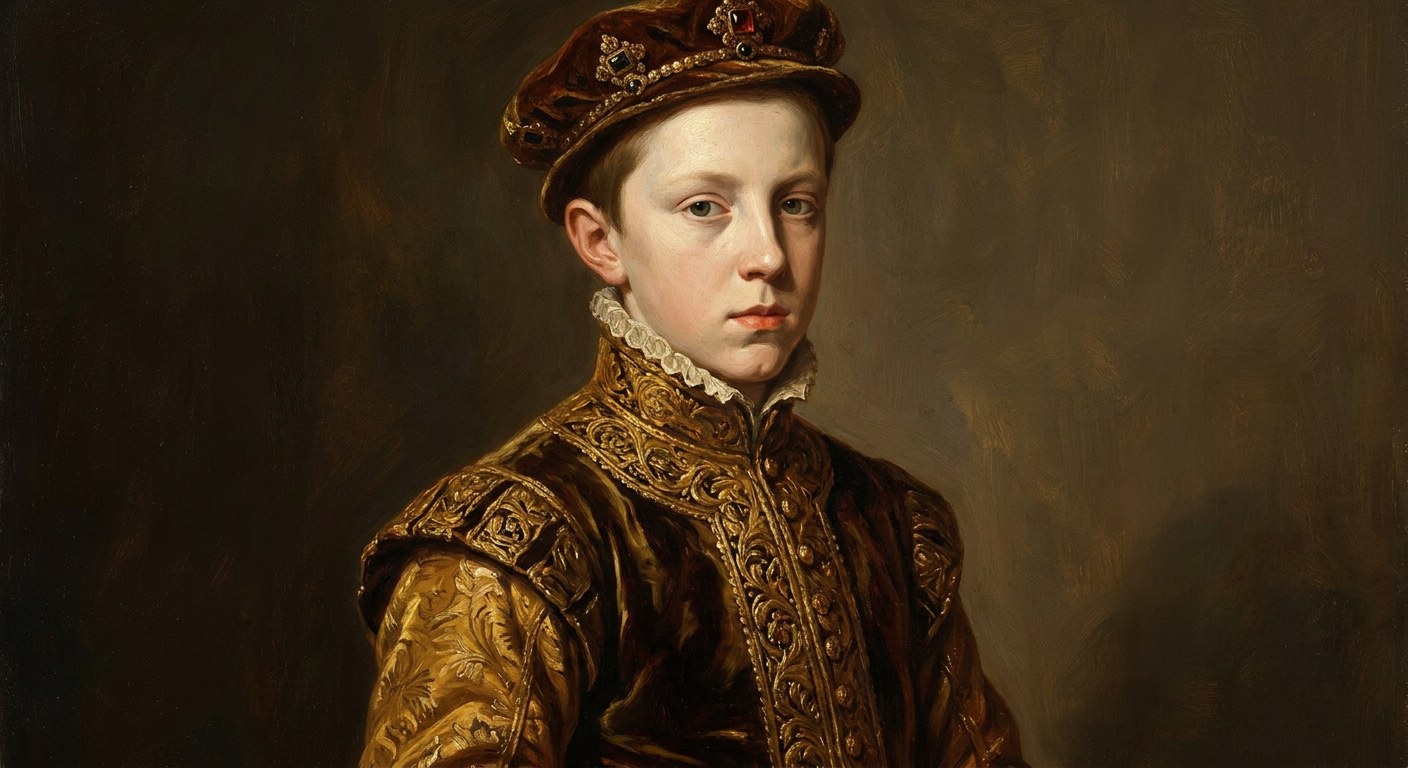
Edward VI
1537 – 1553 · English · King of England
Recommended Audiobooks
Listen next from Marcus Alden

Life Lessons from Frederic Chopin
Marcus Alden · 54 min

Life Lessons from John Wesley
Marcus Alden · 52 min
Introduction
Edward VI (12 October 1537–6 July 1553) was king of England and Ireland from 1547 until his death at the age of fifteen. The only legitimate son of Henry VIII, Edward inherited the Tudor throne when he was nine years old. Because he remained a minor throughout his reign, government was conducted in his name by councillors—first under his maternal uncle Edward Seymour, Duke of Somerset, and later under John Dudley, Duke of Northumberland.
Although Edward’s reign lasted only six and a half years, it transformed the religious identity of England. Henry VIII had broken with Rome while retaining many traditional Catholic doctrines and ceremonies. Under Edward, the government adopted an explicitly Protestant program. English replaced Latin in public worship, clerical marriage became legal, images and shrines were removed, chantries were dissolved, and Archbishop Thomas Cranmer introduced the Book of Common Prayer. The Forty-Two Articles of 1553 presented a Protestant statement of doctrine that helped shape the later Church of England.
The reign was also marked by warfare, economic hardship, inflation, social unrest and political rivalry. Somerset’s expensive campaign against Scotland ended in strategic failure despite victory at the Battle of Pinkie. The religious and economic policies of the government contributed to the Prayer Book Rebellion and Kett’s Rebellion in 1549. Northumberland subsequently restored political order and improved royal finances, but his authority depended heavily on the king’s support.
Edward was intelligent, studious and unusually serious about religion. As he grew older, he became more involved in government and strongly committed to the Protestant cause. During his final illness, he attempted to prevent the Catholic Mary Tudor from inheriting the crown. His “Devise for the Succession” transferred the throne to his Protestant cousin Lady Jane Grey, bypassing both Mary and Elizabeth. The plan collapsed within days of Edward’s death, but it remains one of the most controversial episodes in Tudor history.
Edward’s early death prevented him from ruling independently. Historians therefore continue to debate whether he should be remembered principally as a manipulated child, a developing religious monarch, or the driving force behind an increasingly radical Protestant monarchy.
Quick Facts
| Category | Details |
|---|---|
| Full name | Edward Tudor |
| Royal title | Edward VI, King of England and Ireland |
| Born | 12 October 1537 |
| Birthplace | Hampton Court Palace, Middlesex, England |
| Parents | Henry VIII and Jane Seymour |
| House | Tudor |
| Siblings | Mary Tudor and Elizabeth Tudor, his older half-sisters |
| Acceded to the throne | 28 January 1547 |
| Coronation | 20 February 1547 at Westminster Abbey |
| Age at accession | Nine |
| Principal regents | Edward Seymour, Duke of Somerset; John Dudley, Duke of Northumberland |
| Archbishop of Canterbury | Thomas Cranmer |
| Religion | Protestant; raised within the emerging Church of England |
| Major religious measures | Book of Common Prayer of 1549 and 1552; Acts of Uniformity; Forty-Two Articles |
| Major conflicts | Rough Wooing against Scotland; Prayer Book Rebellion; Kett’s Rebellion |
| Intended successor | Lady Jane Grey |
| Died | 6 July 1553 |
| Place of death | Greenwich Palace, Kent |
| Age at death | Fifteen |
| Probable cause of death | Pulmonary tuberculosis, possibly complicated by an earlier respiratory infection |
| Burial | 8 August 1553 in Westminster Abbey |
| Reign | 28 January 1547–6 July 1553 |
Early Life & Background
Edward was born at Hampton Court Palace shortly after two o’clock in the morning on 12 October 1537. His birth was the long-awaited answer to Henry VIII’s dynastic anxieties. Henry’s first two surviving legitimate children, Mary and Elizabeth, were female and had each been declared illegitimate after the annulment or invalidation of her mother’s marriage. A legitimate son promised continuity for the Tudor dynasty.
Edward’s mother, Jane Seymour, was Henry VIII’s third wife. She had served as a lady-in-waiting to Catherine of Aragon and Anne Boleyn before attracting the king’s attention. Jane married Henry on 30 May 1536, only eleven days after Anne Boleyn’s execution.
The prince was christened in the Chapel Royal at Hampton Court on 15 October 1537. His half-sisters, Mary and Elizabeth, participated in the elaborate ceremonies, while Archbishop Thomas Cranmer acted as one of his godparents. Jane Seymour was initially believed to be recovering, but she soon became seriously ill, probably from complications related to childbirth. She died at Hampton Court on 24 October, leaving Edward motherless at twelve days old.
Later tradition portrayed Edward as a frail child from birth, but contemporary evidence suggests that he was generally healthy during his early years. Henry VIII took intense precautions to protect his son from disease. Edward’s household was kept under strict sanitary regulations, and access to him was carefully controlled.
Sir William Sidney initially served as chamberlain of the prince’s household. Margaret Bryan, who had previously cared for Mary and Elizabeth, acted as Edward’s lady mistress. His early education was supervised by learned tutors, including Richard Cox and John Cheke. They trained him in Latin, Greek, scripture, philosophy, history, geography, mathematics and music. He also learned some French, Spanish and Italian.
Edward’s education reflected Renaissance humanism but increasingly carried a Protestant character. Cheke and Cox encouraged classical learning, moral discipline and the direct study of biblical texts. Edward became a proficient Latinist, composed essays and theological exercises, and maintained a detailed chronicle of public events. His surviving schoolwork reveals intellectual ability, diligence and a strong concern with religious doctrine.
The young prince also developed affectionate relationships with his half-sisters. Mary was twenty-one years older than Edward and sent him gifts and messages. Elizabeth, four years older than he was, shared many of the same humanist influences. Their relationships later became strained by religious differences and the politics of succession.
Henry VIII’s final succession arrangements were established by the Third Succession Act of 1544 and confirmed in his will. Edward stood first in line, followed by Mary and then Elizabeth. If all three died without lawful heirs, the crown was to pass to descendants of Henry’s younger sister, Mary Tudor, Duchess of Suffolk. The descendants of his elder sister Margaret Tudor, whose line ruled Scotland, were excluded.
Rise to Prominence
Henry VIII died at Whitehall Palace on 28 January 1547. The news was temporarily concealed while senior councillors secured control of the government and brought Edward from Hertford to London. On 31 January, Edward was formally informed that he was king. He reportedly grieved for his father alongside Elizabeth.
Henry’s will appointed sixteen executors who were to govern collectively until Edward reached the age of eighteen. Within days, however, Edward Seymour—Jane Seymour’s elder brother and the new king’s maternal uncle—established himself as the dominant figure. Seymour became Duke of Somerset and Lord Protector of the Realm. Although major decisions were formally issued in Edward’s name, Somerset exercised powers approaching those of a regent.
Edward entered London on 19 February and was crowned at Westminster Abbey on 20 February 1547. Archbishop Cranmer conducted the ceremony. Because the king was only nine, the coronation service was shortened. Cranmer’s address presented Edward as a biblical reforming ruler who should suppress idolatry and advance true religion.
Somerset’s government promoted Protestant reform and continued Henry VIII’s attempt to force a dynastic union between England and Scotland. Under the treaties of Greenwich of 1543, the infant Mary, Queen of Scots, was intended to marry Edward. The Scottish Parliament repudiated the agreement, leading to the conflict known as the Rough Wooing.
An English army led by Somerset won a major victory at the Battle of Pinkie, near Musselburgh, on 10 September 1547. The victory was tactically impressive, but it did not produce the desired marriage. French intervention strengthened Scottish resistance, and Mary was sent to France in 1548 to marry the future Francis II. English garrisons in Scotland became increasingly expensive and difficult to maintain.
At court, Edward’s other maternal uncle, Thomas Seymour, Lord Seymour of Sudeley, resented Somerset’s supremacy. Thomas married Henry VIII’s widow, Catherine Parr, without securing the council’s prior approval. He also attempted to build a personal relationship with Edward and sought greater political influence. After Catherine’s death in September 1548, Thomas’s conduct became more reckless. Accused of plotting to abduct the king and alter the government, he was convicted by act of attainder and executed on 20 March 1549. Somerset’s role in allowing his own brother’s execution later damaged his reputation.
Edward was still too young to direct policy, but he was not detached from government. He attended council meetings, received ambassadors, studied state papers and recorded major events. As he matured, his religious convictions became increasingly important to the direction of the reign.
Major Achievements
Edward VI’s principal historical importance lies in the establishment of Protestant worship and doctrine in England. These changes were implemented by ministers and bishops, especially Cranmer, but they were made under Edward’s authority and increasingly aligned with his personal beliefs.
In July 1547, the government issued royal injunctions requiring clergy to preach against the authority of the bishop of Rome, remove objects associated with pilgrimage and provide English Bibles in churches. Official visitations enforced the injunctions. Images, relics and traditional devotional practices came under growing attack.
The Chantries Act of December 1547 dissolved institutions endowed to support priests who said masses for the dead. Protestants rejected the doctrine of purgatory on which chantry foundations depended. The measure also transferred substantial property to the Crown, though much of it was sold to meet financial needs or granted to courtiers.
In 1548, Cranmer’s Order of Communion introduced English prayers into the Latin Mass. The following year Parliament passed the first Act of Uniformity, requiring use of the first Book of Common Prayer from Whitsunday, 9 June 1549. This was the first complete liturgy in English authorized for general use throughout the English Church.
The 1549 prayer book was deliberately cautious in some of its language, but it represented a major break with medieval practice. It simplified services, reduced the number of ceremonies and placed scripture and communal worship at the center of religious life. Its introduction, however, provoked resistance in conservative regions.
After Somerset’s fall, the government adopted more explicitly Reformed policies. Altars were replaced by communion tables, remaining images were removed, and clerical vestments were restricted. The second Book of Common Prayer, authorized by the Act of Uniformity of 1552, revised the communion service in a more clearly Protestant direction. It rejected any suggestion that the priest offered Christ’s body as a sacrifice during the service.
The Forty-Two Articles, issued in June 1553, summarized the theology of Edward’s Church. They affirmed justification by faith, emphasized the authority of scripture, rejected purgatory and denied the Roman Catholic understanding of transubstantiation. Although Mary I suppressed them, they influenced the Thirty-Nine Articles adopted under Elizabeth I.
Edward’s reign also saw important administrative and educational developments. The Crown founded or reorganized schools using former religious endowments, producing institutions later known as King Edward VI schools. In London, royal charters helped establish Christ’s Hospital, St Thomas’ Hospital and Bridewell Hospital. These initiatives reflected both charitable concerns and an attempt to address poverty and social disorder after the dissolution of the monasteries.
Under Northumberland, the government also began restoring financial stability. It ended the extreme debasement of the coinage, reduced military commitments, reformed revenue administration and sought to control expenditure. These measures did not eliminate England’s economic difficulties, but they improved the position inherited from Henry VIII and Somerset.
Defining Moments
Edward’s birth was his first defining moment because it transformed the Tudor succession. For nearly three decades Henry VIII had failed to secure a legitimate male heir. Edward’s arrival appeared to guarantee the dynasty, although his mother’s death and his own eventual childlessness showed how fragile that security remained.
His accession in January 1547 created a child monarchy. The political arrangements surrounding the minority allowed ambitious nobles to exercise extraordinary authority. Somerset’s protectorate initially rested on family connection and popularity, but military expense, religious disruption and social unrest weakened his position.
The year 1549 was the great crisis of the reign. In Devon and Cornwall, opposition to the new prayer book developed into the Prayer Book, or Western, Rebellion. Many rebels demanded restoration of Latin worship, traditional ceremonies and the Mass. Government forces under John Russell suppressed the uprising after violent fighting, including the Battle of Sampford Courtenay in August.
At the same time, Kett’s Rebellion erupted in Norfolk. It began amid grievances over land enclosure but expanded into a broader protest against corrupt local government, exploitative landlords and economic injustice. Robert Kett and thousands of followers occupied Mousehold Heath outside Norwich. After an initial government force was defeated, John Dudley, Earl of Warwick, crushed the rebellion at the Battle of Dussindale on 27 August 1549. Kett was later hanged at Norwich Castle.
These disasters helped bring down Somerset. In October 1549, Warwick and other councillors removed him from power. Somerset was briefly imprisoned, restored to the council and then arrested again in 1551. Convicted of felony for assembling men to kill or imprison political rivals, he was executed on Tower Hill on 22 January 1552. Edward recorded the event in his chronicle with striking emotional restraint.
Warwick, created Duke of Northumberland in 1551, became the dominant minister. Unlike Somerset, he generally governed through the Privy Council rather than assuming the title of protector. Northumberland ended the wars with Scotland and France, returned Boulogne to France under the Treaty of Boulogne in 1550, and pursued further Protestant reform.
Another defining conflict concerned Edward’s half-sister Mary. A devout Catholic, Mary continued to hear Mass in her household despite government orders. She appealed to her cousin Emperor Charles V for protection. Edward and his councillors hesitated to move directly against her because of her popularity and the danger of provoking the emperor. The dispute exposed the limits of the young king’s authority and the incompatibility of his religious principles with Mary’s position as heir.
Edward’s final defining act was his attempt to rewrite the succession. When his health deteriorated in 1553, he drafted a document known as “My Devise for the Succession.” An early version favored the male heirs of Lady Jane Grey and her sisters, but because no such heirs existed, Edward altered it to name “Lady Jane and her heirs male.”
Jane was the granddaughter of Henry VIII’s younger sister, Mary Tudor, and a committed Protestant. In May 1553, she married Lord Guildford Dudley, Northumberland’s son. Judges and councillors were pressured to give legal effect to Edward’s plan through letters patent. Mary and Elizabeth were excluded on the grounds of illegitimacy, although the arrangement contradicted Henry VIII’s statutory settlement.
Edward died before Parliament could confirm the change. Jane was proclaimed queen on 10 July 1553, but Mary mobilized widespread support and was recognized as queen nine days later.
Timeline
| Year | Event |
|---|---|
| 1537 | Edward is born at Hampton Court Palace on 12 October and christened on 15 October; Jane Seymour dies on 24 October. |
| 1543 | The treaties of Greenwich propose a marriage between Edward and Mary, Queen of Scots. |
| 1544 | Parliament restores Mary and Elizabeth to the succession behind Edward. |
| 1547 | Henry VIII dies on 28 January; Edward becomes king and is crowned on 20 February. |
| 1547 | Edward Seymour becomes Duke of Somerset and Lord Protector. |
| 1547 | English forces defeat the Scots at the Battle of Pinkie on 10 September. |
| 1547 | Royal injunctions promote Protestant reform; Parliament passes a new Chantries Act. |
| 1548 | The Order of Communion introduces English elements into the Mass. |
| 1548 | Mary, Queen of Scots, is sent to France, undermining plans for her marriage to Edward. |
| 1549 | Thomas Seymour is executed on 20 March. |
| 1549 | The first Act of Uniformity introduces the English Book of Common Prayer. |
| 1549 | The Prayer Book Rebellion and Kett’s Rebellion are suppressed. |
| 1549 | Somerset is removed from power in October. |
| 1550 | The Treaty of Boulogne ends war with France and provides for the return of Boulogne. |
| 1550 | John Dudley, Earl of Warwick, becomes the leading figure in government. |
| 1551 | Warwick is created Duke of Northumberland. |
| 1551 | Somerset is arrested for a second time. |
| 1552 | Somerset is executed on Tower Hill on 22 January. |
| 1552 | The second Act of Uniformity authorizes a more Protestant Book of Common Prayer. |
| 1552 | Edward suffers measles and smallpox but recovers. |
| 1553 | Edward becomes seriously ill, probably with tuberculosis. |
| 1553 | Lady Jane Grey marries Guildford Dudley on 25 May. |
| 1553 | The Forty-Two Articles are issued in June. |
| 1553 | Edward formalizes his “Devise for the Succession,” naming Jane Grey as heir. |
| 1553 | Edward dies at Greenwich Palace on 6 July. |
| 1553 | Jane is proclaimed queen on 10 July but is deposed on 19 July as Mary I takes power. |
| 1553 | Edward is buried in Westminster Abbey on 8 August. |
Personal Life
Edward never married and had no children. His youth meant that marriage negotiations were instruments of diplomacy rather than expressions of personal preference. The most important proposed match was with Mary, Queen of Scots. Had it succeeded, it might have united the English and Scottish crowns two generations before James VI of Scotland inherited England in 1603. Scottish resistance and French intervention made the plan impossible.
Other possible brides were discussed, including Elisabeth of Valois, a daughter of Henry II of France, but Edward died before any agreement matured. There is no reliable evidence that he had a romantic relationship.
Edward’s daily life combined education, religious observance, ceremony and training for kingship. He studied for long hours, heard sermons, practiced music and took part in hunting, archery and other aristocratic activities. He kept a chronicle in which he summarized political, military and diplomatic events. Its concise, sometimes impersonal style reflects both his education and his awareness that kingship demanded disciplined judgment.
His relationship with Mary deteriorated over religion. Edward believed that permitting the Mass in her household endangered religious uniformity. Mary, however, regarded the Mass as essential to her faith and refused to submit. Their correspondence reveals a conflict between family affection, royal authority and conscience.
Edward appears to have remained on good terms with Elizabeth. Both were highly educated and sympathetic to reform, although Elizabeth was more cautious in public. On New Year’s Day 1549, she gave him a portrait of herself. Her survival and later accession ensured that many Edwardian religious policies were revived after Mary’s death.
Descriptions of Edward emphasize his pale complexion, reddish or auburn hair and dignified bearing. A famous portrait by Hans Holbein the Younger shows him as an infant in a commanding royal pose, holding a golden rattle like a scepter. Later portraits similarly presented him not as an ordinary child but as the embodiment of Tudor monarchy.
Beliefs & Philosophy
Edward’s defining belief was his Protestant Christianity. Unlike Henry VIII, whose rejection of papal authority coexisted with traditional doctrine, Edward embraced the evangelical and Reformed direction of the English Church. He regarded scripture as the highest religious authority and considered the suppression of “idolatry” a royal responsibility.
His theology was shaped by Cranmer, Cox, Cheke and reform-minded preachers. He admired continental reformers and maintained correspondence with figures such as John Calvin. Reformers across Europe saw Edward as a potential Protestant champion whose kingdom might become a model of godly monarchy.
Edward’s conception of kingship drew heavily on Old Testament examples. A ruler was expected to defend true religion, punish vice, promote justice and protect the commonwealth. His education presented the monarch not merely as a political administrator but as a moral guardian answerable to God.
This outlook could encourage sincere concern for education and poor relief. It also justified coercion. Edward supported uniform worship and regarded religious disagreement not simply as personal choice but as disobedience to divine and royal authority. His opposition to Mary’s Mass demonstrates how limited religious toleration was among sixteenth-century rulers of any confession.
His succession plan was likewise shaped by religious conviction. Edward believed that Mary’s accession would reverse Protestant reform and restore papal influence. Excluding her was, from his perspective, an effort to protect the faith as well as the realm. Nevertheless, the plan also violated the existing statutory succession and disregarded Mary’s strong hereditary claim.
Challenges & Controversies
The central challenge of Edward’s reign was minority government. Because the king was a child, authority was exercised by adult ministers who could claim to represent his wishes. This arrangement encouraged factional rivalry and makes it difficult to determine responsibility for particular decisions.
Somerset has sometimes been portrayed as a sympathetic “Good Duke” concerned with the poor. He issued proclamations against unlawful enclosures and established commissions to investigate agrarian grievances. Yet his policies raised expectations that he could not satisfy. His government’s military expenditure, debasement of the coinage and inconsistent response to rebellion contributed to instability.
The wars inherited from Henry VIII placed an enormous burden on royal finances. The victory at Pinkie failed to conquer Scotland, while maintaining garrisons consumed money and manpower. The return of Boulogne to France in 1550 was strategically sensible but could be represented as a humiliating surrender of Henry VIII’s conquest.
Religious reform produced resistance because it altered familiar forms of worship. In Cornwall, where many people spoke Cornish and understood little English, replacing Latin services with an English prayer book did not make worship more accessible. The suppression of the Western rebels was severe, and thousands may have died in combat and reprisals, although precise totals are uncertain.
Economic hardship intensified discontent. Population growth, inflation, poor harvests, enclosure and changes in landholding placed pressure on rural and urban communities. The debasement of the coinage reduced confidence in money and contributed to rising prices. The Edwardian government did not create all these problems, but its fiscal and religious policies often aggravated them.
Northumberland’s reputation remains controversial. Traditional accounts depicted him as an unscrupulous conspirator who manipulated a dying boy to place his daughter-in-law Jane Grey on the throne. Modern historians have noted his administrative ability, conciliar style and success in ending ruinous wars. Even so, his family’s connection to Jane made the succession plan appear self-serving.
Edward’s own role in the devise is also debated. The surviving document is in his hand, and its religious logic matched his known convictions. He was not simply a passive victim. Yet he was fifteen, gravely ill and surrounded by councillors with strong interests in preventing Mary’s accession. The proposal therefore combined Edward’s agency with political pressure from Northumberland and others.
Edward’s illness generated rumors of poisoning, but there is no convincing evidence that he was murdered. He contracted measles and smallpox in 1552 and later developed a severe respiratory illness after becoming unwell in early 1553. Contemporary reports described persistent coughing, fever, weakness and wasting. An examination after death reportedly found badly diseased lungs, making pulmonary tuberculosis the most likely diagnosis.
Famous Quotes
Edward’s surviving chronicle and succession document provide the most reliable evidence of his own words. Spelling and punctuation are often modernized below.
“The Duke of Somerset had his head cut off upon Tower Hill between eight and nine o’clock in the morning.”
Edward recorded his uncle’s execution on 22 January 1552 in notably restrained language. The sentence is often cited as evidence of emotional coldness, although his chronicle generally used a concise, factual style.
“For lack of issue of my body…”
This phrase introduced the contingency at the heart of Edward’s “Devise for the Succession.” It reflected the reality that he had no wife or direct heir.
“…to the Lady Jane and her heirs male.”
Edward altered the devise to make Lady Jane Grey herself the immediate successor, rather than waiting for a male child to be born to her. The wording became the foundation of Jane’s brief claim to the throne.
“Lord God, deliver me out of this miserable and wretched life, and take me among thy chosen.”
This deathbed prayer was reported by the Protestant writer John Foxe. Because Foxe’s account was published after Edward’s death and was intended to celebrate him as a godly ruler, its precise wording should be treated cautiously.
“O my Lord God, defend this realm from papistry, and maintain thy true religion.”
Also preserved in Protestant accounts of Edward’s final hours, this prayer captures the confessional concerns associated with his succession plan, though it cannot be independently verified as a verbatim statement.
Legacy & Influence
Edward VI’s strongest legacy is liturgical. The Book of Common Prayer, principally composed by Cranmer, became one of the most influential works in the English language. Mary I abolished it during her restoration of Catholicism, but Elizabeth I introduced a revised version in 1559. Its language shaped Anglican worship, literature and devotional practice for centuries.
The Edwardian Reformation moved England beyond royal supremacy into doctrinal Protestantism. Communion in both kinds, clerical marriage, services in English and rejection of purgatory became central features of the reformed Church. Although Mary reversed these policies, many Protestant clergy and laypeople went into exile and returned after 1558 with even stronger Reformed convictions.
Edward’s reign also influenced the political development of the Tudor state. The difficulties of minority rule demonstrated the dangers of concentrating authority in a single protector. Northumberland’s reliance on the Privy Council helped restore more collective forms of government, even though his final succession strategy undermined trust in his leadership.
Lady Jane Grey’s nine-day regime became one of the most memorable consequences of Edward’s reign. Her deposition showed that written instruments and council support could not easily overcome hereditary legitimacy, parliamentary statute and popular mobilization. Mary’s success also demonstrated that a Catholic woman could command broad political allegiance in England.
Edward’s posthumous image changed according to religious perspective. Protestant writers such as Foxe celebrated him as a “godly imp” or young shoot of true religion—a new Josiah who purified worship before dying prematurely. Catholic writers regarded the reign as a period of heresy, sacrilege and social destruction. Later popular histories often portrayed Edward as a sickly child controlled by ambitious adults.
Modern scholarship offers a more complex interpretation. Edward was certainly constrained by age, but he was highly educated, politically observant and increasingly assertive. By 1552–1553 he participated meaningfully in council business and religious policy. Had he lived into adulthood, England might have experienced a more thorough Protestant transformation without the Catholic restoration under Mary.
His reign remains important precisely because it was unfinished. Edward left no mature personal government by which his abilities could be fully judged. Yet the reforms enacted in his name permanently altered English Christianity and helped establish the confessional struggles that defined the later Tudor age.
Interesting Facts
- Edward was Henry VIII’s only legitimate son to survive infancy.
- Jane Seymour died only twelve days after Edward’s birth.
- His coronation service was shortened because he was nine years old.
- Edward kept a personal chronicle covering many of the major events of his reign.
- He received an advanced humanist education and could read and write Latin and Greek.
- His proposed marriage to Mary, Queen of Scots, helped cause the Rough Wooing.
- The English victory at Pinkie was one of the largest battles fought between England and Scotland, but it failed to secure the marriage.
- Both of Edward’s maternal uncles, Edward and Thomas Seymour, were executed during his reign.
- The first complete official English prayer book appeared under Edward in 1549.
- The 1552 prayer book was substantially more Protestant than the 1549 version.
- Edward’s government legalized clerical marriage.
- His reign witnessed two major rebellions in the same summer: the Western Rebellion and Kett’s Rebellion.
- He was the first English monarch raised as a Protestant from childhood.
- Edward personally drafted the earliest form of his succession devise.
- Lady Jane Grey’s claim derived from Edward’s plan, but her government lasted only nine days.
- Edward and Mary I were buried in Westminster Abbey, though in different parts of the building.
- The monument planned for Edward was never completed; he lies beneath a later marker near Henry VII’s Lady Chapel.
- Numerous schools still bearing the name King Edward VI trace their origins or reorganization to the Tudor period.
- Edward’s death at fifteen made him one of England’s youngest reigning monarchs to die in office.
- Despite his reputation for lifelong frailty, evidence indicates that he was active and reasonably healthy for much of his childhood.
Frequently Asked Questions
When was Edward VI born?
Edward was born on 12 October 1537 at Hampton Court Palace. He was the son of Henry VIII and Jane Seymour.
How old was Edward VI when he became king?
He was nine years old when Henry VIII died on 28 January 1547. Edward was crowned at Westminster Abbey on 20 February.
Who ruled England during Edward VI’s minority?
Edward Seymour, Duke of Somerset, dominated the government from 1547 to 1549 as lord protector. John Dudley, Duke of Northumberland, became the leading minister from 1550 until Edward’s death, although he governed without taking the title of protector.
Was Edward VI really a sickly child?
Not continuously. He received careful medical attention and appears to have been reasonably healthy during most of his childhood. He survived measles and smallpox in 1552 but developed a fatal respiratory disease, probably tuberculosis, in 1553.
What religion was Edward VI?
Edward was a committed Protestant. He supported the authority of scripture, worship in English, clerical marriage and the rejection of purgatory and papal authority.
What was Edward VI’s greatest achievement?
His reign’s most enduring achievement was the Protestant transformation of public worship, particularly the introduction of the Book of Common Prayer. The 1549 and 1552 editions became foundations of the Anglican liturgical tradition.
What were the rebellions of 1549?
The Prayer Book Rebellion in Devon and Cornwall opposed religious changes and other grievances. Kett’s Rebellion in Norfolk focused more heavily on enclosure, economic exploitation and failures of local government. Both were violently suppressed.
Why was the Duke of Somerset executed?
After his fall from power, Somerset was accused of planning to arrest or kill political rivals. He was acquitted of treason but convicted of felony and executed on 22 January 1552.
Why did Edward exclude Mary from the succession?
Edward regarded Mary’s Catholicism as a threat to Protestant reform. He also relied on the earlier declarations of her illegitimacy, though Henry VIII’s will and an act of Parliament had restored her place in the succession.
Why was Elizabeth also excluded?
The legal argument used against Mary also applied to Elizabeth: both had previously been declared illegitimate. Naming Elizabeth while excluding Mary would also have weakened the stated hereditary justification for the devise.
Did Northumberland force Edward to name Lady Jane Grey?
Northumberland almost certainly encouraged and facilitated the plan, and his family benefited from it. Nevertheless, the earliest draft survives in Edward’s hand, and its Protestant purpose matched his convictions. Most historians therefore view the devise as a collaborative project rather than simply Northumberland’s invention.
How did Edward VI die?
He died at Greenwich Palace on 6 July 1553 after months of coughing, fever and physical decline. Pulmonary tuberculosis is the most widely accepted diagnosis, possibly worsened by an earlier infection.
Where is Edward VI buried?
He was buried in Westminster Abbey on 8 August 1553. Archbishop Thomas Cranmer conducted a Protestant funeral service while Mary I attended a Catholic requiem Mass for him at the Tower of London.
Who succeeded Edward VI?
Lady Jane Grey was initially proclaimed queen under Edward’s devise. Mary Tudor defeated Jane’s regime and was recognized as Queen Mary I on 19 July 1553.
What might have happened if Edward had lived?
Any answer is speculative, but a longer reign would probably have strengthened Protestant institutions and prevented Mary’s Catholic restoration. Whether Edward would have become an effective independent ruler cannot be known.
Lessons from Edward VI
- Minority rule creates political uncertainty: A child monarch may become the focus of rival factions, even when formal institutions remain in place.
- Military victories do not always produce strategic success: Pinkie was a major battlefield triumph, but it failed to secure Scotland or Edward’s proposed marriage.
- Religious reform can have far-reaching social effects: Changes to worship affected language, local identity, communal traditions and political loyalty.
- Economic hardship magnifies political unrest: Inflation, enclosure and taxation helped turn dissatisfaction into rebellion.
- Education can prepare a young ruler for responsibility: Edward’s scholarship enabled him to understand theology and government at an unusually early age.
- Conviction can coexist with intolerance: Edward’s sincere religious beliefs inspired reform but left little room for dissent.
- Legal legitimacy matters: The attempt to bypass Mary failed because the devise lacked the authority, acceptance and parliamentary foundation of the established succession.
- Historical agency must be judged carefully: Edward was influenced by powerful adults, but surviving evidence shows that he also formed and pursued policies of his own.
- Short reigns can have lasting consequences: Edward ruled for only six and a half years, yet his religious settlement shaped English Christianity for generations.
- Unfinished lives invite competing interpretations: Because Edward never reached adulthood, historians must distinguish his demonstrated actions from speculation about the king he might have become.
Further Reading
- Chris Skidmore, Edward VI: The Lost King of England.
- Jennifer Loach, Edward VI, edited by George Bernard and Penry Williams.
- Diarmaid MacCulloch, Thomas Cranmer: A Life.
- Diarmaid MacCulloch, The Boy King: Edward VI and the Protestant Reformation.
- Stephen Alford, Kingship and Politics in the Reign of Edward VI.
- W. K. Jordan, Edward VI: The Young King and Edward VI: The Threshold of Power.
- Dale Hoak, ed., The Mid-Tudor Polity, c. 1540–1560.
- G. W. Bernard, The Late Medieval English Church: Vitality and Vulnerability Before the Break with Rome.
- Eamon Duffy, The Stripping of the Altars: Traditional Religion in England, 1400–1580.
- Eamon Duffy, The Voices of Morebath: Reformation and Rebellion in an English Village.
- John Guy, Tudor England.
- David Loades, The Tudor Court.
- Barrett L. Beer, Northumberland: The Political Career of John Dudley, Earl of Warwick and Duke of Northumberland.
- The Chronicle and Political Papers of King Edward VI, for Edward’s own record of his reign.
- The 1549 and 1552 editions of The Book of Common Prayer, available in scholarly print and digital editions.