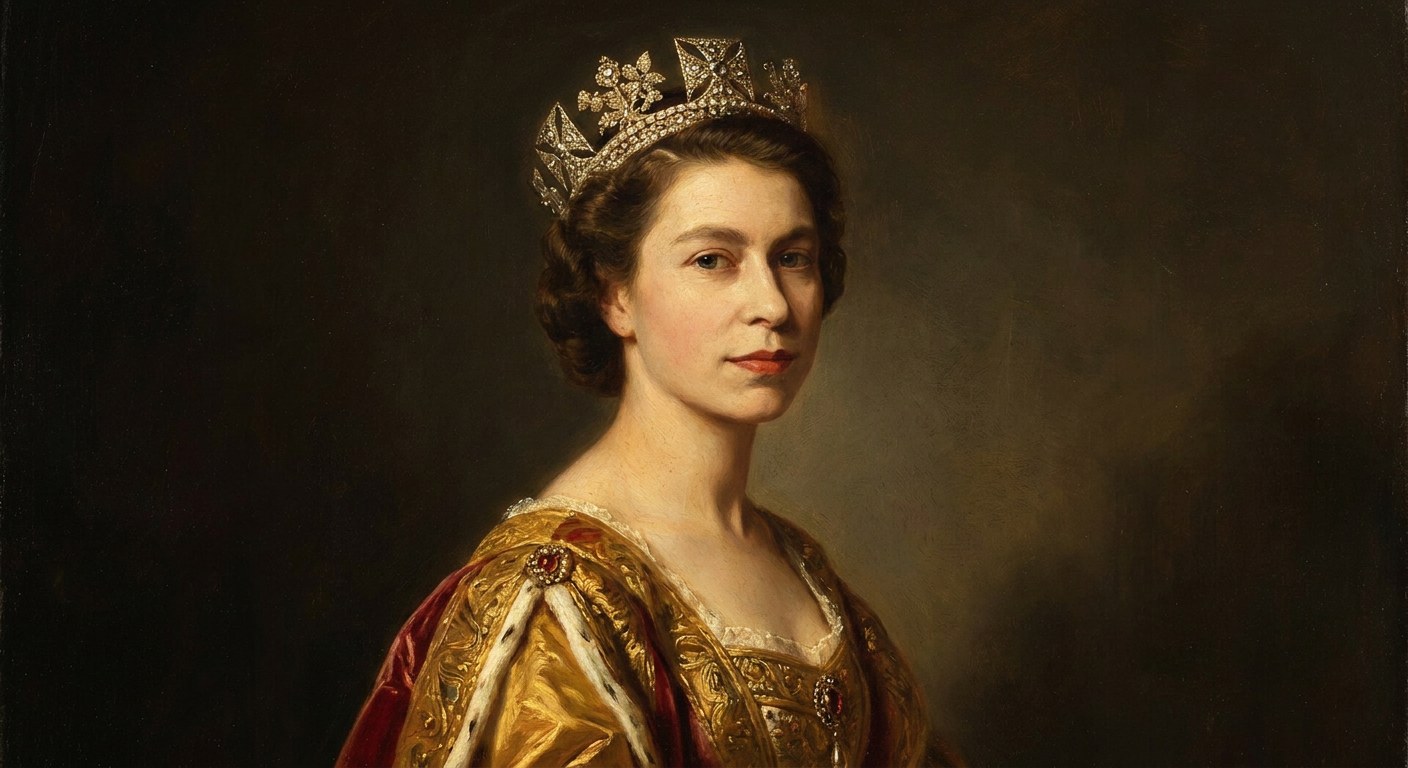
Elizabeth II
1926 – 2022 · British · Queen & Head of State
Recommended Audiobooks
Listen next from Marcus Alden

Life Lessons from Frederic Chopin
Marcus Alden · 54 min

Life Lessons from John Wesley
Marcus Alden · 52 min
Introduction
Elizabeth II was Queen of the United Kingdom from 6 February 1952 until her death on 8 September 2022. Her reign of 70 years and 214 days was the longest in British history and the longest verified reign of any female monarch. During seven decades of profound political, social and technological change, she became one of the world’s most recognizable public figures and a symbol of institutional continuity.
Born Princess Elizabeth of York in 1926, she was not initially expected to become queen. Her position changed dramatically after her uncle, Edward VIII, abdicated in 1936, placing her father on the throne as George VI and making Elizabeth heir presumptive. Her youth was shaped by the Second World War, during which she made public broadcasts, supported wartime charities and trained as a driver and mechanic in the Auxiliary Territorial Service.
Elizabeth inherited the throne at the age of 25. At her accession, Britain was still adjusting to the aftermath of war while its empire was being transformed through decolonization. By the end of her reign, the United Kingdom had experienced 15 prime ministers, joined and left the European Union, undergone major constitutional reforms and become a far more diverse society. The British Empire largely gave way to the voluntary Commonwealth of Nations, an association to which the Queen devoted considerable attention.
Although constitutionally constrained and publicly nonpartisan, Elizabeth exercised influence through personal diplomacy, private counsel and the symbolic authority of the Crown. Her reign included moments of celebration—such as her Silver, Golden, Diamond and Platinum Jubilees—as well as family crises, public criticism and debates over monarchy, privilege and Britain’s imperial legacy.
Elizabeth II’s historical significance lies not in direct political rule but in her longevity, disciplined public service and ability to adapt an ancient institution to the modern media age. To admirers, she represented duty, stability and national unity. To critics, she embodied inherited privilege and unresolved questions about colonialism and democratic accountability. Her life remains central to understanding modern Britain and the evolution of constitutional monarchy.
Quick Facts
| Category | Details |
|---|---|
| Full name | Elizabeth Alexandra Mary Windsor |
| Title | Queen Elizabeth II |
| Born | 21 April 1926 |
| Birthplace | 17 Bruton Street, Mayfair, London, England |
| Died | 8 September 2022 |
| Place of death | Balmoral Castle, Aberdeenshire, Scotland |
| Age at death | 96 |
| Father | King George VI, formerly Prince Albert, Duke of York |
| Mother | Elizabeth Bowes-Lyon, later Queen Elizabeth the Queen Mother |
| Sister | Princess Margaret, Countess of Snowdon |
| House | Windsor |
| Spouse | Prince Philip, Duke of Edinburgh |
| Marriage | 20 November 1947, Westminster Abbey |
| Children | Charles III, Anne, Princess Royal, Prince Andrew, Duke of York, and Prince Edward, Duke of Edinburgh |
| Accession | 6 February 1952 |
| Coronation | 2 June 1953 |
| Reign | 70 years and 214 days |
| Predecessor | George VI |
| Successor | Charles III |
| Principal role | Constitutional monarch and head of state |
| Other major role | Head of the Commonwealth |
| Religion | Church of England |
| Burial | King George VI Memorial Chapel, St George’s Chapel, Windsor Castle |
Early Life & Background
Elizabeth Alexandra Mary was born on 21 April 1926 at the London home of her maternal grandparents, the Earl and Countess of Strathmore and Kinghorne. She was the first child of Albert, Duke of York, the second son of King George V, and Elizabeth Bowes-Lyon. She was named Elizabeth after her mother, Alexandra after her paternal great-grandmother Queen Alexandra, and Mary after her grandmother Queen Mary.
Within her family, she was affectionately called “Lilibet,” a name derived from her childhood attempt to pronounce Elizabeth. Her sister, Princess Margaret Rose, was born at Glamis Castle in Scotland on 21 August 1930. The two sisters were educated at home under the supervision of their governess, Marion Crawford. Elizabeth studied history, literature, music and languages, becoming particularly proficient in French. Henry Marten, vice-provost of Eton College, instructed her in constitutional history.
At birth, Elizabeth was third in the line of succession, after her uncle Edward, Prince of Wales, and her father. Because Edward was expected to marry and have children, few anticipated that she would become monarch. That expectation changed after George V died in January 1936. Edward became Edward VIII but abdicated on 11 December of that year because of opposition to his intended marriage to Wallis Simpson, an American divorcée.
Elizabeth’s father consequently became King George VI, and the ten-year-old princess became heir presumptive. She was not called heir apparent because, under the succession law then in force, a future son born to George VI would have displaced her in the line of succession. No son was born.
The Second World War began in September 1939, when Elizabeth was 13. Suggestions that the princesses should be evacuated overseas were rejected by their mother, who reportedly declared that the children would not leave without her, she would not leave without the King, and the King would never leave Britain. Elizabeth and Margaret spent much of the war at Windsor Castle.
On 13 October 1940, Elizabeth made her first public broadcast during the BBC’s Children’s Hour. Addressing children who had been evacuated from Britain, she expressed sympathy for families separated by war. In 1942, she was appointed colonel-in-chief of the Grenadier Guards and conducted her first solo public engagement by inspecting the regiment.
In February 1945, shortly before her nineteenth birthday, Elizabeth joined the Auxiliary Territorial Service, the women’s branch of the British Army. As Second Subaltern Elizabeth Windsor, service number 230873, she trained in London as a driver and vehicle mechanic. She was later promoted to junior commander. Her service made her the first female member of the royal family to become a full-time active member of the armed services.
On Victory in Europe Day, 8 May 1945, Elizabeth and Margaret anonymously joined crowds celebrating in central London. Elizabeth later remembered the occasion as one of the most memorable nights of her life.
Rise to Prominence
Elizabeth first met Prince Philip of Greece and Denmark as a child, but their serious acquaintance developed after a visit to the Royal Naval College at Dartmouth in 1939. Philip, a naval cadet and distant cousin of Elizabeth, corresponded with her during the war. Their engagement was officially announced on 9 July 1947.
Before the marriage, Philip renounced his Greek and Danish titles, adopted the surname Mountbatten and became a naturalized British subject. George VI created him Duke of Edinburgh, Earl of Merioneth and Baron Greenwich. Elizabeth and Philip married at Westminster Abbey on 20 November 1947. Their first child, Prince Charles, was born on 14 November 1948; Princess Anne followed on 15 August 1950.
As George VI’s health deteriorated, Elizabeth increasingly represented him at public functions. In 1951, she and Philip toured Canada and visited the United States, where they met President Harry S. Truman. In January 1952, they departed on a Commonwealth tour intended to include East Africa, Australia and New Zealand.
On 6 February 1952, while Elizabeth was in Kenya, George VI died at Sandringham House. She and Philip had stayed at Treetops Hotel and were at Sagana Lodge when the news reached them. The 25-year-old princess immediately became queen. Asked what regnal name she wished to use, she replied that she would remain Elizabeth.
The royal couple returned to London on 7 February. Elizabeth’s accession was formally proclaimed, and she began receiving state papers and meeting government officials. Her coronation took place at Westminster Abbey on 2 June 1953. Conducted by Geoffrey Fisher, Archbishop of Canterbury, the ceremony was the first British coronation to be televised in full. Millions watched in Britain, while recordings and broadcasts reached audiences around the world.
The televised coronation helped establish Elizabeth as a monarch of the mass-media age. Yet it also emphasized the religious and constitutional character of kingship. She swore to govern according to law, administer justice with mercy and uphold the Church of England.
Major Achievements
One of Elizabeth II’s principal achievements was maintaining the relevance of constitutional monarchy through an era of rapid transformation. She did not determine government policy, but she fulfilled essential constitutional functions: appointing prime ministers, opening Parliament, granting royal assent to legislation, receiving ambassadors and holding weekly audiences with her heads of government.
During her reign, she was served by 15 British prime ministers, from Winston Churchill to Liz Truss. Her private audiences allowed her to advise, encourage and warn, following the constitutional principles associated with the nineteenth-century writer Walter Bagehot. The content of these meetings remained confidential, helping preserve her political neutrality.
Elizabeth was also central to the development of the modern Commonwealth. At her accession, she was queen of seven independent countries. Over time, many colonies became sovereign states, while several realms became republics. Rather than opposing this transformation, she supported a voluntary Commonwealth based on cooperation and shared institutions. She attended nearly every Commonwealth Heads of Government Meeting during the active decades of her reign and made extensive tours across Africa, Asia, the Caribbean and the Pacific.
Her reign saw a significant modernization of royal communications. The 1953 coronation was televised, the first televised royal Christmas message followed in 1957, and the royal household later embraced documentary film, satellite broadcasting, websites and social media. The monarchy opened itself more visibly to the public, though the balance between accessibility and privacy remained contentious.
Elizabeth undertook more than 270 overseas visits and is widely regarded as one of history’s most extensively travelled heads of state. Her state visits supported British diplomacy and trade while providing occasions for reconciliation. She welcomed foreign leaders ranging from Charles de Gaulle and Nelson Mandela to Emperor Hirohito and multiple United States presidents.
She maintained hundreds of charitable, military and civic patronages. Her public schedule supported organizations associated with education, health, youth, veterans, the arts, science and community service. Programs linked to her reign included the Queen’s Awards for Enterprise and the Queen’s Award for Voluntary Service.
Her jubilees became major national and Commonwealth occasions. The Silver Jubilee of 1977 marked 25 years on the throne; the Golden Jubilee in 2002 marked 50; the Diamond Jubilee in 2012 marked 60; and the Platinum Jubilee in 2022 marked an unprecedented 70 years.
Defining Moments
The Second World War established Elizabeth’s early public identity. Her 1940 broadcast and military service associated her with a generation shaped by sacrifice, rationing and national mobilization. That experience informed her later emphasis on duty and resilience.
The death of George VI was both a personal tragedy and a constitutional turning point. Elizabeth’s accession in Kenya created the striking image of a young princess leaving Britain and returning as queen. Her early reign was closely linked to Winston Churchill, who initially viewed her youth with concern but became one of her most trusted prime ministers.
The decolonization of Africa and the Caribbean transformed the geopolitical basis of the monarchy. Ghana became independent in 1957, Nigeria in 1960, Kenya in 1963 and numerous other territories thereafter. Elizabeth’s celebrated dance with Ghanaian president Kwame Nkrumah during her 1961 visit was interpreted as a gesture of personal diplomacy at a moment of Cold War competition.
In October 1966, a coal-waste tip collapsed at Aberfan in Wales, killing 144 people, including 116 children. The Queen waited eight days before visiting, a delay that generated criticism and later became emblematic of the dangers of excessive royal caution. She returned to Aberfan several times and maintained a lasting relationship with the community.
The year 1992 became one of the most difficult of her reign. Three of her children’s marriages had broken down or were under severe strain, and a fire badly damaged Windsor Castle on 20 November. In a speech marking the fortieth anniversary of her accession, Elizabeth described 1992 as an annus horribilis. Public controversy over the cost of repairing Windsor contributed to reforms: the Queen agreed to pay income and capital gains tax from 1993, and parts of Buckingham Palace were opened to paying visitors.
The death of Diana, Princess of Wales, in Paris on 31 August 1997 created another crisis. The royal family remained at Balmoral with Princes William and Harry, while public grief intensified in London. Critics interpreted the absence of an immediate royal statement and the lack of a flag at half-mast over Buckingham Palace as emotional detachment. On 5 September, Elizabeth returned to London and delivered a live broadcast praising Diana as “an exceptional and gifted human being.” The episode accelerated efforts to make the monarchy more responsive to public emotion.
A more positive milestone came in May 2011, when Elizabeth became the first British monarch to visit the Republic of Ireland since independence. At a state dinner in Dublin Castle, she opened her speech in Irish and expressed sympathy for the painful history between Britain and Ireland. The visit, including a wreath-laying at the Garden of Remembrance, was widely seen as an important act of reconciliation.
During the COVID-19 pandemic, the Queen addressed Britain and the Commonwealth from Windsor Castle on 5 April 2020. Drawing on memories of wartime separation, she promised that better days would return and concluded, “We will meet again.” The address reached an audience facing isolation, illness and uncertainty.
Her husband, Prince Philip, died at Windsor Castle on 9 April 2021, aged 99. Because of pandemic restrictions, the Queen sat alone during his funeral in St George’s Chapel, an image that became symbolic of private grief under public rules.
In June 2022, Britain celebrated her Platinum Jubilee. Though increasingly limited by mobility problems, Elizabeth appeared on the Buckingham Palace balcony and participated in a filmed sketch with Paddington Bear. She appointed Liz Truss as prime minister at Balmoral Castle on 6 September. Two days later, she died peacefully there at the age of 96.
Timeline
| Year | Event |
|---|---|
| 1926 | Born in Mayfair, London, on 21 April |
| 1930 | Her sister, Princess Margaret, is born |
| 1936 | Edward VIII abdicates; her father becomes George VI and Elizabeth becomes heir presumptive |
| 1940 | Makes her first radio broadcast during the Second World War |
| 1942 | Conducts her first solo public engagement |
| 1945 | Serves in the Auxiliary Territorial Service as a driver and mechanic |
| 1947 | Marries Philip Mountbatten at Westminster Abbey |
| 1948 | Prince Charles is born |
| 1950 | Princess Anne is born |
| 1952 | Accedes to the throne after George VI’s death on 6 February |
| 1953 | Crowned at Westminster Abbey on 2 June |
| 1957 | Delivers her first televised Christmas message |
| 1960 | Prince Andrew is born |
| 1964 | Prince Edward is born |
| 1966 | Visits Aberfan eight days after the mining disaster |
| 1969 | The investiture of Prince Charles as Prince of Wales is televised |
| 1977 | Celebrates her Silver Jubilee |
| 1981 | Prince Charles marries Lady Diana Spencer |
| 1982 | Signs the proclamation associated with Canada’s patriated Constitution Act |
| 1986 | Makes a state visit to China |
| 1992 | Experiences her “annus horribilis”; Windsor Castle is damaged by fire |
| 1993 | Begins voluntarily paying income and capital gains tax |
| 1997 | Addresses the nation after Diana’s death |
| 2002 | Celebrates her Golden Jubilee; Princess Margaret and the Queen Mother die |
| 2007 | Becomes the longest-lived British monarch |
| 2011 | Makes a historic state visit to the Republic of Ireland |
| 2012 | Celebrates her Diamond Jubilee and appears in a James Bond sketch for the London Olympics |
| 2015 | Surpasses Queen Victoria as Britain’s longest-reigning monarch |
| 2016 | Celebrates her ninetieth birthday |
| 2020 | Delivers a rare national address during the COVID-19 pandemic |
| 2021 | Prince Philip dies after more than 73 years of marriage |
| 2022 | Celebrates her Platinum Jubilee and dies at Balmoral on 8 September |
Personal Life
Elizabeth married Prince Philip after a courtship that had developed during the Second World War. Their marriage lasted 73 years, making Philip the longest-serving consort of a British monarch. Elizabeth described him during their Golden Wedding anniversary in 1997 as her “strength and stay.”
The couple had four children. Charles was born in 1948 and eventually succeeded his mother as Charles III. Anne, born in 1950, became known for an extensive program of public engagements and equestrian accomplishments. Andrew was born in 1960 and Edward in 1964.
As sovereign, Elizabeth faced the tension between motherhood and constitutional responsibility. Her duties often required lengthy tours, and Charles and Anne sometimes remained in Britain with relatives and household staff. Later portrayals of royal family life showed efforts to create a more informal domestic image, but the emotional effects of royal duty remained a subject of biographical debate.
The Queen enjoyed horses from childhood. She bred and owned racehorses, closely followed bloodstock and racing, and regularly attended the Royal Ascot meeting. She also loved dogs, especially Pembroke Welsh corgis. Her first corgi, Susan, was given to her for her eighteenth birthday, and many later royal corgis descended from Susan.
Her principal residences included Buckingham Palace, Windsor Castle, Sandringham House in Norfolk and Balmoral Castle in Scotland. Balmoral, privately owned by the royal family, provided a comparatively informal retreat where she walked, rode, drove and spent time with relatives.
Elizabeth was known for disciplined routines, careful preparation and an excellent memory for people and events. Her brightly colored outfits and matching hats served a practical purpose: they made her visible in large crowds.
Beliefs & Philosophy
Elizabeth II understood monarchy as a vocation grounded in Christian faith, constitutional restraint and lifelong service. As Supreme Governor of the Church of England, she formally participated in the church’s institutional life, but her religious commitment was also personal. Her Christmas broadcasts increasingly included direct reflections on the teachings of Jesus Christ, forgiveness, reconciliation and compassion.
Her guiding ideal was duty rather than self-expression. In 1947, before she became queen, she publicly dedicated her life to the service of the peoples of the Commonwealth. She repeatedly renewed that commitment over the following decades.
Politically, she maintained strict public neutrality. She did not vote, endorse parties or comment openly on proposed legislation. Her weekly audiences with prime ministers allowed private discussion, but she generally avoided revealing her views. This reserve was essential to her belief that a constitutional monarch should represent the state as a whole rather than any political faction.
Elizabeth also valued continuity, gradual change and personal encounter. Her approach to modernization was cautious: she accepted innovation when it strengthened the institution but resisted changes that might compromise the dignity, neutrality or stability of the Crown.
Challenges & Controversies
Elizabeth’s reign was not free from criticism. Republican opponents argued that hereditary monarchy was incompatible with democratic equality and that royal wealth, tax arrangements and constitutional privileges lacked sufficient transparency. Questions were repeatedly raised about the costs of royal security, palaces and official travel.
The monarchy’s relationship to empire became an increasingly important issue. Elizabeth did not create British colonialism, and much decolonization occurred during her reign, but the Crown remained a symbol of imperial rule for many people. Campaigners in the Caribbean and elsewhere called for apologies, reparations and the removal of the monarch as head of state. Barbados became a republic in 2021, while remaining in the Commonwealth.
The royal response to the Aberfan disaster was criticized as delayed. The crisis following Diana’s death similarly exposed a gap between traditional royal reserve and public expectations of visible emotion.
Family difficulties repeatedly affected the institution. The divorces of Charles, Anne and Andrew contributed to the turbulence of the 1990s. Prince Andrew’s friendship with convicted sex offender Jeffrey Epstein and a civil lawsuit brought by Virginia Giuffre caused serious reputational damage. Andrew denied Giuffre’s allegations and settled the lawsuit in 2022 without admitting liability. In January 2022, the Queen removed his military affiliations and royal patronages, and he ceased using the style “His Royal Highness” in an official capacity.
The departure of Prince Harry and Meghan, Duchess of Sussex, from full-time royal duties in 2020 created another public conflict. Their allegations concerning media pressure, inadequate institutional support and conversations within the royal family about their son’s potential skin color prompted worldwide debate. Buckingham Palace responded that the issues were concerning, while stating that “recollections may vary.”
Historians have also examined the opacity surrounding royal influence. Constitutional procedures such as Queen’s Consent—under which the monarch’s consent is sought before Parliament debates certain bills affecting Crown interests—have led to calls for greater disclosure. No evidence establishes that Elizabeth routinely attempted to govern politically, but critics contend that the boundaries of royal consultation deserve closer scrutiny.
Famous Quotes
“I declare before you all that my whole life, whether it be long or short, shall be devoted to your service.”
—Twenty-first birthday broadcast from Cape Town, 21 April 1947
“My heart is too full for me to say more to you today than that I shall always work, as my father did throughout his reign, to uphold constitutional government.”
—Accession declaration, 1952
“I cannot lead you into battle. I do not give you laws or administer justice, but I can do something else: I can give you my heart and my devotion.”
—Christmas broadcast, 1957
“1992 is not a year on which I shall look back with undiluted pleasure.”
—Guildhall speech, 24 November 1992
“He has, quite simply, been my strength and stay all these years.”
—Speaking of Prince Philip during their Golden Wedding anniversary, 1997
“What I say to you now, as your Queen and as a grandmother, I say from my heart.”
—Broadcast following the death of Diana, Princess of Wales, 5 September 1997
“Grief is the price we pay for love.”
—Message following the terrorist attacks of 11 September 2001
“We should take comfort that while we may have more still to endure, better days will return: we will be with our friends again;