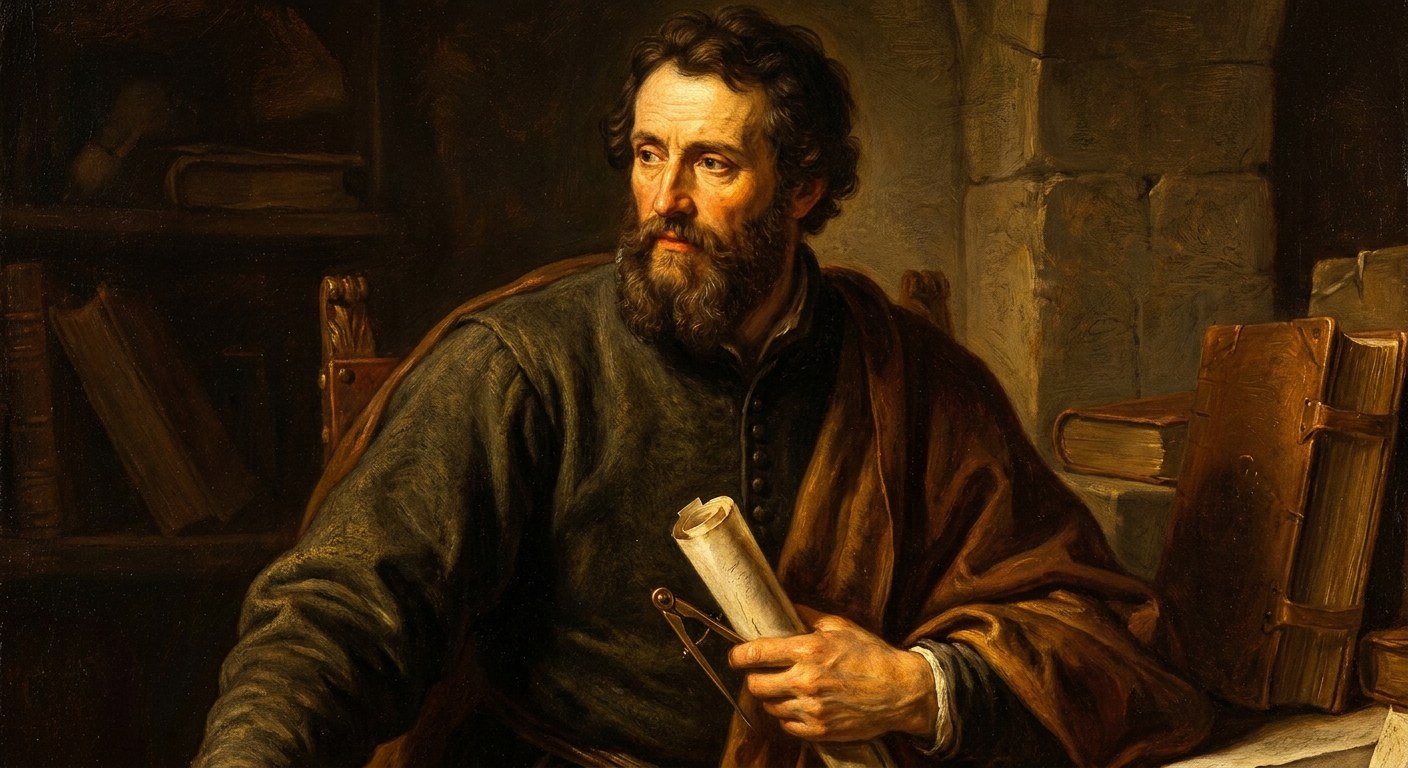
Eratosthenes
276 BC – 194 BC · Ancient Greek · Mathematician & Geographer
Recommended Audiobooks
Listen next from Marcus Alden

Life Lessons from Frederic Chopin
Marcus Alden · 54 min

Life Lessons from John Wesley
Marcus Alden · 52 min
Introduction
Eratosthenes of Cyrene was one of the most versatile scholars of the ancient world. A mathematician, geographer, astronomer, poet, literary critic, historian, and librarian, he embodied the intellectual ambitions of the Hellenistic age—the period when Greek learning spread across the eastern Mediterranean and Near East following the conquests of Alexander the Great.
Born around 276 BCE in Cyrene, a Greek city in present-day Libya, Eratosthenes studied in both Alexandria and Athens before entering the service of the Ptolemaic dynasty of Egypt. Around the middle of the third century BCE, King Ptolemy III Euergetes appointed him head of the Library of Alexandria, the most celebrated scholarly institution of antiquity. There he supervised collections of literary and scientific texts, instructed members of the royal family, and pursued research across an extraordinary range of disciplines.
Eratosthenes is best known for calculating the circumference of Earth through a combination of geometry, astronomical observation, and geographical measurement. His result—traditionally given as 252,000 stadia—may have come remarkably close to the modern value, although the precise accuracy cannot be determined because the length of his stadion is uncertain. More important than the numerical result was his method: he treated Earth as a measurable sphere and showed how observations made at different locations could reveal its total size.
He also developed a mathematical procedure now known as the Sieve of Eratosthenes for identifying prime numbers. In geography, he attempted to create a systematic map of the inhabited world, employed parallels and meridians, and helped establish geography as a distinct field of inquiry. In chronology, he sought to organize Greek history according to a consistent sequence of dates.
Most of Eratosthenes’ works have been lost. What is known comes largely from fragments and later writers, including Strabo, Cleomedes, Ptolemy, Pliny the Elder, and Eutocius. Nevertheless, the surviving evidence reveals a scholar of exceptional breadth—one who united literary culture with mathematical reasoning and helped transform the collection of knowledge into a disciplined search for measurable order.
Quick Facts
| Category | Details |
|---|---|
| Full name | Eratosthenes of Cyrene |
| Greek name | Ἐρατοσθένης ὁ Κυρηναῖος (Eratosthenēs ho Kyrēnaios) |
| Born | c. 276 BCE |
| Birthplace | Cyrene, in present-day Libya |
| Died | c. 194 BCE, possibly 195 BCE |
| Place of death | Alexandria, Ptolemaic Egypt |
| Age at death | Traditionally about 80–82 |
| Father | Aglaos, according to the Byzantine Suda |
| National and cultural identity | Greek of Cyrene |
| Occupations | Mathematician, geographer, astronomer, poet, historian, literary scholar, librarian |
| Known for | Measuring Earth’s circumference; the Sieve of Eratosthenes; systematic geography; ancient chronology |
| Major position | Head of the Library of Alexandria |
| Royal patrons | Ptolemy III Euergetes and the Ptolemaic court |
| Notable works | Geographika, Chronographiai, On the Measurement of the Earth, Hermes, Platonicus |
| Intellectual era | Hellenistic period |
| Traditional nicknames | Pentathlos (“all-around competitor”) and “Beta” |
| Primary areas of influence | Geography, mathematics, astronomy, cartography, chronology, philology |
Early Life & Background
Eratosthenes was born around 276 BCE in Cyrene, a prosperous Greek settlement on the North African coast. Cyrene had been founded by colonists from the Aegean island of Thera in the seventh century BCE and became an important center of commerce, medicine, philosophy, and literature. By Eratosthenes’ lifetime, the region was closely connected to Ptolemaic Egypt.
His father is named as Aglaos in the Suda, a Byzantine encyclopedia compiled many centuries later. Nothing reliable is known about his mother, siblings, or the economic circumstances of his family. His extensive education suggests that he belonged to a household capable of supporting advanced literary and philosophical study.
Cyrene had its own distinguished intellectual traditions. The philosopher Aristippus, founder of the Cyrenaic school, had come from the city, as had the poet Callimachus, who became one of the leading literary figures at Alexandria. Eratosthenes’ education probably began with grammar, poetry, music, and mathematics—the principal elements of elite Greek schooling.
Ancient biographical traditions associate him with several teachers. He is said to have studied grammar under Lysanias of Cyrene and to have been connected with Callimachus. He later traveled to Athens, then one of the most important centers of philosophical instruction in the Greek world. There he reportedly studied under Ariston of Chios, a Stoic philosopher, and encountered the skeptical Academy associated with Arcesilaus of Pitane.
These influences help explain the breadth of his later work. From grammar and poetry he acquired a close concern for texts, language, and literary history. From philosophy he inherited an interest in ethics, cosmology, and the organization of knowledge. Mathematics and astronomy gave him the methods with which he would investigate Earth itself.
Eratosthenes did not become a committed spokesman for a single philosophical school. Instead, he drew from several traditions and pursued questions across disciplinary boundaries. This intellectual independence became one of his defining characteristics.
Rise to Prominence
Eratosthenes first gained recognition as a poet and literary scholar rather than as a geographer. He composed works such as Hermes, a learned poem that appears to have included cosmological and astronomical themes, and Erigone, a poem based on Attic mythology. Their combination of myth, scholarship, and science was characteristic of Alexandrian literary culture.
His reputation eventually attracted the attention of Ptolemy III Euergetes, king of Egypt from 246 to 222 BCE. Around 245 BCE, according to the traditional reconstruction, Ptolemy invited Eratosthenes to Alexandria and appointed him head of the royal library. He may have succeeded the poet Apollonius of Rhodes, although the exact order and official titles of the early Alexandrian librarians remain subjects of scholarly debate.
The Library of Alexandria was part of a broader research institution known as the Mouseion, or “sanctuary of the Muses.” Supported by the Ptolemaic monarchy, it brought together scholars who edited literary texts, investigated scientific questions, compiled reference works, and debated the intellectual heritage of the Greek world and neighboring civilizations.
As head librarian, Eratosthenes occupied one of the most prestigious scholarly positions in the Hellenistic Mediterranean. He was responsible for an enormous and expanding collection of papyrus rolls. The work required expertise in textual criticism, classification, authorship, and literary history. He also appears to have served as a tutor to the future Ptolemy IV Philopator.
Alexandria offered exceptional resources for Eratosthenes’ research. Its library provided access to travel accounts, surveys, astronomical records, historical narratives, and earlier geographical works. Its harbor connected Egypt with the Mediterranean, Red Sea, and Indian Ocean trading systems. The Ptolemaic administration also maintained surveyors and records that could help a scholar estimate distances between cities.
Eratosthenes’ prominence came from his ability to synthesize these resources. Rather than merely preserving information, he compared, criticized, calculated, and reorganized it. This made him a central representative of Alexandrian scholarship at its height.
Major Achievements
Measuring the Circumference of Earth
Eratosthenes’ most celebrated achievement was his estimate of Earth’s circumference. The full account in his own work, probably titled On the Measurement of the Earth, is lost. The best-known explanation survives in On the Circular Motions of the Celestial Bodies by Cleomedes, who wrote centuries later.
Eratosthenes knew that at Syene—modern Aswan in southern Egypt—the midday Sun at the summer solstice was reported to shine directly into a deep well or cast virtually no shadow from upright objects. This indicated that the Sun was nearly overhead. At Alexandria, however, a vertical object cast a measurable shadow at the same time.
The angle of that shadow was approximately one-fiftieth of a full circle, or about 7.2 degrees. Assuming that the Sun’s rays reached Earth in parallel lines and that Earth was spherical, Eratosthenes reasoned that the arc between Alexandria and Syene must also equal one-fiftieth of Earth’s circumference.
The distance between the two cities was taken as 5,000 stadia. Multiplying by 50 produced a circumference of 250,000 stadia. Another figure associated with Eratosthenes is 252,000 stadia, possibly adopted because it could be divided conveniently into 60 and 360 parts.
The modern meridional circumference of Earth is approximately 40,008 kilometers. If Eratosthenes used a stadion of about 157.5 meters, then 252,000 stadia would equal roughly 39,690 kilometers—an impressively close result. However, ancient stadia were not uniform, so claims about his exact percentage of error should be treated cautiously.
His method also involved approximations. Alexandria and Syene do not lie on precisely the same meridian, Syene is not exactly on the Tropic of Cancer, and the Sun is not perfectly overhead there at the solstice. Yet the underlying geometric reasoning was sound and historically revolutionary.
The Sieve of Eratosthenes
The Sieve of Eratosthenes is a systematic procedure for finding prime numbers. Beginning with a list of integers from 2 upward, one circles 2 and removes all higher multiples of 2. The next remaining number, 3, is prime, so its higher multiples are removed. The process continues with 5, 7, and subsequent unmarked numbers.
The procedure is called a “sieve” because composite numbers are filtered out, leaving the primes behind. It remains one of the clearest introductory algorithms in mathematics and computer science.
The earliest surviving detailed attribution appears in the work of the later mathematician Nicomachus of Gerasa. Because Eratosthenes’ own mathematical writings are fragmentary, historians cannot reconstruct his original presentation, but the association with his name is ancient.
Establishing Systematic Geography
Eratosthenes’ three-book Geographika was among the foundational works of mathematical geography. He examined earlier accounts of the inhabited world, discussed Earth’s shape and dimensions, and constructed a map based on measured distances and astronomical principles.
He used important east–west and north–south reference lines—precursors to parallels and meridians—to organize geographical space. His principal parallel extended through regions such as the Pillars of Heracles, the Mediterranean, Rhodes, and Asia. A major meridian ran through places including Alexandria, Syene, and Meroë.
Eratosthenes divided the known world into regions and attempted to estimate their lengths and widths. He drew on military itineraries, maritime voyages, reports from Alexander’s campaigns, and accounts of distant India, Arabia, and northern Europe.
He is often credited with coining or establishing the term geography, from Greek words meaning “description” or “writing of the Earth.” Although the development of terminology is difficult to trace with certainty, he unquestionably helped define geography as a systematic intellectual discipline.
Chronology and Historical Dating
In his Chronographiai, Eratosthenes attempted to arrange major events in Greek history within a consistent chronological framework. Earlier Greek writers often dated events by local magistrates, royal reigns, priesthoods, genealogies, or Olympiads. These systems did not always agree.
Eratosthenes compared traditions and synchronized them with the four-year cycle of the Olympic Games. He reportedly dated the fall of Troy to 1184 or 1183 BCE, a date that became influential in later ancient scholarship.
He also compiled a list of Olympic victors. Although many of his conclusions cannot be verified, his work represented an important movement away from purely legendary genealogies and toward comparative historical chronology.
Astronomy and the Obliquity of the Ecliptic
Ancient sources associate Eratosthenes with a measurement of the obliquity of the ecliptic—the tilt of Earth’s equatorial plane relative to the apparent path of the Sun. A value equivalent to approximately 23 degrees 51 minutes is sometimes linked to him.
Whether every detail of this calculation originated with Eratosthenes is uncertain, but it reflects the astronomical environment in which he worked. He also discussed the sizes and distances of celestial bodies, the climatic zones of Earth, and the relationship between latitude and the length of daylight.
The Delian Problem
Eratosthenes contributed to the famous Delian problem: constructing a cube with exactly twice the volume of a given cube. This required finding two mean proportionals between two given lengths.
A letter and epigram preserved by the late antique mathematician Eutocius describe a mechanical instrument attributed to Eratosthenes, often called the mesolabe, for finding such proportions. The device used movable triangular plates or rulers. Its association with Eratosthenes demonstrates his interest in both theoretical geometry and mechanical solutions.
Defining Moments
One defining moment was Eratosthenes’ move from Cyrene and Athens to Alexandria. The appointment transformed him from an itinerant scholar into a leading figure within a state-supported research institution. It gave him access to texts, observations, administrative records, and an international community of scholars.
A second was his decision to approach Earth as a geometrical object. Greek thinkers before him, including Aristotle, had argued that Earth was spherical. Eratosthenes advanced beyond demonstration of its shape: he gave the planet a measurable scale.
His geographical synthesis was another turning point. Earlier authors had described coastlines, peoples, journeys, and legendary regions. Eratosthenes brought these materials into a mathematical framework and subjected inherited accounts to criticism.
His chronological work likewise expressed a desire to impose order on fragmented traditions. By synchronizing events through Olympiads and other evidence, he treated time much as he treated space: as something that could be divided, compared, and mapped.
Finally, his old age became part of his ancient biographical legend. According to later reports, Eratosthenes lost his sight and, distressed by his inability to read and conduct research, voluntarily stopped eating. He died in Alexandria around 194 BCE. The story may preserve a genuine tradition, but its details cannot be independently confirmed.
Timeline
| Year | Event |
|---|---|
| c. 276 BCE | Born in Cyrene, a Greek city in North Africa |
| c. 260s–250s BCE | Receives literary, grammatical, mathematical, and philosophical education |
| Mid-third century BCE | Studies in Athens; associated by tradition with Ariston of Chios and the Academy |
| Before c. 245 BCE | Gains notice as a poet and scholar |
| c. 245 BCE | Invited to Alexandria and traditionally appointed head of the Library by Ptolemy III Euergetes |
| c. 240s–230s BCE | Conducts literary, chronological, mathematical, and geographical research |
| Third century BCE | Composes Hermes, Geographika, Chronographiai, and other works |
| Third century BCE | Develops the procedure later known as the Sieve of Eratosthenes |
| c. 240 BCE, traditionally | Calculates Earth’s circumference using observations associated with Alexandria and Syene |
| Late third century BCE | Serves the Ptolemaic court and may tutor the future Ptolemy IV Philopator |
| After 222 BCE | Continues scholarly work under Ptolemy IV |
| c. 195–194 BCE | Dies in Alexandria, traditionally after losing his sight |
Personal Life
Very little reliable information survives about Eratosthenes’ private life. No ancient evidence securely identifies a wife, partner, or children. His surviving biography is almost entirely intellectual and institutional.
The Suda names his father as Aglaos but offers few trustworthy details about his household. Ancient writers portray Eratosthenes principally as a scholar devoted to books, mathematics, poetry, and scientific investigation.
His social world would have included members of the Ptolemaic court and the scholarly community attached to the Mouseion. He lived in an environment shaped by royal patronage, intellectual rivalry, and cooperation among specialists in literature, medicine, mathematics, astronomy, and engineering.
Later tradition states that he became blind in old age. Because reading, observation, and textual scholarship defined his life, blindness would have been especially devastating. The claim that he ended his life by refusing food is possible but cannot be established with certainty. Such accounts in ancient biography were sometimes shaped to create a death that symbolically matched a person’s character.
Beliefs & Philosophy
Eratosthenes cannot be assigned neatly to one philosophical school. His education exposed him to Stoicism, Platonism, and other traditions, but his surviving work suggests an eclectic and critical outlook.
He believed that rational inquiry could uncover order in nature. His measurement of Earth depended on the conviction that local observations could be connected through universal geometry. His geography assumed that the world’s apparently irregular features could be represented through lines, distances, zones, and proportions.
He also resisted simplistic ethnic classifications. According to Strabo, Eratosthenes criticized the conventional division of humanity into Greeks and “barbarians.” He argued that people should instead be judged by qualities such as virtue, lawfulness, and political organization. Strabo reports that Eratosthenes pointed to admirable non-Greek peoples and morally deficient Greeks.
This position did not amount to modern egalitarianism, and Eratosthenes remained a member of an elite Greek intellectual culture. Nevertheless, his criticism of rigid ethnic binaries was notable in a world that frequently used the Greek–barbarian distinction as a basic political and cultural category.
His wide range of interests also expressed a philosophical ideal: knowledge was interconnected. Poetry could contain astronomy; geography depended on mathematics and history; chronology required philology; and the study of myth could illuminate cultural memory.
Challenges & Controversies
The greatest challenge in studying Eratosthenes is the loss of his writings. His major works survive only through quotations, summaries, criticisms, and fragments embedded in later authors. Consequently, modern reconstructions must distinguish his ideas from the interpretations of those who transmitted them.
His measurement of Earth has generated continuing debate. Cleomedes’ description may simplify the original procedure, and historians disagree about the source of the 5,000-stadion distance between Alexandria and Syene. It may have come from official surveys, travel estimates, or measurements made by professional route surveyors.
The length of the stadion is another unresolved issue. Different Greek and Egyptian standards existed, so converting 252,000 stadia into modern kilometers is uncertain. Popular claims that Eratosthenes missed the true circumference by less than one percent depend on selecting a particular stadion length.
His geography was criticized by Hipparchus of Nicaea, who argued for more rigorous astronomical coordinates, and later by Strabo, who preserved many fragments while challenging some of Eratosthenes’ assumptions. These criticisms should not be interpreted as evidence of failure. They show that Eratosthenes had created a framework substantial enough for later scholars to test and revise.
The nickname “Beta,” the second letter of the Greek alphabet, has sometimes been interpreted as an insult suggesting that he was second-best in every field. Another nickname, Pentathlos, compared him to an athlete skilled in several events without necessarily being supreme in one. The exact origin and tone of these labels remain uncertain. They may reflect admiration for his versatility as much as criticism.
Attribution also presents difficulties. The surviving Catasterisms, a work on constellations and their myths, circulated under Eratosthenes’ name, but the extant text is generally regarded as a later compilation or epitome based partly on his work. Likewise, later descriptions of the sieve and mesolabe may not preserve his original methods exactly.
Famous Quotes
Few authentic sentences from Eratosthenes survive intact. The following passages are preserved or paraphrased by later writers, and their wording varies by translation.
“It would be better to make such divisions according to good qualities and bad.”
—Idea attributed to Eratosthenes by Strabo, summarizing his criticism of dividing humanity simply into Greeks and barbarians.
“Many of the Greeks are bad, and many of the barbarians are refined.”
—A common translation of the argument reported by Strabo; it represents Eratosthenes’ thought rather than a securely preserved verbatim quotation.
“If, good friend, you wish to obtain from any small cube a cube double of it, and duly to change any solid figure into another, this is in your power.”
—From the epigram accompanying the geometrical device attributed to Eratosthenes and preserved by Eutocius.
“Do not seek to do the difficult business of Archytas’s cylinders, or to cut the cone in the triads of Menaechmus.”
—From the same mathematical epigram, contrasting Eratosthenes’ mechanical method with earlier approaches to the problem of doubling the cube.
Legacy & Influence
Eratosthenes’ most enduring legacy lies in his demonstration that the dimensions of Earth could be derived through reasoned observation. He did not need to travel around the planet. By measuring an angle, estimating a distance, and applying geometry, he connected two local observations to the scale of the globe.
His geographical work influenced Hipparchus, Strabo, Marinus of Tyre, Claudius Ptolemy, and later traditions of cartography. Although later scholars corrected his regional dimensions and introduced more precise coordinate systems, they worked within a field that he had helped define.
The Sieve of Eratosthenes continues to be taught as an efficient and intuitive algorithm for generating prime numbers. Modern implementations are used in mathematics education and computer programming, while more advanced variations process extremely large numerical ranges.
His chronology influenced ancient historians who sought to date the legendary and early historical past. The date of 1184/1183 BCE for the fall of Troy entered a long tradition of chronological calculation and remained influential well beyond antiquity.
Eratosthenes also became an enduring symbol of polymathy. His career challenges the modern separation of the sciences and humanities. He could edit poetry, analyze myth, solve geometrical problems, calculate astronomical quantities, and construct historical timelines because he regarded them as related forms of inquiry.
The lunar crater Eratosthenes bears his name, as does asteroid 3251 Eratosthenes. Modern geodesy, geography, mathematics, and science education continue to commemorate him. Classroom recreations of his shadow experiment allow students in different cities to calculate Earth’s circumference using essentially the same geometrical principle.
His true importance lies not in whether every numerical estimate was perfectly accurate. It lies in his method: gather evidence, question inherited reports, reduce a large problem to measurable relationships, and express the result in a form that others can test.
Interesting Facts
- Eratosthenes was born in Africa but belonged to the Greek-speaking culture of Cyrene.
- He calculated Earth’s circumference more than 1,700 years before the first completed global circumnavigation.
- His experiment did not prove that Earth was spherical; educated Greek astronomers already generally accepted that conclusion. He measured the sphere’s size.
- The familiar story of a solstitial well at Syene comes primarily from Cleomedes, who lived centuries after Eratosthenes.
- Alexandria and Syene are not exactly on the same meridian, yet the method still produced a strong approximation.
- The figure of 252,000 stadia may have been chosen because it divides neatly by 360, producing 700 stadia for each degree.
- The word “sieve” describes how the algorithm filters out composite numbers.
- His lost Geographika consisted of three books.
- He compared and criticized earlier mapmakers rather than accepting travel reports uncritically.
- He wrote poetry on mythology and astronomy in addition to scientific prose.
- His Hermes apparently presented cosmological information in poetic form.
- He devised or described a mechanical approach to doubling the cube.
- Ancient tradition called him Pentathlos, comparing his intellectual range to that of an all-around athlete.
- His supposed nickname “Beta” may have meant that he ranked second in many fields, although the story’s reliability is uncertain.
- A crater on the Moon is named in his honor.
- The systematic use of shadows to calculate Earth’s circumference remains a popular international educational experiment.
Frequently Asked Questions
Who was Eratosthenes?
Eratosthenes was a third-century BCE Greek mathematician, geographer, astronomer, poet, historian, and librarian from Cyrene. He became head of the Library of Alexandria and is especially famous for estimating Earth’s circumference.
When and where was Eratosthenes born?
He was born around 276 BCE in Cyrene, near the modern Libyan city of Shahhat. Cyrene was then a major Greek cultural center in North Africa.
How did Eratosthenes measure Earth?
He compared the angle of the Sun at Alexandria with reports that the Sun was nearly overhead at Syene at noon on the summer solstice. The difference was approximately 7.2 degrees, or one-fiftieth of a circle. Multiplying the estimated Alexandria–Syene distance by 50 gave Earth’s circumference.
Did Eratosthenes know that Earth was round?
Yes. The spherical Earth was already accepted by many Greek philosophers and astronomers. Eratosthenes’ achievement was not discovering its shape but developing a geometrical method for estimating its size.
How accurate was his calculation?
The answer depends on which ancient stadion he used. With one commonly proposed value, his estimate was close to the modern meridional circumference. Because the unit’s exact length is uncertain, a precise percentage of error cannot be established.
What is the Sieve of Eratosthenes?
It is an algorithm for identifying prime numbers. Beginning with 2, one repeatedly removes the multiples of each prime number. The numbers that remain are prime.
Did Eratosthenes invent geography?
Geographical knowledge existed long before him, but he helped transform it into a systematic, mathematical discipline. He measured Earth, organized places through reference lines, evaluated travel reports, and composed a major work titled Geographika.
Was Eratosthenes the head of the Library of Alexandria?
Ancient tradition identifies him as one of the library’s chief scholars or head librarians. He was appointed under Ptolemy III Euergetes around the middle of the third century BCE.
What books did Eratosthenes write?
His works included Geographika, Chronographiai, On the Measurement of the Earth, Platonicus, Hermes, and Erigone. Most survive only in fragments or references by later authors.
Why was Eratosthenes called “Beta”?
According to later tradition, “Beta” implied that he was second-best in many disciplines. The nickname may have been teasing or critical, but it may also have acknowledged his extraordinary range. Its historical context is uncertain.
How did Eratosthenes die?
Later sources report that he became blind in old age and voluntarily starved himself because he could no longer read or study. He probably died in Alexandria around 194 BCE, but the details of his death cannot be independently verified.
What was Eratosthenes’ greatest contribution?
His measurement of Earth is his most famous achievement, but his wider contribution was methodological. He showed how mathematics, observation, textual research, and critical comparison could be combined to investigate the physical and historical world.
Lessons from Eratosthenes
- Large questions can be solved through small observations. A shadow at one location helped reveal the dimensions of an entire planet.
- Methods matter more than fortunate answers. Even where his figures were approximate, Eratosthenes’ reasoning could be examined and repeated.
- Knowledge benefits from synthesis. His achievements emerged from combining geometry, astronomy, geography, literature, and administrative information.
- Inherited claims should be tested. Eratosthenes compared sources instead of accepting every traditional report.
- Useful models can tolerate approximation. Imperfect distances and alignments did not prevent him from reaching a meaningful result.
- Intellectual versatility is a strength. His poetry informed his astronomy, while his historical and literary knowledge strengthened his geography.
- Classification can reveal hidden order. His sieve, maps, and chronological tables all turned complex information into structured patterns.
- Scholarly disagreement drives progress. Criticism from Hipparchus and Strabo helped later geography become more precise.
- Cultural categories deserve scrutiny. His reported rejection of a simple Greek–barbarian division showed an unusual willingness to judge peoples by conduct rather than ancestry alone.
- Curiosity can connect the local and the universal. Eratosthenes used observations in Egypt to answer questions about Earth as a whole.
Further Reading
- Duane W. Roller, Eratosthenes’ Geography: Fragments Collected and Translated, with Commentary and Additional Material.
- Klaus Geus, Eratosthenes von Kyrene: Studien zur hellenistischen Kultur- und Wissenschaftsgeschichte.
- Cleomedes, On the Circular Motions of the Celestial Bodies, translated by Alan C. Bowen and Robert B. Todd.
- Strabo, Geography, especially Books 1 and 2, which preserve and criticize important fragments of Eratosthenes.
- Eutocius of Ascalon, commentary on Archimedes’ On the Sphere and Cylinder, for the material concerning the mesolabe and doubling the cube.
- James Evans, The History and Practice of Ancient Astronomy.
- O. A. W. Dilke, Greek and Roman Maps.
- G. J. Toomer, Ptolemy’s Almagest, for the later development of Greek mathematical astronomy.
- Reviel Netz, The Shaping of Deduction in Greek Mathematics.
- The fragments attributed to Eratosthenes in modern collections of ancient Greek geographical, mathematical, and chronological writings.