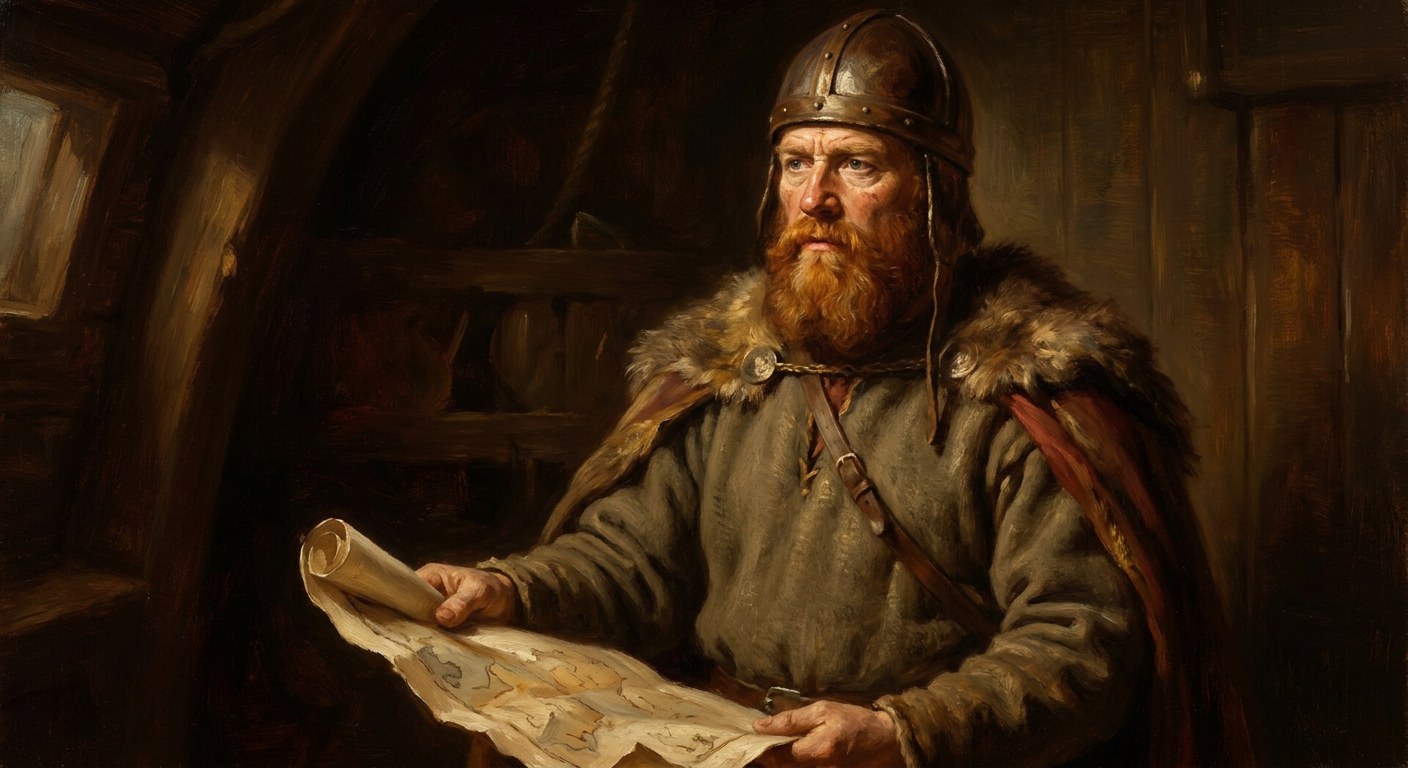
Erik the Red
950 – 1003 · Norse · Explorer & Settler
Recommended Audiobooks
Listen next from Marcus Alden

Life Lessons from Frederic Chopin
Marcus Alden · 54 min

Life Lessons from John Wesley
Marcus Alden · 52 min
Introduction
Erik the Red—known in Old Norse as Eiríkr rauði—was a tenth-century Norse explorer, settler, and chieftain best remembered as the founder of the first enduring European colony in Greenland. Born in Norway and raised in Iceland, he lived during the late Viking Age, when Scandinavian sailors, merchants, farmers, and raiders were expanding across the North Atlantic. His career connected Norway, Iceland, Greenland, and, indirectly, the later Norse voyages to North America.
Erik’s reputation rests on a striking combination of violence, resilience, navigational skill, and persuasive leadership. After being exiled from Iceland for killings arising from a bitter property dispute, he sailed west into poorly known waters. Between approximately 982 and 985, he explored Greenland’s southwestern coast, identifying fjords and valleys where Norse livestock farming might be possible. He then returned to Iceland, recruited colonists, and led a fleet back to Greenland around 985 or 986.
The settlement Erik established at Brattahlíð, near modern Qassiarsuk, became the political and economic center of Greenland’s Eastern Settlement. The wider colony survived for roughly five centuries, maintaining links with Iceland and Norway while developing a distinctive North Atlantic society.
Much of what is known about Erik comes from medieval Icelandic literature, especially The Saga of the Greenlanders and The Saga of Erik the Red. These texts were written centuries after the events they describe and sometimes contradict one another. Archaeology confirms the broad reality of Norse settlement in Greenland, but many details of Erik’s personality, family, and voyages remain uncertain. He is therefore both a historical figure and a saga hero—an influential colonizer whose life must be reconstructed through a careful balance of literary tradition and material evidence.
Quick Facts
| Category | Details |
|---|---|
| Full name | Erik Thorvaldsson |
| Old Norse name | Eiríkr Þorvaldsson |
| Common name | Erik the Red |
| Born | About 950 |
| Birthplace | Probably the Jæren district of southwestern Norway |
| Died | About 1003, possibly in Greenland |
| National and cultural identity | Norse; Norwegian-born and Icelandic-raised |
| Father | Thorvald Asvaldsson |
| Wife | Thjodhild, usually identified as Þjóðhildr Jǫrundardóttir |
| Children | Traditionally Leif Erikson, Thorstein Erikson, Thorvald Erikson, and Freydis Eiriksdottir |
| Known for | Exploring southwestern Greenland and founding its first lasting Norse colony |
| Main residence | Brattahlíð in Greenland’s Eastern Settlement |
| Years of Greenland exploration | Approximately 982–985 |
| Colonizing expedition | Approximately 985 or 986 |
| Main historical sources | The Saga of the Greenlanders and The Saga of Erik the Red |
| Name origin | Probably his red hair and beard, though his temper or reputation may also have contributed |
| Historical era | Viking Age |
Early Life & Background
Erik was born around 950, probably in the district of Jæren in Rogaland, southwestern Norway. His personal name was Erik Thorvaldsson, meaning “Erik, son of Thorvald.” The nickname “the Red” most likely referred to red hair and a red beard. Medieval nicknames often described appearance, temperament, ancestry, or memorable behavior, and later tradition also associated the name with Erik’s fiery disposition.
His father, Thorvald Asvaldsson, left Norway after being implicated in killings. The family migrated west to Iceland, probably during the later phase of Iceland’s settlement period. According to saga tradition, Thorvald established himself at Drangar in the Hornstrandir region of northwestern Iceland, where he eventually died.
Iceland had no king or centralized executive government. Its free farmers lived under a legal system organized around local assemblies and the national Althing, established around 930. Chieftains exercised influence, but disputes were commonly pursued through lawsuits, compensation agreements, alliances, or private retaliation. Outlawry could deprive a person of legal protection and force temporary or permanent exile.
Erik matured in this society of independent farmsteads, competitive households, and carefully defended honor. He later married Thjodhild, a woman traditionally connected to a well-established Icelandic family. Through marriage and settlement, Erik became a substantial farmer rather than merely an itinerant adventurer.
He established a farm called Eiríksstaðir, or “Erik’s farm,” in the Haukadalur area of western Iceland. A reconstructed longhouse at modern Eiríksstaðir commemorates the traditional location. Although its direct identification with Erik cannot be proved beyond doubt, archaeological work confirms Viking Age occupation in the area.
The sagas portray Erik as capable and ambitious but dangerously prone to violent escalation. His troubles began when some of his thralls, or enslaved laborers, caused a landslide that damaged a neighboring farm. A man named Eyvind the Foul killed the thralls. Erik retaliated by killing Eyvind and another man, an act that led to Erik’s banishment from the district.
He then moved to the islands of Breiðafjörður, an extensive bay in western Iceland. There, another dispute emerged over carved high-seat pillars or structural timbers called setstokkar, objects that carried practical, symbolic, and possibly religious importance in Norse households. Erik had entrusted the timbers to a man named Thorgest. When Thorgest refused to return them, Erik seized them, provoking an armed confrontation in which several men were killed.
The dispute was brought before local assemblies. Erik was declared an outlaw for three years, probably around 982. That judgment created the immediate circumstances for his most important achievement: the exploration of Greenland.
Rise to Prominence
Greenland was not entirely unknown to Icelanders before Erik’s voyage. Norse tradition credited Gunnbjörn Ulfsson—often called Gunnbjörn Ulf-Krakuson—with sighting skerries or islands west of Iceland after being driven off course. These landmarks became known as Gunnbjörn’s Skerries. Another explorer, Snæbjörn Galti, may also have attempted to settle or investigate the region before Erik, although the chronology is uncertain.
Erik therefore did not necessarily “discover” Greenland in the absolute sense. Indigenous peoples had lived in Greenland for thousands of years, and Norse sailors had probably seen parts of its eastern coast. His distinction was that he systematically explored areas suitable for colonization and successfully organized a lasting Norse settlement.
Leaving Iceland around 982, Erik sailed west. The exact route is unknown, but Viking Age navigators could use the sun, stars, winds, ocean swells, bird movements, cloud formations, sea color, and accumulated knowledge of sailing directions. Greenland’s east coast was hazardous because of sea ice, powerful currents, and a shortage of sheltered agricultural land.
Saga tradition states that Erik approached Greenland near the latitude of Bláserkr, meaning “Blue Shirt,” a landmark sometimes contrasted with the ice-covered Hvítserkr, or “White Shirt.” Rather than settle on the exposed eastern coast, he sailed south around Cape Farewell and then north into the fjords of southwestern Greenland.
For three years—the term of his Icelandic exile—Erik investigated the coast. He wintered in different locations, named geographical features, and examined valleys that could support hay production and livestock. The interior was dominated by the Greenland ice sheet, but the coastal fjords of the southwest had relatively sheltered pockets of grassland. These conditions allowed a Norse economy based on cattle, sheep, goats, hunting, fishing, and trade.
When his exile ended, Erik returned to Iceland. His reports described the new territory as Greenland. According to The Saga of the Greenlanders, he chose the attractive name because people would be more willing to go there if the land had a favorable name. The episode reveals not only humor but also a practical understanding of recruitment. A colony needed households, livestock, ships, tools, labor, and political support; exploration alone was not enough.
Erik’s campaign succeeded. He persuaded numerous Icelanders—some perhaps affected by land scarcity, family disputes, or limited opportunities—to join him. His transformation from outlaw to colonial leader marked his rise to lasting prominence.
Major Achievements
Erik’s foremost achievement was the creation of the first durable Norse colony in Greenland. Around 985 or 986, a fleet of 25 ships departed Iceland under his leadership. According to saga tradition, only 14 ships reached Greenland. Some turned back, while others were lost at sea. The figures cannot be independently verified, but they emphasize the severe dangers of North Atlantic migration.
The colonists brought more than people and household goods. They carried cattle, sheep, goats, horses, tools, timber, seed, and the essential materials needed to reproduce an Icelandic-style farming society. Their arrival was therefore a planned migration rather than a brief exploratory landing.
Erik established his principal estate at Brattahlíð, meaning “Steep Slope,” at the inner end of Eiríksfjörður, or Erik’s Fjord. The site is associated with modern Qassiarsuk on the Tunulliarfik Fjord in southern Greenland. Its relatively mild microclimate, sheltered water, and grazing land made it one of the colony’s most desirable locations.
Brattahlíð became a center of wealth, hospitality, and political authority. Archaeologists have identified Norse ruins in the area, including farm structures, later church remains, and buildings used for livestock. The precise relationship between every structure and Erik’s household is debated, but the site’s importance is beyond question.
Two principal Norse settlement regions eventually emerged:
- The Eastern Settlement, despite its name, lay in southern and southwestern Greenland around the modern areas of Qaqortoq, Narsarsuaq, and Nanortalik.
- The Western Settlement lay much farther north, near modern Nuuk.
A smaller concentration, sometimes called the Middle Settlement, is generally understood as part of the broader Eastern Settlement rather than a completely separate colony.
Erik’s colony opened a new branch of the Norse Atlantic world. Greenlanders exported valuable Arctic products, including walrus ivory, hides, rope made from walrus or seal skin, and possibly polar-bear skins and live animals. In return, they depended on imported iron, timber, grain, luxury goods, and ecclesiastical supplies.
The settlement also provided the base from which Erik’s son Leif Erikson and other Norse voyagers traveled farther west. Around the beginning of the eleventh century, they reached lands called Helluland, Markland, and Vinland in the sagas. Archaeological discoveries at L’Anse aux Meadows in Newfoundland confirm a Norse presence in North America around the year 1000, although no artifact directly links that site to Erik’s family.
Erik did not himself reach North America as far as reliable tradition indicates. His achievement was nevertheless foundational: without the Greenland colony, the Vinland voyages would have been far less likely.
Defining Moments
One defining moment was Erik’s outlawry in Iceland. The sentence was intended as punishment, yet it gave him both the incentive and the opportunity to investigate Greenland. His life illustrates how exile could operate as a force for geographical expansion in the Viking Age. Outlaws, defeated rivals, younger family members, and ambitious farmers often sought new territory beyond established communities.
A second defining moment was his decision to spend three years exploring rather than merely hiding. Erik appears to have assessed anchorages, pasture, travel routes, and settlement sites with colonization in mind. This practical reconnaissance distinguished his journey from an accidental sighting.
His return to Iceland and recruitment of settlers was equally important. Leadership in a migration required credibility. Colonists had to trust Erik’s account and accept the possibility of shipwreck, isolation, hunger, and permanent separation from familiar communities. The survival of 14 vessels, if the saga figure is correct, gave Erik enough people and livestock to establish a viable settlement network.
Another defining development was the arrival of Christianity. The sagas disagree over the details. The Saga of Erik the Red connects Leif Erikson’s conversion to the Norwegian king Olaf Tryggvason, who ruled from 995 to 1000, and says Leif was charged with introducing Christianity to Greenland. The Saga of the Greenlanders presents a somewhat different sequence.
Thjodhild accepted Christianity and had a small church built near Brattahlíð. Erik reportedly remained attached to the old Norse religion and disliked the effect of his wife’s conversion on their marriage. Archaeologists have found the remains of a small early church and cemetery at Qassiarsuk, though the excavated building cannot be identified with absolute certainty as the exact chapel described in the sagas.
A final defining episode concerns the Vinland expedition. According to The Saga of the Greenlanders, Leif invited Erik to join a westward voyage. Erik agreed but fell from his horse while traveling to the ship. Interpreting the accident as an omen, he stayed home. This tale may be literary embellishment, but it symbolically marks a generational transition: Erik had founded Greenland, while his children carried Norse exploration farther west.
Timeline
| Year | Event |
|---|---|
| c. 950 | Erik is born, probably in the Jæren region of southwestern Norway. |
| c. 960 | His father, Thorvald Asvaldsson, leaves Norway after killings and settles in northwestern Iceland. |
| c. 970s | Erik reaches adulthood in Iceland and becomes a farmer and household leader. |
| Before 982 | He marries Thjodhild and establishes a farm traditionally identified as Eiríksstaðir in Haukadalur. |
| Before 982 | Violent disputes force Erik to leave Haukadalur and relocate to the Breiðafjörður region. |
| c. 982 | Following the conflict with Thorgest, Erik is outlawed for three years. |
| 982–985 | Erik explores the southwestern fjords of Greenland. |
| c. 985 | He returns to Iceland and recruits colonists by promoting the territory as “Greenland.” |
| 985 or 986 | A fleet of 25 ships leaves Iceland; tradition says 14 reach Greenland. |
| Late 980s | Erik establishes Brattahlíð in the Eastern Settlement and becomes a leading chieftain. |
| c. 999–1000 | Leif Erikson returns to Greenland as a Christian; Thjodhild embraces the new religion. |
| c. 1000 | Greenland serves as the starting point for Norse voyages toward Vinland in North America. |
| c. 1002–1003 | An epidemic affects the Greenland colony; Erik may have died around this period. |
| By 1120s | Greenland has its own bishopric at Garðar, demonstrating the colony’s continued development. |
| 1408 | The last securely dated written record from Norse Greenland documents a marriage at Hvalsey Church. |
| 15th century | The Norse Greenland settlements disappear for reasons that remain debated. |
Personal Life
Erik’s wife, Thjodhild, was central to his household and later Christian tradition in Greenland. Different genealogical traditions vary in their details, but she is commonly described as the daughter of Jorund Atlason and as belonging to a family with significant Icelandic connections.
The children traditionally associated with Erik are Leif, Thorstein, Thorvald, and Freydis. Their exact relationships are not consistently presented in the sources. The Saga of Erik the Red and The Saga of the Greenlanders differ over Freydis’s parentage and character, and some scholars question whether all four figures should be treated as children of the same mother.
Leif became the most famous. Known as Leif Erikson, he is credited in the sagas with reaching Vinland. Thorstein attempted to travel to the same western lands but was unsuccessful and later died during an epidemic. Thorvald is portrayed as participating in a Vinland expedition and being killed in an encounter with Indigenous inhabitants.
Freydis occupies a particularly complex place in saga tradition. In one account she is courageous during an Indigenous attack; in another she is manipulative and responsible for a brutal massacre among Norse settlers. These conflicting portrayals show how medieval authors reshaped family memory for moral and dramatic purposes.
At Brattahlíð, Erik presided over a large household that likely included relatives, hired workers, dependents, enslaved people, and guests. His wealth would have been measured in livestock, land, stored fodder, ships, imported goods, and the loyalty of other farmers.
Hospitality was politically significant in Norse culture. Feasts reinforced alliances and displayed a chieftain’s resources. Erik’s estate was therefore not simply a private residence; it was a social and political center in a colony without a king or permanent state administration.
Beliefs & Philosophy
No writings by Erik survive, and the sources provide no systematic account of his philosophy. His values must be inferred cautiously from saga narratives and the social world in which he lived.
Erik appears to have valued personal honor, household authority, courage, and independence. His violent disputes reflect a society in which reputation and retaliation could carry enormous weight. At the same time, his exploration of Greenland reveals patience, long-term planning, and a willingness to take calculated risks.
He was probably raised as a worshipper of the traditional Norse gods. The religion of Viking Age Scandinavia included devotion to deities such as Odin, Thor, Freyr, and Freyja, alongside reverence for ancestors, local spirits, and sacred landscapes. Religious practice varied by household and region and did not depend on a single scripture or centralized church.
Saga tradition portrays Erik as reluctant to convert to Christianity even after Thjodhild accepted the new faith. This should not necessarily be interpreted as a philosophical rejection based on doctrine. Conversion also affected law, household customs, political alliances, burial practices, and relations with the Norwegian monarchy.
Erik’s alleged response to his riding accident before the Vinland voyage suggests a belief in omens, although the story may have been shaped by later authors. Such signs were culturally meaningful in medieval narratives, especially when explaining why a famous leader did or did not undertake a journey.
His naming of Greenland demonstrates a different kind of outlook: a practical recognition that stories and names could shape human behavior. Whether understood as optimism, promotion, or calculated persuasion, it was one of the most successful acts of branding in medieval history.
Challenges & Controversies
The most obvious controversy surrounding Erik is his violence. He was not merely an explorer pushed innocently into exile. The sagas connect him with several killings, even if the legal and moral circumstances differed from modern categories of criminal responsibility. Feud, compensation, self-help, and outlawry formed part of Iceland’s political system, but contemporaries still regarded homicide as a serious matter requiring judgment.
His role as a colonizer also requires careful terminology. Erik founded the first lasting Norse and European settlement in Greenland, but he did not discover an empty land. Greenland had been inhabited by several Paleo-Inuit cultures long before the Norse arrival. The Dorset culture was present in parts of the Arctic world during the broad period of Norse settlement, while the ancestors of today’s Inuit—the Thule culture—expanded into Greenland centuries later, beginning around the thirteenth century.
The extent and character of contact between Norse Greenlanders and Indigenous peoples remain debated. Norse texts used the term skrælingjar for Indigenous inhabitants encountered west of Greenland, but the word is culturally loaded and should be used only in historical context. Archaeological evidence suggests trade or contact occurred, although sustained relationships are difficult to reconstruct.
Another challenge is the reliability of the sagas. The Saga of the Greenlanders was written down in the late twelfth or thirteenth century, and The Saga of Erik the Red survives in later manuscripts. They preserve older oral traditions but were shaped by Christian authors, literary conventions, family interests, and the concerns of medieval Iceland.
The two principal sagas disagree on major questions, including how Leif reached Vinland, the sequence of voyages, Freydis’s role, and the introduction of Christianity. Historians therefore treat them as indispensable but not straightforward eyewitness records.
Even Erik’s death date is uncertain. He may have died around 1003, perhaps during an epidemic that spread through Greenland after the return of a voyage. The sagas do not provide a fully consistent account, and no known burial can be securely identified as his.
Finally, Greenland’s name has inspired a persistent misconception that the island was once broadly green or ice-free. Southwestern Greenland did experience climatic conditions favorable enough for Norse pastoral farming, particularly during portions of the Medieval Climate Anomaly. Yet the great ice sheet remained, and most of Greenland was never arable. Erik’s name referred to the colony’s habitable coastal zones and served as an appealing promotional label, not a scientific description of the entire island.
Famous Quotes
No verbatim statement by Erik survives from his lifetime. The following passages come from later saga tradition and vary by translation; they should not be treated as securely documented spoken words.
“He called the land Greenland, saying that people would be eager to go there if it had a good name.”
—The Saga of the Greenlanders, describing Erik’s decision to name the territory
“Erik said that he had more reason to remain behind because of his misfortune than the others had to abandon their voyage.”
—Saga tradition concerning Erik’s fall from his horse before the proposed Vinland expedition; wording differs among translations
“Erik the Red settled at Brattahlíð in Eiríksfjörður.”
—A concise saga statement identifying the center of Erik’s Greenland estate
These lines are valuable primarily as evidence of how medieval Icelanders remembered Erik: as a persuasive promoter, a man attentive to omens, and the recognized founder of a new settlement.
Legacy & Influence
Erik’s immediate legacy was Norse Greenland. The settlements he founded grew into organized Christian communities with churches, assembly sites, major farms, and eventually a bishopric at Garðar, near modern Igaliku. At its height, Norse Greenland may have contained several thousand inhabitants, although estimates vary.
The colony survived until the fifteenth century—far longer than the temporary Norse presence in Newfoundland. Its endurance testifies to the settlers’ adaptability, but also to their dependence on a fragile combination of pastoral farming, hunting, trade, and communication with Europe.
Erik’s second major legacy was geographical. Greenland extended the western edge of the Norse world and provided the launching point for exploration of northeastern North America. Leif Erikson’s reputation as the first known European to reach continental North America is inseparable from Erik’s earlier achievement.
His story also influenced medieval literature. The Greenland and Vinland sagas combined genealogy, exploration, feud, conversion, supernatural signs, and family conflict. They helped preserve knowledge of North Atlantic voyages that was later supported by archaeology, most dramatically through the discovery and excavation of L’Anse aux Meadows in the twentieth century.
In modern culture, Erik is often presented as a fearless Viking adventurer. That image captures his daring but can obscure his more important role as a farmer, migration organizer, and colonial leader. His expedition was not a raid: it was an effort to move households and establish a permanent agricultural community.
He remains controversial because celebration of “discovery” can erase Indigenous histories. A historically responsible account recognizes both the significance of Erik’s colonization and the much older human presence in Greenland.
Erik’s influence persists in place names, museums, reconstructed farms, novels, television, games, and public commemorations. Modern tourism at Qassiarsuk emphasizes the landscape of Brattahlíð, while scholarship continues to examine how Norse settlers adapted to Greenland’s environment and why their settlements eventually vanished.
Interesting Facts
- Erik’s surname, Thorvaldsson, was a patronymic rather than a hereditary family name.
- His Old Norse nickname, rauði, means “the Red.”
- Erik was exiled from both a local Icelandic district and, later, from Iceland more broadly.
- Greenland had been sighted by Norse sailors before Erik, but he organized its first lasting European colony.
- His exploratory voyage lasted approximately as long as his three-year sentence of outlawry.
- Only 14 of the 25 ships in his colonizing fleet reportedly reached Greenland.
- Brattahlíð stood near modern Qassiarsuk, across the fjord from Narsarsuaq.
- The “Eastern Settlement” was actually in southwestern Greenland; its name was relative to the more northerly Western Settlement.
- Erik’s household occupied some of Greenland’s best agricultural land.
- His wife’s chapel is often described as the first Christian church in Greenland, although the archaeological identification is not certain.
- Erik was probably still devoted to the old Norse religion when Christianity reached Greenland.
- His son Leif became more famous in later tradition for voyages to North America.
- Erik may have intended to accompany Leif but abandoned the journey after falling from his horse.
- Greenland’s Norse population survived for nearly 500 years.
- No confirmed portrait, grave, weapon, ship, or personal object belonging to Erik has been found.
Frequently Asked Questions
When was Erik the Red born?
Erik was probably born around 950. Medieval sources do not provide an exact date, and the estimate is reconstructed from the chronology of his adult life and the settlement of Greenland.
Where was Erik the Red born?
He was born in Norway, probably in the Jæren district of the southwest. He moved to Iceland while still young after his father was forced to leave Norway.
Why was he called Erik the Red?
The nickname probably referred to his red hair and beard. It may also have suggested his fierce temperament, but the physical explanation is more directly consistent with Norse naming customs.
Why was Erik exiled from Iceland?
Erik became involved in a dispute with Thorgest over valuable household timbers. The conflict led to several deaths, and an Icelandic assembly sentenced Erik to three years of outlawry around 982.
Did Erik the Red discover Greenland?
He did not discover Greenland in an absolute sense. Indigenous peoples had inhabited it for thousands of years, and earlier Norse sailors had sighted its coast. Erik explored its southwestern fjords and founded the first lasting Norse colony there.
Why did Erik call it Greenland?
According to The Saga of the Greenlanders, Erik believed settlers would be more willing to migrate if the country had an attractive name. Southwestern Greenland also contained genuinely green coastal pastures during summer, even though most of the island was covered by ice.
How did Erik navigate to Greenland?
No firsthand description survives. Norse mariners used experience-based sailing directions along with the sun, stars, winds, currents, waves, birds, clouds, and visible landmarks. Erik may also have relied on reports from earlier sailors.
Where did Erik live in Greenland?
He lived at Brattahlíð in Eiríksfjörður, in the Eastern Settlement. The site is generally associated with present-day Qassiarsuk and Tunulliarfik Fjord.
Was Erik the Red the father of Leif Erikson?
Yes. Both saga and genealogical traditions identify Erik as Leif’s father. Leif’s patronymic, Erikson or Eiríksson, literally means “son of Erik.”
Did Erik the Red visit North America?
There is no reliable evidence that he did. Saga tradition says he considered joining a Vinland voyage but stayed in Greenland after falling from his horse. His children and other Greenlanders made the westward journeys.
Was Erik the Red a Christian?
Probably not. His wife, Thjodhild, converted to Christianity, but Erik is portrayed as retaining his traditional Norse beliefs. The historical details of Greenland’s conversion remain uncertain.
How did Erik the Red die?
The cause is unknown. He may have died around 1003, possibly during an epidemic in Greenland, but the chronology is based on later literary sources rather than contemporary records.
How accurate are the sagas about Erik?
The sagas preserve important geographical, genealogical, and cultural information, but they were written long after Erik’s lifetime. Historians compare them with archaeology, environmental evidence, place names, and other medieval texts rather than accepting every episode literally.
What happened to the Greenland colony?
The Norse settlements survived until the fifteenth century. Their disappearance probably resulted from several interacting pressures, including climatic cooling, economic isolation, declining demand for walrus ivory, soil erosion, reduced shipping, and demographic vulnerability. No single explanation has been universally accepted.
Lessons from Erik the Red
- Adversity can redirect a life: Erik’s exile led to the achievement for which he is remembered.
- Exploration requires preparation: His success depended on years of reconnaissance, not simply courage.
- Leadership depends on persuasion: Erik had to convince families to risk migration across a dangerous ocean.
- Names and narratives possess power: Calling the country Greenland helped make colonization imaginable.
- Settlements require communities: Ships, livestock, skilled labor, and cooperating households mattered more than individual heroism.
- Historical achievement can coexist with serious wrongdoing: Erik was both an accomplished leader and a man repeatedly involved in lethal violence.
- Sources must be examined critically: The sagas are essential, but their literary character and conflicting accounts require caution.
- “Discovery” is a relative concept: Exploration should never be described in ways that erase earlier Indigenous presence.
- Environmental success can be temporary: Norse Greenland endured for centuries, yet its economy remained vulnerable to ecological and commercial change.
- One generation enables the next: Erik’s Greenland settlement made Leif Erikson’s voyages toward North America possible.
Further Reading
- The Saga of the Greenlanders, in The Sagas of Icelanders, translated by Keneva Kunz.
- The Saga of Erik the Red, in The Vinland Sagas, translated by Keneva Kunz.
- Gwyn Jones, The Norse Atlantic Saga: Being the Norse Voyages of Discovery and Settlement to Iceland, Greenland, and North America.
- Kirsten A. Seaver, The Frozen Echo: Greenland and the Exploration of North America, ca. A.D. 1000–1500.
- William W. Fitzhugh and Elisabeth I. Ward, editors, Vikings: The North Atlantic Saga.
- Jette Arneborg, “Norse Greenland: Research into Abandonment,” in studies of medieval North Atlantic archaeology.
- Else Roesdahl, The Vikings.
- Neil Price, Children of Ash and Elm: A History of the Vikings.
- Birgitta Linderoth Wallace, writings on L’Anse aux Meadows and Norse exploration in North America.
- National Museum of Denmark resources on Norse Greenland.
- Greenland National Museum and Archives materials on the Norse settlements and Indigenous history of Greenland.