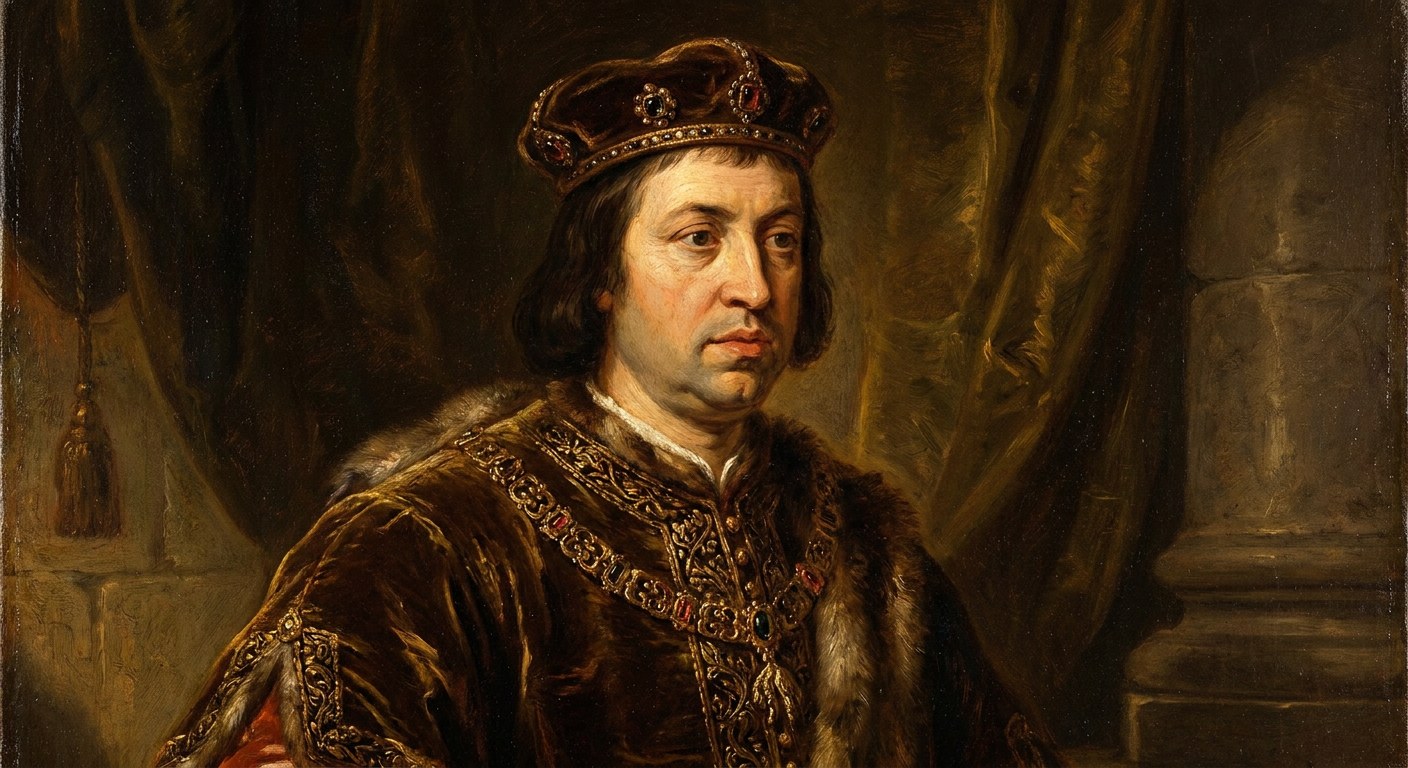
Ferdinand II of Aragon
1452 – 1516 · Aragonese · King & Statesman
Recommended Audiobooks
Listen next from Marcus Alden

Life Lessons from Frederic Chopin
Marcus Alden · 54 min

Life Lessons from John Wesley
Marcus Alden · 52 min
Introduction
Ferdinand II of Aragon (10 March 1452–23 January 1516), known to contemporaries as Fernando and to history as Ferdinand the Catholic, was one of the most consequential European monarchs of the late fifteenth and early sixteenth centuries. Through his marriage to Isabella I of Castile, he helped create a powerful dynastic partnership that brought the crowns of Castile and Aragon under joint rule. Their union did not establish a fully unified Spanish state, but it laid essential foundations for the emergence of Spain as a major European and global power.
Ferdinand was a pragmatic strategist, military organizer and skilled diplomatic operator. Alongside Isabella, he completed the conquest of the Nasrid kingdom of Granada in 1492, ending the last independent Muslim-ruled state on the Iberian Peninsula. The monarchs also supported Christopher Columbus’s Atlantic expedition, reorganized royal government, strengthened the authority of the Crown and expanded Spanish influence in Italy and North Africa. In 1496, Pope Alexander VI granted Ferdinand and Isabella the title “Catholic Monarchs.”
Their reign also had devastating consequences. The Spanish Inquisition became a powerful instrument for enforcing religious conformity. In 1492, the monarchs ordered practicing Jews to convert or leave their realms, while coercive policies toward Muslims eventually undermined the terms under which Granada had surrendered. These measures caused exile, persecution, forced conversion and enduring social trauma.
After Isabella’s death in 1504, Ferdinand continued to rule Aragon and sought to preserve influence in Castile. He defeated French ambitions in southern Italy, became king of Naples and conquered most of Navarre south of the Pyrenees. By the time of his death in 1516, he had helped transform the political balance of Europe and prepared the way for the vast composite monarchy inherited by his grandson Charles V.
Quick Facts
| Category | Details |
|---|---|
| Full name | Ferdinand of Trastámara |
| Common titles | Ferdinand II of Aragon; Ferdinand V of Castile; Ferdinand III of Naples; Ferdinand the Catholic |
| Born | 10 March 1452 |
| Birthplace | Palace of Sada, Sos, Kingdom of Aragon—now Sos del Rey Católico, Spain |
| Died | 23 January 1516 |
| Place of death | Madrigalejo, Extremadura, Crown of Castile |
| Burial place | Royal Chapel of Granada |
| Father | John II of Aragon |
| Mother | Juana Enríquez |
| Dynasty | House of Trastámara |
| Spouses | Isabella I of Castile; Germaine of Foix |
| Reign in Castile | 1474–1504, as king in right of Isabella |
| Reign in Aragon | 1479–1516 |
| Reign in Naples | 1504–1516 |
| Religion | Roman Catholicism |
| Best known for | Dynastic union with Castile, conquest of Granada, sponsorship of Columbus, expansion in Italy and Navarre |
| Principal heirs | His daughter Joanna of Castile and grandson Charles V |
| Papal title | “Catholic King,” granted with Isabella by Pope Alexander VI in 1496 |
Early Life & Background
Ferdinand was born on 10 March 1452 at Sos in the Kingdom of Aragon. His father, John II, was then king of Navarre through his first marriage to Blanche I of Navarre and later became king of Aragon in 1458. Ferdinand’s mother, Juana Enríquez, belonged to a powerful Castilian noble family. This background connected him to the ruling Trastámara dynasty and to influential aristocratic networks on both sides of the Castilian-Aragonese frontier.
The Crown of Aragon was not a single centralized kingdom. It was a composite monarchy including Aragon, Catalonia, Valencia, Majorca and Mediterranean possessions such as Sicily and Sardinia. Each territory retained its own laws, representative institutions, privileges and taxation systems. Ferdinand therefore grew up in a political culture where a monarch had to bargain with regional elites and respect established legal frameworks.
His youth unfolded during severe political instability. John II’s disputes in Navarre and Catalonia drew the family into civil conflict. Ferdinand’s elder half-brother, Charles, Prince of Viana, became the focus of opposition to John. After Charles’s death in 1461, tensions intensified, and the Catalan Civil War began in 1462.
In the same year, Ferdinand was recognized as his father’s heir in the Crown of Aragon. He acquired early experience in warfare, negotiation and the management of competing aristocratic factions. His mother worked energetically to secure his position but died in 1468. Ferdinand, still a teenager, inherited both significant opportunities and difficult obligations.
His education was suited to a Renaissance prince, although he was less celebrated for literary learning than Isabella. He became proficient in diplomacy, court politics and military affairs. He also learned that survival in a composite monarchy depended on flexibility: royal ambitions had to be pursued through institutions, marriage alliances and carefully calibrated concessions.
The most important choice of Ferdinand’s early life was his marriage to Isabella of Castile. Isabella, half-sister of King Henry IV of Castile, had emerged as a leading claimant to the Castilian succession. Ferdinand and Isabella were second cousins, so their marriage required papal dispensation. Questions later arose about the validity and procurement of the document presented at the time, but the match proceeded.
On 19 October 1469, Ferdinand and Isabella married at Valladolid. The marriage was both a personal partnership and a high-stakes political alliance. It joined the heirs of Aragon and Castile while alarming opponents in Castile, Portugal and France.
Rise to Prominence
Ferdinand’s position changed dramatically after Henry IV of Castile died on 11 December 1474. Isabella proclaimed herself queen of Castile at Segovia. Her claim was challenged by supporters of Henry’s daughter, Joanna of Castile, commonly called Joanna la Beltraneja, whose opponents alleged that she was not Henry’s biological child.
King Afonso V of Portugal, Joanna’s uncle, married her and invaded Castile in 1475. The resulting War of the Castilian Succession was simultaneously a civil conflict and an international struggle. Ferdinand played a major military and organizational role. The Battle of Toro on 1 March 1476 was tactically indecisive, but Isabella and Ferdinand successfully presented it as a political victory. Portuguese support for Joanna’s claim gradually weakened.
The Treaty of Alcáçovas, signed in 1479, ended the war. Portugal recognized Isabella and Ferdinand as rulers of Castile, while the Catholic Monarchs accepted Portuguese predominance in most Atlantic regions then under dispute. Castile retained the Canary Islands, a concession of great future importance.
Also in 1479, John II of Aragon died, and Ferdinand inherited the Crown of Aragon. Ferdinand and Isabella now governed the two largest Christian political groupings in Iberia. Their realms, however, did not merge into one centralized state. Castile and the territories of the Crown of Aragon continued to possess separate laws, courts, currencies, representative bodies and administrative traditions.
The couple’s governing relationship had been defined in the Concord of Segovia of 1475. Isabella remained Castile’s sovereign ruler, while Ferdinand exercised extensive authority as her husband and political partner. Royal documents commonly carried both names, and their emblematic motto, Tanto monta, expressed an ideal of coordinated rule.
Ferdinand became indispensable in diplomacy and war. Isabella held stronger legal authority in Castile, but Ferdinand’s political judgment, Mediterranean experience and understanding of international power helped turn their partnership into one of Europe’s most formidable monarchies.
Major Achievements
Consolidation of Royal Authority
Ferdinand and Isabella inherited a Castile troubled by aristocratic violence, disputed jurisdictions and weak royal finances. They did not destroy noble power, but they restored royal authority through administrative and judicial reforms.
The Santa Hermandad, or Holy Brotherhood, was established on a broad basis in 1476 as a league of towns that financed armed forces to suppress banditry and disorder. The monarchs strengthened the royal council, expanded the employment of legally trained officials and increased supervision of municipal government through royal representatives known as corregidores. They also recovered some Crown lands and revenues alienated during earlier reigns.
In Aragon, Ferdinand had to work within stronger constitutional restraints. He generally governed through the established institutions of each territory rather than attempting to impose Castilian practices. Following the Catalan Civil War, the Sentencia Arbitral de Guadalupe of 1486 addressed long-running disputes between Catalan peasants and feudal lords. It abolished several oppressive “bad customs” in exchange for payments, reducing rural tensions without eliminating the social hierarchy.
The Conquest of Granada
The conquest of Granada was the defining military achievement of the joint reign. The Nasrid emirate had survived for more than two centuries as the last Muslim-ruled state in Iberia, often paying tribute to Castile. Beginning in 1482, Ferdinand and Isabella launched a sustained campaign aided by internal divisions within the Nasrid dynasty.
Ferdinand oversaw much of the military planning, while Isabella helped organize supplies, finance and political support. The war involved sieges, artillery, negotiated capitulations and the gradual capture of strongholds. Málaga fell in 1487 after fierce resistance; Baza surrendered in 1489.
Granada itself capitulated on 2 January 1492. The final emir, Muhammad XII—known in Spanish tradition as Boabdil—handed over the Alhambra. The surrender terms promised Granada’s Muslims protection for their property, customs, religious practice and legal institutions.
The victory brought enormous prestige. It was celebrated throughout Christian Europe, particularly because it occurred as Ottoman power was expanding in the eastern Mediterranean. Yet the initial guarantees to Muslims did not endure. Increasing pressure to convert, particularly under Cardinal Francisco Jiménez de Cisneros, provoked resistance. By 1502, Muslims in Castile were ordered to accept baptism or leave, though practical barriers made departure difficult.
Atlantic Expansion
Ferdinand and Isabella approved Christopher Columbus’s westward voyage in 1492 after years of hesitation and negotiation. The Capitulations of Santa Fe, dated 17 April 1492, granted Columbus extensive titles and privileges should he succeed.
Columbus departed from Palos de la Frontera on 3 August and reached the Caribbean in October. His voyage initiated sustained contact between Europe and the Americas, opening the way for Spanish colonization and the construction of a transatlantic empire.
Ferdinand participated in the diplomatic management of the discoveries. Papal bulls issued in 1493 attempted to define Spanish rights, while the Treaty of Tordesillas of 1494 divided spheres of expansion between Castile and Portugal along an agreed Atlantic meridian.
The consequences were global. European power and commerce expanded across the Atlantic, while Indigenous societies suffered conquest, forced labor, disease, displacement and demographic catastrophe. Ferdinand did not design every later feature of colonial rule, but his government helped establish the institutions and claims from which the Spanish Empire developed.
Expansion in Italy
Ferdinand considered the western Mediterranean crucial to Aragonese security. France’s invasion of Italy in 1494 threatened Aragonese interests, particularly Naples. Ferdinand joined diplomatic coalitions against French expansion and relied upon the outstanding commander Gonzalo Fernández de Córdoba, known as the “Great Captain.”
Spanish forces defeated the French at Cerignola and the Garigliano in 1503. These victories demonstrated the effectiveness of infantry formations using firearms alongside pikes and helped establish Spanish military predominance in early modern Europe.
By 1504, Ferdinand controlled the Kingdom of Naples. His Italian policies strengthened Spanish influence but also drew the monarchy into prolonged European rivalry, especially with France.
Dynastic Diplomacy
Ferdinand and Isabella used the marriages of their children to build alliances. Their eldest daughter, Isabella, married first Afonso of Portugal and later King Manuel I. Their son John married Margaret of Austria. Joanna married Philip the Fair, son of the Habsburg emperor Maximilian I. Maria married Manuel I of Portugal after her sister’s death, and Catherine married Arthur, Prince of Wales, and later Henry VIII of England.
The early deaths of Prince John, Isabella of Portugal and Isabella’s son Miguel transformed the succession. Joanna became heir, and her marriage brought the Habsburg dynasty into the Spanish inheritance. This outcome eventually placed Spain, the Netherlands, Naples, Sicily and extensive American possessions under Joanna’s son Charles.
Defining Moments
The marriage at Valladolid in 1469 was the first decisive turning point in Ferdinand’s career. It made him a central participant in Castilian politics and created the partnership that would reshape Iberia.
The War of the Castilian Succession established his reputation as a commander and strategist. Although the Battle of Toro produced no unambiguous battlefield victor, Ferdinand and Isabella won the political struggle by holding Castile and securing recognition through diplomacy.
His accession to the Aragonese throne in 1479 created the dynastic association commonly regarded as the beginning of modern Spain. Ferdinand’s achievement was not administrative unification but coordinated monarchy: separate territories increasingly pursued common dynastic objectives under the same ruling family.
The fall of Granada in 1492 marked the culmination of centuries of Christian expansion in Iberia. That same year also brought the expulsion decree against Jews and Columbus’s first voyage. These events made 1492 a symbolic turning point, joining military triumph, religious coercion and overseas expansion.
Isabella’s death on 26 November 1504 created a new crisis. Under her will, Joanna inherited Castile, with Ferdinand expected to govern if Joanna was unable to rule effectively. Joanna’s husband, Philip the Fair, resisted Ferdinand’s continued authority. Ferdinand temporarily withdrew to Aragon after the Concord of Villafáfila in 1506, but Philip died unexpectedly that September. Ferdinand returned and governed Castile as regent from 1507 on behalf of Joanna.
Ferdinand’s final great territorial acquisition was Upper Navarre. In 1512, amid conflict with France and with papal support, his forces invaded the kingdom. Most of Navarre south of the Pyrenees was incorporated into Castile in 1515. The conquest increased strategic security but deprived the Albret dynasty of the greater part of its realm.
Timeline
| Year | Event |
|---|---|
| 1452 | Ferdinand is born at Sos in the Kingdom of Aragon on 10 March. |
| 1458 | His father becomes John II of Aragon. |
| 1461 | Death of Charles, Prince of Viana, strengthens Ferdinand’s position as heir. |
| 1462 | Ferdinand is recognized as heir to the Crown of Aragon; Catalan Civil War begins. |
| 1468 | His mother, Juana Enríquez, dies. |
| 1469 | Ferdinand marries Isabella of Castile at Valladolid on 19 October. |
| 1474 | Isabella proclaims herself queen of Castile after Henry IV’s death. |
| 1475 | Concord of Segovia defines the royal partnership; war with Portugal intensifies. |
| 1476 | Battle of Toro; broader organization of the Santa Hermandad. |
| 1479 | Treaty of Alcáçovas ends the succession war; Ferdinand becomes king of Aragon. |
| 1480 | The Castilian Inquisition begins operating in Seville. |
| 1482 | Major war against the Nasrid kingdom of Granada begins. |
| 1486 | Sentencia Arbitral de Guadalupe reforms peasant obligations in Catalonia. |
| 1487 | Málaga falls to the Catholic Monarchs. |
| 1489 | Baza surrenders during the Granada campaign. |
| 1492 | Granada surrenders; Jews are ordered to convert or leave; Columbus reaches the Caribbean. |
| 1494 | Treaty of Tordesillas divides overseas spheres between Castile and Portugal. |
| 1496 | Pope Alexander VI grants Ferdinand and Isabella the title “Catholic Monarchs.” |
| 1497 | Ferdinand’s only son, John, dies. |
| 1502 | Muslims in Castile are ordered to convert or depart. |
| 1503 | Spanish forces defeat France at Cerignola and the Garigliano. |
| 1504 | Isabella dies; Joanna succeeds in Castile; Ferdinand secures Naples. |
| 1505 | Ferdinand marries Germaine of Foix. |
| 1506 | Philip the Fair briefly assumes power in Castile but dies in September. |
| 1507 | Ferdinand returns as regent of Castile for Joanna. |
| 1508 | Spanish forces take the Peñón de Vélez de la Gomera in North Africa. |
| 1509 | Oran is captured during campaigns directed by Cardinal Cisneros. |
| 1512 | Ferdinand’s forces invade and occupy most of Navarre. |
| 1515 | Upper Navarre is formally incorporated into the Crown of Castile. |
| 1516 | Ferdinand dies at Madrigalejo on 23 January. |
Personal Life
Ferdinand’s marriage to Isabella was political in origin but developed into an unusually effective royal partnership. The surviving correspondence and accounts of their government suggest mutual trust, though their relationship was not free from strain. Ferdinand had extramarital relationships and fathered several illegitimate children, including Alonso de Aragón, who became archbishop of Zaragoza.
Ferdinand and Isabella had five children who survived infancy:
- Isabella of Aragon, later queen consort of Portugal
- John, Prince of Asturias
- Joanna, later queen of Castile and Aragon
- Maria of Aragon, queen consort of Portugal
- Catherine of Aragon, queen consort of England
Their family experienced repeated tragedy. Prince John died in 1497, less than a year after marrying Margaret of Austria. Their daughter Isabella died in 1498, and her infant son Miguel died in 1500. These deaths made Joanna the dynastic heir.
Joanna’s mental and emotional condition remains debated. Contemporaries described periods of severe instability, while modern historians caution that political opponents—including Ferdinand, Philip and later Charles—benefited from declaring her incapable. Ferdinand confined Joanna at Tordesillas from 1509, formally governing in her name.
In October 1505, Ferdinand married Germaine of Foix, a French princess related to King Louis XII. The marriage formed part of a diplomatic settlement with France and offered Ferdinand the possibility of producing a male heir to the Aragonese realms. Their son, John, was born in 1509 but died within hours. Had he survived, the crowns of Aragon and Castile might have been separated.
Ferdinand died at Madrigalejo on 23 January 1516, reportedly after a period of declining health. He was buried beside Isabella in the Royal Chapel of Granada. His daughter Joanna formally inherited his crowns, but effective power passed to his grandson Charles.
Beliefs & Philosophy
Ferdinand’s governing philosophy combined dynastic ambition, political pragmatism and militant Catholicism. He believed that a monarch should defend the faith, maintain public order, secure justice and increase the power and reputation of the dynasty.
His religiosity was genuine, but religion and statecraft were inseparable in his policies. The conquest of Granada was both a territorial war and a Christian crusade. Ferdinand secured papal support, ecclesiastical revenues and spiritual privileges for participants. His campaigns in North Africa were similarly presented as efforts to defend Christianity and restrain Muslim maritime power.
Ferdinand also sought greater royal influence over the Church. He and Isabella obtained important rights of patronage, particularly in Granada and overseas territories. These arrangements enabled the Crown to influence appointments and organize missionary institutions.
His style was cautious and opportunistic. He preferred alliances, marriages, legal claims and negotiation when these served his objectives, but he was prepared to use war when conditions were favorable. Niccolò Machiavelli treated Ferdinand as a striking example of a ruler who maintained prestige through ambitious undertakings and the skillful presentation of policy.
Ferdinand was not a nationalist in the modern sense. His loyalty was dynastic, religious and territorial. He governed a collection of distinct realms and aimed to preserve their obedience to his house rather than to create a uniform nation-state.
Challenges & Controversies
The most serious criticisms of Ferdinand’s reign concern religious persecution. The Spanish Inquisition was established with papal authorization in 1478 and began operating soon afterward. Unlike the medieval Inquisition, it was closely tied to royal power. Its original focus was on baptized Christians suspected of secretly practicing Judaism.
Under Tomás de Torquemada, appointed inquisitor general in 1483, tribunals used imprisonment, confiscation, public penance and execution. Procedures varied, but secret testimony and coercive interrogation created opportunities for abuse. The Inquisition strengthened religious conformity while generating fear and enriching both institutions and accusers through confiscation.
The Alhambra Decree of 31 March 1492 ordered practicing Jews in Castile and Aragon to accept baptism or depart by the end of July. Estimates of the numbers who left or converted vary considerably, but the disruption was immense. Exiles settled in Portugal, North Africa, Italy, the Ottoman Empire and elsewhere, contributing to the Sephardic diaspora.
Policy toward Muslims followed a similar progression from tolerated difference to coerced conformity. The capitulation of Granada had guaranteed Islamic worship and custom. Those protections were gradually eroded. Forced or pressured conversions and the suppression of revolt led to the creation of a large population of nominally Christian Moriscos whose loyalty would remain a subject of suspicion.
Ferdinand’s treatment of Joanna is another major controversy. Her confinement was justified as necessary because of her incapacity, yet it also enabled Ferdinand to control Castile. The available evidence does not permit a simple retrospective diagnosis. Political manipulation and genuine illness were not mutually exclusive.
His diplomacy could be ruthless. Alliances were adjusted according to strategic advantage, especially during the Italian Wars. Machiavelli admired Ferdinand’s capacity to undertake bold enterprises but also viewed his public religiosity and political maneuvering as instruments of power.
The invasion of Navarre in 1512 relied on disputed legal and religious justifications. Ferdinand portrayed the campaign as necessary because Navarre’s rulers were aligned with France and allegedly implicated in opposition to the pope. For Navarrese loyalists, it was a foreign conquest.
His overseas legacy is equally complex. The Atlantic enterprises approved during his reign initiated enduring exchanges of crops, animals, technologies and peoples. They also opened the way to imperial conquest, enslavement, coerced labor and catastrophic Indigenous population decline.
Famous Quotes
Few statements attributed to Ferdinand can be verified as spontaneous personal remarks. Some famous phrases associated with him are mottos or later reports rather than securely documented quotations.
“Tanto monta.”
“Thus it amounts to the same,” or “It makes no difference,” was Ferdinand’s personal motto. It referred to Alexander the Great’s solution to the Gordian knot: whether untied or cut, the result was the same. The longer expression Tanto monta, monta tanto, Isabel como Fernando is a later popular formulation and was not the couple’s official joint motto.
“The king fights for his country, the queen for her children.”
This sentiment is traditionally associated with the Granada War, but its exact wording and provenance are uncertain. It should be treated as an attribution rather than a securely documented verbatim statement.
“He has always made religion the pretext of his enterprises.”
This is not Ferdinand speaking, but Machiavelli’s celebrated assessment of him in The Prince. It captures Ferdinand’s reputation for combining religious objectives with calculated statecraft.
Legacy & Influence
Ferdinand’s most enduring political legacy was the dynastic association of Castile and Aragon. He did not create a centralized Spanish nation-state, and the component territories retained separate constitutions for centuries. Nevertheless, the common monarchy made coordinated foreign policy, military expansion and dynastic succession possible on an unprecedented scale.
He helped shift Iberian power toward international and imperial horizons. In the Mediterranean, Spanish victories in Italy established control over Naples and created the military reputation that Spain would carry through much of the sixteenth century. In the Atlantic, the voyages initiated under Ferdinand and Isabella became the foundation of a vast colonial empire.
Ferdinand also influenced the development of monarchy. His reign strengthened professional councils, royal justice, fiscal administration and diplomatic representation. Permanent ambassadors and complex alliance systems became increasingly important tools of European politics. His combination of legality, negotiation, propaganda and force anticipated methods associated with the early modern state.
His dynastic strategy produced results beyond anything he could have directly planned. His grandson Charles inherited Castile, Aragon, the Burgundian Netherlands, Naples, Sicily, Sardinia and American claims, and later became Holy Roman Emperor Charles V. Another grandson, Ferdinand, became Holy Roman Emperor Ferdinand I. Through Catherine of Aragon, Ferdinand was grandfather to Mary I of England.
Yet his reputation cannot be separated from coercion. Jewish expulsion, inquisitorial persecution and forced religious assimilation inflicted profound suffering and reduced the pluralism that had characterized medieval Iberia. Later ideals of Catholic unity were achieved through exclusion as well as political integration.
Assessments of Ferdinand have therefore varied. Earlier nationalist histories often celebrated him as a founder of Spanish unity. Some political writers admired his realism and diplomatic skill. Modern scholarship more often emphasizes the composite nature of his monarchy and the human costs of confessional rule and imperial expansion.
Ferdinand was neither simply the architect of modern Spain nor merely a cynical manipulator. He was a ruler formed by civil war, dynastic competition and crusading ideology. His ability to exploit opportunities made him one of Europe’s most successful monarchs, while the institutions and policies he supported left a legacy that was both globally transformative and deeply destructive.
Interesting Facts
- Ferdinand was styled Ferdinand V in Castile but Ferdinand II in Aragon.
- As ruler of Naples, he was Ferdinand III, although numbering conventions can vary by territory.
- His birthplace is now called Sos del Rey Católico in recognition of him.
- Ferdinand and Isabella’s shared heraldry used a yoke and a bundle of arrows, devices linked to their initials in Spanish.
- The motto Tanto monta originally referred to the Gordian knot, not to the equality of Ferdinand and Isabella.
- Ferdinand’s Crown of Aragon included several distinct territories with their own laws and representative institutions.
- His marriage to Isabella took place without the approval of her half-brother, Henry IV of Castile.
- The Battle of Toro was militarily inconclusive but became a major propaganda success for Ferdinand and Isabella.
- Ferdinand survived an assassination attempt in Barcelona in 1492 when a man named Joan de Canyamars attacked him with a sword.
- Gonzalo Fernández de Córdoba’s victories in Italy helped make Spanish infantry a dominant European military force.
- Ferdinand’s second marriage could have separated Aragon from Castile if his infant son had survived.
- His grandson Charles reached Spain in 1517, more than a year after Ferdinand’s death.
- Ferdinand and Isabella are buried in Granada, the city whose conquest became the supreme symbol of their reign.
- Although Joanna inherited the crowns, her father, husband and son all exercised power in her name at different times.
Frequently Asked Questions
Why is Ferdinand called Ferdinand II of Aragon but Ferdinand V of Castile?
Regnal numbers were calculated separately in each kingdom. He was the second Aragonese king named Ferdinand but the fifth king of that name recognized in Castilian numbering. In Naples, he was generally styled Ferdinand III.
Did Ferdinand and Isabella unite Spain?
They united the crowns dynastically, not institutionally. Castile, Aragon, Catalonia, Valencia and other territories retained separate laws, governments, taxation systems and representative bodies. Their marriage laid foundations for Spain’s later political development, but it did not create a centralized modern state.
Who had more power, Ferdinand or Isabella?
In Castile, Isabella was the sovereign queen in her own right, while Ferdinand ruled as her husband and partner. In the Crown of Aragon, Ferdinand was the hereditary sovereign. Their practical relationship was collaborative, though their legal authority differed by territory.
What role did Ferdinand play in Columbus’s voyage?
Ferdinand participated with Isabella in approving and supporting Columbus’s expedition. The project belonged primarily to the Crown of Castile because the Atlantic voyage sailed under Castilian authority. Ferdinand was especially important in the diplomatic negotiations that followed, including relations with Portugal.
Why did Ferdinand and Isabella expel the Jews?
The monarchs and inquisitors argued that practicing Jews encouraged baptized converts to return to Judaism. The expulsion decree sought religious uniformity by separating Jewish communities from Christians. Its rationale reflected intense confessional intolerance and resulted in dispossession, exile and forced conversion.
Was Ferdinand responsible for the Spanish Inquisition?
Ferdinand and Isabella jointly requested papal authorization for an inquisition under royal control. Pope Sixtus IV issued the authorizing bull in 1478. Ferdinand strongly supported the institution, which later operated across much of the monarchy.
What happened after Isabella died?
Their daughter Joanna inherited Castile in 1504. Ferdinand initially remained involved as governor, but Joanna’s husband, Philip the Fair, challenged him. After Philip’s death in 1506, Ferdinand returned to govern Castile as regent for Joanna.
Why did Ferdinand marry Germaine of Foix?
The marriage helped establish peace with France and offered the possibility of a new male heir for Aragon. Their only son died shortly after birth, so Ferdinand’s crowns ultimately passed through Joanna to Charles.
How did Ferdinand acquire Navarre?
In 1512, Ferdinand invaded Navarre while its rulers were aligned with France. His forces occupied most of the kingdom south of the Pyrenees. This territory was incorporated into Castile in 1515, while the Albret dynasty retained lands north of the mountains.
How did Ferdinand die?
Ferdinand died on 23 January 1516 at Madrigalejo in Extremadura after a period of illness. Claims that his health was damaged by supposed fertility treatments are often repeated but cannot be established with certainty.
Lessons from Ferdinand II of Aragon
- Political partnerships can transform history: Ferdinand’s marriage to Isabella created possibilities neither ruler could have achieved independently.
- Institutions matter as much as battles: Councils, courts, taxation and local administration helped make royal power durable.
- A tactical stalemate can become a strategic victory: Ferdinand’s handling of the Battle of Toro illustrates the importance of diplomacy and political communication.
- Composite states require negotiation: He ruled different territories by adapting to their laws rather than imposing complete uniformity.
- Dynastic planning can produce unexpected outcomes: Ferdinand’s marriage alliances eventually placed a vast inheritance in Habsburg hands.
- Military success carries long-term obligations: Conquests in Granada, Italy and Navarre expanded royal power but created enduring political and social tensions.
- Religious certainty can enable persecution: The pursuit of confessional unity inflicted lasting harm on Jewish, Muslim and convert communities.
- Propaganda shapes historical memory: Titles, emblems, ceremonies and chronicles helped turn disputed victories into symbols of legitimacy.
- Pragmatism can bring success but damage trust: Ferdinand’s shifting alliances made him effective, yet also earned him a reputation for calculation.
- Historical achievement must be assessed alongside human cost: State-building and imperial expansion cannot be separated from exile, coercion and conquest.
Further Reading
- John Edwards, Ferdinand and Isabella
- J. H. Elliott, Imperial Spain, 1469–1716
- Henry Kamen, Spain, 1469–1714: A Society of Conflict
- Peggy K. Liss, Isabel the Queen: Life and Times
- Joseph F. O’Callaghan, A History of Medieval Spain
- Teofilo F. Ruiz, Spain’s Centuries of Crisis, 1300–1474
- David Abulafia, The Western Mediterranean Kingdoms, 1200–1500
- Geoffrey Parker, Emperor: A New Life of Charles V
- Bethany Aram, Juana the Mad: Sovereignty and Dynasty in Renaissance Europe
- Niccolò Machiavelli, The Prince, especially Chapter XXI
- Antonio Feros, Speaking of Spain: The Evolution of Race and Nation in the Hispanic World
- Geoffrey Symcox and Blair Sullivan, eds., Christopher Columbus and the Enterprise of the Indies