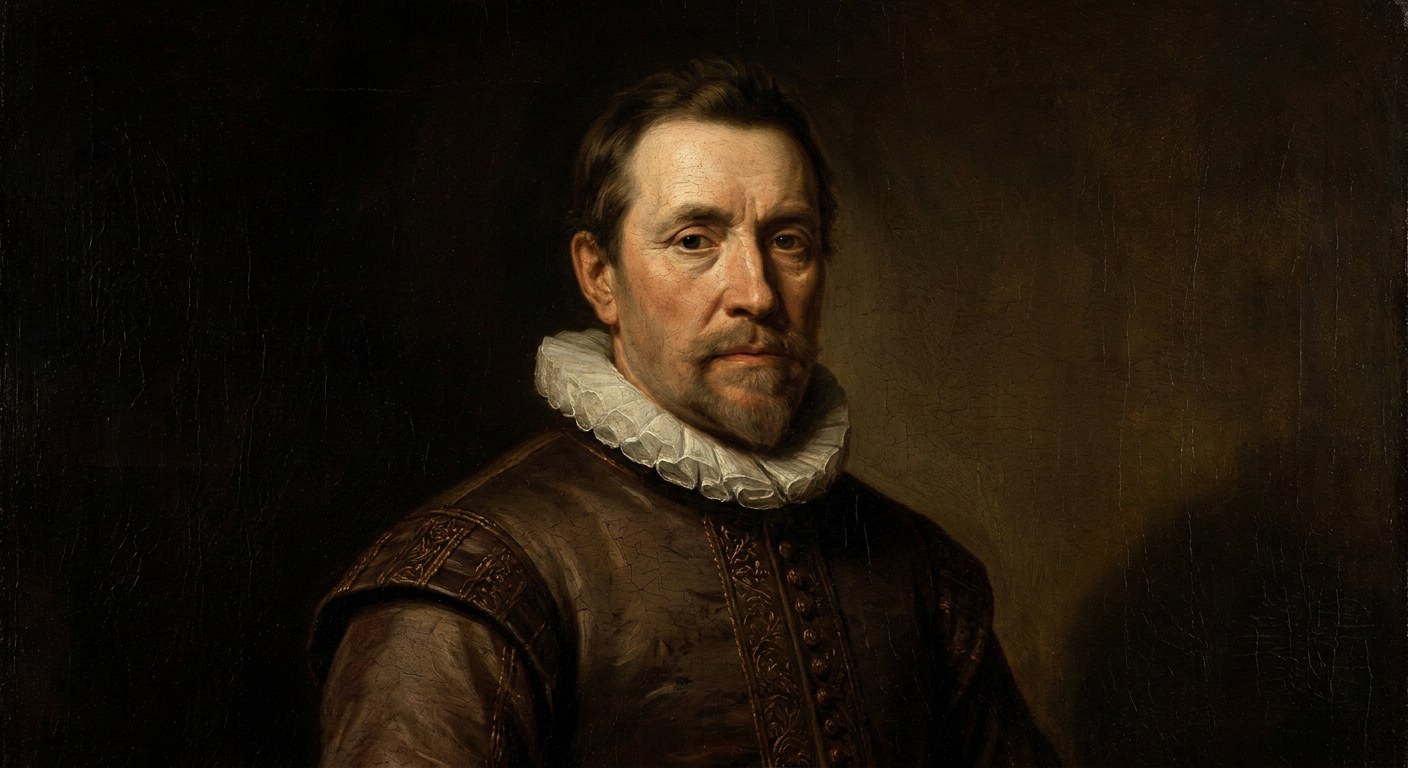
Francis Bacon
1561 – 1626 · English · Philosopher & Statesman
Recommended Audiobooks
Listen next from Marcus Alden

Life Lessons from Frederic Chopin
Marcus Alden · 54 min

Life Lessons from John Wesley
Marcus Alden · 52 min
Introduction
Francis Bacon, 1st Viscount St Alban (1561–1626), was an English philosopher, essayist, lawyer, parliamentarian, and royal minister whose writings helped transform European ideas about knowledge. He is best known for advocating a systematic, cooperative, and evidence-based investigation of nature. Instead of beginning with inherited doctrines and forcing observations to fit them, Bacon urged investigators to collect facts, conduct experiments, compare cases, eliminate false explanations, and advance cautiously toward broader principles.
Bacon did not invent experimentation, nor did he formulate the modern scientific method in its finished form. Medieval scholars, Renaissance naturalists, physicians, artisans, and Bacon's contemporaries had already made important use of observation and experiment. His historic importance lies chiefly in the power and scope of his program. He presented the study of nature as a collective enterprise capable of producing useful discoveries, improving human life, and expanding society's command over natural processes. This vision influenced scientific institutions and became one of the intellectual foundations of the Scientific Revolution.
Bacon was also a major prose stylist and a central figure in the political life of Jacobean England. Under King James I, he rose from parliamentarian and royal legal adviser to attorney general, lord keeper of the Great Seal, and lord chancellor. In 1621, however, his political career ended dramatically when Parliament convicted him of accepting gifts from litigants. The scandal left a permanent mark on his reputation, even though historians continue to debate how his conduct should be understood within the gift-giving culture of early modern government.
His essays remain widely read for their compressed observations about ambition, truth, friendship, revenge, education, and power. His philosophical works—including The Advancement of Learning, Novum Organum, and New Atlantis—helped establish research, experiment, and practical discovery as central ideals of modern intellectual life. Bacon matters not because every scientific proposal he made proved correct, but because he offered an influential answer to a fundamental question: how can human beings organize inquiry so that knowledge grows?
Quick Facts
| Category | Details |
|---|---|
| Born | 22 January 1561, York House, London, England |
| Died | 9 April 1626, Highgate, near London, England |
| Nationality | English |
| Known For | Baconian method, empiricism, philosophy of science, essays, political office |
| Occupation | Philosopher, lawyer, statesman, essayist, parliamentarian |
| Era | English Renaissance and Scientific Revolution |
Early Life and Education
Francis Bacon was born on 22 January 1561 at York House on the Strand in London. He came from a prominent family closely connected to Tudor government. His father, Sir Nicholas Bacon, served Queen Elizabeth I as lord keeper of the Great Seal. His mother, Anne Cooke Bacon, was exceptionally well educated, knew Greek and Latin, translated religious works, and belonged to a distinguished humanist family. Her sister Mildred married William Cecil, Lord Burghley, Elizabeth's most powerful minister. Francis therefore grew up within England's political and intellectual elite.
Bacon was the younger son of Sir Nicholas and Anne. The household in which he was raised combined Protestant devotion, classical scholarship, legal training, and practical statecraft. Poor health affected him at various points in his life, and his early education probably took place largely at home under tutors.
In April 1573, at only twelve years old, Bacon entered Trinity College, Cambridge, together with his elder brother Anthony. The brothers resided in the household of John Whitgift, later archbishop of Canterbury. Cambridge education remained heavily based on Aristotle, scholastic logic, disputation, and the authoritative interpretation of established texts. Bacon later criticized this educational culture for producing arguments rather than discoveries. His dissatisfaction should not be reduced to a simple rejection of Aristotle: Bacon respected the power of ancient learning but believed that excessive reverence for authority had discouraged the direct investigation of nature.
After leaving Cambridge in 1575, Bacon and Anthony entered Gray's Inn, one of London's Inns of Court, where Francis studied law. In 1576, he traveled to France as part of the household of Sir Amias Paulet, the English ambassador. He spent time in Paris and may also have visited other French cities. The experience introduced him to diplomacy, court politics, foreign government, and the religious tensions of continental Europe.
Bacon's stay abroad ended abruptly after his father died in February 1579. Because Sir Nicholas had not completed the financial arrangements he intended for his youngest son, Francis inherited much less than he had expected. He returned to England and resumed legal training at Gray's Inn. The need for income, combined with a strong desire for public service and distinction, shaped much of his subsequent career. He was called to the bar in 1582 and became a bencher of Gray's Inn in 1586.
Rise to Prominence
Bacon entered the House of Commons in 1581 as member for Bossiney in Cornwall. Over the following decades, he represented several constituencies and became an experienced parliamentary speaker and committee member. He addressed legal reform, religious policy, taxation, relations between Crown and Parliament, and the union of England and Scotland.
Although his family connections were impressive, advancement under Elizabeth I came slowly. Bacon sought support from his powerful uncle, Lord Burghley, and later from Burghley's son Robert Cecil. He repeatedly requested government office, arguing that public employment would allow him to serve both the Crown and the advancement of learning. Elizabeth and her ministers, however, did not give him the high position he desired.
During the 1590s, Bacon became associated with Robert Devereux, 2nd Earl of Essex, a charismatic royal favorite. Essex supported Bacon financially and promoted his claims to office. Their alliance nevertheless became strained as Essex lost the queen's confidence. Bacon advised him to withdraw from confrontational politics, but Essex ignored such warnings. After Essex's failed rebellion in London in February 1601, Bacon participated as one of the Crown's lawyers in the proceedings against him. He also helped prepare an official account justifying the government's actions. Essex was convicted of treason and executed.
Bacon's role in the prosecution has often been viewed as evidence of ingratitude toward a former patron. Bacon defended himself by maintaining that loyalty to the queen and the state took priority over private obligation. The episode illustrates the tension between personal loyalty and public ambition that recurred throughout his career.
The accession of James VI of Scotland as James I of England in 1603 improved Bacon's prospects. He was knighted that year and cultivated the new king through writings on government, religious peace, and the proposed union of England and Scotland. In 1604, he became one of the king's learned counsel. He was appointed solicitor general in 1607, attorney general in 1613, and a member of the Privy Council in 1616.
Bacon's legal and political influence continued to grow. In 1617 he became lord keeper of the Great Seal, the office once held by his father. In January 1618 he was appointed lord chancellor, one of the highest offices in the kingdom, and was created Baron Verulam. In 1621 he became Viscount St Alban. His rise appeared to complete a lifelong quest for public authority—but within months, it collapsed.
Major Achievements and Contributions
Bacon's greatest intellectual achievement was his ambitious plan for the renewal of knowledge, which he called the Great Instauration. He believed that the inherited sciences had become stagnant because scholars relied too heavily on ancient books, abstract argument, and premature generalization. Genuine progress required a new method, a new organization of research, and extensive collections of reliable observations.
The approach associated with Bacon is often described as inductive. In simplified form, induction moves from particular observations toward general conclusions. Bacon's actual method was more elaborate. He opposed the practice of gathering a few examples and immediately leaping to sweeping theories. Investigators should instead construct organized tables of instances, compare situations in which a phenomenon appears or is absent, examine variations in degree, and exclude inadequate explanations. Knowledge would rise gradually from carefully tested particulars to increasingly general axioms.
Bacon also analyzed systematic errors in human thinking. He called these errors the “idols” of the mind. The Idols of the Tribe arise from tendencies common to humanity, such as perceiving more order in nature than evidence warrants. The Idols of the Cave result from each person's education, temperament, and habits. The Idols of the Marketplace grow from misleading language and confused definitions. The Idols of the Theatre come from philosophical systems accepted like staged dramas rather than demonstrated accounts of reality. This classification anticipated later concern with cognitive bias, linguistic confusion, and the social sources of error.
A second major contribution was Bacon's vision of science as cooperative and institutional. He understood that no single investigator could collect all the observations required for a comprehensive natural history. Progress depended on coordinated labor, specialized roles, instruments, communication, and public support. In New Atlantis, the fictional institution called Salomon's House organizes experiments and gathers knowledge for the benefit of society. Later admirers saw this as a prophetic image of the research institute or scientific academy.
Bacon consistently associated knowledge with practical power. Learning should not exist merely for prestige or verbal victory. It should relieve suffering, improve medicine and agriculture, develop useful technologies, and enlarge the range of responsible human action. His outlook encouraged the view that scientific discovery could promote material and social improvement.
His contributions were not limited to philosophy. Bacon's Essays helped establish him as one of the finest writers of English prose. Their compact, balanced sentences and memorable aphorisms examine the motives and behavior of people involved in public and private life. He also wrote on legal reform, English history, classical mythology, politics, religion, and education.
As a statesman, Bacon supported measures to rationalize English law and improve government administration. His political conduct did not always match his ideals, and many of his proposals remained unrealized, but he brought unusual intellectual range to questions of policy and jurisprudence.
Key Works / Battles / Ideas
Essays
Bacon first published ten essays in 1597. An expanded edition containing thirty-eight appeared in 1612, and a final edition of fifty-eight essays was issued in 1625. Subjects include truth, death, revenge, adversity, marriage, friendship, ambition, studies, travel, negotiation, and empire. Their style is concise and densely allusive, blending classical references with practical observations drawn from court and political life.
The Advancement of Learning
Published in English in 1605, The Advancement of Learning surveyed the state of human knowledge and identified fields requiring further investigation. Bacon defended learning against charges that it encouraged irreligion, idleness, or political impracticality. He classified branches of knowledge according to the mental faculties of memory, imagination, and reason, corresponding broadly to history, poetry, and philosophy. A greatly expanded Latin version, De Augmentis Scientiarum, appeared in 1623.
Novum Organum
Published in 1620, Novum Organum, or the “New Instrument,” was Bacon's most important statement of method. Its title challenged Aristotle's logical writings, traditionally known as the Organon. Bacon set out his critique of existing philosophy, his doctrine of the four idols, and his program of disciplined induction. The work formed part of the unfinished Great Instauration.
Bacon's procedure was not the same as the modern cycle of hypothesis, mathematical prediction, experiment, and peer review. He underestimated the importance that bold hypotheses and mathematics would have in the emerging physical sciences. Nevertheless, his insistence on organized evidence, repeatable inquiry, and resistance to premature theory proved deeply influential.
The Great Instauration
The Instauratio Magna, or Great Instauration, was intended as a six-part reconstruction of the sciences. Bacon planned a comprehensive classification of knowledge, a new investigative method, a vast natural and experimental history, examples of the method in operation, provisional discoveries, and a completed philosophy of nature. Only portions were finished. The project's incompleteness reflects both its extraordinary scale and Bacon's struggle to combine political responsibilities with scholarship.
New Atlantis
Published posthumously in 1626, New Atlantis describes the fictional island of Bensalem. Its central institution, Salomon's House, employs organized teams to study nature, conduct experiments, make instruments, test medicines, and develop inventions. The work combines utopian fiction, religious themes, imperial assumptions, and a vision of publicly supported research. It became one of the most influential literary depictions of scientific organization.
History of the Reign of King Henry VII
Written after Bacon's fall and published in 1622, this history examined the reign of Henry VII as a study in statecraft, dynastic security, finance, law, and royal authority. Although shaped by Bacon's political concerns and access to limited sources, it was an important contribution to English historical prose.
Natural Histories and Experiments
Bacon attempted to assemble empirical material in works such as Historia Ventorum (History of Winds), Historia Vitae et Mortis (History of Life and Death), and Sylva Sylvarum, published after his death. The observations vary greatly in reliability, and some repeat hearsay or traditional beliefs. These weaknesses demonstrate the distance between Bacon's methodological ideals and the evidentiary standards later science developed.
Timeline of Key Events
| Year | Event |
|---|---|
| 1561 | Born at York House in London on 22 January |
| 1573 | Entered Trinity College, Cambridge, with his brother Anthony |
| 1576 | Entered Gray's Inn and traveled to France with Ambassador Sir Amias Paulet |
| 1579 | Returned to England after the death of his father, Sir Nicholas Bacon |
| 1581 | Entered the House of Commons as member for Bossiney |
| 1582 | Called to the bar as a barrister |
| 1597 | Published the first edition of his Essays |
| 1601 | Took part in the prosecution of his former patron, the Earl of Essex |
| 1603 | Knighted after the accession of James I |
| 1605 | Published The Advancement of Learning |
| 1606 | Married Alice Barnham |
| 1607 | Appointed solicitor general |
| 1612 | Published an expanded edition of the Essays |
| 1613 | Appointed attorney general |
| 1616 | Joined the Privy Council |
| 1617 | Appointed lord keeper of the Great Seal |
| 1618 | Became lord chancellor and Baron Verulam |
| 1620 | Published Novum Organum as part of the Great Instauration |
| 1621 | Created Viscount St Alban; impeached and convicted for accepting gifts |
| 1622 | Published History of the Reign of King Henry VII |
| 1623 | Published De Augmentis Scientiarum |
| 1625 | Published the final and largest edition of his Essays |
| 1626 | Died at Highgate on 9 April; New Atlantis appeared posthumously that year |
Personal Life and Character
Bacon married Alice Barnham on 10 May 1606. She was the young daughter of Benedict Barnham, a wealthy London merchant and alderman. The marriage produced no children. Bacon made elaborate financial arrangements for Alice, but their relationship deteriorated in his final years. Shortly before his death, he altered his will and revoked provisions previously made for her, apparently after a serious estrangement.
His closest early personal and intellectual relationship was with his brother Anthony Bacon, who acted as a foreign intelligence correspondent and political intermediary. Their surviving papers illuminate Francis's ambitions, debts, political calculations, and dependence on networks of patronage.
Contemporaries recognized Bacon's extraordinary intelligence, eloquence, learning, and capacity for work. He could analyze complex legal and political problems with unusual breadth. His ceremonial tastes, expensive household, and desire to maintain the appearance expected of a great officer also contributed to chronic financial difficulties. He borrowed repeatedly and was sometimes pursued by creditors.
Bacon was intensely ambitious. He believed that he possessed both a public vocation in government and an intellectual mission to reform knowledge. Admirers regard this self-confidence as visionary; critics see opportunism and vanity. Both judgments capture aspects of a complicated personality. He could advocate impartial inquiry while navigating a court culture based on favoritism. He praised public service yet aggressively sought status. He valued friendship but placed loyalty to the Crown—and often his own advancement—above private ties.
Some modern writers have debated Bacon's sexuality, drawing on hostile contemporary remarks and ambiguous evidence. The sources do not permit confident conclusions about his private sexual life. Responsible biography distinguishes such speculation from established facts.
Challenges and Controversies
The defining controversy of Bacon's life was his fall from the lord chancellorship in 1621. A Parliament already hostile to royal monopolies and official corruption received complaints from litigants who said they had given Bacon money or valuables while their cases were before him. An investigation produced numerous accusations of accepting gifts.
Bacon submitted to the judgment of the House of Lords and acknowledged that he had received presents from parties involved in litigation. He described himself as guilty of corruption and renounced attempts at a detailed defense. The Lords fined him £40,000, ordered him imprisoned in the Tower of London during the king's pleasure, barred him from holding public office, and prohibited him from sitting in Parliament or coming within the verge of the royal court.
His imprisonment lasted only a few days, and the enormous fine was effectively remitted by the king. Even so, his public career was over. Bacon maintained that although he had accepted gifts—an entrenched practice within the patronage culture of the period—he had not allowed them to alter his judgments. Historians have disagreed over whether the prosecution singled him out as a political sacrifice or exposed genuinely corrupt behavior. The safest conclusion is that gift-taking was common but still ethically and legally dangerous, and that Bacon's position as the chief judicial officer made his conduct particularly serious.
His treatment of Essex remains another major controversy. Bacon owed Essex financial and political support, yet assisted the government in prosecuting him. Political loyalty to the monarch was a compelling obligation in Tudor England, especially after an armed rising. Nevertheless, Bacon's prominent role in presenting the case against his former benefactor damaged his reputation for personal loyalty.
Bacon's intellectual legacy has also attracted exaggeration. Descriptions of him as the sole inventor of the scientific method ignore earlier experimental traditions and the work of contemporaries such as Galileo Galilei, William Gilbert, and Johannes Kepler. Bacon performed no body of scientific work comparable to theirs, and several of his own empirical claims were mistaken. He did not fully appreciate the decisive role of mathematics in physics.
An enduring fringe theory claims that Bacon wrote the plays attributed to William Shakespeare. The theory emerged long after both men's deaths and has not won acceptance among mainstream literary historians. Documentary, linguistic, and historical evidence supports Shakespeare of Stratford-upon-Avon as the author. Bacon's own extensive writings also differ markedly in genre, style, and purpose from Shakespeare's dramatic works.
Death and Immediate Aftermath
In late March or early April 1626, Bacon traveled through the area around Highgate, north of London. According to John Aubrey's later account, Bacon was considering whether cold could preserve flesh. He obtained a fowl and helped pack it with snow. During or after this activity, he became severely chilled and ill, probably with pneumonia.
Unable to return home, Bacon took shelter at the nearby residence of Thomas Howard, Earl of Arundel. The house and bedding were reportedly cold and damp. Bacon died there on 9 April 1626 at the age of sixty-five. A letter traditionally associated with his final illness states that the preservation experiment had succeeded “excellently well,” though the exact circumstances are known through accounts written or transmitted after the event.
He was buried in the Church of St Michael in St Albans, near his estate at Gorhambury. His secretary and chaplain, William Rawley, became an important guardian of his literary reputation. Rawley edited and published several posthumous works, including New Atlantis and Sylva Sylvarum, and wrote an early biography.
Bacon died disgraced as a politician but still convinced of his intellectual mission. His removal from office gave him time to write, revise, translate, and organize his works. The final years therefore produced several important contributions to the reputation that survived his political downfall.
Legacy and Influence Today
Bacon's influence grew substantially after his death. Seventeenth-century advocates of experimental natural philosophy adopted him as a champion of observation, useful knowledge, and collective research. Members of the Royal Society of London, founded in 1660, frequently treated his program as an intellectual precedent. Its early historians portrayed the society's experimental work as fulfilling a Baconian vision, although its practices also drew on many other traditions.
The eighteenth-century Enlightenment further elevated Bacon. Denis Diderot and Jean le Rond d'Alembert acknowledged his influence on the organization of knowledge in the French Encyclopédie. Philosophers and reformers admired his attack on blind authority and his confidence that disciplined inquiry could improve society.
Bacon became strongly associated with empiricism, the broad view that knowledge depends on experience. Later British empiricists such as John Locke and David Hume developed theories very different from Bacon's, so he should not be treated as the straightforward founder of their philosophy. Yet his emphasis on experience, observation, and correction helped shape the intellectual environment in which empiricism flourished.
Modern science does not operate by a single Baconian formula. Scientists use hypotheses, mathematical models, simulations, statistical inference, controlled experiments, field observations, and many other methods. Even so, recognizably Baconian principles remain important: distrust unsupported authority, document observations, search for negative cases, expose conclusions to testing, collaborate across generations, and treat knowledge as revisable.
His analysis of the idols continues to resonate because it recognizes that inquiry can be distorted by innate tendencies, personal background, language, and systems of belief. These themes now appear in discussions of cognitive bias, research design, media literacy, and critical thinking.
Bacon's ideal that knowledge should benefit humanity has had an equally complex legacy. It encouraged medicine, engineering, agricultural improvement, and technological innovation. At the same time, his language about commanding nature has been criticized by environmental thinkers who associate it with exploitative attitudes. Defenders note that Bacon also insisted that nature can be governed only by obeying its laws. His legacy therefore remains central to debates about how scientific power should be used responsibly.
As a writer, Bacon helped perfect the English essay as a form of concentrated reflection. His prose still rewards close reading because it rarely offers simple moral instruction. Instead, it exposes competing motives and examines how ideals function amid ambition, danger, and practical necessity.
Bacon's enduring importance rests on a union of vision and imperfection. He failed to complete his grand philosophical system, fell from office in disgrace, and sometimes accepted claims that later investigation disproved. Yet he articulated with exceptional force the conviction that organized inquiry could overcome error and produce new knowledge. Universities, laboratories, research academies, and collaborative scientific projects all reflect, in part, the institutional future he imagined.
Famous Quotes
“Knowledge itself is power.”
— Meditationes Sacrae (1597), commonly translated from “ipsa scientia potestas est”
“If a man will begin with certainties, he shall end in doubts; but if he will be content to begin with doubts, he shall end in certainties.”
— The Advancement of Learning (1605)
“Nature, to be commanded, must be obeyed.”
— Novum Organum (1620), in standard English translation
“Truth is the daughter of time, not of authority.”
— Novum Organum (1620), in translation
“Reading maketh a full man; conference a ready man; and writing an exact man.”
— “Of Studies,” Essays
“Some books are to be tasted, others to be swallowed, and some few to be chewed and digested.”
— “Of Studies,” Essays
“Revenge is a kind of wild justice; which the more man's nature runs to, the more ought law to weed it out.”
— “Of Revenge,” Essays
Frequently Asked Questions
Who was Francis Bacon?
Francis Bacon was an English philosopher, lawyer, essayist, parliamentarian, and statesman. He served as lord chancellor under James I and developed an influential program for reforming knowledge through organized observation, experimentation, and induction.
Why is Francis Bacon called the father of empiricism?
He is given this title because he emphasized experience and observation over unquestioned reliance on tradition or abstract argument. The description is useful but simplified: empirical inquiry existed before Bacon, and later empiricists developed theories of knowledge that were not identical to his.
Did Francis Bacon invent the scientific method?
No single person invented the scientific method. Bacon helped articulate and popularize a systematic approach based on evidence, comparison, exclusion, and gradual induction. Modern scientific methods also owe much to mathematics, hypothesis testing, instrumentation, peer criticism, and the work of many other thinkers.
What are Bacon's four idols?
They are categories of intellectual error described in Novum Organum: the Idols of the Tribe, arising from common human tendencies; the Cave, arising from individual character and education; the Marketplace, arising from language; and the Theatre, arising from dogmatic philosophical systems.
Why did Francis Bacon lose political office?
In 1621, Parliament investigated complaints that he had accepted gifts from litigants while serving as lord chancellor. Bacon acknowledged receiving gifts and submitted to conviction. He was fined, briefly imprisoned, and barred from future public office, although the king soon relaxed some penalties.
Was Francis Bacon a scientist?
In modern terms, Bacon was primarily a philosopher and organizer of scientific inquiry rather than a successful experimental scientist. He collected observations and proposed experiments, but his greatest contribution was his vision of how investigation should be conducted and institutionally supported.
Did Francis Bacon write Shakespeare's plays?
Mainstream historians and Shakespeare scholars reject this claim. The Baconian authorship theory arose centuries later and lacks persuasive documentary or linguistic evidence. The historical record supports William Shakespeare of Stratford-upon-Avon as the playwright.
How did Francis Bacon die?
Bacon became ill after traveling in cold weather near Highgate, reportedly while investigating whether snow could preserve meat. He died on 9 April 1626, most likely from pneumonia, at the residence of the Earl of Arundel.
Lessons We Can Learn
-
Test assumptions against evidence. Bacon warned that inherited beliefs and personal expectations can distort judgment. Claims become more reliable when they are compared with observation and exposed to possible refutation.
-
Move cautiously from facts to conclusions. A few striking examples do not justify a universal rule. Bacon's method reminds us to seek counterexamples, compare cases, and avoid premature generalization.
-
Recognize recurring sources of bias. The four idols show that error can arise from human nature, personal experience, misleading language, and loyalty to intellectual systems. Critical thinking requires attention to all four.
-
Build institutions that support cooperation. Lasting discovery usually exceeds the abilities of any single individual. Laboratories, archives, universities, research teams, and open communication make cumulative knowledge possible.
-
Match ideals with ethical conduct. Bacon's political fall demonstrates that intellectual brilliance does not excuse compromised judgment. Those entrusted with authority must avoid not only direct corruption but also practices that undermine public confidence.
Further Reading
- Lisa Jardine and Alan Stewart, Hostage to Fortune: The Troubled Life of Francis Bacon (1998).
- Perez Zagorin, Francis Bacon (1998).
- Brian Vickers, Francis Bacon and Renaissance Prose (1968).
- Graham Rees and Maria Wakely, The Instauratio Magna, Part II: Novum Organum and Associated Texts (Oxford Francis Bacon, 2004).
- Markku Peltonen, ed., The Cambridge Companion to Bacon (1996).
Watch and Learn
The Scientific Revolution: Crash Course History of Science #12 · CrashCourse