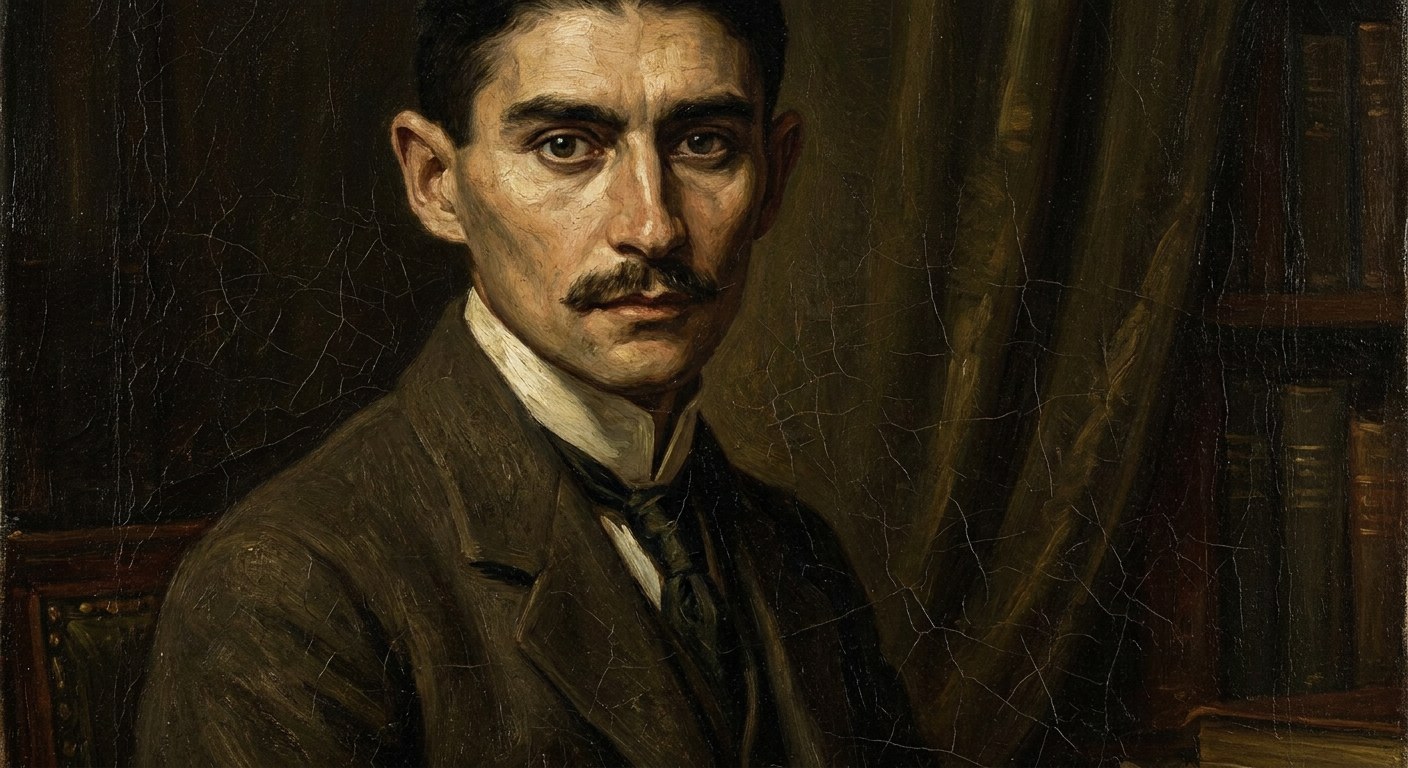
Quick Facts
- Years
- 1883 – 1924
- Nationality
- Austro-Hungarian and Czechoslovak
- Occupation
- Novelist & Short-Story Writer
Franz Kafka
1883 – 1924 · Austro-Hungarian and Czechoslovak · Novelist & Short-Story Writer
Recommended Audiobooks
Listen next from Marcus Alden

Life Lessons from Frederic Chopin
Marcus Alden · 54 min

Life Lessons from John Wesley
Marcus Alden · 52 min
Introduction
Franz Kafka was a Prague-born, German-language writer whose unsettling stories of guilt, alienation, bureaucracy and incomprehensible authority transformed modern literature. Although he published relatively little and remained only modestly known during his lifetime, works such as The Metamorphosis, The Trial and The Castle became central texts of twentieth-century fiction. His name even entered everyday language: Kafkaesque now describes situations in which individuals become trapped in absurd, labyrinthine systems that appear both menacing and irrational.
Kafka matters not because he offered a single philosophy or political program, but because he gave memorable literary form to distinctly modern anxieties. His characters encounter offices whose rules cannot be understood, accusations whose causes are never revealed, transformations that destroy ordinary identity and authorities that remain unreachable. Yet his writing is not merely bleak. Its precise language, deadpan comedy, irony and strange mixture of realism and nightmare make it continually open to new interpretations.
Kafka wrote at the intersection of several identities. He was a Jew in a predominantly Christian society, a German speaker in Czech-majority Prague, a subject of Austria-Hungary who later became a citizen of Czechoslovakia, and an aspiring author employed in the bureaucratic world of insurance. He lived through rapid industrialization, ethnic nationalism, antisemitism, the First World War and the collapse of an empire. These contexts informed his imagination without reducing his work to autobiography.
Much of Kafka's present reputation rests on manuscripts he asked his friend Max Brod to destroy. Brod refused, edited the unfinished novels and arranged their publication after Kafka's death. That decision preserved an extraordinary body of literature, while creating an enduring ethical debate about authorship, privacy and the rights of the dead.
Quick Facts
| Fact | Details |
|---|---|
| Born | 3 July 1883, Prague, Kingdom of Bohemia, Austria-Hungary |
| Died | 3 June 1924, Kierling, Austria, aged 40 |
| Nationality | Austro-Hungarian; Czechoslovak after 1918 |
| Known For | The Metamorphosis, The Trial, The Castle and the idea of the Kafkaesque |
| Occupation | Novelist, short-story writer and insurance official |
| Era | Literary modernism; early twentieth century |
Early Life and Education
Franz Kafka was born in Prague on 3 July 1883, the eldest surviving child of Hermann Kafka and Julie Löwy Kafka. Two sons born before or shortly after him, Georg and Heinrich, died in infancy. Franz grew up with three younger sisters: Gabriele, known as Elli; Valerie, known as Valli; and Ottilie, known as Ottla.
Hermann Kafka came from a poor Jewish family in southern Bohemia. Through determination and commercial ability, he established himself in Prague as a retailer of fancy goods. Julie came from a comparatively prosperous and educated German-speaking Jewish family. Both parents spent long hours at their business, so servants and governesses performed much of the children's daily care.
The Kafka household stood within Prague's German-speaking Jewish minority. Franz knew German and Czech and later studied French, while his developing interest in Jewish culture exposed him to Hebrew and Yiddish. The overlapping worlds of Czech, German, Jewish and imperial culture helped produce the sense of unstable identity often associated with his writing.
Kafka's relationship with his father became one of the most discussed aspects of his life. Hermann was physically imposing, energetic and practical; Franz was sensitive, introspective and drawn to literature. In the long, unsent or undelivered Letter to His Father, written in 1919, Kafka portrayed Hermann as domineering and emotionally overwhelming. The letter is an important personal document, but it is also a carefully constructed literary argument rather than an impartial record of family life.
From 1889 to 1893 Kafka attended the Deutsche Knabenschule, a German elementary school. He then entered the rigorous German-language Altstädter Deutsches Gymnasium in Prague's Old Town. He performed well academically and read widely, though he later remembered school as a source of anxiety. Among the writers who influenced him were Johann Wolfgang von Goethe, Heinrich von Kleist, Gustave Flaubert, Charles Dickens and Fyodor Dostoevsky.
In 1901 Kafka entered the German section of Charles-Ferdinand University in Prague. He briefly considered chemistry before turning to law, a practical subject that offered broad career options. He also attended classes in German literature and art history. At university he met Max Brod, a sociable and ambitious writer who became his closest literary friend, advocate and eventual executor.
Kafka received his Doctor of Law degree in 1906. The degree required a year of unpaid legal service, which he completed in civil and criminal courts. This training introduced him to the language of petitions, judgments, files and procedural authority—materials that would later be transformed in his fiction.
Rise to Prominence
Kafka did not rise to fame in a conventional or rapid way. His literary career developed alongside demanding office employment, fragile health and severe self-criticism. In 1907 he joined the Prague branch of the Italian insurance company Assicurazioni Generali. Its long working hours left little time for writing, and he resigned within a year.
In 1908 he began work at the Workers' Accident Insurance Institute for the Kingdom of Bohemia. This public institution assessed industrial hazards, classified factories and handled compensation claims for injured workers. Kafka proved capable and conscientious. He prepared reports, investigated workplace safety and rose through the professional ranks. Contrary to the image of him as helpless before bureaucracy, he understood administration from within and used it effectively in his career.
The institute's relatively favorable schedule allowed him to write in the evenings and at night, although doing so often exhausted him. He treated literature as his true vocation and regarded anything that interfered with it as a threat. His early prose appeared in literary journals, and his first small collection, Meditation (Betrachtung), was published in book form in 1912.
A decisive creative breakthrough occurred on the night of 22–23 September 1912, when Kafka wrote the story The Judgment in a single extended sitting. He described the experience as one of total artistic release. The story concerns a young merchant whose father suddenly condemns him to death. Its collision of domestic realism, paternal authority and dreamlike logic announced the mature Kafka style.
Soon afterward he wrote much of The Metamorphosis, in which traveling salesman Gregor Samsa awakens transformed into a monstrous vermin. Published in 1915, it became Kafka's best-known work during his lifetime. He also published The Stoker, the opening chapter of the unfinished novel later known as Amerika or The Missing Person, and short-story collections including A Country Doctor.
Kafka gained respect among a limited circle of German-language writers and critics. In 1915 The Stoker received the Fontane Prize through the advocacy of the novelist Carl Sternheim, who transferred his prize money to Kafka. Nevertheless, Kafka was not a major public celebrity. His international prominence came mainly after his death, when Brod published the unfinished novels and promoted him as a writer of exceptional importance.
Major Achievements and Contributions
Kafka's principal achievement was the creation of a fictional world that feels simultaneously ordinary and impossible. He begins with clear, restrained narration, then introduces an irrational event without providing a stable explanation. Characters generally accept the strange premises surrounding them and attempt to proceed logically, even as logic repeatedly fails.
This method distinguished Kafka from writers who treated fantasy as escape or spectacle. In his work, the fantastic exposes pressures already present in everyday life: family obligation, employment, shame, legal power, social exclusion and the uncertainty of personal identity. The result is an atmosphere in which comedy and terror are inseparable.
Kafka also created some of modern literature's most durable images. Gregor Samsa's transformation, Josef K.'s unexplained arrest, the unreachable Castle and the inaccessible law in the parable “Before the Law” all suggest systems whose authority is undeniable but whose meaning cannot be grasped. These images have been applied to totalitarian regimes, corporate administration, colonial power, digital systems and ordinary encounters with impersonal institutions.
His contribution to narrative form was equally important. Kafka left his three novels unfinished, yet their incompleteness often intensifies their themes. The missing explanations and unresolved structures deny readers the certainty they seek. His prose is controlled, economical and syntactically precise, especially in the original German. Translators face the challenge of preserving both its bureaucratic clarity and its ambiguities.
Kafka has frequently been associated with existentialism because his characters confront isolation, responsibility and a world without transparent meaning. He influenced thinkers and writers connected with existentialism and absurdism, including Albert Camus and Jean-Paul Sartre. However, Kafka did not describe himself as an existentialist, and his fiction resists confinement within any single philosophical movement.
His Jewish background is another major interpretive context. Kafka's engagement with Judaism deepened during the 1910s, particularly after he encountered Yiddish theater. He studied Jewish history and Hebrew and contemplated living in Palestine. Scholars have read his inaccessible authorities and elusive laws in relation to Jewish theology, exile and interpretation, though no simple religious allegory explains the works.
Key Works and Ideas
The Metamorphosis
Written in 1912 and published in 1915, The Metamorphosis opens with one of literature's most famous transformations. Gregor Samsa, a traveling salesman who financially supports his parents and sister, awakens as a gigantic insect-like creature—or, more literally, an undefined “monstrous vermin.” The narrative never explains the cause.
The story examines labor, dependency, family resentment and the fragility of human dignity. Gregor's value to his household declines when he can no longer earn money. His physical transformation makes visible an alienation that existed before it. The work can be read psychologically, socially, religiously or politically, but its refusal to confirm any interpretation is central to its power.
The Trial
Kafka began The Trial in 1914 and abandoned it the following year. It was published posthumously by Brod in 1925. Bank employee Josef K. is arrested on his thirtieth birthday, yet remains free to work and move around. He attempts to discover the charge and navigate a court system operating in attics, offices and hidden chambers.
The novel's authority is diffuse rather than concentrated in one identifiable tyrant. Officials possess limited knowledge, procedures reproduce themselves and Josef K. becomes increasingly involved in the logic of his own prosecution. The book has been read as a prophetic account of authoritarianism, but it also concerns guilt, self-judgment, legal interpretation and the human need for intelligible explanations.
The Castle
Written mainly in 1922, The Castle follows a man identified as K., who arrives in a snow-covered village claiming employment as a land surveyor. He struggles to contact the remote Castle that governs the community. Messengers, assistants, innkeepers and officials convey partial or contradictory information, while direct access remains impossible.
Published by Brod in 1926, the unfinished novel explores belonging, recognition and institutional remoteness. K. is persistent but not purely innocent; his determination disrupts village relationships even as the system obstructs him. Kafka reportedly told Brod of a possible ending in which K. would receive permission to remain only as he was dying, but no such ending survives in manuscript form.
The Missing Person (Amerika)
Kafka's first unfinished novel follows Karl Rossmann, a young European sent to the United States after a scandal. Kafka never visited America and built his setting from reading and imagination. The novel combines social criticism, comedy and picaresque adventure. Brod published it in 1927 under the title Amerika, although Kafka had called it Der Verschollene, commonly translated as The Missing Person.
Short Fiction and Parables
Kafka's shorter works include In the Penal Colony, A Hunger Artist, A Country Doctor, The Judgment, “Before the Law,” “A Report to an Academy” and “Josephine the Singer, or the Mouse Folk.” These texts examine punishment, spectatorship, art, bodily suffering and the unstable line between human beings and animals.
His parables are especially influential because they imitate the form of traditional wisdom while withholding a final lesson. Readers are invited to interpret them but discover that interpretation may itself become a trap.
The Kafkaesque
“Kafkaesque” does not simply mean strange or unpleasant. In its strongest sense, it describes an experience in which a person confronts an impersonal system governed by obscure rules, circular reasoning and shifting responsibility. The individual tries to cooperate or seek clarification, but each effort produces further confusion. Humor is essential: Kafka's nightmares are frequently ridiculous as well as frightening.
Timeline of Key Events
| Year | Event |
|---|---|
| 1883 | Born on 3 July in Prague to Hermann and Julie Kafka. |
| 1889 | Begins attending the German elementary school in Prague. |
| 1893 | Enters the German-language gymnasium in the Old Town. |
| 1901 | Enrolls at the German section of Charles-Ferdinand University. |
| 1902 | Meets Max Brod, who becomes his closest literary friend. |
| 1906 | Receives a Doctor of Law degree and begins required legal service. |
| 1907 | Joins Assicurazioni Generali insurance company. |
| 1908 | Begins work at the Workers' Accident Insurance Institute; publishes early prose. |
| 1912 | Publishes Meditation, meets Felice Bauer and writes The Judgment and much of The Metamorphosis. |
| 1913 | Publishes The Stoker. |
| 1914 | Becomes engaged to Felice Bauer for the first time and begins The Trial. |
| 1915 | The Metamorphosis is published; The Stoker receives the Fontane Prize. |
| 1917 | Diagnosed with pulmonary tuberculosis; engagement to Bauer ends permanently. |
| 1919 | Becomes engaged to Julie Wohryzek; writes Letter to His Father. |
| 1920 | Develops an intense relationship and correspondence with Milena Jesenská. |
| 1922 | Retires from the insurance institute because of illness and works on The Castle. |
| 1923 | Moves to Berlin with Dora Diamant in an effort to live independently. |
| 1924 | Publishes A Hunger Artist shortly before dying on 3 June near Vienna. |
| 1925 | Max Brod publishes The Trial. |
| 1926 | Brod publishes The Castle. |
| 1927 | Brod publishes the unfinished novel later widely known as Amerika. |
| 1930s–1940s | Translations and émigré intellectual networks expand Kafka's international reputation. |
| 2016 | Israel's Supreme Court confirms that Brod's remaining papers should pass to the National Library of Israel. |
Personal Life and Character
Kafka's diaries and letters reveal an observant, witty and self-questioning personality. He was often sociable with trusted friends, enjoyed swimming, rowing, walking and attending the theater, and had a strong sense of humor. Brod recalled that Kafka sometimes laughed while reading his work aloud. The popular image of an entirely gloomy recluse therefore captures only part of his character.
At the same time, Kafka suffered from insomnia, anxiety and recurring doubts about his body, work and literary ability. He followed health regimens, practiced chewing methods associated with dietary reform and became a vegetarian for substantial periods. Nighttime writing gave him creative intensity but worsened his exhaustion.
His desire for intimacy repeatedly conflicted with his fear that marriage and domestic responsibility would destroy the solitude required for writing. In 1912 he met Felice Bauer, a Berlin businesswoman. Their relationship unfolded largely through hundreds of letters. They became engaged twice, in 1914 and 1917, but both engagements ended. His letters alternated between longing, analysis, self-accusation and warnings about the difficulty of life with him.
Kafka later became engaged to Julie Wohryzek, but family opposition and practical difficulties contributed to the relationship's collapse. Around 1920 he developed a powerful emotional bond with Milena Jesenská, the Czech writer and translator who produced an early Czech translation of his work. Milena was married, and their relationship was conducted mainly through correspondence.
His final companion was Dora Diamant, a young woman from a Hasidic Jewish family. They met in 1923 and lived together in Berlin, giving Kafka a degree of independence from his parents that he had long desired. Inflation and Kafka's declining health made life difficult, and they eventually returned toward Prague before seeking medical treatment near Vienna.
Kafka was particularly close to his youngest sister, Ottla, who supported his writing and helped care for him during periods of illness. The later fate of his sisters adds a tragic historical aftermath to the family story: Elli, Valli and Ottla were all murdered during the Holocaust.
Challenges and Controversies
Kafka's most persistent challenge was the conflict between employment and artistic work. Although his insurance career was successful, he experienced office duties as an intrusion upon literature. He usually wrote late at night, then went to work with insufficient sleep. His perfectionism compounded the problem. He destroyed some manuscripts and considered much of his surviving writing unworthy of publication.
Tuberculosis transformed his life after he suffered a pulmonary hemorrhage in August 1917. He took repeated periods of medical leave and stayed in rural settings, including with Ottla at Zürau in northern Bohemia. His illness contributed to the end of his engagement to Felice Bauer and eventually forced his retirement in 1922.
The greatest controversy surrounding Kafka concerns Max Brod's treatment of his manuscripts. Kafka left written instructions asking Brod to burn unread his diaries, manuscripts and letters, while permitting a small number of published works to remain. Brod believed that Kafka knew he would refuse; he had previously told Kafka that he would not destroy the papers. After Kafka's death, Brod edited and published the novels.
Without Brod's disobedience, much of Kafka's work would have vanished. Yet his intervention raises serious ethical questions. Did friendship justify overriding explicit instructions? Did Kafka's decision to entrust the papers to someone known to oppose their destruction amount to indirect permission? There is no definitive answer.
Brod also arranged unfinished chapters and sometimes normalized punctuation or wording, influencing how early readers encountered the novels. Later critical editions returned more closely to Kafka's manuscripts and clarified their incomplete, fragmentary condition.
The ownership of Brod's archive generated another prolonged dispute. Brod fled Nazi-occupied Prague for Palestine in 1939, carrying Kafka manuscripts with him. After Brod's death, papers passed into private hands and were stored partly in bank vaults. Israeli courts ultimately ordered their transfer to the National Library of Israel, concluding a case involving questions of personal property and cultural heritage.
Kafka's relationships have also prompted controversy among biographers. His unusually candid letters contain fear, erotic anxiety, emotional dependence and sometimes harsh judgments. Psychological diagnoses made after his death remain speculative. Responsible biography distinguishes his own self-dramatizing prose from verified fact and avoids reducing his fiction to symptoms.
Death and Immediate Aftermath
By 1924 Kafka's tuberculosis had spread to his larynx. Speaking and swallowing became extremely painful, and ordinary nourishment was increasingly difficult. He received treatment at a sanatorium in Kierling, near Vienna, where Dora Diamant and the physician Robert Klopstock attended him.
Franz Kafka died there on 3 June 1924, one month before his forty-first birthday. The immediate cause was the advanced effects of tuberculosis; inability to eat and drink severely weakened him in his final days. His body was returned to Prague, and he was buried in the New Jewish Cemetery in Prague-Žižkov. His parents were later buried in the same grave.
Obituaries appeared in the German- and Czech-language press, including a moving tribute by Milena Jesenská. Kafka was respected by a small literary community, but his death was not treated as the passing of an internationally famous novelist.
Max Brod changed that trajectory. He published The Trial in 1925, The Castle in 1926 and Amerika in 1927, followed by diaries, letters and biographical material. Translation carried Kafka beyond German-speaking Europe. His work attracted particular attention among writers confronting fascism, exile, war and mass bureaucracy.
Legacy and Influence Today
Kafka is now regarded as one of the foundational writers of literary modernism. His influence appears in the work of Jorge Luis Borges, Albert Camus, Samuel Beckett, Gabriel García Márquez, Philip Roth, Haruki Murakami, J. M. Coetzee and many others. Writers as different as George Orwell and Eugène Ionesco found in Kafka a language for impersonal domination and absurd social structures.
His fiction has shaped philosophy, theology, psychology, legal studies and political theory. Existentialist readings emphasize abandonment and responsibility. Theological interpretations examine inaccessible judgment and revelation. Marxist critics focus on alienated labor and administration, while psychoanalytic approaches consider family authority, desire and guilt. Jewish studies scholars explore his relation to law, tradition, exile, Hebrew and Yiddish culture.
Kafka's reputation as a prophet of totalitarianism grew after the Holocaust and the rise of Stalinist regimes. His fiction does seem uncannily relevant to secret accusations, arbitrary detention and administrative terror. Nevertheless, he died before these systems reached their later forms, and his works should not be treated as literal predictions. Their reach is broader because their institutions are rarely tied to one ideology.
The term Kafkaesque remains highly visible in discussions of immigration offices, automated decision-making, surveillance, health-care administration and legal procedures. A person denied a benefit by an algorithm, instructed to appeal through the same opaque system that issued the denial and unable to identify any accountable decision-maker may reasonably describe the experience as Kafkaesque.
Popular culture has adapted Kafka through film, theater, opera, visual art, comics and music. The Metamorphosis is taught worldwide because it is accessible at the level of plot yet inexhaustible in interpretation. Prague has also embraced Kafka as a cultural figure, although the multilingual Jewish city he knew was largely destroyed by nationalism, war and the Holocaust.
Kafka's legacy ultimately rests on his refusal to simplify experience. His stories do not tell readers exactly what the court, castle, transformation or law represents. Instead, they reproduce the human search for meaning under conditions in which final explanations remain unavailable. That combination of clarity and uncertainty is why Kafka continues to feel contemporary.
Famous Quotes
Translations from Kafka's German vary. The following are drawn from his fiction, letters and aphorisms; the remark about hope was reported by Max Brod.
“A book must be the axe for the frozen sea within us.”
— Letter to Oskar Pollak, 1904
“As Gregor Samsa awoke one morning from uneasy dreams he found himself transformed in his bed into a gigantic insect.”
— The Metamorphosis, in a widely used English translation
“Someone must have been telling lies about Josef K., for without having done anything wrong he was arrested one fine morning.”
— The Trial
“From a certain point onward there is no longer any turning back. That is the point that must be reached.”
— Zürau Aphorisms
“A cage went in search of a bird.”
— Zürau Aphorisms
“In the struggle between yourself and the world, second the world.”
— Zürau Aphorisms
“There is an infinite amount of hope in the universe—but not for us.”
— Remark attributed to Kafka by Max Brod
Frequently Asked Questions
Why is Franz Kafka famous?
Kafka is famous for creating disturbing but darkly comic stories about alienation, guilt and opaque authority. The Metamorphosis, The Trial and The Castle became classics, while the adjective “Kafkaesque” made his name part of global vocabulary.
What does Kafkaesque mean?
Kafkaesque describes a situation in which someone is trapped in an absurd, intimidating system with obscure rules, circular procedures and no clearly accountable authority. The term implies a mixture of anxiety, helplessness and dark comedy, not merely something bizarre.
What nationality was Franz Kafka?
Kafka was born in Prague when it belonged to Austria-Hungary and became a citizen of Czechoslovakia after that state was founded in 1918. Culturally, he was a German-speaking Prague Jew who also knew Czech. Assigning him a single modern national label can obscure this complex background.
Did Kafka publish during his lifetime?
Yes. Kafka published stories and collections including Meditation, The Stoker, The Metamorphosis, The Judgment, In the Penal Colony, A Country Doctor and A Hunger Artist. His three unfinished novels were published only after his death.
Did Kafka really ask for his writings to be burned?
Yes. Kafka instructed Max Brod to destroy most unpublished manuscripts, diaries and correspondence. Brod refused because he considered the writings culturally important and believed Kafka had entrusted them to him despite already knowing his objections.
Was Kafka an existentialist?
Kafka is often linked with existentialism because his characters face alienation, guilt and uncertain meaning. However, he wrote before existentialism emerged as a defined postwar movement and did not identify himself with that label. His work also supports theological, political, psychological and comic interpretations.
What did Kafka do for a living?
He worked primarily for the Workers' Accident Insurance Institute for the Kingdom of Bohemia. His duties involved industrial safety, risk classification and compensation for workplace injuries. He was a competent official and received promotions before tuberculosis forced his retirement.
How did Franz Kafka die?
Kafka died from advanced tuberculosis on 3 June 1924 at a sanatorium in Kierling, Austria. The disease had affected his larynx, making swallowing painfully difficult and leaving him severely weakened.
Lessons We Can Learn
-
Transform private anxiety into universal art. Kafka used highly personal fears about work, family and identity to create stories that speak across cultures and generations.
-
Precision can make the impossible believable. His calm, exact prose demonstrates that extraordinary ideas often become more powerful when presented without exaggeration.
-
Question systems that hide responsibility. Kafka's fiction teaches readers to examine institutions whose complexity prevents transparency and accountability.
-
Resist simple interpretations. His works remain alive because they permit competing readings rather than delivering a single fixed message.
-
Cultural survival can depend on difficult choices. Brod's refusal to destroy Kafka's manuscripts preserved masterpieces, but it also reminds us that literary heritage can involve unresolved conflicts between privacy, friendship and public value.
Further Reading
- Reiner Stach, Kafka: The Early Years — the opening volume, in chronological terms, of the most comprehensive modern biography.
- Reiner Stach, Kafka: The Decisive Years — a detailed study of Kafka's life and creative development from 1910 to 1915.
- Reiner Stach, Kafka: The Years of Insight — an account of Kafka's later life, illness and mature writing.
- Max Brod, Franz Kafka: A Biography — the influential early biography by Kafka's friend and literary executor, best read with awareness of Brod's interpretive role.
- Ronald Hayman, K: A Biography of Kafka — an accessible critical biography connecting Kafka's life, correspondence and fiction.
Watch and Learn
What makes something 'Kafkaesque'? · TED-Ed