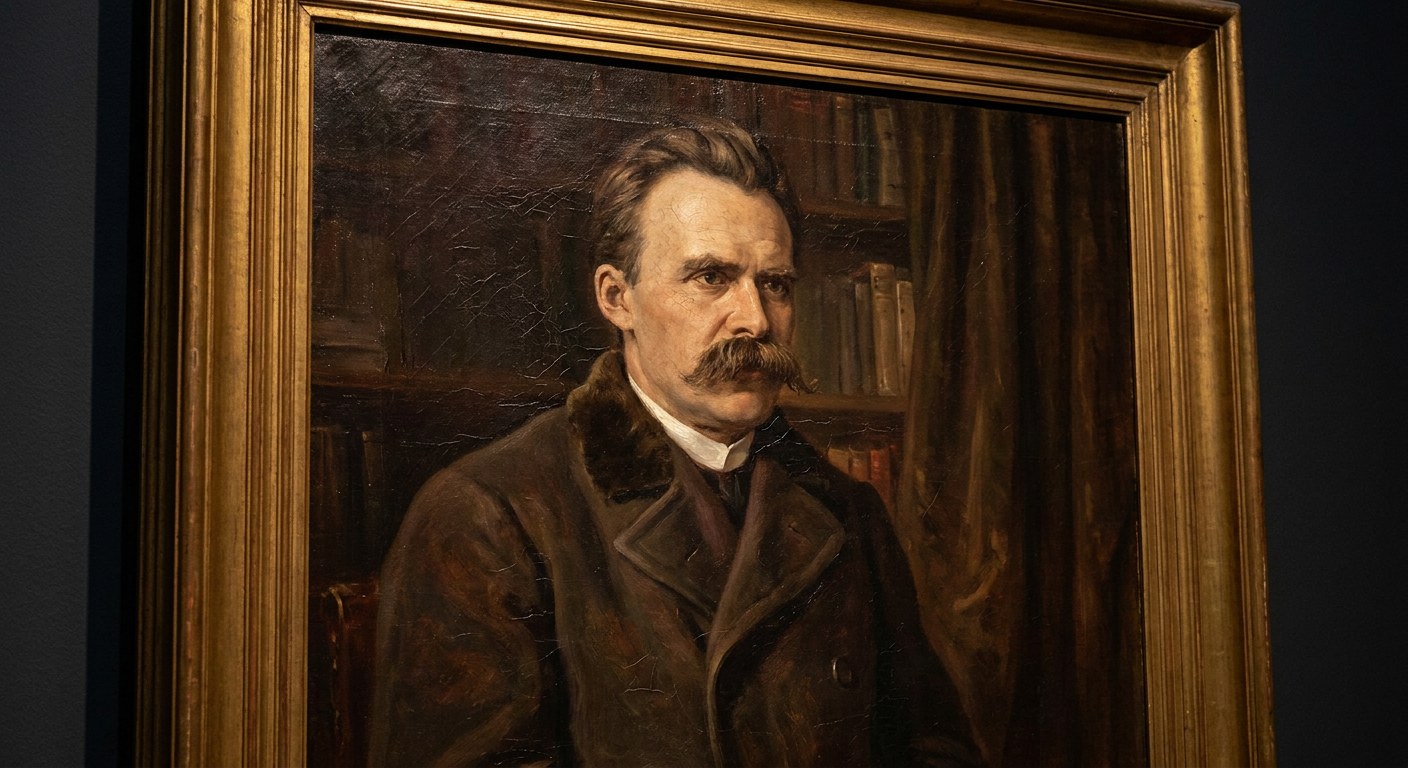
Friedrich Nietzsche
1844 – 1900 · German · Philosopher & Classical Philologist
Recommended Audiobooks
Listen next from Marcus Alden

Life Lessons from Frederic Chopin
Marcus Alden · 54 min

Life Lessons from John Wesley
Marcus Alden · 52 min
Introduction
Friedrich Nietzsche was one of the most provocative and influential philosophers of the modern era. A brilliant classical scholar who became a radical critic of morality, religion, nationalism, mass culture, and conventional philosophy, he challenged readers to examine the values by which they lived. His declarations about the “death of God,” his analysis of nihilism, and his concepts of the Übermensch, the will to power, eternal recurrence, and the revaluation of values transformed debates about meaning, freedom, truth, and human possibility.
Nietzsche did not construct a philosophical system in the traditional manner. He wrote aphorisms, poems, polemics, psychological observations, and symbolic narratives. His style could be lyrical, humorous, furious, ironic, or deliberately unsettling. Rather than supplying permanent doctrines, he often tried to disrupt habits of thought and force readers to confront uncomfortable questions: Where do moral values come from? Whose interests do they serve? Can human beings create meaning after inherited religious certainties have weakened? What would it mean to affirm life even in the face of suffering?
His influence reaches far beyond academic philosophy. Writers, psychologists, theologians, political theorists, artists, and cultural critics have drawn upon—or argued against—his work. Sigmund Freud, Carl Jung, Martin Heidegger, Jean-Paul Sartre, Albert Camus, Michel Foucault, Jacques Derrida, Thomas Mann, and many others engaged with his ideas. Nietzsche is often treated as a forerunner of existentialism, psychoanalysis, genealogy, post-structuralism, and modern cultural criticism.
His legacy is also controversial. After his mental collapse, his writings were managed and selectively edited by his sister, Elisabeth Förster-Nietzsche, a German nationalist and antisemite. She presented aspects of his thought in ways that facilitated their later appropriation by fascists and Nazis, even though Nietzsche himself repeatedly expressed contempt for antisemitism, German nationalism, and authoritarian mass politics. Recovering Nietzsche from these distortions has been a central task of modern scholarship.
Quick Facts
| Fact | Details |
|---|---|
| Born | 15 October 1844, Röcken, Province of Saxony, Kingdom of Prussia |
| Died | 25 August 1900, Weimar, German Empire |
| Nationality | German; born a Prussian subject and formally stateless after 1869 |
| Known For | Critique of morality and religion; nihilism; the Übermensch; will to power; eternal recurrence; perspectivism |
| Occupation | Philosopher, classical philologist, essayist, poet, and cultural critic |
| Era | Nineteenth-century European philosophy; precursor of existentialism and continental philosophy |
Early Life and Education
Friedrich Wilhelm Nietzsche was born on 15 October 1844 in Röcken, a small village near Leipzig in the Prussian Province of Saxony. He was named after King Friedrich Wilhelm IV of Prussia, whose birthday fell on the same date. His father, Carl Ludwig Nietzsche, was a Lutheran pastor and former tutor to members of the Prussian royal household. His mother, Franziska Oehler Nietzsche, also came from a clerical family.
Nietzsche's childhood was marked by early loss. His father developed a severe neurological illness and died in 1849, when Friedrich was four. Nietzsche's younger brother, Joseph, died the following year. The surviving family—Nietzsche, his mother, his younger sister Elisabeth, his paternal grandmother, and two unmarried aunts—moved to Naumburg. Growing up in a religious household dominated by women helped shape both his intellectual independence and his complicated later attitudes toward Christianity, family, and gender.
As a child, Nietzsche was serious, musically gifted, and academically exceptional. Schoolmates reportedly nicknamed him the “little pastor” because of his solemn manner and knowledge of the Bible. He wrote poetry and music, played the piano, and showed a strong command of language. Music remained essential to him throughout his life, although his own compositions never achieved the stature of his philosophical writings.
In 1858 Nietzsche entered Schulpforta, one of Germany's most demanding classical boarding schools. Its rigorous curriculum emphasized Greek, Latin, literature, history, and disciplined textual analysis. There he developed the philological skills that later distinguished his scholarship. He studied ancient authors including Homer, Plato, Aeschylus, Sophocles, and Theognis, while continuing to compose poetry and music.
Nietzsche enrolled at the University of Bonn in 1864 to study theology and classical philology. His initial choice reflected family expectations that he might become a clergyman. Within a year, however, he abandoned theology as his religious faith weakened. His decision distressed his mother, but it marked a decisive turn toward an independent intellectual life.
In 1865 Nietzsche followed the classical scholar Friedrich Wilhelm Ritschl from Bonn to the University of Leipzig. Ritschl quickly recognized his extraordinary abilities. Nietzsche produced notable studies of ancient Greek texts and became deeply influenced by Arthur Schopenhauer's The World as Will and Representation. Schopenhauer's vision of existence as driven by insatiable striving captivated him, although Nietzsche would later reject Schopenhauer's pessimistic denial of life.
During his Leipzig years Nietzsche also discovered the music of Richard Wagner. He met Wagner personally in 1868 and was fascinated by the composer's personality, artistic ambition, and vision of cultural renewal. This relationship became crucial to Nietzsche's early career and later intellectual development.
Rise to Prominence
In 1869, before completing the conventional requirements for a doctorate, Nietzsche was appointed professor of classical philology at the University of Basel in Switzerland. He was only twenty-four. On Ritschl's recommendation, the University of Leipzig granted him a doctorate based on his existing publications without requiring a dissertation or oral examination. His rapid elevation was extraordinary and testified to his reputation as a young scholar.
To take the Basel position, Nietzsche relinquished his Prussian citizenship. He never acquired Swiss citizenship and remained officially stateless for the rest of his life. During the Franco-Prussian War of 1870–1871, he volunteered as a medical orderly because his status prevented him from serving as an armed combatant. He witnessed traumatic injuries and contracted serious illnesses, commonly identified as dysentery and diphtheria. Recurring headaches, digestive problems, impaired eyesight, and periods of exhaustion increasingly disrupted his work thereafter.
At Basel, Nietzsche taught Greek language and literature and formed a close friendship with the historian Jacob Burckhardt. He also became a frequent guest of Richard Wagner and Wagner's wife, Cosima, at their home in Tribschen near Lucerne. Nietzsche initially regarded Wagner as a heroic artist capable of reviving tragic culture in modern Germany.
His first major book, The Birth of Tragedy out of the Spirit of Music, appeared in 1872. It interpreted Greek tragedy as the creative union of two artistic forces: the Apollonian, associated with form, order, and individuation, and the Dionysian, associated with intoxication, music, suffering, and the dissolution of boundaries. Nietzsche argued that Socratic rationalism had weakened the tragic wisdom of Greek culture and suggested that Wagnerian music drama might renew it.
The book attracted attention but was attacked by professional philologists, especially Ulrich von Wilamowitz-Moellendorff, who criticized its speculative method and inadequate use of evidence. The controversy damaged Nietzsche's standing in classical scholarship. Yet the work announced themes that would define his mature philosophy: the relationship between art and suffering, the limits of rationalism, the creation of culture, and the possibility of affirming existence.
From 1873 to 1876 Nietzsche published four essays later collected as the Untimely Meditations. They criticized the self-satisfaction of modern German culture and discussed the uses and dangers of history, Schopenhauer, Wagner, and the independent thinker. These essays established Nietzsche as a cultural critic unwilling to defer to the dominant values of his age.
His admiration for Wagner gradually collapsed. Nietzsche disliked the nationalism, personality cult, Christian symbolism, and antisemitic environment surrounding the Bayreuth Festival. Wagner's final opera, Parsifal, with its themes of purity and redemption, represented to him a surrender to Christian decadence. Their break was both intellectual and personal, leaving Nietzsche isolated but freeing him to develop a more independent philosophy.
Major Achievements and Contributions
Nietzsche's greatest contribution was his radical investigation into the origin and value of values themselves. Traditional philosophers often asked which moral principles were true. Nietzsche asked a prior question: What historical, psychological, and physiological forces produced these principles, and what kinds of life do they encourage? This method became known as genealogy.
In On the Genealogy of Morality, Nietzsche distinguished between “master” and “slave” moralities. Master morality, in his account, arose among powerful social groups that associated goodness with nobility, strength, confidence, and excellence. Slave morality developed among the weak and oppressed, transforming their resentment into a moral system that praised humility, obedience, patience, and compassion while condemning strength as evil. Nietzsche did not merely recommend domination or cruelty; his purpose was to expose morality as historically created rather than timeless or self-evident.
His critique of Christianity formed part of this project. Nietzsche believed that Christianity had given profound expression to the perspective of the suffering and powerless, but he argued that it also encouraged guilt, hostility toward instinct, and hope for a world beyond this life. His phrase “God is dead” did not mean that a deity had literally died. It described the erosion of the Christian worldview under the pressure of modern science, historical criticism, and secular culture. European societies, he argued, continued to rely on moral assumptions rooted in Christianity even as belief in their divine foundation weakened.
Nietzsche saw nihilism—the collapse of authoritative values and meaning—as the looming crisis of European civilization. He did not simply celebrate it. The death of inherited certainties could produce despair, conformity, or destructive politics. Yet it could also open the possibility of creating new values. Nietzsche's philosophy therefore combined diagnosis with an experiment in cultural renewal.
The Übermensch, usually translated as “overman” or “superhuman,” appears most prominently in Thus Spoke Zarathustra. It does not refer to a racial category or comic-book superhero. It symbolizes a person or future humanity capable of overcoming inherited values, cultivating self-mastery, and creating meaning without appealing to supernatural guarantees. Nietzsche contrasted this ideal with the “last man,” a comfortable, risk-averse conformist who seeks only security and trivial pleasure.
The will to power is one of Nietzsche's most debated concepts. It can describe a drive not merely to survive but to expand, interpret, shape, overcome resistance, and transform oneself and the world. Nietzsche did not publish a finished book titled The Will to Power. The volume issued under that name after his collapse was assembled from notebook fragments, and its editorial history requires caution. Scholars disagree about whether the will to power should be understood primarily as psychology, biology, metaphysics, or a flexible interpretive hypothesis.
Nietzsche also developed what later readers called perspectivism. Human knowledge, he argued, always emerges from particular standpoints, needs, affects, languages, and forms of life. This does not necessarily mean that every claim is equally valid or that objective inquiry is impossible. Rather, stronger understanding may require comparing multiple perspectives and recognizing the conditions under which judgments are made.
His concept of eternal recurrence asks whether one could affirm life so completely that one would willingly live every event again, endlessly and in the same sequence. Nietzsche sometimes explored recurrence as a cosmological possibility, but its greatest force is ethical and existential. It serves as a test of one's attitude toward life: can a person embrace existence, including its suffering and mistakes, without wishing it fundamentally otherwise?
Finally, Nietzsche transformed philosophical writing. His aphorisms, parables, satire, poetry, autobiographical reflections, and shifting voices undermined the idea that philosophy must take the form of a neutral treatise. His style made interpretation inseparable from content and influenced generations of literary and philosophical experimentation.
Key Works / Battles / Ideas
The Birth of Tragedy (1872)
Nietzsche's first book examined the Apollonian and Dionysian dimensions of Greek tragedy. Although criticized as classical scholarship, it became an influential work of aesthetics. Its central question—how art makes suffering bearable or meaningful—remained important throughout his career.
Untimely Meditations (1873–1876)
These four essays challenged modern Germany's historical consciousness, education, cultural complacency, and admiration for success. The essay “On the Uses and Disadvantages of History for Life” remains especially influential for distinguishing monumental, antiquarian, and critical approaches to the past.
Human, All Too Human (1878)
This book marked Nietzsche's break with Wagner and Schopenhauer. Written largely in aphorisms, it embraced a more skeptical, psychological, and naturalistic style. Nietzsche examined morality, religion, art, and social life as human products rather than manifestations of eternal truth.
The Gay Science (1882; expanded 1887)
Here Nietzsche presented the “madman” who announces the death of God and introduced eternal recurrence as a personal challenge. The book combines poetry, philosophical psychology, cultural criticism, and a spirit of intellectual experimentation. Its title invokes joyful or spirited knowledge rather than simple amusement.
Thus Spoke Zarathustra (1883–1885)
Nietzsche's best-known and most unusual book is a philosophical drama written in a prophetic, poetic style. Its fictional teacher, Zarathustra, proclaims the Übermensch, confronts nihilism, teaches self-overcoming, and struggles with eternal recurrence. The work deliberately parodies biblical language while resisting any single doctrinal interpretation.
Beyond Good and Evil (1886)
This book offered a more direct presentation of Nietzsche's mature thought. It criticized philosophical dogmatism, examined the psychology behind systems of thought, developed perspectivist themes, and called for “philosophers of the future” capable of creating values.
On the Genealogy of Morality (1887)
Written as three connected essays, the Genealogy investigated the origins of moral concepts, guilt, punishment, bad conscience, asceticism, and ressentiment. It is among Nietzsche's clearest and most influential books, shaping later psychology, sociology, history, and critical theory.
Works of 1888
Nietzsche wrote with astonishing speed during his final productive year. The Case of Wagner attacked Wagnerian decadence; Twilight of the Idols summarized and sharpened many of his criticisms; The Antichrist launched a fierce attack on Christianity; Ecce Homo interpreted his own life and writings; and Nietzsche Contra Wagner assembled passages documenting his opposition to the composer. These works were published either shortly before or after his collapse.
Self-Overcoming and Amor Fati
Across Nietzsche's writings, strength is less a fixed possession than a process of overcoming resistance, reorganizing one's drives, and transforming suffering into knowledge or creation. His phrase amor fati, “love of fate,” names the aspiration not merely to endure necessity but to affirm it. This ideal is closely related to eternal recurrence and his broader commitment to saying yes to life.
Timeline of Key Events
| Year | Event |
|---|---|
| 1844 | Born on 15 October in Röcken, Prussia |
| 1849 | His father, Carl Ludwig Nietzsche, dies after neurological illness |
| 1850 | Family relocates to Naumburg following the death of Nietzsche's younger brother |
| 1858 | Enters the elite classical school Schulpforta |
| 1864 | Begins studying theology and classical philology at the University of Bonn |
| 1865 | Abandons theology, transfers to Leipzig, and discovers Schopenhauer's philosophy |
| 1868 | Meets composer Richard Wagner |
| 1869 | Appointed professor of classical philology at Basel at age twenty-four |
| 1870 | Serves briefly as a medical orderly during the Franco-Prussian War |
| 1872 | Publishes The Birth of Tragedy |
| 1873–1876 | Publishes the four Untimely Meditations |
| 1876–1878 | Break with Wagner becomes increasingly clear |
| 1878 | Publishes Human, All Too Human |
| 1879 | Resigns from Basel because of severe chronic illness |
| 1881 | Develops the idea of eternal recurrence while near Sils Maria |
| 1882 | Publishes the first edition of The Gay Science and meets Lou Salomé |
| 1883–1885 | Publishes the four parts of Thus Spoke Zarathustra |
| 1886 | Publishes Beyond Good and Evil |
| 1887 | Publishes On the Genealogy of Morality |
| 1888 | Writes several late works, including Twilight of the Idols and Ecce Homo |
| 1889 | Suffers a mental collapse in Turin in January |
| 1890 | Placed under the care of his mother in Naumburg |
| 1894 | Elisabeth establishes the Nietzsche Archive |
| 1897 | After his mother's death, Elisabeth moves Nietzsche to Weimar |
| 1900 | Dies in Weimar on 25 August |
Personal Life and Character
Nietzsche never married and had no known children. His adult life was marked by intellectual friendships, painful estrangements, solitude, and repeated searches for climates that might ease his illnesses. After leaving Basel, he traveled among Switzerland, Italy, and southern France, living modestly in rented rooms. Sils Maria in the Swiss Alps became one of his favorite locations, while Genoa, Venice, Nice, Rapallo, and Turin also served as temporary homes.
He was personally more courteous, gentle, and reserved than the aggressive tone of some of his writings might suggest. Friends described careful manners, a quiet voice, and a strong desire for companionship. He valued friendship intensely but could idealize others, react sharply to disappointment, and turn personal conflicts into philosophical judgments.
Music remained one of his deepest passions. His youthful devotion to Wagner was partly an expression of his longing for a union of philosophy, music, and cultural transformation. The eventual rupture wounded him deeply. Even in his attacks on Wagner, admiration and hostility remained intertwined.
In 1882 Nietzsche met Lou Salomé, a highly intelligent young Russian-born writer, through their mutual friend Paul Rée. Nietzsche was captivated by her and proposed marriage, possibly more than once, but she refused. The three briefly imagined an intellectual community. Tensions, jealousy, and interference from Nietzsche's sister Elisabeth helped destroy the arrangement. Nietzsche's subsequent isolation contributed to an emotional crisis, although he continued writing with remarkable productivity.
Nietzsche's relationship with Elisabeth was deeply ambivalent. They had been close in youth, but he despised her marriage to Bernhard Förster, a prominent antisemite who attempted to establish a German nationalist colony in Paraguay. Nietzsche objected to antisemitism and complained about being associated with it. After his collapse, however, Elisabeth gained control over his literary estate and public image.
His comments about women are among the most criticized aspects of his work. Some passages are overtly misogynistic; others appear through fictional voices, irony, or attacks on particular social ideals. Context complicates interpretation but does not erase the hostility of certain statements. At the same time, Nietzsche admired several intellectually independent women and supported some departures from conventional gender roles. The contradictions remain a serious subject of scholarly debate.
Challenges and Controversies
Nietzsche endured severe health problems for most of his working life. He experienced migraines, nausea, vomiting, digestive distress, insomnia, and deteriorating eyesight. At times he could read or write for only short periods. These conditions forced him to resign from Basel in 1879 with a modest pension. His wandering life was partly a continuous search for the right altitude, temperature, diet, and routine.
His health also shaped his philosophy. Nietzsche repeatedly linked thought to the body, diet, climate, illness, and recovery. He treated philosophy not as detached reasoning but as a symptom and expression of particular forms of life. He sometimes described his own movement between sickness and health as a source of psychological insight.
The cause of his final mental collapse remains uncertain. Nineteenth-century physicians diagnosed progressive paralysis, commonly associated with tertiary syphilis, and that explanation long dominated biographies. Later researchers have proposed alternatives, including vascular dementia, hereditary cerebral disease, a brain tumor, or other neurological conditions. The available evidence does not permit a definitive retrospective diagnosis.
A famous story claims that on 3 January 1889 Nietzsche saw a coachman beating a horse in Turin, embraced the animal, and collapsed. Although the episode has become iconic, its details rest on late and uncertain testimony. What is securely documented is that Nietzsche suffered a breakdown in Turin and sent incoherent “madness letters” to friends and public figures. Franz Overbeck traveled from Basel to bring him back.
Nietzsche's political reception is another major controversy. Nazi propagandists appropriated selected concepts and phrases, especially the Übermensch and will to power, while ignoring his contempt for German nationalism, antisemitism, militarized mass movements, and the state. Adolf Hitler visited the Nietzsche Archive and was photographed with Elisabeth, encouraging the appearance of ideological continuity.
Nietzsche was not a liberal democrat or an egalitarian. He frequently used aristocratic language, criticized socialism and democracy, and imagined higher culture as the achievement of exceptional individuals. His writings therefore cannot simply be converted into modern progressive politics. Nevertheless, the racial antisemitism and German imperial nationalism later associated with his name conflict with many of his explicit statements.
Editorial manipulation intensified the problem. Elisabeth arranged unpublished notes into The Will to Power and promoted it as Nietzsche's crowning systematic work, although he had abandoned plans for a book under that title. She did not fabricate every passage, but selection, arrangement, and omission created a misleading impression. Later critical editions reconstructed the notebooks chronologically and distinguished Nietzsche's published works from posthumous compilations.
Nietzsche's fragmentary and rhetorical style also creates interpretive challenges. He uses masks, exaggeration, parody, contradiction, and shifting perspectives. A sentence removed from its setting may appear to express a simple doctrine when it actually plays a role in a larger experiment. Responsible interpretation requires attention to chronology, genre, voice, and editorial history.
Death and Immediate Aftermath
After his collapse, Nietzsche was treated first in Basel and then at a psychiatric clinic in Jena. He never recovered the capacity for sustained philosophical work. In 1890 his mother took him into her home in Naumburg, where he lived in a dependent and largely uncommunicative condition. Following her death in 1897, Elisabeth transferred him to Weimar, home of the Nietzsche Archive.
Nietzsche suffered at least one stroke and became increasingly frail. He died in Weimar on 25 August 1900, aged fifty-five, after pneumonia and a further stroke. He was buried beside his father at the church in Röcken.
By the time of his death, Nietzsche had become famous in European intellectual circles, although he was incapable of understanding or directing his growing reputation. Thus Spoke Zarathustra and his other books attracted artists, avant-garde writers, radicals, conservatives, and spiritual seekers. Elisabeth positioned herself as the authoritative guardian of his legacy and turned the Weimar archive into a center of cultural prestige.
This immediate fame came at a cost. Different movements extracted incompatible Nietzsches from his writings: individualist, aristocrat, atheist prophet, cultural revolutionary, nationalist, psychologist, or mystic. The struggle over what Nietzsche meant began before his death and has never completely ended.
Legacy and Influence Today
Nietzsche's influence on twentieth- and twenty-first-century thought is immense. Existentialists inherited his confrontation with nihilism and his demand that individuals assume responsibility for creating meaning. Although Nietzsche died before existentialism emerged as a named movement, thinkers such as Sartre, Camus, Karl Jaspers, and Heidegger treated him as a decisive predecessor.
Psychology and psychoanalysis found in Nietzsche a penetrating analyst of repression, self-deception, resentment, guilt, sublimation, and unconscious motivation. Freud claimed not to have read Nietzsche extensively until later because the philosopher's insights came so close to psychoanalytic discoveries. Jung lectured at length on Thus Spoke Zarathustra, while Alfred Adler's psychology of striving invited comparisons with the will to power.
Nietzsche's genealogical method profoundly influenced Michel Foucault, who investigated how institutions and systems of knowledge produce categories of truth, normality, and identity. Jacques Derrida, Gilles Deleuze, and other continental philosophers drew upon Nietzsche's critiques of fixed meaning, stable identity, and metaphysical foundations.
His impact on literature includes figures as varied as George Bernard Shaw, W. B. Yeats, Thomas Mann, Hermann Hesse, André Gide, Rainer Maria Rilke, D. H. Lawrence, Albert Camus, and Jorge Luis Borges. Composers and artists also responded to him. Richard Strauss's tone poem Also sprach Zarathustra became one of the most recognizable musical adaptations associated with a philosophical text.
In ethics and political thought, Nietzsche remains both stimulating and dangerous. His critique of ressentiment encourages scrutiny of moral judgments that conceal envy or vengeance. His ideal of self-overcoming inspires accounts of personal development and creativity. Yet his disdain for equality and admiration for rank raise questions about elitism, domination, and exclusion.
Contemporary scholarship generally rejects the simplistic image of Nietzsche as a Nazi philosopher. Critical editions, archival research, and careful historical interpretation have exposed how his sister and later ideologues distorted his work. At the same time, scholars avoid sanitizing him: his anti-democratic remarks, hierarchy, rhetoric of breeding, and misogynistic passages remain genuine difficulties rather than mere inventions.
Nietzsche matters today because the crisis he diagnosed has not disappeared. Secular societies still debate whether morality can survive without religious authority. Individuals still struggle with inherited identities, cultural conformity, resentment, and the demand to create meaningful lives. Political movements still turn uncertainty into dogmatism or search for absolute enemies. Nietzsche offers no easy cure, but he provides a powerful vocabulary for investigating these conditions.
His enduring challenge is not simply to reject old values but to ask what could replace them. Destruction without creation leads to nihilism; freedom without discipline can become emptiness. For Nietzsche, the higher task was to transform criticism into self-overcoming and to learn how to affirm life without denying its tragedy.
Famous Quotes
Translations of Nietzsche vary. The following quotations come from works he prepared for publication rather than from later compilations of his notebooks.
“God is dead! God remains dead! And we have killed him!” — The Gay Science, section 125
“What does not kill me makes me stronger.” — Twilight of the Idols, “Maxims and Arrows,” section 8
“One must still have chaos in oneself to give birth to a dancing star.” — Thus Spoke Zarathustra, Prologue, section 5
“Without music, life would be a mistake.” — Twilight of the Idols, “Maxims and Arrows,” section 33
“Whoever fights monsters should see to it that in the process he does not become a monster. And if you gaze long enough into an abyss, the abyss will gaze back into you.” — Beyond Good and Evil, section 146
“One repays a teacher badly if one always remains nothing but a pupil.” — Thus Spoke Zarathustra, “On the Gift-Giving Virtue”
“Become who you are!” — The Gay Science, section 270
Frequently Asked Questions
What is Friedrich Nietzsche best known for?
Nietzsche is best known for announcing the “death of God,” analyzing nihilism, criticizing Christian and conventional morality, and developing ideas such as the Übermensch, eternal recurrence, will to power, perspectivism, and the revaluation of values. He is also celebrated for his distinctive aphoristic and literary style.
What did Nietzsche mean by “God is dead”?
He meant that the traditional Christian framework had lost much of its authority in modern European culture. Scientific inquiry, historical criticism, and secularization had undermined shared belief, yet society had not fully confronted the moral and existential consequences. The phrase is a cultural diagnosis, not a claim that a literal deity once lived and died.
Was Nietzsche a nihilist?
Nietzsche diagnosed nihilism and sometimes described himself as having passed through it, but he did not simply advocate meaninglessness. He sought ways to overcome nihilism through value creation, self-overcoming, artistic activity, intellectual honesty, and affirmation of life.
What is the Übermensch?
The Übermensch is an ideal presented in Thus Spoke Zarathustra. It represents self-overcoming and the capacity to create values after inherited absolutes have collapsed. It is not a biological race, a nationalist ruler, or merely a physically powerful person.
Did Nietzsche support Nazism or antisemitism?
No. Nietzsche died decades before the Nazi Party was founded and repeatedly criticized antisemitism, German nationalism, and mass political movements. Nazis nevertheless appropriated portions of his vocabulary, aided by his sister's selective presentation of his work. His own elitism and anti-democratic views remain controversial, but they should not be equated automatically with Nazi racial ideology.
Why did Nietzsche break with Richard Wagner?
Nietzsche came to reject Wagner's nationalism, cultural circle, theatrical self-promotion, antisemitic associations, and increasing use of Christian themes. He also changed philosophically, abandoning the Schopenhauerian pessimism that had helped unite them. Their break combined intellectual disagreement with personal disappointment.
Did Nietzsche go insane because of syphilis?
That was the traditional diagnosis, but it has never been conclusively established. Modern researchers have proposed several neurological alternatives. Nietzsche's collapse in 1889 is certain; its precise medical cause remains disputed.
Is Nietzsche an existentialist?
Nietzsche wrote before existentialism emerged as a formal movement, so he was not an existentialist in the historical sense applied to Sartre or Camus. He is nevertheless considered a major precursor because he explored nihilism, individual responsibility, self-creation, suffering, freedom, and life without guaranteed transcendent meaning.
Lessons We Can Learn
-
Question the origins of accepted values. Moral beliefs and social customs have histories. Understanding how they developed can reveal assumptions, interests, and psychological needs hidden beneath claims of timeless truth.
-
Turn criticism into creation. Rejecting inadequate beliefs is only a beginning. Nietzsche warns that destroying old values without developing stronger alternatives can lead to nihilism, cynicism, or passive conformity.
-
Practice self-overcoming. Growth requires more than defeating external rivals. It involves confronting one's habits, resentment, fear, vanity, and self-deception, then transforming resistance into discipline and creativity.
-
Examine ideas from multiple perspectives. Every interpretation emerges from a standpoint. Comparing perspectives and recognizing one's own limitations can produce richer understanding than pretending to speak from nowhere.
-
Affirm life without ignoring suffering. Nietzsche did not promise a painless existence. His ideal of amor fati challenges people to integrate hardship into a meaningful life rather than basing happiness on the wish that reality had been entirely different.
Further Reading
- Julian Young, Friedrich Nietzsche: A Philosophical Biography. A substantial account connecting Nietzsche's life, intellectual development, and major works.
- Rüdiger Safranski, Nietzsche: A Philosophical Biography. An accessible and thoughtful study of Nietzsche's historical context and philosophical evolution.
- Sue Prideaux, I Am Dynamite! A Life of Nietzsche. A vivid modern biography attentive to Nietzsche's friendships, illnesses, travels, and reception.
- Walter Kaufmann, Nietzsche: Philosopher, Psychologist, Antichrist. A landmark twentieth-century reinterpretation that helped separate Nietzsche from Nazi-era distortions.
- Brian Leiter, Nietzsche on Morality. A major scholarly analysis of Nietzsche's critique of morality, psychology, and philosophical naturalism.
Watch and Learn
Existentialism: Crash Course Philosophy #16 · CrashCourse