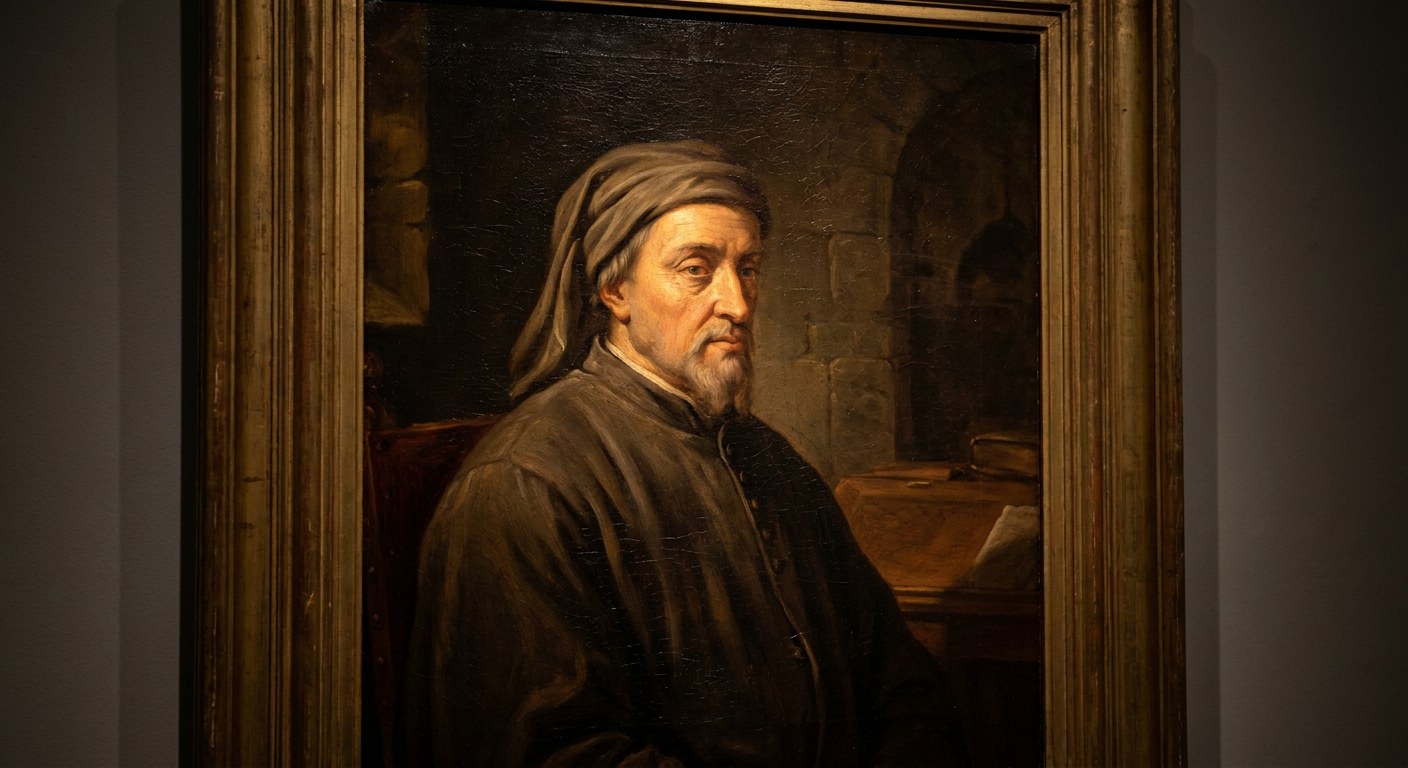
Geoffrey Chaucer
1343 – 1400 · English · Poet, Author & Royal Official
Recommended Audiobooks
Listen next from Marcus Alden

Life Lessons from Frederic Chopin
Marcus Alden · 54 min

Life Lessons from John Wesley
Marcus Alden · 52 min
Introduction
Geoffrey Chaucer was an English poet, author, diplomat, courtier, and royal administrator whose writing transformed the possibilities of English literature. Best known for The Canterbury Tales, he presented medieval society through a vivid company of pilgrims whose stories range from courtly romance and religious legend to bawdy comedy, moral fable, and social satire. His command of voice, characterization, irony, and narrative structure helped establish him as one of the most important writers in the history of the English language.
Chaucer lived during a period of war, plague, religious controversy, and political instability. England was engaged in the Hundred Years’ War, the Black Death remained a recent and recurring catastrophe, and the Peasants’ Revolt of 1381 exposed deep social tensions. The royal court was divided by faction, while writers and scholars were increasingly questioning institutional corruption. Chaucer did not stand outside this world. He served three kings, handled customs revenue, traveled on diplomatic missions, sat in Parliament, supervised royal building projects, and relied on aristocratic patronage.
These experiences gave him an unusually broad view of medieval life. His writings bring together knights, merchants, clerics, artisans, lawyers, laborers, officials, and women of sharply contrasting personalities. Rather than reducing them to simple types, Chaucer frequently allows his characters to expose themselves through their speech. The result is literature of remarkable psychological and social complexity.
Chaucer is often called the father of English poetry, although English literature existed long before him. His true achievement was to demonstrate that the Middle English vernacular could sustain ambitious works comparable to those written in French, Italian, or Latin. Through Troilus and Criseyde, The Parliament of Fowls, The House of Fame, The Legend of Good Women, and especially The Canterbury Tales, he became a foundational figure for later English poets and storytellers.
Quick Facts
| Category | Details |
|---|---|
| Born | About 1343, probably in London, England |
| Died | 25 October 1400, traditionally accepted; Westminster, England |
| Nationality | English |
| Known For | The Canterbury Tales, Troilus and Criseyde, and the development of literary Middle English |
| Occupation | Poet, author, diplomat, courtier, customs official, and royal administrator |
| Era | Late Middle Ages; Plantagenet England |
Early Life and Education
The exact date of Geoffrey Chaucer’s birth is unknown. Most scholars place it in the early 1340s, commonly around 1343. He was probably born in London into a prosperous family connected with the wine trade. His father, John Chaucer, was a vintner who supplied wine and had commercial and court connections. His mother is generally identified as Agnes Copton, an heiress whose family owned property in London.
The surname Chaucer probably derived from the Old French word chaucier, associated with a maker of footwear or hose. By Geoffrey’s lifetime, however, his family belonged to the commercially successful urban middle ranks rather than the artisan class. This background placed him between social worlds: he was neither a hereditary aristocrat nor a poor outsider. His family’s resources and connections gave him access to courtly service, while his urban upbringing exposed him to London’s merchants, officials, craftspeople, and travelers.
No surviving record identifies the school Chaucer attended. He may have received instruction at a London grammar school, where he would have studied Latin, rhetoric, logic, and religious texts. His writings reveal broad learning, including familiarity with classical authors, Christian theology, philosophy, astronomy, medicine, and the literary cultures of France and Italy. Some early biographers suggested that he studied at Oxford or Cambridge, but there is no reliable evidence that he attended either university.
The first secure documentary reference to Chaucer dates from 1357. Household accounts record the purchase of clothing for him while he served as a page in the household of Elizabeth de Burgh, Countess of Ulster, who was married to Lionel of Antwerp, a son of King Edward III. Service in a noble household was an important form of practical education. Chaucer would have learned courtly manners, administration, diplomacy, and the conventions of aristocratic culture. He also encountered French, still widely used among the English elite.
In 1359 Chaucer joined Edward III’s military expedition to France during the Hundred Years’ War. He was captured near Reims in 1360. The king contributed £16 toward his ransom, evidence that Chaucer was already considered a valued member of royal service. He later participated in negotiations associated with the release of English prisoners and the conclusion of peace.
These early experiences—urban commerce, aristocratic service, warfare, captivity, and royal administration—helped shape the social range of his later writing. They gave him firsthand knowledge of the institutions and classes that he would portray with such insight in The Canterbury Tales.
Rise to Prominence
By the 1360s Chaucer had entered sustained royal service. A document of 1367 identifies him as a valet in the household of Edward III. He received an annuity of twenty marks, and his duties probably involved carrying messages, attending the court, and undertaking confidential assignments. Royal service offered financial support and access to influential patrons, but it also demanded flexibility and political caution.
Around 1366 Chaucer married Philippa Roet, a lady-in-waiting connected with the royal household. Philippa’s sister Katherine Swynford became the mistress and later the wife of John of Gaunt, Duke of Lancaster. The marriage therefore linked Chaucer indirectly to one of the most powerful dynastic networks in England. Nevertheless, it would be misleading to attribute his entire career to family connections; his administrative abilities and long record of service were important in their own right.
Chaucer undertook several journeys abroad. A mission to Italy in 1372–1373 took him to Genoa and Florence in connection with English commercial interests. The journey was especially important for his literary development. Although the details of his encounters are unknown, Chaucer became familiar with the works of Dante Alighieri, Petrarch, and Giovanni Boccaccio. Their ambitious use of the vernacular, their handling of classical material, and their sophisticated narrative structures profoundly affected his poetry.
A later journey to Italy in 1378 involved negotiations concerning the marriage of the future Richard II. Chaucer’s diplomatic service also took him to France and the Low Countries. Such travel exposed him to international politics, trade, literature, and court culture at a time when most English people never journeyed far from their birthplace.
On 23 April 1374 Edward III granted Chaucer a daily allowance of a gallon of wine, a benefit later converted into a cash payment. In June of that year he became controller of the customs and subsidy on wool, skins, and hides in the port of London. Wool was central to the English economy, so this was a responsible and potentially demanding office. Chaucer was expected to keep records personally and oversee revenue collection. He lived for a time above Aldgate, one of London’s fortified gates.
During these years Chaucer developed into a major poet. His early writing drew heavily on French courtly traditions, but his encounters with Italian literature encouraged him to attempt longer and more intellectually ambitious works. By the 1380s he had produced poems such as The House of Fame, The Parliament of Fowls, and Troilus and Criseyde. His reputation among courtly and literary audiences steadily increased.
Major Achievements and Contributions
Chaucer’s greatest achievement was his elevation of Middle English into a language of major literature. Fourteenth-century England was multilingual. Latin dominated education, theology, and many official contexts, while French retained prestige among the aristocracy. English was widely spoken but varied greatly by region and had not yet acquired the cultural authority it would later possess. Chaucer chose primarily the London and East Midlands form of Middle English and demonstrated its flexibility across many genres.
He was not the first important English writer, nor did he single-handedly create standard English. Writers such as William Langland, the anonymous author of Sir Gawain and the Green Knight, and John Gower were also central to fourteenth-century literature. Chaucer nevertheless played an exceptional role because his works remained widely copied, printed, imitated, and studied. His language contributed to the prestige of the London literary dialect, even though the development of standard English was a much longer process.
Chaucer was a master of characterization. The pilgrims in The Canterbury Tales are introduced as recognizable social types, yet many emerge as complicated individuals. The Wife of Bath is both a representative of debates about marriage and a forceful personality with her own history, desires, contradictions, and rhetorical strategies. The Pardoner is morally corrupt but startlingly self-aware. The Miller is vulgar and disruptive, while the Knight projects dignity without being entirely free from critical scrutiny.
Another major contribution was Chaucer’s use of irony. His fictional narrator often appears polite, innocent, or unable to perceive the implications of what he describes. Readers must therefore distinguish between the narrator’s apparent judgment and the author’s larger design. This technique permits criticism without reducing the work to a direct sermon. Chaucer can expose greed, hypocrisy, vanity, misogyny, professional rivalry, and abuses of religious office while allowing competing interpretations to remain possible.
His poetry also displayed technical innovation. Chaucer adapted continental meters and forms to English, helping popularize rhyme royal—a seven-line stanza usually rhyming ababbcc. He employed decasyllabic lines that helped prepare the way for later English pentameter. Because Middle English pronunciation differs substantially from modern pronunciation, his meter can seem irregular when read with modern sounds; reconstructed pronunciation reveals much greater rhythmic consistency.
Chaucer was also an important translator and transmitter of ideas. His prose translation of Boethius’s Consolation of Philosophy, known as Boece, brought a major philosophical work to English readers. Questions of fate, providence, free will, fortune, and moral responsibility recur throughout Chaucer’s writings. His Treatise on the Astrolabe, written for a child named Lewis, is one of the earliest substantial scientific manuals in English.
Key Works / Battles / Ideas
The Book of the Duchess
Probably written between the late 1360s and early 1370s, The Book of the Duchess is a dream vision commonly associated with the death of Blanche of Lancaster, the first wife of John of Gaunt. The narrator encounters a grieving knight dressed in black and gradually learns of his loss. The poem blends courtly allegory with a sensitive exploration of bereavement. Its indirect structure shows Chaucer’s early interest in the limits of language and consolation.
The House of Fame
This unfinished dream vision follows a narrator carried by an eagle to the House of Fame, where reputations and reports circulate unpredictably. Drawing on Virgil, Ovid, Dante, and medieval theories of sound, the poem considers how stories are transmitted and distorted. Fame is shown not as a dependable reward for merit but as unstable, arbitrary, and shaped by rumor.
The Parliament of Fowls
In The Parliament of Fowls, birds gather before the goddess Nature to choose their mates on Saint Valentine’s Day. The poem combines political allegory, philosophical reflection, courtly love, and comedy. Different classes of birds debate the meaning of love according to their own interests. It contains one of Chaucer’s most famous observations on artistic difficulty: the life is short and the craft takes long to learn.
Troilus and Criseyde
Often regarded as Chaucer’s finest completed long poem, Troilus and Criseyde retells a tragic love story set during the Trojan War. Chaucer drew chiefly on Boccaccio’s Il Filostrato but greatly expanded the psychological and philosophical dimensions of the narrative. Troilus falls in love with Criseyde, and Pandarus engineers their relationship. When Criseyde is exchanged to the Greek camp, she eventually accepts Diomede, leaving Troilus devastated.
The poem resists easy moral judgments. Criseyde has traditionally been condemned for betrayal, yet Chaucer portrays her vulnerability within a male-dominated wartime society. Troilus is sincere but idealizes love, while Pandarus is both comic facilitator and manipulator. The conclusion turns from earthly passion toward a Christian vision of eternity, raising questions about fortune, human freedom, and the instability of worldly desire.
The Legend of Good Women
This work presents stories of women who suffered for love, including Cleopatra, Dido, Lucretia, and Ariadne. Its prologue survives in two versions and stages a playful literary trial in which Chaucer is accused of writing against women. The poem engages with medieval debates about gender, authority, and the moral responsibilities of authors, although modern readers differ over whether it challenges or reproduces antifeminist traditions.
The Canterbury Tales
Chaucer’s best-known work was probably begun in the late 1380s and remained unfinished at his death. A group of pilgrims gathers at the Tabard Inn in Southwark and travels toward the shrine of Thomas Becket at Canterbury Cathedral. Their host, Harry Bailly, proposes a storytelling contest to entertain the company.
The surviving work includes twenty-four tales, some complete and others fragmentary. The original plan described in the General Prologue would have required far more. The tales encompass chivalric romance, fabliau, beast fable, saint’s life, sermon, moral allegory, and prose treatise. Their diversity allows characters to answer, insult, correct, or compete with one another.
The General Prologue offers a celebrated social panorama, but it should not be mistaken for a neutral census of medieval England. Chaucer selects and arranges his pilgrims for literary purposes. Aristocrats, church figures, professionals, tradespeople, and rural characters appear, while many other groups are absent. The portraits combine conventional social satire with precise individual detail.
Among the most influential narratives are The Knight’s Tale, The Miller’s Tale, The Wife of Bath’s Prologue and Tale, The Pardoner’s Tale, The Nun’s Priest’s Tale, and The Franklin’s Tale. Together they explore authority, sexuality, marriage, class conflict, corruption, violence, storytelling, and the relationship between moral teaching and personal behavior.
The work ends in surviving manuscripts with Chaucer’s Retraction, in which the narrator asks forgiveness for writings associated with worldly vanity while thanking God for his moral and devotional works. Scholars debate how literally to interpret this ending, but it gives the collection a serious spiritual dimension.
A Treatise on the Astrolabe
Written around 1391, this prose work explains the operation of an astronomical instrument used to model the movement of celestial bodies and perform calculations. Chaucer addressed it to his son or godson Lewis, who was about ten years old. The treatise demonstrates his scientific knowledge and his ability to explain technical concepts in English.
Timeline of Key Events
| Year | Event |
|---|---|
| c. 1343 | Born, probably in London, into a family associated with the wine trade |
| 1357 | Recorded as a page in the household of Elizabeth de Burgh, Countess of Ulster |
| 1359–1360 | Serves in Edward III’s French campaign and is captured near Reims |
| 1360 | Edward III contributes £16 toward Chaucer’s ransom |
| c. 1366 | Marries Philippa Roet |
| 1367 | Recorded as a valet in Edward III’s household and granted an annuity |
| 1368–1372 | Probable period of composition of The Book of the Duchess |
| 1372–1373 | Travels to Genoa and Florence on royal business |
| 1374 | Receives a daily wine grant and becomes controller of customs in London |
| 1370s | Composes The House of Fame and other dream-vision poetry |
| 1378 | Undertakes another diplomatic mission to Italy |
| c. 1380–1382 | Composes The Parliament of Fowls |
| c. 1382–1386 | Writes Troilus and Criseyde |
| 1385 | Appointed a justice of the peace in Kent |
| 1386 | Represents Kent in Parliament and loses his London customs offices amid political change |
| c. 1386–1389 | Likely begins developing The Canterbury Tales |
| 1389 | Appointed clerk of the king’s works under Richard II |
| 1390 | Robbed on royal business; later formally released from liability for the lost money |
| 1391 | Leaves the clerkship and becomes deputy forester at North Petherton in Somerset |
| c. 1391 | Writes A Treatise on the Astrolabe for Lewis |
| 1394 | Receives an annual royal pension of £20 |
| 1399 | Henry IV confirms support and adds an annuity; Chaucer leases a home near Westminster Abbey |
| 1400 | Dies, traditionally on 25 October, and is buried in Westminster Abbey |
| 1556 | His remains are placed in a more elaborate tomb, later regarded as the beginning of Poets’ Corner |
Personal Life and Character
Chaucer’s marriage to Philippa Roet connected two people employed in royal and aristocratic households. Philippa served Queen Philippa of Hainault and later members of the Lancaster household. Because Geoffrey’s official duties required travel and residence in different locations, the couple may have spent extended periods apart. Philippa probably died around 1387, when records of payments to her cease.
The identities of Chaucer’s children are not entirely certain. His Treatise on the Astrolabe addresses a young Lewis, described as his little son. Thomas Chaucer, who became a wealthy landowner, royal official, and Speaker of the House of Commons, is widely regarded as Geoffrey’s son, although the evidence is not conclusive. Elizabeth Chaucer, a nun associated with Barking Abbey, and Agnes Chaucer have also been proposed as daughters.
Reconstructing Chaucer’s personality is difficult because his literary narrators should not be treated as straightforward self-portraits. In several poems, a character called Geoffrey appears bookish, physically unheroic, socially awkward, or humorously unaware. These portrayals are carefully designed comic roles. They suggest that Chaucer enjoyed self-deprecation, but they do not provide a transparent record of his private character.
Official documents portray him as adaptable, literate, and trusted with substantial responsibilities. He moved among merchants, royal servants, aristocrats, foreign diplomats, and laborers. His long survival at court suggests political caution. He served Edward III, Richard II, and Henry IV without becoming permanently identified with a defeated faction.
His writing reveals intellectual curiosity and close observation of human conduct. Chaucer could be sympathetic without being sentimental and critical without always declaring a verdict. He was fascinated by the difference between public reputation and private motive, as well as by the ways people use stories to justify themselves.
Challenges and Controversies
Chaucer’s life was shaped by financial uncertainty and political change. Although royal service provided offices, annuities, and gifts, payments were not always regular. He repeatedly sought confirmation of pensions or relief from official obligations. In 1386 he lost his customs positions and his Aldgate residence during a period when the political influence of his patrons weakened. He later returned to royal employment, but his finances appear to have remained uneven.
His tenure as clerk of the king’s works was also difficult. Chaucer supervised construction and repairs at royal properties, including the Tower of London and Westminster. In 1390 he was robbed more than once while carrying official funds. He was eventually discharged from personal liability, but the incidents illustrate the risks of medieval administration.
The most serious modern controversy concerns a 1380 legal document involving Cecily Chaumpaigne. In the document, Chaumpaigne released Chaucer from actions concerning what the Latin text calls de raptu meo. The word raptus could refer to rape or sexual violation, but in medieval legal usage it could also describe abduction or other forms of coercive removal. For generations, the ambiguous wording led scholars to debate whether Chaucer had sexually assaulted, abducted, or improperly employed Chaumpaigne.
Archival research announced in 2022 identified related documents indicating that the dispute likely concerned Chaumpaigne’s transfer of service from the household of Thomas Staundon to Chaucer. Staundon claimed financial damages for the loss of her labor. This evidence makes an employment dispute or alleged poaching of a servant a strong explanation for the release. It does not permit every detail to be reconstructed, however, and historians remain cautious about claiming absolute certainty.
Chaucer’s writings themselves generate controversy. They contain antisemitic, misogynistic, violent, and sexually coercive material inherited in part from medieval genres and sources. The Prioress’s Tale, for example, repeats a hostile anti-Jewish blood-libel narrative. The Wife of Bath challenges male authority but also emerges from traditions that caricature outspoken and sexually experienced women. Modern scholarship asks whether Chaucer endorses such views, exposes them through characterization, or creates deliberately unresolved tensions. The answer varies from tale to tale and cannot be reduced to a single formula.
The ordering and interpretation of The Canterbury Tales present additional difficulties. Chaucer left no complete authorial manuscript, and surviving copies arrange some sections differently. Editors must make decisions about sequence, spelling, punctuation, and textual variants. Even the familiar modern shape of the work is partly an editorial reconstruction.
Death and Immediate Aftermath
In December 1399 Chaucer leased a dwelling within the precincts of Westminster Abbey. His decision may have reflected convenience, financial considerations, or a desire to live near the centers of royal government. He died the following year. The traditional date, 25 October 1400, comes from the inscription on a tomb erected more than a century later and cannot be independently confirmed.
Chaucer was buried in Westminster Abbey. His burial there probably resulted from his status as a royal servant and Westminster resident rather than from an established national tradition of honoring poets. In 1556 the antiquary and poet Nicholas Brigham arranged for a more elaborate tomb. Burials and memorials of later writers accumulated nearby, creating what became known as Poets’ Corner.
Chaucer’s unfinished writings circulated in manuscript after his death. Scribes, readers, and later editors tried to organize The Canterbury Tales, sometimes adding spurious continuations or altering the text. His contemporary and admirer Thomas Hoccleve praised him as the first finder of the English language and included a famous portrait of him in a manuscript of The Regiment of Princes.
Legacy and Influence Today
Chaucer’s influence grew across the fifteenth century. Poets including John Lydgate and Thomas Hoccleve treated him as a master and literary ancestor. His works circulated widely in manuscript, and his reputation became linked to the cultural dignity of English writing.
William Caxton, England’s first major printer, produced an edition of The Canterbury Tales around 1476–1477, making it one of the earliest substantial works printed in England. Caxton later issued a revised edition after obtaining what he considered a better manuscript. Printing helped secure Chaucer’s place in the national canon, even as changes in pronunciation and vocabulary made his language increasingly difficult for readers.
Later writers repeatedly adapted his material. Edmund Spenser honored Chaucer as an English predecessor. William Shakespeare and John Fletcher drew on The Knight’s Tale for The Two Noble Kinsmen, while Shakespeare’s Troilus and Cressida belongs to the wider tradition Chaucer had helped reshape. John Dryden modernized several tales in Fables Ancient and Modern, calling Chaucer the father of English poetry.
Modern novelists owe much to Chaucer’s use of multiple narrators, competing perspectives, and socially varied voices. The pilgrimage framework offers a model for bringing strangers together and allowing their stories to reveal their values. Writers and filmmakers continue to adapt the tales because their themes—desire, status, greed, faith, hypocrisy, marriage, and the unreliability of narration—remain recognizable.
Chaucer is also central to the study of medieval language and culture. His works preserve evidence about pronunciation, vocabulary, social customs, religious practice, occupations, scientific knowledge, and gender debate. Yet scholars emphasize that his poetry is imaginative art, not a transparent documentary record of medieval society.
Today he matters not because he supposedly invented English literature, but because he expanded what English literary art could accomplish. His writing can be comic and tragic, sacred and irreverent, intimate and encyclopedic. It invites readers to listen carefully to conflicting voices and to recognize that narrators, institutions, and traditions may conceal as much as they reveal.
Famous Quotes
Whan that Aprill with his shoures soote / The droghte of March hath perced to the roote.
— The Canterbury Tales, General Prologue
And gladly wolde he lerne, and gladly teche.
— The Canterbury Tales, General Prologue
The lyf so short, the craft so long to lerne.
— The Parliament of Fowls
For out of olde feldes, as men seyth, / Cometh al this newe corn from yeer to yere.
— The Parliament of Fowls
That field hath eyen, and the wode hath eres.
— The Canterbury Tales, The Knight’s Tale
Ful wys is he that kan hymself knowe.
— The Canterbury Tales, The Monk’s Tale
Trouthe is the hyeste thyng that man may kepe.
— Truth
Frequently Asked Questions
Why is Geoffrey Chaucer called the father of English poetry?
Chaucer is given this title because he demonstrated that Middle English could support sophisticated poetry comparable to major works in French, Italian, and Latin. He did not create English literature, but his popularity, technical skill, and influence gave vernacular English exceptional literary prestige.
When and where was Geoffrey Chaucer born?
He was probably born in London in the early 1340s, often estimated as about 1343. No surviving record provides an exact birth date.
What is Geoffrey Chaucer’s most famous work?
His most famous work is The Canterbury Tales, an unfinished collection of stories told by pilgrims traveling from London toward the shrine of Thomas Becket in Canterbury.
Did Chaucer write in Old English?
No. Chaucer wrote primarily in Middle English. Old English was the language of works such as Beowulf and had changed substantially by the fourteenth century.
Was Chaucer only a poet?
No. He was also a courtier, diplomat, customs controller, justice of the peace, member of Parliament, clerk of the king’s works, and forest official. His administrative career supplied income and broadened his knowledge of medieval society.
Did Chaucer finish The Canterbury Tales?
No. Only twenty-four tales survive, and some are incomplete. The plan announced by the Host would have required many more stories. Chaucer died before completing the project or left it unfinished for other reasons.
Did Chaucer meet Petrarch or Boccaccio?
There is no reliable evidence that he personally met either writer. His Italian journeys made such encounters conceivable, but documented proof is lacking. His works nevertheless show strong knowledge of Italian literature, particularly Dante and Boccaccio.
Where is Geoffrey Chaucer buried?
He is buried in Westminster Abbey in London. His tomb became the focal point of the area later known as Poets’ Corner.
Lessons We Can Learn
-
Use the language available to you boldly. Chaucer showed that a language considered less prestigious than Latin or French could become a vehicle for ambitious literature.
-
Listen to conflicting perspectives. His characters rarely speak with one unified voice. Their disagreements teach readers to examine motive, bias, and social position.
-
Experience can enrich creativity. Chaucer transformed knowledge gained from travel, diplomacy, commerce, science, and administration into imaginative art.
-
Humor can reveal serious truths. His comedy exposes greed, hypocrisy, prejudice, and self-deception without abandoning entertainment or human sympathy.
-
Great works need not be complete to be influential. The Canterbury Tales remained unfinished, yet its surviving stories permanently changed English literature.
Further Reading
- Derek Pearsall, The Life of Geoffrey Chaucer: A Critical Biography.
- Marion Turner, Chaucer: A European Life.
- Paul Strohm, Chaucer’s Tale: 1386 and the Road to Canterbury.
- David Wallace, ed., The Cambridge History of Medieval English Literature.
- Larry D. Benson, ed., The Riverside Chaucer.
Watch and Learn
Everything You Need to Know to Read The Canterbury Tales · TED-Ed