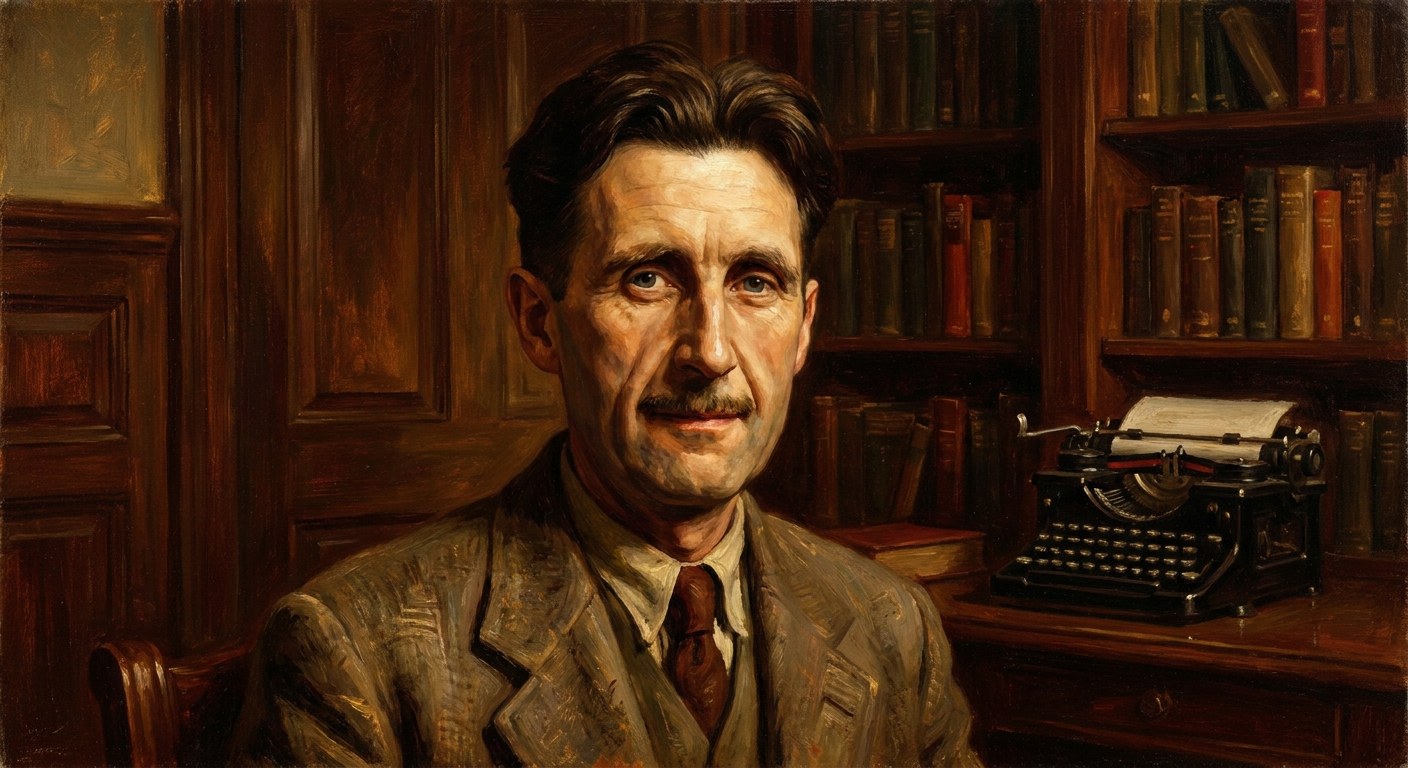
George Orwell
1903 – 1950 · British · Novelist & Essayist
Recommended Audiobooks
Listen next from Marcus Alden

Life Lessons from Frederic Chopin
Marcus Alden · 54 min

Life Lessons from John Wesley
Marcus Alden · 52 min
Introduction
George Orwell was the pen name of Eric Arthur Blair (25 June 1903–21 January 1950), an English novelist, essayist, journalist and critic whose writing transformed political language and modern literature. Best known for the allegorical novella Animal Farm and the dystopian novel Nineteen Eighty-Four, Orwell examined how authoritarian governments manipulate truth, rewrite history, corrupt language and intrude into private life.
His reputation, however, rests on far more than two famous works. Orwell wrote about imperialism in Burma, poverty in Paris and London, unemployment in industrial England, revolutionary politics in Spain, popular culture, nationalism, class prejudice and the moral responsibilities of writers. His prose was direct, observant and often deliberately plain. He believed that clear language could resist political deception, while vague or inflated language could help conceal cruelty and injustice.
Orwell’s politics were complex. He was a democratic socialist who fiercely opposed social inequality and British imperialism, but he was equally hostile to Stalinism and totalitarian rule. His experiences during the Spanish Civil War convinced him that propaganda, censorship and ideological loyalty could destroy truth even within movements claiming to fight for liberation.
Frequently invoked by people across the political spectrum, Orwell remains one of the most influential writers of the twentieth century. Terms derived from his work—including “Orwellian,” “Big Brother,” “doublethink,” “thoughtcrime” and “Newspeak”—have entered everyday language. They continue to shape debates about surveillance, censorship, disinformation, political conformity and the ownership of historical memory.
Quick Facts
| Field | Details |
|---|---|
| Full name | Eric Arthur Blair |
| Pen name | George Orwell |
| Born | 25 June 1903 |
| Birthplace | Motihari, Bengal Presidency, British India |
| Died | 21 January 1950 |
| Place of death | University College Hospital, London, England |
| Age at death | 46 |
| Nationality | British |
| Occupations | Novelist, essayist, journalist, critic and broadcaster |
| Education | St Cyprian’s School; Wellington College; Eton College |
| Political outlook | Democratic socialism; anti-imperialism; anti-totalitarianism |
| Best-known works | Animal Farm and Nineteen Eighty-Four |
| Other major works | Down and Out in Paris and London, Burmese Days, The Road to Wigan Pier, Homage to Catalonia |
| First wife | Eileen O’Shaughnessy |
| Second wife | Sonia Brownell |
| Child | Richard Horatio Blair, adopted in 1944 |
| Cause of death | Complications of pulmonary tuberculosis |
| Burial place | All Saints’ Churchyard, Sutton Courtenay, Oxfordshire |
| Literary distinction | One of the twentieth century’s most influential political writers |
Early Life & Background
Eric Arthur Blair was born on 25 June 1903 in Motihari, in the Bengal Presidency of British India. His father, Richard Walmesley Blair, worked in the Opium Department of the Indian Civil Service, an institution involved in supervising the production of opium for government-controlled trade. His mother, Ida Mabel Blair, born Limouzin, came from a family of French ancestry with commercial connections in Southeast Asia. Eric had an older sister, Marjorie, and a younger sister, Avril.
In 1904, Ida brought Eric and Marjorie to England. Eric spent much of his childhood in the Thames Valley, while his father remained in India until his retirement in 1912. The Blair family possessed the manners and aspirations of the professional middle class but did not have substantial wealth. Orwell later described this social position as the “lower-upper-middle class.” The tensions between status, money, education and class consciousness became recurring subjects in his writing.
In 1911, Blair entered St Cyprian’s, a preparatory school in Eastbourne, Sussex. He attended partly through a reduced-fee arrangement intended to prepare talented boys for scholarships to elite public schools. He later depicted the school as snobbish, humiliating and socially competitive in the autobiographical essay “Such, Such Were the Joys,” although some contemporaries disputed the severity of his account.
Blair won scholarships to Wellington College and Eton College. After a brief period at Wellington, he entered Eton in 1917 and remained there until 1921. Among his teachers was the writer Aldous Huxley, who taught French. Blair was not an exceptionally diligent conventional student, but he read widely and showed an early interest in literature.
Instead of attending university, Blair joined the Indian Imperial Police in 1922. He was posted to Burma, then governed as a province of British India, and served in locations including Moulmein, Twante, Syriam, Insein and Katha. As a colonial police officer, he exercised authority over Burmese subjects while increasingly questioning the system he represented.
The conflict between his official role and his growing hostility to empire became foundational to his moral and literary development. His Burmese experiences later inspired the novel Burmese Days and the essays “A Hanging” and “Shooting an Elephant.” These works portray imperialism not only as destructive to the colonized but also as morally degrading to those who enforce it.
While on leave in England in 1927, Blair decided not to return to Burma. He resigned from the police in January 1928 and committed himself to becoming a writer.
Rise to Prominence
After leaving imperial service, Blair deliberately entered worlds far removed from colonial officialdom. He lived in inexpensive lodgings in London and spent time among tramps, casual laborers and residents of lodging houses. In Paris, where he lived from 1928 to 1929, he worked in poorly paid jobs, including as a dishwasher in hotel and restaurant kitchens. These experiences supplied the material for his first book, Down and Out in Paris and London.
The book appeared in January 1933 under the name George Orwell. Blair adopted a pseudonym partly to protect his family from embarrassment and partly because he remained uncertain about the book’s reception. “George” suggested an ordinary English name, while “Orwell” came from the River Orwell in Suffolk, a landscape he admired. Although he continued to be known as Eric Blair among friends and relatives, George Orwell became his permanent literary identity.
Down and Out in Paris and London combined memoir, reportage and crafted narrative. It introduced themes that would define Orwell’s career: class inequality, the dignity of ordinary people, the social invisibility of poverty and the difference between respectable assumptions and lived reality.
His first novel, Burmese Days, was published in the United States in 1934 and in Britain in 1935 after concerns about possible legal action. Its bitter portrayal of racism, loneliness and corruption within the Anglo-Indian colonial community established Orwell as an important critic of empire.
During the early 1930s, Orwell supported himself through reviewing, teaching and work in a secondhand bookshop in Hampstead. His experiences in the shop informed the novel Keep the Aspidistra Flying and the essay “Bookshop Memories.” He also published A Clergyman’s Daughter in 1935, a formally experimental novel about faith, social pressure and economic insecurity.
In 1936, the publisher Victor Gollancz commissioned Orwell to investigate unemployment and working-class life in northern England. Orwell visited industrial communities in Lancashire and Yorkshire, descended into a coal mine and stayed in working-class homes. The resulting book, The Road to Wigan Pier, was published in 1937 by the Left Book Club.
Its first half offered vivid social reporting on housing, wages, mining and unemployment. Its second half argued for socialism while criticizing class prejudice, dogmatism and cultural alienation within parts of the British socialist movement. The book expanded Orwell’s audience and established him as a distinctive voice on the political left.
Major Achievements
Orwell’s greatest achievement was his ability to unite literature, political argument and close observation without reducing one to the other. His work moved between novels, memoirs, documentary reportage, essays, reviews, columns and radio broadcasts.
Homage to Catalonia, published in 1938, became one of the most important eyewitness accounts of the Spanish Civil War. Unlike many contemporary narratives, it documented political repression within the Republican camp and challenged misleading accounts promoted by Soviet-aligned organizations. Although the book sold poorly at first, it later became central to Orwell’s reputation for intellectual independence.
His essays are another major part of his achievement. “Politics and the English Language” analyzed how clichés, euphemisms and abstract phrasing can obscure responsibility. “The Prevention of Literature” defended intellectual freedom. “Notes on Nationalism” examined ideological obsession and selective morality. “Inside the Whale,” “Charles Dickens,” “The Lion and the Unicorn” and “Why I Write” combined criticism, autobiography and political analysis.
Orwell also elevated ordinary subjects into serious literary material. He wrote memorably about tea, pubs, boys’ comics, postcards, book reviewing, school memories, weather, food and domestic routines. This breadth reflected his belief that politics was embedded in daily life rather than confined to governments and parties.
His most famous fiction appeared near the end of his life. Animal Farm, published in Britain on 17 August 1945, retold the history of the Russian Revolution and its Stalinist betrayal through the story of farm animals who overthrow their human owner. Its apparent simplicity concealed a tightly constructed analysis of revolutionary idealism, propaganda, privilege and political corruption.
Nineteen Eighty-Four, published in Britain on 8 June 1949, presented a society in which the Party controls public records, language, personal relationships and even the boundaries of permissible thought. The novel’s lasting power comes not from predicting one exact future but from identifying recurring mechanisms of domination: permanent war, pervasive surveillance, forced confession, historical falsification and the destruction of independent standards of truth.
Defining Moments
One of Orwell’s first defining experiences was his service in Burma. As a police officer, he saw colonial authority at close range. His later writing suggests that guilt over his participation in imperial rule helped shape his decision to live among people excluded from respectable society.
A second turning point was his investigation of poverty. Orwell did not merely study deprivation from a distance; he entered lodging houses, kitchens, hop fields and industrial neighborhoods. His accounts were selective and literary rather than neutral sociological records, but they gave him an unusually concrete understanding of labor, hunger and social stigma.
The Spanish Civil War was perhaps the decisive political experience of his life. Orwell arrived in Barcelona in December 1936 intending to report on the conflict but joined the militia of the Workers’ Party of Marxist Unification, known as the POUM. He served on the Aragon front. On 20 May 1937, a sniper’s bullet passed through his throat, narrowly missing major arteries and damaging his voice.
While Orwell recovered, the Soviet-supported Communist authorities moved against the POUM, denouncing it as a fascist organization. Friends and comrades were arrested, and Orwell and Eileen escaped Spain in June 1937. He concluded that powerful political movements could suppress inconvenient facts and make demonstrable falsehoods appear official. This conviction directly influenced Animal Farm and Nineteen Eighty-Four.
Another defining moment came when British publishers initially rejected Animal Farm. During the wartime alliance with the Soviet Union, an anti-Stalinist allegory was politically uncomfortable. The delay reinforced Orwell’s concern that censorship could arise not only through direct government orders but also through social pressure, institutional caution and intellectual conformity.
His wife Eileen’s sudden death in 1945, while undergoing surgery, was a profound personal loss. At the same time, Animal Farm brought him financial success and international recognition. In worsening health, he withdrew for long periods to the remote Scottish island of Jura, where he completed Nineteen Eighty-Four. The effort contributed to his physical collapse but secured his global literary reputation.
Timeline
| Year | Event |
|---|---|
| 1903 | Eric Arthur Blair is born on 25 June in Motihari, British India. |
| 1904 | His mother takes him and his sister Marjorie to England. |
| 1911 | He begins attending St Cyprian’s preparatory school in Eastbourne. |
| 1917 | After a short period at Wellington, he enters Eton College as a King’s Scholar. |
| 1921 | He leaves Eton. |
| 1922 | He joins the Indian Imperial Police and is posted to Burma. |
| 1927 | He returns to England on leave and decides to abandon colonial service. |
| 1928 | He resigns from the police and begins pursuing a writing career. |
| 1928–1929 | He lives in Paris and works in low-paid jobs, including as a dishwasher. |
| 1933 | Down and Out in Paris and London is published under the name George Orwell. |
| 1934 | Burmese Days is published in the United States. |
| 1935 | A Clergyman’s Daughter appears; the British edition of Burmese Days is published. |
| 1936 | Keep the Aspidistra Flying is published; Orwell investigates northern industrial poverty and marries Eileen O’Shaughnessy. |
| 1936–1937 | He travels to Spain and fights with a POUM militia in the Spanish Civil War. |
| 1937 | The Road to Wigan Pier is published; Orwell is shot in the throat and later escapes Spain. |
| 1938 | Homage to Catalonia is published; Orwell travels to French Morocco for his health. |
| 1939 | Coming Up for Air is published. |
| 1941 | He begins working for the BBC’s Eastern Service. |
| 1943 | He resigns from the BBC and becomes literary editor of Tribune. |
| 1944 | Eric and Eileen adopt Richard Horatio Blair. |
| 1945 | Eileen dies on 29 March; Animal Farm is published on 17 August. |
| 1946 | Orwell spends increasing amounts of time on Jura and publishes “Politics and the English Language” and “Why I Write.” |
| 1947 | Tuberculosis is diagnosed after his health deteriorates seriously. |
| 1948 | He completes the manuscript of Nineteen Eighty-Four. |
| 1949 | Nineteen Eighty-Four is published; Orwell marries Sonia Brownell on 13 October. |
| 1950 | He dies in London on 21 January and is buried at Sutton Courtenay. |
Personal Life
Orwell married Eileen O’Shaughnessy on 9 June 1936 at St Mary’s Church in Wallington, Hertfordshire. Eileen was intelligent, independent and politically engaged. She supported Orwell’s work, managed practical and financial matters, and accompanied him to Spain, where she worked in the Barcelona office of the Independent Labour Party.
The couple lived modestly, at times keeping animals and growing food. In June 1944, they adopted a baby boy, Richard Horatio Blair. Orwell was reportedly an affectionate father, though his work, illness and wartime travel often complicated family life.
Eileen died unexpectedly on 29 March 1945 in Newcastle upon Tyne while undergoing surgery for a uterine condition. Orwell was abroad as a war correspondent at the time. Her death left him responsible for Richard with assistance from his sister Avril and others.
Orwell formed intense friendships and made several proposals of marriage after Eileen’s death. In October 1949, while seriously ill at University College Hospital, he married Sonia Brownell, an editorial assistant associated with the literary magazine Horizon. Sonia later played an important role in protecting Orwell’s literary estate and promoting his work.
Orwell enjoyed gardening, fishing, carpentry, keeping animals and the rituals of traditional English domestic life. He was tall, thin and physically awkward, with a deep voice that became altered after his throat wound. Heavy cigarette smoking and years of recurring respiratory illness worsened his tuberculosis.
He requested burial according to Anglican rites, despite his religious skepticism. He was buried under his birth name, Eric Arthur Blair, in All Saints’ Churchyard at Sutton Courtenay.
Beliefs & Philosophy
Orwell described his political position as democratic socialism. He believed that extreme inequality damaged freedom, dignity and social trust. He supported public ownership and economic reform but rejected one-party dictatorship, political terror and the suppression of dissent.
His socialism was ethical as much as economic. It rested on fairness, decency and opposition to hierarchy. He distrusted political theories that excused cruelty in the name of historical necessity. For Orwell, no promised future could justify deliberate lies or the destruction of individual conscience.
His opposition to imperialism emerged from direct experience. He understood empire as a system sustained by force and racial domination, even when presented as orderly or benevolent. Yet he also recognized the psychological traps of imperial rule, in which officials became prisoners of the authority they were expected to display.
Truth was central to Orwell’s philosophy. He feared the disappearance of a shared factual world in which evidence could challenge power. In his writing, totalitarianism did not merely censor opinions; it attempted to control memory and determine what counted as reality.
Orwell likewise believed that political language mattered. Euphemism could make violence sound administrative, while clichés allowed writers to avoid thought. His ideal prose was concrete, economical and honest. He did not always meet his own standards, but his analysis of linguistic manipulation remains highly influential.
Although skeptical of organized religion and supernatural belief, Orwell respected parts of England’s Christian moral tradition. He valued compassion, personal loyalty and ordinary decency. He was also a patriot, though not a nationalist in the uncritical sense. During the Second World War, he supported Britain’s struggle against Nazi Germany while advocating socialist transformation at home.
Challenges & Controversies
Orwell endured poverty, professional uncertainty and severe illness. For much of the 1930s, his books earned little money. He worked as a teacher, bookshop assistant, reviewer, broadcaster and journalist. Chronic respiratory problems eventually developed into tuberculosis, which was diagnosed conclusively in the late 1940s. Medical treatment was limited before antibiotics became widely available.
His work often provoked opposition from both right and left. Conservatives objected to his socialism and anti-imperialism. Communists and Soviet sympathizers attacked his criticism of Stalinism, especially his account of Spain. Orwell’s refusal to subordinate facts to political loyalty contributed to his later stature but isolated him during his lifetime.
Modern scholars also debate his methods. Down and Out in Paris and London and The Road to Wigan Pier draw on genuine observation, but they are shaped narratives rather than transparent documentary records. Orwell sometimes adopted identities or emphasized selected episodes to create literary force.
His attitudes reflected some prejudices of his era. Private writings and occasional published passages contain language about women, Jewish people and gay men that readers now recognize as sexist, antisemitic or homophobic. Scholars disagree about how such remarks should be weighed against his broader opposition to prejudice and authoritarianism. A complete assessment must acknowledge both his moral insight and his limitations.
Another controversy concerns a list he supplied in 1949 to his friend Celia Kirwan, who worked for the British Foreign Office’s Information Research Department. Orwell named writers and public figures whom he considered unsuitable for anti-Communist propaganda work because of suspected pro-Soviet sympathies or political unreliability. The list included personal and sometimes prejudiced annotations. Defenders distinguish it from a police denunciation, while critics regard his cooperation with a secret government propaganda unit as inconsistent with his defense of liberty.
Orwell’s legacy is also contested because “Orwellian” is used so broadly. Political groups with opposing beliefs cite him as an ally. This can flatten his actual position: he opposed totalitarianism from within the democratic socialist tradition, not from a position of political neutrality.
Famous Quotes
“All animals are equal, but some animals are more equal than others.”
— Animal Farm
“Big Brother is watching you.”
— Nineteen Eighty-Four
“If liberty means anything at all it means the right to tell people what they do not want to hear.”
— Proposed preface to Animal Farm
“Political language—and with variations this is true of all political parties, from Conservatives to Anarchists—is designed to make lies sound truthful and murder respectable.”
— “Politics and the English Language”
“To see what is in front of one’s nose needs a constant struggle.”
— “In Front of Your Nose”
“The object of power is power.”
— Nineteen Eighty-Four
“In a time of universal deceit, telling the truth is a revolutionary act.”
The final quotation is widely attributed to Orwell, but no reliable source has been found in his published writings. It should therefore be treated as unverified, despite its compatibility with themes he explored.
Legacy & Influence
Orwell died before he could witness the full impact of Nineteen Eighty-Four. Within a few years, the novel became a standard reference point for discussions of dictatorship, propaganda and surveillance. Its vocabulary entered political speech across the world.
The adjective “Orwellian” now describes systems or practices involving intrusive surveillance, official deception, censorship, manipulated language or the denial of obvious facts. “Big Brother” signifies an authority that constantly watches. “Doublethink” describes the trained acceptance of contradictory beliefs. “Newspeak” refers to language designed to restrict thought, while the “memory hole” symbolizes the destruction of inconvenient information.
His influence extends across literature, journalism, political theory, film, television and digital culture. Dystopian writers such as Margaret Atwood and numerous later novelists have engaged with his themes. Journalists continue to cite his commitment to eyewitness reporting and linguistic clarity. Historians of the Cold War regard him as a major anti-Stalinist writer whose socialism prevented his critique from becoming a simple defense of existing capitalism.
Animal Farm has been translated into many languages and adapted for stage, radio, animation and live-action film. It remains widely taught because it makes complex political processes understandable without losing their moral seriousness. Nineteen Eighty-Four has repeatedly returned to bestseller lists during controversies over government surveillance, manipulated media and “alternative facts.”
Orwell’s essays may constitute an equally durable legacy. Their voice—personal, lucid, skeptical and willing to criticize allies—helped shape modern English nonfiction. His insistence that writers examine their own motives remains especially significant.
Yet Orwell’s greatest contribution may be a habit of mind rather than a set of slogans: test claims against evidence, distrust euphemism, resist the erasure of memory and refuse to excuse falsehood merely because it benefits one’s preferred political side.
Interesting Facts
- George Orwell was born Eric Arthur Blair and used both names in different areas of his life.
- His surname “Orwell” was inspired by the River Orwell in Suffolk.
- Aldous Huxley, the author of Brave New World, briefly taught him French at Eton.
- Orwell’s father worked in the colonial administration connected with the British-controlled opium trade.
- While serving in Spain, Orwell was shot through the throat but survived.
- His Spanish militia unit was associated with the POUM, a revolutionary Marxist party opposed to Stalinism.
- He worked for the BBC from 1941 to 1943, producing cultural broadcasts intended largely for Indian audiences.
- Room 101 in Nineteen Eighty-Four may have been named after a conference room at the BBC’s Broadcasting House that Orwell disliked, though accounts vary.
- Several publishers rejected Animal Farm before Secker & Warburg accepted it.
- Orwell completed much of Nineteen Eighty-Four at Barnhill, an isolated farmhouse on Jura in Scotland’s Inner Hebrides.
- He typed the final manuscript while gravely ill.
- The title Nineteen Eighty-Four may have resulted from reversing the final two digits of 1948, the year in which he completed the book, although the precise reason remains uncertain.
- Orwell asked to be buried in an English country churchyard according to Anglican rites.
- His gravestone bears “Eric Arthur Blair,” not “George Orwell.”
- He was only 46 when he died.
Frequently Asked Questions
Why did Eric Blair call himself George Orwell?
He adopted the name for Down and Out in Paris and London in 1933, partly to protect his family and partly to establish a separate literary identity. “George” sounded traditionally English, and “Orwell” referred to the River Orwell in Suffolk.
What is George Orwell most famous for?
He is most famous for Animal Farm and Nineteen Eighty-Four. The first is an allegory of revolutionary betrayal and Stalinism; the second examines totalitarian power, surveillance, propaganda and control over truth.
Was George Orwell a socialist?
Yes. Orwell consistently identified with democratic socialism. He supported greater economic equality and opposed capitalism’s class divisions, but he rejected Stalinism, dictatorship and one-party government.
Why did Orwell fight in the Spanish Civil War?
He went to Spain in late 1936 to oppose Francisco Franco’s Nationalist uprising. He joined a POUM-affiliated militia because of the political connections through which he entered Spain. His experiences convinced him that Soviet-backed forces were suppressing rival left-wing groups and falsifying accounts of events.
How was Orwell wounded?
On 20 May 1937, while serving on the Aragon front, he was shot through the throat by a sniper. The bullet narrowly missed major blood vessels. He temporarily lost much of his voice and retained a changed vocal quality.
Is Animal Farm only about the Soviet Union?
Its principal historical target is the Russian Revolution and the rise of Stalinism. Napoleon represents Stalin, Snowball resembles Trotsky, and the farm’s transformation parallels the emergence of a privileged Soviet ruling class. However, its themes also apply more broadly to propaganda, concentrated power and failed revolutions.
Did Orwell predict modern surveillance?
Orwell did not predict every modern technology. Instead, he dramatized the political consequences of constant monitoring and the disappearance of private life. His ideas remain relevant to debates about cameras, data collection, digital tracking and state or corporate surveillance.
What does “Orwellian” mean?
“Orwellian” usually describes deceptive or oppressive practices associated with Orwell’s fictional regimes: surveillance, censorship, propaganda, historical revision and language that disguises reality. The term is often overused, so its meaning depends on careful context.
What was Orwell’s final book?
His final completed book was Nineteen Eighty-Four, published in 1949. He had considered other projects, including another novel, but died before completing them.
How did George Orwell die?
He died from complications of pulmonary tuberculosis at University College Hospital in London on 21 January 1950.
Lessons from George Orwell
- Defend objective facts. Political freedom becomes fragile when evidence can be replaced by officially convenient narratives.
- Use clear language. Plain, precise words make manipulation more difficult and responsibility harder to hide.
- Question your own side. Loyalty to a cause should not require silence about its failures or crimes.
- Observe before judging. Orwell’s strongest work grew from close attention to workplaces, homes and individual experiences.
- Distinguish patriotism from nationalism. Affection for a country need not require claims of superiority or automatic obedience.
- Protect intellectual freedom. Literature and journalism depend on the right to state unwelcome conclusions.
- Remember that power seeks permanence. Institutions rarely surrender authority without pressure and accountability.
- Do not romanticize poverty. Hardship may reveal courage, but it also humiliates, exhausts and restricts human possibility.
- Preserve historical memory. Accurate records provide a defense against propaganda and manufactured consensus.
- Apply moral standards consistently. Cruelty and dishonesty do not become acceptable because they serve a favored ideology.
- Recognize personal limitations. Orwell’s own prejudices show that moral criticism must include self-examination.
- Value ordinary decency. Political ideals matter most when they protect dignity in everyday life.
Further Reading
- George Orwell, Down and Out in Paris and London (1933)
- George Orwell, Burmese Days (1934)
- George Orwell, The Road to Wigan Pier (1937)
- George Orwell, Homage to Catalonia (1938)
- George Orwell, Animal Farm (1945)
- George Orwell, Nineteen Eighty-Four (1949)
- George Orwell, “Shooting an Elephant”
- George Orwell, “Politics and the English Language”
- George Orwell, “Why I Write”
- George Orwell, “Notes on Nationalism”
- George Orwell, “The Prevention of Literature”
- Bernard Crick, George Orwell: A Life
- D. J. Taylor, Orwell: The Life
- Gordon Bowker, George Orwell
- Michael Shelden, Orwell: The Authorized Biography
- Peter Davison, editor, The Complete Works of George Orwell
- Sylvia Topp, Eileen: The Making of George Orwell
- Rebecca Solnit, Orwell’s Roses