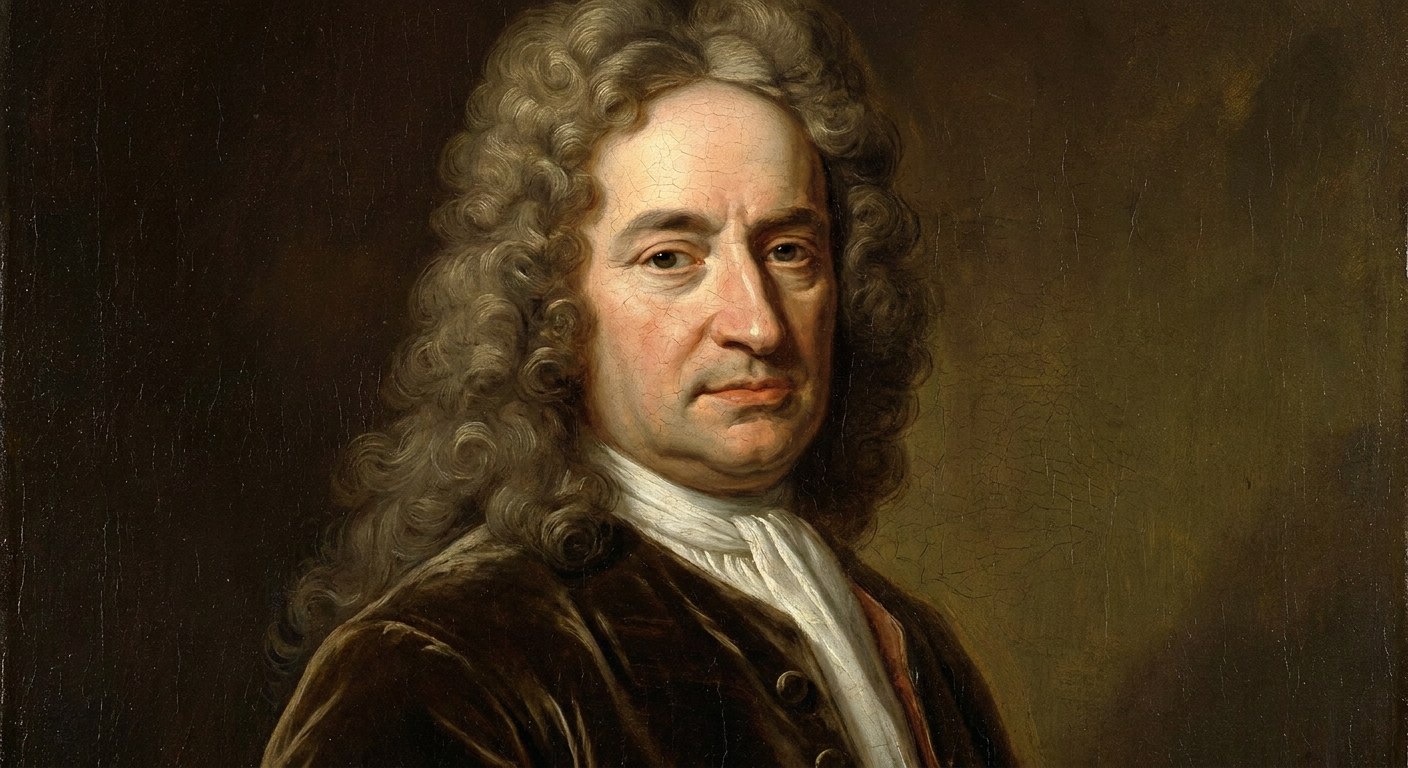
Gottfried Wilhelm Leibniz
1646 – 1716 · German · Philosopher & Mathematician
Recommended Audiobooks
Listen next from Marcus Alden

Life Lessons from Frederic Chopin
Marcus Alden · 54 min

Life Lessons from John Wesley
Marcus Alden · 52 min
Introduction
Gottfried Wilhelm Leibniz was one of the most versatile and original thinkers in European history. A philosopher, mathematician, jurist, diplomat, historian, librarian, engineer and political adviser, he contributed to an extraordinary range of disciplines. He independently developed differential and integral calculus, introduced mathematical notation still used today, designed an advanced mechanical calculator, promoted binary arithmetic and helped establish institutions of scientific research. In philosophy, he created a distinctive metaphysical system built around simple substances called monads, the principle of sufficient reason and the idea that God selected the best of all possible worlds.
Leibniz belonged to the last generation in which a single scholar could plausibly aspire to master nearly every recognized field of knowledge. His surviving papers reveal interests extending from logic, linguistics and theology to mining technology, Chinese philosophy, medicine and international law. He believed that apparently separate branches of knowledge could be organized into a rational system and that disputes might eventually be resolved through a universal symbolic language.
Although Leibniz became internationally respected, his career was marked by unfinished projects, political disappointments and a bitter priority dispute with Isaac Newton over the invention of calculus. At his death in 1716, his reputation was less secure than his achievements deserved. His influence subsequently expanded, however, and modern scholars recognize him as a major precursor of mathematical logic, computer science, information theory and analytic philosophy. His enduring importance lies not only in particular discoveries but also in his conviction that reason, symbolism and cooperation could enlarge human understanding.
Quick Facts
| Fact | Details |
|---|---|
| Born | 1 July 1646, Leipzig, Electorate of Saxony, Holy Roman Empire |
| Died | 14 November 1716, Hanover, Electorate of Hanover, Holy Roman Empire |
| Nationality | German |
| Known For | Calculus, Leibniz notation, monadology, binary arithmetic, mechanical calculation and the principle of sufficient reason |
| Occupation | Philosopher, mathematician, jurist, diplomat, historian, librarian and inventor |
| Era | Scientific Revolution and early Enlightenment |
Early Life and Education
Gottfried Wilhelm Leibniz was born in Leipzig on 1 July 1646 according to the Gregorian calendar, or 21 June under the Julian calendar then used locally. His father, Friedrich Leibnütz, was a professor of moral philosophy and an official at the University of Leipzig. His mother, Catharina Schmuck, came from a family connected with the legal profession. Leibniz later standardized the spelling of his surname as Leibniz.
Friedrich died in 1652, when his son was six. The family nevertheless retained his substantial personal library, which became central to Leibniz's intellectual development. The young student taught himself Latin and gained access to works of ancient history, scholastic philosophy, theology and Renaissance humanism. He later recalled reading authors such as Livy with intense enthusiasm. By adolescence, he could move between classical sources and contemporary scholarly debates with unusual ease.
Leibniz attended Leipzig's Nicolai School before entering the University of Leipzig in 1661, at approximately fourteen years of age. He studied philosophy under Jakob Thomasius, whose historical approach helped him appreciate both Aristotle and newer mechanical philosophies. Leibniz also encountered the works of Francis Bacon, Galileo Galilei, Johannes Kepler, Thomas Hobbes and René Descartes. Rather than simply reject scholastic thought, he sought to combine useful elements of older metaphysics with the mathematical science of his own century.
He received a bachelor's degree in 1663 after defending a dissertation on the principle of individuation—the question of what makes an individual being uniquely itself. He then spent a short period at the University of Jena, where the mathematician and philosopher Erhard Weigel encouraged his interest in mathematical methods and logical analysis. Back in Leipzig, Leibniz earned a master's degree in philosophy in 1664 and completed legal studies.
In 1666 he published Dissertatio de arte combinatoria—Dissertation on the Art of Combinations. Inspired partly by the medieval thinker Ramon Llull, the work imagined a method for representing concepts through basic elements that could be systematically combined. Although still immature, it foreshadowed Leibniz's lifelong ambition to create a universal symbolic language and a logical calculus of reasoning.
Leipzig did not grant him the law doctorate he sought, possibly because of his youth or university politics. He therefore went to the University of Altdorf near Nuremberg, where he received a doctorate in law in 1667. The university offered him an academic position, but he declined it. Leibniz preferred a life of public service and broad intellectual activity to the narrower career of a conventional professor.
Rise to Prominence
After leaving Altdorf, Leibniz entered the circle of Johann Christian von Boineburg, an influential former minister of the elector of Mainz. Boineburg recognized his ability and introduced him to diplomatic, legal and ecclesiastical affairs. Leibniz later entered the service of Johann Philipp von Schönborn, elector and archbishop of Mainz. Among his tasks was work connected with reforming the legal code.
This period exposed Leibniz to the political fragmentation of the Holy Roman Empire and to the religious divisions of Europe. He began proposing plans for Christian reconciliation, legal modernization and international peace. In a diplomatic memorandum, he suggested directing the ambitions of Louis XIV of France toward Egypt rather than Germany. The plan was never adopted, but it illustrates his habit of joining abstract analysis to ambitious political strategy.
Leibniz traveled to Paris in 1672 as part of this diplomatic effort. He remained there for approximately four years, and the visit transformed him intellectually. Paris was a center of European science, and Leibniz met leading scholars, including the Dutch mathematician and physicist Christiaan Huygens. Huygens guided his study of advanced mathematics and helped him recognize gaps in his earlier training.
Leibniz rapidly mastered contemporary mathematical techniques and began making original discoveries. During a visit to London in 1673, he demonstrated a model of his calculating machine to the Royal Society. The society elected him a fellow that year. His machine, later known as the stepped reckoner, was designed to perform multiplication and division as well as addition and subtraction. Although the surviving machines were mechanically unreliable, their underlying stepped-drum mechanism became influential in the history of calculation.
While in Paris, Leibniz developed the fundamental ideas of his calculus. In manuscripts dated 1675, he used an elongated letter S—the integral sign ∫, derived from the Latin summa—to represent summation. He also introduced the differential notation dx and dy. These symbols proved flexible, intuitive and well suited to further development.
Financial and political changes eventually made it necessary for Leibniz to leave Paris. In 1676 he accepted employment with the House of Brunswick-Lüneburg in Hanover. On his journey he visited London and the Netherlands, where he met natural philosophers and spoke with Baruch Spinoza. Leibniz reached Hanover late in 1676 and remained connected with its ruling dynasty for the rest of his life.
Major Achievements and Contributions
The independent development of calculus
Leibniz's most famous mathematical achievement was his independent creation of differential and integral calculus. Isaac Newton had developed his method of fluxions earlier, beginning in the mid-1660s, but initially circulated it mainly through manuscripts and private correspondence. Leibniz arrived at calculus by a different route and published first.
In 1684, Leibniz published Nova methodus pro maximis et minimis—A New Method for Maxima and Minima—in the journal Acta Eruditorum. This concise paper presented differential calculus. A second paper in 1686 discussed integral calculus. His notation, including ∫, d, dx and dy, was adopted and expanded by mathematicians such as the Bernoulli brothers. Most of it remains standard.
Calculus provided systematic methods for studying rates of change, curves, areas, motion and optimization. It became indispensable to physics, engineering, astronomy, economics and numerous later sciences. Historians now generally agree that Newton and Leibniz developed calculus independently, though each worked within a European mathematical culture shaped by many predecessors.
Binary arithmetic
Leibniz gave one of the earliest systematic modern accounts of binary arithmetic, in which all numbers are represented using only 0 and 1. His paper Explication de l'arithmétique binaire appeared in 1703, although he had investigated the subject earlier.
Leibniz was fascinated by both the practical and philosophical implications of binary representation. He also corresponded with the Jesuit missionary Joachim Bouvet about perceived parallels between binary patterns and the hexagrams of the Chinese Book of Changes. The historical relationship between these systems is complex, but the exchange reflected Leibniz's serious interest in Chinese learning.
Binary arithmetic later became fundamental to digital computing. Leibniz did not design a modern electronic computer, yet his effort to reduce calculation and reasoning to symbolic operations makes him an important intellectual ancestor of computer science.
Mechanical calculation
Inspired partly by earlier calculating machines, including that of Blaise Pascal, Leibniz designed a device capable in principle of carrying out all four elementary arithmetical operations. Its central innovation was the stepped drum, sometimes called the Leibniz wheel. Variations of this mechanism appeared in later calculators.
The machine was difficult and expensive to build with seventeenth-century manufacturing techniques. Its practical failures should not obscure its conceptual significance. Leibniz imagined a future in which machines could relieve people of routine intellectual labor, allowing reasoners to focus on higher problems.
Logic and the universal characteristic
Leibniz envisioned a characteristica universalis, or universal characteristic: a symbolic language in which concepts and relationships could be represented precisely. Alongside it, he proposed a calculus ratiocinator, a formal method for calculating valid conclusions.
He hoped that disputants might someday settle disagreements by translating them into symbolic form and calculating the result. Although he never completed this project, his manuscripts contain important work on combinations, relations, identity and logical inclusion. In the nineteenth and twentieth centuries, logicians recognized Leibniz as a precursor of symbolic logic and automated reasoning.
Philosophy and metaphysics
Leibniz's philosophy attempted to reconcile modern science, traditional metaphysics and Christian theology. He argued that reality ultimately consists of monads: simple, immaterial and indivisible centers of perception and activity. Monads do not interact by exchanging physical parts. Instead, their states correspond through a divinely established order known as pre-established harmony.
To explain this harmony, Leibniz compared mind and body to perfectly synchronized clocks. Mental and bodily events correspond without requiring direct causal exchange between fundamentally different substances. This theory was intended to answer problems created by Cartesian dualism.
Leibniz distinguished between truths of reason and truths of fact. Truths of reason are necessary, and their denial produces contradiction. Truths of fact are contingent: they could have been otherwise. Nevertheless, every fact must have a sufficient reason why it is so rather than otherwise. This principle of sufficient reason became one of his most influential philosophical doctrines.
He also formulated a strong version of the identity of indiscernibles: there cannot be two distinct things possessing all the same properties. If nothing distinguishes two supposed entities, Leibniz argued, they are not genuinely two.
Theology and optimism
In Essays on Theodicy of 1710, Leibniz addressed the problem of evil: how can suffering and wrongdoing exist if God is perfectly good, wise and powerful? He argued that God considered every possible world and created the best achievable total order. A world containing freedom, stable natural laws and the greatest overall perfection might include local evils that are permitted because of their role within the whole.
This did not mean that every individual event was good or that existing institutions should never be improved. Leibniz actively pursued reforms. His claim concerned the optimal structure of creation viewed in its entirety. Nevertheless, the doctrine became vulnerable to caricature, most famously through the relentlessly optimistic Dr. Pangloss in Voltaire's Candide.
Science, institutions and scholarship
Leibniz contributed to dynamics and debated the proper measure of force. He defended vis viva, calculated as mass multiplied by velocity squared, against approaches centered on momentum. Though his terminology differs from modern physics, vis viva anticipated aspects of kinetic energy.
He conducted geological observations, proposed theories about the formation of the Earth and studied fossils. He also worked on drainage and wind-powered pumping systems for the Harz silver mines, although the projects suffered from technical difficulties and administrative resistance.
Leibniz helped found the Brandenburg Society of Sciences in Berlin in 1700 and became its first president. The institution later developed into the Prussian Academy of Sciences. He advised rulers on academies and scientific organization in Vienna and Russia, believing that publicly supported research could improve medicine, industry, education and government.
Key Works / Battles / Ideas
Dissertation on the Art of Combinations (1666)
This youthful work explored how complex concepts could be constructed from simpler elements. It anticipated Leibniz's later plans for formal logic and a universal language of thought.
Discourse on Metaphysics (1686)
Written during correspondence with Antoine Arnauld, the Discourse presented major elements of Leibniz's mature philosophy. It discussed individual substances, divine choice, freedom, truth and the relationship between God and creation. It was not published during his lifetime.
New Essays on Human Understanding (completed 1704)
Leibniz composed this work as a detailed response to John Locke's Essay Concerning Human Understanding. Rejecting the view that the mind begins simply as a blank slate, he argued that experience activates innate dispositions and structures. Leibniz withheld the book after Locke's death in 1704, and it was not published until 1765.
Essays on Theodicy (1710)
Leibniz's only major philosophical book published during his lifetime examined divine justice, human freedom and evil. It popularized the term theodicy and defended the claim that God created the best possible world.
Monadology (1714)
Written in French as a compact summary of his metaphysics, this work described monads, perception, appetite, pre-established harmony and the hierarchy of beings. The title by which it is now known was supplied by later editors. It remains the most widely read introduction to Leibniz's mature system.
The Clarke correspondence (1715–1716)
In letters exchanged with Samuel Clarke, a defender and associate of Newton, Leibniz debated space, time, divine action and natural law. He opposed the idea that space and time exist as absolute containers, maintaining instead that space expresses relations among coexisting things and time expresses relations of succession. These exchanges remain significant in the philosophy of physics.
The calculus dispute
The controversy with Newton's supporters became the defining intellectual battle of Leibniz's later years. Questions about chronology, unpublished manuscripts and borrowed ideas hardened into accusations of plagiarism. National rivalry intensified the conflict. The dispute damaged Leibniz's reputation in Britain and divided European mathematicians, even though later historical research vindicated the essential independence of his discovery.
Timeline of Key Events
| Year | Event |
|---|---|
| 1646 | Born in Leipzig on 1 July. |
| 1652 | His father dies, leaving a library that supports Leibniz's self-education. |
| 1661 | Enters the University of Leipzig. |
| 1663 | Completes a dissertation on individuation and studies briefly at Jena. |
| 1666 | Publishes Dissertation on the Art of Combinations. |
| 1667 | Receives a doctorate in law from the University of Altdorf. |
| 1668–1672 | Works in Mainz on legal, political and diplomatic projects. |
| 1672 | Travels to Paris and enters its leading scientific circles. |
| 1673 | Demonstrates his calculating machine in London and becomes a fellow of the Royal Society. |
| 1675 | Develops key elements and notation of integral and differential calculus. |
| 1676 | Meets Spinoza and begins service to the House of Brunswick-Lüneburg in Hanover. |
| 1684 | Publishes his first paper on differential calculus. |
| 1686 | Writes the Discourse on Metaphysics and publishes on integral calculus. |
| 1687–1690 | Travels through southern Germany, Austria and Italy for historical research. |
| 1700 | Helps establish the Brandenburg Society of Sciences and becomes its first president. |
| 1703 | Publishes his explanation of binary arithmetic. |
| 1704 | Completes New Essays on Human Understanding. |
| 1710 | Publishes Essays on Theodicy. |
| 1712 | A Royal Society report favors Newton in the calculus controversy. |
| 1714 | Writes the works now known as Monadology and Principles of Nature and Grace. |
| 1715–1716 | Debates Samuel Clarke about God, space, time and natural philosophy. |
| 1716 | Dies in Hanover on 14 November. |
Personal Life and Character
Leibniz never married and had no known children. His life revolved around scholarship, correspondence, travel and service at court. He maintained intellectual friendships with prominent women, including Electress Sophia of Hanover and her daughter Sophia Charlotte, who became queen in Prussia. Their conversations encouraged him to explain complex philosophical and religious questions to educated readers outside universities.
He was sociable, diplomatic and intellectually curious, although he could also be defensive about his discoveries. He possessed a remarkable ability to adapt his arguments to different audiences. In Latin, French and German—and sometimes through engagement with additional languages—he corresponded with scholars, rulers, missionaries and officials across Europe and beyond.
Leibniz was a tireless writer but an inconsistent organizer. He published relatively few complete books, preferring essays, memoranda and letters. Tens of thousands of manuscript pages survived, many of which remained unpublished for generations. His handwriting and notes reveal a mind constantly revising, classifying and beginning new projects.
He enjoyed comfort and courtly society but was not simply an ornamental intellectual. He investigated machines, mines, archives and administrative systems. His practical projects frequently exceeded the resources available to him, yet they demonstrate his conviction that knowledge should serve public improvement.
Physically, Leibniz was described as relatively short and increasingly affected by ill health in later life. He suffered from gout and other ailments. Despite these difficulties, he maintained a punishing workload and an enormous correspondence until shortly before his death.
Challenges and Controversies
The most serious controversy of Leibniz's career concerned calculus. Newton had devised his fluxional method before Leibniz's discoveries, but Leibniz published his method first and introduced the notation that became dominant. Suspicion arose after correspondences and manuscript exchanges were interpreted as evidence that Leibniz had taken ideas from Newton.
The dispute escalated during the early eighteenth century. In 1712 the Royal Society issued the Commercium Epistolicum, a report supporting Newton's priority and implying wrongdoing by Leibniz. The inquiry was not impartial: Newton, then president of the Royal Society and himself a party to the dispute, played a substantial role in preparing and reviewing the report.
Modern historians distinguish priority from dependence. Newton reached calculus earlier, while Leibniz developed and published his version independently. The two systems used different concepts and notation. The quarrel nevertheless produced a long division between British and continental mathematics. British adherence to Newtonian fluxions contributed to relative isolation from developments associated with Leibnizian notation.
Leibniz also faced difficulties as a court servant. The Hanoverian rulers employed him to write the history of the House of Brunswick. He undertook extensive archival journeys and discovered valuable documents, but his perfectionism and broadening ambitions prevented him from finishing the history. His patron, Georg Ludwig, became increasingly impatient.
When Georg Ludwig became King George I of Great Britain in 1714, Leibniz wanted to join the new royal court in London. The king ordered him to remain in Hanover until the Brunswick history was completed. The calculus dispute and the king's dissatisfaction weakened Leibniz's standing at precisely the moment when the Hanoverian dynasty achieved its greatest prominence.
Some of his scientific and engineering plans also failed. The Harz mining project consumed years without delivering the promised results, partly because of mechanical limitations, local opposition and administrative complications. His schemes for religious reunion between Catholics and Protestants likewise produced extensive correspondence but no lasting institutional agreement.
His philosophical optimism provoked criticism even during his lifetime. Later readers sometimes interpreted it as complacency toward suffering. A more careful reading shows that Leibniz did not deny evil; he attempted to explain how a rational and benevolent creator could permit it. Whether that explanation succeeds remains a central subject of debate.
Death and Immediate Aftermath
Leibniz's health deteriorated during 1716. He died in Hanover on 14 November, probably after suffering from gout and related illness. He was seventy years old.
His funeral was strikingly modest for a thinker of international reputation. The Hanoverian court did not attend in an official capacity, and his secretary was reportedly the only court representative present. The Berlin academy he had helped establish did not immediately provide an adequate public commemoration. His death thus reflected his political isolation and the displeasure of his employer.
Leibniz was buried in Hanover's Neustädter Hof- und Stadtkirche St. Johannis. His grave was initially inconspicuous. Yet his manuscripts, correspondence and published works continued to circulate. In 1765 the posthumous publication of New Essays on Human Understanding enlarged awareness of his philosophy, while later editions gradually revealed the extraordinary scope of his unpublished research.
Legacy and Influence Today
Leibniz's mathematical legacy is visible whenever calculus is written with differentials and integral signs. His notation proved more adaptable than Newton's for many purposes and became an international mathematical language. The product rule, the Leibniz rule for differentiation under the integral sign and numerous formulas and concepts carry his name.
His binary arithmetic occupies a prominent place in histories of computing. Modern digital circuits represent and manipulate information through binary states, although the path from Leibniz's paper to electronic computers was neither direct nor continuous. More broadly, his dream of formalized reasoning anticipated mathematical logic, programming languages and artificial intelligence.
Nineteenth-century logicians and twentieth-century philosophers rediscovered the importance of his logical manuscripts. Bertrand Russell presented Leibniz as a major predecessor of logic-centered philosophy, while Louis Couturat emphasized his formal work. Contemporary scholars regard him as an important figure in the prehistory of predicate logic, modal logic and theories of possible worlds.
The philosophical language of possible worlds has become especially influential. Leibniz used possible worlds to discuss necessity, contingency and divine choice. Modern philosophers employ related frameworks in semantics, metaphysics and the analysis of counterfactual statements, often without accepting Leibniz's theology.
His relational accounts of space and time continue to inform debates in the philosophy of physics. The Leibniz-Clarke correspondence poses questions about whether space exists independently of objects and whether an entirely shifted universe would represent a genuinely different physical state. These issues resonate with later discussions of symmetry, relativity and the status of spacetime.
Leibniz also matters as a theorist of knowledge. His claim that the mind has innate tendencies rather than being a passive blank slate influenced later debates in philosophy, psychology and linguistics. His concept of minute perceptions—mental events too faint to be consciously noticed—anticipated later attention to unconscious or subliminal processes, though it should not be equated directly with modern psychological theories.
His intercultural interests were unusually broad for a European scholar of his period. He respected Chinese philosophy, supported intellectual exchange with China and argued that Europeans had much to learn from Chinese ethics and government. His interpretations were constrained by missionary reports and the assumptions of his age, but his willingness to treat another learned civilization as an intellectual partner was significant.
Above all, Leibniz embodied a vision of unified knowledge. He believed that mathematics, metaphysics, law, science and theology could illuminate one another. Although modern specialization makes his universal ambition difficult to reproduce, interdisciplinary research, computational reasoning and global scientific institutions all reflect aspects of the future he imagined.
Famous Quotes
“Nothing happens without a sufficient reason; that is, nothing happens without its being possible for one who knows enough things to give a reason sufficient to determine why it is so and not otherwise.”
— Principles of Nature and Grace, section 7
“There are also two kinds of truths: those of reasoning and those of fact. Truths of reasoning are necessary, and their opposite is impossible; those of fact are contingent, and their opposite is possible.”
— Monadology, section 33
“Each portion of matter may be conceived as like a garden full of plants and like a pond full of fishes.”
— Monadology, section 67
“Nature never makes leaps.”
— New Essays on Human Understanding
“The present is big with the future.”
— New Essays on Human Understanding
“Music is the pleasure the human mind experiences from counting without being aware that it is counting.”
— Letter to Christian Goldbach, 1712
“If controversies were to arise, there would be no more need of disputation between two philosophers than between two accountants. For it would suffice to take their pencils in their hands and to say to each other: Let us calculate.”
— On the universal characteristic, translated from Leibniz's writings
Frequently Asked Questions
Who was Gottfried Wilhelm Leibniz?
Gottfried Wilhelm Leibniz was a German polymath of the Scientific Revolution and early Enlightenment. He worked as a philosopher, mathematician, jurist, diplomat, historian, librarian, engineer and scientific organizer. He is best known for independently developing calculus and for philosophical doctrines including monadology and the principle of sufficient reason.
Did Leibniz or Newton invent calculus first?
Newton developed his method of fluxions earlier, during the 1660s. Leibniz developed his calculus independently in the 1670s and published first, in 1684. The modern scholarly consensus credits both with independent invention. Leibniz's notation became the foundation of the notation generally used today.
What is a monad in Leibniz's philosophy?
A monad is a simple, indivisible and immaterial center of perception and activity. Monads are not physical atoms and have no spatial parts. Each expresses the universe from its own perspective, while the correspondence among their states is explained by pre-established harmony.
What is the principle of sufficient reason?
The principle states that there must be a sufficient reason why something exists or occurs as it does rather than otherwise. Leibniz used it in metaphysics, theology and natural philosophy. It underlies his famous question of why there is something rather than nothing.
Did Leibniz invent binary numbers?
He did not originate every use of two-state or binary patterns, which existed in earlier cultures and mathematical traditions. He did provide one of the first systematic modern explanations of binary arithmetic and demonstrated how ordinary numbers and calculations could be expressed using only 0 and 1.
What did Leibniz mean by the best possible world?
He argued that a perfectly wise and good God would choose the possible world with the greatest overall balance of order, richness, freedom and perfection. Individual suffering could still occur within that total system. The claim was later satirized by Voltaire in Candide.
Why did Leibniz never finish the history of the House of Brunswick?
The commission expanded into a vast investigation of European genealogy, politics and medieval sources. Leibniz traveled widely and gathered important documents, but his perfectionism, competing duties and tendency to broaden projects prevented completion. The failure damaged his relationship with the Hanoverian court.
How did Leibniz influence computers and artificial intelligence?
His direct influence on modern hardware was limited, but his binary arithmetic, mechanical calculator and plans for formalized reasoning anticipated central ideas of computing. His calculus ratiocinator imagined that rules of inference could be carried out through symbolic calculation, an ambition closely related to automated reasoning and artificial intelligence.
Lessons We Can Learn
-
Connect disciplines rather than isolating them. Leibniz's greatest insights often emerged where mathematics, philosophy, language, law and engineering overlapped.
-
Good notation can transform knowledge. His calculus symbols were not merely convenient abbreviations; they made difficult relationships easier to see, teach and extend.
-
Ambitious visions need practical execution. Leibniz imagined academies, machines and universal systems, but unfinished projects show the importance of setting limits and completing essential work.
-
Intellectual disputes require fair institutions. The calculus controversy demonstrates how nationalism, personal rivalry and conflicts of interest can distort judgments about discovery.
-
Remain open to knowledge from other cultures. Leibniz's engagement with Chinese thought reflected his belief that learning should cross political, linguistic and religious boundaries.
Further Reading
- Maria Rosa Antognazza, Leibniz: An Intellectual Biography (Cambridge University Press, 2009).
- E. J. Aiton, Leibniz: A Biography (Adam Hilger, 1985).
- Nicholas Jolley, Leibniz (Routledge, 2005).
- Roger Ariew and Daniel Garber, eds., G. W. Leibniz: Philosophical Essays (Hackett Publishing, 1989).
- Brandon C. Look, Leibniz (Polity Press, 2013).
Watch and Learn
Why Is There Something Rather Than Nothing? · TED-Ed