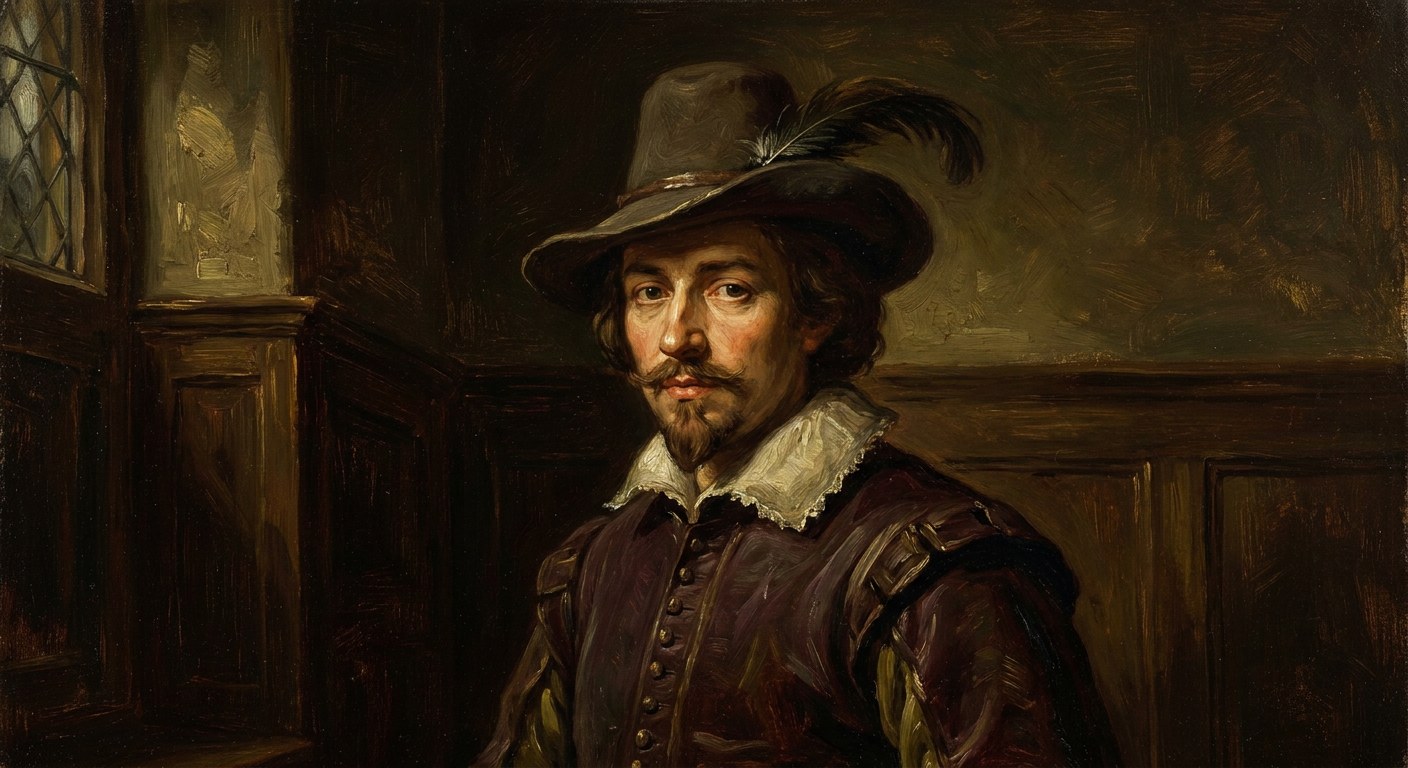
Guy Fawkes
1570 – 1606 · English · Soldier & Conspirator
Recommended Audiobooks
Listen next from Marcus Alden

Life Lessons from Frederic Chopin
Marcus Alden · 54 min

Life Lessons from John Wesley
Marcus Alden · 52 min
Introduction
Guy Fawkes was an English Catholic soldier and conspirator whose name became inseparable from the failed Gunpowder Plot of 1605. The plotters intended to destroy the House of Lords during the State Opening of Parliament on 5 November, killing King James I, members of the royal family, leading nobles, bishops and government officials. They hoped the attack would trigger a rebellion and ultimately replace England’s Protestant government with a Catholic regime.
Fawkes did not originate or lead the conspiracy. That role belonged principally to Robert Catesby, a charismatic Catholic gentleman from Warwickshire. Fawkes was recruited because of his military experience in the Spanish Netherlands and his knowledge of gunpowder. Using the alias “John Johnson,” he was placed in charge of the explosives stored beneath the House of Lords.
Shortly after midnight on 5 November 1605, Fawkes was discovered near 36 barrels of gunpowder in an undercroft beneath Parliament. He was arrested, interrogated and tortured before revealing his identity and the names of fellow conspirators. Tried for high treason in January 1606, he was sentenced to be hanged, drawn and quartered. He died on 31 January after apparently breaking his neck while mounting or jumping from the scaffold.
Over time, Fawkes’s historical identity became obscured by legend. In Britain, he became the symbolic “Guy” burned in effigy during annual commemorations of the plot’s failure. In later popular culture, especially through the graphic novel and film V for Vendetta, a stylized mask based on his appearance became an international emblem of rebellion, protest and anonymity. These later meanings are far removed from the religious and political objectives of the actual conspirators.
Fawkes remains one of the most recognizable figures in British history—not because he succeeded, but because his failure generated a powerful national ritual, a lasting political myth and an image repeatedly reinvented for new causes.
Quick Facts
| Category | Details |
|---|---|
| Full name | Guy Fawkes |
| Alternative names | Guido Fawkes; “John Johnson” |
| Born | 13 April 1570 |
| Birthplace | York, England |
| Baptized | 16 April 1570 at St Michael le Belfrey, York |
| Parents | Edward Fawkes and Edith Fawkes, commonly identified as Edith Jackson before marriage |
| Education | St Peter’s School, York |
| Religion | Baptized in the Church of England; later converted to Roman Catholicism |
| Occupation | Soldier and conspirator |
| Military service | Served with Catholic Spanish forces in the Low Countries |
| Known for | Guarding the gunpowder prepared for the Gunpowder Plot of 1605 |
| Political objective | Destruction of the Protestant government and restoration of Catholic power |
| Arrested | Shortly after midnight on 5 November 1605 |
| Tried | 27 January 1606 at Westminster Hall |
| Conviction | High treason |
| Died | 31 January 1606 |
| Place of death | Old Palace Yard, Westminster, London |
| Cause of death | Broken neck during execution, followed by posthumous dismemberment |
| Historical commemoration | Guy Fawkes Night, Bonfire Night or Fireworks Night, observed on 5 November |
Early Life & Background
Guy Fawkes was born in York on 13 April 1570 and baptized three days later at St Michael le Belfrey, a church beside York Minster. His father, Edward Fawkes, worked as a proctor or legal official in the ecclesiastical courts. His mother, Edith, came from a family with commercial and civic connections in York. Guy had siblings, although not all survived childhood, a common reality in sixteenth-century England.
The Fawkes family publicly belonged to the established Protestant Church of England. This fact is important because Guy was not raised from birth as an openly practicing Catholic. His father held a position connected to the ecclesiastical legal system and died in 1579, when Guy was about eight years old. His mother subsequently married Dionis Baynbrigge of Scotton, near Harrogate. The Baynbrigge family had Catholic associations, and this household may have helped expose the young Fawkes to Catholic belief and networks.
Fawkes attended St Peter’s School in York, one of the city’s leading educational institutions. The school’s headmaster, John Pulleyn, was associated with Catholic sympathies, although the precise influence of the school on Fawkes is difficult to establish. Several men connected with the broader world of English Catholic resistance also had links to York and St Peter’s, including the Wright brothers, John and Christopher, who later joined the Gunpowder Plot.
The England of Fawkes’s youth was divided by the religious consequences of the Reformation. Queen Elizabeth I’s government required outward conformity to the Church of England. Catholics who refused to attend Anglican services—known as recusants—could face fines, surveillance and imprisonment. Catholic priests trained abroad and secretly entered England, while some Catholic families maintained hidden chapels and shelters called priest holes.
Government hostility intensified after Pope Pius V excommunicated Elizabeth in 1570 and declared her subjects released from allegiance to her. Subsequent events—including Catholic plots, the activities of missionary priests, Spanish conflict with England and the attempted invasion by the Spanish Armada in 1588—encouraged officials to view Catholicism not merely as a private religion but as a potential political threat.
Fawkes converted to Roman Catholicism, probably during adolescence or early adulthood. The exact date and circumstances are unknown. His conversion appears to have been sincere and consequential. He eventually left England and entered military service in the continental struggle between Catholic Spain and the predominantly Protestant Dutch rebels.
In 1591, Fawkes disposed of property inherited through his father, and around 1592 he traveled to the Low Countries. This decision marked the beginning of the military career that would later make him valuable to Robert Catesby’s conspiracy.
Rise to Prominence
In the Low Countries, Fawkes joined English Catholic exiles serving the Spanish crown in the Eighty Years’ War. He fought in forces associated with Sir William Stanley, an English commander who had defected to Spain in 1587. To English authorities, Stanley was a traitor; to militant Catholic exiles, he was a defender of the true faith.
Fawkes gained practical experience in siege warfare, explosives and military discipline. He participated in Spanish campaigns against Dutch and English forces and is often associated with the Spanish capture of Calais in 1596. Contemporary descriptions suggest that he developed a reputation for courage, seriousness and competence. He was reportedly recommended for advancement to captain, although he does not appear to have obtained that rank.
While abroad, Fawkes increasingly used the Italian form of his first name, “Guido.” This may have reflected his Catholic and continental identity. He later signed confessions as “Guido Fawkes,” though torture severely affected the appearance of his signature.
Following the death of Elizabeth I in March 1603, many English Catholics hoped that James VI of Scotland, who became James I of England, would relax the penal laws against them. James was the son of the Catholic Mary, Queen of Scots, and his early language encouraged cautious optimism. Those hopes faded as the new government continued recusancy fines and took further action against Catholic clergy.
In 1603, Fawkes traveled to Spain with Thomas Wintour, another English Catholic who would become a central member of the Gunpowder Plot. Their mission was to seek Spanish support for an invasion or uprising in England. Fawkes submitted a memorandum describing James I in hostile terms and argued that intervention might assist English Catholics.
The Spanish government declined. Spain was moving toward peace with England, formalized by the Treaty of London in 1604, and had no interest in renewing an expensive war. The failure of diplomatic appeals helped convince a small group of radical Catholics that foreign assistance would not come. Robert Catesby instead proposed direct violence against the English state.
On 20 May 1604, Catesby, Thomas Wintour, John Wright, Thomas Percy and Fawkes met at the Duck and Drake inn in London. After swearing an oath of secrecy, reportedly followed by Mass, they committed themselves to a plan to destroy Parliament with gunpowder.
Fawkes’s recruitment brought the group a participant with military expertise who was relatively unknown in London. He posed as Percy’s servant under the name “John Johnson” and helped supervise preparations near the Palace of Westminster.
Major Achievements
The term “achievements” requires caution in Fawkes’s case. His historical importance arose from participation in an attempted act of mass political violence, not from a constructive public accomplishment. Nevertheless, several aspects of his career explain why he became so prominent.
First, Fawkes became an experienced soldier at a time when few English Catholic gentlemen had extensive knowledge of continental warfare. His service in the Spanish Netherlands gave him familiarity with gunpowder, fortifications and siege operations. These skills made him a logical choice to manage the explosives beneath Parliament.
Second, he successfully operated under an assumed identity for months. As “John Johnson,” the supposed servant of Thomas Percy, Fawkes moved around the Westminster property and guarded the conspirators’ materials without initially attracting decisive suspicion.
Third, he displayed notable composure immediately after his arrest. According to government accounts, he openly admitted that he intended to destroy Parliament while initially refusing to reveal the names of his companions. James I reportedly admired his “Roman resolution,” even as the king authorized increasingly severe interrogation.
Finally, although the Gunpowder Plot failed completely, Fawkes became its enduring public symbol. Robert Catesby devised and led the conspiracy, but he was killed before trial. Fawkes, captured beside the explosives, provided the government with a vivid personification of the danger. His name became attached to the annual commemoration, entered everyday English as the word “guy,” and eventually acquired global cultural significance.
These outcomes were not achievements in the sense intended by Fawkes himself. His principal objective—the destruction of Parliament and establishment of a Catholic political order—ended in failure, execution and harsher conditions for English Catholics.
Defining Moments
Fawkes’s conversion to Catholicism was the first decisive transformation of his life. It separated him from the religious establishment into which he had been baptized and aligned him with a persecuted but resilient English Catholic community.
His departure for the Low Countries was equally important. Military service gave him technical competence and placed him among exiles who interpreted English religious policy as tyranny. The experience hardened his identity as a militant Catholic willing to act against his native government.
The Spanish mission of 1603 marked another turning point. When Spain refused assistance, peaceful or externally supported change seemed increasingly unlikely to radicals such as Catesby and Wintour. Fawkes returned from the mission prepared to take part in a domestic conspiracy.
The meeting of 20 May 1604 formally created the core group behind the Gunpowder Plot. The conspirators planned to strike at the State Opening of Parliament, when the king, Lords, bishops and judges would be assembled in one place. They also envisioned a subsequent uprising in the Midlands, the seizure of Princess Elizabeth—James’s young daughter—and her installation as a figurehead monarch.
Traditional accounts claimed that the conspirators attempted to dig a tunnel beneath Parliament. Modern historians have questioned whether such a tunnel existed, since no physical trace or reliable independent evidence survives. What is certain is that Thomas Percy obtained access to an undercroft beneath the House of Lords. By March 1605, the conspirators were able to store gunpowder there, concealed beneath firewood, coal and other materials.
Thirty-six barrels were ultimately placed in the undercroft. The opening of Parliament was repeatedly postponed, partly because of plague, and eventually fixed for 5 November 1605. Fawkes was to ignite the fuse and escape across the Thames before leaving the country.
The plot began to unravel after Lord Monteagle received an anonymous warning letter on 26 October. It urged him to avoid Parliament because the assembly would “receive a terrible blow.” The authorship remains uncertain. Monteagle delivered the letter to the government, where it was shown to Robert Cecil, Earl of Salisbury, the king’s chief minister.
On 4 November, officials searched the parliamentary buildings. During an initial inspection, the Earl of Suffolk and Monteagle encountered Fawkes and noticed a large quantity of fuel in the undercroft. A more thorough search led by Sir Thomas Knyvet shortly after midnight uncovered the gunpowder. Fawkes was carrying matches and a watch and was arrested before he could ignite the charge.
Timeline
| Year | Event |
|---|---|
| 1570 | Guy Fawkes is born in York on 13 April and baptized at St Michael le Belfrey on 16 April. |
| 1579 | His father, Edward Fawkes, dies. |
| 1580s | Fawkes attends St Peter’s School, York, and later converts to Roman Catholicism. |
| 1591 | He disposes of property inherited from his father. |
| c. 1592 | Fawkes leaves England to serve Catholic Spanish forces in the Low Countries. |
| 1596 | He is associated with Spanish military operations during the capture of Calais. |
| 1603 | Fawkes and Thomas Wintour seek Spanish support for action in England; Spain refuses. |
| 1604 | On 20 May, Fawkes joins Robert Catesby, Thomas Wintour, John Wright and Thomas Percy in the initial Gunpowder Plot oath. |
| 1604 | Fawkes adopts the identity “John Johnson” while working around the conspirators’ Westminster property. |
| 1605 | In March, the conspirators gain access to an undercroft beneath the House of Lords and store gunpowder there. |
| 1605 | On 26 October, Lord Monteagle receives an anonymous warning letter. |
| 1605 | Late on 4 November and shortly after midnight on 5 November, Parliament is searched and Fawkes is arrested. |
| 1605 | On 6 November, James I authorizes the use of torture; Fawkes subsequently confesses. |
| 1605 | On 8 November, Catesby, Thomas Percy and the Wright brothers are killed at Holbeche House in Staffordshire. |
| 1606 | On 27 January, Fawkes and seven surviving conspirators are tried and convicted of high treason. |
| 1606 | On 31 January, Fawkes is executed at Old Palace Yard, Westminster. |
| 1606 | Parliament establishes an annual public thanksgiving for deliverance from the plot. |
| 1859 | The Observance of 5th November Act is repealed, ending the statutory religious service, though popular celebrations continue. |
| 1982–1989 | Alan Moore and David Lloyd’s V for Vendetta popularizes a stylized Guy Fawkes mask. |
| 2005 | The film adaptation of V for Vendetta further internationalizes the mask as a protest symbol. |
Personal Life
Little reliable information survives about Fawkes’s intimate or domestic life. He is not known to have married, and there is no firmly documented evidence that he had children. Later claims about a wife or descendants are generally speculative and unsupported by contemporary records.
His adult life was unusually mobile. Rather than establishing himself as a landowner or tradesman in England, he sold inherited property and spent more than a decade in military service abroad. This placed him within a transnational community of Catholic soldiers, priests, diplomats and political exiles.
Contemporaries described Fawkes as tall, powerfully built and physically capable, with thick reddish-brown hair, a moustache and beard. Such descriptions should be treated cautiously because they often come through hostile or official sources. Nevertheless, they helped shape later visual representations of him.
Fawkes appears to have formed his strongest bonds through religion, military service and conspiracy. Thomas Wintour trusted him enough to involve him in Catesby’s plan, while the plotters assigned him the operation’s most technically demanding task. His willingness to remain beside the gunpowder also indicates the depth of his commitment.
Beliefs & Philosophy
Fawkes’s worldview was rooted in militant Counter-Reformation Catholicism. He believed the Protestant religious settlement imposed by the English monarchy was illegitimate and destructive to the true Church. His years in Spanish service strengthened a confessional identity that transcended national loyalty.
His actions suggest that he regarded violence as morally permissible when used against a government considered heretical and oppressive. The intended explosion was not a narrowly targeted assassination. It would have killed many people, including individuals who had no direct responsibility for anti-Catholic laws. The plot therefore represented an extreme form of religiously justified political violence.
The conspirators expected the destruction of Parliament to create an opportunity for revolution. Their wider plan included a Catholic uprising in the Midlands and the capture of Princess Elizabeth. They hoped to place her on the throne under Catholic guardianship, though practical details remained uncertain.
Fawkes’s conduct under initial interrogation reflected a soldierly ideal of loyalty and endurance. He admitted responsibility but tried to shield his companions. His resistance did not last under torture, and he eventually provided information about the conspiracy.
It would be misleading to portray Fawkes as a modern advocate of democracy, secular liberty or generalized resistance to government. He did not seek parliamentary reform or popular sovereignty. His objective was confessional regime change: the overthrow of a Protestant monarchy and ruling order in favor of Catholic power.
Challenges & Controversies
The central controversy surrounding Fawkes is the tension between historical reality and later symbolism. In some modern contexts, he is treated as an anti-authoritarian folk hero. Historically, however, he participated in a plan to kill the king and much of the political establishment through an indiscriminate explosion, then exploit the resulting chaos to install a Catholic regime.
Another issue is whether the conspirators genuinely dug a tunnel toward Parliament. Early official narratives included a tunneling episode, but the evidence is weak. No tunnel was found, and some historians regard the story as a later embellishment or misunderstanding. The undercroft and gunpowder, by contrast, are well documented.
The Monteagle letter has generated centuries of debate. Its author was never conclusively identified. Candidates have included Francis Tresham, Monteagle’s brother-in-law and one of the plotters, as well as Thomas Wintour or Monteagle himself. Tresham denied writing it before dying in the Tower of London in December 1605.
The government’s handling of the investigation also deserves scrutiny. James I personally authorized torture, beginning with “gentler” methods and proceeding to harsher ones if necessary. Fawkes was probably subjected to manacles and perhaps the rack. His deteriorating signatures provide striking evidence of his physical condition, although the exact sequence of tortures remains uncertain.
At trial, Fawkes and seven other surviving conspirators were charged with high treason. The proceedings were designed not only to establish guilt but to present a public lesson about divine providence, royal authority and Catholic danger. All were convicted. The prescribed punishment—hanging, drawing and quartering—was deliberately brutal.
On 31 January 1606, Fawkes was taken to Old Palace Yard with Thomas Wintour, Ambrose Rookwood and Robert Keyes. Weakened by torture, he climbed the scaffold and either jumped or fell, breaking his neck. He was dead before his body was cut down and quartered. Portions of his remains were displayed as warnings.
The failed plot intensified anti-Catholic suspicion. New measures required an oath of allegiance and reinforced recusancy penalties. Although many English Catholics condemned the conspiracy, they collectively suffered from its political consequences.
Famous Quotes
No extensive body of securely authenticated writing by Fawkes survives. Statements attributed to him were recorded by officials or later writers and should be read in that context.
“A desperate disease requires a dangerous remedy.”
This statement is traditionally attributed to Fawkes as an explanation of the plot’s violence. Its precise wording and transmission are uncertain, but it captures the conspirators’ claim that extreme persecution justified extreme action.
“To blow you Scotch beggars back to your native mountains.”
Fawkes reportedly gave this defiant answer when questioned about the large quantity of gunpowder. The remark was directed at the Scottish king and his courtiers, though its wording comes through hostile official reporting.
“I wish all my Christian brethren were acquainted with what I have done.”
A version of this sentiment appears in records of Fawkes’s early examination, expressing his willingness to acknowledge the intended attack before torture compelled fuller disclosure.
Legacy & Influence
The government moved quickly to transform the failed conspiracy into a national commemoration. Parliament passed the Observance of 5th November Act in 1606, requiring annual church services of thanksgiving for the king’s deliverance. Sermons, bells and bonfires reinforced the message that divine providence had protected Protestant England.
Over time, 5 November became known as Guy Fawkes Night, Bonfire Night or Fireworks Night. Communities burned bonfires, set off fireworks and displayed effigies of Fawkes. In some periods, celebrations also included strongly anti-Catholic imagery, including the burning of papal figures. The statutory observance was repealed in 1859, but the popular festival continued.
The familiar rhyme helped preserve the event in collective memory:
Remember, remember, the Fifth of November,
Gunpowder, treason and plot.
Fawkes became more famous than Catesby partly because he was captured at the scene. The annual effigy was called a “guy,” and by the nineteenth century the word came to mean a strangely dressed or disreputable man. In modern English, especially American English, “guy” developed into an informal term for any man and, in plural usage, for groups of people.
His image underwent another transformation in the late twentieth century. Writer Alan Moore and artist David Lloyd used a stylized Guy Fawkes mask for the revolutionary protagonist of the graphic novel V for Vendetta, first published beginning in 1982. The 2005 film adaptation made the design globally recognizable.
Activists later adopted the mask during demonstrations, including those associated with the Anonymous collective, Occupy protests and other anti-establishment movements. In these settings, the mask has represented anonymity, collective identity and resistance to perceived oppression.
This symbolism bears only a loose relationship to the historical Fawkes. The fictional “V” opposes a totalitarian state, whereas Fawkes sought a violent Catholic counterrevolution in a confessional monarchy. The difference illustrates how historical figures can become detached from their original motives and repurposed as cultural symbols.
Fawkes’s lasting importance therefore lies in several overlapping legacies: the history of English Catholic resistance, the development of state security practices, the ritual memory of national danger, the evolution of Bonfire Night and the modern politics of masks and protest.
Interesting Facts
- Fawkes was born within sight of York Minster and baptized at nearby St Michael le Belfrey.
- He often used “Guido,” the Italian form of Guy, after spending years among continental Catholics.
- Fawkes was not the leader of the Gunpowder Plot; Robert Catesby was its principal organizer.
- His plot alias was “John Johnson,” and he presented himself as Thomas Percy’s servant.
- The conspirators stored 36 barrels of gunpowder beneath the House of Lords.
- Some of the gunpowder may have deteriorated, but experts generally agree that enough remained to devastate the chamber and surrounding buildings.
- The traditional story of a tunnel under Parliament is disputed by modern historians.
- Fawkes carried slow matches and a watch when arrested, supporting the conclusion that he was prepared to ignite the explosives.
- James I authorized his torture in writing, ordering interrogators to proceed from milder methods to the worst.
- Fawkes’s signature changed from clear and confident to faint and barely legible after interrogation.
- He avoided the prolonged agony of hanging, drawing and quartering by breaking his neck at the scaffold.
- The modern Palace of Westminster was constructed centuries later; most of the parliamentary complex associated with the plot was destroyed by fire in 1834.
- The word “guy” ultimately derives from the effigies of Guy Fawkes displayed on 5 November.
- The well-known Guy Fawkes mask is based mainly on David Lloyd’s artistic design, not a reliable contemporary portrait.
- The Yeomen of the Guard still ceremonially search the cellars before the State Opening of Parliament, although the modern practice is symbolic and forms only one part of parliamentary security.
Frequently Asked Questions
Who was Guy Fawkes?
Guy Fawkes was an English Catholic soldier and one of the thirteen principal conspirators in the Gunpowder Plot of 1605. He was assigned to guard and ignite explosives stored beneath the House of Lords.
Was Guy Fawkes the leader of the Gunpowder Plot?
No. Robert Catesby conceived and led the plot. Fawkes became its most famous participant because officials captured him near the gunpowder beneath Parliament.
Why did Guy Fawkes want to blow up Parliament?
Fawkes and his companions believed James I’s Protestant government persecuted Catholics and had rejected meaningful religious toleration. They intended to destroy the ruling establishment and launch a Catholic uprising. Their plan was an act of mass political violence, not a campaign for modern democracy.
How much gunpowder was discovered?
Officials found 36 barrels in the undercroft beneath the House of Lords. The barrels were concealed under coal, firewood and other materials.
Who warned the government about the plot?
Lord Monteagle received an anonymous letter on 26 October 1605 warning him to stay away from Parliament. He gave it to the authorities. The author’s identity remains unknown, although Francis Tresham has often been suspected.
When was Guy Fawkes arrested?
He was arrested shortly after midnight on 5 November 1605 during a search led by Sir Thomas Knyvet. This is why the plot’s failure is commemorated on 5 November, even though the decisive search began during the night of 4 November.
Was Guy Fawkes tortured?
Yes. James I authorized torture after Fawkes refused to identify his companions. The precise methods are not fully documented, but he was probably subjected to shackling and possibly the rack. His signatures show severe physical deterioration.
What happened to the other conspirators?
Catesby, Thomas Percy and John and Christopher Wright were killed during a confrontation at Holbeche House on 8 November 1605. Surviving conspirators were captured, tried and executed. Francis Tresham died in the Tower before trial.
How did Guy Fawkes die?
He was sentenced to be hanged, drawn and quartered. On 31 January 1606, he broke his neck after falling or jumping from the scaffold at Old Palace Yard. His corpse was then dismembered according to the sentence.
Is Bonfire Night a celebration of Guy Fawkes?
Historically, it celebrated the failure of the plot and the survival of James I, not Fawkes himself. Modern observances are usually secular community events centered on fireworks and bonfires, although their origins lie in Protestant thanksgiving and anti-Catholic politics.
Why do protesters wear Guy Fawkes masks?
The modern mask comes from V for Vendetta, created by Alan Moore and David Lloyd and later adapted into a film. Protesters use it to symbolize anonymity and resistance. Its meaning reflects modern fiction more than Fawkes’s actual religious politics.
Did Guy Fawkes say “Remember, remember the Fifth of November”?
No evidence shows that Fawkes wrote or spoke the famous rhyme. It developed as part of the popular commemoration of the plot’s defeat.
Lessons from Guy Fawkes
- Religious persecution can encourage radicalization: Discrimination against Catholics created genuine grievances, though those grievances did not justify indiscriminate violence.
- Violence often harms the cause it claims to serve: The plot failed and produced harsher laws, deeper suspicion and greater suffering for English Catholics.
- Historical memory simplifies complex events: Fawkes became more famous than Catesby because he was captured beside the explosives.
- Symbols can outgrow their origins: The Guy Fawkes mask now represents causes that the historical Fawkes would not have recognized.
- Sources require careful evaluation: Official confessions obtained under torture, disputed tunneling stories and uncertain quotations cannot be accepted uncritically.
- Political conspiracies depend on secrecy but are vulnerable to divided loyalties: The Monteagle letter demonstrated how concern for relatives or fear of mass casualties could undermine the plot.
- Motives and methods must be judged separately: English Catholics faced serious restrictions, but the plan to kill hundreds remained morally and politically extreme.
- Commemoration shapes national identity: Bonfire Night helped define Protestant British memory for centuries.
- Popular heroes may differ sharply from historical people: Modern portrayals of Fawkes as a democratic freedom fighter are anachronistic.
- Failed events can have immense consequences: Although the explosion never occurred, the Gunpowder Plot influenced law, religion, language, ritual and popular culture.
Further Reading
- Antonia Fraser, The Gunpowder Plot: Terror and Faith in 1605.
- Mark Nicholls, Investigating Gunpowder Plot.
- John Gerard, The Autobiography of an Elizabethan.
- Alan Haynes, The Gunpowder Plot: Faith in Rebellion.
- James Sharpe, Remember, Remember: A Cultural History of Guy Fawkes Day.
- Pauline Croft, King James.
- W. C. Richardson, James I and English Politics, 1603–1609.
- The National Archives, United Kingdom, Gunpowder Plot documents and educational collections.
- UK Parliament, historical resources on the Gunpowder Plot and the Palace of Westminster.
- Oxford Dictionary of National Biography, entries on Guy Fawkes, Robert Catesby and Thomas Wintour.