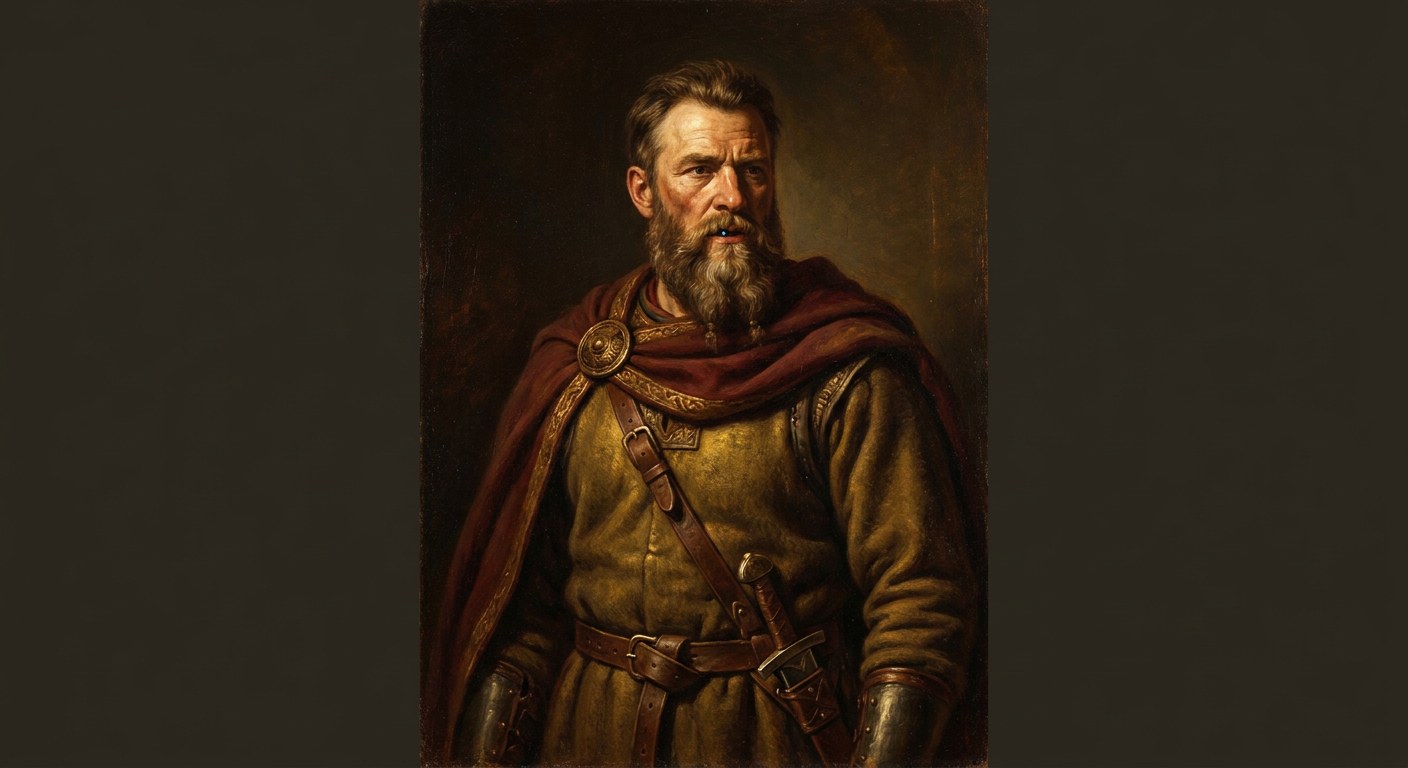
Harald Bluetooth
910 – 986 · Danish · King of Denmark & Norway
Recommended Audiobooks
Listen next from Marcus Alden

Life Lessons from Frederic Chopin
Marcus Alden · 54 min

Life Lessons from John Wesley
Marcus Alden · 52 min
Introduction
Harald “Bluetooth” Gormsson was a tenth-century king who helped transform Denmark from a loose collection of regional power centers into a more unified, Christian monarchy. Ruling Denmark from approximately 958 until 986, and exercising authority over parts of Norway for a time, Harald stood at the intersection of the Viking Age and the emerging political order of medieval Europe.
His reign is remembered chiefly for three connected achievements: consolidating royal power, promoting Christianity, and commissioning major monuments and fortifications. The great Jelling runestone—often described as Denmark’s “birth certificate”—proclaims that Harald “won for himself all Denmark and Norway” and “made the Danes Christian.” Archaeological evidence from Jelling, the ring fortresses, bridges, and other large public works supports the view that his government possessed unusual organizational capacity.
Harald’s accomplishments should not be interpreted too literally or simply. Tenth-century kingship depended on personal alliances, tribute, military success, and negotiation with powerful local elites. “All Denmark” did not necessarily mean a centralized state with fixed borders in the modern sense, while the conversion of the Danes was a gradual process rather than a single royal decree. Pagan practices survived after Harald’s baptism, and Christian influence had already reached Denmark before his reign.
Much of Harald’s biography remains uncertain. Contemporary or near-contemporary sources are limited, while later chroniclers and Icelandic saga writers combined historical memory with legend. Even the familiar nickname “Bluetooth,” from Old Norse Blátǫnn, appears only in later tradition. Nevertheless, inscriptions, archaeology, Frankish and Saxon histories, and medieval Scandinavian accounts allow historians to reconstruct the broad outline of a reign that changed northern Europe.
More than a thousand years later, Harald’s name gained a second life through Bluetooth wireless technology. The technology’s creators selected him as a symbol of unification: just as Harald was credited with bringing Danish territories together, the new standard was intended to connect different electronic devices.
Quick Facts
| Category | Details |
|---|---|
| Full name | Harald Gormsson |
| Common name | Harald Bluetooth |
| Old Norse name | Haraldr Gormsson, nicknamed Blátǫnn |
| Born | Probably in the early tenth century; exact date unknown |
| Birthplace | Probably Denmark; exact location unknown |
| Father | Gorm the Old |
| Mother | Thyra, commemorated at Jelling |
| Dynasty | House of Jelling |
| Title | King of Denmark; overlord or king in parts of Norway |
| Reign in Denmark | Approximately 958–986 |
| Norwegian authority | Principally during the 970s and early 980s |
| Religion | Raised in a predominantly Norse pagan society; later baptized as a Christian |
| Spouse or spouses | Traditionally associated with Gunhild, Tove, and Gyrid; the evidence is incomplete and disputed |
| Notable children | Sweyn Forkbeard; probably Gunhild; other children are reported in later sources |
| Major monuments | The great Jelling stone, Jelling complex, Ravning Enge bridge, and Danish ring fortresses associated with his reign |
| Predecessor | Gorm the Old |
| Successor | Sweyn Forkbeard |
| Died | Traditionally around 986, possibly in or near Jomsborg; details are uncertain |
| Burial | Traditionally Roskilde, though the identification and location of his grave remain uncertain |
| Best known for | Consolidating Denmark, adopting Christianity, monumental building, and inspiring the name of Bluetooth technology |
Early Life & Background
Harald was the son of Gorm the Old and Queen Thyra. His family ruled from Jelling in central Jutland, which became one of the most important royal and ceremonial centers of Viking-Age Denmark. Gorm is commonly regarded as the first ruler in the direct royal line associated with the later Danish monarchy, although Denmark had kings long before him.
Harald’s birth date is unknown. He was probably born during the early tenth century, at a time when Denmark was not yet a uniformly administered kingdom. Power was distributed among regional magnates, warrior retinues, assembly communities, and royal families. A successful king needed ships, land, wealth, loyal followers, and the ability to reward allies. Royal authority could expand rapidly after victory and weaken just as quickly after defeat.
Denmark’s location made it strategically important. Jutland controlled approaches between continental Europe and Scandinavia, while the Danish islands commanded routes between the North Sea and the Baltic. The trading settlement of Hedeby, near the base of the Jutland peninsula, linked Scandinavian commerce with the Carolingian and later German worlds. Danish rulers therefore interacted with Saxons, Franks, Slavs, Norwegians, and other Scandinavian peoples through trade, diplomacy, raiding, and war.
Harald grew up in a culture still dominated by Norse religious traditions. Gods such as Odin, Thor, and Freyr were honored through ritual, sacrifice, feasting, and local cult practices. Christianity, however, was not unknown. Missionaries had worked in Denmark since at least the ninth century, Christian merchants traveled through Danish ports, and some Scandinavian elites recognized the diplomatic value of relations with Christian rulers.
Jelling preserves the strongest evidence for Harald’s immediate family. The smaller Jelling stone was raised by Gorm in memory of Thyra, whom its inscription calls “Denmark’s adornment” or “Denmark’s strength,” depending on the translation. Harald later commissioned the larger stone in memory of both parents. Together with the burial mounds, church, stone settings, and other structures at Jelling, these monuments presented the dynasty as the center of a developing Danish kingdom.
Later medieval sources give Harald siblings, including a brother named Knud Dana-Ast, but the details cannot always be verified. It is possible that Harald inherited power after the deaths of both his father and a brother, yet the surviving contemporary evidence does not provide a clear succession narrative.
Rise to Prominence
Harald probably became king after Gorm’s death around 958. Dendrochronological evidence from a burial chamber at Jelling points to the late 950s, and this date is commonly connected with Gorm’s death and Harald’s accession. Medieval accounts differ, however, and precise regnal dates remain approximate.
His initial power base lay in Jutland. Extending authority across the Danish islands and over regional chieftains would have required military force, negotiated loyalties, dynastic connections, and control of strategic routes. The claim on the great Jelling stone that Harald won “all Denmark” suggests that territorial consolidation was central to how he wished his reign to be remembered.
Harald also operated within the political orbit of the East Frankish, or German, kingdom. Otto I, crowned Holy Roman emperor in 962, sought influence along the empire’s northern frontier. The archbishopric of Hamburg-Bremen claimed ecclesiastical authority over Scandinavian missions, making conversion inseparable from imperial diplomacy.
A crucial account comes from Widukind of Corvey, a Saxon historian writing in the tenth century. Widukind described how a cleric named Poppo proved the power of Christianity by carrying heated iron without injury. Impressed by the ordeal, Harald accepted Christianity and ordered his subjects to honor Christ, although Widukind added that they were not entirely forbidden from continuing older practices.
Widukind’s account may preserve a genuine tradition, but it should not be read as a complete description of Danish conversion. Harald’s baptism probably occurred around 960 or in the early 960s. Later authors connected it to a military defeat by Otto I, but the evidence for a straightforward conquest-and-conversion episode is uncertain. Harald may have converted partly from conviction and partly because baptism strengthened diplomatic relations with Christian Europe and provided ideological support for centralized monarchy.
By the later 960s, Harald was powerful enough to intervene in Norway. His opportunity arose from conflict involving King Harald Greycloak and the exiled Norwegian noble Haakon Sigurdsson, the jarl of Lade.
Major Achievements
Harald’s most famous achievement was the consolidation of Denmark. The wording of the Jelling inscription—“won for himself all Denmark”—implies that unification was an active political and military process rather than an uncomplicated inheritance. His kingdom probably included Jutland, Zealand, Funen, and adjacent Danish territories, though the exact boundaries and degree of control varied.
He also extended his influence into Norway. Around 970, Harald Greycloak was killed at Limfjord in circumstances linked to Danish intervention. Haakon Sigurdsson then ruled much of Norway, initially as Harald’s subordinate or ally. Harald’s Jelling inscription accordingly claimed Norway. In practice, his authority there was indirect and unstable. Haakon retained substantial autonomy and eventually rejected Danish overlordship.
Christianization formed another central part of Harald’s reign. Churches and bishoprics helped connect Denmark to literate, transregional institutions. Bishops were associated with Schleswig, Ribe, and Aarhus, although the development of these sees was uneven. Christian clergy could assist rulers through diplomacy, record keeping, ritual legitimacy, and contacts with foreign courts.
The great Jelling stone visually communicated this new order. One face displays a large animal entangled with a serpent; another presents Christ with outstretched arms surrounded by interlaced ornament. Its combination of runic text, Scandinavian artistic forms, dynastic commemoration, and Christian imagery makes it one of the most important monuments of the Viking Age.
Harald’s reign is also associated with an extraordinary program of construction. Geometrically planned circular fortresses appeared at strategic locations, including:
- Trelleborg on Zealand
- Aggersborg in northern Jutland
- Fyrkat near Hobro
- Nonnebakken at Odense
- Borgring near Køge
These sites are often called Trelleborg-type or Viking ring fortresses. Their standardized layouts featured circular ramparts, axial gates, intersecting roads, and longhouses arranged in quadrants. Tree-ring dating places important phases of several fortresses around 980, within Harald’s reign.
Their exact purposes remain debated. They may have served as military garrisons, centers of royal administration, supply bases, refuges, training sites, or instruments for controlling routes and populations. Whatever their individual functions, their coordinated planning demonstrates access to labor, engineering knowledge, timber, transportation, and royal command on a remarkable scale.
The Ravning Enge bridge, constructed around 979 or 980 across the Vejle River valley, was another major undertaking. Approximately 760 meters long, it facilitated movement through Jutland and may have had both military and symbolic importance. Harald’s government also appears to have reinforced parts of the Danevirke defensive system near Denmark’s southern frontier, though separating his work from earlier and later construction phases is difficult.
These projects reveal a ruler seeking to make kingship physically visible. Monumental architecture did not merely defend territory; it displayed the monarch’s ability to organize people and landscapes.
Defining Moments
Harald’s accession in the late 950s marked the continuation of the Jelling dynasty and the beginning of a more ambitious phase of Danish royal power. By commemorating Gorm and Thyra, he grounded his authority in ancestry while also presenting himself as the ruler who surpassed his predecessors.
His baptism was perhaps the greatest ideological turning point of his reign. Christianity provided access to a political culture in which kingship was sanctioned by a universal religion. Yet conversion also carried risks. Some nobles may have viewed the new faith as a threat to traditional rituals, local autonomy, and established relationships between rulers and cult communities.
The commissioning of the great Jelling stone turned Harald’s political program into a permanent public statement. The monument linked three claims: dynastic legitimacy, territorial conquest, and religious transformation. Few surviving Viking-Age objects express royal ideology so directly.
The construction boom around 980 represented the high point of Harald’s organizational power. Ring fortresses and the Ravning Enge bridge suggest preparation for conflict on a large scale. Their building may have been connected with tensions involving the German empire, resistance within Denmark, campaigns in Norway, or some combination of these pressures.
Harald’s later years were dominated by setbacks. Haakon Sigurdsson broke with Danish authority in Norway, and Harald faced a revolt led by his son Sweyn, later called Forkbeard. According to later traditions, Harald was wounded and fled to a stronghold associated with Jomsborg on the southern Baltic coast. He died soon afterward, traditionally around 986.
The precise sequence is uncertain. Medieval narratives were written long after the event and often sought to dramatize father-son conflict. Even so, the broad conclusion is credible: Harald’s reign ended violently, and Sweyn emerged as king.
Timeline
| Year | Event |
|---|---|
| Early 900s | Harald is probably born in Denmark to Gorm and Thyra; the exact date is unknown. |
| c. 936 | Gorm the Old is attested as king in later reconstructions of the period. |
| c. 958 | Gorm dies; Harald probably succeeds him as king. |
| c. 960–965 | Harald is baptized and begins publicly supporting Christianity. |
| 960s | Christian institutions expand in Denmark under royal patronage. |
| c. 965 | The great Jelling stone is commonly dated to around this period, though estimates vary. |
| c. 970 | Harald Greycloak of Norway is killed; Haakon Sigurdsson rules Norway under nominal Danish overlordship. |
| 973 | Otto I dies; political conditions along Denmark’s southern frontier change. |
| 974 | Emperor Otto II campaigns against Denmark and gains control of positions near the Danevirke, according to German accounts. |
| Late 970s | Harald reasserts power along the southern frontier; the exact military sequence is disputed. |
| c. 979–980 | The Ravning Enge bridge is built. |
| c. 980–981 | Major Danish ring fortresses are constructed or occupied. |
| c. 980s | Haakon Sigurdsson rejects Harald’s authority and defeats Danish efforts to restore control in Norway. |
| c. 985–986 | Sweyn Forkbeard rebels against Harald. |
| c. 986 | Harald dies, reportedly after being wounded during the rebellion. |
| Late 10th or early 11th century | Tradition holds that Harald’s body was taken to Roskilde for Christian burial. |
| 1996 | The name “Bluetooth” is proposed for a short-range wireless standard, invoking Harald as a symbol of unification. |
Personal Life
Harald’s personal life is difficult to reconstruct because contemporary evidence concentrates on political acts rather than private relationships. Later sources assign him several wives or partners, but their chronology and historical status are uncertain.
A woman named Tove is securely connected with Harald through the Sønder Vissing runestone in Jutland. Its inscription identifies her as “Tove, Mistivoj’s daughter, Harald the Good, Gorm’s son’s wife.” Mistivoj was likely an Obotrite Slavic ruler. If so, the marriage reflects Harald’s diplomatic links with powerful Slavic elites south of the Baltic.
Other traditions identify wives named Gunhild or Gyrid. Gyrid was said to be connected to the Swedish royal family, but this rests mainly on later narrative sources. It is possible that medieval writers preserved genuine dynastic memories, yet it is equally possible that relationships were simplified or invented to explain later alliances.
Harald’s best-known son was Sweyn Forkbeard, who overthrew him and later ruled Denmark, Norway, and England. Sweyn’s career extended the ambitions of the Jelling dynasty and prepared the way for the North Sea empire of Harald’s grandson Cnut the Great.
A daughter named Gunhild is often identified as the wife of Pallig, a Danish leader in England. She may have died during the St. Brice’s Day massacre ordered by the English king Æthelred II in 1002, although her identity is not certain. Other supposed children, including Haakon and Thyra, appear in later genealogical traditions whose reliability varies.
Father-son conflict shaped Harald’s final years. Sweyn’s rebellion may have reflected religious disagreement, aristocratic resistance, a succession dispute, or dissatisfaction with Harald’s demands for labor and military service. Sources written from Christian perspectives sometimes portrayed Sweyn as a pagan rebel against his Christian father, but Sweyn later ruled as a Christian king. The struggle was therefore probably more political than theological.
Beliefs & Philosophy
No writings by Harald survive, and it would be misleading to attribute a systematic personal philosophy to him. His actions, however, suggest a view of kingship based on conquest, ancestry, public monumentality, and religious legitimacy.
Harald’s upbringing was rooted in Norse pagan culture. His father Gorm was remembered by later Christian authors as hostile to Christianity, although such portraits may exaggerate the contrast between father and son. Harald’s conversion did not erase pre-Christian traditions overnight. Religious change in Denmark was gradual, and mixed practices probably continued for generations.
Christianity offered important advantages to a ruler seeking greater unity. A Christian king could present himself as governing under divine authority rather than merely as the strongest among competing war leaders. Bishops and clergy also connected Denmark with the courts and institutions of Europe.
Harald’s religious policy may therefore have combined genuine belief with political calculation. These motives were not mutually exclusive in medieval society. Conversion could be sincerely spiritual, diplomatically useful, and institutionally transformative at the same time.
The imagery at Jelling is especially revealing. Christ is rendered within Scandinavian ornamental traditions rather than in a purely imported artistic language. Harald’s new religion was presented not as the destruction of Danish identity but as part of a new royal vision for Denmark.
Challenges & Controversies
One central controversy concerns the scale of Harald’s “unification” of Denmark. The Jelling stone is royal propaganda as well as historical evidence. Harald may have defeated rivals and secured broad recognition without creating a uniformly governed state. Local magnates, assemblies, and regional customs remained important.
His claim to Norway is similarly difficult to assess. Harald exercised influence through Haakon Sigurdsson rather than through direct administration. Once Haakon rejected Danish authority, Harald’s Norwegian claim became more aspirational than real.
The circumstances of Harald’s conversion are disputed. Widukind’s account emphasizes Poppo’s ordeal, while later German traditions associate conversion with imperial victory. Danish royal ideology instead portrayed Harald as the agent who Christianized his people. Modern historians generally avoid reducing the event to either miracle or military coercion.
The ring fortresses generate further debate. Their date places them within Harald’s reign, but their intended enemy is unknown. They may have been built against German attack, for campaigns overseas, or to impose control during internal unrest. Their relatively short periods of use raise questions about whether Harald’s ambitious military system collapsed after his overthrow.
Harald’s nickname is another uncertainty. Blátǫnn literally appears to mean “blue tooth,” but in Old Norse color vocabulary, “blue” could describe a dark or blackened shade. The name may have referred to a damaged, dead, or unusually colored tooth. Suggestions that it referred to blue clothing, dark complexion, or metaphorical weaponry are speculative.
His death and burial are also uncertain. Later sources place his death after flight to Jomsborg, traditionally associated with Wolin in modern Poland. Adam of Bremen stated that Harald was taken to Roskilde for burial. No grave has been conclusively identified as his.
Finally, the sources themselves present challenges. Widukind was near-contemporary but wrote from Saxony. Adam of Bremen wrote roughly a century later and had ecclesiastical interests. Saxo Grammaticus and Icelandic saga authors wrote later still. Archaeology can correct or complement these texts, but material evidence rarely supplies names and motives on its own.
Famous Quotes
No reliably recorded spoken words of Harald Bluetooth survive. His most famous “quotes” are therefore the royal declarations carved on the great Jelling stone. Translations differ slightly because of runic language and syntax.
“King Harald ordered these monuments to be made in memory of Gorm, his father, and in memory of Thyra, his mother.”
The inscription establishes dynastic continuity and publicly honors the parents from whom Harald derived legitimacy.
“That Harald who won for himself all Denmark and Norway…”
This phrase summarizes Harald’s claim to territorial achievement. It should be read as a royal assertion rather than a modern description of fixed national borders.
“…and made the Danes Christian.”
These words became the classic statement of Denmark’s royal conversion. They refer to Harald’s sponsorship and enforcement of Christianity, not to the immediate conversion of every inhabitant.
Legacy & Influence
Harald’s most enduring legacy is the association between Danish monarchy, territorial unity, and Christianity. Earlier Danish kings had possessed substantial power, and Christian influence preceded him, but Harald combined these developments in a particularly effective royal program.
Jelling became a national site of memory. Its monuments record the transition from pagan royal commemoration to Christian kingship while demonstrating continuity within the ruling dynasty. The large runestone’s inscription and Christ image have made it one of Denmark’s most recognizable historical artifacts. The Jelling mounds, runic stones, and church are now part of a UNESCO World Heritage Site.
Harald’s fortresses transformed historians’ understanding of Viking-Age government. They show that a Scandinavian ruler could standardize plans, mobilize large labor forces, and coordinate construction across distant regions. Such evidence challenges older stereotypes of Viking society as composed only of decentralized raiders and farmers.
His immediate political legacy was complicated by his overthrow. Yet Sweyn Forkbeard continued the dynasty’s expansion and became king of England in 1013. Sweyn’s son Cnut the Great later ruled a North Sea empire encompassing England, Denmark, and Norway. Harald’s consolidation of Danish kingship helped make these conquests possible.
Christianization also altered Denmark’s cultural orientation. Latin literacy, church organization, European diplomacy, and new forms of art and burial gradually became more prominent. Harald did not complete this transformation, but his reign was a decisive stage.
In modern times, Harald’s name became globally familiar through Bluetooth wireless technology. In 1996, Intel engineer Jim Kardach proposed “Bluetooth” as a temporary project name during cooperation among companies seeking a common short-range wireless standard. Harald’s reputed unification of Denmark and Norway served as a metaphor for uniting computers, mobile phones, and other devices.
The Bluetooth logo combines the runes ᚼ (Hagall) and ᛒ (Bjarkan), representing Harald’s initials, H and B. What began as a historical nickname consequently became one of the most widely recognized symbols of the digital age.
Interesting Facts
- Harald’s nickname “Bluetooth” is not recorded in his own inscriptions and comes from later Scandinavian tradition.
- The “blue” in Blátǫnn may have meant dark, blackened, or discolored rather than bright blue.
- The great Jelling stone is sometimes called Denmark’s “birth certificate” because it names Denmark and proclaims its Christianization.
- The stone contains one of Scandinavia’s earliest monumental representations of Christ.
- Harald’s father, Gorm, raised the smaller Jelling stone for Queen Thyra; Harald raised the larger stone for both parents.
- The Ravning Enge bridge was the longest known bridge from Viking-Age Scandinavia.
- Aggersborg, the largest known Danish ring fortress, had an internal diameter of roughly 240 meters.
- The ring fortresses were built according to strikingly regular geometric plans.
- Tove, one of Harald’s wives, commissioned her own runestone at Sønder Vissing.
- Harald’s son Sweyn Forkbeard conquered England, and his grandson Cnut became one of the most powerful rulers in eleventh-century Europe.
- The Bluetooth symbol is a bind-rune combining the runic equivalents of H and B.
- Bluetooth technology’s name was initially intended to be temporary, but it remained because proposed commercial alternatives were unsuitable or unavailable.
- Harald’s traditional burial at Roskilde would make his story part of the early history of the city that later became Denmark’s principal royal burial center.
- The exact location of Jomsborg, where Harald allegedly died, remains debated, though it is often connected with Wolin in Poland.
Frequently Asked Questions
When was Harald Bluetooth born?
His birth date is unknown. Most reconstructions place it in the early tenth century, probably several decades before he became king around 958. No contemporary source records his birthplace.
Why was Harald called Bluetooth?
The Old Norse nickname Blátǫnn means “blue tooth” or “dark tooth.” It may have referred to a discolored or damaged tooth. Other explanations exist, but none can be proven, and the nickname is not contemporary with Harald’s reign.
When did Harald Bluetooth rule Denmark?
He probably ruled from approximately 958 until about 986. Both dates are reconstructed from archaeological and written evidence rather than from a complete contemporary royal chronology.
Did Harald Bluetooth unite Denmark?
He significantly consolidated it and claimed to have won “all Denmark.” However, this did not produce a modern centralized nation-state. Regional elites and local assemblies remained powerful, and royal authority depended on alliances and military strength.
Did Harald rule Norway?
Harald claimed Norway and exercised overlordship there after about 970, largely through Haakon Sigurdsson. His control was indirect and temporary. Haakon eventually rejected Danish authority.
How did Harald become a Christian?
Widukind of Corvey reported that a cleric named Poppo carried heated iron unharmed, persuading Harald of Christianity’s truth. Harald’s baptism probably also reflected diplomatic and political relations with the German empire and Christian Europe.
Did Harald force all Danes to convert?
The Jelling stone says he “made the Danes Christian,” but conversion was gradual. Harald gave Christianity royal support and probably encouraged or required its public recognition. Pagan customs nevertheless continued after his reign.
What did Harald build?
His reign is associated with the monumental complex at Jelling, the Ravning Enge bridge, renovations to defensive works, and several standardized ring fortresses, including Trelleborg, Fyrkat, Aggersborg, Nonnebakken, and Borgring.
Why did Sweyn Forkbeard rebel against Harald?
The exact reasons are unknown. Possible factors include a struggle over succession, opposition among Danish magnates, dissatisfaction with royal centralization, military failures, and tensions over religious or foreign policy. Later sources may have exaggerated the religious dimension.
How did Harald Bluetooth die?
Later accounts say he was wounded during Sweyn’s rebellion, fled to Jomsborg, and died around 986. The location, circumstances, and exact date cannot be confirmed.
Where was Harald buried?
Adam of Bremen reported that Harald’s body was taken to Roskilde and buried in a church. No grave has been conclusively identified, and later rebuilding complicates archaeological investigation.
Is Bluetooth technology really named after him?
Yes. The wireless standard was named after Harald as a symbol of connecting separate devices and industries. Its logo combines runes corresponding to the initials H and B.
Lessons from Harald Bluetooth
- Political unity is usually a process, not a single event. Harald’s Denmark emerged through conquest, negotiation, infrastructure, and dynastic symbolism.
- Technology and infrastructure can strengthen government. Fortresses, roads, bridges, and defenses helped make royal authority visible and practical.
- Religious change often has multiple causes. Harald’s conversion likely involved faith, diplomacy, institutional development, and political strategy.
- Public monuments shape historical memory. The Jelling stone preserved Harald’s preferred account of his reign for more than a millennium.
- Royal propaganda must be examined critically. Claims such as winning “all Denmark and Norway” reveal ambitions as well as facts.
- Large projects can provoke resistance. Harald’s construction and military programs demonstrated power but may also have burdened local communities and elites.
- A ruler’s defeat does not erase long-term influence. Although Harald was overthrown, the monarchy he strengthened expanded under his descendants.
- Cultural adaptation can be more effective than simple replacement. Jelling’s Christian imagery used Scandinavian artistic forms to communicate a new faith.
- Historical reputations evolve. A Viking-Age nickname became a modern symbol of wireless connectivity.
- Uncertainty is part of responsible history. Harald’s life shows why archaeology, inscriptions, chronicles, and later traditions must be compared rather than accepted uncritically.
Further Reading
- Judith Jesch, The Viking Diaspora — A broad study of Viking mobility, identity, language, and settlement.
- Else Roesdahl, The Vikings — A clear archaeological and historical overview of Viking-Age Scandinavia.
- Stefan Brink and Neil Price, eds., The Viking World — A wide-ranging scholarly reference covering politics, religion, trade, warfare, and material culture.
- Anders Winroth, The Age of the Vikings — An accessible reassessment of Viking society and Scandinavian expansion.
- Neil Price, Children of Ash and Elm: A History of the Vikings — A detailed cultural history emphasizing belief, society, and archaeology.
- Peter Sawyer, ed., The Oxford Illustrated History of the Vikings — Essays on Scandinavian expansion and political development.
- Saxo Grammaticus, The History of the Danes (Gesta Danorum) — An important but much later medieval narrative that should be read critically.
- Adam of Bremen, History of the Archbishops of Hamburg-Bremen — A major eleventh-century source for Scandinavian rulers and Christianization.
- Widukind of Corvey, Deeds of the Saxons — The near-contemporary source for Poppo’s ordeal and Harald’s conversion.
- The National Museum of Denmark’s resources on Jelling and the Viking ring fortresses — Useful introductions to the archaeological evidence.
- UNESCO, “Jelling Mounds, Runic Stones and Church” — An overview of Jelling’s global historical significance.
- UNESCO, “Viking-Age Ring Fortresses” — Information on Denmark’s monumental network of circular fortifications.