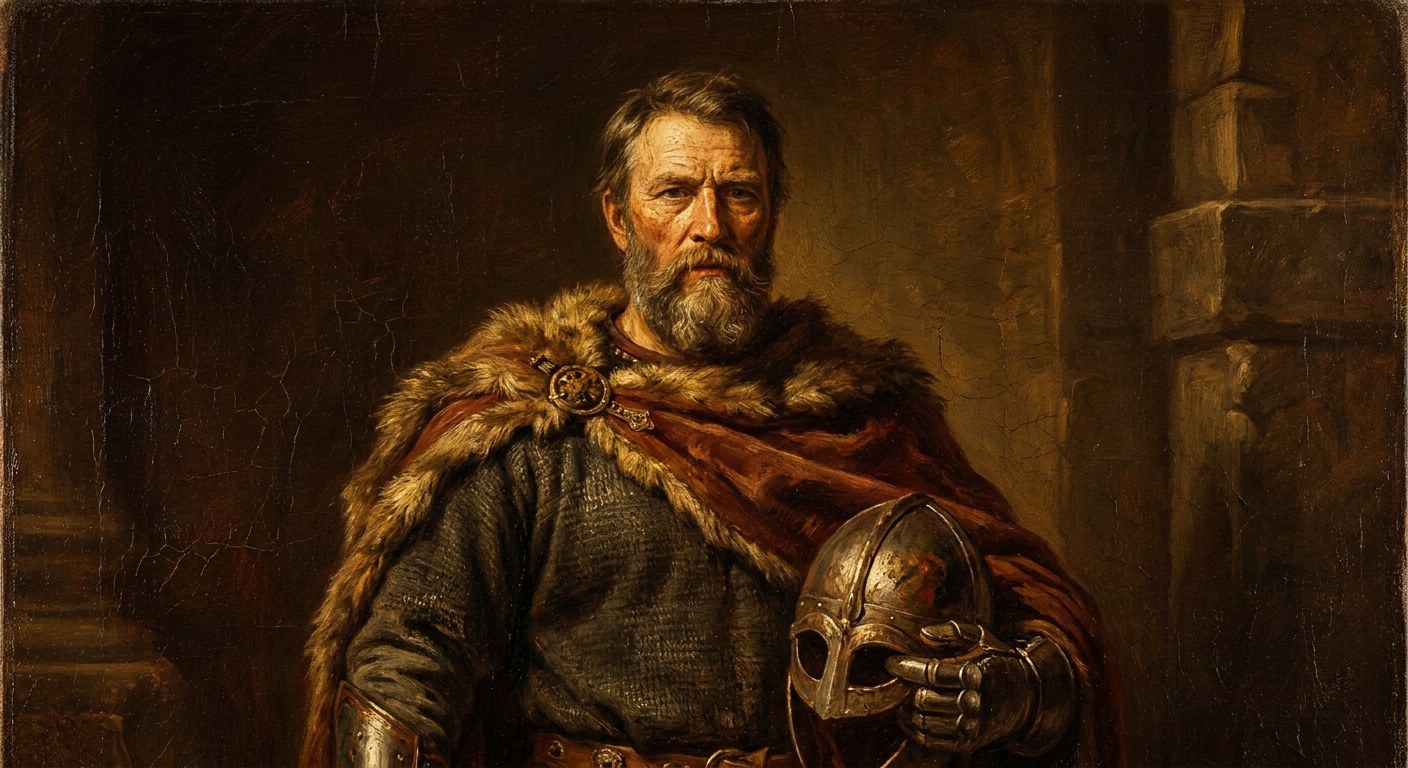
Harald Hardrada
1015 – 1066 · Norwegian · King & Military Commander
Recommended Audiobooks
Listen next from Marcus Alden

Life Lessons from Frederic Chopin
Marcus Alden · 54 min

Life Lessons from John Wesley
Marcus Alden · 52 min
Introduction
Harald Hardrada—more precisely Harald Sigurdsson, later remembered by the Old Norse epithet harðráði, “hard ruler” or “stern in counsel”—was one of the most formidable warrior-kings of the eleventh century. Born around 1015 into the Norwegian aristocracy, he fought in the defining conflicts of his age across Scandinavia, the lands of Kievan Rus’, the Byzantine Empire, the Mediterranean, and England. His death at the Battle of Stamford Bridge on 25 September 1066 is often treated as a symbolic endpoint of the Viking Age.
Harald’s career was exceptional even by the standards of medieval kingship. As a teenager, he fought beside his half-brother, King Olaf II of Norway, at the Battle of Stiklestad in 1030. Defeat sent him into exile, first to Sweden and then to the court of Yaroslav the Wise in Rus’. From there, Harald entered Byzantine service and rose within the famed Varangian Guard, campaigning in the Mediterranean and acquiring immense wealth. He returned to Scandinavia in the 1040s, became co-king with his nephew Magnus the Good, and ruled Norway alone from 1047 until his death.
As king, Harald consolidated royal authority, encouraged trade and coinage, founded or developed urban centers, and fought a prolonged but ultimately unsuccessful war to conquer Denmark. His methods could be ruthless. He crushed resistance from powerful aristocrats, imposed royal control over distant regions, and inspired both admiration and fear. Later Icelandic sagas presented him as courageous, intelligent, ambitious, poetic, and dangerously uncompromising.
Harald’s final campaign was an invasion of England launched in alliance with Tostig Godwinson, the exiled brother of the English king Harold Godwinson. After defeating the northern English earls at Fulford, Harald’s army was surprised and destroyed at Stamford Bridge. Less than three weeks later, Harold Godwinson himself fell to William of Normandy at Hastings. Harald’s death therefore stands at the center of one of the most consequential years in European history.
Quick Facts
| Category | Details |
|---|---|
| Full name | Harald Sigurdsson |
| Common name | Harald Hardrada |
| Old Norse name | Haraldr Sigurðarson |
| Epithet | Harðráði, usually translated as “hard ruler,” “stern ruler,” or “stern in counsel” |
| Born | Around 1015 |
| Birthplace | Traditionally associated with Ringerike, Norway |
| Father | Sigurd Syr, a regional king or powerful chieftain |
| Mother | Åsta Gudbrandsdatter |
| Half-brother | Olaf II Haraldsson, later Saint Olaf |
| Spouses | Elisiv of Kyiv; traditionally also Tora Torbergsdatter |
| Children | Maria, Ingegerd, Magnus II, and Olaf III, according to medieval tradition |
| Reign | 1046–1066; sole king from 1047 |
| Predecessor | Magnus the Good |
| Successors | Magnus II Haraldsson and Olaf III Haraldsson |
| Major foreign service | Kievan Rus’ and the Byzantine Empire |
| Famous military association | The Varangian Guard |
| Principal rival | Svein Estridsson of Denmark |
| Final campaign | Invasion of England in 1066 |
| Died | 25 September 1066 |
| Place of death | Stamford Bridge, Yorkshire, England |
| Cause of death | Killed in battle, traditionally by an arrow to the throat |
| Burial | Initially near York; later reburied at Trondheim, Norway |
| Historical significance | Major Norwegian monarch and one of the last great Viking warrior-kings |
Early Life & Background
Harald was born around 1015, probably in eastern Norway. His father, Sigurd Syr, controlled territory in the uplands and is described in the sagas as a prudent, prosperous ruler more interested in agriculture and administration than raiding. Harald’s mother, Åsta Gudbrandsdatter, had previously been married to Harald Grenske and was the mother of Olaf Haraldsson, the future King Olaf II. Harald was therefore Olaf’s maternal half-brother.
This family connection placed Harald close to Norway’s struggle for political and religious consolidation. During the early eleventh century, Norway was not yet a centralized monarchy in the later medieval sense. Kings depended on regional assemblies, landed aristocrats, local chieftains, household warriors, tribute, and alliances. Rival rulers in Denmark and Sweden frequently intervened in Norwegian affairs.
Olaf II attempted to strengthen royal authority and advance Christianity, but his policies created powerful enemies. In 1028, Cnut the Great, ruler of England and Denmark, forced Olaf into exile and added Norway to his North Sea empire. Olaf returned in 1030 to recover his throne. The approximately fifteen-year-old Harald joined him.
On 29 July 1030, Olaf’s army confronted a coalition of Norwegian opponents at Stiklestad in Trøndelag. Olaf was killed, and his forces were defeated. Saga tradition depicts Harald fighting bravely and suffering serious wounds. Although some details were embellished by later writers, Harald’s presence at Stiklestad is broadly accepted.
With assistance from sympathetic farmers and local supporters, Harald escaped eastward across the mountains into Sweden. He could not safely remain in Norway while Cnut’s representatives and Olaf’s domestic enemies controlled the country. This defeat began an exile that transformed him from a young Norwegian nobleman into a soldier of international experience.
Rise to Prominence
After reaching Sweden, Harald traveled east to Kievan Rus’, a federation of principalities linked by river routes between Scandinavia, the Baltic, the Black Sea, and the Byzantine world. Scandinavian warriors had long served Rus’ princes as mercenaries and retainers. Harald entered the service of Yaroslav I, known as Yaroslav the Wise, grand prince of Kyiv.
Sources attribute military responsibilities to Harald despite his youth. He may have participated in campaigns connected with Poland, steppe peoples, or internal rivalries, although precise reconstructions are difficult. His Norwegian royal connections, battlefield experience, and leadership skills would have made him valuable to Yaroslav.
Around 1034 or 1035, Harald traveled south to Constantinople, capital of the Byzantine Empire. There he joined the Varangian Guard, an elite force composed substantially of Scandinavians and, later, Anglo-Saxons. The Varangians served as imperial bodyguards and as shock troops in major campaigns.
Harald’s Byzantine career is described in Norse poetry, sagas, and Greek sources, but these accounts do not always agree. He appears to have campaigned against Arab forces and pirates and probably served in Sicily under the Byzantine general George Maniakes between 1038 and 1040. The expedition captured several towns from Muslim rulers before collapsing amid disputes among Byzantine commanders and their allies.
Harald may also have fought in Asia Minor and participated in the suppression of the Bulgarian uprising led by Peter Delyan in 1041. Norse tradition later called him the “burner of Bulgars.” His service brought rank, prestige, and considerable wealth. Byzantine rulers rewarded elite soldiers, while victorious troops could profit from gifts and plunder. Harald reportedly sent treasure to Yaroslav for safekeeping.
The sagas claim that Harald enjoyed the favor of Empress Zoë, quarreled with Byzantine authorities, was imprisoned, escaped, and helped overthrow an emperor. These episodes contain legendary elements, but Harald probably did become entangled in the political turmoil surrounding the fall of Michael V in 1042. Soon afterward, he left Constantinople and returned to Rus’.
Harald married Elisiv, or Elizabeth, a daughter of Yaroslav and the Swedish princess Ingegerd Olofsdotter. The marriage connected him to one of Europe’s most prestigious dynastic networks. By the time Harald returned to Scandinavia, he possessed military fame, diplomatic connections, loyal followers, and a fortune large enough to support a bid for power.
Norway had changed during his absence. Cnut died in 1035, and Olaf’s son Magnus the Good became king. Magnus also obtained Denmark in 1042 after the death of Harthacnut. Harald, as Olaf’s half-brother, had his own claim to royal status. He initially allied himself with Magnus’s Danish rival, Svein Estridsson, but negotiations produced a settlement. In 1046, Harald and Magnus became joint kings of Norway, reportedly in exchange for Harald sharing his Byzantine wealth.
Magnus died in 1047. Harald then became sole king of Norway, while Svein secured Denmark. The arrangement created the central conflict of Harald’s reign.
Major Achievements
Harald’s most important achievement was the strengthening of the Norwegian monarchy. Earlier kings had often exercised uneven authority outside their core regions. Harald used military force, appointments, taxation, royal estates, and political alliances to extend direct control over much of the kingdom.
He confronted aristocrats who possessed enough land, followers, and prestige to challenge the crown. By defeating or eliminating important rivals, Harald reduced the independence of regional magnates. His reputation as a harsh ruler arose partly from these struggles. To supporters, he imposed order; to opponents, he was tyrannical.
Harald also contributed to the growth of Norway’s monetary economy. Coins had been minted under earlier kings, but Harald produced royal coinage on a larger scale. His later coins often contained less silver than their models, suggesting deliberate debasement. Although controversial, minting reinforced the king’s authority over exchange, taxation, and public symbols.
He is traditionally credited with founding Oslo around 1050. Archaeological evidence indicates that settlement in the area developed gradually, so “founding” should not be understood as creating a city in a single act. Nevertheless, Harald’s reign was important in Oslo’s emergence as a royal and commercial center. He also supported the strategic importance of Nidaros, present-day Trondheim.
Internationally, Harald made Norway a major military power. He assembled fleets, maintained experienced household troops, and conducted repeated campaigns against Denmark. Although he did not conquer the Danish kingdom, he demonstrated Norway’s ability to challenge it over many years.
The most important Norwegian victory in that conflict came at the naval Battle of Niså, usually dated to 1062. Harald defeated Svein Estridsson’s fleet near the coast of Halland. Svein escaped, according to tradition with help from a former opponent, but his losses were severe. The victory enhanced Harald’s prestige even though it did not produce permanent control of Denmark.
Harald also cultivated the image of a learned warrior. Medieval sources credit him with composing skaldic verse, and several stanzas attributed to him survive. Whether every verse is authentic cannot be certain, but poetry was an important aristocratic accomplishment. His combination of literacy-adjacent court culture, military leadership, and international experience distinguished him from a simple raider.
Defining Moments
The Battle of Stiklestad
Stiklestad shaped Harald’s identity and ambitions. He lost his half-brother, suffered defeat, and entered exile. Olaf’s subsequent recognition as a saint transformed the family’s political standing. Harald later ruled partly as the heir to Olaf’s dynasty, though his own methods were often more pragmatic than saintly.
Service in the Byzantine Empire
Harald’s years in Byzantine service gave him experience unavailable to most Scandinavian rulers. He encountered professional armies, siege warfare, Mediterranean naval operations, complex taxation, monumental cities, and imperial court politics. His wealth from this period later financed his pursuit of the Norwegian crown.
The Settlement with Magnus the Good
Rather than immediately wage a destructive civil war, Harald negotiated a division of royal power with Magnus in 1046. The compromise reveals political flexibility beneath his aggressive reputation. Magnus’s death the following year allowed Harald to take full control without defeating his nephew in battle.
The War for Denmark
Harald based his claim to Denmark on political arrangements associated with Magnus the Good and earlier Scandinavian succession agreements. Svein Estridsson, however, possessed strong domestic support. Harald repeatedly raided Danish territory, attacked commercial centers such as Hedeby, and defeated Danish forces, but tactical success did not overcome Svein’s political legitimacy. Around 1064 or 1065, the two rulers made peace, each retaining his own kingdom.
The Destruction of Domestic Rivals
Among Harald’s most controversial actions was his conflict with Einar Tambarskjelve, one of Norway’s most influential aristocrats. Einar had played a major role in national politics and supported Magnus’s restoration. As tension with Harald increased, Einar and his son Eindride were killed around 1050, apparently at the king’s order or with his approval. The episode exemplified Harald’s determination to prevent magnates from becoming alternative centers of power.
Harald also fought Håkon Ivarsson, another powerful nobleman. Such conflicts show that Norwegian unification was not merely a patriotic project; it involved coercion, confiscation, exile, and bloodshed.
The Invasion of England
After abandoning his Danish ambitions, Harald pursued a claim to England. Medieval sources differ on its precise legal basis. Harald reportedly invoked an agreement under which Harthacnut and Magnus the Good would inherit each other’s kingdoms. Because Magnus had claimed Harthacnut’s inheritance, Harald considered himself Magnus’s successor to that claim.
The opportunity came in 1066. King Edward the Confessor died on 5 January, and Harold Godwinson became king. Edward’s succession was disputed by William, duke of Normandy, Harald Hardrada, and possibly others. Harold’s estranged brother Tostig Godwinson, the former earl of Northumbria, sought foreign aid and joined Harald.
Harald sailed to England with a large fleet, traditionally said to number about 300 ships, although medieval numbers are often exaggerated. His son Olaf, his wife Elisiv, and his daughters accompanied the expedition as far as the Orkneys or northern staging areas. Harald then moved south, joined Tostig, and entered the Humber.
On 20 September 1066, Harald and Tostig defeated the forces of the northern earls Edwin of Mercia and Morcar of Northumbria at the Battle of Fulford, near York. York submitted, and hostages were arranged.
Five days later, King Harold Godwinson arrived after a rapid march from southern England. Harald’s forces had gathered at Stamford Bridge, apparently expecting hostages rather than battle. Many Norwegians had left their armor with the ships at Riccall because of the warm weather. The English attack achieved strategic surprise.
Harald formed his men into a defensive formation, but reinforcements arrived too late to reverse the battle. He was killed, traditionally by an arrow through the throat. Tostig also died, and the Norwegian army collapsed. Harald’s son Olaf and the Orkney leader Paul Thorfinnsson negotiated permission to depart. Tradition claimed that only 24 ships were required to carry the survivors home, a dramatic figure intended to emphasize the scale of the disaster.
Timeline
| Year | Event |
|---|---|
| c. 1015 | Harald Sigurdsson is born, probably in eastern Norway. |
| 1028 | Cnut the Great drives Olaf II from Norway. |
| 1030 | Harald fights beside Olaf at Stiklestad; Olaf is killed and Harald flees. |
| c. 1031 | Harald enters the service of Yaroslav the Wise in Kievan Rus’. |
| c. 1034–1035 | He travels to Constantinople and joins Byzantine service. |
| 1038–1040 | Harald probably campaigns in Sicily under George Maniakes. |
| 1041 | He is associated with Byzantine operations against the Bulgarian uprising. |
| 1042 | Harald leaves Constantinople amid imperial political upheaval. |
| c. 1044–1045 | He marries Elisiv, daughter of Yaroslav the Wise. |
| 1045 | Harald returns to Scandinavia and challenges Magnus the Good. |
| 1046 | Harald becomes co-king of Norway with Magnus. |
| 1047 | Magnus dies; Harald becomes sole king of Norway. |
| c. 1050 | Harald attacks Hedeby and intensifies war against Denmark. |
| c. 1050 | Einar Tambarskjelve and his son are killed amid conflict with Harald. |
| c. 1050 | Oslo’s early urban development is traditionally linked to Harald. |
| 1062 | Harald defeats Svein Estridsson at the naval Battle of Niså. |
| 1064–1065 | Harald and Svein make peace, ending the struggle for Denmark. |
| January 1066 | Edward the Confessor dies; Harold Godwinson becomes king of England. |
| September 1066 | Harald invades northern England with Tostig Godwinson. |
| 20 September 1066 | Harald defeats Edwin and Morcar at Fulford. |
| 25 September 1066 | Harald is killed at the Battle of Stamford Bridge. |
| 1067 | His son Olaf returns to Norway and later rules as Olaf III. |
Personal Life
Harald’s best-documented dynastic marriage was to Elisiv of Kyiv, known in Old Norse as Ellisif. She was a daughter of Yaroslav the Wise and Ingegerd, making her part of a family connected to the ruling houses of Sweden, France, Hungary, and other European states. Their marriage probably occurred shortly before Harald returned to Norway.
Harald composed or was credited with composing verses addressed to a woman commonly identified as Elisiv. In them, he boasts of martial accomplishments while lamenting that the “gold-ringed goddess in Russia” does not favor him. The poems may preserve genuine elements of courtship, though their surviving forms were transmitted much later.
Harald and Elisiv had two daughters, Maria and Ingegerd. Tradition states that Maria died in Orkney on the same day that Harald fell at Stamford Bridge, although the story cannot be independently verified. Ingegerd later married King Olaf I of Denmark and subsequently King Philip of Sweden.
Norwegian saga tradition also describes Harald’s union with Tora Torbergsdatter, daughter of the powerful magnate Torberg Arnesson. She was the mother of Harald’s sons Magnus and Olaf. Whether Harald and Tora underwent a fully Christian marriage while Elisiv was alive is uncertain. Elite Scandinavian relationships in this transitional period did not always conform neatly to later church law.
Magnus became king shortly before or immediately after his father’s final expedition and ruled until 1069. Olaf, who survived the English campaign, became known as Olaf Kyrre, “Olaf the Peaceful.” His long reign contrasted sharply with his father’s relentless warfare.
Harald’s personality is known mainly through saga literature written generations after his death. These sources portray him as physically imposing, confident, observant, witty, suspicious, and severe. He rewarded loyalty generously but reacted ruthlessly to opposition. Such descriptions reflect both remembered traits and literary ideals of kingship.
Beliefs & Philosophy
Harald was a Christian king ruling a society in which Christian institutions were still developing. His half-brother Olaf had become Norway’s patron saint, and Harald benefited from association with Olaf’s sacred dynasty. He supported churches and maintained ties with the broader Christian world.
His relationship with ecclesiastical authorities was nevertheless complicated. Harald resisted outside interference, particularly when he believed church appointments threatened royal independence. Adam of Bremen, writing from a perspective favorable to the archbishopric of Hamburg-Bremen, criticized Harald’s conduct and portrayed him as proud and oppressive. The criticism must be read in the context of disputes over control of the Scandinavian church.
Harald’s practical philosophy of government appears to have emphasized royal sovereignty, loyalty, military readiness, and political realism. His behavior suggests that he believed a king had to dominate rival magnates rather than merely preside over them. Wealth was a tool of rule: it maintained retainers, purchased alliances, financed fleets, and displayed divine or dynastic favor.
At the same time, Harald belonged to the Norse aristocratic culture of honor. Courage, reputation, generosity, poetic ability, and refusal to retreat were central to elite identity. The sagas’ account of his death—fighting aggressively despite surprise and inferior preparation—fit this heroic ideal.
Challenges & Controversies
The greatest limitation of Harald’s reign was his inability to convert military victories into a durable Danish conquest. Years of campaigning consumed lives and resources, while Svein Estridsson retained sufficient support to rebuild after defeat. Harald’s claim may have possessed a dynastic rationale, but many Danes regarded Svein as their legitimate ruler.
Harald’s domestic centralization also generated resistance. The killings of Einar Tambarskjelve and Eindride were remembered as treacherous. Conflict with Håkon Ivarsson and other magnates revealed the costs of reducing aristocratic autonomy. The epithet Hardrada reflects this enduring image of severity, although it was popularized in later sources rather than necessarily used during Harald’s lifetime.
His coinage is another subject of debate. Some issues contained a low proportion of silver, effectively lowering their intrinsic value. This may have increased royal revenue, but it could also undermine confidence and burden those required to accept the coins at an official value.
The reliability of the sources presents a major historical challenge. Snorri Sturluson’s Heimskringla, including the Saga of Harald Hardrada, was written in the thirteenth century, nearly two centuries after Harald’s death. Snorri drew on earlier poetry and traditions, some of which are valuable, but shaped them into dramatic narratives. Byzantine, English, Danish, and German sources provide external evidence yet have their own biases and limitations.
Harald’s English expedition has often been romanticized as the “last Viking invasion.” In reality, Scandinavian warfare and migration did not suddenly end in 1066. Nor was Harald merely a traditional Viking raider: he was a Christian monarch commanding a royal army and advancing a dynastic claim. Nonetheless, Stamford Bridge marked the destruction of the last major Scandinavian attempt to conquer England in the manner of Cnut’s North Sea empire.
Famous Quotes
No long speech attributed to Harald can be accepted uncritically. Most quotations come from sagas composed well after his lifetime, while the verses may preserve older material.
A stanza attributed to Harald during his eastern career boasts of his accomplishments but ends with a repeated complaint about Elisiv:
“Yet the gold-ringed Gerðr in Russia
will not accept my love.”
Before Stamford Bridge, Harald is said to have improvised a verse after stumbling, presenting the fall as an omen but refusing fear:
“Forward we go in battle array,
without armor beneath the blue blades.”
When asked who the imposing man on horseback was during negotiations before the battle, Tostig reportedly identified Harald. The English rider—traditionally Harold Godwinson—was then said to remark:
“He is a big man and of proud appearance; but it is likely that he has finished his good fortune.”
This exchange is literary and not a verbatim record. Its survival reveals how later writers understood Harald: magnificent, dangerous, and approaching a fate he would not evade.
Legacy & Influence
Harald Hardrada’s reign was crucial to the formation of medieval Norway. He did not create the Norwegian kingdom from nothing, but he strengthened institutions, restrained regional rivals, encouraged urban development, and made royal authority harder to challenge. His successors inherited a more consolidated monarchy.
His son Olaf III adopted a less militaristic style and presided over growing trade, church organization, and urban life. The contrast between “Harald the Hard Ruler” and “Olaf the Peaceful” became a useful historical framework: Harald conquered and centralized, while Olaf stabilized and developed.
Internationally, Harald embodied the interconnectedness of the eleventh-century world. His life linked Norway with Sweden, Kyiv, Constantinople, Sicily, Bulgaria, Denmark, and England. He was not confined to a remote Scandinavian sphere; he participated in networks that connected the North Atlantic to the Mediterranean and Eurasian river routes.
Stamford Bridge gave Harald a special place in English history. His invasion forced Harold Godwinson to move rapidly north, defeat the Norwegians, and then march south to confront William of Normandy. Historians continue to debate how much the northern campaign weakened the English army before Hastings, but it unquestionably imposed enormous logistical and physical demands.
In Norway, Harald became a national historical figure: admired as a warrior and state-builder but criticized for ruthlessness. In Icelandic literature, he is one of the most vividly characterized kings—clever, sarcastic, ambitious, and formidable. Modern novels, games, television programs, and popular histories have expanded his reputation far beyond Scandinavia.
Calling him “the last Viking” is memorable but oversimplified. Harald was simultaneously a Viking-style expeditionary leader, Byzantine veteran, Christian monarch, dynastic claimant, poet, and administrator. His life illustrates the transformation of Scandinavian elites from mobile warrior bands into centralized European kingships.
Interesting Facts
- Harald was only about fifteen when he fought at Stiklestad.
- His epithet harðráði refers more directly to harsh rule or stern counsel than to physical courage.
- He served one of the world’s wealthiest empires before becoming king of Norway.
- Byzantine sources may refer to him as Araltes, a form of Harald.
- He probably fought in Sicily under George Maniakes, one of Byzantium’s most famous generals.
- Harald sent much of his eastern wealth to Yaroslav the Wise for safekeeping.
- His marriage to Elisiv linked Norway’s dynasty with the ruling family of Kyiv.
- Several skaldic stanzas are attributed to Harald himself.
- He reportedly escaped Constantinople by sailing through or around barriers across the Golden Horn, though saga details are uncertain.
- Harald’s struggle for Denmark lasted much of his reign.
- His victory at Niså was militarily impressive but politically inconclusive.
- Oslo traditionally dates its foundation to Harald’s reign, although settlement developed over time.
- Harald’s 1066 army included Norwegians, Orkneymen, and allies associated with Tostig.
- His famous raven banner was called Landeyðan, often translated as “Land-Waster.”
- He left part of his army and much of its armor at Riccall before Stamford Bridge.
- His sons both became kings of Norway.
- His daughter Ingegerd became queen in both Denmark and Sweden.
- Harald was probably about fifty years old when he died—an advanced age for an active medieval battlefield commander.
- His remains were eventually associated with a church in Trondheim, though the exact location is now uncertain.
- His defeat occurred only nineteen days before the Battle of Hastings.
Frequently Asked Questions
Why was Harald called Hardrada?
“Hardrada” derives from the Old Norse harðráði. It can mean “hard ruler,” “stern ruler,” or “stern in counsel.” The name reflects his reputation for uncompromising government and severe treatment of opponents. It should not be confused with hárfagri, “fair-haired,” the epithet of the earlier Harald Fairhair.
Was Harald Hardrada really the last Viking?
He is often called “the last great Viking,” especially because his death at Stamford Bridge symbolically marks the end of the Viking Age. The label is convenient rather than exact. Viking activity continued after 1066, and Harald was also a Christian king leading a state-sponsored dynastic invasion.
Did Harald serve in the Varangian Guard?
Yes. The evidence strongly supports his service in the Byzantine military and his association with the Varangian Guard. The exact ranks he held and every campaign attributed to him remain debated.
How did Harald become rich?
He accumulated wealth through military pay, imperial rewards, gifts, and plunder during his years in Rus’ and Byzantine service. He reportedly deposited treasure with Yaroslav the Wise. This fortune helped him recruit supporters and negotiate a share of the Norwegian kingdom.
Why did Harald claim Denmark?
Harald inherited Magnus the Good’s political position and argued that agreements involving Magnus and Harthacnut gave him a claim to Denmark. Svein Estridsson had stronger practical support among the Danes, preventing Harald from turning battlefield successes into conquest.
Why did Harald invade England?
He claimed succession rights through Magnus the Good and Harthacnut. The political crisis following Edward the Confessor’s death gave him an opportunity, while Tostig Godwinson provided intelligence, contacts, and a local alliance.
Who defeated Harald Hardrada?
King Harold II Godwinson of England defeated him at Stamford Bridge on 25 September 1066. Harald and Tostig were both killed.
How did Harald Hardrada die?
English and Norse traditions agree that he died in battle. The best-known account says an arrow struck him in the throat, but the precise manner of death cannot be independently verified.
Did Stamford Bridge end the Viking Age?
It did not end Scandinavian warfare immediately, but historians often use the battle as a symbolic endpoint. The defeat ended Harald’s invasion and the last major Norwegian attempt to conquer England.
Was Harald a successful king?
His record was mixed. He failed to conquer Denmark and died during a failed invasion of England, yet he ruled Norway for two decades, strengthened the monarchy, promoted coinage and urban growth, defeated major rivals, and left a stable dynasty.
Lessons from Harald Hardrada
- Experience can be transformed into authority: Harald used knowledge gained in exile and foreign service to support his kingship.
- Military victory does not guarantee political control: His triumph at Niså failed to deliver Denmark because Svein retained local legitimacy.
- Wealth is most powerful when converted into networks: Harald’s treasure mattered because it financed followers, alliances, and royal claims.
- Adaptability can rescue a defeated cause: After Stiklestad, Harald rebuilt his career across several foreign courts.
- Centralization carries human and political costs: His stronger monarchy was achieved partly through violence against domestic rivals.
- Reputation is a form of power: Harald cultivated an image of courage, generosity, intelligence, and severity.
- Ambition can exceed strategic limits: The English invasion offered enormous rewards but exposed Harald far from his base.
- Surprise and logistics can decide history: At Stamford Bridge, dispersed troops and abandoned armor helped turn a victorious campaign into catastrophe.
- Historical legends require critical reading: Saga stories preserve valuable memories but mix fact, poetry, politics, and literary invention.
- A failed final campaign need not erase a consequential reign: Harald’s death dominates popular memory, yet his state-building shaped Norway for generations.
Further Reading
- Snorri Sturluson, Heimskringla: History of the Kings of Norway, especially the Saga of Harald Hardrada.
- Morkinskinna: The Earliest Icelandic Chronicle of the Norwegian Kings.
- Fagrskinna: A Catalogue of the Kings of Norway.
- The Anglo-Saxon Chronicle, entries for 1066.
- Adam of Bremen, History of the Archbishops of Hamburg-Bremen.
- John Skylitzes, A Synopsis of Byzantine History, 811–1057.
- Kelly DeVries, The Norwegian Invasion of England in 1066.
- Judith Jesch, The Viking Diaspora.
- Sverre Bagge, From Viking Stronghold to Christian Kingdom: State Formation in Norway, c. 900–1350.
- Claus Krag, The Early Unification of Norway.
- Peter Sawyer, The Oxford Illustrated History of the Vikings.
- Else Roesdahl, The Vikings.
- Neil Price, Children of Ash and Elm: A History of the Vikings.
- Michael Enright, studies of Scandinavian kingship and warrior culture.
- Archaeological and numismatic publications from the Museum of Cultural History in Oslo and the Norwegian University of Science and Technology in Trondheim.