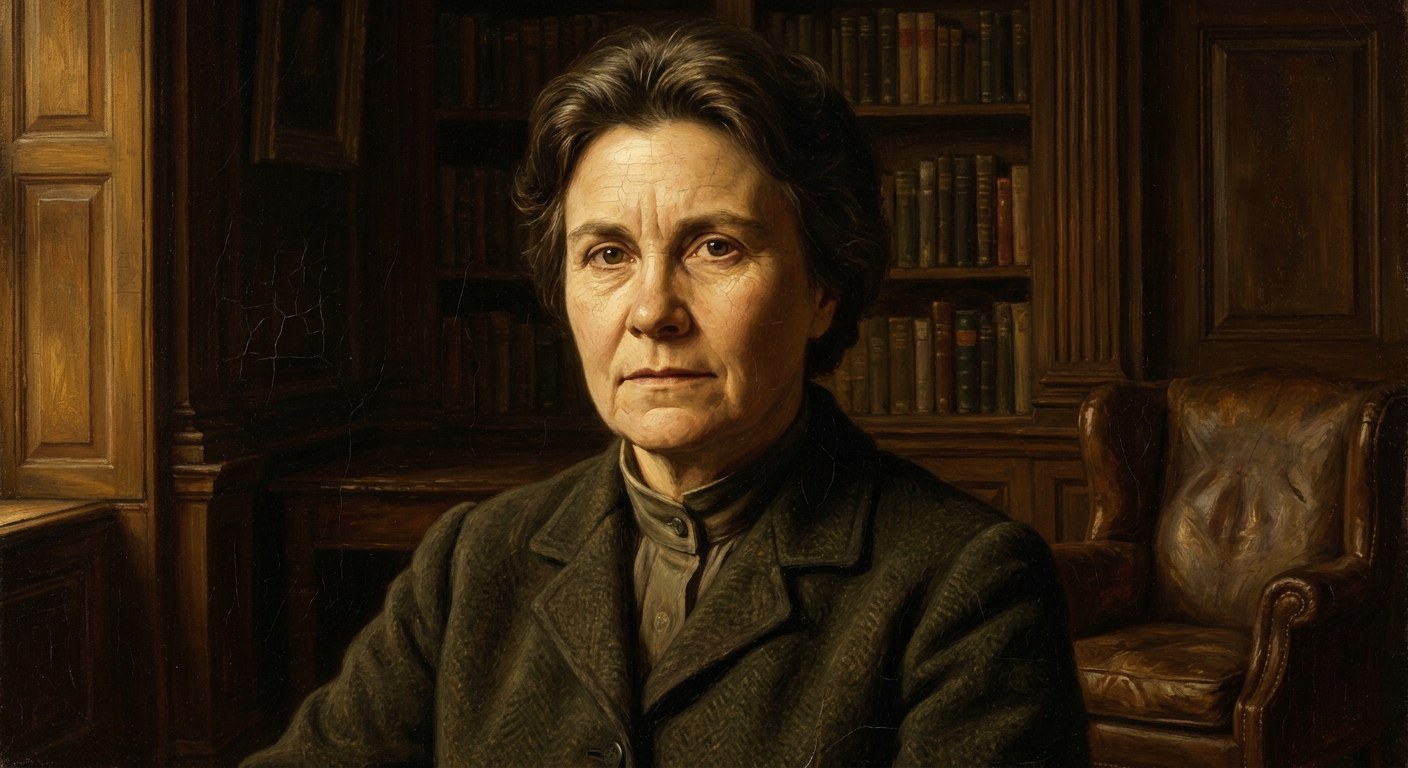
Harper Lee
1926 – 2016 · American · Novelist
Recommended Audiobooks
Listen next from Marcus Alden

Life Lessons from Frederic Chopin
Marcus Alden · 54 min

Life Lessons from John Wesley
Marcus Alden · 52 min
Introduction
Nelle Harper Lee, known professionally as Harper Lee, was an American novelist whose reputation rests primarily on one of the most widely read and debated works of modern American literature: To Kill a Mockingbird. Published in 1960, the novel transformed memories of Lee’s small-town Alabama childhood into a story about race, law, childhood, conscience, courage, and moral failure. It won the Pulitzer Prize for Fiction, inspired an acclaimed motion picture, and became a fixture in schools and libraries throughout the English-speaking world.
Lee’s achievement was unusual not only because of the novel’s enormous popularity, but also because of the public silence that followed it. She largely withdrew from literary celebrity, rarely granted interviews, and published no second novel for more than five decades. This reticence turned her into an enigmatic cultural figure. It also encouraged myths about her personality, her creative process, and even the authorship of her work.
In 2015, the publication of Go Set a Watchman complicated both Lee’s public image and the moral world associated with To Kill a Mockingbird. Written before the celebrated novel but set later in the lives of several of its characters, the manuscript presented an older and more politically compromised Atticus Finch. Its publication generated major questions about artistic development, race, aging, consent, and the commercial treatment of famous authors.
Lee matters because she created characters and conflicts that continue to shape discussions of justice and racial inequality. Her work has inspired empathy and moral reflection, but it has also been criticized for centering a white perspective on Black suffering and for offering a limited account of structural racism. That combination of influence, emotional power, and continuing controversy makes Harper Lee essential to the study of twentieth-century American literature.
Quick Facts
| Fact | Details |
|---|---|
| Born | April 28, 1926, Monroeville, Alabama, United States |
| Died | February 19, 2016, Monroeville, Alabama, United States |
| Nationality | American |
| Known For | To Kill a Mockingbird and Go Set a Watchman |
| Occupation | Novelist and writer |
| Era | Twentieth- and early twenty-first-century American literature |
Early Life and Education
Nelle Harper Lee was born on April 28, 1926, in Monroeville, a small town in southern Alabama. She was the youngest of four children of Amasa Coleman Lee and Frances Cunningham Finch Lee. Her first name, Nelle, was reportedly chosen because it was her maternal grandmother’s name, Ellen, spelled backward. As an author, she used Harper Lee, partly avoiding the likelihood that readers would mispronounce Nelle as “Nellie.”
Lee’s father was a lawyer, newspaper owner and editor, businessman, and member of the Alabama legislature. His legal career helped provide the background for Atticus Finch, although Atticus was never a simple portrait of Amasa Lee. Like his fictional counterpart, Lee’s father was a small-town attorney and had once participated in the defense of Black clients in a criminal case. His political and racial attitudes also evolved over time, reflecting contradictions that later became relevant to interpretations of both To Kill a Mockingbird and Go Set a Watchman.
Monroeville supplied much of the physical and social atmosphere that Lee later reimagined as Maycomb. She grew up during the Great Depression in the legally segregated South, where white supremacy was enforced through law, custom, economics, and violence. The courthouse, neighborhood streets, class distinctions, religious culture, and racial divisions of her hometown all left visible traces in her fiction.
As a child, Lee was energetic, independent, and often described as a tomboy. She read extensively and developed an early interest in language and storytelling. Her closest childhood friend was Truman Persons, later known as Truman Capote. Capote spent time in Monroeville with relatives, and the two imaginative, unconventional children formed a strong bond. They wrote stories together on a typewriter given to them by Lee’s father. Capote later became the model for Dill Harris in To Kill a Mockingbird, while Lee inspired the character Idabel Thompkins in some of Capote’s writing.
Lee attended Monroe County High School. She then studied at Huntingdon College in Montgomery from 1944 to 1945 before transferring to the University of Alabama. At the university she wrote for campus publications, including the humor magazine Rammer Jammer, and eventually became its editor. Her sharp wit and willingness to satirize university life were already evident.
Following the professional example of her father and older sister Alice, Lee studied law. She also participated in a summer program at the University of Oxford in England in 1948. Yet legal study did not satisfy her deepest ambitions. In 1949, only months before she might have completed her law degree, she left the University of Alabama without graduating and moved to New York City to become a writer.
Rise to Prominence
Life in New York did not bring immediate literary success. Lee supported herself by working as a reservations agent for Eastern Air Lines and later for the British Overseas Airways Corporation. She wrote during her free time, producing stories and sketches rooted in Southern life. Although she disliked publicity, she built a small but important circle of friends in the city.
A decisive moment came at Christmas in 1956. Lee’s friends Michael and Joy Brown gave her a remarkable gift: enough money to leave her job for a year and concentrate on writing. Their note reportedly told her that she had one year away from employment to write whatever she pleased. Lee later described the gift as an extraordinary act of faith.
She used that opportunity to develop a manuscript concerning a young woman named Jean Louise Finch who returns from New York to her Alabama hometown. Through friends, Lee was introduced to literary agent Maurice Crain. The manuscript reached editor Tay Hohoff at J. B. Lippincott & Co. Hohoff recognized Lee’s talent but judged the work episodic and not yet ready for publication.
Instead of rejecting Lee outright, Hohoff began an intensive editorial collaboration with her. The process lasted roughly two and a half years. Lee shifted the story’s focus away from the adult Jean Louise and toward her childhood as Scout Finch. She reworked characters, chronology, tone, and plot, eventually organizing the novel around the trial of Tom Robinson, a Black man falsely accused of raping a white woman.
The resulting book, To Kill a Mockingbird, was published on July 11, 1960. Lee reportedly hoped that reviewers would treat it kindly and that it might sell a few thousand copies. Instead, the novel became a bestseller and a cultural phenomenon. Its appearance coincided with a crucial phase of the modern civil rights movement, when Americans were confronting school desegregation, sit-ins, racial violence, and the entrenched injustices of the Jim Crow South.
The novel’s combination of childhood humor, courtroom drama, mystery, and moral instruction made difficult material accessible to a broad audience. Scout’s voice allowed readers to encounter Maycomb’s racial and class hierarchies through a perspective that was observant but not always fully aware of their meaning. Atticus Finch, the lawyer who defends Tom Robinson despite community hostility, became an enduring symbol of integrity and professional courage.
Major Achievements and Contributions
In 1961, To Kill a Mockingbird received the Pulitzer Prize for Fiction. The honor confirmed Lee’s place among major American writers less than a year after the publication of her first novel. The book went on to sell tens of millions of copies and was translated into numerous languages.
Its success expanded further through the 1962 film adaptation directed by Robert Mulligan and produced by Alan J. Pakula. Horton Foote wrote the screenplay, and Gregory Peck played Atticus Finch. The film won three Academy Awards, including Best Actor for Peck and Best Adapted Screenplay for Foote. Lee approved of the adaptation and formed a lasting friendship with Peck and his family. She gave Peck a pocket watch that had belonged to her father, and he wore it when he accepted his Academy Award.
Lee also made an important contribution to Truman Capote’s In Cold Blood. In late 1959, after four members of the Clutter family were murdered in Holcomb, Kansas, Lee traveled there with Capote. Her practical manner and ability to establish trust helped them gain access to residents, investigators, and witnesses. She took extensive notes, conducted interviews, and assisted Capote throughout the early research. In Cold Blood, published in 1966, was dedicated to Lee and Capote’s partner, Jack Dunphy, but the exact scale of Lee’s contribution was not widely understood for many years.
Although Lee did not publish another novel during the next half-century, she produced several short nonfiction pieces. These included “Love—In Other Words,” “Christmas to Me,” and “When Children Discover America.” In a 2006 letter published in O, The Oprah Magazine, she recalled how books had shaped her childhood and defended the importance of reading in a technologically changing world.
Her public honors accumulated gradually. In 1966, President Lyndon B. Johnson appointed her to the National Council on the Arts. In 2007, President George W. Bush awarded her the Presidential Medal of Freedom, the highest civilian honor in the United States. In 2010, President Barack Obama presented her with the National Medal of Arts.
Lee’s broadest contribution was to place questions of race, justice, conscience, and childhood moral development before a mass readership. The novel encouraged many readers—especially young white readers—to recognize the cruelty of racial prejudice. At the same time, later criticism has shown that its moral vision is incomplete. Its Black characters are given less narrative depth and agency than its white protagonists, and its courtroom-centered story can imply that individual decency is an adequate response to systemic oppression. The novel’s importance lies partly in the conversations it opened and partly in the arguments it continues to provoke.
Key Works / Battles / Ideas
To Kill a Mockingbird
Set in the fictional town of Maycomb, Alabama, during the Depression, To Kill a Mockingbird is narrated retrospectively by Jean Louise “Scout” Finch. Scout lives with her older brother Jem and their widowed father, Atticus. Their childhood fascination with the reclusive Arthur “Boo” Radley gradually intersects with the central public drama of the novel: Atticus’s defense of Tom Robinson.
Tom is accused of assaulting Mayella Ewell, a white woman from an impoverished family. Evidence presented at trial strongly indicates that Tom is innocent and that Mayella’s father, Bob Ewell, was responsible for her injuries. Nevertheless, an all-white jury convicts Tom. He is later shot and killed while attempting to escape prison.
The novel examines several forms of prejudice. Race is central, but Lee also explores class divisions, gender expectations, social isolation, family reputation, and mob behavior. The mockingbird functions as a symbol of vulnerable innocence: to harm one is to destroy something that has brought no injury to others.
Atticus’s defense of Tom established him as one of fiction’s best-known lawyers. The American Film Institute later named Gregory Peck’s screen version of Atticus the greatest hero in American cinema. Yet the character has always invited debate. Admirers view him as a model of disciplined conscience. Critics argue that he remains emotionally restrained about racist injustice and that the narrative elevates white moral growth above Black experience.
Go Set a Watchman
Go Set a Watchman was published on July 14, 2015. Although promoted as a newly discovered second novel, it was actually an earlier manuscript written in the 1950s. Its characters and themes were reworked during the editorial process that produced To Kill a Mockingbird. It is therefore best understood as an antecedent or developmental draft rather than a conventional sequel.
In the book, an adult Jean Louise returns to Maycomb and discovers that Atticus has associated with segregationist politics. Her idealized image of her father collapses, forcing her to develop an independent moral conscience. The work is more uneven than To Kill a Mockingbird, but it provides valuable evidence of Lee’s artistic development and of conflicts within white Southern society during the civil rights era.
The presentation of Atticus shocked readers accustomed to the heroic figure of the later novel. Yet the difference demonstrates how extensively Lee and Hohoff transformed the original material. It also raises difficult questions about whether moral heroes are products of selective memory and whether children must eventually judge their parents by principles independent of family loyalty.
Conscience and Perspective
Two ideas recur throughout Lee’s writing: the need to view events from another person’s perspective and the obligation to preserve one’s conscience against social pressure. In To Kill a Mockingbird, empathy is not presented as mere politeness. It is a discipline that can expose the cruelty hidden beneath respectable customs.
However, empathy has limits when it is not accompanied by historical understanding or meaningful action. Modern teaching of Lee’s work increasingly places it alongside texts by Black writers such as Richard Wright, James Baldwin, Maya Angelou, Toni Morrison, and Bryan Stevenson. Such pairing allows readers to appreciate Lee’s achievement without treating one white-authored novel as a complete account of American racism.
Timeline of Key Events
| Year | Event |
|---|---|
| 1926 | Nelle Harper Lee is born in Monroeville, Alabama, on April 28. |
| 1944 | Enters Huntingdon College in Montgomery. |
| 1945 | Transfers to the University of Alabama and later studies law. |
| 1948 | Attends a summer program at the University of Oxford. |
| 1949 | Leaves university without a degree and moves to New York City. |
| 1956 | Receives financial support from Michael and Joy Brown to write full-time for one year. |
| 1957 | Submits an early manuscript that develops into To Kill a Mockingbird. |
| 1959 | Travels to Kansas to assist Truman Capote with research for In Cold Blood. |
| 1960 | To Kill a Mockingbird is published on July 11. |
| 1961 | Wins the Pulitzer Prize for Fiction. |
| 1962 | The acclaimed film adaptation of To Kill a Mockingbird is released. |
| 1966 | Is appointed by President Lyndon B. Johnson to the National Council on the Arts. |
| 2007 | Receives the Presidential Medal of Freedom. |
| 2010 | Receives the National Medal of Arts. |
| 2014 | Lee’s sister and longtime protector, Alice Lee, dies at age 103. |
| 2015 | Go Set a Watchman is published amid intense debate. |
| 2016 | Harper Lee dies in Monroeville on February 19 at age 89. |
Personal Life and Character
Lee never married and had no children. For many years she divided her time between a modest apartment in New York and the house in Monroeville that she shared with her older sister Alice. Alice Lee, an attorney who practiced past the age of 100, handled many of her sister’s legal and business affairs and helped protect her privacy.
Friends portrayed Harper Lee as intelligent, humorous, loyal, direct, and unimpressed by literary fame. She enjoyed reading, conversation, sports, travel, and ordinary social life with trusted companions. Her public image as a total recluse was exaggerated. She maintained friendships and attended selected events, but she strongly resisted interviews, intrusive visitors, and the expectation that authors must continually explain their work.
Lee’s reluctance to publish again has been interpreted in several ways. She may have felt overwhelmed by the success of her first novel or dissatisfied with subsequent writing. She may also simply have valued privacy and refused to produce a book merely to satisfy commercial demand. Reports that she was secretly writing another major novel were never substantiated by a completed publication.
Her friendship with Truman Capote changed over time. Their different temperaments, Capote’s troubled later life, and possible tensions concerning fame and recognition created distance. Nevertheless, their shared childhood and Lee’s contribution to In Cold Blood remain central to both literary biographies.
Lee suffered a stroke in 2007 and experienced declining eyesight and hearing. She later lived in an assisted-living facility in Monroeville. Even in old age, acquaintances described her as mentally engaged, though sharply differing claims about her health became part of the controversy surrounding Go Set a Watchman.
Challenges and Controversies
Lee’s most persistent challenge was the burden created by extraordinary early success. After To Kill a Mockingbird, readers and publishers expected another masterpiece. Her silence encouraged speculation that she had stopped writing because of fear, perfectionism, creative exhaustion, or resentment of publicity. Because Lee rarely answered such claims, speculation often replaced evidence.
A recurring rumor alleged that Truman Capote had written or substantially authored To Kill a Mockingbird. No credible evidence supports this theory. Lee’s manuscripts, correspondence, editorial history, voice, and documented years of revision establish her authorship. Capote himself acknowledged reading an early version, but he did not claim to have written the novel.
The book has also been repeatedly challenged or removed from school curricula. Objections have focused on racial slurs, depictions of sexual assault, profanity, and the emotional effect of teaching the book to Black students. Some challengers have sought removal; others have argued for fuller historical framing rather than censorship. Defenders emphasize the novel’s critique of racism and its educational value, while critics caution that classroom discussion can reproduce harm if the language and perspective are handled carelessly.
Literary criticism has further questioned the book’s racial politics. Tom Robinson is crucial to the plot but has limited opportunity to exist beyond the accusations and trial imposed upon him. Calpurnia, the Finch family’s Black housekeeper, is respected yet largely presented through Scout’s understanding. The story’s emotional center remains the moral education of white characters. Consequently, many scholars consider the novel an important liberal challenge to prejudice but not a comprehensive critique of white supremacy.
The greatest controversy of Lee’s final years concerned Go Set a Watchman. Lee’s lawyer, Tonja Carter, announced that the manuscript had been found among papers in a safe-deposit box. Questions soon arose about when it had actually been identified and whether Lee, then in her late eighties and living with sensory impairments, had knowingly approved publication.
Concern intensified because Alice Lee, who had long protected Harper’s interests, died shortly before the announcement. Some friends believed Harper Lee was capable of making the decision; others doubted whether she fully understood the publication plans. Alabama authorities investigated allegations of elder abuse and found no basis for intervention. No conclusive public evidence established that Lee was coerced, but doubts about consent and the publisher’s handling of the manuscript have never entirely disappeared.
There was also disagreement over marketing. Calling Watchman a sequel suggested a newly completed continuation, whereas it was a draft that predated Mockingbird. For scholars, the manuscript is illuminating because it reveals the scale of Lee’s revisions. For general readers, however, its publication without a substantial scholarly apparatus risked obscuring that history.
Death and Immediate Aftermath
Harper Lee died in her sleep on February 19, 2016, at an assisted-living residence in Monroeville. She was 89. According to family representatives, her death was unexpected, and she had been in relatively stable health. A private funeral was held at First United Methodist Church in Monroeville, attended by family and close friends. She was buried at Hillcrest Cemetery near members of her family.
Tributes came from writers, actors, teachers, lawyers, political leaders, and readers around the world. President Barack Obama and First Lady Michelle Obama praised her ability to change American attitudes through storytelling. Many remembrances emphasized the lasting influence of Scout and Atticus, while others used the moment to reconsider the novel’s limitations and the controversy surrounding Lee’s final publication.
Lee’s death also renewed attention to the management of her literary estate. Rights to her work remained immensely valuable, and adaptations continued to generate legal and artistic disputes. Her papers, letters, and surviving manuscripts became especially important to scholars seeking a clearer account of her writing process.
Legacy and Influence Today
Harper Lee remains one of the most widely recognized American novelists of the twentieth century. To Kill a Mockingbird continues to be read in schools, universities, book clubs, and legal communities. Its straightforward narrative surface allows younger readers to enter complex discussions, while its ambiguities sustain scholarly debate.
The novel has exerted particular influence on the legal profession. Many lawyers have cited Atticus Finch as an inspiration for public service, criminal defense, and the principle that unpopular clients deserve representation. Legal scholars, however, have also questioned whether admiration for Atticus can become self-congratulatory, allowing readers to identify with individual virtue without confronting the institutions that produce injustice.
The book’s theatrical life has extended its influence. Christopher Sergel’s stage adaptation became a familiar production in schools and communities. A later Broadway adaptation by Aaron Sorkin, first produced in 2018 with Jeff Daniels as Atticus, revised the dramatic emphasis and made Atticus’s moral transformation more explicit. The production demonstrated both the story’s durability and the continuing desire to reinterpret it for changing audiences.
Monroeville has embraced its association with Lee, though she sometimes resisted the commercialization of her private life. The town’s courthouse, preserved as part of the Monroe County Museum, helped inspire the courtroom setting of the novel and film. Annual theatrical performances have made the community an important destination for readers.
Lee’s reputation today is more complex than it was at the height of Atticus Finch’s heroic status. She is honored for creating an emotionally compelling condemnation of racial prejudice, but readers increasingly ask whose voice is missing, whose pain drives the plot, and whether empathy alone can produce justice. Go Set a Watchman has made that debate still richer by revealing a more conflicted version of Atticus and by exposing the revision process behind the famous novel.
Her lasting influence does not depend on treating her work as flawless. Instead, it rests on the power of her storytelling and on the difficult questions her books continue to generate. Lee’s fiction asks readers to examine inherited beliefs, resist the judgment of the crowd, and recognize the human costs of unjust systems. The fact that later generations can challenge her answers while still engaging deeply with her questions is a measure of her literary importance.
Famous Quotes
The following lines are from Lee’s published fiction and should be understood in the voices and contexts of her characters rather than as direct records of her personal speech.
“You never really understand a person until you consider things from his point of view—until you climb into his skin and walk around in it.”
—Atticus Finch, To Kill a Mockingbird
“The one thing that doesn’t abide by majority rule is a person’s conscience.”
—Atticus Finch, To Kill a Mockingbird
“Real courage is when you know you’re licked before you begin, but you begin anyway and see it through no matter what.”
—Atticus Finch, To Kill a Mockingbird
“Until I feared I would lose it, I never loved to read. One does not love breathing.”
—Scout Finch, To Kill a Mockingbird
“People generally see what they look for, and hear what they listen for.”
—Judge Taylor, To Kill a Mockingbird
“Mockingbirds don’t do one thing but make music for us to enjoy.”
—Miss Maudie, To Kill a Mockingbird
“Atticus, he was real nice.” “Most people are, Scout, when you finally see them.”
—Scout and Atticus Finch, To Kill a Mockingbird
Frequently Asked Questions
What was Harper Lee’s full name?
Her full name was Nelle Harper Lee. She published under the name Harper Lee, avoiding confusion about the pronunciation of Nelle.
Why is Harper Lee famous?
Lee is famous for writing To Kill a Mockingbird, the Pulitzer Prize-winning 1960 novel about childhood, racial injustice, conscience, and law in the segregated American South.
Did Harper Lee base Scout on herself?
Scout is not a literal autobiography, but the character draws substantially on Lee’s childhood in Monroeville. Scout’s family setting, tomboyish personality, reading habits, and friendship with Dill have parallels in Lee’s life.
Was Atticus Finch based on Harper Lee’s father?
Amasa Coleman Lee helped inspire Atticus because he was a lawyer and community figure in Monroeville. However, Atticus is a fictional construction rather than an exact portrait, and the character changed significantly during revision.
Did Truman Capote write To Kill a Mockingbird?
No. There is no credible evidence that Capote wrote the novel. Lee’s drafts, correspondence, editorial collaboration, and documented revisions demonstrate that she was its author. Capote read an early manuscript, while Lee later assisted him with In Cold Blood.
Is Go Set a Watchman a sequel?
Not in the usual sense. It is set after the events associated with Scout’s childhood, but Lee wrote it before To Kill a Mockingbird. Her editor encouraged her to rework its childhood passages into the novel that was eventually published in 1960.
Why was the publication of Go Set a Watchman controversial?
Lee was elderly, had suffered a stroke, and had impaired hearing and eyesight. Some observers questioned whether she fully consented to publication. Authorities found no evidence requiring action, but conflicting accounts and the manuscript’s marketing left unresolved ethical concerns.
How did Harper Lee die?
Lee died in her sleep on February 19, 2016, at an assisted-living residence in Monroeville, Alabama. She was 89 years old.
Lessons We Can Learn
-
Moral judgment should not depend on popularity. Lee’s fiction repeatedly shows that conscience may require resistance to family, neighbors, institutions, and majority opinion.
-
Empathy requires disciplined imagination. Attempting to understand another person’s perspective can weaken prejudice, even though empathy must be joined with knowledge and action.
-
Great writing often depends on revision. The transformation of Go Set a Watchman into To Kill a Mockingbird demonstrates the importance of editing, patience, and a willingness to rebuild a manuscript.
-
Cultural classics should remain open to criticism. Appreciating a book does not require ignoring its limitations. Responsible reading examines both what a work reveals and what it leaves unseen.
-
A private life can coexist with public influence. Lee showed that an author need not become a constant celebrity for her writing to shape generations of readers.
Further Reading
- Charles J. Shields, Mockingbird: A Portrait of Harper Lee — A major biography drawing on interviews, archival research, and Lee’s cultural context.
- Marja Mills, The Mockingbird Next Door: Life with Harper Lee — A personal account of the author and her sister Alice, though aspects of its authorization have been disputed.
- Casey Cep, Furious Hours: Murder, Fraud, and the Last Trial of Harper Lee — An acclaimed study of an Alabama murder case and Lee’s attempt to write about it.
- Joseph Crespino, Atticus Finch: The Biography — A historical examination of the ideas, people, and Southern politics behind Lee’s best-known character.
- Claudia Durst Johnson, Understanding Harper Lee’s To Kill a Mockingbird — A scholarly introduction to the novel’s historical background, themes, and reception.
Watch and Learn
Why should you read To Kill a Mockingbird? - Iseult Gillespie · TED-Ed