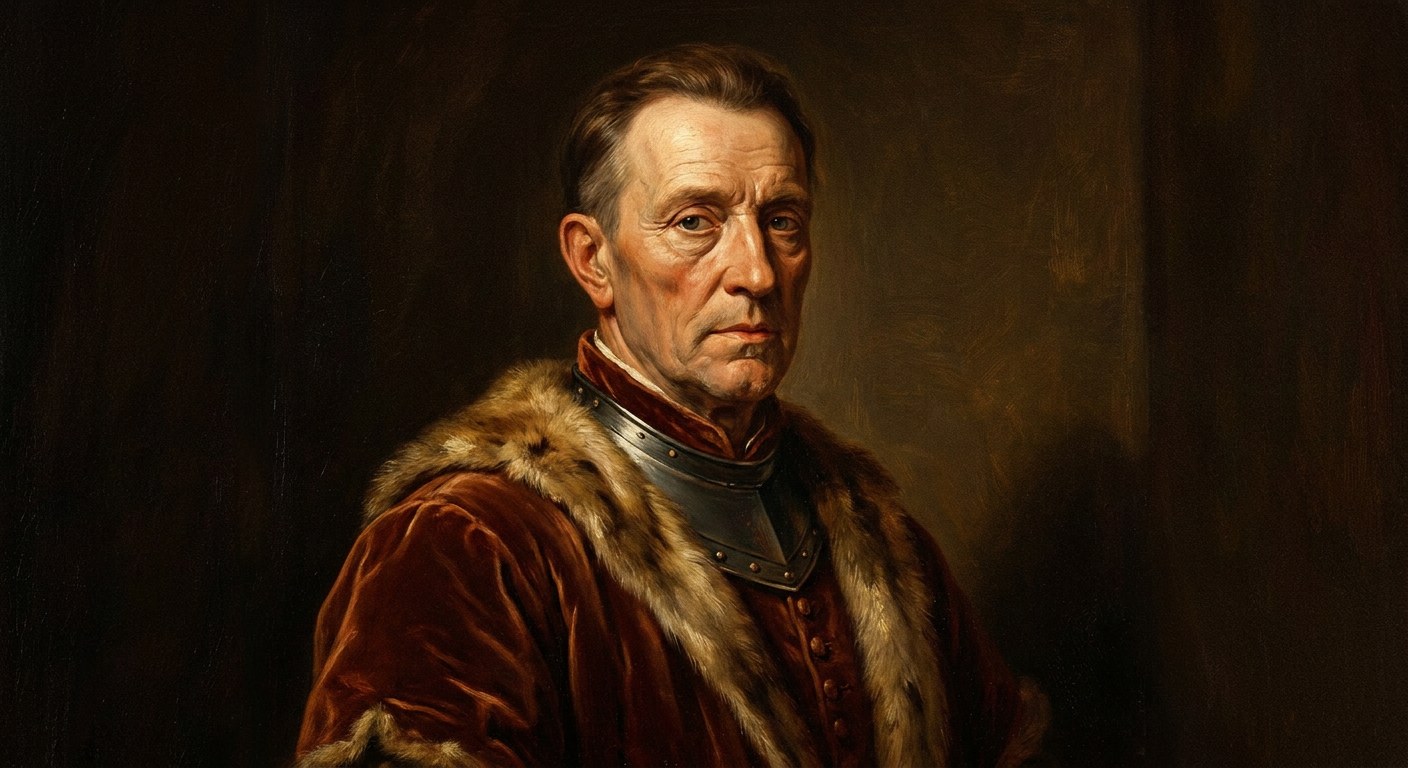
Henry V
1386 – 1422 · English · King & Military Commander
Recommended Audiobooks
Listen next from Marcus Alden

Life Lessons from Frederic Chopin
Marcus Alden · 54 min

Life Lessons from John Wesley
Marcus Alden · 52 min
Introduction
Henry V of England (16 September 1386–31 August 1422) was one of the most celebrated warrior-kings of the Middle Ages. Reigning from 1413 until his death, he transformed a politically divided kingdom into an effective military power, revived England’s claim to the French crown, and won a legendary victory at the Battle of Agincourt. By the Treaty of Troyes in 1420, Henry had become regent and recognized heir to Charles VI of France, apparently placing the crowns of England and France within his grasp.
His reputation rests on more than battlefield success. Henry was an energetic administrator, a skilled political leader, a committed—at times severe—Christian ruler, and an effective communicator who increasingly employed English in royal government. He understood logistics, naval power, siege warfare, diplomacy, and the symbolic value of kingship. His campaigns were carefully prepared, financed through Parliament and taxation, and supported by alliances with important French factions.
Yet Henry’s achievements came at a considerable human cost. His conquest of Normandy involved destructive sieges, civilian suffering, executions, confiscations, and the displacement of communities. He ordered the killing of many French prisoners during the Battle of Agincourt, suppressed the Lollard religious movement, and responded ruthlessly to suspected treason. His ambitious French settlement also proved difficult to sustain after his early death.
The historical Henry was more complex than the heroic figure later created by chronicles, patriotic tradition, and William Shakespeare. He was neither simply a chivalric national hero nor merely an aggressive conqueror. He was a disciplined, intensely purposeful monarch whose brief reign changed the course of the Hundred Years’ War and left England with both a powerful legend and a dangerous imperial inheritance.
Quick Facts
| Category | Details |
|---|---|
| Full name | Henry of Monmouth |
| Regnal name | Henry V |
| Born | 16 September 1386, probably at Monmouth Castle, Wales |
| Father | Henry Bolingbroke, later Henry IV of England |
| Mother | Mary de Bohun |
| Dynasty | House of Lancaster, a branch of the Plantagenet dynasty |
| Reign | 21 March 1413–31 August 1422 |
| Coronation | 9 April 1413, Westminster Abbey |
| Predecessor | Henry IV |
| Successor | Henry VI |
| Spouse | Catherine of Valois |
| Marriage | 2 June 1420, Troyes, France |
| Child | Henry VI of England |
| Best-known victory | Battle of Agincourt, 25 October 1415 |
| Major political settlement | Treaty of Troyes, 21 May 1420 |
| Died | 31 August 1422, Château de Vincennes, near Paris |
| Age at death | 35 |
| Burial place | Westminster Abbey, London |
Early Life & Background
Henry was born on 16 September 1386, probably in the gatehouse of Monmouth Castle. Because he was not originally expected to become king, the circumstances of his birth were less carefully documented than those of a direct royal heir. He became known as Henry of Monmouth.
His father, Henry Bolingbroke, was the son of John of Gaunt, Duke of Lancaster, and a grandson of Edward III. His mother, Mary de Bohun, belonged to a wealthy and influential aristocratic family. She died in 1394, when Henry was still a child. Henry had several younger siblings, including Thomas, Duke of Clarence; John, Duke of Bedford; Humphrey, Duke of Gloucester; and Philippa, who later became queen of Denmark, Norway, and Sweden.
As a noble child, Henry received an education suited to aristocratic and military life. He learned Latin and French, studied religion and literature, trained in horsemanship and arms, and developed an interest in music. He later showed a strong command of administration and may have possessed at least some knowledge of Welsh. His education was probably supervised in part by clerics and members of the extended Lancastrian household.
Henry’s early life unfolded amid political instability. King Richard II, his father’s cousin, ruled England but faced persistent aristocratic opposition. In 1398 Richard exiled Bolingbroke following a dispute with Thomas Mowbray, Duke of Norfolk. Henry remained in England and was taken into the king’s household. He accompanied Richard on the king’s expedition to Ireland in 1399 and was treated honorably, but events soon altered his position dramatically.
After John of Gaunt died in February 1399, Richard confiscated the Lancastrian inheritance rather than allowing Bolingbroke to receive it. Bolingbroke returned from exile, initially claiming that he intended only to recover his lands. He gathered support, captured Richard, and took the throne as Henry IV in September 1399. The young Henry of Monmouth consequently became Prince of Wales, Duke of Lancaster, Duke of Cornwall, and heir to the English crown.
The new Lancastrian dynasty faced an immediate problem of legitimacy. Henry IV had deposed an anointed king and possessed a hereditary claim weaker than that of some rival descendants of Edward III. Prince Henry grew to adulthood knowing that military effectiveness, political loyalty, and public demonstrations of lawful kingship were essential to his family’s survival.
Rise to Prominence
Henry’s first major responsibilities came in Wales. In 1400, Owain Glyndŵr led a revolt against English rule and proclaimed himself Prince of Wales. The uprising developed into a serious military and political challenge, supported at different moments by Welsh landholders, France, and English opponents of Henry IV.
Although still in his teens, Prince Henry was given a leading role in the defense of the Welsh Marches. He worked closely with experienced soldiers and administrators, especially members of the Beaufort family and royal officers based at Chester. The long conflict taught him the practical difficulties of campaigning in hostile territory: maintaining garrisons, securing roads, supplying armies, managing local alliances, and financing prolonged warfare.
On 21 July 1403 Henry fought at the Battle of Shrewsbury against the rebel army of Henry “Hotspur” Percy. The prince was struck in the face by an arrow, which lodged deeply near his nose or cheek. The royal surgeon John Bradmore devised a specialized instrument to widen and clean the wound before extracting the arrowhead. Henry survived an injury that could easily have killed him or left him severely disabled.
Rather than withdrawing from the battle, according to contemporary accounts, Henry continued fighting. The royal army defeated the rebels, and Hotspur was killed. The experience contributed greatly to Henry’s military reputation and probably reinforced his personal identification with courage, discipline, and providential survival.
During the following years, Henry took an increasingly independent role in government. By 1407–1408 the revolt in Wales was losing momentum, and English forces recovered important strongholds, including Aberystwyth and Harlech. Glyndŵr was never captured, but organized resistance largely collapsed.
Henry’s political prominence increased as Henry IV’s health deteriorated. Between 1409 and 1411, the prince and his allies exercised considerable influence through the royal council. They favored an active policy in France and supported the Burgundian faction in the civil conflict between the Burgundians and Armagnacs.
Tensions developed between father and son. In 1411 Henry IV reasserted control, dismissed the prince’s allies from leading positions, and adopted a different French policy. Later stories suggested that Prince Henry attempted to seize the crown before his father’s death, but the evidence is uncertain and was amplified by later writers.
The image of Henry as a reckless youth who suddenly reformed upon becoming king is also difficult to substantiate. He may have participated in the energetic social life of a noble military household, but contemporary records show him taking warfare and government seriously from an early age. Shakespeare’s association of the prince with Sir John Falstaff is a brilliant literary creation, not a reliable account of Henry’s youth.
Henry IV died on 20 March 1413. The prince succeeded him the following day and was crowned at Westminster Abbey on 9 April. A snowstorm occurred during the ceremony, interpreted by observers either as a favorable sign or as an ominous one.
Major Achievements
Henry’s first achievement was the consolidation of Lancastrian rule. He attempted to present himself as king of the entire political community rather than the leader of a victorious faction. He restored the son of Henry “Hotspur” Percy to part of his inheritance, treated several former opponents with calculated generosity, and arranged the honorable reburial of Richard II’s remains at Westminster Abbey. These actions helped distance his reign from the unresolved conflicts of his father’s accession.
Henry also improved the authority and coherence of royal government. He worked closely with Parliament, the council, military commanders, church leaders, and urban communities. His campaigns required extraordinary taxation, but he generally obtained grants through formal political negotiation. He demanded accountability from officials and paid close attention to the organization of armies, fleets, artillery, transport, and supplies.
A notable development of his reign was the increased use of English in royal correspondence and administration. The “Signet Office” letters associated with Henry’s government helped establish English as an acceptable language of high political business after centuries in which Latin and French had predominated.
Henry’s greatest ambition was the recovery of English possessions and rights in France. English kings had claimed the French crown since Edward III, but by 1413 England retained only limited territories there. Henry entered negotiations with the French monarchy while preparing for war. His demands included extensive lands, financial compensation, and marriage to Catherine, daughter of Charles VI. The scale of the claims made agreement unlikely.
In August 1415 Henry crossed the Channel and besieged Harfleur in Normandy. The town surrendered on 22 September, but disease—probably dysentery—seriously weakened his army. Henry nevertheless marched toward the English-held port of Calais. A much larger French force intercepted him near the village of Agincourt.
On 25 October 1415, Saint Crispin’s Day, the English won a remarkable victory. Henry’s army occupied a narrow front between woods, protected by stakes and supported by large numbers of longbowmen. Mud, congestion, and poor coordination hindered the French men-at-arms. Repeated French attacks failed, and many leading nobles were killed or captured.
Agincourt transformed Henry’s international prestige, but it did not by itself conquer France. He therefore pursued a more systematic campaign. In 1417 he returned with a well-equipped invasion force and began the conquest of Normandy. Caen fell in September 1417; Falaise surrendered in February 1418; and other towns and castles followed. Rouen, the Norman capital, capitulated in January 1419 after a siege of nearly six months.
Henry’s military success was assisted by France’s internal divisions. Charles VI suffered recurrent mental illness, while the Armagnac and Burgundian factions fought for control of the government. The assassination of John the Fearless, Duke of Burgundy, by supporters of the dauphin Charles at Montereau on 10 September 1419 drove John’s successor, Philip the Good, toward an alliance with Henry.
The resulting Treaty of Troyes, concluded on 21 May 1420, was the high point of Henry’s reign. Charles VI recognized Henry as regent of France and heir to the French throne, excluding the dauphin. Henry married Charles’s daughter Catherine of Valois on 2 June. If the treaty endured, Henry or his descendants would rule both kingdoms, although each was theoretically to retain its own laws and institutions.
Henry entered Paris with Charles VI in December 1420. He had achieved a position no previous English king had secured: formal recognition by the French monarchy as successor to the French crown.
Defining Moments
The Battle of Shrewsbury was Henry’s first defining test. His serious wound and survival gave him both military credibility and a personal narrative of endurance. Years of campaigning in Wales then supplied the administrative and logistical experience that shaped his later methods in France.
His accession in 1413 marked another turning point. Henry deliberately cultivated an image of moral seriousness and national reconciliation. His treatment of Richard II’s memory and of selected former enemies suggested confidence, but mercy always remained subordinate to political security.
The Southampton Plot of July 1415 tested that security immediately before the French expedition. Richard, Earl of Cambridge; Henry, Lord Scrope of Masham; and Sir Thomas Grey were accused of conspiring to replace Henry with Edmund Mortimer, Earl of March. Mortimer himself informed the king. Grey was executed rapidly, while Cambridge and Scrope were tried and beheaded. Scrope’s involvement was particularly shocking because he had been close to Henry. The episode demonstrated that the king would act decisively against suspected treason.
Agincourt became the central event of Henry’s legend. His leadership, the discipline of his troops, and the effectiveness of the English and Welsh archers produced a victory against severe odds. During the battle, however, Henry ordered many prisoners to be killed when he feared renewed attack and a possible threat to his rear. Although such an order could be defended by medieval military necessity, contemporaries recognized the killing of valuable noble captives as extraordinary.
The fall of Rouen in 1419 revealed a different aspect of Henry’s strategy. He preferred negotiated surrender when towns submitted on his terms, but he was willing to use starvation and intimidation. During the siege, noncombatants expelled from Rouen were trapped between the city walls and English lines, where many suffered and died. Henry refused to allow them through, maintaining pressure on the defenders.
Finally, the Treaty of Troyes appeared to vindicate his entire policy. Yet it also committed England to enforcing a contested settlement across a large and resistant kingdom. The dauphin and his supporters rejected the treaty, and Henry’s victory therefore depended on continued war.
Timeline
| Year | Event |
|---|---|
| 1386 | Henry is born on 16 September, probably at Monmouth Castle. |
| 1394 | His mother, Mary de Bohun, dies. |
| 1398 | Henry Bolingbroke, his father, is exiled by Richard II. |
| 1399 | Bolingbroke deposes Richard II and becomes Henry IV; Henry is created Prince of Wales. |
| 1400 | Owain Glyndŵr’s revolt begins in Wales. |
| 1403 | Henry is wounded in the face at the Battle of Shrewsbury on 21 July. |
| 1407–1408 | English forces recover Aberystwyth and Harlech as the Welsh revolt declines. |
| 1409–1411 | Prince Henry becomes a dominant figure on the royal council. |
| 1411 | Henry IV reasserts personal control and removes the prince’s allies from government. |
| 1413 | Henry IV dies; Henry V succeeds on 21 March and is crowned on 9 April. |
| 1414 | Sir John Oldcastle’s Lollard rising is defeated. |
| 1415 | The Southampton Plot is uncovered; Harfleur falls; Henry wins the Battle of Agincourt on 25 October. |
| 1416 | English naval victories help protect communications with France; Emperor Sigismund visits England. |
| 1417 | Henry begins the systematic conquest of Normandy; Caen falls. |
| 1418 | Falaise and numerous Norman strongholds surrender; the siege of Rouen begins. |
| 1419 | Rouen falls in January; John the Fearless is assassinated at Montereau in September. |
| 1420 | The Treaty of Troyes recognizes Henry as regent and heir of France; he marries Catherine of Valois. |
| 1421 | Henry returns to France after his brother Clarence is killed at Baugé; Henry’s son is born at Windsor. |
| 1422 | Meaux surrenders after a long siege; Henry dies at Vincennes on 31 August. |
| 1422 | Charles VI dies on 21 October; the infant Henry VI is proclaimed king of France by the Anglo-Burgundian alliance. |
Personal Life
Henry married relatively late, and the marriage was inseparable from his French policy. Catherine of Valois, born in 1401, was the daughter of Charles VI and Isabeau of Bavaria. Their wedding took place at Troyes on 2 June 1420 following the Treaty of Troyes. Catherine was crowned queen at Westminster Abbey on 23 February 1421.
The surviving evidence offers little insight into the couple’s private relationship. Their marriage served a dynastic and diplomatic purpose, but there is no firm reason to conclude that it was unhappy. Catherine accompanied Henry during part of his triumphal return to England.
Their only child, the future Henry VI, was born at Windsor Castle on 6 December 1421 while Henry V was campaigning in France. Tradition claims that Henry refused to see the infant after receiving an ominous prophecy, but this story is unsupported. In reality, military obligations kept father and son apart. Henry V never saw his child.
Henry was an active and physically resilient man, accustomed to armor, riding, marches, and the demands of campaigning. His portraits show a long, narrow face and a distinctive nose, possibly affected by the wound he received at Shrewsbury. He was interested in music and employed musicians in his household. The famous “Agincourt Carol” reflects the celebratory culture surrounding his victory, although Henry did not compose it.
His closest relationships were often political and military. His brothers played major roles in the war: Thomas, Duke of Clarence, was killed at Baugé in 1421; John, Duke of Bedford, later became regent in France; and Humphrey, Duke of Gloucester, became protector in England during Henry VI’s minority.
Beliefs & Philosophy
Henry’s kingship was deeply shaped by medieval Christianity. He attended religious services, supported monasteries and religious foundations, and interpreted military success through divine providence. After Agincourt he emphasized that victory belonged to God rather than merely to English arms. The singing of the psalm Non nobis, Domine became associated with this attitude, although later traditions embroidered the details.
He regarded kingship as a sacred office carrying obligations to defend justice, preserve order, protect the Church, and punish rebellion. His piety was not gentle in a modern sense. It reinforced his certainty that disciplined force could be morally legitimate when used for a lawful cause.
Henry founded or supported religious houses, including the Bridgettine abbey at Syon and the Carthusian monastery at Sheen. These foundations expressed both personal devotion and the ceremonial authority of the Lancastrian monarchy.
He was hostile to Lollardy, a reform movement influenced by the writings of John Wycliffe. Lollards criticized aspects of Church wealth, clerical authority, and established doctrine. Henry viewed religious dissent not only as heresy but also as a potential threat to public order. His former associate Sir John Oldcastle was accused of heresy and later implicated in an unsuccessful rising near London in January 1414. Oldcastle escaped capture for several years but was executed in 1417.
Henry’s political philosophy emphasized unity, obedience, and purposeful government. He expected soldiers, officials, clergy, and subjects to fulfill clearly defined duties. His ordinances for armies sought to restrain unauthorized plunder, protect military discipline, and ensure command. Such rules did not make warfare humane, but they reveal his desire to control violence rather than allow it to become militarily counterproductive.
Challenges & Controversies
The legitimacy of the Lancastrian dynasty remained an underlying challenge throughout Henry’s life. His father had seized the crown, and rival lines descended from Edward III retained claims of their own. Henry’s success reduced open opposition, but the Southampton Plot demonstrated that dynastic alternatives had not disappeared.
His French war is the greatest subject of historical controversy. Henry presented his campaign as the lawful enforcement of hereditary rights. Modern historians, however, also emphasize political calculation, territorial ambition, royal prestige, and the economic interests of soldiers and landholders. His claims were rooted in medieval dynastic law, but France already possessed its own monarchy, institutions, and political identity.
The treatment of prisoners at Agincourt remains particularly disputed. When Henry believed that French forces might renew the battle and that captives could rearm or overwhelm their guards, he ordered prisoners killed. The exact number is unknown. Military danger was real, but the decision violated the customary expectation that noble captives would be spared for ransom.
The conquest of Normandy brought further suffering. Towns endured bombardment, hunger, confiscation, and execution. At Caen, English troops killed inhabitants after storming the city. During the siege of Rouen, Henry maintained a blockade despite the desperate condition of civilians caught outside the walls. After conquest, lands were redistributed to English supporters, while those who rejected Henry’s authority risked dispossession or exile.
Henry’s repression of Lollardy likewise complicates his heroic reputation. Heresy was treated harshly throughout medieval Europe, and Henry acted within the assumptions of his age. Nevertheless, people were imprisoned or executed under a religious policy that allowed little room for dissent.
The execution of Lord Scrope after the Southampton Plot also raised legal and moral questions. Scrope claimed that he had joined discussions only to discover and expose the conspiracy, but Henry did not accept his defense. The speed and severity of the proceedings reveal how personal betrayal and political danger could override royal mercy.
Finally, Henry’s settlement in France was strategically overextended. Maintaining garrisons and continuing war required money and manpower that England could not provide indefinitely. His successes depended heavily on Burgundian cooperation and French division. Once those conditions changed, the dual monarchy became increasingly difficult to preserve.
Famous Quotes
No extensive personal memoir by Henry survives, and many sayings attributed to him come from later chronicles or drama. The most famous “Henry V quotations” are Shakespearean rather than historical.
“We few, we happy few, we band of brothers.”
—William Shakespeare, Henry V, Act IV, Scene 3. This is part of the fictional Saint Crispin’s Day speech; there is no evidence that Henry used these words at Agincourt.
“Once more unto the breach, dear friends, once more.”
—William Shakespeare, Henry V, Act III, Scene 1, imagined as Henry’s address during the siege of Harfleur.
“The game’s afoot:
Follow your spirit, and upon this charge
Cry ‘God for Harry, England, and Saint George!’”
—William Shakespeare, Henry V, Act III, Scene 1. The passage helped shape Henry’s later image as an embodiment of English patriotism.
“Not unto us, O Lord, not unto us, but unto thy name give the glory.”
—Psalm 115:1 in traditional numbering. The Latin opening, Non nobis, Domine, was associated by chroniclers and later tradition with Henry’s response to victory at Agincourt. It expresses his public insistence that God receive credit for the triumph.
Legacy & Influence
Henry’s immediate legacy was the Anglo-French dual monarchy. When he died, his nine-month-old son inherited the English crown. After Charles VI died in October 1422, the infant Henry VI was also proclaimed king of France under the Treaty of Troyes. Government fell to Henry V’s brothers and leading nobles: Bedford directed the war in France, while Gloucester and the royal council played major roles in England.
For a time, Henry’s settlement survived. The Anglo-Burgundian alliance controlled Paris and much of northern France. Yet the dauphin continued the struggle as Charles VII. Joan of Arc’s intervention in 1429 helped revive the Valois cause, and Burgundy reconciled with Charles in 1435. By 1453 England had lost nearly all its French territories except Calais.
Henry’s early death therefore protected his personal reputation from the later collapse. Because he died at the height of his power, contemporaries and later generations remembered the victories rather than the unsustainable burdens they created. His son inherited war, debt, a disputed French crown, and a prolonged royal minority. Henry VI’s later political failures contributed to the Wars of the Roses.
As a military commander, Henry left an enduring reputation for preparation and command. Agincourt displayed his tactical judgment, but the Normandy campaigns better reveal his full abilities. He coordinated fleets, artillery, siege equipment, finance, intelligence, and garrisons across several years. He could inspire troops personally, yet his success depended on organization as much as battlefield courage.
His administrative legacy includes the increased prestige of written English. Royal letters produced under Henry contributed to the emergence of a standardized form of administrative English sometimes associated with “Chancery English.” The process was gradual, but his government played an important part in it.
Henry’s cultural influence is inseparable from Shakespeare’s Henry V, first performed around 1599. Shakespeare presents a charismatic king capable of humor, eloquence, severity, and political manipulation. The play has been interpreted both as patriotic celebration and as a critical examination of war and kingship.
Film adaptations have repeatedly reshaped the legend. Laurence Olivier’s 1944 film emphasized patriotic unity during the Second World War. Kenneth Branagh’s 1989 adaptation presented a darker, muddier, and more psychologically troubled vision of war. Later portrayals have continued to contrast heroic leadership with conquest’s human cost.
Historians now assess Henry through both English and French evidence. He remains an exceptional medieval ruler, but admiration for his discipline and achievement is balanced by attention to coercion, civilian suffering, religious persecution, and the fragility of his imperial project.
Interesting Facts
- Henry was known as “Henry of Monmouth” because of his probable birthplace at Monmouth Castle.
- The arrow wound he received at Shrewsbury required a sophisticated operation by the surgeon John Bradmore.
- The scar from that injury may explain why surviving portraits generally show Henry from his left side.
- He was the first English king since the Norman Conquest to use English extensively in his personal and governmental correspondence.
- Welsh archers and soldiers served in his armies, despite Henry’s earlier campaigns against the revolt in Wales.
- Agincourt occurred on 25 October, the feast day of Saints Crispin and Crispinian.
- Henry’s army at Agincourt was weakened by disease and an exhausting march from Harfleur.
- He maintained strict military ordinances against unauthorized looting and indiscipline.
- His queen, Catherine of Valois, later formed a relationship with Owen Tudor, helping establish the Tudor dynasty.
- Henry’s funeral procession carried his body from France to England for burial at Westminster Abbey.
- His tomb included a silver-plated effigy, but the precious metal was later stolen.
- Henry died before Charles VI, missing the French crown by less than two months.
- He never met his only son, Henry VI.
- Sir John Falstaff, his famous companion in Shakespeare’s plays, was fictional and partly derived from earlier dramatic portrayals of Sir John Oldcastle.
Frequently Asked Questions
When did Henry V become king?
Henry became king on 21 March 1413, the day after Henry IV’s death. He was crowned at Westminster Abbey on 9 April 1413.
Why is Henry V famous?
He is best known for defeating a larger French army at the Battle of Agincourt in 1415 and for conquering much of Normandy. The Treaty of Troyes later recognized him as regent and heir to the French throne.
Was Henry V really a wild prince?
The popular image comes mainly from later stories and Shakespeare. Although Henry may have enjoyed aristocratic recreation, contemporary evidence shows that he carried serious military and governmental responsibilities from his teenage years.
How did Henry V win at Agincourt?
He chose a narrow battlefield that limited the French numerical advantage. English and Welsh longbowmen disrupted French attacks, while deep mud and crowding exhausted the advancing men-at-arms. Strong discipline and poor French coordination also contributed to the outcome.
How many soldiers fought at Agincourt?
Exact numbers are uncertain. Modern estimates often suggest that Henry had roughly 6,000–9,000 men, most of them archers, while the French force may have numbered between 12,000 and 20,000 or more. Older accounts sometimes give much higher totals.
Did Henry V order prisoners to be killed?
Yes. During Agincourt, he ordered the killing of many French prisoners when he feared another attack and believed the captives posed a danger. Historians debate the scale and necessity of the order, but the event is well attested.
Did Henry V conquer France?
He conquered Normandy and gained control over Paris and much of northern France through military campaigns and alliance with Burgundy. He did not conquer the entire kingdom, and forces loyal to the dauphin still controlled substantial territories.
Did Henry V become king of France?
No. The Treaty of Troyes named him heir to Charles VI, but Henry died on 31 August 1422. Charles survived until 21 October, so Henry never personally inherited the French crown.
Who was Henry V’s wife?
He married Catherine of Valois, daughter of Charles VI of France, on 2 June 1420. Their son became Henry VI.
How did Henry V die?
Henry died at the Château de Vincennes near Paris on 31 August 1422, probably from dysentery or another severe intestinal illness contracted during campaigning. Claims that he died from heatstroke are less widely accepted.
Where is Henry V buried?
He is buried in Westminster Abbey, close to the shrine of Edward the Confessor. His chantry chapel remains one of the abbey’s notable medieval monuments.
Is Shakespeare’s Henry V historically accurate?
The play draws on chronicles and real events but reshapes them for dramatic purposes. Its speeches, character interactions, and depiction of Henry’s youth should not be treated as literal historical evidence.
Lessons from Henry V
- Preparation can outweigh numerical strength: Henry’s victories depended on logistics, planning, positioning, and discipline as much as courage.
- Political unity is a strategic resource: He reduced internal division before undertaking major foreign campaigns.
- Symbolism matters in leadership: Ceremonies, language, religion, and public gestures strengthened his authority.
- Success can conceal long-term weakness: The Treaty of Troyes appeared triumphant but imposed commitments England struggled to sustain.
- Military glory has human costs: Agincourt, Caen, and Rouen should be remembered alongside the suffering of prisoners, soldiers, and civilians.
- Decisiveness can become severity: Henry’s firmness preserved his rule, but it also produced executions and religious persecution.
- Historical reputations are constructed: Chronicles, Shakespeare, nationalism, and film have all created different versions of Henry.
- Institutions outlast individual leaders: Henry’s empire depended heavily on his personal energy and alliances, making it vulnerable after his death.
- Contemporary values require historical context: Henry should be understood within medieval ideas of law, religion, chivalry, and kingship without ignoring the consequences of his actions.
- A short reign can have a long legacy: In only nine years, Henry changed English government, the Hundred Years’ War, and the cultural memory of monarchy.
Further Reading
- Christopher Allmand, Henry V
- Anne Curry, Henry V: From Playboy Prince to Warrior King
- Anne Curry, Agincourt: A New History
- Juliet Barker, Agincourt: Henry V and the Battle That Made England
- Malcolm Vale, Henry V: The Conscience of a King
- John Matusiak, Henry V
- Ian Mortimer, 1415: Henry V’s Year of Glory
- Gerald L. Harriss, Shaping the Nation: England 1360–1461
- Jonathan Sumption, The Hundred Years War, Volume IV: Cursed Kings
- William Shakespeare, Henry V
- The Letters of Henry V, edited from surviving royal correspondence
- The Gesta Henrici Quinti, an important contemporary narrative of Henry’s reign and the Agincourt campaign