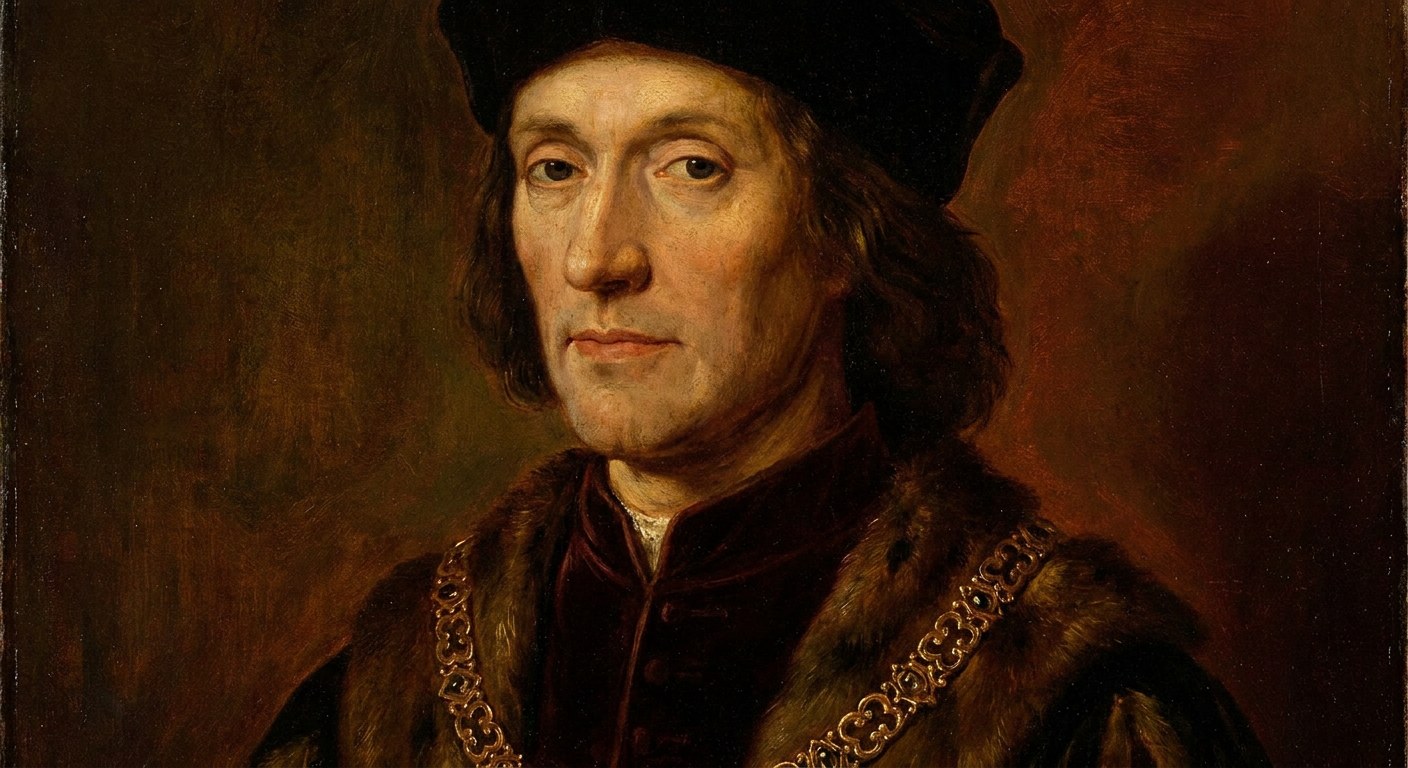
Henry VII
1457 – 1509 · Welsh-English · King of England
Recommended Audiobooks
Listen next from Marcus Alden

Life Lessons from Frederic Chopin
Marcus Alden · 54 min

Life Lessons from John Wesley
Marcus Alden · 52 min
Introduction
Henry VII (28 January 1457–21 April 1509) was the founder of the Tudor dynasty and one of the most consequential rulers in English history. Victorious over Richard III at the Battle of Bosworth Field in 1485, he brought the main phase of the Wars of the Roses to an end and transformed a vulnerable claim to the throne into a durable monarchy.
Henry was not an obvious future king. His hereditary title descended through the Beaufort family from John of Gaunt, a son of Edward III, but the Beaufort line had originally been born outside marriage and was formally excluded from the succession. For much of his youth, Henry lived under guardianship or in exile. His opportunity arose only after years of dynastic warfare had eliminated many stronger candidates and alienated Richard III from important sections of the political nation.
As king, Henry relied less on battlefield glory than on political calculation, financial discipline and control of the nobility. He married Elizabeth of York, symbolically uniting Lancaster and York; suppressed rebellions; negotiated valuable diplomatic agreements; and accumulated a substantial reserve for the Crown. His methods, however, could be coercive. Bonds, recognizances, legal penalties and the activities of the Council Learned in the Law generated fear and resentment.
Henry VII’s reign established the institutional, financial and dynastic foundations inherited by his son Henry VIII. Although often overshadowed by later Tudors, he was the ruler who made their age possible.
Quick Facts
| Category | Details |
|---|---|
| Full name | Henry Tudor |
| Regnal name | Henry VII |
| Born | 28 January 1457 |
| Birthplace | Pembroke Castle, Wales |
| Father | Edmund Tudor, Earl of Richmond |
| Mother | Lady Margaret Beaufort |
| Dynasty | Tudor |
| Reign | 22 August 1485–21 April 1509 |
| Coronation | 30 October 1485, Westminster Abbey |
| Predecessor | Richard III |
| Successor | Henry VIII |
| Spouse | Elizabeth of York |
| Marriage | 18 January 1486 |
| Principal children | Arthur, Margaret, Henry, Elizabeth, Mary and Edmund |
| Decisive victory | Battle of Bosworth Field, 22 August 1485 |
| Major internal battle | Battle of Stoke Field, 16 June 1487 |
| Died | 21 April 1509 |
| Place of death | Richmond Palace, Surrey |
| Burial place | Henry VII Lady Chapel, Westminster Abbey |
| Age at death | 52 |
Early Life & Background
Henry Tudor was born at Pembroke Castle on 28 January 1457 during the Wars of the Roses, the dynastic conflicts fought by rival branches and supporters of the royal House of Plantagenet. His father, Edmund Tudor, Earl of Richmond, had died in captivity on 1 November 1456, nearly three months before Henry’s birth. Edmund was a son of Owen Tudor and Catherine of Valois, widow of Henry V. Through this connection, Henry belonged to a family associated with the Lancastrian court, although the Tudor descent itself gave him no hereditary right to the English crown.
Henry’s claim came through his mother, Lady Margaret Beaufort. She was a great-granddaughter of John of Gaunt, Duke of Lancaster, and Katherine Swynford. Their Beaufort children had been born before their parents married but were subsequently legitimized by papal authority and by an act of Richard II. When Henry IV confirmed their legitimacy, however, he added a restriction excluding them from succession to the Crown. Henry Tudor’s title was therefore distant, politically disputed and transmitted through a woman.
Margaret was only thirteen when Henry was born. The difficult delivery may have prevented her from bearing further children, and Henry remained her only child. Although mother and son spent long periods apart, Margaret became one of his most determined political advocates.
Henry’s paternal uncle Jasper Tudor, Earl of Pembroke, initially protected him. After the Yorkist triumph of 1461, Pembroke Castle passed to William Herbert, a leading supporter of Edward IV, and Henry became part of Herbert’s household. He received the education expected of a nobleman and learned to navigate a world in which loyalty, inheritance and survival were closely connected.
A Lancastrian restoration briefly returned Henry VI to power in 1470, but Edward IV recovered the throne the following year. The Lancastrians suffered devastating defeats at Barnet on 14 April 1471 and Tewkesbury on 4 May. Henry VI’s son, Edward of Westminster, was killed at Tewkesbury, while Henry VI died in the Tower of London shortly afterward. These events unexpectedly elevated the importance of Henry Tudor’s otherwise weak claim.
In September 1471, Jasper and Henry escaped from Wales by sea. Intending to reach France, they landed in Brittany, where Duke Francis II treated them as politically valuable guests. Henry would spend approximately fourteen years abroad, usually in Brittany and later in France. Exile taught him patience, secrecy and dependence on diplomacy—qualities that strongly marked his kingship.
Rise to Prominence
For much of Edward IV’s reign, Henry remained a potential Lancastrian claimant rather than an active contender. Edward sought his surrender, while Francis II resisted or delayed English demands. Henry’s position changed dramatically after Edward’s unexpected death on 9 April 1483.
Edward’s twelve-year-old son succeeded nominally as Edward V, but the boy’s uncle Richard, Duke of Gloucester, assumed control of the government. Edward V and his brother Richard of Shrewsbury were lodged in the Tower of London and then disappeared from public view. Richard took the crown as Richard III on 26 June 1483 after Edward IV’s children were declared illegitimate.
Richard’s accession divided the Yorkist establishment. In the autumn of 1483, Henry Stafford, Duke of Buckingham, joined a broad but poorly coordinated rebellion. Henry Tudor prepared to land in England, promising to marry Edward IV’s eldest daughter, Elizabeth of York. The marriage pledge allowed Lancastrian exiles and disaffected Yorkists to unite around him. Storms and the rapid collapse of Buckingham’s rebellion forced Henry to turn back, while Buckingham was captured and executed.
Early in 1484, Henry publicly renewed his promise to marry Elizabeth. Richard III attempted to undermine him by winning over exiles and pressuring Brittany. Warned that Breton officials might hand him over, Henry escaped into France. The French regency provided money and troops for another invasion, partly because Richard’s government was viewed as potentially hostile to French interests.
Henry sailed from Harfleur on 1 August 1485 and landed at Mill Bay near Dale, Pembrokeshire, on 7 August. He advanced through Wales and the English Midlands, gathering supporters while presenting himself as a deliverer from Richard’s alleged tyranny. His army included English and Welsh followers, French troops and experienced exiles.
The decisive encounter took place near Market Bosworth in Leicestershire on 22 August 1485. Richard commanded the larger royal army, but the loyalties of powerful magnates—especially Thomas, Lord Stanley, and Sir William Stanley—were uncertain. During the battle, Richard launched a direct attack intended to kill Henry. The intervention of William Stanley’s forces helped defeat the assault, and Richard was killed.
According to tradition, Richard’s crown was recovered from the battlefield and placed on Henry’s head. Whatever the exact ceremony, Bosworth gave Henry possession of the kingdom. He declared that his reign had begun on 21 August, the day before the battle. This legal maneuver enabled those who had fought for Richard on 22 August to be treated as rebels against the lawful king.
Henry entered London on 3 September and was crowned at Westminster Abbey on 30 October 1485. Parliament recognized his title without defining it in terms that might expose the weaknesses of his hereditary claim. He dated his kingship from conquest and divine favor, while also invoking descent and parliamentary recognition.
On 18 January 1486, he married Elizabeth of York. Their union helped reconcile the rival dynastic traditions, though Henry carefully ensured that he had been crowned before the marriage so that his kingship could not be represented merely as a consequence of his wife’s rights.
Major Achievements
Henry VII’s most immediate achievement was the establishment of a new dynasty after decades of instability. He promoted the Tudor rose, combining the red rose associated with Lancaster and the white rose of York. The symbolism simplified a complex conflict into a story of division healed by marriage and Tudor rule.
He also restrained the political power of the nobility. Henry did not attempt to destroy the aristocracy, whose local authority remained essential to government. Instead, he limited overmighty subjects through acts of attainder, financial securities, restrictions on unauthorized retaining and selective restoration of confiscated estates. Magnates were expected to serve the Crown but discouraged from maintaining private military followings that could threaten it.
Royal finance became a central concern. Henry increasingly administered ordinary revenues through the royal Chamber rather than relying solely on the slower Exchequer. Crown lands were recovered, feudal dues enforced and customs income supervised more closely. He also used bonds and recognizances—formal financial obligations guaranteeing good behavior—to hold potentially unreliable subjects accountable.
These policies produced a richer and more independent monarchy. Older claims that Henry left almost £2 million in ready money are generally considered exaggerated, but he undoubtedly died with substantial reserves and valuable assets. His financial success strengthened the Crown, though its human and political costs were significant.
Henry encouraged commerce and concluded important trading agreements. The Intercursus Magnus of 1496 restored profitable trade between England and the Burgundian Netherlands after an embargo. The agreement was particularly important to the English cloth industry. In 1506, Henry exploited the accidental arrival in England of Philip of Burgundy to secure the more favorable but short-lived Malus Intercursus.
Diplomatically, Henry avoided prolonged continental warfare. The Treaty of Medina del Campo with Spain in 1489 arranged the marriage of Prince Arthur to Catherine of Aragon and aligned England with the rising Spanish monarchy. The Treaty of Étaples in 1492 ended Henry’s brief invasion of France and provided him with a French pension while requiring France to stop supporting the pretender Perkin Warbeck.
The Truce of Ayton in 1497 reduced conflict with Scotland. It was followed by the Treaty of Perpetual Peace in 1502 and the marriage of Henry’s daughter Margaret Tudor to James IV of Scotland in 1503. That marriage ultimately proved of immense historical importance: their descendants inherited the English throne in 1603, bringing the crowns of England and Scotland under James VI and I.
Henry also sponsored maritime enterprise. In 1496 he granted letters patent to the Venetian navigator John Cabot, who sailed from Bristol and reached land across the North Atlantic in 1497, probably Newfoundland or another part of northeastern North America. Cabot’s voyage later became an important foundation for English claims in the region.
Defining Moments
The Battle of Bosworth was the central turning point of Henry’s life. He entered England as an exile with a doubtful title and emerged as king. Yet victory did not guarantee security. His early reign was filled with conspiracies intended to exploit surviving Yorkist loyalties.
In 1486, Lord Lovell and the Stafford brothers attempted rebellion. The rising collapsed quickly, but it demonstrated that resistance remained active. A more serious threat followed in 1487, when Lambert Simnel was presented as Edward, Earl of Warwick, the young Yorkist nephew of Edward IV and Richard III. The real Warwick was Henry’s prisoner in the Tower, but Simnel’s supporters crowned him “Edward VI” in Dublin.
An invasion force led by John de la Pole, Earl of Lincoln, landed in England. Henry defeated it at the Battle of Stoke Field on 16 June 1487. Lincoln was killed, and Simnel was captured. Rather than execute the boy, Henry employed him in the royal household, first in the kitchens and later as a falconer. Stoke is often considered the final major battle of the Wars of the Roses.
The appearance of Perkin Warbeck in the 1490s created an even more persistent danger. Warbeck claimed to be Richard, Duke of York, the younger of the missing princes in the Tower. He received recognition or assistance from Margaret of York, Duchess of Burgundy; Charles VIII of France; Maximilian I; James IV of Scotland; and other European rulers. His value lay partly in his ability to serve as an instrument of pressure against Henry.
Warbeck attempted several invasions before landing in Cornwall in September 1497. His support collapsed, and he surrendered. Henry initially kept him under close supervision at court, but after an attempted escape and alleged conspiracy with the Earl of Warwick, Warbeck was hanged at Tyburn on 23 November 1499. Warwick was beheaded on 28 November.
The year 1497 also saw the Cornish rebellion, prompted by taxation for war against Scotland. Thousands marched east under Thomas Flamank, Michael Joseph—known as An Gof—and Lord Audley. Henry’s forces defeated them at Blackheath on 17 June. The revolt revealed the danger of imposing national military costs on regions that felt remote from the conflict.
Dynastic tragedy reshaped Henry’s final years. Prince Arthur married Catherine of Aragon in November 1501 but died at Ludlow Castle on 2 April 1502, probably from an infectious illness. The king’s second son, Henry, became heir. Elizabeth of York died on 11 February 1503, shortly after giving birth to a daughter who also died. Contemporary accounts suggest that the normally controlled king was deeply affected.
Timeline
| Year | Event |
|---|---|
| 1457 | Henry Tudor is born at Pembroke Castle on 28 January. |
| 1461 | Yorkist victory places Edward IV securely on the throne; Henry comes under William Herbert’s guardianship. |
| 1471 | After the defeat of the Lancastrians, Henry and Jasper Tudor flee to Brittany. |
| 1483 | Richard III takes the crown; Buckingham’s rebellion fails; Henry promises to marry Elizabeth of York. |
| 1484 | Henry escapes from Brittany to France and renews his marriage pledge. |
| 1485 | Henry lands in Wales and defeats Richard III at Bosworth on 22 August; crowned on 30 October. |
| 1486 | Marries Elizabeth of York on 18 January; Prince Arthur is born on 20 September. |
| 1487 | Defeats Lambert Simnel’s supporters at Stoke Field on 16 June. |
| 1489 | Treaty of Medina del Campo establishes an alliance and marriage agreement with Spain. |
| 1491 | Perkin Warbeck begins publicly advancing his claim to be Richard, Duke of York. |
| 1492 | Henry invades France; the Treaty of Étaples ends the campaign and secures a French pension. |
| 1494 | Prince Henry, the future Henry VIII, is created Duke of York. |
| 1496 | Intercursus Magnus restores trade with the Burgundian Netherlands; John Cabot receives royal authorization. |
| 1497 | Cabot reaches North America; Cornish rebels are defeated at Blackheath; Warbeck is captured. |
| 1499 | Perkin Warbeck and Edward, Earl of Warwick, are executed. |
| 1501 | Prince Arthur marries Catherine of Aragon. |
| 1502 | Arthur dies at Ludlow; Treaty of Perpetual Peace agreed with Scotland. |
| 1503 | Elizabeth of York dies; Margaret Tudor marries James IV of Scotland. |
| 1504 | Parliament grants Henry new revenues; financial enforcement intensifies in his later reign. |
| 1506 | Philip of Burgundy’s enforced stay produces the Treaty of Windsor and Malus Intercursus. |
| 1509 | Henry VII dies at Richmond Palace on 21 April; Henry VIII succeeds him. |
Personal Life
Henry married Elizabeth of York, eldest daughter of Edward IV and Elizabeth Woodville. Their marriage began as a political settlement, but surviving evidence suggests that it developed into a stable and affectionate partnership. Elizabeth participated in court ceremonial, patronage and dynastic representation, although she did not exercise the same overt political authority as Henry’s mother.
The couple had at least seven children. Four survived infancy: Arthur, Margaret, Henry and Mary. Elizabeth, Edmund and Katherine died young. Arthur’s birth in Winchester in 1486 was deliberately associated with the legend of King Arthur and with Henry’s Welsh ancestry.
Margaret Tudor married James IV of Scotland; their great-grandson James VI of Scotland inherited the English throne in 1603. Mary Tudor married Louis XII of France in 1514 and, after his death, secretly married Charles Brandon, Duke of Suffolk. Henry VIII became one of England’s most famous and controversial monarchs.
Lady Margaret Beaufort remained a powerful presence throughout Henry’s reign. She managed large estates, supported education and religion, and used a distinctive quasi-royal style. She did not share sovereignty with her son, but her status at court was exceptional.
Henry’s household projected magnificence through clothing, architecture, ceremony and tournaments. His reputation for personal miserliness is too simple: he spent heavily when display strengthened royal prestige. He commissioned the magnificent Lady Chapel at Westminster Abbey and planned an elaborate Renaissance tomb, eventually created by the Florentine sculptor Pietro Torrigiano.
Beliefs & Philosophy
Henry’s outlook combined conventional late-medieval Christianity with an intense belief in providence and legitimate kingship. His victory at Bosworth was presented as evidence of divine judgment. Religious ceremonies, foundations, almsgiving and prayers for the royal dead helped express both sincere devotion and dynastic legitimacy.
He cultivated the memory of Henry VI, whose reputation for holiness had grown after his death. Henry VII promoted efforts toward Henry VI’s canonization and used Lancastrian sanctity to reinforce Tudor authority. He also founded religious observances and endowed prayers for himself and his family.
As a ruler, Henry valued order, obedience and calculation. Years of exile had taught him that political loyalty was unstable and that apparently secure rulers could fall quickly. He therefore preferred written obligations, controlled patronage and financial guarantees to broad trust.
His government was not “modern” in the sense of replacing medieval institutions with a centralized bureaucracy. It remained personal, dynastic and dependent on royal servants. Nevertheless, Henry used existing institutions with unusual persistence and precision. His guiding philosophy was practical: preserve the dynasty, prevent rival power centers and avoid unnecessary risks.
Challenges & Controversies
The weakness of Henry’s original title never disappeared completely. He claimed the throne by hereditary right, conquest, divine favor and parliamentary recognition without allowing any one explanation to dominate. His marriage to Elizabeth of York strengthened his dynasty, but he resisted any suggestion that she was the true source of his authority.
His decision to date his reign from 21 August 1485 was legally effective but morally questionable. It allowed him to attaint men who had loyally served the reigning king at Bosworth. Although not all were punished permanently, the measure displayed Henry’s willingness to manipulate law in support of political security.
Financial enforcement became the greatest grievance of his later reign. The Council Learned in the Law, associated especially with Edmund Dudley and Sir Richard Empson, pursued feudal dues, penal bonds and other royal claims. Many demands had a legal basis, but the system could be arbitrary, intimidating and difficult to challenge. After Henry’s death, Empson and Dudley were arrested and eventually executed under Henry VIII.
Henry’s treatment of Yorkist claimants was also severe. Edward, Earl of Warwick, had spent most of his life imprisoned despite showing little personal capacity for rebellion. His execution in 1499 removed a dynastic obstacle, and contemporaries believed Spain had wanted Warwick eliminated before Catherine of Aragon’s marriage to Arthur proceeded.
Taxation generated open resistance. The Yorkshire rebellion of 1489 led to the killing of Henry Percy, Earl of Northumberland. The Cornish rebellion of 1497 marched to the outskirts of London. Both episodes showed that financial recovery and foreign policy could impose destabilizing burdens on the population.
Traditional histories sometimes credit Henry with creating the Court of Star Chamber. This is misleading. The royal council had long exercised judicial functions, and the 1487 legislation often associated with Star Chamber strengthened a conciliar tribunal rather than creating the later institution in its fully developed form.
Famous Quotes
Few memorable sayings can be securely attributed to Henry VII. Later writers—especially Francis Bacon in The History of the Reign of King Henry the Seventh—often supplied polished speeches or judgments that should not be treated as verbatim records.
“By the grace of God, King of England and of France, and Lord of Ireland.”
This formal royal style appeared in Henry’s official documents. The claim to France was conventional among English monarchs and did not mean that Henry controlled the French kingdom.
“Our dearest consort the Queen.”
Henry used conventional but significant language of this kind in references to Elizabeth of York. It reflects her formal place within the Tudor monarchy, though it does not by itself reveal private emotion.
“He had no purpose to make war upon France, but to make money.”
This famous sentence is Francis Bacon’s later assessment of Henry’s 1492 French campaign, not a direct quotation from the king. It captures Henry’s reputation for using limited military action to obtain diplomatic and financial advantage.
“His wisdom, by often evading from perils, was turned rather into a dexterity to deliver himself from dangers, when they pressed him, than into a providence to prevent and remove them afar off.”
Another judgment by Bacon rather than Henry’s own words, this influential description portrays a ruler shaped by insecurity and skilled at escaping immediate threats.
Legacy & Influence
Henry VII left a stable succession, a solvent Crown and a monarchy with greater control over its leading subjects. These achievements were not inevitable. In 1485 he had been an exile with limited resources and a controversial title; by 1509 the Tudor dynasty was internationally recognized and connected by marriage to Spain and Scotland.
His financial methods influenced the early government of Henry VIII, although the new king quickly distanced himself from the unpopular machinery of enforcement. Henry VIII inherited the benefits of his father’s caution but pursued a far more expensive and aggressive foreign policy.
The marriage of Margaret Tudor to James IV became Henry’s most enduring dynastic achievement. When Elizabeth I died childless, Margaret’s descendant James VI of Scotland succeeded as James I of England. The Tudor effort to secure peace through marriage thus contributed to the Union of the Crowns.
Historians have revised older portrayals of Henry as either a dreary miser or the heroic founder of a modern nation-state. He was a late-medieval dynastic king who governed through household servants, noble cooperation, law, patronage and personal supervision. His reign did not end conflict or create an absolute monarchy, but it reduced the likelihood that noble rivalry would again overthrow the political order.
Henry died at Richmond Palace on 21 April 1509, probably after a prolonged illness involving tuberculosis or a related respiratory condition. His death was initially kept quiet while arrangements for succession were completed. He was buried beside Elizabeth of York in the Lady Chapel at Westminster Abbey.
Interesting Facts
- Henry VII was the first monarch of the Tudor dynasty.
- His father died before he was born, and his mother was only thirteen at his birth.
- He spent roughly fourteen years in exile in Brittany and France.
- His hereditary claim was weaker than those of several surviving Yorkists.
- The Tudor rose was a political emblem designed to symbolize reconciliation.
- Henry used a red dragon standard at Bosworth, emphasizing his Welsh ancestry.
- Lambert Simnel was pardoned and employed in the royal household instead of being executed.
- Henry supported John Cabot’s 1497 Atlantic voyage from Bristol.
- He was the last English king to win his throne personally on a battlefield.
- His eldest son was named Arthur partly to evoke British legend and Winchester’s claimed association with Camelot.
- The King’s Mother, Margaret Beaufort, outlived him by only two months.
- Henry’s tomb effigies are important examples of early Renaissance sculpture in England.
Frequently Asked Questions
Why did Henry VII have a claim to the throne?
Henry descended from Edward III through his mother, Margaret Beaufort, and the Beaufort branch of the House of Lancaster. The claim was weak because it passed through a female line and because the Beauforts had been excluded from the succession. Henry strengthened it through military victory, parliamentary recognition and marriage to Elizabeth of York.
How did Henry VII defeat Richard III?
Henry invaded in August 1485 with exiles, French troops and supporters gathered in Wales and England. At Bosworth, Richard’s larger army was weakened by uncertain loyalties. William Stanley intervened on Henry’s side during Richard’s final attack, and Richard was killed.
Did Henry VII end the Wars of the Roses?
Bosworth ended Richard III’s reign, but dynastic conflict continued. Henry faced rebellions associated with Lambert Simnel and Perkin Warbeck, and the Battle of Stoke Field in 1487 is often described as the wars’ final major battle.
Why did Henry marry Elizabeth of York?
The marriage united Henry’s Lancastrian association with the senior Yorkist line represented by Edward IV’s daughter. It broadened support for the Tudor dynasty and weakened the appeal of rival claims.
Was Henry VII a miser?
He was cautious and closely involved in finance, but “miser” is an oversimplification. Henry spent generously on diplomacy, court display, buildings, ceremonies and dynastic projects. His unpopularity arose less from refusing to spend than from the aggressive methods used to increase royal income.
What were bonds and recognizances?
They were legal financial obligations. A person might promise to pay a large sum if he broke specified conditions or failed to behave loyally. Henry used them to control nobles and officials, but their extensive enforcement created resentment.
Who were Lambert Simnel and Perkin Warbeck?
Both were pretenders used by Yorkist opponents. Simnel impersonated Edward, Earl of Warwick, and was defeated in 1487. Warbeck claimed to be Richard, Duke of York, one of the missing princes in the Tower, and remained a threat until his capture in 1497 and execution in 1499.
Who succeeded Henry VII?
His surviving son succeeded him as Henry VIII on 21 April 1509. The new king was seventeen years old and inherited a secure crown and substantial resources.
How successful was Henry VII’s foreign policy?
It was generally successful in defensive and dynastic terms. Henry avoided prolonged war, obtained French payments, restored Burgundian trade, allied with Spain and arranged peace with Scotland. Some agreements, particularly the Malus Intercursus, proved temporary.
Where is Henry VII buried?
He is buried with Elizabeth of York in the Lady Chapel that bears his name at Westminster Abbey. Their bronze-gilt tomb was created by Pietro Torrigiano.
Lessons from Henry VII
- Patience can be a political strength: Henry survived years of exile before acting when circumstances favored him.
- Legitimacy requires more than legal arguments: He combined descent, victory, parliamentary approval, marriage and symbolism.
- Reconciliation is strengthened by institutions: The marriage of Lancaster and York mattered because it was supported by government, ceremony and succession.
- Financial independence increases political power: Strong revenues reduced Henry’s dependence on irregular parliamentary grants.
- Security policies can become oppressive: Bonds and legal penalties stabilized the Crown but damaged trust.
- Diplomacy may accomplish more than war: Henry often used treaties, marriages and commercial pressure instead of expensive conquest.
- Succession planning is essential: His careful dynastic strategy ensured a peaceful transfer of power in 1509.
- Personal experience shapes leadership: Exile and insecurity made Henry cautious, observant and sometimes suspicious.
- Historical reputations require nuance: Henry was neither simply a miser nor an uncomplicated founder of modern government.
Further Reading
- S. B. Chrimes, Henry VII
- Sean Cunningham, Henry VII
- Thomas Penn, Winter King: Henry VII and the Dawn of Tudor England
- Nathen Amin, Henry VII and the Tudor Pretenders
- Michael Hicks, The Wars of the Roses
- Christine Carpenter, The Wars of the Roses: Politics and the Constitution in England, c. 1437–1509
- John Guy, Tudor England
- Francis Bacon, The History of the Reign of King Henry the Seventh
- Polydore Vergil, Anglica Historia
- Steven Gunn, Early Tudor Government, 1485–1558