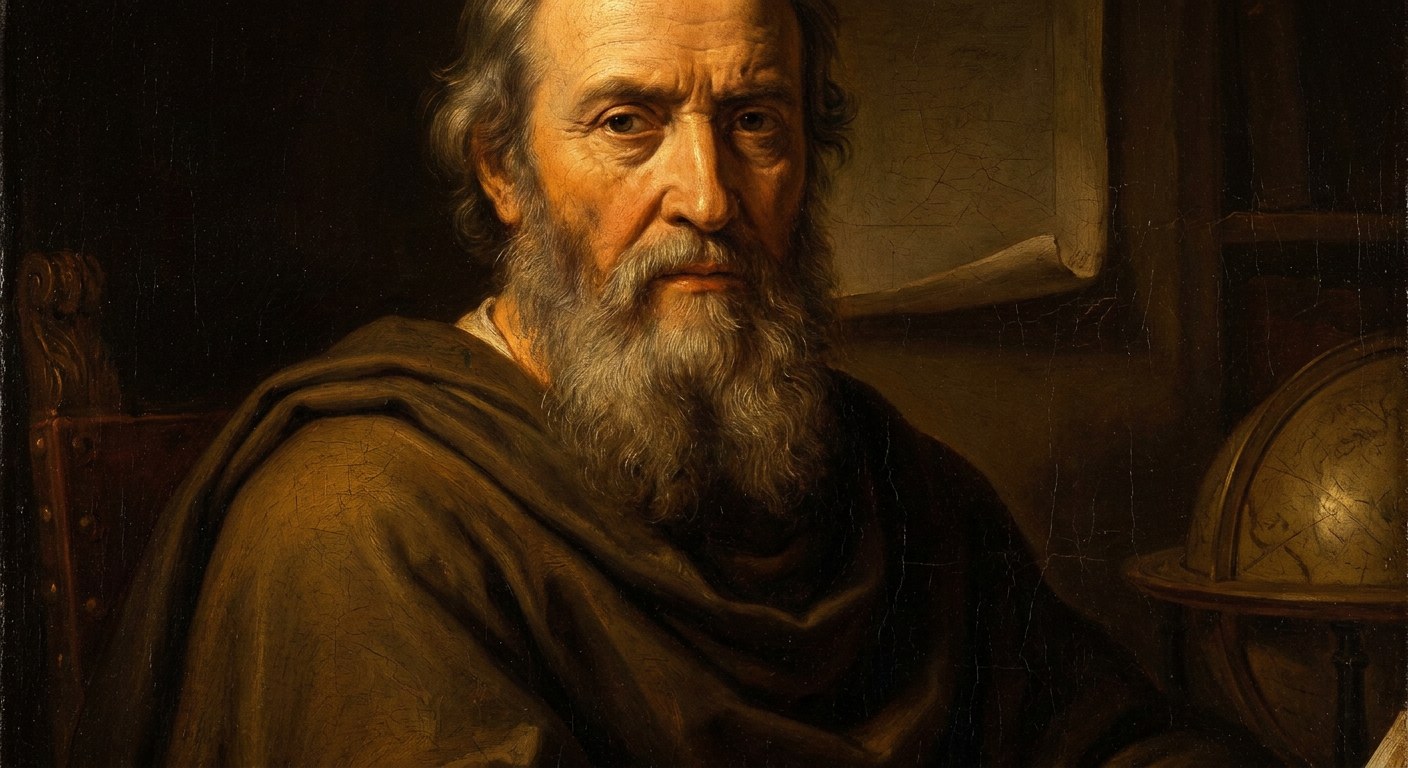
Herodotus
484 BC – 425 BC · Ancient Greek · Historian & Geographer
Recommended Audiobooks
Listen next from Marcus Alden

Life Lessons from Frederic Chopin
Marcus Alden · 54 min

Life Lessons from John Wesley
Marcus Alden · 52 min
Introduction
Herodotus was an ancient Greek writer whose Histories is the earliest large-scale historical narrative to survive from the classical world. Born at Halicarnassus in Asia Minor during the fifth century BC, he investigated the rise of the Persian Empire, the customs of numerous peoples and the long conflict between Persia and the Greek city-states. His account culminates in the failed invasions of Greece led by the Persian kings Darius I and Xerxes I.
Herodotus matters not simply because he recorded famous battles. He attempted something intellectually ambitious: to discover why a major war had occurred, compare competing explanations and preserve human achievements from oblivion. The opening sentence of his work identifies its purpose as the presentation of his inquiry so that the deeds of Greeks and non-Greeks would not lose their renown and so that the causes of their conflict would be remembered. The Greek word he used, historiē, meant inquiry or investigation; it eventually supplied the modern word “history.”
Cicero later called Herodotus “the father of history,” a title that remains attached to him. Yet he was also an ethnographer, geographer, political observer, storyteller and student of religion. He described Egypt, Scythia, Libya, Babylonia and the Persian world, embedding their landscapes and customs within his account of war. Although some reports are inaccurate or marvelous, Herodotus frequently distinguishes eyewitness testimony from hearsay, names alternative versions and tells readers when he doubts a story.
His mixture of research and storytelling has generated debate for more than two millennia. Admirers see an open-minded investigator who tried to understand foreign cultures on their own terms. Critics have called him credulous, imprecise or even dishonest. Modern scholarship generally adopts a more balanced view: Herodotus worked without archives, standardized maps or modern archaeological methods, but nevertheless established enduring practices of historical explanation, source comparison and cultural inquiry.
Quick Facts
| Fact | Details |
|---|---|
| Born | c. 484 BC, Halicarnassus, Caria, Persian Empire |
| Died | c. 425 BC; place uncertain, traditionally Thurii or possibly Athens |
| Nationality | Ancient Greek, from a Greek city under Persian rule |
| Known For | Writing The Histories and investigating the Greco-Persian Wars |
| Occupation | Historian, prose author, traveler and ethnographer |
| Era | Classical Greece, fifth century BC |
Early Life and Education
Reliable information about Herodotus's life is scarce. Most evidence comes from scattered remarks in The Histories and from much later biographical traditions. He was probably born around 484 BC in Halicarnassus, a coastal city in Caria in southwestern Asia Minor, at the site of modern Bodrum in Turkey. Halicarnassus had Greek and Carian inhabitants and lay within the Achaemenid Persian Empire. This culturally mixed background may help explain Herodotus's interest in encounters between peoples and his refusal to treat the non-Greek world as a single, undifferentiated enemy.
Halicarnassus was traditionally associated with Dorian Greeks, although Herodotus wrote in an Ionic literary dialect. The city was ruled in his youth by a dynasty subordinate to Persia. Artemisia I, its celebrated ruler, commanded ships for Xerxes at the Battle of Salamis in 480 BC. Herodotus gives her an unusually prominent and admiring role, praising her intelligence even though she fought against the Greeks.
A much later Byzantine encyclopedia, the Suda, names Herodotus's father as Lyxes and his mother as Dryo or Rhoio. It also associates him with the epic poet Panyassis, possibly as a relative. Because this testimony was recorded many centuries after Herodotus, its details cannot be accepted without caution. The names and his opportunities for travel have nevertheless encouraged the reasonable suggestion that he came from a prosperous or socially prominent family.
Nothing definite is known about his formal education. His writing shows deep familiarity with Homer, especially the Iliad and Odyssey, as well as with epic storytelling, genealogies, oracles and the geographical and intellectual traditions of Ionia. He probably encountered the work of Hecataeus of Miletus, an earlier prose writer who composed genealogical and geographical accounts. Herodotus sometimes criticizes earlier mapmakers and explicitly challenges Hecataeus on particular questions, demonstrating both indebtedness and independence.
Later tradition claims that Herodotus's family opposed Lygdamis, the tyrant of Halicarnassus, and went into exile on the island of Samos. Herodotus supposedly returned, helped overthrow the tyrant and then left because of political hostility. Parts of this story may preserve genuine memories, but the evidence is late and uncertain. His detailed knowledge of Samos suggests that he spent substantial time there, whether as an exile, resident or visitor.
His education was not confined to books or oral instruction. The Histories presents travel, observation and conversation as essential ways of acquiring knowledge. Herodotus questioned priests, guides, local informants, soldiers and members of different communities. Whether every journey traditionally assigned to him occurred exactly as described remains debated, but his work unmistakably reflects sustained engagement with a wide geographical world.
Rise to Prominence
Herodotus appears to have traveled extensively through the eastern Mediterranean and lands connected to the Persian Empire. Passages in The Histories imply visits to Egypt, Phoenicia, the Black Sea region, Cyrene in North Africa and parts of Asia Minor and mainland Greece. He knew major sanctuaries such as Delphi and Dodona and possessed detailed information about Athens, Sparta and other Greek communities. Claims that he personally reached every distant place he describes, including Babylon, are more controversial because ancient writers could combine observation with reports from traders and local intermediaries.
His travels served a developing historical project. Instead of producing a simple chronological record, Herodotus gathered explanations, traditions, family memories, monuments, inscriptions and accounts of customs. He compared stories and often preserved several versions. This method allowed his narrative to expand beyond the Greco-Persian Wars into an inquiry into the societies incorporated into, threatened by or interacting with Persia.
Public oral performance may have played an important role in his career. Ancient Greek prose and poetry were commonly read aloud, and self-contained episodes in The Histories could have been presented before audiences. Later authors claimed that Herodotus recited at Athens or at the Olympic Games. Plutarch reports that Athens awarded him ten talents after a public reading, but this anecdote was written centuries later and cannot be independently confirmed. It remains plausible that he performed portions of his work and gained recognition through recitation.
Herodotus developed connections with the intellectual world of Periclean Athens. His favorable treatment of Athens as a decisive defender of Greek freedom has sometimes been linked to those associations, although he also criticizes Athenian behavior and preserves hostile traditions. He may have known the tragedian Sophocles; an ancient tradition says that Sophocles wrote a poem in his honor. Similarities between their works suggest a shared cultural environment, but the exact nature of their relationship is uncertain.
Around 444 or 443 BC, Athenians and other Greeks founded the colony of Thurii near the former site of Sybaris in southern Italy. Strong ancient testimony associates Herodotus with this settlement, and some writers called him “Herodotus of Thurii.” He may have become a citizen there. The foundation attracted prominent intellectuals and planners, making it a suitable environment in which to compose or revise an expansive prose work.
By the later fifth century BC, Herodotus had transformed decades of stories and research into The Histories. Internal references indicate that he continued revising the text after the beginning of the Peloponnesian War in 431 BC. His fame ultimately rested on this single work, but its immense scope made him one of antiquity's foundational prose authors.
Major Achievements and Contributions
Herodotus's greatest achievement was to create a sustained explanation of a major international conflict. Earlier Greeks had recorded genealogies, local traditions, voyages and chronological lists, while epic poets celebrated heroic warfare. Herodotus brought several traditions together in a unified inquiry organized around the question of how Persia and the Greek states came into conflict.
His narrative begins with legendary accounts of abductions between Asia and Europe, but soon moves to Croesus, king of Lydia, whom Herodotus identifies as the first ruler known to have subjected Greeks in Asia Minor. From Croesus's fall, the story expands through the conquests of Cyrus the Great, Cambyses II and Darius I. Each stage introduces new peoples and regions before the work reaches Xerxes' invasion of Greece and the Greek victory at Mycale in 479 BC.
A second major contribution was his treatment of causation. Herodotus examines personal ambition, imperial expansion, revenge, geography, political institutions, chance, religious signs and moral reversal. No single principle explains every event. Decisions emerge from debates and conflicting interests, while apparently powerful rulers remain vulnerable to miscalculation and changing fortune.
Herodotus also pioneered comparative ethnography. His descriptions of Egyptian religious practice, Scythian nomadism, Persian education, burial customs, marriage practices and foodways attempt to explain how societies organize life differently. He repeatedly observes that people tend to regard their own customs as best. Although his categories and reports reflect Greek assumptions, he often responds to cultural difference with curiosity rather than contempt.
Geography is integral to his history. Rivers, deserts, coastlines, roads and climate influence conquest and resistance. Herodotus discusses the Nile's floods, the shape of the Black Sea, Persian royal roads and the enormous spaces through which armies had to move. Some geographical theories are mistaken, but his insistence that political events must be located in physical environments helped broaden historical explanation.
He also developed recognizable methods of source criticism. Herodotus uses formulations equivalent to “I heard,” “I saw,” “they say” and “in my opinion.” He sometimes refuses to choose between accounts and occasionally rejects a claim as implausible. His famous principle is that he is obliged to report what is said but not obliged to believe all of it. These distinctions are not applied consistently, yet they reveal an awareness that testimony must be evaluated rather than merely repeated.
Finally, Herodotus preserved information unavailable elsewhere. His figures and explanations cannot always be verified, but his work remains essential for studying the Achaemenid Empire, archaic Greece, Egypt, Scythia and the Persian Wars. Archaeology and Near Eastern sources sometimes contradict him, but they have also confirmed aspects once dismissed as fantasy, illustrating the value of testing rather than automatically accepting or rejecting ancient testimony.
Key Works / Battles / Ideas
The Histories
Herodotus's only surviving work is conventionally divided into nine books, each named after one of the Muses. That arrangement was probably imposed by scholars in the Hellenistic period rather than designed by Herodotus himself. The narrative is complex but purposeful: accounts of geography, legend and custom repeatedly illuminate the growth of Persian power and the choices confronting rulers and communities.
Books 1 through 4 describe the rise of Persia and its expansion. Book 1 centers on Croesus and Cyrus. Books 2 and 3 cover Egypt, Cambyses, the accession of Darius and Persian imperial politics. Book 4 examines Scythia and Libya. Books 5 and 6 trace the Ionian Revolt and Darius's campaign against Greece. Books 7 through 9 narrate Xerxes' invasion and its defeat.
The Greco-Persian Wars
Herodotus is the principal narrative source for several defining engagements:
- Marathon (490 BC): An Athenian-led force defeated Darius's expeditionary army. Herodotus emphasizes military decisions, civic institutions and the disputed conduct of the Alcmaeonid family.
- Thermopylae (480 BC): King Leonidas and a Greek force defended the pass before being overwhelmed. Herodotus commemorates Spartan courage while acknowledging the contributions of Thespians and other allies.
- Artemisium (480 BC): Greek and Persian fleets fought near Euboea while the struggle at Thermopylae unfolded.
- Salamis (480 BC): Themistocles helped induce the Greeks to fight in confined waters, where their fleet defeated Xerxes' larger naval force.
- Plataea and Mycale (479 BC): Greek victories on land and across the Aegean ended the immediate Persian invasion.
Herodotus sometimes gives implausibly large troop totals, especially for Xerxes' forces. Modern historians reconstruct smaller numbers using logistical evidence. Nevertheless, his account preserves details about command, alliances, strategy, topography and morale that remain central to analysis.
Freedom, Government and Power
The contrast between free Greek citizens and subjects of a monarch is a major theme, but Herodotus does not reduce history to propaganda. Greeks are divided, quarrelsome and capable of betrayal; Persians can be courageous, wise and disciplined. Several Persian figures receive sympathetic portraits.
In the celebrated constitutional debate of Book 3, Persian nobles discuss democracy, oligarchy and monarchy. Scholars dispute whether such a debate occurred, but the episode demonstrates Herodotus's interest in how political systems shape behavior. Elsewhere, the exiled Spartan king Demaratus tells Xerxes that Spartans are free yet obey the law as their master.
Custom and Cultural Relativism
Herodotus illustrates the power of custom with a story about Darius. The king asks Greeks what payment would persuade them to eat their dead fathers; they reject the idea in horror. He then asks Callatian Indians, who practiced funerary consumption, what would persuade them to burn their fathers; they are equally appalled. The lesson is not that every practice is identical in value, but that inherited conventions profoundly shape judgment.
Fortune, Hubris and Reversal
Power in The Histories is unstable. Croesus thinks himself supremely fortunate before losing his kingdom. Xerxes commands a vast empire yet cannot guarantee victory. Advisers warn rulers that human prosperity changes and that excessive ambition invites catastrophe. These themes resemble Greek tragedy, although Herodotus combines moral patterning with practical analysis of supplies, terrain, institutions and decisions.
Timeline of Key Events
| Year | Event |
|---|---|
| c. 484 BC | Herodotus is born at Halicarnassus in Persian-ruled Caria. |
| 480–479 BC | The invasions and battles later central to The Histories occur during his childhood. |
| c. 460s–450s BC | Probable period of extensive travel and research in the eastern Mediterranean and beyond. |
| c. 454 BC | Traditional approximate date for activity or residence in Athens; precise chronology is unknown. |
| c. 450s–440s BC | May publicly recite portions of his developing work in Greek cities. |
| 444/443 BC | Traditionally joins the foundation of Thurii in southern Italy. |
| c. 440s–430s BC | Composes, organizes and revises The Histories. |
| 431 BC | Peloponnesian War begins; references in the work show knowledge of some early wartime events. |
| c. 425 BC | Approximate date of death, although proposals range into the early 420s BC. |
| 1st century BC | Cicero famously describes Herodotus as the “father of history.” |
Personal Life and Character
Almost nothing reliable is known about Herodotus's domestic life. No secure ancient evidence identifies a spouse or children. Later traditions supply family names and political adventures, but they do not provide a verifiable personal biography in the modern sense. His character must therefore be approached principally through his authorial voice.
That voice is inquisitive, sociable and frequently humorous. Herodotus is fascinated by unusual animals, monumental buildings, ingenious strategies, dreams, rituals and reversals of fortune. He allows informants to speak through stories and often pauses to offer a judgment. At the same time, he can admit uncertainty. Rather than concealing disagreement, he tells readers when different communities offer incompatible accounts.
He shows notable sympathy toward individuals on opposing sides. Persian kings may be ambitious or cruel, but Persian soldiers and advisers are not treated as faceless barbarians. Artemisia is praised for sound counsel; the Persian noble Otanes speaks against autocracy; and Xerxes is portrayed with moments of grief and humanity as well as arrogance. Herodotus's Greeks are similarly varied rather than uniformly heroic.
His intellectual personality combines rational investigation with belief in divine signs, oracles and providential patterns. This was not necessarily contradictory within his culture. He could question a particular tale while accepting that divine forces punished excessive success or communicated through prophecy. His world remained religiously meaningful even as he sought human causes.
Herodotus also possessed a strong desire to memorialize. He records names, epitaphs and deeds because mortality threatens both individuals and communities with oblivion. His historical writing is therefore an ethical and literary act of remembrance as well as an inquiry into causes.
Challenges and Controversies
Herodotus has attracted criticism since antiquity. Thucydides, his younger contemporary, never names him directly but contrasts his own austere history of the Peloponnesian War with works designed for immediate entertainment. Thucydides' emphasis on political and military precision encouraged later readers to see Herodotus as the less rigorous storyteller, although the two historians pursued different subjects and methods.
Plutarch went further in On the Malice of Herodotus, accusing him of bias against certain Greeks, especially Boeotians and Corinthians. These complaints demonstrate how politically sensitive Herodotus's judgments remained. Communities cared deeply about whether their ancestors appeared courageous, neutral or treacherous during the Persian Wars.
The most persistent controversy concerns credibility. Herodotus includes giant gold-digging ants, winged snakes, unusual reproductive practices and conversations he could not personally have witnessed. Yet not every marvelous report is endorsed by the author. He may label it hearsay, express skepticism or merely preserve what informants told him. The gold-digging “ants,” for example, have prompted attempts to connect the account with Himalayan marmots and linguistic misunderstanding, though no explanation is universally accepted.
His Egyptian narrative is especially debated. Herodotus offers invaluable observations but also misunderstood aspects of chronology, language, religion and monument construction. His statement that he learned from Egyptian priests does not guarantee that communication was direct or accurate. Translation, local storytelling and his own interpretive framework could all reshape information.
His military numbers present another challenge. The millions assigned to Xerxes' expedition exceed what most modern scholars consider logistically possible. Ancient numerical traditions were vulnerable to exaggeration, copying errors and symbolic inflation. Historians therefore use his qualitative narrative while checking totals against terrain, supply requirements, inscriptions and other evidence.
Some twentieth-century scholars accused Herodotus of inventing travels or sources. More recent scholarship usually resists an all-or-nothing verdict. Oral testimony cannot be footnoted in modern fashion, and inaccuracies do not by themselves prove fabrication. His descriptions contain both demonstrable mistakes and strikingly accurate local knowledge.
Bias is equally complex. Herodotus admires Athens for choosing resistance and argues that its naval contribution saved Greece, but he also records Athenian aggression and dubious traditions. He values Greek freedom but respects foreign accomplishments. His work is not culturally neutral; it was written in Greek for a Greek-speaking audience. Nevertheless, its sustained attention to non-Greek perspectives is exceptional for its period.
Death and Immediate Aftermath
The date, place and circumstances of Herodotus's death are unknown. He probably died around 425 BC, although dates extending into the early 420s have been proposed. References to events in the first years of the Peloponnesian War indicate that he remained active after 431 BC. The absence of clear allusions to later developments helps establish an approximate limit but cannot yield an exact year.
Ancient traditions variously located his tomb at Thurii, Athens or Pella in Macedonia. Thurii is often preferred because of his association with the colony, yet no account can be verified. There is likewise no reliable evidence that he died violently or under unusual circumstances.
The Histories circulated and became an important point of reference soon after his lifetime. Thucydides' work can be read partly as a response to the kind of history Herodotus practiced, while later Greek historians inherited questions about evidence, causation, speeches and narrative structure. The division into nine books and their association with the Muses probably took shape under scholars who edited and organized texts at Alexandria centuries later.
Herodotus's reputation quickly became double-edged. He was honored as a master storyteller and investigator, yet mocked as a “father of lies” by detractors who distrusted his marvels. That tension between admiration and suspicion has remained central to his reception.
Legacy and Influence Today
Herodotus's most visible legacy is the discipline's name. His historiē transformed inquiry into a literary form devoted to preserving and explaining the past. Cicero's description of him as pater historiae, the father of history, captures his foundational position, though it should not imply that no one before him investigated earlier events. Mesopotamian, Egyptian, Hebrew and Greek traditions had long recorded kings, wars and communal memories. Herodotus's distinction lies in the scale, organization and investigative voice of his surviving work.
He influenced ancient historians including Thucydides, Xenophon, Polybius, Diodorus Siculus and Plutarch, whether as a model or a writer to correct. His integration of geography and ethnography also shaped later descriptions of foreign lands. Roman authors read him for both information and style; Cicero praised the flowing quality of his prose even while recognizing its legendary material.
During the Renaissance, Greek manuscripts and printed editions renewed Western European engagement with The Histories. Scholars, political thinkers and travelers drew upon his accounts of empire, government and cultural difference. Modern archaeology and the decipherment of Egyptian and Near Eastern texts made it possible to test his claims against independent evidence.
Today, historians treat Herodotus neither as an infallible authority nor as a mere fabulist. His claims are compared with inscriptions, material remains, environmental studies and Achaemenid sources. This critical use exemplifies a basic historical principle: valuable sources may contain perspective, error and literary shaping without becoming useless.
His ethnographic method remains especially relevant. Herodotus asks why practices that seem self-evident to one society appear strange to another. His answer—that custom exerts extraordinary power—anticipates later comparative approaches in anthropology. At the same time, modern readers can identify stereotypes and asymmetries in his descriptions, making his work useful for studying both cross-cultural curiosity and the limits of ancient representation.
His narratives retain a powerful place in popular culture. Marathon, Thermopylae and Salamis appear in novels, films, documentaries and strategic studies, often through stories first preserved by him. Popular adaptations sometimes simplify his nuanced narrative into a clash between freedom and despotism. Reading Herodotus directly reveals a more complicated world of divided Greeks, diverse imperial subjects, intelligent advisers and leaders trapped by their own choices.
Above all, Herodotus endures because he joins analysis to human storytelling. He understood that history concerns institutions and armies but also fear, pride, grief, rumor, memory and accident. His willingness to ask questions, compare testimony and preserve uncertainty remains recognizable to historians more than twenty-four centuries later.
Famous Quotes
Translations of Herodotus vary, so wording differs among editions. The following statements are genuinely attributed to The Histories and are identified by their conventional book and section numbers.
“Herodotus of Halicarnassus here displays his inquiry, so that human achievements may not become forgotten in time, and great and marvelous deeds—some displayed by Greeks, some by barbarians—may not be without their glory.”
— The Histories, 1.1
“Very few things happen at the right time, and the rest do not happen at all. The conscientious historian will correct these defects.”
— This familiar saying is often attributed to Herodotus, but it is not securely found in The Histories and is therefore not accepted as genuine.
“I am bound to tell what I am told, but not in every case to believe it.”
— The Histories, 7.152
“Custom is king of all.”
— The Histories, 3.38, quoting a saying associated with Pindar
“No one is so foolish as to choose war over peace. In peace sons bury their fathers, but in war fathers bury their sons.”
— The Histories, 1.87, spoken by Croesus
“Of all men's miseries the bitterest is this: to know so much and to have control over nothing.”
— The Histories, 9.16
“Great deeds are usually wrought at great risks.”
— The Histories, 7.50, in Artabanus's counsel to Xerxes
“Circumstances rule men; men do not rule circumstances.”
— The Histories, 7.49, in Artabanus's warning about contingency
The second item is included as a correction because it is widely circulated under Herodotus's name but is not a reliable ancient quotation. It should not be cited as his words.
Frequently Asked Questions
Why is Herodotus called the Father of History?
Cicero gave Herodotus this title because The Histories is the earliest surviving Greek work to present a large, organized investigation into past events, their causes and their wider cultural setting. Herodotus compared reports, traveled, evaluated evidence and explained why Greeks and Persians came into conflict. The title recognizes his influence, not the absence of earlier historical records in other civilizations.
When and where was Herodotus born?
He was probably born around 484 BC at Halicarnassus in Caria, now Bodrum in Turkey. The city had Greek and Carian cultural connections and belonged to the Persian Empire. This position between Greek and Persian worlds likely informed his broad interest in cultural interaction.
What did Herodotus write?
His sole surviving work is The Histories. It describes the rise of the Persian Empire and the Greco-Persian Wars while including extensive material on geography, religion, customs, politics and legendary traditions. Its modern division into nine books was probably created by later editors.
Did Herodotus witness the Persian Wars?
He was probably a young child during Xerxes' invasion in 480–479 BC and could not have personally observed most major events. He reconstructed them later through oral testimony, monuments, travel, local traditions and earlier knowledge. Some informants may have been veterans or descendants of participants.
Was Herodotus a reliable historian?
He is indispensable but must be used critically. He preserves valuable information, identifies alternative versions and sometimes distinguishes observation from hearsay. He also reports legends, exaggerates numbers and makes geographical or chronological errors. Archaeology has both corrected and supported elements of his narrative.
Where did Herodotus travel?
His work indicates knowledge gained through travel in Egypt, Asia Minor, mainland Greece, the Aegean, southern Italy and probably regions around the Black Sea. He also describes Babylon, Phoenicia, Libya and Scythia. Scholars debate whether every first-person-sounding description proves that he personally visited the location.
How did Herodotus differ from Thucydides?
Herodotus explored a broad intercultural past through travel, oral traditions, geography, marvels and moral reflection. Thucydides concentrated more narrowly on the contemporary Peloponnesian War and stressed political calculation, military analysis and rigorous chronology. Both selected and shaped evidence, but their subjects, narrative styles and stated standards differed.
How did Herodotus die?
No reliable account survives. He probably died around 425 BC, but the exact year and place are uncertain. Thurii is the traditional leading possibility because he was associated with its foundation, although Athens and Pella also appear in ancient traditions.
Lessons We Can Learn
-
Investigate before judging. Herodotus sought testimony, visited places and compared traditions. His example encourages inquiry rather than reliance on a single convenient account.
-
Distinguish reporting from belief. By signaling doubt and preserving competing versions, he showed that a researcher can record a claim without endorsing it. Modern readers should make the same distinction.
-
Take cultural context seriously. Practices that seem natural are often products of custom. Understanding another society requires asking what its members value and why.
-
Power does not eliminate uncertainty. Croesus, Darius and Xerxes command immense resources yet suffer from poor judgment, geography, resistance and chance. Authority should never be mistaken for complete control.
-
Preserve complexity. Herodotus did not portray every Greek as virtuous or every Persian as villainous. Responsible history recognizes courage, error and humanity on more than one side.
Further Reading
- Herodotus. The Histories. Translated by Robin Waterfield. Oxford World's Classics, 1998.
- Herodotus. The Landmark Herodotus: The Histories. Edited by Robert B. Strassler; translated by Andrea L. Purvis. Anchor Books, 2007.
- Thomas, Rosalind. Herodotus in Context: Ethnography, Science and the Art of Persuasion. Cambridge University Press, 2000.
- Dewald, Carolyn, and John Marincola, editors. The Cambridge Companion to Herodotus. Cambridge University Press, 2006.
- Munson, Rosaria Vignolo. Herodotus: Volume 1, Herodotus and the Narrative of the Past. Oxford University Press, 2013.
Watch and Learn
Why is Herodotus called “The Father of History”? · TED-Ed