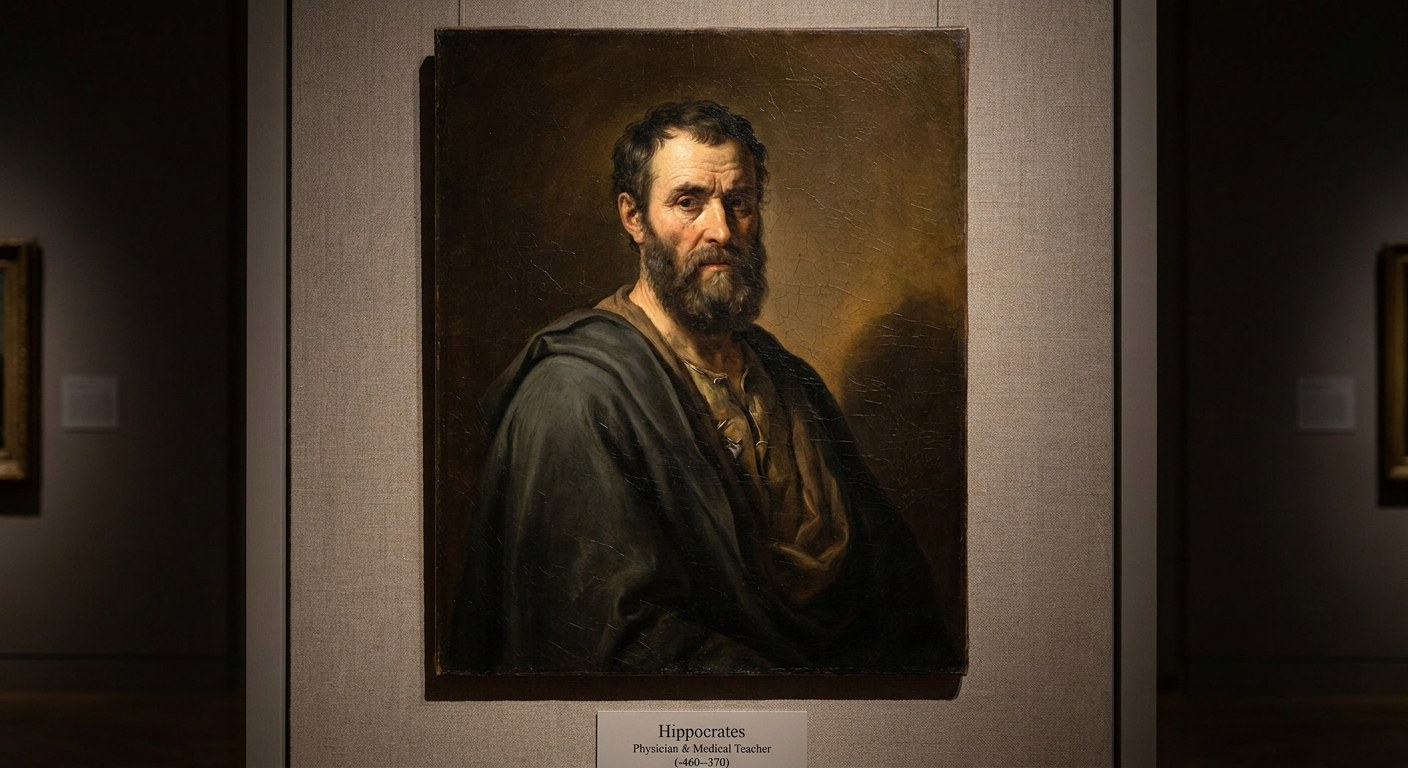
Hippocrates
460 BC – 370 BC · Ancient Greek · Physician & Medical Teacher
Recommended Audiobooks
Listen next from Marcus Alden

Life Lessons from Frederic Chopin
Marcus Alden · 54 min

Life Lessons from John Wesley
Marcus Alden · 52 min
Introduction
Hippocrates of Kos, traditionally dated to about 460–370 BC, is the most famous physician of classical Greece and one of the foundational figures in the history of medicine. Often called the “father of medicine,” he became the symbolic representative of an approach that sought natural explanations for disease, emphasized careful observation of patients and attached moral obligations to medical practice.
The historical Hippocrates is difficult to separate from later legend. He almost certainly existed and enjoyed a distinguished reputation during his lifetime. Plato, writing in the fourth century BC, referred to “Hippocrates of Kos, the Asclepiad” as a physician who taught medicine for payment. Aristotle also knew him as a notable doctor. Yet most familiar stories about his travels, cures and character were recorded centuries later, while the approximately sixty medical treatises gathered under his name were composed by several authors over a long period.
For that reason, modern historians distinguish between Hippocrates the individual and the broader Hippocratic tradition. The latter is represented by the Hippocratic Corpus, a diverse collection dealing with epidemics, surgery, fractures, prognosis, diet, anatomy, women’s health, medical ethics and the relationship between environment and disease. Some texts disagree sharply with others, making it unlikely that Hippocrates wrote them all—and uncertain whether he personally wrote any surviving treatise.
His importance nevertheless remains profound. Hippocratic medicine helped establish the patient’s history, visible symptoms, living conditions and probable course of illness as subjects of systematic study. Its practitioners attempted to explain epilepsy, fever and other disorders through bodily and environmental causes rather than treating them solely as divine punishment. They also articulated enduring ethical ideals, most famously in the oath later associated with Hippocrates.
Hippocrates should not be portrayed as a modern scientist born thousands of years too early. His medicine included speculative theories, especially ideas involving bodily fluids or humors, and lacked knowledge of microorganisms, circulation and cellular biology. Even so, the tradition bearing his name helped make medicine a disciplined intellectual craft whose practitioners were expected to observe closely, reason carefully and accept responsibilities toward their patients.
Quick Facts
| Fact | Details |
|---|---|
| Born | c. 460 BC, Kos, ancient Greece |
| Died | c. 370 BC, traditionally at Larissa in Thessaly |
| Nationality | Ancient Greek |
| Known For | Hippocratic medicine, clinical observation, medical ethics and the Hippocratic Oath tradition |
| Occupation | Physician and medical teacher |
| Era | Classical Greece, fifth–fourth centuries BC |
Early Life and Education
Reliable information about Hippocrates’s childhood is scarce. He was born around 460 BC on Kos, an Aegean island close to the coast of Asia Minor. Kos possessed a sanctuary of Asclepius, the Greek god of healing, although the surviving sanctuary was substantially developed after Hippocrates’s lifetime. Medicine in the Greek world was practiced by several kinds of healers, including temple attendants, itinerant physicians, root cutters, athletic trainers and members of medical families.
A biography attributed to the second-century AD physician Soranus of Ephesus identifies Hippocrates’s father as Heraclides, himself a physician, and his mother as Praxitela. It claims that the family traced its descent through Asclepius and ultimately to the hero Heracles. Such genealogies conferred social prestige but cannot be treated as literal history. The word Asclepiad could refer to a supposed descendant of Asclepius, a member of a medical lineage or, more generally, a physician associated with a healing tradition.
Hippocrates probably received his first medical training within his family. Greek medical knowledge was frequently passed from fathers to sons, supplemented by practical experience with patients. A trainee learned to recognize symptoms, prepare drugs, set fractures, treat wounds and advise patients about food, drink, sleep and exercise. Formal universities and standardized medical licenses did not exist.
Later tradition connected Hippocrates with philosophers such as Democritus and Gorgias and credited him with study at famous centers of learning. These associations are possible in a broad cultural sense but cannot be verified as personal teacher-student relationships. Classical Greek physicians operated in an intellectual environment shaped by natural philosophy, debates over matter and change, and attempts to identify regular causes behind natural events.
Plato provides the earliest important external evidence. In the dialogue Protagoras, set dramatically in the late fifth century BC, a young man wishes to study with Hippocrates of Kos and pay him fees. This suggests that Hippocrates was known not merely as a practitioner but also as a professional teacher. In Phaedrus, Plato invokes Hippocrates in a discussion about understanding the nature of the body as a whole, although the exact meaning of the passage remains debated.
Rise to Prominence
Hippocrates lived during a period of political conflict and intellectual experimentation. The Persian Wars had recently reshaped the Greek world, while the Peloponnesian War between Athens and Sparta dominated much of his adult life. Physicians often traveled from city to city, seeking employment from individuals, communities, armies or political rulers. Hippocrates may likewise have practiced beyond Kos, although specific itineraries reported by later authors are uncertain.
His prominence probably came from a combination of successful practice, teaching and association with a recognizable method. Unlike healers who attributed illness primarily to divine displeasure, physicians in the Hippocratic tradition looked for patterns in diet, climate, water, winds, seasons and bodily condition. This did not necessarily imply atheism. Greek physicians could believe in gods while still arguing that diseases had intelligible natural causes.
The treatise On the Sacred Disease illustrates this position. Its author discusses epilepsy, commonly regarded as especially divine, and argues that it is no more sacred than other illnesses. The disease has a natural origin, the writer maintains, even if all nature may ultimately be considered divine. The argument criticizes ritual healers who used purification, incantation and dietary prohibitions while claiming privileged religious knowledge.
Another source of authority was prognosis. Without modern diagnostic testing or highly effective drugs, ancient physicians often gained trust by predicting how an illness would develop. Careful attention to breathing, sleep, appetite, pain, excretions, posture, facial appearance and changes in fever allowed an experienced practitioner to identify recurring patterns. A correct prognosis demonstrated expertise and helped families prepare for recovery or death.
By the early fourth century BC, Hippocrates’s name had become proverbial. Aristotle’s Politics calls him “the great Hippocrates,” apparently contrasting his greatness as a physician with his physical size. This indicates a reputation extending beyond Kos and beyond medical circles. His students, descendants and later admirers helped transform that reputation into a durable medical lineage.
Major Achievements and Contributions
Establishing a tradition of clinical observation
The most important achievement associated with Hippocratic medicine was its disciplined attention to the individual patient. Case histories in the Epidemics record symptoms day by day, including fever, sweating, thirst, urine, stool, sleep, delirium and crises. Many cases end honestly with the word “died.” These records were not controlled experiments, but they reveal an effort to preserve observations and compare the courses of illnesses.
The celebrated description known as the “Hippocratic facies” identified a cluster of changes sometimes seen near death: sunken eyes, a sharp nose, cold ears and altered facial color. Such signs were used prognostically rather than as explanations of disease.
Seeking natural causes
Hippocratic authors generally treated disease as part of nature. The body could be affected by food, weather, physical exertion, water supply, geography and internal imbalance. This orientation encouraged physicians to investigate circumstances instead of relying exclusively on supernatural explanations.
The treatise Airs, Waters, Places advised traveling doctors to examine prevailing winds, seasonal changes, water sources, terrain and local ways of life. Some of its environmental observations anticipated later interests in epidemiology and public health. Other sections, however, made sweeping and prejudicial claims about the character of entire populations. Its importance lies in treating health as connected to environment, not in the accuracy of every conclusion.
Prognosis and the course of illness
Hippocratic practitioners developed an elaborate interest in prognosis. They observed whether symptoms appeared in regular sequences and whether turning points occurred on particular “critical days.” This framework was imperfect, but it shifted attention toward the development of disease over time.
Prognosis also had an ethical and social role. It allowed the physician to explain what had already happened, describe the patient’s present condition and predict what might follow. In a competitive medical marketplace, this could distinguish a trained practitioner from a charlatan.
Regimen and preventive care
Diet, exercise, bathing, sleep, sexual activity and work formed major parts of Hippocratic treatment. The Greek term diaita referred broadly to a way of life, not merely food restriction. Physicians adjusted regimens according to age, constitution, season and illness. Although some advice rested on mistaken physiology, the broader principle that habits and surroundings influence health remains fundamental.
Surgery and injury care
Several Hippocratic works contain practical guidance on wounds, dislocations and fractures. On Fractures and On Joints describe manipulation, bandaging, splinting and traction. The texts emphasize positioning and warn against excessive intervention. The “Hippocratic bench,” a traction device associated with reducing fractures and dislocations, reflects this mechanical side of ancient practice.
The corpus also describes trepanation, cautery, drainage and other procedures. Operations inside major body cavities remained exceptionally dangerous because practitioners lacked anesthesia, antisepsis and an understanding of infection.
Medical ethics
The Hippocratic tradition connected technical skill with standards of conduct. The famous Hippocratic Oath requires loyalty to teachers, confidentiality, avoidance of certain harmful acts and a commitment to enter households for patients’ benefit. It invokes Greek gods and reflects the values of a particular medical group rather than a universal code accepted by all ancient physicians.
The familiar phrase “first, do no harm” does not occur in the oath in that exact form. A related principle appears in Epidemics: the physician should help the sick or at least avoid harming them. Modern medical oaths are usually adaptations rather than word-for-word recitations of the ancient document.
Key Works / Battles / Ideas
No surviving book can be assigned to Hippocrates with complete confidence. The Hippocratic Corpus contains roughly sixty works, depending on how texts are counted. Most were written in Ionic Greek between the late fifth and fourth centuries BC, although parts may be later. Their vocabulary, doctrines and styles vary, demonstrating multiple authorship.
Important works include:
- The Hippocratic Oath: A compact statement of obligations to teachers, patients and households. Its prohibitions concerning lethal drugs, abortion and surgery have generated extensive debate because their precise meanings and historical setting are uncertain.
- Aphorisms: Short medical observations covering prognosis, diet, age, seasons and disease. Its opening sentence—“Life is short, and the Art long”—became one of medicine’s most famous sayings.
- Epidemics: Collections of clinical observations and case histories from places including Thasos. The title refers to diseases present among a population, not exclusively to epidemics in the modern sense.
- On the Sacred Disease: An argument that epilepsy has a natural cause and should not be considered uniquely divine.
- Airs, Waters, Places: A study of how climate, geography, water and customs may affect health and human communities.
- Prognostic: Guidance on reading symptoms and forecasting the course of acute disease.
- On Fractures and On Joints: Practical discussions of orthopedic injuries, reduction techniques and bandaging.
- On Ancient Medicine: A defense of medicine as a craft grounded in accumulated experience, opposing overly simple philosophical theories about the body.
- On the Nature of Man: A work traditionally attributed to Hippocrates’s son-in-law Polybus. It presents the influential theory that the body contains four humors: blood, phlegm, yellow bile and black bile.
- Diseases of Women and related gynecological texts: Sources for ancient approaches to menstruation, fertility and childbirth, but also evidence of erroneous assumptions about female anatomy and physiology.
Four-humor theory became closely identified with Hippocrates, but it should not be reduced to one man’s discovery. Different corpus texts propose different bodily substances and causes. The systematic doctrine of four humors was developed and amplified by later physicians, especially Galen in the Roman Empire.
Hippocratic medicine was largely nonspecific by modern standards. Treatment could involve rest, modified diet, baths, herbal preparations, bloodletting, purging or cautery. Some measures may have relieved symptoms; others were ineffective or harmful. Its historical achievement was methodological and professional rather than a record of uniformly successful cures.
Timeline of Key Events
| Year | Event |
|---|---|
| c. 460 BC | Hippocrates is traditionally born on Kos into a medical family. |
| c. 440–430 BC | Probable period of medical training and early practice; exact dates are unknown. |
| 431 BC | The Peloponnesian War begins during Hippocrates’s adulthood. |
| c. 430 BC | Plague strikes Athens. Later legends connect Hippocrates with responses to epidemics, but his presence in Athens is unproven. |
| Late 5th century BC | Hippocrates gains a reputation as a physician and teacher. |
| c. 420–400 BC | Several early works now included in the Hippocratic Corpus are probably composed, though authorship is uncertain. |
| c. 390s BC | Plato’s Protagoras identifies Hippocrates of Kos as a famous physician who accepts students for fees. |
| Early 4th century BC | Plato’s Phaedrus associates Hippocrates with a method of considering the body’s nature as a whole. |
| c. 370 BC | Traditional approximate date of Hippocrates’s death, reportedly at Larissa in Thessaly. |
| Later 4th century BC | Aristotle refers to “the great Hippocrates,” confirming his established reputation. |
| 3rd century BC onward | Hippocratic writings are collected, studied and organized at centers such as Alexandria. |
| 2nd century AD | Galen writes extensive commentaries and makes Hippocratic medicine central to later medical education. |
Personal Life and Character
Nearly everything reported about Hippocrates’s private life comes from sources written long after his death. Soranus’s biography names his wife only indirectly and states that he had two sons, Thessalus and Draco, both physicians. A daughter supposedly married Polybus, another doctor associated with the Hippocratic school. Aristotle attributes On the Nature of Man to Polybus, making him one of the few figures in the Hippocratic circle linked to a specific surviving text by an ancient authority.
Later biographies portray Hippocrates as modest, dignified, self-controlled and devoted to healing. This image may reflect ideals drawn from the medical writings rather than independent knowledge of his personality. Treatises such as The Physician describe the desirable practitioner as healthy in appearance, clean, calm, trustworthy and restrained. A physician’s demeanor mattered because patients judged competence partly through speech, dress and behavior.
Numerous legends embellished his career. He was said to have cured the Macedonian king Perdiccas II, recognized that the philosopher Democritus was wise rather than insane and refused lavish offers from the Persian king Artaxerxes. Another story claimed that he helped save Athens from plague by ordering fires to purify the air. These tales celebrated patriotism, diagnostic brilliance and moral independence, but historians do not regard them as secure facts.
Hippocrates’s relationship to religion was probably more complex than the popular contrast between science and superstition suggests. The oath invokes Apollo, Asclepius, Hygieia and Panacea. Hippocratic authors criticized healers who exploited religious fear, yet they did not necessarily reject divine reality. Their distinctive claim was that disease followed natural processes that physicians could investigate.
Challenges and Controversies
The central controversy is authorship. Scholars have attempted for centuries to identify the “genuine” works of Hippocrates, but no consensus exists. Some treatises may preserve his ideas or originate in his circle, yet linguistic and doctrinal differences prevent the corpus from being treated as one author’s coherent system.
The title “father of medicine” can also mislead. Organized medical practices existed long before Hippocrates in Egypt, Mesopotamia, India and elsewhere. Greek medicine itself had many practitioners and traditions. Hippocrates was not the inventor of medicine; he became the emblem of one especially influential Greek medical movement.
The claim that he single-handedly separated medicine from religion is similarly exaggerated. Natural explanations appeared among earlier Greek thinkers, while Hippocratic texts retained religious language and cultural assumptions. Healing sanctuaries continued to flourish alongside professional medicine, and patients could consult both temple and physician without seeing a contradiction.
Hippocratic theories were often incorrect. Humoral explanations lacked a sound anatomical or experimental basis. Human dissection was rare or absent in classical Greek medical practice, limiting knowledge of internal structures. Some treatments—particularly aggressive purging, bloodletting and cautery—could worsen illness.
The gynecological writings are especially controversial. They preserve valuable evidence about women’s health in antiquity and show sustained attention to reproduction, but they also depict the female body through assumptions that modern medicine rejects. The idea of a “wandering womb,” although more complicated in the sources than popular summaries suggest, became notorious as an example of gendered medical error.
The oath presents interpretive problems as well. Its prohibition against giving a deadly drug has been cited in modern debates about euthanasia, while its language about an abortive pessary has been invoked in arguments over abortion. Historians caution that the text addressed the practices of a specific ancient community and cannot be mapped straightforwardly onto modern law. Its instruction to leave cutting for bladder stones to specialists may indicate professional division of labor rather than opposition to all surgery.
Finally, many later quotations and health slogans have been falsely assigned to Hippocrates. Statements such as “Let food be thy medicine and medicine be thy food” do not appear in the surviving corpus in that form. Responsible accounts must distinguish authentic ancient passages from modern paraphrases and internet inventions.
Death and Immediate Aftermath
Hippocrates is traditionally said to have died at Larissa in Thessaly around 370 BC. Ancient sources disagree about both the date and his age. Some credited him with a lifespan of eighty-five, ninety, one hundred or even more than one hundred years. Such extraordinary ages were a conventional way of honoring sages and physicians, so the commonly used dates remain approximations.
Later tradition claimed that Hippocrates was buried between Larissa and Gyrton and that a swarm of bees inhabited his tomb. Their honey was supposedly used to treat children’s mouth ulcers. This picturesque story belongs to legend rather than verifiable biography.
His medical family and pupils apparently continued teaching after his death. Thessalus, Draco and Polybus were all remembered as representatives of his school. During the following centuries, medical writings associated with Kos and other centers were gathered under Hippocrates’s prestigious name. Scholars at Hellenistic Alexandria catalogued and commented on these works, helping create the corpus known today.
Hippocrates’s immediate importance was therefore not based on a single book or discovery. It rested on a professional reputation that successors converted into an intellectual authority. His name became the standard under which diverse Greek medical knowledge could be collected, debated and transmitted.
Legacy and Influence Today
Hippocratic medicine shaped medical thought for more than two millennia. The physician Galen, active in the second century AD, treated Hippocrates as the exemplary medical authority and interpreted the corpus through his own theories of anatomy, physiology and humoral balance. Galen’s synthesis dominated much of Byzantine, Islamic and Latin European medicine.
Scholars in the medieval Islamic world translated and analyzed Hippocratic works. Physicians including al-Razi and Ibn Sina inherited Hippocratic and Galenic concepts while criticizing, reorganizing and expanding them. Through Arabic and Greek transmission, Hippocratic writings entered European medical schools and remained part of learned medicine into the early modern period.
The rise of anatomical dissection, experimentation, microscopy, germ theory and modern physiology eventually displaced humoral medicine. Yet several Hippocratic commitments survived in transformed form: close observation, careful documentation, prognosis, attention to environment and recognition that physicians have duties beyond technical competence.
The Hippocratic Oath remains the most recognizable symbol of medical ethics. Few graduates now swear its ancient wording. Modern versions often remove references to Greek gods, revise the duties owed to teachers and address contemporary concerns such as patient autonomy, equality, privacy and responsible use of technology. The World Medical Association’s Declaration of Geneva is one prominent modern physician’s pledge inspired by the same broad tradition.
The term “Hippocratic” persists in medical vocabulary. Hippocratic fingers, or digital clubbing, describe enlargement of the fingertips associated with several chronic diseases. The Hippocratic facies refers to characteristic facial changes in severe illness or impending death. The Hippocratic method is a historical technique for reducing a dislocated shoulder, though safer modern procedures are generally preferred.
Hippocrates also remains central to discussions about what medicine is. Is it primarily a science, a practical craft, an ethical vocation or some combination of all three? The corpus does not offer one answer, but it preserves early and influential efforts to unite observation, reasoning, experience and professional conduct.
His legacy is strongest when approached critically. He should neither be dismissed because ancient medicine was scientifically limited nor celebrated through unsupported myths. The historical Hippocrates mattered because his name came to represent a community of inquiry: physicians observing bodies, debating causes, recording outcomes and asking how healers should behave toward vulnerable people.
Famous Quotes
Because the Hippocratic Corpus has multiple authors, these quotations are genuinely found in works traditionally attributed to Hippocrates, but none can be proven to be his spoken or written words personally. Translations vary.
“Life is short, and the Art long; the crisis fleeting; experience perilous, and decision difficult.”
— Aphorisms, 1.1
“For extreme diseases, extreme methods of cure, as to restriction, are most suitable.”
— Aphorisms, 1.6
“As to diseases, make a habit of two things—to help, or at least to do no harm.”
— Epidemics, Book I
“Old men endure fasting most easily; next, adults; young persons not nearly so well; and most especially infants.”
— Aphorisms, 1.13
“Persons who are naturally very fat are apt to die earlier than those who are slender.”
— Aphorisms, 2.44
“What medicines do not heal, the lance will; what the lance does not heal, fire will.”
— Aphorisms, 7.87
“Things that are holy are revealed only to men who are holy.”
— The Law
Frequently Asked Questions
Why is Hippocrates called the father of medicine?
He became the symbolic founder of a Greek medical tradition emphasizing natural causes, clinical observation, prognosis and professional conduct. The title recognizes his influence, not the literal invention of medicine, which existed in several ancient civilizations before his lifetime.
Did Hippocrates write the Hippocratic Oath?
Its authorship is unknown. The oath forms part of the Hippocratic Corpus, but scholars cannot demonstrate that Hippocrates wrote it. It may have represented the commitments of a particular group of Greek physicians rather than all ancient medical practitioners.
What did Hippocrates believe caused disease?
Writings associated with his tradition usually explain disease through bodily condition, diet, lifestyle, climate, water and other natural factors. Some texts emphasize humoral imbalance. The corpus is diverse, however, and does not present one consistent theory.
Did Hippocrates invent the theory of four humors?
Not by himself. On the Nature of Man, attributed in antiquity to Polybus, describes blood, phlegm, yellow bile and black bile. Later physicians—especially Galen—systematized and popularized four-humor theory under Hippocratic authority.
Is “First, do no harm” in the Hippocratic Oath?
No. The exact Latin expression primum non nocere does not appear in the oath. A related statement in Epidemics advises physicians to help patients or at least avoid harming them.
Did Hippocrates say, “Let food be thy medicine”?
There is no reliable evidence that this sentence appears in the Hippocratic Corpus. Diet was extremely important in Hippocratic medicine, but the familiar wording is a modern misattribution.
What is the Hippocratic Corpus?
It is a collection of roughly sixty ancient Greek medical works on subjects including epidemics, prognosis, surgery, diet, anatomy, reproduction and ethics. The texts were written by multiple authors, mainly during the classical and early Hellenistic periods.
How certain are Hippocrates’s birth and death dates?
They are approximate. Around 460 BC is the traditional date of his birth, while around 370 BC is commonly given for his death. Ancient accounts disagree and include legendary claims that he lived to an exceptionally advanced age.
Lessons We Can Learn
- Observe before concluding. Hippocratic case records show the lasting value of following symptoms, circumstances and changes over time rather than relying on quick assumptions.
- Treat expertise as an ethical responsibility. Technical knowledge gives professionals power over vulnerable people and therefore creates obligations of confidentiality, restraint and honesty.
- Consider the whole environment. Health is influenced not only by immediate symptoms but also by water, climate, diet, work, housing and social conditions.
- Admit uncertainty. Ancient physicians often lacked effective cures, yet their best writings carefully recorded failures and deaths. Intellectual honesty is essential to progress.
- Respect tradition without turning it into myth. Hippocrates’s genuine importance becomes clearer when later legends, false quotations and obsolete theories are distinguished from his historical influence.
Further Reading
- Jacques Jouanna, Hippocrates, translated by M. B. DeBevoise, Johns Hopkins University Press, 1999.
- Vivian Nutton, Ancient Medicine, 2nd edition, Routledge, 2013.
- Helen King, Hippocrates Now: The “Father of Medicine” in the Internet Age, Bloomsbury Academic, 2020.
- W. H. S. Jones, trans., Hippocrates, multiple volumes, Loeb Classical Library, Harvard University Press.
- Philip van der Eijk, Medicine and Philosophy in Classical Antiquity: Doctors and Philosophers on Nature, Soul, Health and Disease, Cambridge University Press, 2005.
Watch and Learn
The Power of the Placebo Effect · TED-Ed