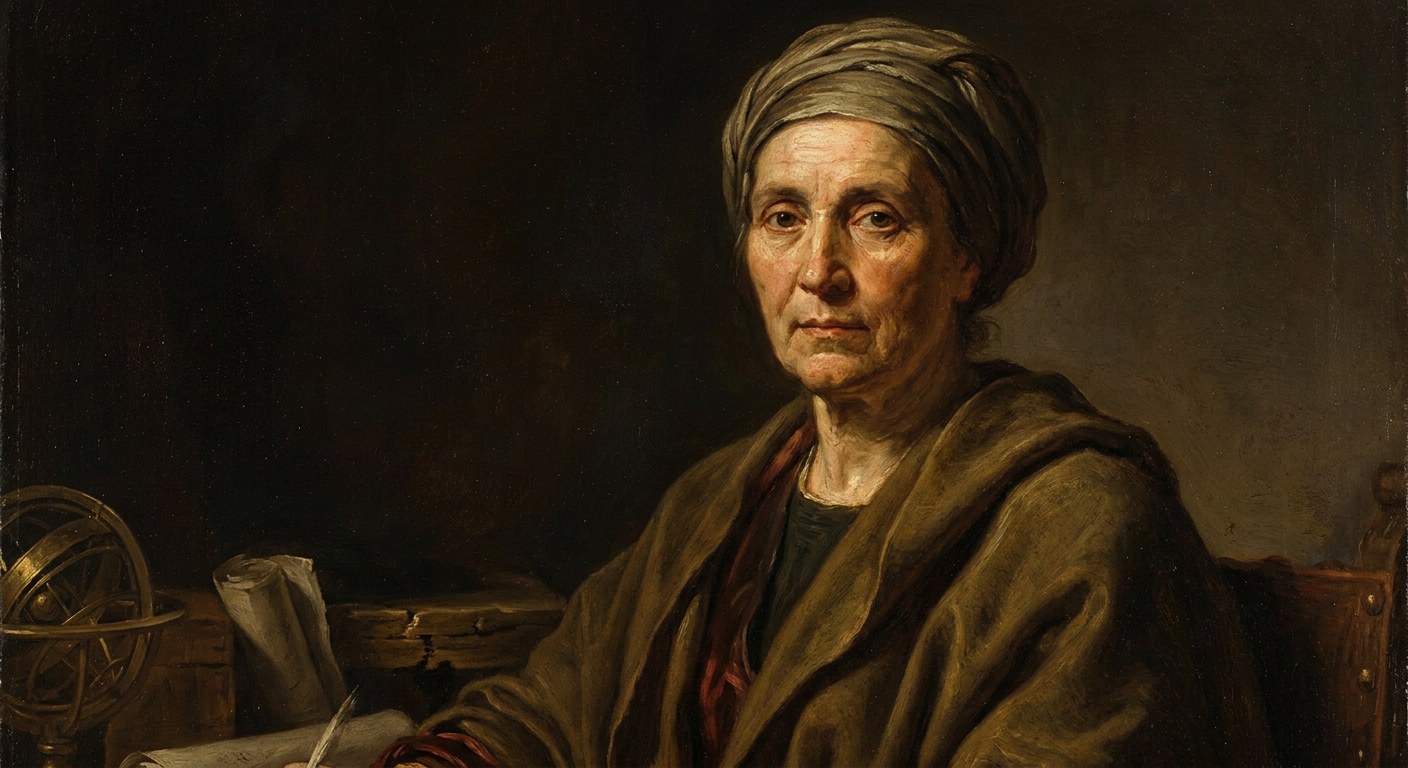
Hypatia
355 – 415 · Greco-Egyptian · Mathematician & Philosopher
Recommended Audiobooks
Listen next from Marcus Alden

Life Lessons from Frederic Chopin
Marcus Alden · 54 min

Life Lessons from John Wesley
Marcus Alden · 52 min
Introduction
Hypatia of Alexandria (c. 355–415 CE) was a mathematician, astronomer, philosopher, and teacher whose life embodied both the intellectual brilliance and the political tensions of the late Roman world. Working in Alexandria, one of antiquity’s greatest centers of scholarship, she became the leading public representative of the city’s Neoplatonic philosophical tradition. Her lectures attracted students from across the eastern Mediterranean, including Christians as well as adherents of traditional Greco-Roman religion.
Hypatia belonged to the final generations of scholars who actively preserved, explained, and taught the mathematical sciences of classical antiquity. Ancient evidence associates her with commentaries or editions concerning Diophantus’s Arithmetica, Apollonius of Perga’s Conics, and astronomical tables derived from the work of Claudius Ptolemy. Although none of her writings survives independently under her name, references in ancient texts and manuscripts indicate that she contributed to the transmission of Greek mathematics and astronomy.
Her fame, however, rests not only on scholarship. In March 415, amid a bitter conflict between Alexandria’s imperial governor, Orestes, and its powerful Christian bishop, Cyril, Hypatia was seized and brutally killed by a Christian mob. Her murder became one of the most notorious episodes of late antiquity. Later generations transformed her into many different symbols: the last champion of classical reason, a pagan martyr, a victim of religious intolerance, a feminist icon, and an emblem of intellectual freedom.
The historical Hypatia was more complex than any single legend. She was neither the last ancient philosopher nor the final scientist of the classical world, and her death did not directly cause the destruction of the Library of Alexandria. She was nevertheless an exceptional woman who achieved unusual public authority in a society dominated by men. Her life illuminates the interaction of philosophy, mathematics, religion, gender, and urban politics during the transformation of the Roman Empire.
Quick Facts
| Category | Details |
|---|---|
| Full name | Hypatia of Alexandria |
| Greek name | Ὑπατία (Hypatía) |
| Born | Probably c. 355 CE; estimates range from c. 350 to 370 |
| Birthplace | Alexandria, Roman Egypt |
| Died | March 415 CE |
| Place of death | Alexandria, Roman Egypt |
| Age at death | Probably about 60, though uncertain |
| Father | Theon of Alexandria, mathematician and astronomer |
| Occupations | Philosopher, mathematician, astronomer, teacher, commentator |
| Philosophical school | Neoplatonism |
| Main fields | Philosophy, geometry, arithmetic, astronomy |
| Works associated with her | Commentaries or editions on Diophantus, Apollonius, and astronomical tables |
| Notable student | Synesius of Cyrene, later bishop of Ptolemais |
| Political connection | Adviser or associate of Orestes, imperial prefect of Egypt |
| Cause of death | Murder by a Christian mob during a political and religious crisis |
| Historical significance | One of the best-known women scholars of the ancient world |
Early Life & Background
Hypatia was born in Alexandria, probably around 355 CE. Her precise birth year is unknown. Modern estimates vary because ancient sources provide no age at her death, and later descriptions are inconsistent. A date near 355 fits the surviving evidence reasonably well, particularly her established reputation by the time Synesius of Cyrene studied with her in the 390s.
Alexandria had been founded by Alexander the Great in 331 BCE and developed under the Ptolemaic dynasty into a major center of commerce and scholarship. Its famous Mouseion and Library had sponsored generations of mathematicians, physicians, geographers, poets, and textual scholars. By Hypatia’s lifetime, the original royal institutions had long since declined or changed form, but Alexandria remained intellectually prestigious. It was also an intensely divided city whose Greek, Egyptian, Jewish, and Christian communities frequently competed for influence.
Hypatia’s father, Theon of Alexandria, was a respected mathematician and astronomer active during the later fourth century. He is often described as the last scholar securely associated with the Alexandrian Mouseion, although the nature of that institution in his era is uncertain. His surviving works include commentaries on Ptolemy’s Almagest and Handy Tables, as well as an edited recension of Euclid’s Elements. Theon’s edition of Euclid became highly influential and helped preserve the text through the medieval period.
Hypatia almost certainly received her initial mathematical and astronomical education from Theon. In a culture in which women rarely gained advanced formal training, her access to a scholarly household was decisive. She learned geometry, arithmetic, astronomy, and the demanding traditions of Greek textual commentary. Such scholarship required more than copying ancient works: commentators clarified arguments, corrected corrupt passages, provided demonstrations, reorganized material, and adapted difficult texts for students.
Later stories portray Theon as deliberately training his daughter’s mind and body to perfection. These accounts are poorly documented and often reflect modern romanticization. What can be said with confidence is that Hypatia acquired an education equal or superior to that of elite male intellectuals and eventually achieved a reputation independent of her father.
The religious character of her upbringing is less clear. She belonged to the Hellenic philosophical tradition and was probably associated culturally with traditional Greco-Roman religion. Yet her mature teaching emphasized a philosophical Neoplatonism capable of attracting Christians. There is no reliable evidence that she was an aggressive opponent of Christianity.
Rise to Prominence
By the late fourth century, Hypatia had emerged as an important teacher in Alexandria. She became the head or leading figure of a philosophical circle sometimes called the Alexandrian Neoplatonic school. This was not necessarily a university with a fixed building and formal bureaucracy. Ancient philosophical instruction often took place through lectures, private seminars, textual interpretation, and personal mentorship.
Hypatia taught the works of Plato and Aristotle alongside mathematics and astronomy. According to the church historian Socrates Scholasticus, writing approximately a decade after her death, she “far surpassed all the philosophers of her own time” and publicly explained philosophical doctrines to those who wished to hear her. His account is especially valuable because he was a relatively near-contemporary Christian author and was not hostile to Hypatia.
Her most famous student was Synesius of Cyrene, a wealthy provincial aristocrat who studied in Alexandria before becoming bishop of Ptolemais in Cyrenaica. Several of his letters to Hypatia survive. They reveal an enduring relationship of intellectual loyalty and affection. Synesius addressed her with extraordinary reverence, calling her his mother, sister, teacher, and benefactress. He sought her advice on philosophical, scientific, and personal matters and asked her to recommend or inspect technical instruments.
Synesius’s correspondence also shows that Hypatia’s students formed a close intellectual community. Membership in this circle carried social prestige, and former pupils remained connected after leaving Alexandria. Some became high-ranking imperial officials or churchmen. Hypatia’s ability to teach Christians such as Synesius demonstrates that the boundaries between pagan and Christian intellectual life were not always rigid.
Her public authority extended beyond the classroom. Ancient sources state that she appeared openly in the city, wearing the philosopher’s cloak, and spoke with magistrates and prominent citizens. Such visibility was unusual for a woman in late Roman society. Philosophers could serve as advisers, moral exemplars, and informal mediators, and Hypatia appears to have fulfilled all three roles.
Her learning, self-possession, and social connections gave her access to Alexandria’s governing elite. Socrates Scholasticus reports that she frequently met public officials and enjoyed the confidence of Orestes, the imperial prefect of Egypt. This civic influence would ultimately place her in danger.
Major Achievements
Hypatia’s most important scholarly achievement was her role in preserving and interpreting difficult works of Greek mathematics and astronomy. Because her writings have been lost, the precise nature of her contributions remains debated.
A late antique notice preserved in the Suda, a tenth-century Byzantine encyclopedia drawing on earlier sources, credits her with writings on Diophantus’s Arithmetica, Apollonius’s Conics, and an “astronomical canon.” The terminology may refer to commentaries, edited texts, teaching editions, or explanatory notes.
Diophantus of Alexandria’s Arithmetica examined algebraic problems involving numerical solutions. Hypatia’s commentary may have clarified Diophantus’s procedures, supplied intermediate steps, or added exercises. Some scholars have suggested that portions of the surviving Greek and Arabic traditions may preserve traces of her editorial work, but no passage can be assigned to her with certainty.
Apollonius of Perga’s Conics was a sophisticated study of the ellipse, parabola, and hyperbola. A commentary by Hypatia would have required advanced mastery of Greek geometry. The fact that such a work was attributed to her is itself evidence of her mathematical standing. The first four books of the Conics survive in Greek, while others survive largely through Arabic translation, but Hypatia’s specific contribution cannot be isolated.
The “astronomical canon” may have been connected with Ptolemy’s Handy Tables, which allowed users to calculate the positions of celestial bodies and other astronomical phenomena. Hypatia may have edited, explained, or updated tables used in astronomical instruction.
A subscription in some manuscripts of Book III of Ptolemy’s Almagest states that Theon’s recension was “reviewed” or “revised” by “the philosopher Hypatia, my daughter.” Scholars disagree over exactly what this wording means. It may indicate that Hypatia checked Theon’s edition, collaborated with him, or prepared a corrected version. Although the evidence does not justify attributing the entire edition to her, it strongly suggests scholarly participation.
Hypatia has also been connected with the construction of an astrolabe and a hydroscope. In one letter, Synesius described or requested assistance concerning a silver planispheric astrolabe, an instrument used to represent the heavens and solve astronomical problems. In another, he asked for a hydroscope, probably a form of hydrometer used to measure the density or specific gravity of liquids. These letters show that Hypatia possessed expertise in the mathematical principles underlying scientific instruments. They do not establish that she invented either device; both had earlier precedents.
Her greatest achievement may have been pedagogical. She maintained a demanding tradition of mathematical and philosophical study while making it accessible to a new generation. Through students who entered imperial and ecclesiastical service, her influence reached well beyond Alexandria.
Defining Moments
One defining moment was Hypatia’s emergence from her father’s scholarly circle as an independent philosopher. Ancient evidence distinguishes her reputation from Theon’s and suggests that she eventually became more celebrated than he was. Her public teaching gave her a rare position among ancient women.
A second was her mentorship of Synesius and other elite students during the 390s. Their later careers demonstrate the reach of her school. Synesius’s letters preserve the clearest personal evidence for her intellectual authority and reveal that Christian students could regard a non-Christian woman as their philosophical guide.
The destruction of the Serapeum in 391 or 392 formed part of the wider setting of her career. After conflict between pagans and Christians, imperial authorization enabled Bishop Theophilus of Alexandria and his supporters to convert or destroy the temple complex. A library or collection of books had once been associated with the Serapeum, but the event was not the destruction of the original Great Library, which had already suffered decline and dispersal. There is no reliable evidence that Hypatia was present at the Serapeum or played a role in its defense.
The most consequential turning point came after Cyril became bishop of Alexandria in 412. Cyril inherited a powerful episcopal office from his uncle Theophilus and soon clashed with Orestes, the imperial prefect. Their conflict concerned jurisdiction, public order, and political authority, though religious divisions intensified it.
Hypatia’s association with Orestes made her vulnerable. A rumor spread that she was preventing a reconciliation between the prefect and the bishop. Whether Cyril personally encouraged this accusation is unknown. In March 415, a mob attacked Hypatia, dragged her to a building identified by Socrates as the Caesareum, killed her, mutilated her body, and burned the remains outside the city. Her murder ended a remarkable scholarly career and became a lasting stain on Alexandrian public life.
Timeline
| Year | Event |
|---|---|
| c. 355 | Hypatia is probably born in Alexandria to the mathematician Theon. |
| c. 370s–380s | She receives advanced training in mathematics, astronomy, philosophy, and textual commentary. |
| 391–392 | The Serapeum is destroyed or converted during religious conflict under Bishop Theophilus; Hypatia’s involvement is not documented. |
| Early 390s | Hypatia is established as a teacher of philosophy and mathematics in Alexandria. |
| c. 393–395 | Synesius of Cyrene probably studies with Hypatia. |
| Late 390s–early 400s | Her school attracts an elite circle of students, including Christians and future officials. |
| c. 400 | Synesius’s correspondence reflects Hypatia’s continuing authority as teacher and scientific adviser. |
| 409–414 | Synesius serves as bishop of Ptolemais while maintaining respect for Hypatia. |
| 412 | Cyril succeeds Theophilus as bishop of Alexandria. |
| 414–415 | Conflict intensifies between Cyril and Orestes, the imperial prefect of Egypt. |
| March 415 | Hypatia is seized and murdered by a Christian mob in Alexandria. |
| c. 425–439 | Socrates Scholasticus writes an influential account condemning her murder. |
| 10th century | The Suda preserves notices about Hypatia’s life and writings. |
| 18th–21st centuries | Hypatia becomes an enduring symbol in debates over reason, religion, gender, and freedom of inquiry. |
Personal Life
Very little reliable information survives about Hypatia’s private life. She apparently never married and had no known children. Ancient sources praise her chastity, a quality admired in several late antique philosophical and Christian traditions. Her unmarried status may also have allowed her greater freedom to teach, maintain intellectual relationships, and participate in civic affairs.
The Suda reports that she remained a virgin and rejected prospective suitors. A more graphic anecdote, derived from a later philosophical tradition associated with Damascius, claims that she discouraged an infatuated student by showing him a menstrual cloth to demonstrate the physical reality behind idealized desire. The story may have been intended as a philosophical lesson about controlling passion and distinguishing bodily attraction from true beauty. Its historical reliability is uncertain.
Synesius’s letters offer a more convincing glimpse of her personality. They portray a teacher who inspired affection, trust, and reverence. Her former pupils sought her judgment even after attaining prominent positions. She appears to have been intellectually exacting but personally supportive.
Hypatia’s public behavior was exceptional. She reportedly wore the philosopher’s cloak and moved confidently among male officials and scholars. Socrates emphasized her dignity and self-command, stating that she appeared before magistrates without embarrassment because her learning earned universal respect.
Claims about her physical appearance are largely speculative. Later writers often described her as beautiful, but such descriptions commonly served literary purposes, combining intellectual excellence with idealized virtue. No contemporary portrait securely identified as Hypatia survives.
Beliefs & Philosophy
Hypatia was a Neoplatonist, a follower of the philosophical tradition developed from Plato and shaped by thinkers such as Plotinus, Porphyry, and later Iamblichus. Neoplatonists held that reality formed an ordered hierarchy ultimately dependent on a supreme first principle, commonly called “the One.” The philosophical life sought purification from distraction and an ascent of the intellect toward unity and truth.
Her version of Neoplatonism appears to have been relatively intellectual, ethical, and inclusive. Unlike some later Neoplatonists who emphasized elaborate ritual practices known as theurgy, Hypatia’s surviving intellectual network seems to have concentrated on mathematical study, moral discipline, contemplation, and the interpretation of Plato and Aristotle. This conclusion remains tentative because her philosophical writings have not survived.
Mathematics had a spiritual as well as practical function within Platonism. Geometry and astronomy trained the mind to move beyond changing sensory objects toward stable, intelligible relationships. For Hypatia, teaching conic sections or planetary calculation may therefore have formed part of a broader philosophical education.
Her school was not defined by militant opposition to Christianity. Synesius was a Christian who became a bishop, yet he continued to honor Hypatia. Other pupils and associates also came from Christian backgrounds. The philosophical language of divine unity, intellect, and the soul could overlap with Christian intellectual traditions, even where theological differences remained.
Hypatia probably participated in elements of traditional Hellenic culture and did not convert to Christianity. Later sources call her a “pagan,” but that broad label can obscure the philosophical character of her identity. She was killed in a city where religious affiliation had political consequences, yet the immediate conflict surrounding her death involved civic power and personal influence as much as doctrine.
No evidence supports the popular portrayal of Hypatia as a modern secular atheist. Nor can she simply be described as a defender of experimental science against all religion. She inhabited a world in which mathematics, philosophy, ethics, and theology were closely interconnected.
Challenges & Controversies
The first major challenge in reconstructing Hypatia’s life is the scarcity of evidence. None of her books survives as an identifiable independent work. Historians rely on manuscript notices, Synesius’s letters, Socrates Scholasticus, the later philosopher Damascius, the Suda, and the seventh-century chronicler John of Nikiu. These sources differ sharply in date, purpose, and reliability.
Her birth year is disputed. Some reconstructions place it around 355, while others prefer a later date near 370. The earlier date makes her an experienced teacher in her thirties or forties when Synesius studied with her and approximately 60 at her death. The later date reflects traditions portraying her as youthful in 415, but those descriptions may be literary.
The nature of her original mathematical contributions is also debated. She was unquestionably learned, but evidence more securely identifies her as a commentator, editor, and teacher than as the discoverer of new theorems. Modern distinctions between “original research” and “commentary” should not be imposed too rigidly: editing, explaining, and extending authoritative texts were central forms of ancient scholarship.
Hypatia’s murder has generated the greatest controversy. Socrates Scholasticus states that a group led by a church reader named Peter attacked her because she was believed to obstruct reconciliation between Cyril and Orestes. He condemned the killing as completely alien to Christianity and wrote that it brought disgrace upon Cyril and the Alexandrian church.
Damascius, writing about a century later, accused Cyril more directly, suggesting that the bishop’s jealousy of Hypatia’s prestige helped cause her death. John of Nikiu, writing much later from a strongly hostile perspective, portrayed her as a magician who deceived Orestes and praised her killers. Modern historians generally consider Socrates the most reliable narrative, while using the later accounts cautiously.
There is no conclusive evidence that Cyril ordered the murder. Nevertheless, the perpetrators belonged to the Christian civic environment over which his episcopate exercised considerable influence, and the campaign of suspicion against Hypatia benefited his position. Cyril therefore cannot be entirely separated from the political and religious climate in which the killing occurred, even if direct responsibility remains unproven.
The murder is sometimes presented as the moment when ancient science died or when the Library of Alexandria was burned. Both claims are inaccurate. The Great Library’s decline occurred over centuries, and Hypatia was not killed inside it. Scientific, mathematical, and philosophical work continued in Alexandria and elsewhere after 415. Her death was still a profound act of political violence against a scholar and a sign of the dangers created by factional conflict.
Famous Quotes
No securely authenticated verbatim statement by Hypatia survives. Many sayings attributed to her online—including “Reserve your right to think” and “Fables should be taught as fables”—come from modern writers or cannot be traced to ancient evidence. The following famous passages are ancient testimonies about her rather than direct quotations from Hypatia.
“There was a woman at Alexandria named Hypatia, daughter of the philosopher Theon, who made such attainments in literature and science as to far surpass all the philosophers of her own time.”
—Socrates Scholasticus, Ecclesiastical History, Book VII, chapter 15, translation wording varies
“On account of the self-possession and ease of manner which she had acquired in consequence of the cultivation of her mind, she not infrequently appeared in public in the presence of the magistrates.”
—Socrates Scholasticus, Ecclesiastical History, VII.15
“My mother, my sister, my teacher, my benefactress in all things and beings, whatever is honored in name and deed.”
—Synesius of Cyrene, addressing Hypatia in a letter; translation wording varies
“Surely nothing can be farther from the spirit of Christianity than the allowance of massacres, fights, and transactions of that sort.”
—Socrates Scholasticus, condemning Hypatia’s murder, Ecclesiastical History, VII.15
Legacy & Influence
Hypatia’s immediate scholarly legacy survived through her students, her collaborations, and the mathematical texts she helped transmit. Even if her exact words disappeared, the works associated with her continued to shape mathematical and astronomical learning in Greek, Syriac, Arabic, and Latin traditions.
Her death also had political consequences. According to later imperial legislation, the activities of Alexandrian clerical groups, particularly the parabalani, came under greater regulation, although their precise role in Hypatia’s murder is uncertain. The killing damaged the reputation of Cyril’s episcopate and was condemned by Christian as well as non-Christian observers.
Hypatia was not the last pagan philosopher. Neoplatonic schools continued in Athens, Alexandria, and other cities, producing figures such as Hierocles, Proclus, Ammonius, Damascius, and Simplicius. Alexandria itself remained a center of learning. Yet her murder acquired symbolic importance because it brought together intellectual distinction, gender, religious division, and political violence.
During the Enlightenment, writers including John Toland and Voltaire used Hypatia’s story to criticize ecclesiastical intolerance. Their accounts often simplified late Roman politics and portrayed her as a purely rational victim of fanatical religion. Christian apologists responded by questioning these interpretations or minimizing Cyril’s responsibility.
In the nineteenth century, Charles Kingsley’s novel Hypatia presented a highly romanticized vision of Alexandria and made her story familiar to a broad English-speaking audience. Later artists depicted her as a beautiful, youthful martyr, despite uncertainty about her age and appearance.
In the twentieth and twenty-first centuries, Hypatia became an important figure in women’s history and the history of science. The academic journal Hypatia: A Journal of Feminist Philosophy, founded in 1986, adopted her name. Scientific projects, educational institutions, and astronomical features have also commemorated her.
The 2009 film Agora, directed by Alejandro Amenábar and starring Rachel Weisz, brought Hypatia to a new global audience. The film effectively dramatized the volatility of late antique Alexandria but took significant liberties, including presenting speculative scientific discoveries and compressing historical events.
Hypatia’s most enduring significance lies in what her life makes visible. She demonstrates that women participated at high levels in ancient intellectual culture, even when social institutions restricted them. She also shows that philosophy and science flourished through teaching, commentary, and community—not only through isolated discoveries. Her death remains a warning about the ease with which rumor, factionalism, and struggles for power can turn a respected intellectual into a political target.
Interesting Facts
- Hypatia is the earliest woman mathematician for whom relatively substantial biographical evidence survives, though earlier women are associated with Pythagorean and other philosophical traditions.
- Her name derives from the Greek hypatos, meaning “highest” or “supreme.”
- Her father, Theon, produced a recension of Euclid’s Elements that became the standard form known to many later readers.
- Hypatia taught both pagan and Christian students.
- Her student Synesius became a Christian bishop without repudiating his former teacher.
- She was associated with an astrolabe but did not invent the instrument; astrolabe-like devices existed centuries earlier.
- The hydroscope mentioned by Synesius was probably used to measure properties of liquids.
- No authenticated portrait of Hypatia survives from antiquity.
- She did not die while defending the Great Library of Alexandria.
- The famous Library was not destroyed in a single event during her lifetime.
- Ancient sources describe her wearing the philosopher’s cloak, a visible sign of professional identity.
- Her murder occurred during Lent in March 415.
- The principal near-contemporary account of her death was written by a Christian historian who strongly condemned the killers.
- Several widely circulated “Hypatia quotes” are modern inventions or misattributions.
- A lunar crater and the asteroid 238 Hypatia are named after her.
Frequently Asked Questions
When and where was Hypatia born?
Hypatia was born in Alexandria in Roman Egypt, probably around 355 CE. Her exact birth date is unknown, and proposed dates range from approximately 350 to 370.
What was Hypatia famous for?
She was famous as a teacher of Neoplatonic philosophy and as an expert in mathematics and astronomy. Ancient evidence associates her with commentaries or editions of works by Diophantus, Apollonius, and Ptolemy.
Did Hypatia invent the astrolabe?
No. Forms of the astrolabe existed before Hypatia. Synesius’s letters show that she understood the instrument and may have advised on its construction or use, but they do not identify her as its inventor.
Did any of Hypatia’s writings survive?
No work survives independently and securely under her name. References to her commentaries and possible traces of her editorial activity remain, but historians cannot reconstruct her writings with certainty.
Was Hypatia a pagan?
She belonged to the Hellenic Neoplatonic tradition and was not known to be Christian. “Pagan” is therefore broadly applicable, but it should not imply that she was an anti-Christian activist. She taught Christians and maintained close relationships with them.
Why was Hypatia murdered?
She was accused of preventing reconciliation between Orestes, the imperial prefect, and Cyril, the bishop of Alexandria. A Christian mob led by a reader named Peter seized and killed her. Her intellectual prestige, non-Christian identity, gender, and political association with Orestes all contributed to her vulnerability.
Did Cyril order Hypatia’s murder?
No surviving evidence proves that Cyril directly ordered it. Socrates Scholasticus did not make that accusation, while Damascius later linked Cyril more directly to jealousy and hostility. Cyril’s responsibility remains debated, though the murder occurred within the highly charged political environment of his episcopate.
How was Hypatia killed?
According to Socrates Scholasticus, the attackers pulled her from her carriage, took her to the Caesareum, stripped and killed her, dismembered or mutilated her body, and burned the remains at a place called Cinaron. Details vary in translation and later retellings.
Was Hypatia the last librarian of Alexandria?
No reliable ancient source identifies her as librarian of the Great Library. The original institution had already declined or disappeared in its classical form. She was a teacher and philosopher working within Alexandria’s continuing scholarly culture.
Was Hypatia the last ancient scientist?
No. Mathematics, astronomy, medicine, and philosophy continued for centuries in the Roman and Byzantine worlds and flourished later in Islamic scholarly traditions. Hypatia’s death was symbolically powerful but did not end ancient science.
How historically accurate is the film Agora?
Agora captures aspects of Alexandria’s religious and political conflict but alters chronology and invents elements of Hypatia’s scientific work. Its portrayal of her investigating heliocentrism and elliptical planetary orbits is not supported by ancient evidence.
Why is Hypatia important today?
She is important as a documented woman scholar, an influential teacher, a contributor to the preservation of Greek mathematics, and a victim of political and sectarian violence. Her story encourages critical discussion about evidence, intellectual freedom, and the representation of women in history.
Lessons from Hypatia
- Education can overcome social barriers: Hypatia achieved authority in fields and public spaces normally dominated by men.
- Teaching is a major form of intellectual achievement: Her influence survived largely through students, commentaries, and scholarly transmission.
- Intellectual communities can cross religious boundaries: Her circle included Christians and non-Christians united by philosophical study.
- Historical evidence requires careful evaluation: Romantic legends about Hypatia should be distinguished from the limited but meaningful ancient record.
- Rumor can become politically lethal: The claim that she obstructed reconciliation helped turn a respected teacher into a target.
- Scholarship is vulnerable when absorbed into factional conflict: Hypatia’s civic connections exposed her to struggles that were not merely academic or theological.
- Preservation matters as much as discovery: By editing and explaining earlier texts, scholars such as Hypatia helped carry ancient knowledge into later eras.
- Complex figures should not be reduced to symbols: Hypatia was more than either a pagan martyr or a modern secular scientist.
- Religious history is not a simple conflict between faith and reason: Christians studied with Hypatia, and a Christian historian provided the strongest ancient condemnation of her murder.
- Intellectual freedom depends on civic restraint: Learning cannot flourish where political rivalry permits intimidation and mob violence.
Further Reading
- Maria Dzielska, Hypatia of Alexandria.
- Edward J. Watts, Hypatia: The Life and Legend of an Ancient Philosopher.
- Michael A. B. Deakin, Hypatia of Alexandria: Mathematician and Martyr.
- Alan Cameron, Jacqueline Long, and Lee Sherry, Barbarians and Politics at the Court of Arcadius.
- Edward J. Watts, City and School in Late Antique Athens and Alexandria.
- Socrates Scholasticus, Ecclesiastical History, Book VII, chapter 15.
- Synesius of Cyrene, Letters, especially the letters addressed to Hypatia.
- Damascius, The Philosophical History, surviving fragments.
- John of Nikiu, Chronicle, for a later and hostile Christian account.
- The Suda, entry on Hypatia, for Byzantine preservation of earlier biographical traditions.
- A. C. Bowen, “Theon of Alexandria,” studies concerning late antique mathematical astronomy.
- Charles Kingsley, Hypatia—valuable for the history of Hypatia’s modern image, but not as a reliable biography.