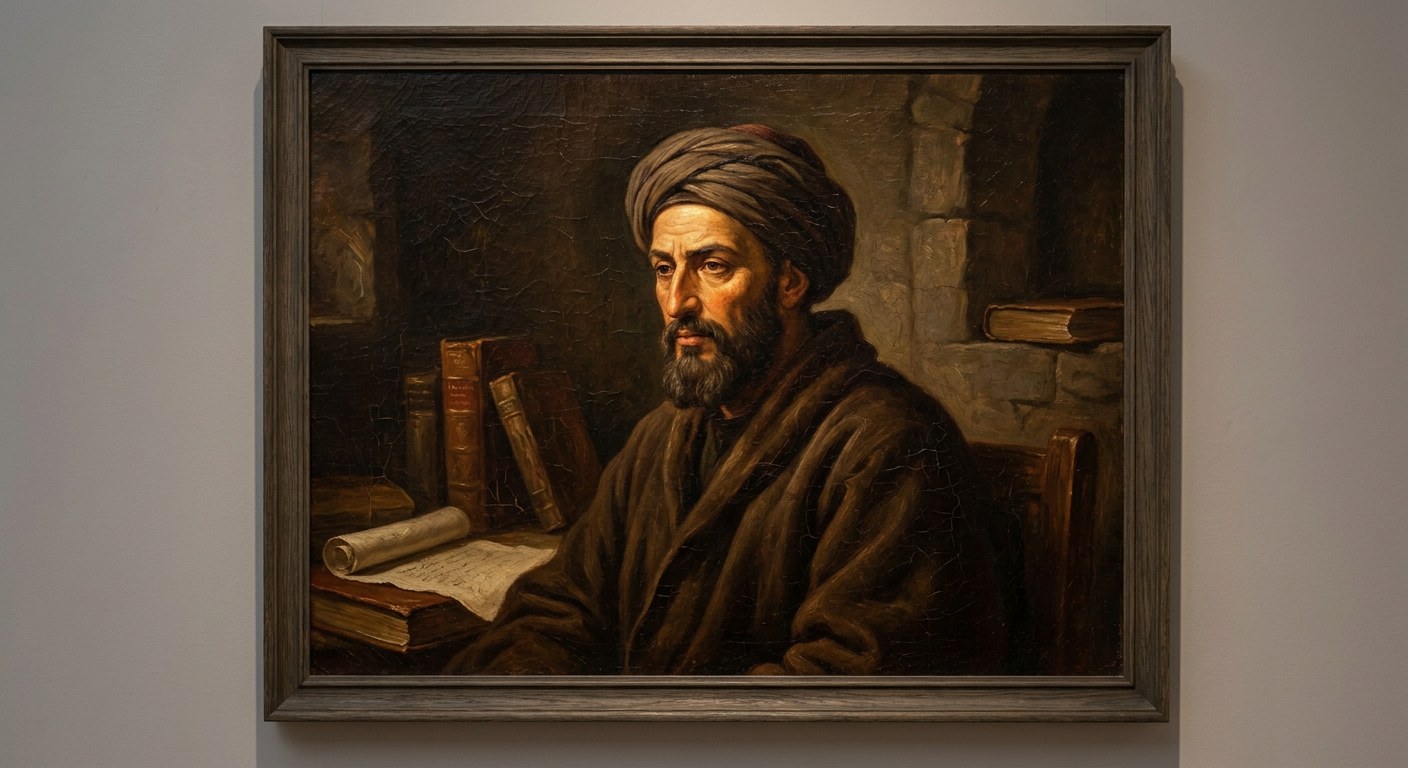
Quick Facts
- Years
- 1332 – 1406
- Nationality
- Tunisian Arab
- Occupation
- Historian, Philosopher & Statesman
Ibn Khaldun
1332 – 1406 · Tunisian Arab · Historian, Philosopher & Statesman
Recommended Audiobooks
Listen next from Marcus Alden

Life Lessons from Frederic Chopin
Marcus Alden · 54 min

Life Lessons from John Wesley
Marcus Alden · 52 min
Introduction
Ibn Khaldun was a North African historian, jurist, political adviser, educator, and social theorist whose analysis of civilization made him one of the most original thinkers of the medieval world. His full name was Wali al-Din Abd al-Rahman ibn Muhammad ibn Muhammad ibn Khaldun al-Hadrami. He is best known for the Muqaddimah, or Prolegomena, the remarkable introduction to his universal history, Kitab al-Ibar.
Writing in the fourteenth century, Ibn Khaldun asked questions that remain central to history, sociology, economics, and political science. Why do states rise and fall? What binds communities together? Why do ruling dynasties lose their strength? How do taxation, labor, geography, education, and culture shape society? Most importantly, how can historians distinguish credible reports from exaggeration, propaganda, and myth?
His answer was to develop what he called the science of human social organization, or ilm al-umran al-bashari. Historical reports, he argued, should not be accepted merely because earlier authorities had transmitted them. They had to be tested against what was possible within the economic, political, geographical, and social conditions of a particular age.
Ibn Khaldun’s insights grew out of an exceptionally turbulent life. He served competing rulers in Tunis, Fez, Granada, Béjaïa, and Cairo; was imprisoned for political intrigue; lived among tribal communities; lost family members in a shipwreck; served repeatedly as a senior judge; and personally negotiated with the conqueror Timur outside Damascus. His experiences gave him direct knowledge of courts, bureaucracies, tribal alliances, warfare, education, and the instability of dynastic government.
Modern descriptions of Ibn Khaldun as the father of sociology, economics, or the philosophy of history can be illuminating, but they must be used carefully. He did not work within modern academic disciplines, and his thought remained rooted in Islamic jurisprudence, theology, philosophy, and medieval historical writing. Nevertheless, his effort to discover general patterns in social and political life gives him an enduring place in global intellectual history.
Quick Facts
| Category | Details |
|---|---|
| Born | 27 May 1332 in Tunis, Hafsid Sultanate |
| Died | 17 March 1406 in Cairo, Mamluk Sultanate |
| Nationality | Commonly described as Tunisian or North African Arab; nationality in the modern sense did not exist in his era |
| Known For | The Muqaddimah, the theory of asabiyyah, critical historiography, and analysis of dynastic cycles |
| Occupation | Historian, jurist, judge, statesman, diplomat, teacher, and political theorist |
| Era | Late medieval Islamic world, particularly the fourteenth-century Maghreb and Mamluk Egypt |
Early Life and Education
Ibn Khaldun was born in Tunis on 27 May 1332, corresponding to 1 Ramadan 732 AH. His family was learned, politically experienced, and conscious of a distinguished Andalusian heritage. The Khaldun family had lived for generations in Seville, where some of its members held public office under Muslim rulers. As Christian kingdoms expanded through the Iberian Peninsula, the family left al-Andalus and eventually settled in North Africa.
The family claimed descent from an Arab ancestor associated with Hadramawt in southern Arabia. Medieval genealogical claims often reinforced social standing, and modern historians cannot independently verify every link in the lineage. What is clear is that Ibn Khaldun inherited both an Andalusian cultural identity and close familiarity with scholarship and government.
His father, Muhammad, withdrew from active politics and devoted himself largely to learning. Ibn Khaldun consequently received the education expected of a young man from an elite scholarly family. He memorized the Quran, studied Arabic grammar and literature, learned traditions concerning the Prophet Muhammad, and trained in Maliki jurisprudence, the dominant Sunni legal school of North Africa.
His teachers also introduced him to logic, mathematics, philosophy, and the rational sciences. Among the most important was Muhammad ibn Ibrahim al-Abili, a philosopher and mathematician who exposed him to sophisticated traditions of logical inquiry. This combination of religious learning, legal reasoning, literature, and philosophy later helped Ibn Khaldun move between several intellectual worlds.
His youth coincided with severe political and demographic upheaval. North Africa was divided among competing dynasties, including the Hafsids in Tunis, the Marinids in Morocco, and the Zayyanids of Tlemcen. Rulers depended on unstable coalitions of officials, urban elites, soldiers, and tribal groups. Courts could offer rapid advancement, but allegiance to a defeated prince could lead just as quickly to exile or prison.
An even greater catastrophe arrived with the Black Death. The plague reached Tunis in 1348 and 1349, killing Ibn Khaldun’s parents and many of his teachers. He was still a teenager. The epidemic devastated urban populations, disrupted education and administration, and contributed to the instability that marked his world. In his later history, Ibn Khaldun described the plague as a civilizational disaster that emptied cities and transformed the inhabited world.
The loss of his family and mentors ended the protected phase of his youth. Rather than continue solely as a scholar, he entered government service, beginning a career that would combine intellectual work with political risk.
Rise to Prominence
Around 1352, Ibn Khaldun received his first court appointment in Tunis. He served as sahib al-alamah, an official responsible for writing the formal introductory formula and signature mark on state documents. The post was not among the highest in government, but it gave the young scholar access to court life and administrative practice.
He soon became dissatisfied with his prospects in Tunis and moved westward. In Fez, the Marinid sultan Abu Inan Faris gathered scholars and administrators at a culturally ambitious court. Ibn Khaldun entered royal service and gained access to an impressive intellectual circle. Yet Marinid politics were dangerous. Accused of participating in a conspiracy involving a displaced Hafsid prince, he was imprisoned in 1357. Abu Inan’s death in 1358 brought his release.
Over the following years, Ibn Khaldun became deeply involved in the shifting alliances of the Maghreb. He supported ministers, princes, and rival claimants when he believed they could advance his interests or restore political order. His intelligence, education, and ability to communicate with tribal leaders made him useful, but his willingness to change patrons also created enemies.
In 1362 he traveled to Granada, the capital of the last major Muslim state in Iberia. There he was welcomed by the Nasrid ruler Muhammad V and by the celebrated writer and vizier Ibn al-Khatib. Ibn Khaldun had previously helped Muhammad V during the ruler’s exile in North Africa, and the restored sultan treated him favorably.
In 1363 Muhammad V sent Ibn Khaldun as an ambassador to King Pedro I of Castile in Seville. The mission carried personal significance because Seville had been the home of Ibn Khaldun’s ancestors. According to Ibn Khaldun’s own account, Pedro offered to restore his family’s former estates if he would remain in Castile. He declined and returned to Granada after completing his diplomatic assignment.
His position there did not last. Tension developed between Ibn Khaldun and Ibn al-Khatib, possibly because each feared the other’s influence over the sultan. Ibn Khaldun returned to North Africa and accepted high office in Béjaïa, also known as Bougie, under the Hafsid prince Abu Abdallah Muhammad. He became hajib, a position with substantial administrative authority, and also lectured on jurisprudence.
When Abu Abdallah was killed in 1366, Ibn Khaldun again had to maneuver among rival rulers. He served or negotiated with several North African powers and often acted as an intermediary with Arab and Berber tribes. These experiences were crucial to his later analysis. He saw that rulers based in cities could not govern effectively without military solidarity, fiscal resources, and cooperation from groups beyond the court.
Major Achievements and Contributions
Ibn Khaldun’s greatest achievement was the creation of a systematic framework for explaining human society and historical change. He did not treat history simply as a succession of rulers, battles, and dates. He sought to identify the social mechanisms that made such events possible.
A critical method for history
Medieval historians often relied heavily on chains of transmission and the authority of earlier writers. Ibn Khaldun respected transmitted knowledge but argued that sound attribution alone was insufficient. Reports could still be impossible because narrators misunderstood conditions, exaggerated numbers, flattered rulers, promoted sectarian interests, or repeated attractive stories without examining them.
Historians therefore needed knowledge of social organization. A report about an enormous army, for example, should be compared with the population, wealth, food supply, transportation, and administrative capacity of the state said to have raised it. Historical criticism required both evaluation of sources and understanding of how societies functioned.
The science of civilization
Ibn Khaldun called his field ilm al-umran, the science of human social organization or civilization. Its subjects included political authority, economic production, crafts, cities, rural and pastoral life, education, religion, taxation, and the transmission of culture.
He maintained that human beings require cooperation because individuals cannot produce everything needed for survival or defend themselves alone. Social organization is therefore necessary. Yet cooperation also creates conflict and injustice, making restraining authority essential. Political power develops from this interaction between dependence, solidarity, competition, and coercion.
Asabiyyah and group solidarity
His most famous concept is asabiyyah. It is often translated as group feeling, social cohesion, collective solidarity, or esprit de corps. No single English expression captures its full meaning.
Ibn Khaldun believed that communities capable of mutual defense and sacrifice possess political strength. Kinship can reinforce asabiyyah, but alliances, client relationships, shared hardship, and religious commitment can also expand it. Groups accustomed to difficult conditions often develop stronger cohesion than wealthy urban populations whose defense has been delegated to soldiers and rulers.
Strong asabiyyah enables an ambitious group to conquer territory and establish a dynasty. Once successful, however, rulers centralize authority, weaken potential rivals, accumulate wealth, and adopt luxurious habits. Later generations inherit power without the discipline that created it. The dynasty becomes dependent on paid troops, officials, and heavy taxation, while its original solidarity declines.
Dynastic cycles
Ibn Khaldun’s model of political history is often described as cyclical. A vigorous group from outside or at the edge of settled civilization conquers a weakened state. Its first leaders retain courage and collective discipline. Their descendants enjoy greater security and refinement, but over several generations the ruling house becomes isolated, extravagant, and fiscally burdensome. Eventually another cohesive group replaces it.
He sometimes presented this process as unfolding across roughly three generations, though he did not claim that every dynasty followed an inflexible timetable. His theory was a pattern derived particularly from the political history of North Africa and the wider Islamic world, not a mechanical law applicable without qualification to all societies.
Economic thought
Ibn Khaldun gave labor a central role in production and prosperity. Human work, specialized skills, trade, demand, and cooperation allow cities to generate wealth beyond the level of mere subsistence. Larger populations can support more specialized crafts, which in turn increase productivity and refinement.
He also examined the relationship between government and economic life. Secure property, predictable administration, and moderate taxation encourage people to produce and trade. Arbitrary confiscation destroys incentives and undermines confidence. When rulers expand their expenses and impose heavier assessments, economic activity may contract, ultimately reducing revenue.
This discussion is sometimes presented as an anticipation of modern supply-side economics or the Laffer curve. The comparison can be suggestive, but Ibn Khaldun was not offering a modern mathematical model. His argument belonged to a broader moral and political analysis of dynastic decline, injustice, and state finance.
Geography, environment, and culture
Ibn Khaldun explored how geography, climate, food, and ways of earning a living affected human communities. He contrasted pastoral or nomadic life with settled urban civilization, although his categories were more complex than a simple opposition between desert and city. He understood that different environments encouraged different political and economic structures.
Some of his environmental arguments relied on inherited medieval geography and climatic theories that are scientifically obsolete. Nevertheless, his attempt to relate culture to material and ecological conditions was important. He generally looked for social and historical explanations rather than attributing every difference to unchanging human nature.
Education and knowledge
As a teacher, Ibn Khaldun criticized harsh instruction, excessive memorization, and methods that overloaded beginners with advanced details. He advocated gradual teaching, repetition at increasing levels of complexity, and attention to the learner’s developing capacity. Cruel treatment, he argued, could produce dishonesty, passivity, and loss of initiative.
Key Works / Battles / Ideas
The Muqaddimah
The Muqaddimah, completed in its first form in 1377, is Ibn Khaldun’s masterpiece. Its title means introduction, but it grew into an independent inquiry into historical knowledge and civilization. The work discusses the nature of society, political authority, tribal and urban life, dynasties, economic activity, education, science, and the writing of history.
The book’s originality lies not in any single observation but in the way Ibn Khaldun organized many observations into a causal framework. Politics depended on solidarity; state power affected taxation and production; prosperity encouraged urban culture; luxury weakened ruling houses; and reliable history required understanding all these relationships.
Kitab al-Ibar
The Muqaddimah formed the opening portion of Kitab al-Ibar, whose extended title may be translated as the Book of Lessons and Record of Beginnings and Events in the History of the Arabs, Persians, Berbers, and Their Powerful Contemporaries. The multivolume history covered universal history but was especially valuable for the history of North Africa and the Berber peoples.
Ibn Khaldun combined written sources with information gathered through political service and direct contact with rulers and tribal communities. Modern historians do not accept every detail uncritically, but the work preserves indispensable material about medieval Maghrebi society.
The Autobiography
Ibn Khaldun also wrote an autobiography, commonly known as the Ta'rif. It records his ancestry, education, travels, appointments, political activities, and meeting with Timur. It is among the fullest intellectual autobiographies to survive from the medieval Islamic world.
The work is an essential source, but it is also an act of self-presentation. Ibn Khaldun naturally emphasized his learning, diplomatic importance, and reasons for changing allegiance. Historians compare it with other evidence rather than treating it as completely neutral testimony.
Encounter with Timur
Ibn Khaldun’s most dramatic personal encounter occurred during Timur’s siege of Damascus in 1401. Ibn Khaldun had accompanied the Mamluk sultan al-Nasir Faraj’s expedition from Egypt. When the sultan returned urgently to Cairo, Ibn Khaldun remained in besieged Damascus.
Seeking negotiations, he was lowered from the city wall by ropes and taken to Timur. The two men met several times. Timur questioned him about North Africa, political conditions, and geography, while Ibn Khaldun presented written information and gifts. Ibn Khaldun’s account combines caution, observation, and calculated flattery. He secured permission to return to Egypt, leaving one of history’s most remarkable records of an intellectual confronting a world conqueror.
Timeline of Key Events
| Year | Event |
|---|---|
| 1332 | Born in Tunis into a scholarly family of Andalusian origin |
| 1348–1349 | Loses his parents and several teachers during the Black Death |
| c. 1352 | Enters Hafsid government service in Tunis |
| 1354 | Moves to Fez and joins the Marinid court of Abu Inan |
| 1357 | Imprisoned after being accused of involvement in political conspiracy |
| 1358 | Released following Abu Inan’s death |
| 1362 | Travels to Granada and enters the court of Muhammad V |
| 1363 | Serves as ambassador to Pedro I of Castile in Seville |
| 1365 | Becomes a high official in Béjaïa under Abu Abdallah Muhammad |
| 1375 | Withdraws to Qalat Ibn Salama in present-day Algeria |
| 1377 | Completes the first version of the Muqaddimah |
| 1378 | Returns to Tunis to consult libraries and continue his history |
| 1382 | Leaves North Africa and settles in Cairo |
| 1384 | Appointed Maliki chief judge; members of his family later perish at sea while attempting to join him |
| 1387 | Performs the pilgrimage to Mecca |
| 1401 | Meets Timur during the siege of Damascus |
| 1406 | Dies in Cairo on 17 March |
Personal Life and Character
Information about Ibn Khaldun’s private household is limited. He married and had children, but the names and lives of most family members are poorly documented. A devastating personal tragedy occurred after he settled in Egypt. His family attempted to join him by sea, but their vessel was wrecked, killing his wife and children or, according to cautious interpretations of the evidence, at least several close members of his household.
His autobiography reveals a man of exceptional confidence. Ibn Khaldun believed strongly in his intellectual abilities and in the originality of his historical method. He was ambitious, politically alert, and skilled at cultivating powerful patrons. He could also be defensive when explaining changes of allegiance or conflicts with colleagues.
His career shows courage and adaptability. He survived imprisonment, revolutions, epidemics, travel through unstable territories, and repeated changes of regime. His willingness to negotiate with tribal leaders and meet Timur demonstrates both personal nerve and diplomatic calculation.
Contemporaries and later biographers also remembered him as a demanding jurist. In Cairo, he attempted to enforce legal standards strictly and resist patronage networks. This earned respect but also hostility. His repeated appointments and dismissals as Maliki chief judge suggest that he could be principled and formidable, but not always politically accommodating.
Challenges and Controversies
Ibn Khaldun’s political career was marked by frequent shifts of loyalty. Critics have portrayed him as an opportunist who moved between rival courts whenever circumstances changed. There is some basis for this judgment: he participated actively in political schemes and repeatedly sought influential office. Yet the Maghreb of his time offered few stable loyalties. Dynasties fragmented, rulers were overthrown, and officials often had to negotiate rapidly changing conditions merely to survive.
His judicial career in Cairo was equally unsettled. He was appointed Maliki chief judge several times and removed almost as often. His strict decisions and efforts to reform judicial practice antagonized established interests. At the same time, his manner may have contributed to the resistance he encountered.
Some passages in the Muqaddimah contain derogatory generalizations about sub-Saharan African peoples and repeat assumptions drawn from medieval climatic and geographical theory. These statements are rightly criticized. Scholars also note that other parts of his work explain human variation through environment, political organization, and modes of livelihood rather than a fixed biological hierarchy. That complexity provides context but does not erase the prejudice in particular passages.
Modern claims that Ibn Khaldun single-handedly invented sociology, economics, or modern historiography can also distort his achievement. His work had precedents in Greek philosophy, Islamic jurisprudence, political advice literature, geography, and earlier Muslim historical writing. He should not be detached from those traditions or turned into a modern social scientist before his time.
Conversely, limiting him to the role of a traditional chronicler understates his originality. The most accurate view recognizes him as a medieval Islamic thinker who created an unusually systematic and comparative science of society, one that can enter into productive conversation with later disciplines without being identical to them.
Death and Immediate Aftermath
Ibn Khaldun spent his final years in Cairo teaching, revising his works, and serving intermittently as Maliki chief judge. He died on 17 March 1406, or 26 Ramadan 808 AH, at approximately seventy-three years of age by the solar calendar.
He was buried in a Sufi cemetery outside Bab al-Nasr, one of Cairo’s northern gates. The precise location of his grave was later lost. His death did not create an immediate intellectual movement devoted to his social theory. His historical writings circulated, and later scholars read and copied them, but the analytical originality of the Muqaddimah was not always the aspect most emphasized.
Ottoman historians and statesmen later found his ideas about dynastic development and political decline useful. Broader international recognition accelerated in the nineteenth century, when European orientalists edited, translated, and debated his work. That rediscovery eventually established Ibn Khaldun as a major figure in accounts of global historical and social thought.
Legacy and Influence Today
Ibn Khaldun is now studied across the world in history, sociology, political science, economics, philosophy, Islamic studies, and education. His concept of asabiyyah continues to inform discussions of state formation, nationalism, military cohesion, tribal politics, social capital, and collective identity.
Historians value his insistence that reports be tested against social reality. His method anticipated a central principle of modern historical scholarship: sources must be evaluated not only for who transmitted them but also for motive, context, plausibility, and material possibility.
Political theorists continue to examine his account of how successful ruling groups lose cohesion. His descriptions of administrative expansion, elite luxury, fiscal pressure, and dependence on professional soldiers have been compared with theories of imperial overextension and state decline. Such comparisons are most useful when they preserve the historical specificity of his ideas.
Economists cite his discussions of labor, specialization, markets, taxation, property, and incentives. He understood that prosperity depends on cooperation, security, productive activity, and confidence that rulers will not seize the fruits of labor arbitrarily. Although he did not establish modern economics, his work is an important landmark in the global history of economic thought.
In education, his warnings against harsh discipline and premature complexity still sound strikingly contemporary. He recognized that learning is cumulative and that humiliation can damage curiosity and independent judgment.
Ibn Khaldun also has symbolic importance in the modern Arab and Muslim worlds. Universities, research centers, streets, prizes, and public institutions bear his name. Tunisia honors him as one of the most celebrated figures born in the region, while scholars across North Africa emphasize the Maghrebi and Andalusian settings that shaped his outlook.
His greatest legacy is methodological. Ibn Khaldun challenged readers to look beneath events and identify the structures that connect power, solidarity, production, culture, and knowledge. He demonstrated that history could be more than memory or moral storytelling: it could become a disciplined investigation of how human societies work.
Famous Quotes
Translations of Ibn Khaldun vary. The following genuine passages are commonly rendered from the Muqaddimah, particularly through Franz Rosenthal’s English translation.
“The past resembles the future more than one drop of water another.”
“Social organization is necessary to the human species.”
“Government is an institution which prevents injustice other than such as it commits itself.”
“Man is a child of the customs and the things he has become used to. He is not the product of his natural disposition and temperament.”
“At the beginning of a dynasty, taxation yields a large revenue from small assessments. At the end of the dynasty, taxation yields a small revenue from large assessments.”
“Injustice ruins civilization.”
“Sedentary culture is the goal of civilization.”
“The craft of history is a craft dear to the nations and races.”
Frequently Asked Questions
Who was Ibn Khaldun?
Ibn Khaldun was a fourteenth-century North African historian, Maliki jurist, statesman, diplomat, judge, and social theorist. He was born in Tunis, worked across the Maghreb and Islamic Spain, and spent his later career in Mamluk Cairo.
Why is Ibn Khaldun called the father of sociology?
He is sometimes given that title because he studied society systematically and proposed general explanations for social cohesion, political authority, economic production, and historical change. The label is retrospective, however. Ibn Khaldun called his discipline the science of civilization, not sociology, and worked in a medieval Islamic intellectual context.
What is the Muqaddimah?
The Muqaddimah is the extensive introduction to Ibn Khaldun’s universal history, Kitab al-Ibar. It presents his method of historical criticism and his theories concerning civilization, government, asabiyyah, economics, education, and the rise and decline of dynasties.
What does asabiyyah mean?
Asabiyyah refers to the solidarity or group feeling that enables people to cooperate, defend one another, and seek political power. Kinship can strengthen it, but shared religion, alliances, common hardship, and collective purpose can also create or enlarge it.
What did Ibn Khaldun believe caused empires to fall?
He argued that ruling groups often lose the solidarity and discipline that brought them to power. Luxury, political centralization, fiscal pressure, dependence on paid troops, and the exclusion of former allies weaken the dynasty until a more cohesive rival can replace it.
Did Ibn Khaldun invent economics?
No. Economic reflection existed long before him in many civilizations. Ibn Khaldun nevertheless made important contributions by analyzing labor, specialization, trade, taxation, property, incentives, public expenditure, and the economic consequences of government injustice.
Did Ibn Khaldun meet Timur?
Yes. During Timur’s siege of Damascus in 1401, Ibn Khaldun left the city and met the conqueror several times. They discussed North Africa, politics, geography, and history. Ibn Khaldun later recorded the encounter in his autobiography.
Where is Ibn Khaldun buried?
He was buried in a Sufi cemetery outside Bab al-Nasr in Cairo. The exact location of his grave was subsequently lost.
Lessons We Can Learn
-
Test information against reality. A claim should not be accepted simply because it is old, popular, or repeated by respected authorities. Evidence must be compared with social, economic, and material conditions.
-
Social cohesion is a form of power. Wealth and institutions matter, but communities also depend on trust, cooperation, and willingness to pursue shared goals.
-
Success can create the causes of decline. Prosperity may encourage complacency, excessive spending, isolation, and loss of the discipline that originally produced success.
-
Government and economic life are interconnected. Security and fair administration encourage productive activity, while arbitrary confiscation and excessive fiscal pressure weaken both society and the state.
-
Serious thought can grow from practical experience. Ibn Khaldun’s theories were shaped not only by books but also by diplomacy, imprisonment, political failure, travel, teaching, and direct observation of different communities.
Further Reading
- Ibn Khaldun, The Muqaddimah: An Introduction to History, translated by Franz Rosenthal and abridged by N. J. Dawood.
- Robert Irwin, Ibn Khaldun: An Intellectual Biography.
- Allen James Fromherz, Ibn Khaldun: Life and Times.
- Aziz Al-Azmeh, Ibn Khaldun: An Essay in Reinterpretation.
- Walter J. Fischel, Ibn Khaldun in Egypt: His Public Functions and His Historical Research.
Watch and Learn
What Is Sociology?: Crash Course Sociology #1 · CrashCourse