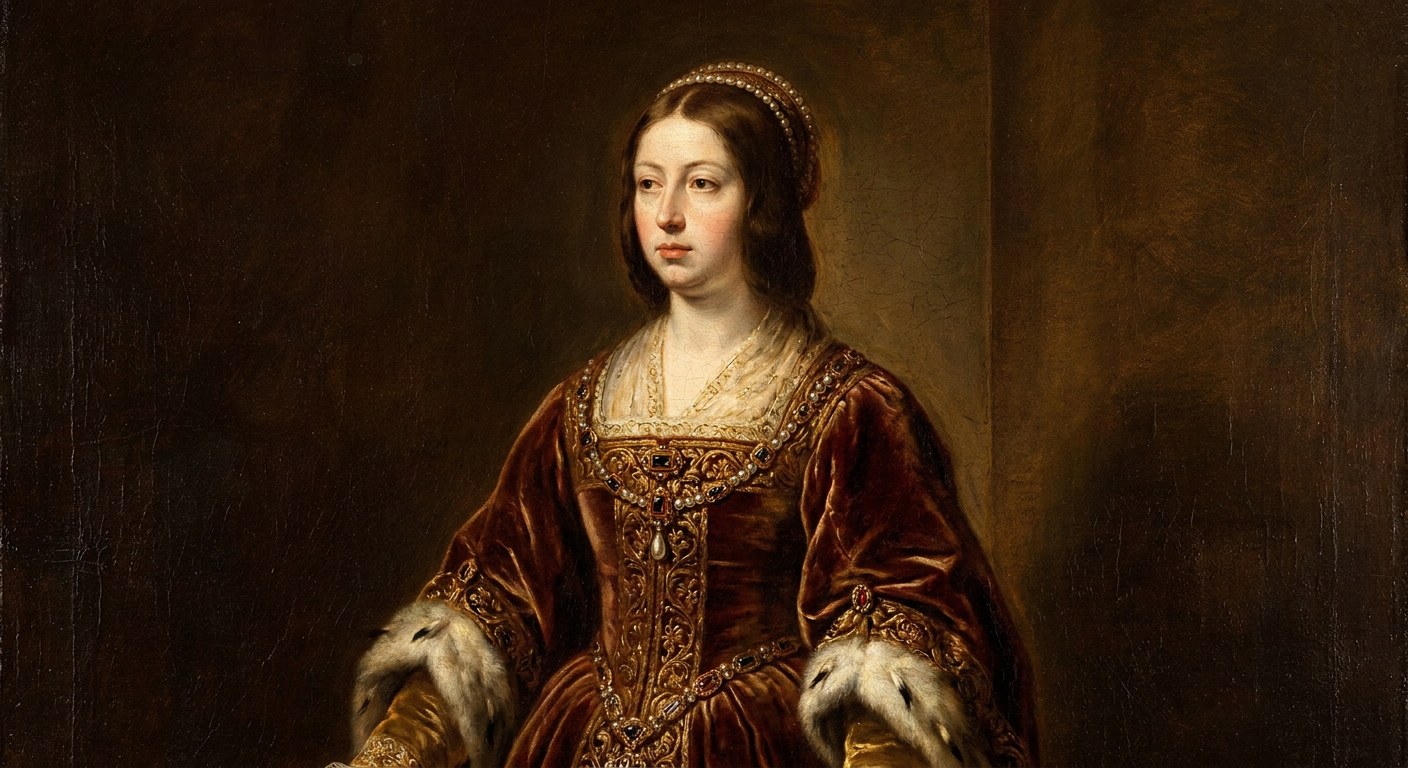
Isabella I of Castile
1451 – 1504 · Castilian · Queen of Castile
Recommended Audiobooks
Listen next from Marcus Alden

Life Lessons from Frederic Chopin
Marcus Alden · 54 min

Life Lessons from John Wesley
Marcus Alden · 52 min
Introduction
Isabella I of Castile (22 April 1451–26 November 1504) was one of the most consequential monarchs of late medieval Europe. Queen of Castile and León from 1474 until her death, she ruled jointly with her husband, Ferdinand II of Aragon, in a dynastic partnership that transformed the political landscape of the Iberian Peninsula. Known collectively as the Catholic Monarchs—a title granted by Pope Alexander VI in 1496—Isabella and Ferdinand strengthened royal government, completed the conquest of the Nasrid kingdom of Granada, sponsored Christopher Columbus’s first Atlantic voyage, and laid foundations for the global Spanish monarchy of the sixteenth century.
Her reign combined formidable political ability with militant religious conviction. Isabella overcame a disputed succession, civil war, resistance from powerful nobles, and the institutional limits imposed on a woman exercising sovereign authority. She reorganized aspects of Castilian administration, improved the monarchy’s finances, expanded mechanisms of royal justice, and used marriage diplomacy to connect her dynasty with Portugal, England, Burgundy, and the Habsburg world.
Yet Isabella’s legacy is inseparable from policies that caused profound suffering. She and Ferdinand established the Spanish Inquisition under royal control, ordered the expulsion of practicing Jews from their kingdoms in 1492, and pursued religious uniformity through coercion. The conquest of Granada ended centuries of Muslim sovereignty in Iberia and was followed by increasing pressure on Muslims to convert. Her sponsorship of Columbus initiated permanent contact between Europe and the Americas, with immense global consequences that included conquest, colonization, disease, forced labor, and the destruction of Indigenous societies.
Isabella was neither the sole creator of modern Spain nor merely Ferdinand’s consort. She was Castile’s hereditary sovereign and an active decision-maker whose choices shaped Europe, Africa, the Atlantic world, and the Americas. Her life therefore demands both recognition of her political achievements and close examination of the human costs of her program of dynastic expansion and Christian uniformity.
Quick Facts
| Category | Details |
|---|---|
| Full name | Isabella of Trastámara |
| Common title | Isabella I of Castile |
| Born | 22 April 1451 |
| Birthplace | Madrigal de las Altas Torres, Kingdom of Castile |
| Died | 26 November 1504, aged 53 |
| Place of death | Medina del Campo, Castile |
| Reign | 13 December 1474–26 November 1504 |
| Coronation/proclamation | Proclaimed queen at Segovia on 13 December 1474 |
| Dynasty | House of Trastámara |
| Father | John II of Castile |
| Mother | Isabella of Portugal |
| Half-brother | Henry IV of Castile |
| Brother | Alfonso of Castile |
| Husband | Ferdinand II of Aragon, married 19 October 1469 |
| Children who survived infancy | Isabella, John, Joanna, Maria, and Catherine |
| Major title | Queen of Castile and León |
| Joint dynastic title | The Catholic Monarchs |
| Principal residences | Segovia, Valladolid, Toledo, Seville, Granada, and Medina del Campo |
| Burial place | Royal Chapel of Granada |
| Best known for | Union with Ferdinand, conquest of Granada, support for Columbus, administrative reform, the Inquisition, and the expulsion of the Jews |
| Successor in Castile | Joanna I, with Philip of Burgundy recognized as king-consort |
Early Life & Background
Isabella was born on 22 April 1451 at Madrigal de las Altas Torres, in present-day Ávila province. Her father, John II of Castile, belonged to the Trastámara dynasty. Her mother, Isabella of Portugal, was the king’s second wife. Isabella had an older half-brother, Henry, from John II’s first marriage, and a younger full brother, Alfonso, born in 1453.
When John II died in 1454, Henry became Henry IV of Castile. The young Isabella and Alfonso initially lived with their widowed mother at Arévalo. Their household experienced financial insecurity, while their mother’s mental health deteriorated. Although later representations sometimes portrayed Isabella’s childhood as one of extreme poverty, she remained a royal princess with attendants and an education appropriate to her rank. She learned Castilian literature, religion, music, courtly conduct, and practical dynastic politics. As an adult, she studied Latin more seriously and supported humanist learning.
Henry IV eventually brought Isabella and Alfonso to court, partly to keep them under supervision. Castile was then troubled by factional conflict. Powerful aristocratic families competed for offices, estates, and influence, while the king’s authority was repeatedly challenged. Henry’s marriage to Joan of Portugal produced a daughter, Joanna, born in 1462. Opponents alleged that Joanna was not Henry’s biological child and derisively called her la Beltraneja, implying that her father was the royal favorite Beltrán de la Cueva. The accusation was politically useful but never proved.
In 1465, rebel nobles symbolically deposed Henry in the theatrical “Farce of Ávila” and proclaimed Alfonso king. Isabella did not initially place herself at the center of the rebellion. Alfonso’s sudden death in July 1468, probably from disease, made her the chief alternative to Joanna.
Rather than immediately claiming the crown, Isabella negotiated with Henry. Under the Agreement of the Bulls of Guisando, reached in September 1468, Henry recognized Isabella as Princess of Asturias and presumptive heir. In return, she acknowledged him as lawful king and agreed not to marry without his consent, although Henry was also expected not to force her into marriage against her will.
Marriage was a matter of international strategy. Candidates included Afonso V of Portugal, a French prince, and Ferdinand, heir to the Crown of Aragon. Isabella chose Ferdinand. Because they were second cousins, a papal dispensation was required. They married at Valladolid on 19 October 1469, relying on a document presented as a dispensation from the deceased Pope Pius II; its authenticity has long been doubted. A valid dispensation was later issued by Pope Sixtus IV.
Henry regarded the marriage as a breach of their agreement and restored Joanna’s claim. Isabella’s choice nevertheless proved decisive. Ferdinand brought military experience and Aragonese connections, while Isabella possessed the stronger direct claim to Castile. Their marriage created a partnership but did not legally merge their kingdoms.
Rise to Prominence
Henry IV died in Madrid on 11 December 1474. Two days later Isabella had herself proclaimed queen in Segovia. She appeared with the symbols of sovereignty and emphasized that she inherited Castile in her own right. Ferdinand was absent when the proclamation took place, and tensions soon arose over the distribution of authority.
The Concord of Segovia, concluded on 15 January 1475, established the terms of their joint government. Official documents and coinage bore both names, and Ferdinand received broad powers in Castile. Isabella, however, remained the kingdom’s hereditary sovereign and the ultimate source of Castilian legitimacy. Their motto, “Tanto monta”, came to represent their partnership, though it originally referred more specifically to Ferdinand’s emblem of the Gordian knot.
Isabella’s accession triggered the War of the Castilian Succession. Joanna’s supporters argued that she was Henry IV’s legitimate daughter and rightful heir. Her uncle and prospective husband, Afonso V of Portugal, invaded Castile in 1475 and married Joanna, though papal approval for the union was problematic.
The conflict was both a civil war and an international struggle. Isabella and Ferdinand won support from towns, sections of the nobility, and the clergy. The Battle of Toro on 1 March 1476 was militarily indecisive, but Ferdinand successfully presented it as a political victory. Portuguese forces withdrew, and Joanna’s Castilian support weakened.
At the Cortes of Madrigal in 1476, Isabella’s position was consolidated. The monarchy expanded the Santa Hermandad, a federation of municipal militias used to police roads, suppress private warfare, and strengthen order. This was not an entirely new institution, but Isabella and Ferdinand organized it on a wider scale and placed it in royal service.
The succession war formally ended with the Treaty of Alcáçovas in 1479. Afonso V renounced his claim to Castile, while Joanna eventually entered the convent of Santa Clara at Coimbra. Castile recognized Portuguese predominance along much of the African Atlantic, except for the Canary Islands, which remained under Castilian control.
Also in 1479, Ferdinand succeeded his father as king of Aragon. From that point, Castile and the territories of the Crown of Aragon shared monarchs. They retained separate laws, institutions, currencies, taxes, and political traditions. The union was dynastic rather than a centralized national merger, but it created a durable concentration of power.
Major Achievements
One of Isabella’s central objectives was the restoration of effective royal authority after decades of instability. She and Ferdinand traveled extensively, heard petitions, convened representative assemblies, and intervened in local disputes. Their government made greater use of trained jurists—often drawn from the lesser nobility or urban elites—rather than relying exclusively on the highest aristocracy.
The Royal Council of Castile was reorganized at the Cortes of Toledo in 1480. Grandees retained prestige, but legally educated officials assumed a larger role in daily administration. The crown reviewed grants of lands and revenues made during Henry IV’s reign, recovering some resources while negotiating compromises with influential nobles. The monarchs did not destroy aristocratic power; instead, they disciplined, incorporated, and frequently cooperated with it.
Isabella also promoted the use of corregidores, royal officials sent to supervise municipal government. Their increasing presence extended royal influence into Castilian towns. Financial management improved, and the monarchy’s income grew, although the Granada war and court expenses remained substantial.
Her most celebrated military achievement was the conquest of Granada, the last Muslim-ruled kingdom in Iberia. Castilian attacks had occurred for centuries, but the final war began in 1482. Isabella played an important logistical and political role, helping secure funds, supplies, artillery, medical services, and noble participation. She visited campaign areas and maintained the coalition supporting the war.
The conflict proceeded through sieges and negotiated capitulations. Ronda fell in 1485, Málaga in 1487, Baza in 1489, and Granada itself capitulated in late 1491. On 2 January 1492, Muhammad XII—known in Spanish tradition as Boabdil—surrendered the city to the Catholic Monarchs. The capitulation terms initially guaranteed Granada’s Muslims religious practice, property, legal customs, and protection.
Isabella also encouraged education and religious reform. She supported scholars such as Antonio de Nebrija, whose Grammar of the Castilian Language appeared in 1492, and fostered learning among women at court. She educated her daughters to an unusually high standard for royal women, preparing them to act as queens and diplomatic partners abroad.
Her international marriage strategy was remarkably influential. Her children married into the ruling houses of Portugal, England, and Burgundy-Habsburg Europe. These alliances helped make her grandson Charles V ruler of a vast composite monarchy.
Isabella’s sponsorship of Columbus’s expedition was another world-changing act. After years of negotiation, the monarchs and Columbus signed the Capitulations of Santa Fe on 17 April 1492. Columbus sailed from Palos de la Frontera on 3 August and reached the Caribbean in October. Although he believed he had approached Asia, the voyage opened sustained European contact with the Americas.
The papal bulls of 1493 and the Treaty of Tordesillas of 1494 attempted to divide overseas spheres between Castile and Portugal. These agreements ignored the sovereignty of the peoples already living in the lands concerned, but they shaped the early geopolitics of European imperial expansion.
Defining Moments
Isabella’s secretive marriage to Ferdinand in 1469 was her first great act of independent statecraft. By rejecting Henry IV’s preferred candidates, she risked losing her recognized place in the succession. The decision nevertheless gave her a capable political and military partner and connected Castile with Aragon.
Her proclamation at Segovia in 1474 was equally defining. As a woman claiming sovereign authority, Isabella carefully presented herself as Castile’s legitimate hereditary ruler. She did not rule simply as Ferdinand’s wife; Ferdinand exercised authority in Castile because of their settlement and marriage to its queen.
The War of the Castilian Succession tested whether that claim could survive. Isabella traveled, negotiated, raised funds, and cultivated supporters. Victory enabled her to govern from a position of greater strength and gave the monarchy an opportunity to restructure royal institutions.
The fall of Granada in 1492 represented the culmination of her crusading ambitions. To Christian contemporaries, it was a triumph celebrated across Europe. For Granada’s Muslims, it marked the end of Muslim sovereignty and the beginning of a period in which negotiated protections gradually gave way to coercive conversion, repression, and eventual expulsion.
The year 1492 also exposed the harsher side of Isabella’s religious program. On 31 March, she and Ferdinand issued the Alhambra Decree, ordering Jews in their realms to accept baptism or leave by the end of July. Many departed for Portugal, North Africa, Italy, the Ottoman Empire, and other destinations; others converted under severe pressure. Those baptized became subject to scrutiny as conversos, especially by the Inquisition.
Columbus’s voyage that same year gave 1492 an enduring global significance. Isabella supported additional expeditions and Castilian colonization. She sometimes objected to the enslavement of Indigenous people whom she regarded as free vassals of the crown and ordered certain captives returned. Yet she also authorized enslavement in specified circumstances, supported conversion and imperial dominion, and approved systems that contributed to coercive labor and colonial exploitation.
A final defining period involved dynastic tragedy. Isabella’s only son, John, Prince of Asturias, died in 1497. Her eldest daughter Isabella died in 1498, and that daughter’s infant son, Miguel da Paz, died in 1500. The succession therefore passed to Isabella’s daughter Joanna, whose marriage to Philip of Burgundy brought Castile toward Habsburg rule.
Timeline
| Year | Event |
|---|---|
| 1451 | Isabella is born at Madrigal de las Altas Torres on 22 April. |
| 1453 | Her younger brother Alfonso is born. |
| 1454 | John II dies; Isabella’s half-brother becomes Henry IV of Castile. |
| 1462 | Henry IV’s daughter Joanna is born. |
| 1465 | Rebel nobles proclaim Alfonso king during the Farce of Ávila. |
| 1468 | Alfonso dies; Henry recognizes Isabella as heir under the Agreement of the Bulls of Guisando. |
| 1469 | Isabella marries Ferdinand of Aragon at Valladolid on 19 October. |
| 1470 | Isabella’s first surviving child, Isabella, is born. |
| 1474 | Henry IV dies; Isabella is proclaimed queen at Segovia on 13 December. |
| 1475 | The Concord of Segovia regulates joint rule; the succession war intensifies. |
| 1476 | Battle of Toro; the Santa Hermandad is strengthened at the Cortes of Madrigal. |
| 1478 | Pope Sixtus IV authorizes an inquisition under royal nomination in Castile. |
| 1479 | Treaty of Alcáçovas ends the succession war; Ferdinand becomes king of Aragon. |
| 1480 | Royal Council is reorganized at Toledo; first inquisitors are appointed to Seville. |
| 1481 | First major executions associated with the Spanish Inquisition take place at Seville. |
| 1482 | Final war against Nasrid Granada begins. |
| 1483 | Tomás de Torquemada becomes inquisitor-general. |
| 1487 | Málaga falls to Castilian-Aragonese forces. |
| 1489 | Baza capitulates. |
| 1491 | Granada agrees to surrender under negotiated capitulations. |
| 1492 | Granada falls; Jews are ordered to convert or leave; Nebrija publishes his grammar; Columbus reaches the Caribbean. |
| 1493 | Columbus returns and departs on his second voyage; papal bulls address overseas claims. |
| 1494 | Treaty of Tordesillas divides claimed overseas spheres between Castile and Portugal. |
| 1496 | Pope Alexander VI grants Isabella and Ferdinand the title “Catholic Monarchs.” |
| 1497 | Prince John dies; Castilian forces occupy Melilla in North Africa. |
| 1498 | Isabella’s eldest daughter dies in childbirth. |
| 1500 | Miguel da Paz, Isabella’s grandson and dynastic heir, dies. |
| 1501–1502 | Granada’s Muslims are compelled to convert or leave the Crown of Castile. |
| 1503 | The Casa de Contratación is established at Seville to regulate Atlantic commerce. |
| 1504 | Isabella dies at Medina del Campo on 26 November. |
Personal Life
Isabella and Ferdinand’s marriage was both personal and political. They spent long periods together on campaign and in government, but Ferdinand’s duties in Aragon and Italy sometimes separated them. Ferdinand had extramarital relationships and illegitimate children. Surviving correspondence nevertheless suggests mutual trust, practical cooperation, and affection, even when political disagreements arose.
They had several children, five of whom survived infancy:
- Isabella of Aragon married first Afonso, Prince of Portugal, and later King Manuel I of Portugal.
- John, Prince of Asturias, married Margaret of Austria but died in 1497 without a surviving child.
- Joanna of Castile, later called Joanna the Mad, married Philip the Handsome of Burgundy and inherited Castile.
- Maria of Aragon married Manuel I of Portugal after her sister’s death.
- Catherine of Aragon married Arthur, Prince of Wales, and later Henry VIII of England.
Isabella took a close interest in her children’s education and marriages. Catherine’s later refusal to accept the annulment of her marriage to Henry VIII reflected, in part, the dynastic pride and religious conviction instilled by her mother.
The queen maintained a mobile court. She favored relatively sober clothing by royal standards in some contexts but understood the political value of ceremony, display, tapestries, jewelry, and elaborate religious observance. She collected books and works of art, supported musicians, and employed educated women, including the humanist Beatriz Galindo, known as La Latina.
Years of warfare, travel, childbirth, and family bereavement affected Isabella’s health. By 1504 she suffered from fever and dropsy, a historical term for severe fluid retention. She died at the royal palace in Medina del Campo on 26 November 1504. Her remains were eventually placed beside Ferdinand’s in the Royal Chapel of Granada.
Beliefs & Philosophy
Isabella understood monarchy as a divinely sanctioned responsibility. She believed that a ruler was obligated to administer justice, defend the Church, maintain public order, and protect the legitimate rights of the crown. Her style of kingship was active and itinerant: rulers were expected to appear before their subjects, receive petitions, and correct abuses.
Her Catholic faith was intense and personal. She attended Mass frequently, observed devotional practices, supported monasteries, and promoted reform among clergy and religious orders. Influenced by figures such as Cardinal Francisco Jiménez de Cisneros, she favored stricter discipline and education within the Church.
Her concern for justice was genuine but bounded by late medieval hierarchies and religious assumptions. She could intervene against official abuses and declare Indigenous inhabitants of the Americas to be free royal subjects. At the same time, she viewed Christian conversion as an essential political and spiritual goal and accepted coercive policies against religious minorities.
Isabella’s political philosophy was therefore not one of modern tolerance. She increasingly equated unity of faith with public order and dynastic stability. This conviction underpinned both her support for ecclesiastical reform and her participation in persecution.
She also believed strongly in the legitimacy of female hereditary rule. Although she operated within a patriarchal society, she did not treat her sex as disqualifying. She used traditional images of queenship—piety, motherhood, intercession—alongside unmistakable symbols of sovereign power.
Challenges & Controversies
The Spanish Inquisition is among the gravest controversies of Isabella’s reign. Pope Sixtus IV authorized Isabella and Ferdinand in 1478 to nominate inquisitors in Castile. The first tribunal began operating in Seville in 1480. Its initial focus was on baptized Christians suspected of secretly practicing Judaism, not on unbaptized Jews as such.
Inquisitorial procedures included secret testimony, confiscation of property, imprisonment, coercive interrogation, torture in some cases, public penance, and execution by secular authorities. Estimates of deaths during Isabella’s reign vary, and older claims of enormous totals are not supported by modern scholarship. Nonetheless, thousands were investigated or punished, communities were terrorized, and significant numbers were executed. The institution’s royal character gave the monarchy a powerful mechanism of religious and social control.
The expulsion of the Jews in 1492 was another destructive policy. Jewish communities had lived in Iberia for centuries and contributed to commerce, medicine, scholarship, administration, and cultural life. The Alhambra Decree accused Jews of encouraging converts to return to Judaism. Its remedy—conversion or exile—uprooted tens of thousands of people and inflicted financial, emotional, and cultural devastation. The decree remained formally in force until Spain revoked it in 1968.
The conquest of Granada also produced broken promises. The original capitulations offered substantial protection to Muslim inhabitants. Relations deteriorated, especially after Cisneros pursued aggressive conversion policies around 1499. Revolts followed, and by 1502 Muslims in the Crown of Castile were required to convert or leave. These policies created the population later known as the Moriscos.
Isabella’s American legacy is similarly complex. She objected on several occasions to Columbus’s enslavement of Indigenous people and insisted that many were her free vassals. Her 1504 codicil instructed her successors to ensure that the inhabitants of the Indies were treated well and not harmed in person or property.
These statements did not amount to opposition to colonialism. Isabella asserted Castilian sovereignty over inhabited lands without Indigenous consent, promoted conversion, and permitted exceptions under which captives could be enslaved. During her reign, forced labor, tribute demands, warfare, and settlement began to devastate Caribbean communities. Her protections were inconsistently enforced and operated within an imperial system that exposed Indigenous peoples to exploitation.
Some older nationalist histories credited Isabella and Ferdinand with “unifying Spain.” This is an oversimplification. Their marriage joined dynasties, but Castile and the Crown of Aragon remained legally distinct. Portugal remained independent, and the annexation of most of Navarre occurred only after Isabella’s death. Their reign was a crucial stage in the formation of the Spanish monarchy, not the completion of a modern unified nation-state.
Famous Quotes
Many sayings attributed to Isabella were recorded later or survive only in translated and modernized form. They should therefore be treated cautiously.
“I am the queen of Castile, and this city is mine.”
This saying is traditionally associated with Isabella’s forceful assertion of authority, but its exact wording and context are uncertain.
“Do not allow the Indians, inhabitants and dwellers in the said Indies and mainland, gained or to be gained, to receive any injury in their persons or goods.”
This is a translated and shortened rendering of the humanitarian instruction in Isabella’s 1504 codicil. It expressed a real concern, although colonial practices under her authority often contradicted it.
“There is no doubt that one must believe what the Holy Mother Church believes and holds.”
This sentiment, preserved in accounts of her religious outlook, reflects Isabella’s commitment to Catholic orthodoxy, though English versions vary.
“I shall assume the undertaking for my own Crown of Castile.”
Frequently linked to Columbus’s voyage, this quotation appears in later retellings rather than secure contemporary documentation.
The popular story that Isabella declared she would pawn her jewels to finance Columbus is also unsupported. Her jewels had previously been pledged during the Granada war, and the expedition was funded through a combination of royal, institutional, and private resources.
Legacy & Influence
Isabella left Castile stronger, wealthier, and more effectively governed than she had found it. Her reforms did not create an absolute monarchy, but they expanded royal supervision of justice, municipalities, taxation, and the Church. She demonstrated that the crown could discipline aristocratic competition while preserving noble cooperation.
Her dynastic policies had extraordinary consequences. Through Joanna, Isabella became the grandmother of Charles V, Holy Roman Emperor and king of Spain, and Ferdinand I, later Holy Roman Emperor. Through Catherine of Aragon, she became the grandmother of Mary I of England. Her descendants occupied thrones across Europe.
The conquest of Granada altered the religious and political geography of Iberia. The city became a symbol of Christian triumph and the chosen burial place of the Catholic Monarchs. Yet the conquest also inaugurated a prolonged assault on Muslim religious life and contributed to the later forced conversion and expulsion of the Moriscos.
Columbus’s voyages transformed world history. They initiated sustained exchanges of crops, animals, diseases, populations, and technologies across the Atlantic—the process known as the Columbian Exchange. They also helped create a Spanish imperial system that brought enormous wealth and power to Europe while subjecting Indigenous peoples to conquest, demographic catastrophe, forced labor, and cultural disruption.
Isabella’s religious policies influenced Spain’s identity for centuries. The Inquisition became a durable institution, while the expulsions and coerced conversions narrowed the peninsula’s religious diversity. These actions remain central to modern reassessments of her reign.
Her historical reputation has shifted repeatedly. Catholic and Spanish nationalist traditions often portrayed her as a saintly founder of national unity. Liberal, Jewish, Muslim, Indigenous, and postcolonial interpretations have emphasized persecution and imperial violence. A cause for her Catholic beatification was opened in the twentieth century, but her treatment of Jews, Muslims, and Indigenous peoples has generated substantial opposition.
The most balanced assessment recognizes Isabella as an exceptionally capable ruler whose achievements cannot be separated from coercion. She strengthened government, won a contested crown, managed a powerful political partnership, and reshaped international affairs. She also used that power to impose religious conformity and launch an imperial expansion with devastating consequences.
Interesting Facts
- Isabella was Castile’s sovereign in her own right; Ferdinand was not the original hereditary claimant to the Castilian crown.
- Her marriage to Ferdinand did not immediately create the modern state of Spain.
- She studied Latin as an adult with the scholar Beatriz Galindo.
- Antonio de Nebrija dedicated his 1492 Castilian grammar to Isabella.
- The queen traveled extensively rather than ruling from a permanent capital.
- Isabella helped organize field hospitals during the Granada campaigns, sometimes associated with the term Queen’s Hospital.
- The familiar title “Catholic Monarchs” was granted several years after the conquest of Granada.
- Columbus did not prove that the world was round; educated Europeans already knew the Earth was spherical.
- Isabella did not simply sell or pawn her jewels to finance Columbus’s first voyage.
- Her only son, John, died at nineteen, transforming the European succession.
- Her daughter Catherine became the first wife of Henry VIII of England.
- Isabella’s granddaughter was Mary I of England, while her grandson Charles V ruled territories across Europe and the Americas.
- Isabella requested a relatively plain Franciscan burial habit, despite the grandeur later associated with her tomb.
- The Royal Chapel at Granada contains the tombs of Isabella and Ferdinand, although their remains are held in a crypt below.
- Her will sought to prevent royal estates from passing out of the crown and addressed the treatment of Castile’s new overseas subjects.
Frequently Asked Questions
Why was Isabella I important?
Isabella secured the Castilian throne after a civil war, strengthened royal government, completed the conquest of Granada, supported Columbus’s Atlantic expedition, and created an influential dynastic alliance with Aragon. Her reign helped prepare the rise of Spain as a major European and global power.
Did Isabella and Ferdinand create Spain?
Not in the modern centralized sense. Their marriage established a dynastic union between Castile and the Crown of Aragon, but each retained its own institutions, laws, taxes, and political identity. The development of a unified Spanish state was a gradual process extending well beyond their reigns.
Did Isabella personally finance Christopher Columbus?
She authorized and supported his expedition, but the famous story that she pawned her jewels is almost certainly legendary. Financing came from royal revenues and other contributors, including officials and private participants.
Why did Isabella expel the Jews?
Isabella and Ferdinand argued that Jewish communities encouraged baptized converts to continue practicing Judaism. Seeking religious uniformity, they ordered Jews to convert or leave in 1492. The policy reflected anti-Jewish prejudice and caused mass displacement, dispossession, coerced conversion, and lasting cultural loss.
Did Isabella establish the Spanish Inquisition?
She and Ferdinand requested and implemented the royal-controlled Inquisition authorized by Pope Sixtus IV in 1478. Earlier medieval inquisitions had existed elsewhere, but the Spanish institution developed distinctive ties to royal authority.
Was Isabella tolerant toward Muslims after Granada’s surrender?
The 1491 capitulations initially guaranteed Muslim religious and legal rights. Those protections were progressively undermined. Aggressive conversion campaigns, revolt, and royal decrees culminated in the 1502 requirement that Muslims in Castile convert or leave.
Did Isabella oppose Indigenous slavery?
She opposed some instances of enslavement and declared many Indigenous Americans to be free subjects of the crown. However, she permitted slavery under certain classifications and supported conquest, conversion, tribute, and colonization. Her interventions did not prevent widespread exploitation.
Who succeeded Isabella?
Her daughter Joanna I of Castile inherited the crown. Joanna’s husband, Philip of Burgundy, sought political control, while Ferdinand later resumed authority as regent. Joanna’s son Charles eventually became king of Castile and Aragon.
Why was Joanna called “the Mad”?
Joanna displayed severe emotional and psychological distress, particularly after her husband’s death. Her father, husband, and son also had political reasons to portray her as incapable of ruling. Modern historians cannot diagnose her confidently and debate how much her reputation reflected genuine illness versus political manipulation.
Where is Isabella buried?
She is buried in the Royal Chapel of Granada beside Ferdinand. Their daughter Joanna and son-in-law Philip the Handsome are also interred there.
Lessons from Isabella I of Castile
- Legitimacy must be actively maintained: Isabella combined hereditary claims with negotiation, ceremony, military success, and coalition-building.
- Political partnerships require defined authority: The Concord of Segovia helped manage the potentially dangerous overlap between Isabella’s sovereignty and Ferdinand’s power.
- Institutions often matter more than dramatic victories: Councils, courts, municipal officials, finances, and administrative routines gave the monarchy lasting influence.
- Education can strengthen leadership: Isabella’s patronage of scholarship and the education of her daughters enhanced their diplomatic and political capabilities.
- Dynastic decisions can have global consequences: Her children’s marriages reshaped European succession and helped create the Habsburg monarchy.
- Religious conviction can inspire reform and justify persecution: Isabella’s faith motivated charitable and educational activity but also coercion, expulsion, and inquisitorial violence.
- Protective declarations are ineffective without enforcement: Her instructions concerning Indigenous peoples did not prevent exploitation within the colonial system she sponsored.
- National myths require scrutiny: Simplified stories about Spanish unity, Columbus, royal jewels, and religious triumph obscure a more complicated past.
- Effective leadership is not the same as ethical leadership: Isabella’s political skill was exceptional, but ability does not erase responsibility for harmful policies.
- Historical legacies can be both creative and catastrophic: The same reign strengthened institutions and learning while facilitating persecution, conquest, and empire.
Further Reading
- J. H. Elliott, Imperial Spain, 1469–1716.
- Peggy K. Liss, Isabel the Queen: Life and Times.
- Giles Tremlett, Isabella of Castile: Europe’s First Great Queen.
- John Edwards, Isabella: Catholic Queen and Spanish Monarch.
- Tarsicio de Azcona, Isabel la Católica: Estudio crítico de su vida y su reinado.
- Henry Kamen, The Spanish Inquisition: A Historical Revision.
- Joseph Pérez, The Spanish Inquisition: A History.
- L. P. Harvey, Islamic Spain, 1250 to 1500.
- David Nirenberg, Communities of Violence: Persecution of Minorities in the Middle Ages.
- Felipe Fernández-Armesto, Columbus.
- Hugh Thomas, Rivers of Gold: The Rise of the Spanish Empire.
- William D. Phillips Jr. and Carla Rahn Phillips, The Worlds of Christopher Columbus.
- Documents collected in The Book of Privileges Issued to Christopher Columbus, edited and translated by Helen Nader.
- Isabella’s testament and codicil of 1504, available in scholarly Spanish editions and archival collections.