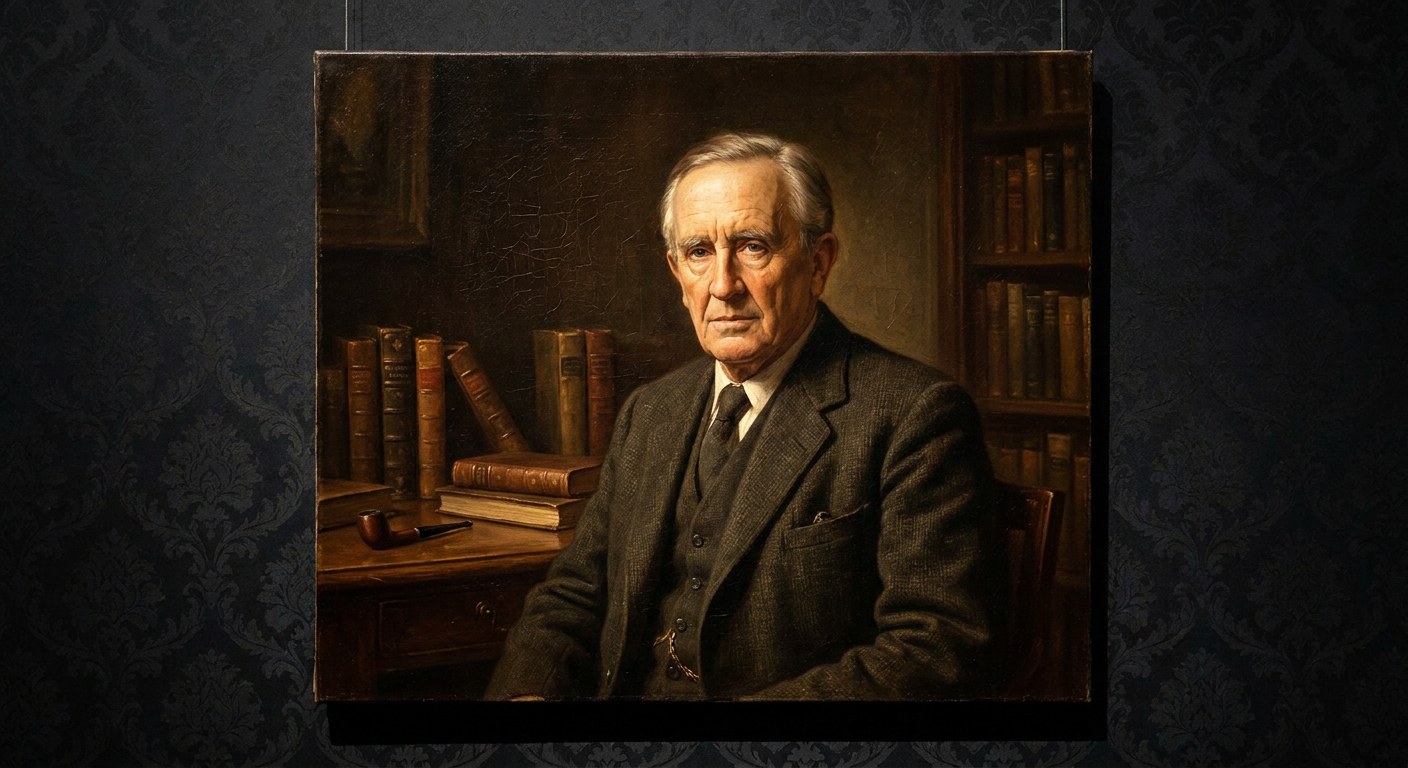
J. R. R. Tolkien
1892 – 1973 · British · Novelist, Poet & Philologist
Recommended Audiobooks
Listen next from Marcus Alden

Life Lessons from Frederic Chopin
Marcus Alden · 54 min

Life Lessons from John Wesley
Marcus Alden · 52 min
Introduction (Why He Matters)
John Ronald Reuel Tolkien—better known as J. R. R. Tolkien—was a British writer, poet, university professor, and philologist whose stories transformed modern fantasy literature. As the author of The Hobbit and The Lord of the Rings, he created Middle-earth, an imagined world distinguished by its immense historical depth, invented languages, interrelated mythologies, and carefully constructed geography. His work provided a model for generations of fantasy novelists and helped establish fantasy as a major field of modern publishing and popular culture.
Tolkien was not simply a novelist who decorated his stories with invented words. He was a professional scholar of language and medieval literature. His knowledge of Old English, Middle English, Old Norse, Gothic, Welsh, Finnish, and other languages shaped the names, poetry, legends, and peoples of his fictional world. Indeed, Tolkien sometimes suggested that his stories grew out of his linguistic inventions: he developed languages and then imagined the histories, migrations, conflicts, and cultures that could have produced them.
His experiences also influenced his fiction. Orphaned at a young age, he developed a powerful attachment to friendship, family, faith, and the English countryside. As a British Army officer during the First World War, he served on the Somme and lost several close friends. Although he rejected simple biographical interpretations of his books, his writing repeatedly explores comradeship, courage, grief, mortality, environmental destruction, and the corrupting desire for power.
Tolkien’s achievement extended beyond fiction. His influential scholarship on Beowulf helped change how academics interpreted that poem, while his essay “On Fairy-Stories” offered a sophisticated defense of fantasy as a serious literary mode. After his death, the publication of The Silmarillion and many volumes edited by his son Christopher revealed the extraordinary scale of the mythology behind his famous novels.
Few twentieth-century authors have exercised such broad influence. Tolkien’s works have inspired novels, films, games, music, visual art, academic scholarship, fan communities, and invented-language studies around the world. He is widely regarded as one of the principal architects of modern high fantasy.
Quick Facts
| Fact | Details |
|---|---|
| Born | 3 January 1892, Bloemfontein, Orange Free State, southern Africa |
| Died | 2 September 1973, Bournemouth, England |
| Nationality | British |
| Known For | The Hobbit, The Lord of the Rings, The Silmarillion, and the creation of Middle-earth |
| Occupation | Writer, poet, philologist, university professor, and translator |
| Era | Twentieth century |
Early Life and Education
John Ronald Reuel Tolkien was born on 3 January 1892 in Bloemfontein, then part of the Orange Free State in southern Africa. His father, Arthur Reuel Tolkien, was an English bank manager, and his mother, Mabel Suffield Tolkien, came from a Birmingham family. Tolkien had one younger brother, Hilary Arthur Reuel Tolkien, born in 1894.
The climate did not suit Mabel or her elder son, and in 1895 she took Ronald and Hilary to England for what was intended to be an extended visit. Arthur remained in Bloemfontein. Before the family could be reunited, he contracted rheumatic fever and died in February 1896. Mabel and her sons were left with limited financial resources.
Tolkien’s childhood in and around Birmingham exerted a lasting influence on his imagination. For a time the family lived at Sarehole, then a rural hamlet with fields, trees, a mill, and country lanes. The landscape has often been associated with the pastoral character of the Shire. By contrast, the industrial development of Birmingham and the nearby Black Country contributed to Tolkien’s deep unease about machinery, pollution, and the destruction of rural environments.
Mabel educated her sons at home during their early years. She taught Ronald botany, drawing, handwriting, Latin, and the rudiments of language. He showed an exceptional interest in words, scripts, and the relationships between languages. He also encountered fantasy literature, including works by George MacDonald and Andrew Lang, although he later assessed some childhood favorites critically.
In 1900 Mabel was received into the Roman Catholic Church. The decision alienated members of her Protestant family and increased her financial difficulties. Catholicism nevertheless became central to Tolkien’s identity and remained an important foundation of his moral and imaginative life.
Tolkien attended King Edward’s School in Birmingham, apart from a shorter period at St Philip’s Grammar School. He studied classical languages and developed a growing fascination with Germanic philology. He was particularly captivated by Welsh names and by the sound and structure of languages. His later encounter with Finnish had a profound effect on the development of Quenya, one of his principal Elvish languages.
Mabel Tolkien died from complications of diabetes in November 1904, when Ronald was twelve. Insulin treatment was not yet available. Tolkien later regarded his mother as a martyr to her Catholic faith, believing that family hostility toward her conversion had contributed to her hardship. Guardianship of Ronald and Hilary passed to Father Francis Xavier Morgan of the Birmingham Oratory, who became a major source of affection, discipline, and financial assistance.
As a teenager Tolkien lived in a boarding house where he met Edith Bratt, another orphan. They fell in love, but Father Morgan feared that the relationship would interfere with Tolkien’s education and instructed him not to contact Edith until he turned twenty-one. Tolkien obeyed. At midnight on his twenty-first birthday, he wrote to her and renewed their relationship. Edith had become engaged to another man, but she ended that engagement and chose Tolkien.
At King Edward’s School, Tolkien formed a close intellectual fellowship with Rob Gilson, Geoffrey Bache Smith, and Christopher Wiseman. Their group, the Tea Club and Barrovian Society, or TCBS, met to exchange ideas and discuss literature. Tolkien later associated this friendship with a sense that he and his companions might contribute something significant to art and culture.
In 1911 Tolkien entered Exeter College, Oxford. He initially studied Classics but eventually changed to English Language and Literature, concentrating on philology and early Germanic texts. He studied Old English, Old Norse, Gothic, Welsh, and Finnish and read medieval works that would inform his scholarship and fiction. In 1915 he graduated with first-class honors.
Rise to Prominence
Britain was already at war when Tolkien completed his degree. He was commissioned as a second lieutenant in the Lancashire Fusiliers and trained as a signals officer. Before being sent overseas, he married Edith Bratt at St Mary Immaculate Catholic Church in Warwick on 22 March 1916.
Tolkien arrived in France in June 1916 and took part in the Battle of the Somme, one of the bloodiest campaigns of the First World War. His battalion participated in operations around areas including Ovillers and the Schwaben Redoubt. In October he contracted trench fever, a disease transmitted by body lice, and was evacuated to England. Recurring illness kept him from returning to sustained front-line service.
The war devastated the TCBS. Rob Gilson and Geoffrey Bache Smith were killed, leaving Tolkien and Christopher Wiseman as the principal survivors of the original circle. Tolkien resisted claims that The Lord of the Rings was a direct allegory of the First World War. Nevertheless, his familiarity with fear, military organization, devastated landscapes, bereavement, and loyalty under extreme pressure formed part of the experience from which he wrote.
During the war years Tolkien began developing the mythology that eventually became The Silmarillion. Early poems and tales introduced figures, places, and themes that would remain central to his legendarium. One of the most important was the story of Beren and Lúthien, inspired in part by seeing Edith dance in a woodland glade near Roos in Yorkshire in 1917.
After the armistice, Tolkien joined the staff of the Oxford English Dictionary. He worked mainly on words near the beginning of the letter W, researching their histories and meanings. The position sharpened his skills as a lexicographer and historical linguist, although he remained there for only a relatively short period.
In 1920 he became Reader in English Language at the University of Leeds. He was promoted to professor in 1924 and collaborated with E. V. Gordon on an edition of the Middle English poem Sir Gawain and the Green Knight. Their edition, published in 1925, became an important scholarly work.
That same year Tolkien returned to Oxford as Rawlinson and Bosworth Professor of Anglo-Saxon and a fellow of Pembroke College. He became known as a demanding but charismatic lecturer with an extraordinary capacity for making ancient texts and languages feel alive. His academic reputation grew through teaching, editorial work, and essays on early English literature.
Tolkien’s literary breakthrough began with a sentence written while marking examination papers: “In a hole in the ground there lived a hobbit.” He initially knew little about hobbits, but the sentence developed into a story he told his children. The manuscript reached the publisher George Allen & Unwin, where the young Rayner Unwin reportedly gave it a favorable assessment. The Hobbit appeared in 1937 and became a critical and commercial success.
The publisher requested a sequel. Tolkien began what he expected would be another children’s adventure, but the project expanded dramatically in scale, seriousness, and historical complexity. After years of composition and revision, it became The Lord of the Rings.
Major Achievements and Contributions
Tolkien’s most visible achievement was the creation of Middle-earth. Unlike a setting invented merely to support one plot, Middle-earth possessed imagined ages of history, multiple language families, changing political boundaries, genealogies, calendars, legends, and competing cultural memories. This depth created the impression that readers were encountering only one portion of a much older world.
His invented languages were fundamental to that accomplishment. Quenya drew some of its aesthetic inspiration from Finnish, while Sindarin was strongly influenced by Welsh phonology. Tolkien also devised writing systems, including the Tengwar and Cirth, and constructed linguistic changes across fictional time. Names and dialects became evidence of migration, ancestry, social status, and cultural contact.
Tolkien helped define high fantasy: fiction set in an internally coherent secondary world and concerned with events of large moral or historical importance. He did not invent fantasy literature, which had many earlier practitioners, but the reach and structure of his work established conventions that later writers adopted, adapted, or challenged. Elves, dwarves, quests, maps, invented histories, dark lords, and fellowships became familiar features of the genre partly because of his influence.
His portrayal of power was equally significant. The One Ring does not merely grant useful magical abilities; it tempts individuals to dominate others, even when their initial intentions appear benevolent. Characters such as Gandalf and Galadriel recognize that possessing overwhelming power could corrupt their desire to do good. The destruction of the Ring therefore depends less on superior force than on humility, mercy, endurance, and renunciation.
Tolkien also made a major contribution to medieval scholarship. His 1936 British Academy lecture, “Beowulf: The Monsters and the Critics,” argued that Beowulf should be studied as a work of poetic art rather than treated mainly as a repository of historical information. By taking the poem’s monsters, structure, and tragic vision seriously, Tolkien helped redirect modern Beowulf criticism.
In “On Fairy-Stories,” first delivered as a lecture in 1939 and later published in expanded form, Tolkien examined fantasy, enchantment, recovery, escape, and consolation. He defended “escape” by distinguishing the escape of a prisoner from the flight of a deserter. He also discussed the “eucatastrophe,” a sudden joyous turn that does not deny suffering but prevents it from having the final word.
His Oxford career connected scholarship and creative work. Tolkien served as Rawlinson and Bosworth Professor of Anglo-Saxon from 1925 to 1945 and then as Merton Professor of English Language and Literature from 1945 until his retirement in 1959. He advocated a curriculum that gave serious attention to linguistic history and medieval literature.
Tolkien’s influence was extended by his participation in the Inklings, an informal Oxford literary circle whose members included C. S. Lewis, Charles Williams, and Owen Barfield. Members met in Lewis’s rooms and at Oxford pubs, especially the Eagle and Child, to discuss ideas and read works in progress. Tolkien read portions of The Lord of the Rings aloud to the group. His friendship with Lewis was particularly important, though the two men later became less close.
In recognition of his literary and scholarly distinction, Tolkien was appointed a Commander of the Order of the British Empire in 1972. Oxford also awarded him an honorary Doctorate of Letters that year.
Key Works / Battles / Ideas
The Hobbit (1937)
Tolkien’s first published Middle-earth novel follows Bilbo Baggins, a comfort-loving hobbit who joins Thorin Oakenshield and a company of dwarves seeking to recover treasure from the dragon Smaug. Its mixture of humor, adventure, riddles, songs, danger, and moral choice made it successful with both younger and older readers. Tolkien later revised the chapter “Riddles in the Dark” to make its account of the Ring consistent with The Lord of the Rings.
The Lord of the Rings (1954–1955)
Although often called a trilogy, Tolkien conceived The Lord of the Rings as one continuous novel divided internally into six books. Publishing costs led Allen & Unwin to issue it in three volumes: The Fellowship of the Ring, The Two Towers, and The Return of the King. The story follows Frodo Baggins and his companions as they attempt to destroy the One Ring in Mordor while war spreads across Middle-earth.
The novel combines epic conflict with intimate experiences of friendship, pity, temptation, trauma, and loss. Its ending is not a simple restoration. Victory saves Middle-earth from Sauron, yet cultures decline, the Elves depart, and Frodo cannot fully recover from his wounds. This mixture of triumph and sorrow is central to Tolkien’s vision.
The Silmarillion (1977)
Tolkien worked on his larger mythology throughout most of his adult life but did not bring it into a final publishable form. After his death, Christopher Tolkien edited a coherent version with assistance from the writer Guy Gavriel Kay. Published in 1977, The Silmarillion recounts the creation of the world, the rebellion of the Noldorin Elves, the wars against Morgoth, the downfall of Númenor, and events leading toward The Lord of the Rings.
“Beowulf: The Monsters and the Critics” (1936)
This landmark lecture argued that the monsters Grendel, Grendel’s mother, and the dragon were essential to the poem’s meaning. Tolkien emphasized Beowulf’s artistic unity and its meditation on courage and mortality. The essay remains one of the most frequently discussed contributions to the study of the poem.
“On Fairy-Stories”
Tolkien’s essay presents fantasy as an intellectually and artistically serious form. He used the term “sub-creation” for humanity’s making of imagined worlds within the larger created world. Successful fantasy, in his view, produces a “Secondary World” in which the reader can experience literary belief because its internal laws are consistent.
The Battle of the Somme
Tolkien’s participation in the Somme was brief compared with that of many soldiers, but it was consequential. He served as a signals officer amid mass casualties, mechanical warfare, mud, disease, and the deaths of friends. It would be reductive to decode Middle-earth as a battlefield allegory, yet the war formed part of the emotional and historical background of his fiction.
The Legendarium and Invented Languages
Tolkien used “legendarium” for the interconnected body of myths and legends that eventually surrounded Middle-earth. Its development extended from early works such as The Book of Lost Tales to late revisions concerning cosmology, Elvish history, and human mortality. Language invention supplied much of its underlying structure. Tolkien’s world-building was therefore philological: stories emerged from words, and words carried traces of imagined history.
Timeline of Key Events
| Year | Event |
|---|---|
| 1892 | Born in Bloemfontein on 3 January |
| 1896 | His father, Arthur Tolkien, died in southern Africa |
| 1900 | Mabel Tolkien entered the Roman Catholic Church |
| 1904 | His mother died; Father Francis Morgan became his guardian |
| 1911 | Entered Exeter College, Oxford |
| 1915 | Graduated with first-class honors in English Language and Literature |
| 1916 | Married Edith Bratt; served in France during the Battle of the Somme |
| 1917 | Began developing major elements of his mythology while recovering from illness |
| 1919 | Joined the staff of the Oxford English Dictionary |
| 1920 | Became Reader in English Language at the University of Leeds |
| 1925 | Became Rawlinson and Bosworth Professor of Anglo-Saxon at Oxford |
| 1936 | Delivered “Beowulf: The Monsters and the Critics” |
| 1937 | Published The Hobbit |
| 1945 | Became Merton Professor of English Language and Literature |
| 1954 | Published The Fellowship of the Ring and The Two Towers |
| 1955 | Published The Return of the King |
| 1959 | Retired from Oxford University |
| 1965 | A major American paperback readership helped turn Tolkien into a cultural phenomenon |
| 1971 | Edith Tolkien died |
| 1972 | Received a CBE and an honorary doctorate from Oxford |
| 1973 | Died in Bournemouth on 2 September |
| 1977 | Christopher Tolkien published the edited Silmarillion |
Personal Life and Character
Tolkien and Edith had four children: John Francis Reuel, Michael Hilary Reuel, Christopher John Reuel, and Priscilla Mary Anne Reuel. Family life played an important role in Tolkien’s creative development. He invented stories for his children and wrote illustrated letters in the voice of Father Christmas over many years. These were later collected as The Father Christmas Letters.
His relationship with Edith was loving but not without difficulties. Their personalities, interests, and religious backgrounds differed. Edith converted to Catholicism before their marriage, though she sometimes found Tolkien’s intense attachment to his faith and male academic friendships isolating. Even so, Tolkien regarded their bond as the emotional source of the tale of Beren and Lúthien. Those names were later inscribed beneath Edith’s and Tolkien’s names on their shared grave.
Tolkien was a devout Catholic who attended Mass regularly and prayed in Latin. His faith shaped his understanding of creation, free will, providence, evil, sacrifice, and mortality. Yet he did not write The Lord of the Rings as an explicit religious allegory. Its theology is embedded in the moral and metaphysical structure of the narrative rather than presented through direct institutional equivalents.
Friends and students remembered Tolkien as witty, sociable, learned, and capable of great warmth. He enjoyed conversation, wordplay, beer, tobacco, trees, and reading aloud in expressive voices. He could also be disorganized, perfectionistic, and chronically late with manuscripts. His drive to revise languages and reconcile historical details repeatedly delayed completion of his mythology.
He disliked aspects of modern industrial society and was suspicious of centralized power, bureaucracy, and the reckless application of technology. His views do not fit neatly into a modern partisan category. He described his political leanings in private correspondence in idiosyncratic terms, at times expressing sympathy for anarchy understood as the reduction of domination, and at other times for nonconstitutional monarchy. His fiction consistently warns against coercive power and the assumption that good ends justify domination.
Challenges and Controversies
Tolkien’s first major challenge was personal loss. His father died when he was four, and his mother died when he was twelve. The deaths of close friends during the First World War deepened his familiarity with grief. Recurrent trench fever disrupted his military service, although it probably saved him from longer exposure to the Western Front.
He also struggled to finish and publish his work. The Lord of the Rings took roughly twelve years to write and revise. Tolkien hoped to publish it together with The Silmarillion, but publishers considered the combined project too long and financially risky. Negotiations and disagreements caused delays before he returned to Allen & Unwin. Even after the novel’s success, he was unable to finalize the enormous mass of competing drafts that constituted his older mythology.
Academic obligations frequently competed with creative writing. Lecturing, tutoring, examining, administration, and the need to support a family limited his time. Tolkien’s perfectionism made matters harder: a change to one name or chronology could require alterations across languages, genealogies, maps, and narratives.
Modern discussion has examined the representation of race in Tolkien’s work. Critics have questioned descriptions that associate darkness, geography, or physical appearance with evil, particularly in passages concerning Orcs and some human allies of Sauron. Scholars disagree about how these elements should be understood in relation to medieval literary traditions, European racial assumptions, and Tolkien’s moral framework. His fictional peoples cannot be mapped straightforwardly onto modern ethnic categories, but the language of race and inherited nature in the legendarium remains a legitimate subject of critical analysis.
Tolkien explicitly rejected Nazi racial doctrine and antisemitism. In a 1938 draft response to a German publisher asking whether he was of “Aryan” origin, he challenged the misuse of that linguistic term and stated that he would regret having no Jewish ancestors. At the same time, his private comparison between Dwarves and Jews—especially in relation to language, diaspora, and cultural memory—has generated debate over whether aspects of the portrayal draw upon stereotypes as well as admiration.
His fiction has also been criticized for including relatively few central female characters. Figures such as Éowyn, Galadriel, Lúthien, Melian, and Morwen possess courage and authority, but the narrative world remains overwhelmingly male, particularly in The Hobbit and the Fellowship. Defenders note the significance of Tolkien’s major female characters, while critics emphasize their limited number and narrative space.
Environmental and political readings have produced further debate. Tolkien’s hostility toward industrial destruction is unmistakable, especially in Isengard, Mordor, and the Scouring of the Shire. Yet efforts to assign him a complete contemporary political program are misleading. He distrusted allegorical decoding and distinguished allegory from the broader “applicability” that allows readers to connect a story to their own experiences.
Death and Immediate Aftermath
Edith Tolkien died on 29 November 1971 at the age of eighty-two. Tolkien was deeply affected by her death. He returned to Oxford, where Merton College provided him with rooms, though he also visited friends and family elsewhere.
In late August 1973 Tolkien traveled to Bournemouth to stay with friends. He became ill and was admitted to a private hospital with a bleeding gastric ulcer. Complications developed, and he died on 2 September 1973 at the age of eighty-one.
Tolkien was buried with Edith in Wolvercote Cemetery, Oxford. Their gravestone identifies Edith as “Lúthien” and Tolkien as “Beren,” commemorating the legendary lovers whose separation, sacrifice, and reunion had held profound personal meaning for them.
At his death, Tolkien left behind a vast and difficult archive. Many works existed in multiple, sometimes incompatible versions. Christopher Tolkien devoted decades to organizing, editing, and publishing this material. His first major achievement was The Silmarillion in 1977, followed by Unfinished Tales in 1980 and the twelve-volume History of Middle-earth between 1983 and 1996.
Legacy and Influence Today
Tolkien’s most obvious legacy is the modern fantasy genre. Writers including Ursula K. Le Guin, Terry Pratchett, Stephen R. Donaldson, George R. R. Martin, Guy Gavriel Kay, and countless others have written in a literary environment profoundly shaped by Middle-earth. Some adopted Tolkienian conventions; others consciously resisted them. Even works that reject his model often define themselves in relation to it.
His influence extends beyond literature. Tabletop role-playing games such as Dungeons & Dragons developed in a culture where Tolkien’s elves, dwarves, halfling-like peoples, quests, and medievalized settings were widely recognizable. Video games, collectible card games, fantasy illustration, heavy metal music, and online communities have repeatedly drawn upon his imagery and methods of world-building.
Film adaptations greatly expanded his global audience. Ralph Bakshi’s animated The Lord of the Rings appeared in 1978. Peter Jackson’s live-action film trilogies based on The Lord of the Rings and The Hobbit became international commercial successes and won numerous awards. Jackson’s The Return of the King won eleven Academy Awards, including Best Picture. Later television productions further demonstrated the durability and economic importance of Tolkien’s world.
Academically, Tolkien studies has become a substantial interdisciplinary field. Scholars examine his manuscripts, languages, medieval sources, theology, environmentalism, narrative techniques, war experiences, editorial history, and reception. His manuscripts are held principally by the Bodleian Libraries in Oxford and Marquette University in Wisconsin, making them important centers for Tolkien research.
His scholarship remains influential, particularly “Beowulf: The Monsters and the Critics.” A prose translation of Beowulf by Tolkien was published posthumously in 2014, allowing readers to compare his scholarly engagement with the poem to the heroic world of his fiction.
Tolkien’s ecological importance has also grown. The Ents, the destruction of Fangorn, the industrialization of Isengard, and the devastation of the Shire dramatize the moral cost of treating nature as raw material. His affection for trees and local landscapes resonates strongly in an age of climate change, habitat loss, and rapid urban development.
Above all, Tolkien demonstrated that an imagined world could possess linguistic, historical, and moral depth without sacrificing narrative excitement. His finest stories reject easy optimism but also reject despair. Small acts of mercy can alter history; ordinary people can bear extraordinary burdens; victory can involve irreversible loss; and the desire to control others can corrupt even the well-intentioned. Those themes help explain why Tolkien remains more than a successful fantasy writer. He is one of the defining literary imaginations of the twentieth century.
Famous Quotes
“Not all those who wander are lost.” — The Fellowship of the Ring
“All we have to decide is what to do with the time that is given us.” — Gandalf, The Fellowship of the Ring
“Short cuts make long delays.” — Pippin, The Fellowship of the Ring
“Courage is found in unlikely places.” — Gildor, The Fellowship of the Ring
“The tale grew in the telling.” — Foreword to the second edition of The Lord of the Rings
“I cordially dislike allegory in all its manifestations.” — Foreword to the second edition of The Lord of the Rings
“The road goes ever on and on.” — Bilbo’s walking song, The Lord of the Rings
Frequently Asked Questions
What was J. R. R. Tolkien’s full name?
His full name was John Ronald Reuel Tolkien. Family and close friends generally called him Ronald. The initials J. R. R. became his familiar professional and literary name.
Did Tolkien invent the fantasy genre?
No. Fantasy existed long before Tolkien and drew upon myth, folklore, romance, fairy tales, and earlier writers such as William Morris, George MacDonald, Lord Dunsany, and E. R. Eddison. Tolkien nevertheless reshaped the genre so profoundly that he is often called the father of modern high fantasy.
Did Tolkien fight in the First World War?
Yes. Tolkien served as a British Army signals officer with the Lancashire Fusiliers. He was present during the Battle of the Somme in 1916 but contracted trench fever and was evacuated to England.
Is The Lord of the Rings a trilogy?
It is commonly marketed and read as a trilogy because it was published in three volumes. Tolkien, however, regarded it as one continuous novel divided into six internal books, plus appendices.
How many languages did Tolkien invent?
There is no simple total because many of his languages exist only as fragments or changed substantially over time. He developed several interconnected linguistic systems, with Quenya and Sindarin being the most complete and famous. He also devised languages or language sketches for Dwarves, Men, Orcs, and other peoples.
Was The Lord of the Rings an allegory of the Second World War?
No. Tolkien explicitly denied that interpretation and disliked strict allegory. The story developed over many years and contained ideas that predated the Second World War. Readers may apply its themes to modern events, but characters and events do not correspond systematically to wartime nations or leaders.
What religion was Tolkien?
Tolkien was a committed Roman Catholic. His beliefs influenced the moral and metaphysical foundations of his fiction, including its treatment of providence, mercy, temptation, sacrifice, and death. His books are not direct religious allegories.
Who completed The Silmarillion after Tolkien’s death?
Tolkien’s son Christopher edited The Silmarillion from his father’s manuscripts, with assistance from Guy Gavriel Kay. Christopher later published many additional drafts and related writings, enabling readers to follow the mythology’s development.
Lessons We Can Learn
-
Small acts can have enormous consequences. Tolkien’s stories repeatedly show that mercy, loyalty, and courage displayed by seemingly unimportant people can change history.
-
Power deserves moral suspicion. The One Ring illustrates how the desire to control others can corrupt even those who begin with admirable intentions.
-
Deep knowledge strengthens creativity. Tolkien transformed decades of linguistic and literary study into fiction of extraordinary richness. Expertise and imagination need not be opposites.
-
Friendship helps people endure hardship. From the TCBS and the Inklings to Frodo and Sam, Tolkien’s life and work emphasize companionship as a source of resilience.
-
Progress should not require the destruction of nature. Tolkien’s portrayal of industrialized landscapes warns against technological development detached from humility, stewardship, and respect for living things.
Further Reading
- Humphrey Carpenter, J.R.R. Tolkien: A Biography — The standard authorized biography, first published in 1977.
- J. R. R. Tolkien, The Letters of J.R.R. Tolkien, revised and expanded edition, edited by Humphrey Carpenter with Christopher Tolkien — An essential collection illuminating Tolkien’s life, beliefs, scholarship, and fiction.
- John Garth, Tolkien and the Great War: The Threshold of Middle-earth — A detailed study of Tolkien’s early mythology, friendships, and First World War experience.
- Tom Shippey, J.R.R. Tolkien: Author of the Century — A major critical examination of Tolkien’s literary achievement and philological imagination.
- Christina Scull and Wayne G. Hammond, The J.R.R. Tolkien Companion and Guide — A comprehensive reference work on Tolkien’s chronology, writings, relationships, and intellectual world.
Watch and Learn
How Did World War I Inspire the Fantasy World of The Lord of the Rings? · TED-Ed