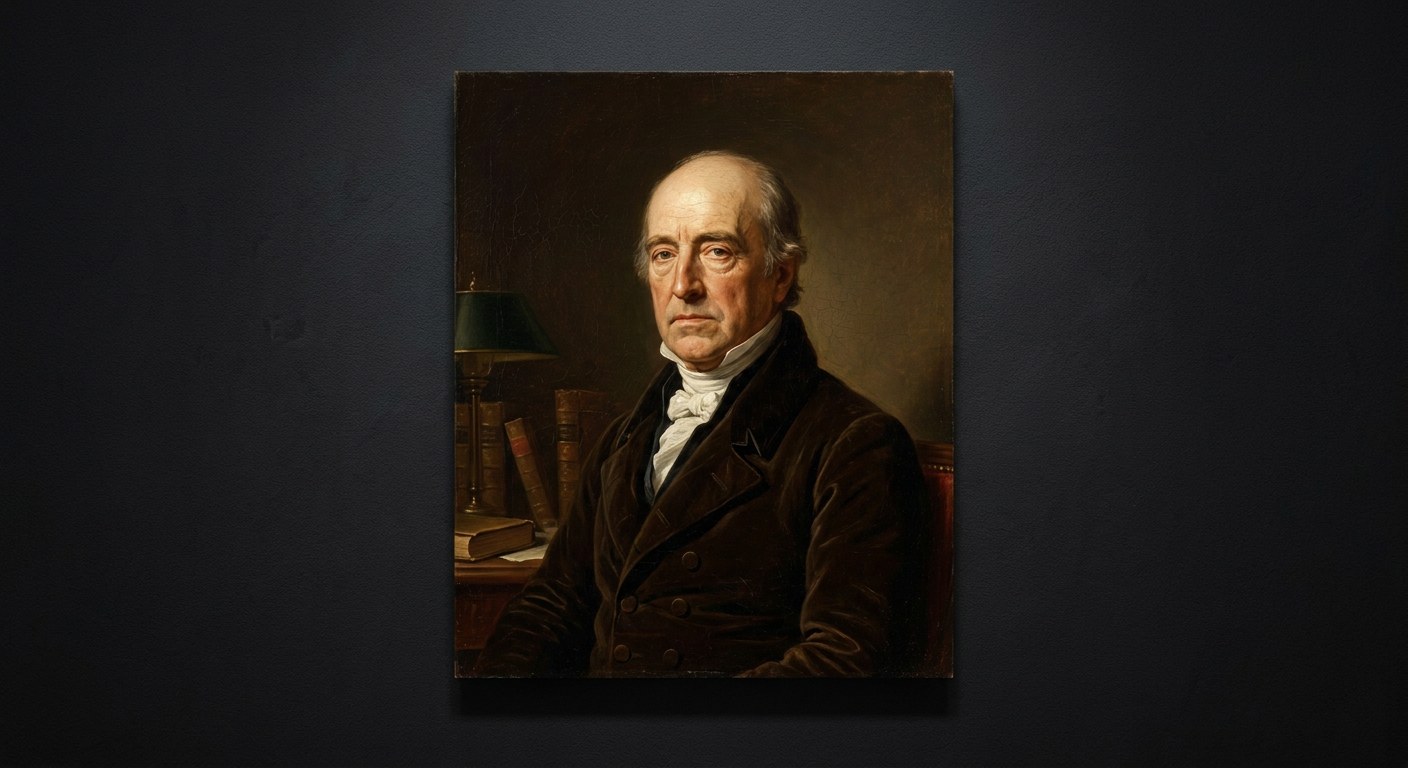
Jeremy Bentham
1748 – 1832 · British · Philosopher, Jurist & Social Reformer
Recommended Audiobooks
Listen next from Marcus Alden

Life Lessons from Frederic Chopin
Marcus Alden · 54 min

Life Lessons from John Wesley
Marcus Alden · 52 min
Introduction (Why He Matters)
Jeremy Bentham was an English philosopher, jurist, political theorist, and social reformer whose ideas helped shape modern thinking about law, government, punishment, public administration, and ethics. He is best known as the principal founder of classical utilitarianism, the doctrine that institutions and actions should be judged by their consequences for human happiness. In Bentham’s most famous formulation, the proper objective of morality and legislation was “the greatest happiness of the greatest number.”
Bentham wrote during an era in which English law was notoriously complex, inconsistent, expensive, and resistant to systematic reform. Rather than treating inherited institutions as sacred, he asked what practical purposes they served. Laws, punishments, and political arrangements were justified only if they reduced suffering or increased well-being. This approach made him a radical critic of legal fictions, secretive government, arbitrary authority, harsh criminal penalties, colonial domination, religious privilege, and restrictions on political participation.
His reform proposals ranged across an extraordinary number of subjects. Bentham advocated the codification of law, more accessible courts, greater governmental transparency, prison reform, freedom of expression, religious toleration, wider suffrage, and the abolition of many cruel punishments. He opposed slavery and questioned traditional prejudice against women and homosexual people. His observation that the morally relevant question about animals is not whether they can reason or speak, but whether they can suffer, became a foundational statement in modern animal ethics.
Bentham was not a conventional politician, and many of his proposals were not enacted during his lifetime. Nevertheless, his writings inspired a circle of reformers known as the philosophical radicals, influenced major nineteenth-century thinkers such as John Stuart Mill, and contributed to legal and administrative reforms in Britain and beyond. His Panopticon prison design also became one of the most debated models in the history of surveillance and institutional power.
Even Bentham’s treatment of his own body reflected his determination to challenge custom. Following his instructions, his skeleton was preserved, dressed, and displayed as an “Auto-Icon.” It remains at University College London, making Bentham’s posthumous presence almost as famous as his philosophy.
Quick Facts
| Fact | Detail |
|---|---|
| Born | 15 February 1748, Houndsditch, London, England |
| Died | 6 June 1832, Queen Square Place, Westminster, London |
| Nationality | English; commonly described more broadly as British |
| Known For | Classical utilitarianism, the greatest happiness principle, legal reform, and the Panopticon |
| Occupation | Philosopher, jurist, political theorist, and social reformer |
| Era | Enlightenment and early nineteenth-century reform era |
Early Life and Education
Jeremy Bentham was born in Houndsditch, London, on 15 February 1748. His father, Jeremiah Bentham, was a prosperous attorney who hoped that his intellectually gifted son would rise to the highest ranks of the legal profession. His mother, Alicia Whitehorn Bentham, came from a financially comfortable family. Jeremy was the eldest surviving child; his younger brother Samuel Bentham later became an engineer and naval administrator whose ideas influenced Jeremy’s plans for institutional design.
Bentham was a remarkable child. Family accounts describe him reading serious works at an unusually young age and beginning the study of Latin while still very young. His precocity encouraged his father’s expectations, although the shy and physically small boy did not possess the temperament of an ambitious courtroom advocate. His childhood was also marked by emotional sensitivity, a fear of ghosts, and discomfort with some of the stern religious ideas surrounding him.
He attended Westminster School, one of England’s leading schools, before entering Queen’s College, Oxford, in 1760 at only twelve years old. He received his Bachelor of Arts degree in 1763 and his Master of Arts in 1766. Oxford gave him a formal classical and legal education, but Bentham later recalled the university with considerable dissatisfaction. He believed its teaching was dominated by empty formalism, unexamined tradition, and clerical interests rather than useful knowledge.
Bentham entered Lincoln’s Inn to prepare for the bar and attended lectures on English law delivered by William Blackstone at Oxford. Blackstone’s polished presentation of the common law profoundly affected him—but mainly by provoking disagreement. Where Blackstone tended to portray the English constitution and legal system as products of accumulated wisdom, Bentham saw confusion, irrationality, technical obscurity, and avoidable suffering.
He was called to the bar in 1769. His father expected a lucrative legal career, perhaps even eventual advancement to the office of lord chancellor. Bentham instead found legal practice distasteful. The delays, fees, procedural traps, and archaic language of the courts convinced him that he could contribute more by exposing and redesigning the system than by prospering within it. Financial support and inherited property allowed him to pursue the unusual career of a largely independent writer and reformer.
Rise to Prominence
Bentham’s intellectual career began with a sustained attack on the assumptions underlying English law. His first major published work, A Fragment on Government (1776), anonymously criticized passages in Blackstone’s Commentaries on the Laws of England. The book challenged the idea that political obligation rested upon an original social contract. Bentham regarded such a contract as a fiction. People obeyed government, he argued, because obedience was generally useful; when resistance promised greater overall benefit, the basis of obedience could disappear.
The work attracted attention for its sharp reasoning and confident criticism. Although its authorship was initially concealed, Bentham was recognized as an original and formidable legal thinker. In place of appeals to tradition or imaginary agreements, he proposed the principle of utility: laws and institutions should be evaluated by their tendency to promote happiness and prevent suffering.
Bentham developed this method more fully in An Introduction to the Principles of Morals and Legislation, printed in 1780 and published in 1789. It opened with his celebrated declaration that humanity is governed by “two sovereign masters, pain and pleasure.” The book offered a systematic account of utility, motivation, punishment, and legislation. Bentham even proposed a “felicific” or hedonic calculus for comparing consequences according to factors such as intensity, duration, certainty, proximity, fecundity, purity, and extent.
During the 1780s Bentham traveled in continental Europe and visited his brother Samuel in Russia. Samuel’s experiments with workshop supervision contributed to Jeremy’s conception of the Panopticon, a circular institutional design in which a central observer could potentially watch occupants housed around the perimeter. Bentham presented it as a model for prisons, workhouses, factories, schools, and other institutions requiring supervision.
The Panopticon campaign consumed Bentham for years. He proposed to build and manage a model prison under contract with the British government. He believed constant apparent visibility would encourage orderly behavior while reducing administrative costs. Government ministers showed interest, and Parliament authorized expenditures, but the plan was repeatedly delayed and ultimately abandoned. Bentham regarded the failure as a personal injustice and an example of aristocratic influence defeating rational reform. In 1813 he received substantial financial compensation from the government, though the prison was never built.
By the early nineteenth century, Bentham’s reputation had become international. His works were translated and circulated in Europe and the Americas, often through the efforts of the Swiss editor Étienne Dumont. Bentham corresponded with political leaders, jurists, and reformers and offered model legal codes to governments around the world. His London home became the center of a reform-minded network that later became known as the philosophical radicals.
Major Achievements and Contributions
Founding classical utilitarianism
Bentham’s greatest philosophical achievement was turning the principle of utility into a comprehensive program of ethics and government. Pleasure and freedom from pain were, in his view, the ultimate goods. An action, rule, or institution was beneficial insofar as it increased the overall balance of happiness over suffering among those affected.
His utilitarianism was impartial in principle. The happiness of rulers, aristocrats, or clergy did not possess greater intrinsic value than anyone else’s. This insistence gave utilitarianism a potentially democratic force: each person’s welfare had to enter the calculation. Bentham’s framework was later revised by John Stuart Mill, Henry Sidgwick, and many modern moral philosophers, but his basic emphasis on consequences and equal consideration remains central to consequentialist ethics.
Reforming law and punishment
Bentham treated law as a human instrument rather than an inherited mystery. He attacked the English common-law system for relying on precedent, technical language, judicial discretion, and what he called “fictions.” He preferred clearly written, publicly available legal codes defining offenses, rights, procedures, and penalties.
Punishment, he argued, is itself an evil because it inflicts pain. It can be justified only when it prevents greater harm—for example, through deterrence, incapacitation, or reform. Punishment should therefore be proportionate and no more severe than necessary. This reasoning challenged the numerous capital offenses and brutal penalties found in eighteenth-century criminal law.
Bentham also criticized legal arrangements that benefited lawyers and officials while making justice expensive or inaccessible. His writings contributed to a climate in which codification, procedural simplification, and evidence-based reform became major goals of nineteenth-century jurisprudence.
Constitutional and democratic reform
Bentham’s political views grew increasingly democratic. Earlier in life, he hoped enlightened rulers might introduce rational reforms from above. Repeated frustration persuaded him that officials frequently pursued their own “sinister interests.” Institutional checks were therefore needed to align governmental conduct with public welfare.
He eventually supported a broad male franchise, frequent elections, the secret ballot, electoral districts of roughly equal population, ministerial accountability, and extensive publicity for public business. He defended freedom of the press as a safeguard against misgovernment. His Constitutional Code attempted to design an entire administrative system around transparency, responsibility, and the prevention of official abuse.
Social reform and equal consideration
Bentham’s writings contained unusually forward-looking arguments on several social issues. He condemned slavery and the slave trade, supported religious toleration, and opposed legal discrimination based on religious belief. He also rejected ascetic moral systems that condemned harmless pleasures merely because they offended custom.
In manuscripts not published in full during his lifetime, Bentham criticized punishments imposed on consensual homosexual conduct. He argued that private acts causing no identifiable harm did not justify criminal penalties. This was an exceptionally radical position in a period when male homosexual activity was punishable by death in England.
Bentham also recognized the injustice of excluding women from political rights and criticized aspects of women’s subordinate status. He did not develop a complete feminist philosophy comparable to that of Mary Wollstonecraft, and some of his remarks retained contemporary assumptions, but his utilitarian impartiality undermined claims that sex alone justified unequal treatment.
Animal ethics
Bentham’s discussion of animals became one of his most enduring contributions. Earlier moral theories often emphasized rationality or language as the qualifications for moral standing. Bentham focused instead on sentience—the capacity to experience pain and pleasure. His question, “Can they suffer?”, supplied a foundation for later animal-welfare and animal-rights thought.
He did not argue that humans and animals must always receive identical treatment. Rather, he insisted that animal suffering counts morally and cannot be dismissed merely because of species membership. Thinkers such as Peter Singer later developed this insight into influential critiques of speciesism and industrial animal exploitation.
Language, logic, and political economy
Bentham also wrote extensively on logic, language, evidence, economics, and administration. He analyzed how abstract legal terms could conceal confusion and developed methods of paraphrasis for explaining them through statements about observable actions and consequences. In economics, he examined taxation, interest, prices, poverty, and public finance. Although not all his conclusions endured, his determination to connect policy with incentives anticipated later approaches in economics and public-choice theory.
Key Works / Battles / Ideas
A Fragment on Government (1776)
Bentham’s first important publication was an attack on Blackstone’s defense of English law. It rejected the original-contract theory and argued that government should be judged by utility. The book announced Bentham’s lifelong battle against reverence for institutions merely because they were old.
An Introduction to the Principles of Morals and Legislation (1789)
This is Bentham’s best-known philosophical work. It defines utility, analyzes pleasure and pain, classifies motives and offenses, and explains when punishment may be justified. Its proposed hedonic calculus was not a simple mechanical formula; rather, it identified considerations relevant to judging the consequences of policy and conduct.
The greatest happiness principle
Bentham held that the goal of moral and political decision-making was the greatest net happiness of all affected. This principle required consequences to be considered impartially. Critics later questioned whether aggregate happiness could justify violating individual rights, but Bentham believed secure expectations, equal treatment, and good laws were generally indispensable to social welfare.
The Panopticon writings
In Panopticon; or, The Inspection-House, Bentham described a building whose occupants could be observed from a central position without knowing when observation was occurring. He saw this uncertainty as a means of encouraging self-discipline. Bentham claimed his scheme would improve prison conditions, reduce costs, and make administrators accountable through outside inspection.
Modern readers often interpret the Panopticon more darkly. Michel Foucault used it in Discipline and Punish as a model for modern disciplinary power, in which people internalize surveillance and regulate themselves. Bentham’s design is therefore discussed today in debates about prisons, workplaces, closed-circuit cameras, data collection, and digital monitoring.
Rationale of Judicial Evidence
Compiled and edited from Bentham’s manuscripts and published in 1827, this work attacked exclusionary rules and technical barriers that prevented courts from considering relevant evidence. Bentham favored broad admissibility, open examination, and procedures designed to discover truth rather than enrich legal professionals.
Constitutional Code
Bentham’s ambitious late work laid out a democratic and administrative constitution. It emphasized popular sovereignty, official responsibility, economical administration, open proceedings, and mechanisms for exposing corruption. Only part appeared during his lifetime, but the project summarized decades of thinking about institutional design.
Anarchical Fallacies
Written in response to declarations of natural rights associated with the French Revolution, this work attacked the concept of rights existing independently of law. Bentham famously called such claims “nonsense upon stilts.” He did not oppose legal rights; on the contrary, he wanted rights to be precisely defined and effectively protected. His objection was to treating vague assertions of natural or imprescriptible rights as if they were enforceable without institutions and legislation.
Codification
Bentham’s “battle” for codification unified much of his career. He wanted comprehensive codes that ordinary citizens could understand. Law should inform people in advance of the consequences of their actions, restrain officials, and reduce dependence on expensive professional interpretation. His own terminology could be elaborate and eccentric, but the objective was clarity, consistency, and accessibility.
Timeline of Key Events
| Year | Event |
|---|---|
| 1748 | Born on 15 February in Houndsditch, London. |
| 1760 | Entered Queen’s College, Oxford, at the age of twelve. |
| 1763 | Received his Bachelor of Arts degree. |
| 1766 | Received his Master of Arts degree and continued legal training. |
| 1769 | Called to the bar but chose scholarship over legal practice. |
| 1776 | Published A Fragment on Government anonymously. |
| 1780 | An Introduction to the Principles of Morals and Legislation was printed; it was formally published in 1789. |
| 1785–1787 | Traveled through Europe and stayed with his brother Samuel in Russia. |
| 1787 | Developed and circulated the Panopticon letters. |
| 1789 | Published An Introduction to the Principles of Morals and Legislation. |
| 1791 | Published a collected version of the Panopticon proposals. |
| 1792 | Inherited his father’s estate, strengthening his financial independence. |
| 1802 | Étienne Dumont published a French presentation of Bentham’s legislative ideas, greatly increasing his European influence. |
| 1808 | Began a close association with James Mill, a leading member of the emerging Benthamite circle. |
| 1813 | Received government compensation after the failure of the Panopticon prison project. |
| 1817 | Published Plan of Parliamentary Reform, supporting democratic changes. |
| 1822–1824 | Issued major portions of his codification and constitutional writings. |
| 1823 | Helped inspire and finance the Westminster Review, a journal of philosophical radicalism. |
| 1827 | Rationale of Judicial Evidence, edited by John Stuart Mill, was published. |
| 1832 | Died on 6 June in Westminster; his body was dissected and preserved according to his instructions. |
Personal Life and Character
Bentham never married and had no children. As a young man he experienced romantic attachments, and late in life he recalled an early love, but scholarship and reform became the organizing commitments of his adult existence. Financial independence allowed him to maintain an unusual daily routine centered on reading, correspondence, and composition.
He was extraordinarily industrious. Bentham produced tens of thousands of manuscript pages, often writing on small sheets that could be arranged, revised, and combined. His output was so vast that editors published many works from his papers, sometimes years after they were written. This practice complicates interpretation because edited publications do not always reproduce a single finished text authorized by Bentham.
Bentham could be warm, playful, and generous toward friends, but he was also stubborn and sensitive to opposition. He invented words and labels, enjoyed classifying concepts, and sometimes wrote in a dense, repetitive style. His desire for comprehensive precision could make his prose difficult even when his ultimate objective was clarity.
His home at Queen Square Place in Westminster became a meeting place for reformers. Associates included James Mill, John Stuart Mill, Francis Place, John Bowring, and other figures connected with philosophical radicalism. Bentham took an interest in the education of the young John Stuart Mill, though James Mill was the chief architect of his son’s demanding upbringing.
Bentham is often described as a founder of University College London, but that claim requires qualification. He supported the principles associated with the new institution—especially nonsectarian education—and his followers played major roles in its creation. However, he did not personally found the university. UCL adopted him as a spiritual ancestor, and his Auto-Icon is now one of its best-known historical objects.
Challenges and Controversies
The central controversy surrounding Bentham is whether maximizing aggregate happiness adequately protects individuals. If sacrificing one person produced greater happiness for many others, would utilitarianism require it? Bentham believed well-designed laws, security, and stable expectations were themselves major sources of happiness. Even so, critics argue that a purely aggregative theory may struggle to explain why certain rights should not be overridden.
His rejection of natural rights has also remained controversial. Bentham feared that vague declarations encouraged confusion and potentially violent conflict. Yet defenders of human rights argue that moral rights provide standards by which unjust laws can be condemned. Bentham’s famous attack can appear especially troubling after later struggles against slavery, tyranny, and genocide, although his own practical commitments were often humane and egalitarian.
The Panopticon presents another difficulty. Bentham considered it a rational alternative to chaotic, unhealthy, and brutal prisons. He also proposed public inspection of administrators. Nevertheless, the plan concentrated power in the observer and depended upon the occupants’ awareness that they might always be watched. Modern critics see it as a blueprint for intrusive surveillance and psychological control.
Bentham’s attitude toward colonialism was complex and changed over time. He criticized imperial misrule and eventually argued that colonies should be emancipated because imperial relationships burdened both colonizers and colonized. However, like many European reformers of his era, he sometimes assumed that supposedly rational legislation could be exported without sufficient regard for local political cultures.
His reform campaigns also encountered practical failure. The government’s abandonment of the Panopticon consumed years of his time and embittered him. Many legal and constitutional proposals were too extensive to be adopted as complete systems. His habit of devising technical vocabulary and elaborate classifications sometimes reduced the accessibility of ideas intended to simplify public life.
Finally, Bentham’s posthumously published writings raise editorial questions. Secretaries and editors arranged enormous collections of unfinished material, occasionally smoothing or reshaping his arguments. Modern scholarly editions seek to reconstruct his texts from manuscripts and distinguish Bentham’s own formulations from those of his editors.
Death and Immediate Aftermath
Bentham remained intellectually active into his eighties. He died at his home in Queen Square Place, Westminster, on 6 June 1832, aged eighty-four. His death came in the same year as the passage of Britain’s first Reform Act, a limited but significant step toward the representative changes he and his associates had promoted.
In accordance with instructions in his will, Bentham’s body was made available for anatomical study. On 9 June 1832, the physician and lecturer Thomas Southwood Smith delivered a commemorative address and conducted a public dissection. Bentham hoped that the use of his corpse would advance medical knowledge and challenge religious and cultural prejudice against dissection.
His skeleton was then articulated, padded, dressed in his own clothes, and placed in a chair. Bentham had called such a preserved representation an Auto-Icon, meaning a person serving as his own image. Efforts to preserve his actual head through experimental desiccation produced an unsettling result, so a wax head was placed on the figure. The real preserved head was stored separately and is no longer displayed publicly.
Bentham’s Auto-Icon eventually came into the care of University College London. Since 2020 it has been displayed in a case in UCL’s Student Centre. Contrary to a popular legend, the Auto-Icon does not routinely attend meetings of the university’s governing council and is not formally recorded as “present but not voting,” though it has occasionally been transported for special events.
His immediate intellectual legacy passed to the philosophical radicals. They continued campaigns for parliamentary, legal, educational, and administrative reform through journals, organized pressure, and parliamentary activity.
Legacy and Influence Today
Bentham’s most obvious legacy is utilitarianism. John Stuart Mill modified Bentham’s theory by distinguishing higher and lower qualities of pleasure and giving greater attention to individuality and liberty. Henry Sidgwick later refined utilitarian ethics, while twentieth- and twenty-first-century philosophers developed act, rule, preference, and negative forms of consequentialism.
Utilitarian reasoning remains influential in public policy. Cost-benefit analysis, health economics, welfare economics, and evidence-based administration all share Bentham’s insistence that policies be assessed through their effects on well-being. Modern attempts to measure quality of life, compare medical interventions, or allocate scarce resources often confront recognizably Benthamite questions.
His legal influence is equally important. Bentham helped popularize the ideal of clearly expressed, systematic law. Although England did not replace the common law with a complete Benthamite code, nineteenth-century reforms simplified legal procedure, reduced capital offenses, reorganized courts, and made administration more professional. His jurisprudence influenced the development of legal positivism, particularly through John Austin, who distinguished law as it exists from law as it ought to be.
Bentham’s democratic ideas contributed to the intellectual program of British radicalism: broader suffrage, electoral accountability, secret voting, open government, and scrutiny of public officials. His belief that institutions must be designed around realistic incentives rather than idealized virtue anticipates modern constitutional design and public-choice analysis.
His animal-ethics passage is quoted throughout contemporary debates about factory farming, animal experimentation, conservation, and legal protections for sentient beings. The shift from asking whether animals possess humanlike intelligence to asking whether they suffer remains one of the clearest examples of Bentham’s moral influence.
The Panopticon has acquired a legacy Bentham could not have anticipated. Through Michel Foucault and later surveillance studies, it became a metaphor for institutions in which visibility produces obedience. Today it is invoked in discussions of workplace monitoring, online tracking, facial recognition, social media, and state databases. This legacy is ambivalent: Bentham wanted transparent, efficient institutions, yet his design also illustrates the dangers of unequal access to information.
The Bentham Project at University College London continues to edit and publish his manuscripts. Digital transcription initiatives have enabled volunteers and scholars to work with his enormous archive. His Auto-Icon attracts visitors, but the preserved body should not overshadow the seriousness of his intellectual project: to subject every institution to rational criticism and ask whether it improves the lives of those governed by it.
Famous Quotes
“Nature has placed mankind under the governance of two sovereign masters, pain and pleasure.”
— An Introduction to the Principles of Morals and Legislation
“The greatest happiness of the greatest number is the foundation of morals and legislation.”
— A Fragment on Government
“The question is not, Can they reason? nor, Can they talk? but, Can they suffer?”
— An Introduction to the Principles of Morals and Legislation
“Publicity is the very soul of justice.”
— Bentham’s writings on judicial institutions
“Secrecy, being an instrument of conspiracy, ought never to be the system of a regular government.”
— Constitutional Code
“Natural rights is simple nonsense: natural and imprescriptible rights, rhetorical nonsense,—nonsense upon stilts.”
— Anarchical Fallacies
“Prejudice apart, the game of push-pin is of equal value with the arts and sciences of music and poetry.”
— The Rationale of Reward
Frequently Asked Questions
What was Jeremy Bentham’s main philosophical idea?
Bentham’s central idea was the principle of utility: actions and institutions should be evaluated according to whether they increase happiness and reduce suffering. He sought the greatest net well-being for everyone affected, not merely for a privileged class.
Did Jeremy Bentham invent utilitarianism?
Earlier thinkers, including Francis Hutcheson, David Hume, Claude-Adrien Helvétius, and Cesare Beccaria, developed related ideas. Bentham’s achievement was to turn utility into a systematic theory of morality, legislation, punishment, and institutional reform. He is therefore regarded as the principal founder of classical utilitarianism.
What was Bentham’s felicific calculus?
The felicific calculus was a method for assessing pleasures and pains by considering their intensity, duration, certainty, proximity, fecundity, purity, and extent. Bentham did not provide a universally usable numerical scale; the calculus was chiefly a framework for disciplined comparison of consequences.
What was the Panopticon?
The Panopticon was an institutional design with occupants arranged around a central observation point. Because they could not know when they were being watched, Bentham expected them to regulate their own behavior. He promoted it especially as a prison design, but the proposed British Panopticon was never constructed.
Was Jeremy Bentham a founder of University College London?
Not literally. Bentham did not participate directly in UCL’s establishment in 1826, although several of his associates did, and the institution embodied principles he supported, such as nonsectarian education. UCL regards him as its spiritual founder and houses his Auto-Icon.
Why is Bentham important to animal rights?
Bentham argued that the capacity to suffer—not the possession of language or advanced reasoning—is what makes a being morally considerable. This idea became foundational for modern animal-welfare and animal-rights philosophy.
What did Bentham mean by “nonsense upon stilts”?
He was criticizing claims that natural rights exist independently of laws and political institutions. Bentham supported many protections now described as human rights, but he believed genuine rights had to be created, specified, and enforced by law.
Where is Jeremy Bentham’s body today?
His preserved skeleton, dressed in his clothing and topped with a wax head, is displayed as the Auto-Icon at University College London. His actual preserved head is stored separately under controlled conditions and is not part of the public display.
Lessons We Can Learn
-
Judge institutions by their effects. Bentham reminds us that age, prestige, and tradition do not prove that a law or institution is beneficial. Public systems should be tested against their consequences for human welfare.
-
Include every affected interest. Moral decision-making should not ignore people because they lack wealth, rank, political influence, or social approval. Bentham’s impartiality also encourages serious consideration of animal suffering.
-
Make power visible and accountable. His defense of publicity shows why open courts, a free press, accessible records, and public scrutiny are essential checks on official self-interest.
-
Use no more coercion than necessary. Because punishment inflicts suffering, it requires justification and should be proportionate to the harm it prevents. This remains a vital principle in criminal justice.
-
Balance reforming ambition with safeguards for individuals. Bentham’s bold system-building demonstrates the value of comprehensive thought, while criticisms of utilitarianism and the Panopticon warn that efficiency and aggregate welfare must not erase dignity, privacy, or individual protection.
Further Reading
- Philip Schofield, Utility and Democracy: The Political Thought of Jeremy Bentham — A major scholarly study of Bentham’s utilitarianism and democratic development.
- H. L. A. Hart, Essays on Bentham: Studies in Jurisprudence and Political Theory — Influential essays on Bentham’s legal and political philosophy.
- Gerald J. Postema, Bentham and the Common Law Tradition — A detailed examination of Bentham’s jurisprudence and criticism of common law.
- Mary P. Mack, Jeremy Bentham: An Odyssey of Ideas, 1748–1792 — A substantial intellectual biography covering Bentham’s formative years.
- Jeremy Bentham, An Introduction to the Principles of Morals and Legislation, edited by J. H. Burns and H. L. A. Hart — A reliable scholarly edition of Bentham’s foundational utilitarian text.
Watch and Learn
Utilitarianism: Crash Course Philosophy #36 · CrashCourse