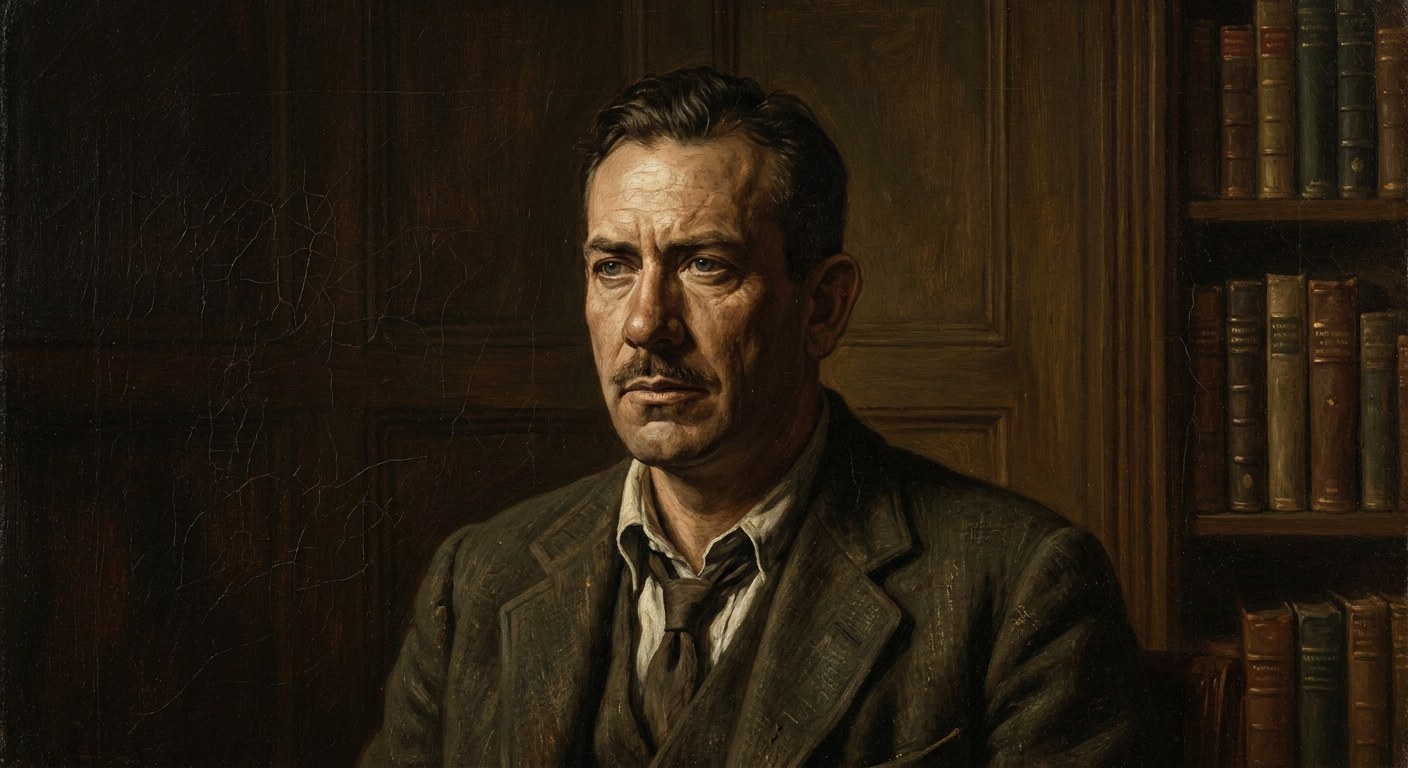
John Steinbeck
1902 – 1968 · American · Novelist & Journalist
Recommended Audiobooks
Listen next from Marcus Alden

Life Lessons from Frederic Chopin
Marcus Alden · 54 min

Life Lessons from John Wesley
Marcus Alden · 52 min
Introduction
John Steinbeck was one of the most influential and widely read American writers of the twentieth century. A novelist, short-story writer, dramatist, journalist, and war correspondent, he wrote with unusual sympathy about agricultural laborers, migrant families, fishermen, mechanics, ranch hands, and other people often overlooked by mainstream literature. His finest books combined social observation with humor, symbolism, biblical rhythms, and a deep attachment to the landscapes of California.
Steinbeck is best known for The Grapes of Wrath, his epic account of an Oklahoma family driven west by economic hardship and ecological disaster during the Great Depression. Published in 1939, the novel became both a literary landmark and a national controversy. It helped draw attention to the exploitation of migrant farmworkers, won the Pulitzer Prize, and became one of the defining works of American social realism. Other enduring books include Of Mice and Men, East of Eden, Cannery Row, The Pearl, and The Winter of Our Discontent.
His writing was never limited to political protest. Steinbeck explored loneliness, friendship, moral responsibility, ambition, violence, family inheritance, and the human desire for dignity. His fictional world was shaped by California's Salinas Valley and Monterey Peninsula, but his concerns were universal. He could be comic and tender in one book, tragic and polemical in another.
In 1962, Steinbeck received the Nobel Prize in Literature for what the Swedish Academy called his “realistic and imaginative writings, combining as they do sympathetic humour and keen social perception.” Although some critics disputed the award, his reputation remained strong among readers, educators, dramatists, and filmmakers. His works continue to be taught, adapted, challenged, and debated, confirming his place among the major American novelists.
Quick Facts
| Fact | Details |
|---|---|
| Born | February 27, 1902, Salinas, California, United States |
| Died | December 20, 1968, New York City, United States |
| Nationality | American |
| Known For | The Grapes of Wrath, Of Mice and Men, East of Eden, and fiction about working people |
| Occupation | Novelist, short-story writer, journalist, dramatist, and war correspondent |
| Era | Twentieth-century American literature; Great Depression and postwar eras |
Early Life and Education
John Ernst Steinbeck Jr. was born on February 27, 1902, in Salinas, California, a small agricultural community surrounded by one of the most productive farming regions in the United States. The geography of the Salinas Valley—its mountains, fields, ranches, towns, fog, and seasonal labor—became central to his imagination. He later referred to the region as the “Long Valley,” transforming it into a literary landscape comparable to William Faulkner's fictional Yoknapatawpha County.
His father, John Ernst Steinbeck, held several jobs and eventually served as treasurer of Monterey County. His mother, Olive Hamilton Steinbeck, had worked as a schoolteacher and encouraged her son's interest in books and language. Steinbeck grew up with three sisters: Esther, Elizabeth, and Mary. Through his mother's family, he inherited stories about the Hamiltons, Irish-American settlers who later appeared in fictionalized form in East of Eden.
As a boy, Steinbeck read widely and explored the countryside around Salinas. Thomas Malory's Le Morte d'Arthur made a particularly strong impression on him. Its tales of loyalty, fellowship, betrayal, and failed ideals remained important throughout his life. He began writing stories while young and contributed to his high-school newspaper and yearbook.
Steinbeck graduated from Salinas High School in 1919 and entered Stanford University. His university career was irregular. He attended classes intermittently between 1919 and 1925, taking courses that interested him—especially English, creative writing, and marine biology—while ignoring requirements he considered unhelpful. He left Stanford without earning a degree.
During these years, Steinbeck worked at ranches, farms, construction sites, factories, and a sugar-beet plant. Such jobs introduced him to migrant laborers and working-class communities, providing experiences that would inform his later fiction. A marine biology course also strengthened his interest in ecology and the interdependence of living organisms.
In 1925, he traveled to New York City, hoping to establish himself as a writer. He worked briefly as a reporter for the New York American and took manual jobs, including construction work. Unable to sell his fiction or adapt to newspaper reporting, he returned to California. The apparent failure was formative: Steinbeck concluded that his strongest material lay not in New York's literary world but in the people and landscapes he already knew.
Rise to Prominence
Steinbeck's first novel, Cup of Gold, appeared in 1929. A romanticized story about the seventeenth-century privateer Henry Morgan, it bore little resemblance to the socially grounded fiction that later made him famous. It sold poorly, as did his next books, The Pastures of Heaven (1932) and To a God Unknown (1933). Nevertheless, these works introduced lasting themes: the power of the land, the instability beneath apparently peaceful communities, and the relationship between human beings and nature.
In 1930, Steinbeck married Carol Henning. The couple settled for a time in Pacific Grove, near Monterey. Carol supported and encouraged his work during years of financial insecurity and later helped choose the title The Grapes of Wrath, taken from “The Battle Hymn of the Republic.”
A decisive influence during this period was Edward F. Ricketts, a marine biologist and owner of a biological supply laboratory in Monterey. Ricketts combined scientific curiosity with philosophical interests and a nonjudgmental approach to human behavior. His ideas about ecology, group behavior, and “non-teleological” thinking—the attempt to understand what exists without forcing it into a predetermined moral scheme—shaped Steinbeck's outlook. Ricketts also inspired characters in several books, most famously Doc in Cannery Row.
Steinbeck achieved his first popular success with Tortilla Flat in 1935. Set near Monterey, the novel follows a group of paisanos whose unconventional community is held together by friendship, wine, petty theft, and mutual obligation. Its humor appealed to a broad audience, although later critics questioned its romanticized and stereotypical presentation of Mexican American characters.
Steinbeck then turned more directly toward labor conflict and economic injustice. In Dubious Battle (1936) portrayed a strike among California fruit pickers and examined the psychology of collective action. Rather than depicting either workers or organizers as morally simple heroes, the novel explored manipulation, sacrifice, idealism, and violence within mass movements.
Of Mice and Men followed in 1937. The compact tragedy centers on George Milton and Lennie Small, itinerant ranch workers who dream of owning a small farm. Steinbeck designed the work as a “play-novelette,” a narrative capable of being adapted easily for the stage. Its combination of simple language, emotional power, and dramatic structure brought him national recognition. A successful Broadway production opened in 1937, and film adaptations later carried the story to an international audience.
In the same decade, Steinbeck published The Red Pony, a cycle of stories about a boy growing up on a California ranch. Through episodes involving birth, death, aging, and disappointment, it offered a restrained account of a child's initiation into the realities of life.
Major Achievements and Contributions
Steinbeck's greatest achievement was The Grapes of Wrath, published in April 1939. Its creation grew out of his reporting on migrant labor in California. In 1936, he wrote a series of newspaper articles, later collected as The Harvest Gypsies, describing the living and working conditions of displaced agricultural families. He visited camps, spoke with workers, and observed the effects of hunger, disease, low wages, and hostility from local authorities.
The novel follows the Joad family after drought, debt, and mechanized agriculture force them from their Oklahoma farm. Traveling west along Route 66, they expect California to offer jobs and security. Instead, they encounter an oversupply of labor, deliberate wage suppression, police intimidation, and squalid camps. Interchapters widen the story beyond one family, making the Joads representative of a larger historical migration.
The Grapes of Wrath was both a critical and commercial sensation. It won the 1940 Pulitzer Prize for Fiction and the National Book Award. John Ford directed a celebrated 1940 film adaptation starring Henry Fonda as Tom Joad. The book also provoked outrage. Growers' organizations denounced it as distorted propaganda; libraries and local authorities in several communities removed or banned it; and copies were publicly burned. Eleanor Roosevelt defended the essential truth of Steinbeck's depiction after visiting migrant camps herself.
The novel's contribution was not merely documentary. Steinbeck used biblical echoes, recurring images, shifts between individual and collective perspectives, and lyrical descriptions of nature to turn a contemporary crisis into an American epic. Its central insight is that survival depends not only on individual endurance but also on solidarity—the movement from “I” toward “we.”
Steinbeck also made important contributions to ecological writing. With Ed Ricketts, he joined a 1940 marine-collecting expedition in the Gulf of California. Their collaborative book, Sea of Cortez (1941), combined scientific records, travel narrative, humor, and philosophy. A revised edition, The Log from the Sea of Cortez, appeared in 1951 after Ricketts's death. The work anticipated later environmental writing by presenting organisms as members of interconnected communities rather than isolated specimens.
During the Second World War, Steinbeck placed his writing at the service of the Allied cause. The Moon Is Down (1942), a short novel about resistance in an occupied European town, was translated and clandestinely distributed in countries under Nazi occupation. He also wrote Bombs Away (1942), an account of an American bomber crew, and served as a war correspondent for the New York Herald Tribune in 1943. His dispatches from England, North Africa, and Italy were later collected in Once There Was a War.
Steinbeck contributed to film as well. He wrote the original story for Alfred Hitchcock's Lifeboat (1944), although he objected to elements of the finished film. His story for Viva Zapata! became a 1952 motion picture directed by Elia Kazan and starring Marlon Brando. Several of Steinbeck's novels and stories were adapted repeatedly for stage, cinema, radio, and television.
In 1962, the Swedish Academy awarded Steinbeck the Nobel Prize in Literature. In his Nobel lecture, he argued that the writer had a responsibility to expose human faults while celebrating humanity's capacity for courage, compassion, and greatness. President Lyndon B. Johnson awarded him the Presidential Medal of Freedom in 1964.
Key Works / Battles / Ideas
Of Mice and Men (1937)
This tragic novella dramatizes the precarious lives of migrant ranch workers during the Great Depression. George protects Lennie, a physically powerful man with an intellectual disability, while both dream of independence. The story examines friendship, loneliness, disability, power, and the fragility of hope. Its final act has generated continuing debate about mercy, responsibility, and violence.
The Grapes of Wrath (1939)
Steinbeck's masterpiece combines the Joad family's journey with panoramic chapters about migration, capitalism, mechanized farming, and social unrest. The novel insists that poverty is not simply an individual failure but can be produced by economic systems. Its portrayal of organized resistance made it politically explosive, while its language gave the migrant experience enduring literary form.
Cannery Row (1945)
Set among Monterey's sardine canneries during the Depression, Cannery Row focuses on Doc and a loose community of outsiders. The novel is episodic, affectionate, and comic, yet shadowed by loneliness and failure. Its neighborhood functions as a miniature ecosystem in which people survive through informal exchange, companionship, and accommodation.
The Pearl (1947)
Based on a Mexican folk tale, The Pearl tells of Kino, a poor pearl diver who discovers an immensely valuable pearl. What initially appears to promise freedom instead brings greed, exploitation, and violence. The parable explores colonial inequality, material desire, and the destructive consequences of a society that values wealth over human life.
East of Eden (1952)
Steinbeck regarded East of Eden as the book into which he had put everything he knew. Set largely in the Salinas Valley, it interweaves the histories of the fictional Trask family and the partly autobiographical Hamilton family. Drawing on the biblical story of Cain and Abel, it examines sibling rivalry, rejection, inherited guilt, and moral choice. The Hebrew word timshel, interpreted in the novel as “thou mayest,” expresses its belief that people retain the ability to choose their moral path.
The Winter of Our Discontent (1961)
Steinbeck's final novel studies moral decline in postwar America. Its protagonist, Ethan Allen Hawley, belongs to a once-prominent New England family but works as a grocery clerk. Pressured by status anxiety and material expectations, he begins compromising his principles. The novel addresses corruption, self-deception, and the gap between public virtue and private conduct.
Social Responsibility and Human Dignity
Across Steinbeck's work runs a conviction that literature should enlarge sympathy. He resisted simplistic political labels, but he repeatedly examined concentrated wealth, insecure labor, prejudice, and institutional violence. At the same time, he distrusted rigid ideology and portrayed groups as capable of both solidarity and cruelty. His characteristic method joined close observation of individuals with an ecological sense of the community as a larger organism.
Timeline of Key Events
| Year | Event |
|---|---|
| 1902 | Born in Salinas, California, on February 27 |
| 1919 | Graduated from Salinas High School and began attending Stanford University |
| 1925 | Left Stanford without a degree and moved briefly to New York City |
| 1929 | Published his first novel, Cup of Gold |
| 1930 | Married Carol Henning |
| 1935 | Achieved his first major commercial success with Tortilla Flat |
| 1936 | Published In Dubious Battle and reported on California migrant camps |
| 1937 | Published Of Mice and Men and The Red Pony |
| 1939 | Published The Grapes of Wrath |
| 1940 | Won the Pulitzer Prize for Fiction; joined Ed Ricketts on the Sea of Cortez expedition |
| 1941 | Published Sea of Cortez with Ricketts |
| 1942 | Published The Moon Is Down and Bombs Away |
| 1943 | Divorced Carol Henning, married Gwyn Conger, and served as a war correspondent |
| 1945 | Published Cannery Row |
| 1947 | Published The Pearl and traveled in the Soviet Union with photographer Robert Capa |
| 1948 | Divorced Gwyn; Ed Ricketts died after a train struck his car |
| 1950 | Married Elaine Scott |
| 1952 | Published East of Eden; Viva Zapata! was released |
| 1954 | Published Sweet Thursday |
| 1958 | Published Once There Was a War |
| 1960 | Traveled across the United States with his dog Charley |
| 1961 | Published The Winter of Our Discontent |
| 1962 | Published Travels with Charley and received the Nobel Prize in Literature |
| 1964 | Received the Presidential Medal of Freedom |
| 1966 | Published America and Americans and visited South Vietnam |
| 1968 | Died in New York City on December 20 |
| 1969 | Journal of a Novel: The East of Eden Letters was published posthumously |
Personal Life and Character
Steinbeck married three times. His first wife, Carol Henning, shared the difficult early years of his career and contributed practically and intellectually to his work. Their marriage ended in 1943, as Steinbeck's fame, work habits, emotional restlessness, and relationship with singer Gwyn Conger created increasing strain.
Steinbeck married Conger in 1943. They had two sons: Thomas Steinbeck, born in 1944, and John Steinbeck IV, born in 1946. The marriage ended in divorce in 1948. His relationships with his sons were complicated by separation, travel, and periods of emotional distance.
In 1950, he married Elaine Scott, the former wife of actor Zachary Scott. The marriage lasted until Steinbeck's death. Elaine brought stability to his later life and accompanied him on international travels. The couple lived primarily in New York City and maintained a cottage in Sag Harbor, Long Island.
Steinbeck could be warm, humorous, generous, and intensely loyal, but he was also private, moody, and capable of withdrawing from those close to him. He enjoyed practical jokes, inventions, travel, conversation, and working with his hands. Fame made him uncomfortable, and he often distrusted critics and literary society.
His friendship with Ed Ricketts was among the most important relationships of his life. Ricketts's death in 1948 devastated him. Steinbeck later transformed memories of their friendship into The Log from the Sea of Cortez and returned repeatedly to ideas they had explored together.
In 1960, feeling disconnected from his country, Steinbeck traveled approximately 10,000 miles across the United States in a camper truck named Rocinante, accompanied by his French poodle, Charley. Travels with Charley presented the journey as a search for contemporary America. Later research demonstrated that the published narrative rearranged events and omitted stretches during which Steinbeck stayed in hotels or traveled with Elaine. It is therefore best understood as a crafted literary travelogue rather than a literal day-by-day record.
Challenges and Controversies
Steinbeck endured poverty, repeated rejection, and poor sales during the first years of his career. Even after becoming famous, he faced sharp divisions in critical opinion. Admirers praised his accessibility, compassion, and narrative power. Detractors accused him of sentimentality, overstatement, simplistic symbolism, or uneven characterization. His later books were often compared unfavorably with his Depression-era fiction.
The Grapes of Wrath produced his greatest controversy. California agricultural interests argued that its camps and labor practices were exaggerated. Political conservatives branded Steinbeck a radical or communist sympathizer. Although he defended workers and associated with figures on the American left, he never joined the Communist Party and became suspicious of ideological conformity. The Federal Bureau of Investigation collected information about him, while the Internal Revenue Service audited him repeatedly. The surviving record does not support claims that he was a Soviet agent or party functionary.
The sources behind The Grapes of Wrath have also prompted debate. Steinbeck drew on his own reporting and on information provided by Tom Collins, manager of a federal migrant camp. Scholars have additionally emphasized parallels between Steinbeck's novel and Sanora Babb's unpublished manuscript Whose Names Are Unknown, based on her work with Dust Bowl migrants. Babb shared notes with Collins, and some material circulated within the same reform network. The evidence reveals overlapping documentary sources and raises questions about recognition, particularly for a female writer whose novel was delayed, but it does not establish that Steinbeck simply copied Babb's manuscript.
Steinbeck's portrayals of ethnicity and disability are also reassessed by modern readers. Tortilla Flat can seem affectionate yet stereotyped in its treatment of paisanos. The Pearl depicts colonial oppression but filters a Mexican community through an American author's parable. In Of Mice and Men, Lennie's disability is central to a plot ending in his death, creating difficult questions about agency and representation. The book's racial slur and depiction of Crooks reflect the racism of its setting but have contributed to frequent school challenges.
Steinbeck's political position during the Vietnam War surprised many former allies. After visiting South Vietnam in 1966 and 1967, he wrote dispatches generally supportive of American troops and initially sympathetic to President Lyndon Johnson's policies. His son John IV served in Vietnam and later became an antiwar journalist. Steinbeck privately developed greater doubts, but his published reporting damaged his standing with many opponents of the war.
The 1962 Nobel Prize was itself controversial. Some American and European critics regarded Steinbeck as an uneven or outdated choice. Later publication of Swedish Academy records showed that he emerged from a limited shortlist and was viewed as a compromise candidate. Yet debate about the selection process does not erase the international reach or historical importance of his best work.
Death and Immediate Aftermath
Steinbeck's health deteriorated during the 1960s. He had been a heavy smoker and suffered from cardiovascular disease. He died of heart failure at his apartment in New York City on December 20, 1968, at the age of 66.
A memorial service was held at St. James' Episcopal Church in New York. In accordance with his wishes, Steinbeck was cremated. His ashes were later buried in the Hamilton family plot at the Garden of Memories Memorial Park in Salinas, close to the California landscape that had shaped his life and fiction.
His death prompted tributes emphasizing his defense of the dispossessed and his ability to give ordinary lives epic significance. Assessments were nevertheless mixed, reflecting longstanding disagreements about his politics, sentiment, and literary stature. Posthumous publications—including Journal of a Novel, The Acts of King Arthur and His Noble Knights, and collections of letters—gave readers a fuller picture of his discipline, ambitions, doubts, and creative process.
Legacy and Influence Today
Steinbeck remains one of the most frequently taught American authors. Of Mice and Men is widely used in schools because of its brevity, dramatic form, and ethical complexity. The Grapes of Wrath remains central to the study of the Great Depression, migration, environmental disaster, labor history, and protest literature. East of Eden continues to attract readers through its ambitious family saga and examination of moral freedom.
His influence extends beyond literature. Historians and social scientists use his writing as evidence of how Americans understood the Depression and the transformation of western agriculture. Labor activists have drawn on the Joads as symbols of displacement and solidarity. Environmental writers recognize in Sea of Cortez an early literary expression of ecological interconnectedness.
Steinbeck's work remains relevant because the conditions he examined have not disappeared. Migrant labor, housing insecurity, economic inequality, corporate concentration, drought, forced migration, and hostility toward displaced people remain global concerns. His fiction asks readers to see those affected not as statistics but as individuals embedded in families and communities.
His reputation is preserved by institutions including the National Steinbeck Center in Salinas, Stanford University's Steinbeck collections, and the Center for Steinbeck Studies at San José State University. His childhood home in Salinas has also become a historical destination. Festivals, conferences, theatrical productions, and new editions continue to generate interest in his life and writings.
At the same time, Steinbeck's legacy is not static. Scholars examine his debts to collaborators and informants, the role of women in his career, his treatment of race and disability, and the tensions between documentary observation and fictional invention. This critical reassessment strengthens rather than diminishes serious engagement with his work.
Steinbeck's enduring achievement lies in his ability to unite social criticism with memorable storytelling. He described hunger and injustice without losing sight of humor, companionship, sensual pleasure, or moral choice. At his best, he made the lives of marginalized people impossible to ignore and transformed a particular California landscape into part of the world's literary imagination.
Famous Quotes
“And now that you don't have to be perfect, you can be good.”
— East of Eden
“I wonder how many people I've looked at all my life and never seen.”
— The Winter of Our Discontent
“A sad soul can kill you quicker, far quicker, than a germ.”
— Travels with Charley
“All war is a symptom of man's failure as a thinking animal.”
— Once There Was a War
“In the souls of the people the grapes of wrath are filling and growing heavy, growing heavy for the vintage.”
— The Grapes of Wrath
“There ain't no sin and there ain't no virtue. There's just stuff people do.”
— The Grapes of Wrath
“To be alive at all is to have scars.”
— The Winter of Our Discontent
“The writer is delegated to declare and to celebrate man's proven capacity for greatness of heart and spirit—for gallantry in defeat, for courage, compassion and love.”
— Nobel Prize acceptance speech, 1962
Frequently Asked Questions
Why is John Steinbeck important?
Steinbeck gave literary visibility to migrant workers, agricultural laborers, and other marginalized people while exploring universal themes such as friendship, loneliness, family conflict, and moral choice. His combination of social realism, symbolism, humor, and accessible storytelling made several of his books classics of American literature.
What is John Steinbeck's most famous book?
The Grapes of Wrath is generally regarded as his most famous and historically important novel. Published in 1939, it follows the Joad family's migration from Oklahoma to California during the Great Depression. It won the Pulitzer Prize for Fiction in 1940.
Did John Steinbeck win the Nobel Prize?
Yes. Steinbeck received the Nobel Prize in Literature in 1962 for his realistic and imaginative writing, sympathetic humor, and social perception. He used his Nobel lecture to discuss the moral responsibilities of writers in an age threatened by war and destructive technology.
Was John Steinbeck a communist?
No evidence shows that Steinbeck was a member of the Communist Party. He supported labor rights, criticized economic exploitation, and associated with left-wing writers and organizers, which led some opponents to call him a communist. He nevertheless distrusted rigid ideology and criticized authoritarianism.
Is Of Mice and Men based on a true story?
It is fiction, but Steinbeck based its setting and atmosphere on his experience working around ranches and laborers in California. He later said that Lennie was inspired in part by a real worker he had known, although the published narrative is not a factual account of that person's life.
Why has The Grapes of Wrath been banned?
The novel has been challenged for profanity, sexual references, political content, and its harsh depiction of landowners, law enforcement, and California agriculture. Kern County, California, famously removed it from public libraries in 1939 after pressure from agricultural interests. Such bans helped make the book a symbol of debates over censorship.
Where did Steinbeck get the title The Grapes of Wrath?
The title comes from Julia Ward Howe's Civil War anthem “The Battle Hymn of the Republic”: “He is trampling out the vintage where the grapes of wrath are stored.” Steinbeck's first wife, Carol, suggested the title, which evokes both biblical judgment and growing social anger.
Where is John Steinbeck buried?
Steinbeck's ashes are buried in the Hamilton family plot at the Garden of Memories Memorial Park in Salinas, California. His burial there symbolically returned him to the region that inspired much of his greatest writing.
Lessons We Can Learn
-
Pay attention to overlooked lives. Steinbeck showed that farmworkers, migrants, and social outsiders possess stories worthy of serious art and public attention.
-
Empathy requires observation. His strongest social fiction grew from travel, reporting, conversation, and direct encounters rather than abstract assumptions about poverty.
-
Individual problems may have structural causes. The Grapes of Wrath demonstrates how debt, labor markets, technology, and institutional power can shape personal hardship.
-
Human beings depend on communities. From George and Lennie to the Joad family and the residents of Cannery Row, Steinbeck's characters reveal both the necessity and fragility of mutual support.
-
Moral choice remains possible. Despite his awareness of violence, greed, and failure, Steinbeck repeatedly affirmed the human capacity for courage, compassion, responsibility, and change.
Further Reading
- Jackson J. Benson, The True Adventures of John Steinbeck, Writer — A comprehensive scholarly biography based on extensive archival research.
- Jay Parini, John Steinbeck: A Biography — An accessible account of Steinbeck's life, relationships, and literary development.
- William Souder, Mad at the World: A Life of John Steinbeck — A modern biography emphasizing the anger, empathy, and contradictions behind Steinbeck's work.
- John Steinbeck and Elaine Steinbeck, edited by Thomas Fensch, Steinbeck: A Life in Letters — A revealing selection of correspondence covering his career and private life.
- Susan Shillinglaw, Carol and John Steinbeck: Portrait of a Marriage — A study of Steinbeck's first marriage and Carol Henning Steinbeck's important role in his early career.
Watch and Learn
Why should you read The Grapes of Wrath? · TED-Ed