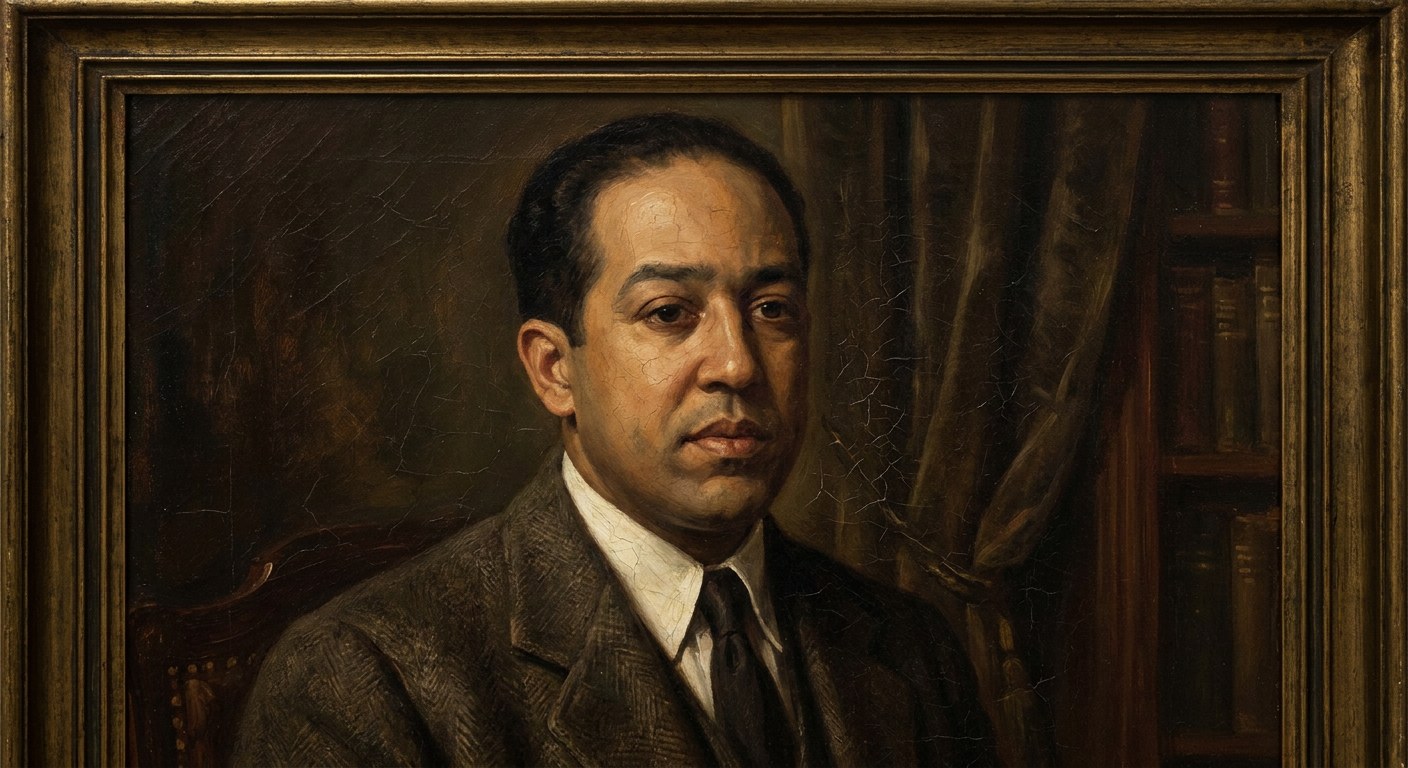
Langston Hughes
1901 – 1967 · American · Poet, Novelist & Playwright
Recommended Audiobooks
Listen next from Marcus Alden

Life Lessons from Frederic Chopin
Marcus Alden · 54 min

Life Lessons from John Wesley
Marcus Alden · 52 min
Introduction
Langston Hughes was one of the most influential American writers of the twentieth century and a defining voice of the Harlem Renaissance. A poet, novelist, dramatist, essayist, journalist, translator, and social critic, he transformed the rhythms of blues, jazz, spirituals, and everyday Black speech into a flexible literary language. His work portrayed African American life with humor, anger, tenderness, pride, and remarkable accessibility.
Hughes mattered not only because of what he wrote but also because of whom he chose to write about. At a time when many publishers expected Black artists either to imitate white literary conventions or to present respectable, idealized characters, Hughes centered workers, musicians, migrants, domestic servants, dreamers, and residents of Harlem’s streets and nightclubs. He insisted that ordinary Black life was a worthy subject for serious art.
His career stretched from the early 1920s to the civil rights era. During those decades, he addressed segregation, economic exploitation, colonialism, war, racial violence, and the unfulfilled promises of American democracy. Yet his writing was never confined to protest. It also celebrated music, laughter, love, faith, endurance, and communal creativity.
Through poems such as “The Negro Speaks of Rivers,” “Mother to Son,” “I, Too,” “The Weary Blues,” and “Harlem,” Hughes entered the permanent canon of American literature. His experiments with musical form helped establish jazz poetry, while his essays articulated a confident vision of independent Black artistic expression. Generations of poets, playwrights, musicians, teachers, and activists continue to draw upon his work.
Quick Facts
| Fact | Details |
|---|---|
| Born | February 1, 1901, Joplin, Missouri, United States |
| Died | May 22, 1967, New York City, United States |
| Nationality | American |
| Known For | Harlem Renaissance poetry, jazz poetry, social criticism, and portrayals of African American life |
| Occupation | Poet, novelist, playwright, essayist, journalist, and translator |
| Era | Harlem Renaissance and twentieth-century American literature |
Although Hughes himself and many older reference works gave 1902 as his birth year, documentary research using census and related records has established that he was born in 1901.
Early Life and Education
James Mercer Langston Hughes was born in Joplin, Missouri, to Caroline Mercer Langston Hughes, usually called Carrie, and James Nathaniel Hughes. His parents separated when he was young. His father eventually settled in Mexico, where he worked as a lawyer and businessman. Hughes’s relationship with him was difficult. The elder Hughes had become deeply embittered by racial discrimination in the United States, yet he was also critical of many Black Americans and disapproved of his son’s literary ambitions.
Hughes’s maternal family possessed a notable history of abolitionism and political activism. His grandmother, Mary Patterson Langston, was the widow of Charles Henry Langston, an abolitionist associated with the struggle against slavery in Kansas. Charles’s brother, John Mercer Langston, became an attorney, diplomat, educator, and one of the first African Americans elected to the United States Congress. Stories about this family tradition gave the young Hughes a sense of connection to Black resistance and achievement.
Because his mother frequently traveled in search of employment, Hughes spent much of his childhood with his grandmother in Lawrence, Kansas. The household had little money, and he later recalled periods of loneliness. His grandmother’s stories about abolitionists and freedom fighters nevertheless taught him to admire courage and racial pride. After her death, he briefly lived with family friends before rejoining his mother.
Hughes lived for a time in Lincoln, Illinois, where a teacher selected him as class poet. He later said the choice was influenced by the stereotype that Black people possessed an innate sense of rhythm. Rather than rejecting poetry, he began experimenting seriously with it. He read Paul Laurence Dunbar, Carl Sandburg, Walt Whitman, and other poets whose use of vernacular language and expansive free verse influenced his development.
The family moved to Cleveland, Ohio, where Hughes attended Central High School. He wrote poems, edited the school yearbook, contributed to the literary magazine, and began shaping his public identity as a writer. Cleveland’s ethnically diverse neighborhoods and active Black community also exposed him to new political and cultural ideas.
After graduating in 1920, Hughes went to Mexico to seek financial help from his father. During the journey, while crossing the Mississippi River, he wrote “The Negro Speaks of Rivers.” The poem connected ancient rivers—the Euphrates, Congo, Nile, and Mississippi—with the depth and continuity of Black history. It appeared in the June 1921 issue of The Crisis, the magazine of the National Association for the Advancement of Colored People, and immediately marked Hughes as a promising young poet.
Under pressure from his father, Hughes enrolled at Columbia University in New York City in 1921 to study engineering rather than literature. He encountered racism on campus and felt alienated from university life, but he was captivated by nearby Harlem. He attended performances, met artists, and absorbed the neighborhood’s music and energy. After one academic year, he left Columbia.
Hughes then supported himself through various jobs. In 1923 he worked as a mess attendant aboard a freighter traveling to West Africa and Europe. He spent time in Paris, where he worked in a nightclub kitchen and encountered expatriate artists and musicians. These travels broadened his awareness of colonialism and the African diaspora. After returning to the United States, he worked in Washington, D.C., while continuing to publish poetry. He later attended Lincoln University in Pennsylvania, a historically Black institution, graduating in 1929.
Rise to Prominence
Hughes’s breakthrough resulted from talent, persistence, and a celebrated encounter with poet Vachel Lindsay. In 1925, while working as a busboy at Washington’s Wardman Park Hotel, Hughes placed several poems beside Lindsay’s plate. Lindsay read them publicly and told reporters that he had discovered a talented “Negro busboy poet.” The story generated national publicity, although Hughes had already published in important Black periodicals.
That same year, Hughes’s poem “The Weary Blues” won a prize sponsored by Opportunity, the journal of the National Urban League. The poem depicts a Black pianist performing late into the night. Its repetition, syncopation, and melancholy cadence translate blues performance into written verse. It became the title poem of Hughes’s first collection, published by Alfred A. Knopf in 1926.
The Weary Blues established Hughes as a major figure in the Harlem Renaissance, the flourishing of Black literature, music, visual art, theater, and scholarship during the 1920s. He formed friendships and professional relationships with writers including Zora Neale Hurston, Countee Cullen, Wallace Thurman, Arna Bontemps, and Claude McKay. He also interacted with influential intellectuals such as W. E. B. Du Bois and Alain Locke.
In 1926 Hughes published “The Negro Artist and the Racial Mountain” in The Nation. The essay responded to a young Black poet who reportedly wished to be considered simply a poet rather than a “Negro poet.” Hughes interpreted this wish as evidence of pressure to assimilate into white middle-class culture. He declared that Black artists should express themselves freely, without shame and without tailoring their work to either white or Black respectability. The essay became one of the foundational statements of African American cultural independence.
His second poetry collection, Fine Clothes to the Jew (1927), was more controversial. Its portraits of blues singers, prostitutes, gamblers, laborers, and poor residents offended some Black reviewers who feared that such depictions reinforced white prejudice. Hughes defended his right to represent the full range of Black experience. The dispute confirmed his determination to resist demands that African American literature serve only as racial public relations.
Major Achievements and Contributions
Hughes’s most important formal contribution was his integration of African American music with literary technique. He did not merely mention blues or jazz; he adapted their structures. Repeated lines, call-and-response patterns, improvisational shifts, syncopated phrasing, and blues stanzas shaped the sound and movement of his poems. This approach helped create what became known as jazz poetry.
His work also made modern poetry unusually accessible. Hughes could write with sophistication without abandoning direct language. Schoolchildren, nightclub audiences, political organizers, scholars, and general readers could all engage with his verse. This accessibility sometimes led critics to underestimate his technical control, but it contributed greatly to his cultural influence.
Hughes was exceptionally versatile. His novel Not Without Laughter appeared in 1930 and received the Harmon Gold Medal for literature. Drawing partly upon his Kansas childhood, it follows a Black boy named Sandy Rogers as he confronts poverty, family tensions, religion, music, and conflicting models of adulthood. The novel avoids a single representative portrait of Black life, instead presenting competing values within one family and community.
He also became an important dramatist. His play Mulatto, concerning a mixed-race son’s conflict with his white father in the segregated South, reached Broadway in 1935. Although Hughes objected to changes made by producer Martin Jones, the production became one of the longest-running Broadway plays by a Black author up to that time. Hughes founded the Harlem Suitcase Theatre in 1938 and encouraged inexpensive, politically engaged productions that could reach working-class audiences.
In fiction, Hughes created Jesse B. Semple, better known as Simple, a Harlem workingman who comments on race, employment, marriage, politics, and everyday absurdities. Simple first appeared in Hughes’s columns for the Chicago Defender during the 1940s. The character’s humorous conversations with an educated narrator allowed Hughes to discuss serious subjects through vernacular wit. Collections included Simple Speaks His Mind, Simple Takes a Wife, and The Best of Simple.
Hughes wrote extensively for children and young readers, believing that Black history should be taught honestly. Works such as The Dream Keeper and Other Poems, The First Book of Negroes, and Famous Negro Heroes of America introduced younger audiences to African American culture and global Black history.
He was also an editor and translator. With Arna Bontemps, he compiled The Poetry of the Negro, 1746–1949, a major anthology that linked African American, African, and Caribbean traditions. Hughes translated or promoted writers including Nicolás Guillén of Cuba, Jacques Roumain of Haiti, and Federico García Lorca of Spain. His international perspective helped connect the Harlem Renaissance to wider anticolonial and diasporic movements.
Key Works / Battles / Ideas
“The Negro Speaks of Rivers”
Written when Hughes was still a teenager, this poem presents Black identity as ancient, global, and enduring. Its speaker claims symbolic intimacy with great rivers associated with civilization and the African diaspora. The final image—“My soul has grown deep like the rivers”—became one of Hughes’s most recognized lines.
The Weary Blues
The 1926 collection established Hughes’s reputation and demonstrated how blues performance could shape poetry. Its title poem recreates a musical scene through rhythm, repetition, and sound. Rather than treating popular music as culturally inferior, Hughes presented it as a source of historical memory and artistic innovation.
“I, Too”
“I, Too” answers traditions of patriotic poetry, particularly Walt Whitman’s expansive vision of America. Its Black speaker is sent away when company arrives but predicts that exclusion will end. The poem combines restraint with confidence: the speaker belongs to the nation and expects the nation eventually to recognize that fact.
“The Negro Artist and the Racial Mountain”
This 1926 essay argued that Black artists should not measure themselves by white standards or feel ashamed of Black culture. Hughes did not prescribe a single style. Instead, he defended artistic freedom grounded in self-acceptance. The essay continues to influence debates over cultural identity, audience expectations, and representation.
Radical and Anticolonial Writing
The Great Depression intensified Hughes’s concern with class inequality. During the 1930s he published poems and articles sympathetic to labor movements, socialism, and anticolonial struggles. He traveled to the Soviet Union in 1932 as part of a group invited to participate in a film project about race in the United States. The film was abandoned, but Hughes traveled through Soviet Central Asia and later wrote about the experience.
In 1937 he reported from Spain during the Spanish Civil War for the Baltimore Afro-American and other outlets, supporting the Republican cause against Francisco Franco’s Nationalists. He emphasized the presence of Black volunteers in the Abraham Lincoln Brigade and interpreted fascism as connected to racism and imperialism.
Montage of a Dream Deferred
Published in 1951, Montage of a Dream Deferred was among Hughes’s most ambitious poetic achievements. Inspired by bebop, the book presents a rapidly changing sequence of voices, scenes, and rhythms from postwar Harlem. Its best-known poem, “Harlem,” asks what happens when a dream is repeatedly postponed. The concluding possibility—an explosion—gave the poem prophetic force during the civil rights era and beyond.
Religious and Dramatic Works
Hughes’s relationship to religion was complex. He criticized hypocrisy and the use of Christianity to justify oppression, but he respected the spiritual creativity of Black churches. His gospel musical Black Nativity, first performed off-Broadway in 1961, retold the Nativity through scripture, spirituals, gospel music, dance, and poetry. It became one of his most frequently performed theatrical works.
Timeline of Key Events
| Year | Event |
|---|---|
| 1901 | Born in Joplin, Missouri, on February 1 |
| 1910s | Raised largely in Lawrence, Kansas; later attends high school in Cleveland |
| 1921 | “The Negro Speaks of Rivers” appears in The Crisis; enrolls at Columbia University |
| 1923 | Works aboard a freighter and travels to West Africa and Europe |
| 1925 | Wins an Opportunity poetry prize for “The Weary Blues” |
| 1926 | Publishes The Weary Blues and “The Negro Artist and the Racial Mountain” |
| 1927 | Publishes Fine Clothes to the Jew |
| 1929 | Graduates from Lincoln University in Pennsylvania |
| 1930 | Publishes Not Without Laughter, winner of the Harmon Gold Medal |
| 1932 | Travels to the Soviet Union with a group of Black artists and writers |
| 1935 | Mulatto opens on Broadway |
| 1937 | Reports on the Spanish Civil War |
| 1940 | Publishes the first volume of his autobiography, The Big Sea |
| 1943 | Jesse B. Semple, or Simple, begins appearing in Hughes’s newspaper columns |
| 1951 | Publishes Montage of a Dream Deferred |
| 1953 | Testifies before Senator Joseph McCarthy’s investigative subcommittee |
| 1956 | Publishes the autobiography I Wonder as I Wander |
| 1961 | Black Nativity premieres off-Broadway |
| 1967 | Dies in New York City on May 22 |
| 1991 | The Schomburg Center’s Langston Hughes Auditorium opens above the site of his ashes |
Personal Life and Character
Hughes never married and had no children. He guarded his private life carefully, preferring to present himself publicly through his work. Scholars have debated his sexuality, and some have interpreted poems, friendships, and silences as evidence that he may have been gay or sexually nonconforming. No conclusive public declaration by Hughes survives, however, and responsible biographies distinguish interpretation from established fact.
Friends often described him as courteous, humorous, disciplined, and attentive to other people. He possessed a gift for listening and could transform ordinary conversation into literature. His approachable public manner sometimes concealed strong convictions and a capacity for professional independence.
Hughes treated writing as serious daily labor. Financial necessity also encouraged his extraordinary productivity. He gave readings, wrote newspaper columns, edited anthologies, prepared children’s books, translated foreign authors, and accepted theatrical and musical commissions. Unlike writers supported by universities or inherited wealth, he generally earned his living through writing and public appearances.
Patronage shaped his early career but also created tension. The wealthy arts patron Charlotte Osgood Mason supported Hughes in the late 1920s. Mason expected the Black artists she funded to express what she considered a primitive or spiritual racial essence. Hughes increasingly found these expectations restrictive, and their relationship ended painfully around 1930. The experience reinforced his resistance to external control over Black art.
Harlem remained Hughes’s symbolic and practical home. From 1947 until his death, he lived in a brownstone at 20 East 127th Street. The neighborhood supplied voices, settings, conflicts, and rhythms for his poetry and Simple stories. Even after international travel and national fame, he remained closely identified with Harlem’s cultural life.
Challenges and Controversies
Hughes lived under constant racial discrimination. Segregated institutions limited education, travel, housing, publication, and employment for African Americans. His decision to write openly about Black poverty and sexuality exposed him to criticism from both white reviewers and Black leaders concerned about racial stereotypes.
His political writing created the most serious threat to his career. During the Depression, Hughes associated with left-wing writers, supported labor causes, and published poems praising revolutionary change. He visited the Soviet Union and contributed to publications connected with the American left. Although he repeatedly stated that he had never joined the Communist Party, his earlier work made him a target during the Cold War.
In 1953 Hughes was summoned before the Senate Permanent Subcommittee on Investigations, then led by Senator Joseph McCarthy. He was questioned about communism, his travels, and poems published in radical periodicals. Hughes testified that he had never been a Communist Party member and explained that some of his earlier political writing arose from the economic suffering and racial injustice of the 1930s.
The testimony protected his ability to publish and travel, but it remained controversial. Some critics believed he had retreated too far from his radical past, while others viewed his measured answers as a strategy for surviving an atmosphere of intimidation. His later anthologies omitted or revised some of his most radical poems, encouraging debate over censorship, self-censorship, and political pressure.
A poem titled “Goodbye Christ,” written during his left-wing period, was repeatedly used against him. The poem attacked wealthy institutions and public figures who exploited Christianity; opponents often presented it simply as an attack on faith. Its circulation helped trigger protests against Hughes’s appearances and contributed to congressional scrutiny.
Hughes also experienced literary disputes. His collaboration with Zora Neale Hurston on Mule Bone, a comedy based on African American folklore, collapsed amid disagreements over authorship and control. Their friendship never fully recovered, and the play was not professionally staged until decades later.
By the 1960s, some younger Black nationalist writers considered Hughes’s interracial outlook and accessible style insufficiently militant. Yet Hughes supported decolonization and racial equality while maintaining that Black art could encompass many political and aesthetic positions. Later Black Arts writers frequently criticized and borrowed from him at the same time.
Death and Immediate Aftermath
Langston Hughes died in New York City on May 22, 1967, at the age of sixty-six. His death followed complications from abdominal surgery associated with prostate cancer. Memorial observances celebrated him as a poet of Harlem, an international literary figure, and a witness to nearly half a century of African American history.
Hughes’s ashes were placed beneath the floor of the foyer leading to the Langston Hughes Auditorium at the Schomburg Center for Research in Black Culture in Harlem. The site is marked by a cosmogram designed by artist Houston Conwill and inspired by “The Negro Speaks of Rivers.” Its central inscription reads, “My soul has grown deep like the rivers.”
Posthumous collections, performances, recordings, and scholarly editions followed. Because much of his work had appeared in newspapers, magazines, scripts, translations, and occasional publications, editors continued recovering and organizing his immense body of writing.
Legacy and Influence Today
Hughes helped make African American vernacular culture central to modern literature. His use of blues and jazz demonstrated that forms developed in Black communities could provide sophisticated structures for poetry. Later writers including Gwendolyn Brooks, Amiri Baraka, Maya Angelou, Nikki Giovanni, Sonia Sanchez, and many spoken-word artists developed possibilities that Hughes had helped open.
His poetry also influenced music. Composers and performers have set his words to jazz, classical, gospel, and popular music. Hughes collaborated with musicians during his lifetime and treated poetry readings as performances shaped by timing, tone, and audience response. Contemporary connections among hip-hop, spoken-word poetry, and political verse echo his commitment to rhythm and public accessibility.
In education, poems such as “Mother to Son,” “I, Too,” and “Harlem” introduce students to metaphor, voice, rhythm, and historical context. Their apparent simplicity rewards close reading. A staircase, a dinner table, or a deferred dream becomes a way to examine racial hierarchy, perseverance, and citizenship.
Hughes’s patriotism was critical rather than complacent. He exposed the contradiction between American democratic ideals and racial injustice while refusing to surrender his claim to the nation. That combination makes his writing relevant to continuing debates about equality, protest, identity, and belonging.
His internationalism is equally significant. Hughes viewed Black experience in the United States as part of a wider history involving Africa, the Caribbean, Latin America, Europe, colonialism, and migration. Modern scholarship increasingly emphasizes these global dimensions of his career.
Institutions, schools, literary prizes, theaters, and cultural centers bear his name. His Harlem residence is listed on the National Register of Historic Places, while the Schomburg Center preserves the symbolic resting place of his ashes. More importantly, his poems remain part of public speech. They are recited at commemorations, protests, classrooms, churches, and artistic performances whenever people ask what America is and what it might become.
Famous Quotes
“I, too, sing America.” — “I, Too”
“My soul has grown deep like the rivers.” — “The Negro Speaks of Rivers”
“Life for me ain’t been no crystal stair.” — “Mother to Son”
“What happens to a dream deferred?” — “Harlem”
“Hold fast to dreams / For if dreams die” — “Dreams”
“Let America be America again.” — “Let America Be America Again”
“I am the darker brother.” — “I, Too”
“Maybe it just sags / like a heavy load.” — “Harlem”
Frequently Asked Questions
When and where was Langston Hughes born?
Langston Hughes was born on February 1, 1901, in Joplin, Missouri. For many years, biographies commonly listed 1902 because Hughes himself used that year. Later documentary research, including census evidence, established 1901 as the correct year.
Why was Langston Hughes important to the Harlem Renaissance?
Hughes became one of the movement’s most recognizable literary voices. He celebrated Black culture, used blues and jazz techniques in poetry, and defended the independence of Black artists. His work reached audiences beyond elite literary circles and helped define the Harlem Renaissance for later generations.
What is Langston Hughes’s most famous poem?
There is no single universally accepted answer. “Harlem,” with its question about a dream deferred, is probably his most frequently quoted poem. “The Negro Speaks of Rivers,” “I, Too,” “Mother to Son,” and “The Weary Blues” are also among his best-known works.
What is jazz poetry?
Jazz poetry is verse shaped by the rhythms, improvisation, phrasing, and performance traditions of jazz. Hughes was one of its leading pioneers. His poems often use repetition, syncopation, shifting voices, and musical structures derived from blues, spirituals, and jazz performance.
Was Langston Hughes a communist?
Hughes sympathized with socialist ideas and left-wing causes during the Great Depression, published in radical journals, and traveled to the Soviet Union. He stated under oath that he had never been a member of the Communist Party. Scholars generally describe him as a politically independent leftist whose views and public presentation changed during the Cold War.
Did Langston Hughes write only poetry?
No. He wrote novels, short stories, plays, autobiographies, essays, newspaper columns, translations, opera librettos, musicals, histories, and books for children. His Simple stories and the novel Not Without Laughter remain important parts of his achievement.
Was Langston Hughes married?
No. Hughes never married and had no children. He kept his intimate life private. His sexuality remains a subject of scholarly interpretation, but he did not leave a definitive public statement identifying himself with a particular sexual orientation.
How did Langston Hughes die?
Hughes died on May 22, 1967, after complications from abdominal surgery connected with prostate cancer. He was sixty-six years old. His ashes rest beneath a memorial cosmogram at the Schomburg Center for Research in Black Culture in Harlem.
Lessons We Can Learn
-
Draw strength from cultural roots. Hughes transformed Black music, speech, history, and community life into enduring literature rather than treating them as barriers to artistic success.
-
Make difficult ideas accessible. His direct language showed that writing can be intellectually serious without becoming remote from ordinary readers.
-
Challenge a nation to honor its ideals. Hughes criticized American injustice while insisting that Black Americans belonged fully within the national story.
-
Protect creative independence. His conflicts with patrons, producers, critics, and political investigators demonstrate the importance—and cost—of resisting outside control.
-
Turn deferred hopes into art and action. Hughes acknowledged disappointment without accepting permanent defeat. His poetry repeatedly converts frustration into imagination, solidarity, and determination.
Further Reading
- Arnold Rampersad, The Life of Langston Hughes, 2 volumes. The standard comprehensive scholarly biography.
- Langston Hughes, The Big Sea. Hughes’s first autobiography, covering his youth, travels, and the Harlem Renaissance.
- Langston Hughes, I Wonder as I Wander. His second autobiography, focused especially on his international travels during the 1930s.
- Faith Berry, Langston Hughes: Before and Beyond Harlem. A biography emphasizing the international dimensions of his career.
- Wallace Best, Langston’s Salvation: American Religion and the Bard of Harlem. A study of Hughes’s complex engagement with religion and spirituality.
Watch and Learn
Langston Hughes and the Harlem Renaissance · Biography